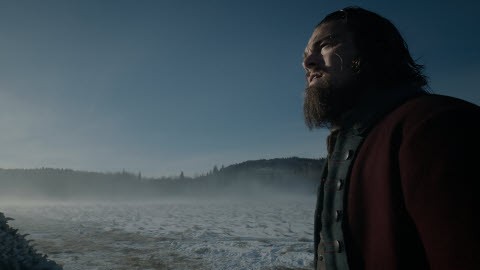
Movie Review: The Revenant

Definition of: Revenant

— one that returns after death or a long absence

Revenant

Watching The Revenant was exhausting. 2 hours and 36 minutes long, it didn’t let go. Not for a minute.

It took me into the icy winter of Montana. Inspired by true events that happened to the legendary explorer Hugh Glass in 1823 in Montana and South Dakota, the movie tells a story of betrayal and redemption. Glass (Leonardo DiCaprio) is a member of a hunting and trapping party in the wild west. After they are raided by hostile Indians and decimated, Glass gets surprised and attacked by a female grizzly who is protecting her cubs. Glass was mauled so badly that his friends did not expect him to survive. Three men, including Glass’ half Indian son, stay behind with him until he dies, while the rest of the party moves on. John Fitzgerald (Tom Hardy), the most experienced frontiersman, decides to abandon Glass. Against unimaginable odds, Glass survives, and starts his journey of 200 miles through the winter wilderness of Montana, alone, without weapons, only able to crawl, his body covered with festering wounds, driven by sheer willpower and relentless pursuit of redemption.

I have hiked mountains in Montana with a bear can in my pack in case I encountered a grizzly. After watching the grizzly attack in The Revenant, I know just how utterly helpless a modern human would be if attacked by a grizzly. The speed, size and ferocity of an angry bear is unmatched by any other predator in the world. A hardened frontiersman like Glass with a rifle in hand pointed at the bear could do nothing to protect himself. My puny bear spray can in my pack would be totally useless. Oh my, will I ever again have the courage to hike in the great north?

The bear attack in this movie alone is worth watching. Mind you, it’s very challenging and difficult, but it’s the most realistic and graphic animal attack I have ever seen in a movie. It’s so realistic, I felt I was there, I was groaning, gasping, and – I admit – I looked away a few times.

The scenery of the mountains in Montana (actually filmed in Canada and then in Southern Argentina, when they ran out of winter in the north) was breathtaking. As a lover of the outdoors, I enjoyed watching the winter wilderness. This is a movie for “winter people.” The movie constantly shoves the cold and unforgiving brutality of nature into our faces.

It also brings out the battles between the American and French trappers and the various Indian bands. Why did the Indians go after the whites so ferociously? Why did the whites kill, maim, and rape the Indians. Why did one side cheat and steal from the other? The Revenant gives an unadulterated look into a grim and violent period of American history, not so far in the past at all.

Leonardo DiCaprio did the job of his lifetime here. This will get him his Oscar. He not only carries the movie, DiCaprio is the movie. From the first minute, to the last, he overpowers us with the sheer pain, wildness, and ferocious will of the character he plays. It does not seem like he acts. We are watching Hugh Glass, being crushed by his environment, over, and over, and over again – only to stand up and rise next. DiCaprio takes us into the wilderness with him, and into the soul of a frontiersman and trapper, and the father of an Indian child, and the husband of an Indian woman.

The Revenant is not a movie. It’s an experience. And it is hard work to watch.

Rating - Four Stars


Book Review: Napoleon – by Andrew Roberts

Napoleon3

I knew very little about Napoleon. I had never read about that period of European history. Yet, now, after reading this masterful biography of over 800 pages, I feel truly enriched.

Napoleon was born in Corsica in 1769 to an average family. His father died when he was very young. He was interested in history and was a voracious reader, even as a boy. His heroes were Alexander the Great and Julius Caesar. As a teenager, he enrolled in a military school and eventually received a commission as a lieutenant in the French artillery. Through extremely hard work, relentless ambition, charm and charisma, he worked through the ranks and became a general at age 27. Soon he was the most popular general in the French military. Due to the power vacuum and incompetence of the government after the French Revolution, he managed a military coup before we was 30 years old, ending up as the head of government as a First Consul. A few years later he crowned himself Emperor.

Now, that was a self-made man if there has ever been one.

There may be more books written about Napoleon than any other figure in history. Roberts’ book presents new material based on the 33,000 letters Napoleon wrote over the course of his life, sometimes as many as 30 a day. But I am not a historian, so to me, this biography was a first introduction to a great man of history.

Well – great in some measures – and frightening in others. Napoleon was a killing machine. During the 15 years he was in power, he conscripted millions of young French men away from their farms, shops, factories and schools into the military, just to lead them into endless battles to be brutally killed. Many battles “only” had 4,000 killed or wounded. Others 30,000 or more. Of the 600,000 men he took into Russia, eventually reaching Moscow, less than 50,000 or so came back home. Most of the men died of Typhus and other diseases, fatigue, starvation, and on the way home in the winter, the brutal, relentless cold of the Russian winter.

We know about “great battles” in history, names like Austerlitz and Waterloo. What actually is “great” about battles, places where tens of thousands of men lost their lives because of the megalomania of their leaders, all monarchs with grandiose egos and destiny on their minds? Was the greatness in the interest of the people?

Reading about one of the greatest statesmen and leaders in history, I found that there are many lessons to be learned for success and leadership, even now, almost 200 years after his death. Whether I agree with Napoleon’s tactics or not, he was definitely a remarkable man, and one worth reading a huge and long book about. Napoleon set out to be listed among the greats, and nobody will doubt that he achieved just that. Alexander the Great, Julius Caesar, George Washington, Napoleon, they go together.

Roberts did a great job telling the story of Napoleon, the man, and his life, from the beginning to his last days.

As I worked through this biography, I realized that War and Peace by Leo Tolstoy, widely acclaimed as the greatest novel of all time, actually plays during the Napoleonic Wars from 1805 to 1810. So I picked up War and Peace, and I am ready to embark now on this huge novel, with keen interest kindled by Napoleon: a Life.

Rating - Four Stars

Book Review: The Richest Man Who Ever Lived – by Greg Steinmetz

Fugger

Jacob Fugger was born in 1459 in Augsburg, Germany and died 1525, at the age of 66. He single-handedly created a banking and trade empire that reached to all ends of the globe. His company was the largest commercial concern the world had ever seen. He was essentially the father of modern banking and finance, and the methods that he applied still are used in business today, including double-entry bookkeeping.

Most Americans have never heard of Jacob Fugger. He was a contemporary of Albrecht Dürer (1471 – 1528), Martin Luther (1483 – 1546), and Leonardo da Vinci (1452 – 1519). He was most active at the time when Magellan circumnavigated the globe, and when Columbus first arrived in America. I, too, had never heard of Jacob Fugger.

Fugger made his money initially as a trader of textiles. He then got into mining of copper, silver and mercury, and basically cornered the market on metals. He was a trader and a banker. And here is where it gets interesting: At a time when the Catholic Church forbid money lending for interest, calling the sin “usury,” he made a huge amount of his money by lending. Eventually he convinced the Pope to allow lending. He was also instrumental for funding the emperors of his day. The Habsburg emperor Maximilian I might never have been emperor without Fugger’s money. His grandson and successor, Charles V relied exclusively on Fugger to finance his election and then many of his wars. Charles was emperor (and king of Spain) during the time when gold from the Americas started flooding into Europe. Fugger had his hands on the gold by controlling the purses of the emperors.

Günter Ogger wrote a biography about Fugger titled Kauf dir einen Kaiser (buy yourself an emperor), which is part of Steinmetz’s bibliography in the book.

How does one compare very rich people to one another when they live in very different times? Some people compiled lists of assets, converted them to gold, and then valued them. Others compared the assets to the GNP of the times. This was the method Steinmetz used to measure Fugger and list him as the richest man who ever lived. When he died, supposedly his net worth was about 2 percent of the GNP of Europe, indeed a vast amount of money.

During Fugger’s time, he mostly traded in florins, the currency used by Florence, Italy, based on gold, and generally referred to as “pieces of gold” in literature. When the fairy tale writers the Brothers Grimm spoke of pieces of gold, they referred to florins. This book is full of references of florins. For instance, Fugger lent Charles V 544,000 florins to buy his election for emperor. So what is a florin?

I did a little research and found some rough numbers. A weaver (a skilled worker) in the year 1500 would earn one florin every 4 to 6 weeks. A mercenary might earn one or two florins a month. So let’s just average that and say that a florin is pay for a month for an average worker. That would make 12 florins a year an annual normal income. Let’s compare that to $50,000 in today’s America. That would make one florin worth $4166. Ok, let’s say $4000.

Given that, Fugger lent Charles V $2 billion – just to bribe the electors. This reminds me of what it costs to run for U.S. president today. Obviously, Fugger was Charles’ SuperPAC. Incidentally, it took Fugger years to get his money back from the Emperor. It’s pretty tricky when you loan money to a guy who is above the law and can just kill you if he so chooses. The only thing protecting Fugger from demise, over and over again, was that the royals knew quite well that they’d need his money in the future.

So maybe he was not the richest man who ever lived, but he was one of them. Here are a few lists that I found for comparison:

He is number 6 on this list.

He is not at all on this list.

He is number 6 on this list.

He is number 7 on this list.

He is number 4 on this list.

I am glad I didn’t read the negative Amazon reviews of this book before I read it myself. Some reviewers blasted the author for bad and clumsy writing. I usually don’t like clumsy writing, but I noticed none of it. The writing is simple, succinct, informative and easy to read. The stories are not chronological, but rather topical, so there are overlaps in the way the chapters flow through history. It worked fine for me.

I was delighted by how much I learned about the Renaissance. The period came alive in front of my eyes. How do you do international business without telephones, fax machines, the Internet, and travel other than walking or by coach. How do you survive when the church can just accuse you of heresy and burn you at the stake if they so choose? How do you trade when the roads are infested with highway robbers?

I found The Richest Man Who Ever Lived a highly readable and informative book that inspired me to find more material about history during that time.

Rating - Four Stars

Movie Review: Everest

Everest

Up to 1996, one in four people who climbed Mt. Everest died in the attempt. One in four.

Then, in 1996, when commercial outfits started taking up amateurs, things got more dangerous. 1996 was the most deadly year in Everest history, when 15 people died on the mountain, eight of them on May 11, 1996.

The events of that expedition and fateful day were chronicled by Outside writer Jon Krakauer in his book Into Thin Air. I read that book at the time, first because I have always been a fan of Krakauer’s writings, and second because I am a hobby climber. The book takes you onto the mountain and into the action and eventual disaster.

This movie brings the events of May 1996 to life. We get to know what drives the  women and men to put themselves into such extremely risky situations. Think about it: One in four people summiting Everest dies, usually on the way back down! What kind of mindset does it take to make a decision to accept this kind of risk?

The movie Everest tries to answer this question. Of course, the scenery, the tremendous forces of unbridled nature, and the indomitable spirit of the humans trying to battle it make for an epic movie.

Mild Spoiler Ahead…

I knew the story, I knew the outcome, I knew who would survive and who would perish. Rob Hall, the New Zealander guide and the main protagonist, was the first non-Sherpa who had summited Everest five times. Climbers don’t come more experienced than that. Yet, he perished on May 11, when one of his clients begged him to help him reach the peak. Rob broke his own rule and went back to the peak after turn-around time. He eventually paid with his life. Rob Hall, as well as the 250 other people who died on the mountain over the years, is still there, a frozen corpse, at the exact spot, in the exact position, where he took his last breath.

Everest tells the stories of the adventurers without moralizing and without unduly focusing on their individual triumphs or deaths. It just shows it as it is, at a place where humans are not meant to be.

Rating - Four Stars

Movie Review: A River Runs Through It

A_river_runs_through_it_coverFor a week now we have stayed at a lodge home in rural Montana. In front of a huge stone fireplace sixteen feet high, under giant barn beams that make up the ceiling, on a comfortable couch, the stars bright outside in the vast Montana sky, we watched the movie A River Runs Through It.

It tells the story of two brothers, Norman (Craig Sheffer) and Paul (Brad Pitt), the sons of a Presbyterian minister (Tom Skerritt), following their lives from early childhood in Montana in the early 20th century through their younger years into adulthood.

Norman tells the story from his point of view. He is the son that goes off to college and later becomes a college professor. Paul, his hard-living younger brother stays in Montana where he works as a newspaper reporter. The father and the brothers are as different as can be, except for their love of fly fishing. The river ties them all together.

Directed by Robert Redford and based on an autobiographical book by Norman MacLean, A River Runs Through It tells a family epic and makes us think of what in life really matters.

Rating - Four Stars

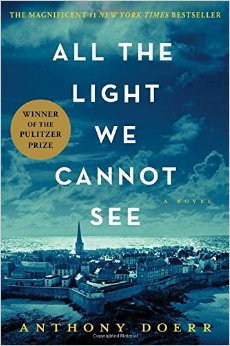
Book Review: All the Light we Cannot See – by Anthony Doerr

All the LightIn Paris before World War II, Marie-Laure is a blind French girl. Her father is a locksmith at a Natural History Museum in Paris. He dotes on her, teaches her to be self-sufficient and buys her hugely expensive Braille books of Jules Verne.

Werner and his younger sister Jutta are German orphan children, living in an orphanage in the Ruhr area of Germany, the industrial and coal mining district of the country. Werner is brilliant with electronics and technology. When the Nazis rise, they notice him and he gets a scholarship for one of the best schools in the country. The Reich invests in its youth.

These two protagonists grow up separately before and during the war, and through a series of plot twists, their paths cross in 1944, just as the Allies land in Normandy and start taking France back.

Hitler’s “Thousand Year Reich” lasted a total of twelve years. He is single-handedly responsible for tens of millions of deaths in Europe, and for turning Germany and the surrounding countries into wastelands of destruction. Hundreds of millions of people’s lives were turned upside down and very often destroyed as a result of the war. Marie-Laure and Werner are common people caught up in the maelstrom of destruction.

Through their stories we see the pain those times inflicted on the people. After the war was over, we follow a few of their friends and relatives all they way to today’s time, and we witness the scars.

My own parents were born in 1935 and 1936 in Germany, children in the war. They could have been Marie-Laure and Werner. I am fortunate that both of them are still alive. When I talk to them today, and ask about their childhood, their eyes do not remain dry, and the pain and suffering is still trapped within them. Their lives never had a chance to unfold, and their entire adulthood, their middle age and their old age are characterized by coping with what was done to them when they were children.

All the Light we Cannot See tells a timeless story, with deep insight, of a brutal time, and a dark age in history. It’s unlike any World War II book, yet, it’s the World War II book that everyone should read.

C’est la vie.

Rating - Four Stars

Buy the book here.

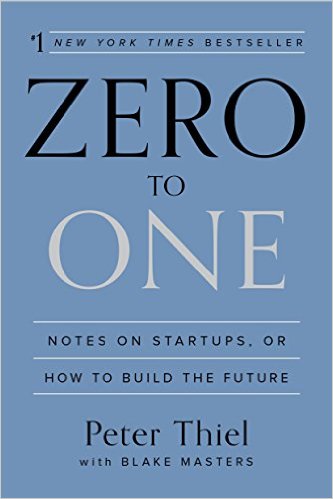
Book Review: Zero to One – by Peter Thiel

Zero to One

A book about startup businesses.

Thiel knows something about the subject. He was one of the founders of PayPal and sold the company in 2004. His share was worth several hundred million dollars. Then he bought into Facebook as its first outside investor in 2004, and got a 10% share for $500,000. He then became a venture capitalist, investing in many tech companies and listening to proposals from entrepreneurs every day. He is worth over $2 billion, and his is only 47 years old.

So when Thiel writes about how to build a startup business, it pays to listen.

He is definitely not modest. The book is full of sweeping generalizations and questionable statements of fact that really are just his opinions. He dismisses any business that does not have the potential to become another Facebook or Google.

He says that real entrepreneurs dress in T-shirts and jeans, not suits. Obviously, that’s an opinion, not a fact. He does not know all real entrepreneurs. But he is so full of himself, and so convinced of his methods, that he states those opinions as facts.

Here is such a passage:

The most obvious clue was sartorial: cleantech executives were running around wearing suits and ties. This was a huge red flag, because real technologists wear T-shirts and jeans. So we instituted a blanket rule: pass on any company whose founders dressed up for pitch meetings. Maybe we still would have avoided these bad investments if we had taken the time to evaluate each company’s technology in detail. But the team insight— never invest in a tech CEO that wears a suit— got us to the truth a lot faster.

— Thiel, Peter; Masters, Blake (2014-09-16). Zero to One: Notes on Startups, or How to Build the Future (p. 160). The Crown Publishing Group. Kindle Edition.

This is just one example. But be that as it may, he knows something about startups. If you are working a job and you are happy doing it, don’t read this book. If you want to start a new Chinese take-out place in Palo Alto, definitely don’t read this book. It will crush you. If you want to start a lifestyle business, make a little money for yourself and your family, this book is not worth it.

But – if you want to start a company that makes a dent in the universe (to quote Steve Jobs), if your objective is to start a business that becomes a billion-dollar venture within a few years, this is absolutely, positively required reading.

Annoying, cocky, and maddeningly self-absorbed as Thiel is, he knows what to look for in a startup.

And if your dream is to start one, here you go – buy the book here. It’s the best $11.84 you will ever spend.

Rating - Four Stars

Book Review: Elon Musk – by Ashlee Vance

Musk

The subtitle for this book is Tesla, SpaceX, and the Quest for a Fantastic Future.

There are not many people in history that have created a billion-dollar company. The odds against are astronomical. Elon Musk has created several billion-dollar companies, and right now he is running two of them simultaneously. That is utterly astounding. What does it take to do that?

This biography describes who Musk is and how it came about that he was able to accomplish what he did. It starts with his childhood in South Africa, his rocky upbringing and unfortunate family circumstances. He landed in Canada with the proverbial few dollars in his pockets and started working hard, taking menial jobs and trying to be creative. And he made it big. He is now one of the icons of high-tech business in the world. And he has only just started. As I write this, he is only 44.

The biography of Elon Musk is required reading for anyone who wants to start a business.

I have started a business, and run one, and am still running one. Elon Musk started his first business after mine was already established, and he built Tesla and SpaceX long after I was already rolling along. There is a lot I can learn from him.

Reading this excellent biography by Ashlee Vance was a good start.

Rating - Four Stars

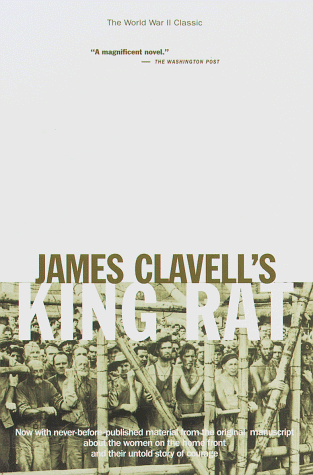
Book Review: King Rat – by James Clavell

james-clavell-king-rat

King Rat tells the story of a group of American, English and Australian POW in Changi, the Japanese prison camp outside of Singapore, in the approximate location of the Singapore airport of today.

The King is an American corporal who has mastered the workings of the black market. Everyone in the camp reveres and secretly hates him for his “success.” Where everyone is close to starvation or suffering from disease, where men are dressed in rags and loincloths, the King has all the food, cigarettes and clothes he needs. His entourage, those feeding off him, includes men and officers alike. Over the years, he has built a reputation of being the person that can “get things” and trade. Outside the camp, the traders and guards trust him and his integrity. Inside, prisoners come to him with their little treasures and ask him to trade them for money, food or favors. He obliges, for a fee.

In a world of prison camps, in North Korea, in China, in Guantanamo, in Africa and in the Middle East, in prison camps where men are hurt and broken, reading King Rat brings life in prison alive in front of our eyes. We feel what it’s like in stark, shocking reality.

I am grateful to those that came before me and paid so dearly so I can sit here and have the right and freedom to write what I want.

I am grateful for having had a chance to read James Clavell’s King Rat.

Rating - Four Stars


Book Review: How to Win at the Sport of Business – by Mark Cuban

How to Win

Anyone in business should read Mark Cuban’s book How to Win at the Sport of Business. Anyone in college should read it. Anyone who wants to be successful.

Anyone should read this book.

It’s a quick read, it’s a very short book. A good solid hour, or maybe two, gets the job done.

How did a young guy in Texas who lived in a friend’s three-bedroom apartment with six people with no education become worth 3 billion dollars?

Here is a rags to riches story that will inspire anyone. The book is a collection of blog posts, edited together into a coherent motivational shot in the arm.

You cannot afford not to read this little book full of nuggets of invaluable advice about business, life and passion. What more can I say than to give you a little excerpt:

When I was growing up I was told over and over again, if you can sell, you can always get a job. Of course, I was told that after a friend of my mom’s told me when I was in high school, that I should also have a trade to fall back on. He tried to teach me how to lay carpet. My first, last and only experience was working for him and watching him shake his head and rip out what I had done…. But I digress. I don’t remember who told me that selling was a job for a lifetime, but they were right. If you can sell, you can find a job in sports. I will take a high school dropout who is caring, involved and can sell over an MBA in sports management almost every time. What makes a good salesperson? Let me be clear that it’s not the person who can talk someone into anything. It’s not the hustler who is a smooth talker. The best salespeople are the ones who put themselves in their customer’s shoes and provide a solution that makes the customer happy.

Do not hesitate another second, go to Amazon and put down $2.99 and start reading and learning.

Rating - Four Stars


Book Review: The World Without Us – by Alan Weisman

World Without Us

Imagine all the people in the world disappeared today. Gone. I recognize this is a hypothetical scenario, one that has a low likelihood of happening, but — it could happen. An Ebola-like plague could sweep the world and eradicate the human race in a matter of a few weeks. There have been doomsday books, like Stephen King’s The Stand that were based on just that premise. My favorite book about this subject is Earth Abides by George Stewart. Both novels start out with just about all people dead, and one single survivor eventually finding another one, starting the long process of building a new world from scratch and from the ruins of the old world.

The World Without Us is not a novel. It is a speculative work taking on many of the controversies of our society, including overpopulation, climate change and runaway pollution. Every chapter explores, from its own viewpoint, what it would be like if humans simply were no longer here.

Here is an example. What would happen in New York City if humans disappeared. Surprisingly, the city would come to pieces very quickly, must faster than other places out west.

Schuber peers down into a square pit beneath the Van Siclen Avenue station in Brooklyn, where each minute 650 gallons of natural groundwater gush from the bedrock. Gesturing over the roaring cascade, he indicates four submersible cast-iron pumps that take turns laboring against gravity to stay ahead. Such pumps run on electricity. When the power fails, things can get difficult very fast. Following the World Trade Center attack, an emergency pump train bearing a jumbo portable diesel generator pumped out 27 times the volume of Shea Stadium. Had the Hudson River actually burst through the PATH train tunnels that connect New York’s subways to New Jersey, as was greatly feared, the pump train— and possibly much of the city— would simply have been overwhelmed.

Weisman, Alan (2007-07-10). The World Without Us (p. 25). St. Martin’s Press. Kindle Edition.

650 gallons of natural groundwater run into that one subway station every minute, and pumps must keep running 24 hours a day to keep it try. When the power runs out (and that’s another chapter), in a half hour the water would be high enough to flood the tracks and trains could no longer pass. In 36 hours the entire subways system would fill up. Weisman goes on:

Even if it weren’t raining, with subway pumps stilled, that would take no more than a couple of days, they estimate. At that point, water would start sluicing away soil under the pavement. Before long, streets start to crater. With no one unclogging sewers, some new watercourses form on the surface. Others appear suddenly as waterlogged subway ceilings collapse. Within 20 years, the water-soaked steel columns that support the street above the East Side’s 4, 5, and 6 trains corrode and buckle. As Lexington Avenue caves in, it becomes a river.

Weisman, Alan (2007-07-10). The World Without Us (pp. 25-26). St. Martin’s Press. Kindle Edition.

This is just about one of our great cities.

There are 441 operating nuclear power plants in the world. Without the regulating eye of humans, many of these plants would go through some form of catastrophic failure and eventual meltdown. Imagine 441 Chernobyls around the world. Check out this map and find how close you live to one? Hey Australia! Safest place on Earth in case of a meltdown.

world_map_nuclear
Source: International Nuclear Safety Center at Argonne National Laboratory.

This map is from 2005, I could not find a newer one, but given how long it takes to build such a plant, and considering that they are not building many more, it’s pretty close.

The World Without Us was published in 2007. Given today’s pace of development, and pollution in China (check out this link and be shocked), and runaway fossil-fuel-burning, things are much worse than described by Weisman in 2007, when there were only 6.5 billion people on the planet, rather than seven.

We’re adding one million people to the planet every four days.

The World Without Us reads like a fast-paced thriller, where the bad guys are out the make the world go away. As I read the book, I realized that I was in it, and it wasn’t a thriller, it wasn’t a novel, it was a giant reality show, and my life, and the life of my children, and their children, was on the line.

Don’t you understand what I’m tryin’ to say
Can’t you feel the fears I’m feelin’ today?
If the button is pushed, there’s no runnin’ away
There’ll be no one to save with the world in a grave
Take a look around you boy, it’s bound to scare you boy

— Barry McGuire, Eve of Destruction

Choose not to read this book at your own peril.

Rating - Four Stars

Movie Review: Selma

Think of all the hate there is in Red China
Then take a look around to Selma, Alabama
You may leave here for four days in space
But when you return it’s the same old place
The pounding of the drums, the pride and disgrace
You can bury your dead but don’t leave a trace
Hate your next door neighbor but don’t forget to say grace

And tell me
Over and over and over and over again my friend
You don’t believe
We’re on the eve of destruction

— Barry McGuire, Eve of Destruction

Selma

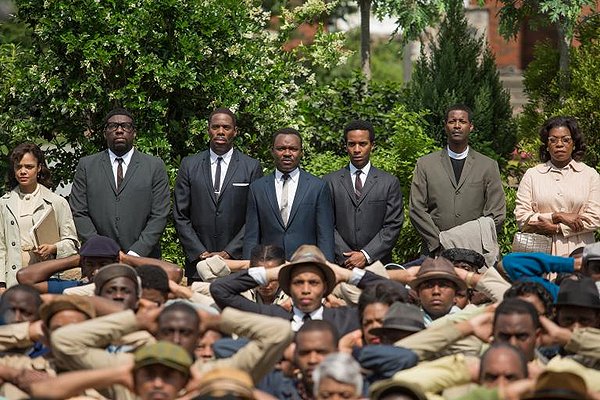
Selma tells the story that every American should know by heart. But most of us only know: “It has something to do with black people and Martin Luther King.”

After watching Selma, the images of hate, repression, brutality by white supremacists against blacks, injustice and twisted views of the rights of people will forever remain etched into the minds and memories of the viewer.

During a dangerous and turbulent three-month period in 1965, Martin Luther King led a campaign to secure equal voting rights for blacks. The white power structure, even though only 50% of the population in the south, wasn’t having any of it, and thugs blew up churches killing 14-year-old girls, and attacked unarmed and peaceful protestors with baseball bats wrapped in barbed wire. The police stood by and turned the other way, or worse, charged the crowds in riot gear and beat helpless people with batons, whipping them, and kicking them in their backs as they fled. The opposition of the establishment was violent.

The movie takes us there with Dr. Martin Luther King Jr. (David Oyelowo) when he stands up to President Johnson (Tom Wilkonson) in the Oval Office, holding firm in his demand. We are there when the epic march from Selma to Montgomery resulted in one of the most significant victories for the civil rights movement, the Voting Rights Act of 1965.

As I watched, I marveled how so many people, only 50 years ago, could be so blatantly prejudiced and discriminating, while they pledge every day

one nation, under God, with liberty and justice for all…

Selma is a 2 hour and 7 minute movie with a powerful thought in every minute. I often disparage religion, but in this film, religious imagery created the most powerful moment of all for me: It was when King called on clergy from all over the country to join him in the march in Selma, and there they were, all types of creeds and denomination, shoulder to shoulder, on the bridge, standing and facing police in riot gear. When the police backed down, King led them all in prayer.

Belief is a powerful thing.

Selma took a lot out of me to watch, but it will stand out as one of the very best movies I have seen in years.

Rating - Four Stars

Movie Review: Remembrance – Die Verlorene Zeit – Zagubiony Czas

Remembrance is a German movie of 2011 with three titles in three languages

Remembrance – the English title, is probably the least descriptive.

Die Verlorene Zeit – the German title, means “lost time.”

Zagubiony Czas – the Polish title, also means “lost time.”

This movie is about World War II, the Nazi concentration camps in Poland, what the war did to Poland and its people. It is also about undying love, and the moral obligations to life.

Based on the true story of Jerzy Bielecki and Cyla Cybulska, the German drama is directed by Anna Justice. It tells the story of Hannah Silberstein, German-Jewish woman from Berlin held in a concentration camp in Poland, who falls in love with a captured Polish resistance member named Tomasz Limanowski.

Remembrance1Tomasz orchestrates a daring escape for the two of them, and thus effectively saves her life – and his. But being free does not mean being safe. Poland is war-torn, and there is no safe place to hide. Quickly the couple is separated again, and eventually both come to believe the other to be dead.

In 1976, thirty years later, Hannah is married to an intellectual in New York City. They have a college aged daughter. By pure chance, she sees a television interview of Tomasz in Poland – he seems very alive indeed. Her old quest to find the love of her life is rekindled, and it brings turmoil over her family.

Germans know how to make movies that seem realistic. In Hollywood movies Germans would speak English with German accents. Here in Die Verlorene Zeit, we are treated to German when the Germans speak in the concentration camp, Polish when the Poles speak, and English, for the scenes that take place in New York. There are English subtitles for the Polish and German dialog. This approach to the language not only makes the scenes realistic, but it also puts the viewer into the middle of the action. What would it be like to be a Polish prisoner, donning a German uniform, pretending to be a German, but only knowing a few words, when your life – literally – depends on it? How does a German woman hide in Poland when she does not speak the language?

As is done by so many World War II movies, the terrible plight and suffering the Nazis put millions of Germans, Poles and Russians through boggles the mind. How could they inflict so much injustice on so many people for so long? How could they destroy so many lives – destroy by killing, then destroy by separating families, and lovers?

But then, if it hadn’t been for the war they caused, my own father, a young boy from Silesia, now Poland, would never have had to flee the east when the Russians invaded, and he would never have met my mother in Bavaria, and I would not exist, and I would not be writing this review.

The injustice of war, the crime of atrocities, comes to vivid life in Remembrance. It reminds us of the depth of the human spirit, and the seeming inevitability of fate.

Rating - Four Stars

Book Review: River God – by Wilbur Smith

War is the game played by old men with the lives of the young.

RiverGodRiver God is set in Ancient Egypt, some time during the speculative 13th or 14th dynasty, or roughly between 1700 to 1500 BC. Egyptologists call the era the Second Intermediate Period which followed the Middle Kingdom. Even though that time is about 3700 years ago for us, the Egyptians of the time already thought of themselves as an ancient people. Note that the Great Pyramid of Cheops in Giza was already almost 1000 years old then. To them, that was ancient, ancient antiquity.

The story is told in the first person by a slave and eunuch. Taita, the slave, happens to be brilliant and talented. He knows medicine, architecture, writing, city planning, engineering and many other skills. Such a slave is worth his weight in gold many times over, literally, and rich people will do anything to possess and retain such a slave for themselves.

Taita, therefore, has access to the most powerful people in the empire, and through his eyes we get a first-hand view of the machinations of power in ancient Egypt. The politics, the intrigues, and the sheer struggle for survival, not just for the working class, but also for royalty, comes to life in brilliant colors.

The story is well conceived and plays against a historical background, even though the actual players and their names and individual stories are fictional, yet entirely credible and plausible.

Written in 1994 and filling 662 pages, the story is loosely historically accurate. I am sure it’s not enough for an Egyptologist, but for a novice in ancient history, it serves as a great introduction to a mysterious world far, far away from us, yet, one that lasted many thousands of years longer and our own modern American civilization thus far.

Incredible!

Rating - Four Stars


Book Review: Edge of Eternity – by Ken Follett

Edge of Eternity

Edge of Eternity is another giant work by a giant writer, a thousand-page book that I could not put down. It is the third book of the Century Trilogy by Follett. There is only one thing wrong with the Century Trilogy: the way he named the books:

  • Fall of Giants
  • Winter of the World
  • Edge of Eternity
  • I could never remember these titles, and I still won’t now that I have read all three. They are epic-sounding, big and vague, and in my opinion impossible to remember. But that’s ok. I think of them as book 1, 2 and 3 of the Century Trilogy.

In Edge of Eternity, we still follow the main families that were introduced in the first two books, but now we are with the grandchildren. The story spans from 1961, the Kennedy presidency and the beginning of the civil rights movement, all the way to 1989 and the fall of the Berlin Wall.

In Germany, our characters are the Franck family, with Werner and Carla being the grandparents. The main characters are Walli, who becomes a pop musician, and the various characters around him.

In Russia, the patriarchs Grigori and Katherine are still alive, but the action surrounds their grandchildren, the twins Tanya and Dimka.

In the United States, Lev Peshkov is still a dandy, but George, his black grandson is the main character.

In England, Ethel still is the leader of the Williams family. Her grandson Dave, a musician, is the protagonist in this story.

Finally, the Dewars are also around, Cam and Beep, the grandchildren, being the leading characters.

Since it has been too long since I read the first two books, I had to pause occasionally to make sure I connected the story all the way to the present in this book, but as I kept reading, things kept coming together.

I love epics, and this trilogy is as epic as it gets.

Through the main characters, I got to be in the room with Krushchev in the Kremlin and Kennedy in the White House during the Cuban missile crisis. I was able to follow the civil rights movement and the thinking of its leaders like Martin Luther King. The pop music culture that dominated the sixties in England and the United States came alive through the band that Walli and Dave formed, called Plum Nellie. How did communism sustain itself through the leaderships of Krushchev, Breshnev and Gorbachev? Why did the East Germans build a wall to imprison its own people for decades, and how did they get away with it? And why did the Berlin wall eventually come down?

Following the main characters in this story, I felt I had a front-row seat with the major figures in the history of the 20th century and its huge movements. History came alive in front of my eyes, through all three of these works, unlike any other that I can remember reading.

Edge of Eternity is an extremely well written book and part of a powerful trilogy about the history of the 20th century.

Rating: **** (out of 4)