Book Review: Edge of Eternity – by Ken Follett

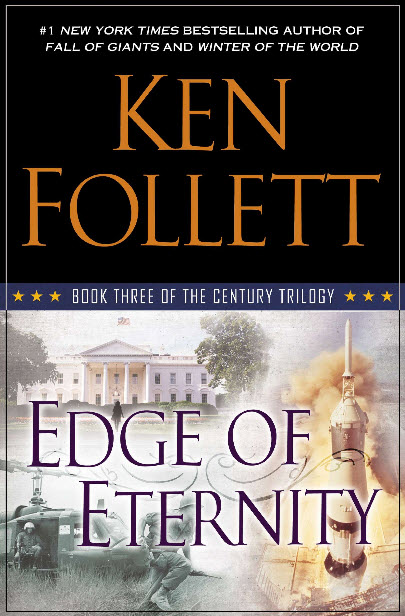
Edge of Eternity

Edge of Eternity is another giant work by a giant writer, a thousand-page book that I could not put down. It is the third book of the Century Trilogy by Follett. There is only one thing wrong with the Century Trilogy: the way he named the books:

  • Fall of Giants
  • Winter of the World
  • Edge of Eternity
  • I could never remember these titles, and I still won’t now that I have read all three. They are epic-sounding, big and vague, and in my opinion impossible to remember. But that’s ok. I think of them as book 1, 2 and 3 of the Century Trilogy.

In Edge of Eternity, we still follow the main families that were introduced in the first two books, but now we are with the grandchildren. The story spans from 1961, the Kennedy presidency and the beginning of the civil rights movement, all the way to 1989 and the fall of the Berlin Wall.

In Germany, our characters are the Franck family, with Werner and Carla being the grandparents. The main characters are Walli, who becomes a pop musician, and the various characters around him.

In Russia, the patriarchs Grigori and Katherine are still alive, but the action surrounds their grandchildren, the twins Tanya and Dimka.

In the United States, Lev Peshkov is still a dandy, but George, his black grandson is the main character.

In England, Ethel still is the leader of the Williams family. Her grandson Dave, a musician, is the protagonist in this story.

Finally, the Dewars are also around, Cam and Beep, the grandchildren, being the leading characters.

Since it has been too long since I read the first two books, I had to pause occasionally to make sure I connected the story all the way to the present in this book, but as I kept reading, things kept coming together.

I love epics, and this trilogy is as epic as it gets.

Through the main characters, I got to be in the room with Krushchev in the Kremlin and Kennedy in the White House during the Cuban missile crisis. I was able to follow the civil rights movement and the thinking of its leaders like Martin Luther King. The pop music culture that dominated the sixties in England and the United States came alive through the band that Walli and Dave formed, called Plum Nellie. How did communism sustain itself through the leaderships of Krushchev, Breshnev and Gorbachev? Why did the East Germans build a wall to imprison its own people for decades, and how did they get away with it? And why did the Berlin wall eventually come down?

Following the main characters in this story, I felt I had a front-row seat with the major figures in the history of the 20th century and its huge movements. History came alive in front of my eyes, through all three of these works, unlike any other that I can remember reading.

Edge of Eternity is an extremely well written book and part of a powerful trilogy about the history of the 20th century.

Rating: **** (out of 4)

Book Review: Trustee from the Toolroom – by Nevil Shute

TrusteeFromTheToolroomTrustee from the Toolroom by Nevil Shute is the most delightful novel I have read in a very long time. Spending time with the book, letting the paragraphs slide by, was pure joy, every minute of it. I just didn’t want it to end.

Shute died in 1960 and the book was published posthumously later that year. I must admit I had never read another Shute book, never heard of the author and I would certainly not have come across this one had it not been for a recommendation by a friend and colleague.

Trustee from the Toolroom is the story of Keith Stewart, a frumpy British engineer and journalist who has carved out a meager business building model engineering projects and writing about them in a niche magazine called the Miniature Mechanic. He loves what he does, and he and his wife live childless and seemingly content. They have just enough to get by and they are happy with their modest lives.

Keith’s wife’s sister Jo is married to a retired British naval officer. The two have one young daughter. They decide to sail in their own boat from England to the Pacific, with the goal of establishing themselves in Vancouver. During the journey, they leave their daughter with the Stewarts. They intend to have her flown over after they arrive in Vancouver some five months later.

A hurricane in the middle of the South Pacific changes everything, and Keith faces the conflicts of deciding to maintain his small and safe existence in an English village, or risk everything to recover the nest egg his in-laws have put aside for their daughter, making him the trustee. In the end, Keith chooses the path of adventure and courage.

This book is a novel without any villain or even any intense conflict. It simply tells the story, in great detail, of how Keith lives and eventually embarks on an exotic trip across half the globe on a very unlikely mission. We think we know the eventual outcome but the suspense comes from wanting to know how he accomplishes it, step by step.

Shute is an excellent story-teller. All the main characters are very likeable and honorable. Everyone seems to do the right thing all the time. It’s almost like a fairy tale, except there is no bad guy. The challenges in the story are simply life’s obstacles and accidental misfortunes.

A story like that just makes you feel good reading it, and everyone should have that experience once in a while.

Rating: **** (out of 4)

Book Review: Incidents in the Life of a Slave Girl – by Harriet Jakobs

Some of the greatest novels of all time have one distinct villain who dedicates his life to making the hero miserable by pursuing him relentlessly, against all odds and reason. Examples are Javert in Les Misérables or Danglars in The Count of Monte Cristo. We draw some comfort from the knowledge that those are fictional characters, and the stories are made up. Sadly, there are many examples in real life where tormentors do target single individuals with the simple objective of hurting and breaking them. Recently I reviewed the book Unbroken by Laura Hillenbrand. She tells the story of “the Bird,” a sadistic Japanese prison guard who tortures a prisoner of war. Unfortunately, “the Bird” is a real person, and the victim could have been any one of us.

slavegirlDr. Flint was a slave owner who took a liking to his slave Linda when she was a little girl. When she didn’t respond to the sexual harassment and abuse, he made it his life’s quest to hurt her in every way he could.

The book Incidents in the Life of a Slave Girl, one of the first autobiographical stories of female American slaves, was published as a novel in 1861 under the pseudonym of Linda Brent. It was based the real story of Harriet Ann Jakobs, who was born a slave in South Carolina in 1813. After escaping slavery she became an abolitionist speaker and reformer.

Harriet educates us about aspects of slavery that we might not have thought about, particularly as it concerns women and girls. Since the slaves are the property of the master, they can do anything they want with them. That opens up obvious and unspeakable possibilities, especially concerning young and beautiful girls. Owners would abuse the girls sexually. The girls would get pregnant at a young age, and since the children follow the status of the mothers, the children, too, would be slaves. All the owner had to do is feed them to grow up, and thus they could expand their stable of “livestock.” Many of them were not morally concerned that these slaves were actually their own children. The mothers were inferior, so the children were too, no matter that they sired them themselves.

One of the most brutal practices of slavery was separation of families. Even if slaves were married and had children, the families still belonged to the owners. In times of financial distress, the owners would sell of the families, often in pieces. Fathers who were strong could be sold off for plantation work, while the mothers stayed behind. They would never see each other again. Worse, children would be sold one at a time, or as sibling packages, without the mothers. Scenes of wailing mothers begging to be bought along with their children, just so they could stay with them, were frequent at slave markets. The markets were the most dreadful experiences for slaves.

Injustice abounded. An old man, who may have worked as a family servant for generations, would simply be discarded like trash when he was old and feeble and could no longer work. Sometimes a slave might manage to get the funds to “buy himself” free. Often there was fraud, and the owners would take the money only to re-enslave the subject under some pretext or legal loophole that the hapless slave didn’t know about.

Slaves were kept ignorant. It was forbidden to teach them to read and write. An ignorant, uneducated man cannot improve his lot and certainly he can’t challenge authority.

When Linda escaped, she was hidden by her family in a little attic over a storage shed next to the porch of her grandmother’s house. The attic had a hidden trapdoor for access from the storage shed. It was nine feet long, seven feet wide and at the highest point only three feet high. It was completely dark, insect and rat-infested and not insulated. So in the summer it turned into an oven, and in the winter it was bitter cold. The roof leaked and could not be fixed without exposing the occupant.

In this hell hole Linda could not even stand up or exercise. She drilled a few small knot holes so light and air could come in. She tried to keep herself busy with sewing. Not even all the occupants in the house, like other slaves, knew about her presence there. Only her grandmother and uncle tended to her for her necessities.

She lived in this coffin for seven years.

Here I must stop, because Harriet Jakobs tells her own story in brilliant clarity herself much better than I ever could recount it.

If you are only going to read one book about slavery in your life, Incidents in the Life of a Slave Girl is the one I would recommend you read.

Rating: ****


Book Review: Unbroken – by Laura Hillenbrand

On June 6, 2014, the 70th anniversary of D-Day, I saw a photograph of an old man with a walker, kissing the ground on Omaha Beach.

return-to-d-day-1

Presumably, he landed here on June 4, 1944 when he was a young man. All his life he has grieved for this friends who lost their lives right here on this sand so many years ago. What was it that spared him and allowed him to live a full life? Was it all just luck?

World War II veterans are now all much over 90 years old. There are very few left who have seen the atrocities with their own eyes, who have had to live with the memories of terrible loss and pain. One of those men is Louie Zamperini. He was born in 1916, grew up in Torrance, California, and he is now 98 years old. He has outlived everyone he knew. And he told his story.

unbrokenUnbroken is the story of the life of Louie Zamperini. Written by Laura Hillenbrand and first published in 2010, the book tells the story of a troubled youth growing up in Southern California. Louie found that he had a knack for running, and promptly proceeded to break many records. The apex of his running career was when he participated in the 1936 Olympics in Berlin, where he actually met Hitler. When America joined the war after Pearl Harbor, Louie was a bombardier stationed in the Pacific theater. He was shot down, survived many weeks on a raft and eventually was captured by the Japanese. He endured unimaginable abuse for two years as a POW of the Japanese.

One of the guards, Mutsushiro Watanabe, nicknamed “the Bird,” was the most brutal and sadistic abuser of all. He targeted Louie and brutalized and beat him daily, for years.

The book Unbroken is one of the most powerful, shattering, nightmarish books I have read in a long time. I have read many books about World War II and the atrocities committed by the Nazis. From that perspective, the war in the Pacific was just a footnote. Yes, the Japanese were waging war, too. I had no idea that the Japanese were so brutal, so abusive, and so reckless with human life and dignity. The Nazi death camps seem mild in comparison.

Japan held some 132,000 POWs from America, Britain, Canada, New Zealand, Holland, and Australia. Of those, nearly 36,000 died, more than one in every four. Americans fared particularly badly; of the 34,648 Americans held by Japan , 12,935— more than 37 percent—died. By comparison , only 1 percent of Americans held by the Nazis and Italians died. Japan murdered thousands of POWs on death marches, and worked thousands of others to death in slavery, including some 16,000 POWs who died alongside as many as 100,000 Asian laborers forced to build the Burma-Siam Railway. Thousands of other POWs were beaten, burned, stabbed, or clubbed to death, shot, beheaded, killed during medical experiments, or eaten alive in ritual acts of cannibalism. And as a result of being fed grossly inadequate and befouled food and water, thousands more died of starvation and easily preventable diseases. Of the 2,500 POWs at Borneo’s Sandakan camp, only 6, all escapees, made it to September 1945 alive. Left out of the numbing statistics are untold numbers of men who were captured and killed on the spot or dragged to places like Kwajalein, to be murdered without the world ever learning their fate.

– (Kindle Locations 5081-5092)

Unbroken is a testimony to the human spirit. How much pain and suffering and loss of dignity and humanity can a person endure before breaking, before dying? Unbroken shows how much in graphic, painful, chilling, frightening detail.

And to top it all off, Louie Zamperini is alive today to confirm his story. We may never forget.

I didn’t know how brutal the Japanese were. How did they change so quickly after the war? It seems right after the surrender, they went into high gear searching for their own countrymen war criminals. It’s hard for me to reconcile that these brutal, bestial people are the same ones that are now building my Toyota.

Here is an interview in 60 Minutes with “the Bird.” This will not be meaningful to you if you have not read the book. I recommend you read the book first, and then come back here and check out the interview of “the Bird.” It will give you cold chills.

Here is a video of a 60 Minutes interview with Watanabe, “the Bird.”

Louie Zamperini is a remarkable man. Hillenbrand’s book Unbroken is a remarkable book.

Rating: ****

Zamperini2
Louie Zamperini at age 22 and 95.

Finally, for more information about World War II in the Pacific, there is a great blog, which I have been following, called Pacific Paratrooper. Please check it out!

Book Review: Savage Harvest – by Carl Hoffman

Savage HarvestThe subtitle of Savage Harvest is “A Tale of Cannibals, Colonialism, and Michael Rockefeller’s Tragic Quest for Primitive Art.”

For me, reading Savage Harvest represented a vicarious journey into a world that is hard to believe still exists today in 2014, a journey into the stone age. It blew my mind wide open, and now has me pondering primitive art (I am going back to the Metropolitan Museum of Art as soon as I can get back to New York City), cannibalism (and the fact that is most likely still exists in today’s world in remote places), and exotic travel.

Carl Hoffman, the author of Lunatic Express, which I reviewed here four years ago, has made several journeys to Papua New Guinea, investigating the disappearance of Michael Rockefeller, who vanished in New Guinea in 1961 at the age of 23. Michael was the son of Nelson Rockefeller, then governor of New York, soon to be Vice President of the United States, and one of the most powerful and definitely richest men in the world. He was interested in primitive art and was on a quest to bring some of it home to New York by immersing himself into the culture in Papua New Guinea with the Asmat people.

The photo below shows the young Rockefeller surrounded by Asmat villagers in what appears to be a jubilant dance.

Savage Harvest 1
Picture Credit National Geographic Magazine

On November 20, 1961, he disappeared without a trace. All the power of money and government swarmed down on New Guinea, yet nobody could find a clue. Michael Rockefeller had vanished.

Reminiscent of Into the Wild by Jon Krakauer, Carl Hoffman meticulously retraced Rockefeller’s steps in New Guinea, searched records in the Netherlands and many other parts of the world, and unraveled the mystery of the disappearance one tedious step at a time. Since what happens amongst stone-age primitive people cannot be researched by reading archives, Carl immersed himself with the Asmat.

Savage Harvest 3
Picture Credit: The Washingtonian

Here is a picture of Carl with some of his Asmat friends when he lived with them while researching Savage Harvest.

What fascinated me about this book was that there were people in 1961 who were so untouched by the rest of the world, so remote, that most of them had never seen any white people, save a few forlorn missionaries. They were a very violent culture, practiced cannibalism as an accepted ritual as they had done for thousands of years. The Dutch and later Indonesian authorities and the Catholic Church worked on eradicating cannibalism with the Asmat. I can imagine that there are, today in 2014, still isolated tribes in the interior of New Guinea, and possibly other remote places in the world, that have not been touched by any civilization from the outside, save the contrails of modern jet travel, who still practice cannibalism today.

Savage Harvest delves deeply into the soul of the Asmat people, shows how they think, how their culture works, and why they might have practiced such a gruesome and repulsive practice, seemingly without any reservation. Their culture is so distant, so alien, so removed from anything we know in the modern world, we can’t even begin to understand. Here is a comment someone named “Scotty” wrote below the Smithsonian article with some interesting insight:

Savage Harvest 2
comment in Smithsonian article

I had started Twitter and email exchanges with the author after my review of Lunatic Express in 2010. Then, two years ago, I contributed to the author’s kickstarter project to fund his second trip to New Guinea, and in return I received my own hardcover signed copy. Thanks, Carl, for a great project completed. It lived up to all its promise and more. Savage Harvest 4

[Click here to order this book from Amazon]

Book Review: The Seven Daughters of Eve – by Bryan Sykes

Seven DaughtersThere are seven individual women, who lived between 10,000 years ago and 45,000 years ago between the Middle East and various areas of Europe, who are the direct ancestors of 95% of all European people alive today. Yes, exactly seven women. I am European, so I am likely the direct descendent of one of those seven individuals.

How can this be possible?

In a previous post I mused about how many ancestors we all have. I made the point that going back just 28 generations, or only about 675 years, I have over 130 million ancestors. The chart in that post illustrates that. However, the maternal line, going back to my mother, and from her to her mother, and so on, moving back through time, there is only ONE in each generation. There may be a million ancestors in a given generation, but there is only ONE mother of a mother of a mother of a mother and so on.

The author Bryan Sykes is a professor of human genetics at the University of Oxford. He has done pioneering work in genetics, specializing in studying mitochondrial DNA. One of the striking attributes is that the mitochondrial DNA is not passed on by males, only by females. Therefore, my personal mitochondrial DNA can be studied and compared with that of other contemporaries. When Sykes did this, he discovered that all modern Europeans pretty much belonged to one of only seven “groups” or “clans” as he calls them. Studying mutation frequency and the base mitochondrial DNA, coupled with the anthropological record, he was able to determine that there were seven specific women that are the mothers of all Europeans. Here is an excerpt:

The seven clusters had ages of between 45,000 and 10,000 years. What these estimates actually tell us is the length of time it has taken for all the mutations that we see within a cluster to have arisen from a single founder sequence. And, by purely logical deduction, the inescapable but breathtaking conclusion is that the single founder sequence at the root of each of the seven clusters was carried by just one woman in each case. So the ages we had given to each of the clusters became the times in the past when these seven women, the clan mothers, actually lived. It required only that I gave them names to bring them to life and to arouse in me, and everyone who has heard about them, an intense curiosity about their lives. Ursula, Xenia, Helena, Velda, Tara, Katrine and Jasmine became real people. I chose names that began with the letter by which the clusters had been known since we had adopted Antonio Torroni’s alphabetic classification system. Ursula was the clan mother of cluster U. Cluster H had Helena at its root. Jasmine was the common ancestor for cluster J; and so on. These were no longer theoretical concepts, obscured by statistics and computer algorithms; they were now real women. But what were they like, these women to whom almost everyone in Europe is connected by an unbroken, almost umbilical thread reaching back into the deep past? (pp. 196-197).

He then traced further back into our African roots and found one single woman, who lived about 150,000 years ago in Africa, who is the mother of all human beings alive today. He calls her fittingly Mitochondrial Eve.

Sykes writes The Seven Daughters of Eve for the non-scientist, but he goes through great pains to describe his research, the steps he went through to come to his conclusions, and the various scientific hurdles he had to jump. The book reads like a detective story, and I had trouble putting it down. After he makes his scientific points, the muses about the lives of the seven women. How might they have lived, what were the conditions of their lives like, how did they spend their days?

The roots of our human existence, our history and our unique humanness became alive for me as I read this book. Many times I was caught in reveries, dreaming about the lives of my ancestors. I was overwhelmed by the immense time periods that have elapsed, and how very unlikely our human existence actually is. 45,000 years represents about 2,000 generations. I know my grandmother. That’s three generations. However, my grandmother’s DNA comes from one of the seven daughters of Eve, 2,000 generations ago.

The Seven Daughters of Eve inspired me on many levels and has enriched my life. I will never think about humanity the same way again.

Rating: ****

Movie Review: Blackfish

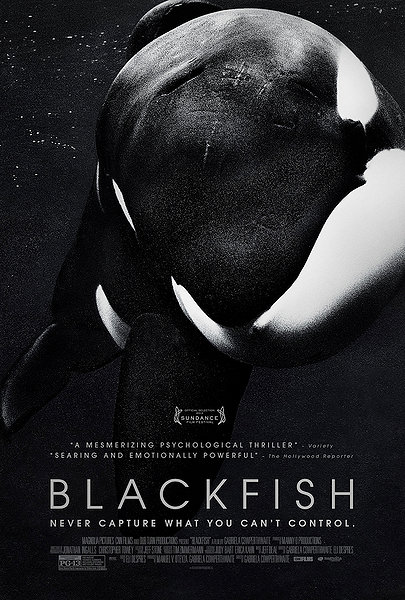
BlackfishBlackfish is an eye-opening documentary of 83 minutes directed by Gabriela Cowperthwaite. It includes gruesome footage never seen before of injuries and deaths of whales and human trainers.

The profitable marine theme park industry, with Sea World at the top of the pyramid, does not want its lead attraction, the orca show, to be disparaged or challenged. As a result, Sea World apparently creates false facts, misleads its own trainers, and covers up the truth after accidents inevitably happen.

The documentary tells the story of the notorious performing whale Tilikum, who, unlike any orca in the wild, has taken the lives of several people while in captivity.

Tilicum was captured when he was only four or five years old and brutally taken away from his mother and has lived in captivity ever since.

If I had been taken away from my mother at age five and kept all my life in a 12 by 16 foot cell, the proportional equivalent of a killer whale tank at Sea World, while having to perform stupid and unnatural tricks for audiences on a regular schedule, I would have been psychotic too by the time I was 45 years old.

Having a life-long interest in non-human intelligence, I had to watch this documentary. Evidence to my interest in cetaceans and their intelligence is the fact that “Cetaceans” is one of the categories in this blog that you can search. Here is one article that deals specifically with intelligence of whales.

I think that the time of animals in circuses is gone. That counts for elephants in big tents, lions and tigers in Las Vegas, and whales and dolphins at Sea World and any other captive commercial programs. Ironically I just got back from Hawaii, where I talked with a trainer working for Dolphin Encounter.

Dolphin EncounterThey have 13 dolphins who live and perform there, supposedly all born and raised in captivity. She argued that the dolphins have it better there than they would in the wild, with free healthcare and room and board. There happened to be a veterinarian there doing stomach imagery with scopes down the dolphins’ throats while we were standing there watching.

The dolphins seemed ok, but we can’t talk to them, and they can’t tell us how they feel – so how do we know?

The documentary movie Blackfish brings this controversial subject right in front of the public. It can’t be good for Sea World. I am saying this when I live within 30 minutes of the park in San Diego. Sorry, Sea World, it’s time to figure out how to make money without imprisoning and enslaving fellow sentient species.

Rating - Four Stars


Book Review: Winter of the World – by Ken Follett

Winter of the WorldDid you ever wonder how communism arose in the Soviet Union and how it became so compelling for so many people in so many countries for such a long time?

Did you ever want to learn how exactly East Germany came about? What was going on with the German people that caused them to split up the nation?

Did you ever wonder how Nazism could possibly arise in an educated, civilized country and how it came to corrupt the government, law enforcement, the judicial system, and eventually the military?

Reading Winter of the World, the second book of Follett’s Century Trilogy, answers these questions and many others. The book follows events that led up to World War II, and then guides the reader through the war and the first post-war years. It makes world history come to life in front of his eyes, just like Fall of Giants, the first book of the trilogy, did.

The characters in Winter of the World are in some cases the same as the protagonists we got to know in Fall of Giants. Earl Fitzherbert in England is still in charge of Ty Gwyn, and his sister Maud is living in Germany with her husband Walter. The elder Williamses are still alive. But they are no longer the main characters. Rather, the story is carried by their children. Boy Fitzherbert and his illegitimate brother Lloyd Williams are main characters from England.

The Buffalo Peshkov family, now led by the gangster-like Lev plays a pivotal role and connects the American contingent with the Russian roots. Lev’s daughter Daisy is a key contributor to the story. Lev’s illegitimate son Greg works for the United States government in intelligence, and his, unbeknownst to him, half-brother Volodya Peshkov is a Red Army Intelligence officer. Grigory Peshkov, his father, is a general and close adviser to Stalin. I found Volodya’s observation of communism, Stalin and his murderous regime, as well as his view of the American system most interesting. It helped me understand how the Soviet empire came about.

Then there is the American Dewar family, where Woody Dewar, Gus’ son, plays the most pivotal role. On the American side we learn about Pearl Harbor and how it forced America into the war.

In Germany, the van Ulrich family, particularly their younger daughter Carla, teach us about what life was like in Berlin, under the yoke of the Gestapo, behind the curtain of Germany, then the evil empire. Carla’s brother Eric illustrates how young German men could possibly be convinced to go to war and attack neighboring countries, looting and raping them until nothing was left.

Closing the loop back in England, there is also Ethel Leckwith, formerly Williams, Dai’s daughter and Billy’s sister. Both Ethel and Billy end up as English Members of Parliament.

The middle of the last century is spread wide open and through the actions and challenges of these six major families and their interconnections, Follett presents a history lesson as riveting as any epic novel.

He writes in a very simple language, which is easy to read and which makes it hard to put the book down, although it’s 940 tightly written pages in hardcover. This is like reading War and Peace or Count of Monte Cristo – or Follett’s own Pillars of the Earth – in other words: a massive reading undertaking.

But I never noticed, besides the experience that it took me a lot longer to read this than other books. When I was done, I was sorry I had to leave all the people I got to know so well. I can’t wait for the third book now.

Rating: ****

Book Review: 1984 – by George Orwell

1984What an excellent time to re-read 1984.

I first read this book when I was a teenager in the 1970s, and while I recalled some of the basic concepts, most of the story and plot had faded into nebulous memory. At the time I first read the book, the year 1984 was still a decade or so in the future, and as a teenager, that’s a long time. Utopia.

Then 1984 actually came. I still remember New Year’s Eve 1984. One of the guests at our house was Terry and I can still hear him saying:

Can you believe it’s now already 1984? Do you realize that the year 2000 is as far away as 1968?

Meaning, of course, that to all of us flower children, 1968 was just recently around  the corner and very fresh in memory, and 2000 would therefore be here in no time.

Winston Smith is the protagonist. He lives in a society where 15% of all people belong to The Party, and whose lives are completely controlled and monitored by the state. The other 85%, called the “Proles” as a short for proletarians, are the uneducated masses who are pretty much ignored by the state and do and live as they please. The world is divided into three superstates: Oceania (the state Winston Smith belongs to), Eurasia and Eastasia. The three states are continuously at war with one another. The party members are under surveillance day and night, to the point where the state tries to control their thoughts. “Thoughtcrime” is a common offense, and can have the death penalty. Sex for pleasure is a crime. Reading or writing materials that are not approved by the state is a crime. Children are brainwashed to report suspicious activities of their parents. Once a person is arrested, he may never return. An elaborate process of editing and re-editing old news to match the new reality keeps thousands of people busy. Not only does the state control the future, it controls the past by continuously re-writing it.

There are not many books that have had the cultural impact of 1984. The year 1984 itself has become an icon for “Big Brother.” The term “Big Brother” or even “Big Brother is Watching You” comes from 1984. The term “Orwellian” has become an adjective to describe a system of control or government. Terms like “thoughtcrime” or “doublespeak” were first introduced in 1984. Orwell predicted monitors for the entire population by installing telescreens everywhere. This was written in 1949, and he foresaw what we would describe as flat screen televisions that not only showed images, like a television, but that also contained cameras, where the state could observe the people. Telescreens were two-way communications devices installed everywhere, including in the various rooms of people’s homes or apartments.

At times the book was a bit slow for me. I enjoyed the first (of three) parts the most, since it described Winston’s life and environment. The second part, his affair with Julia, brought some action and tension. The third part, his arrest and rehabilitation was too detailed politically and ideologically for me. I didn’t need to get all the background. It kind of felt like I was reading Ayn Rand, following monologues of endless pages that didn’t really interest me anymore.

Overall, however, 1984 is an absolute must read book for any educated person. It was written almost 65 years ago but it is as authentic and important now as it ever was.

With the recent privacy scandals and the general upheaval that the Internet brought, 1984 is ever more important and impactful.

Watch out – Big Brother is watching you.

Rating - Four Stars

Book Review: Animal Farm – by George Orwell

Animal FarmMr. Jones owns the Manor Farm. His animals, including pigs, horses, cows, sheep, a donkey, geese, chickens and some dogs and a cat (and many others) decide they don’t want to be oppressed by humans any longer and they rebel, throwing out Mr. Jones, his wife and all the human farm hands.

The animals are free to live their own lives as they see fit. At first, they delve into their work with vigor and enthusiasm. They create a philosophy called Animalism, along with Seven Commandments that are designed to guide them in their society. All goes well for a while, until some rivalries arise among their leaders.

Animal Farm is a fable that can be read in just a few hours. In this story, animals think, talk and feel. It’s the best fable I have ever read.

Orwell wrote this book in 1943 – 1944, and it created quite a controversy in England because it was seen as a mockery of Stalin and his regime. To me, having recently read a number of books about Hitler and the Nazis, I took it as a fitting criticism of Hitler’s reign. Of course, there are so many parallels between Stalin and Hitler that makes it easy to choose one of the two to think about while reading.

Animal Farm should be required reading on the first day for anyone in any elected office.

How about Kim Jung Un in today’s world? I wonder if he ever read Animal Farm?

He needs to. Oink, oink.

Rating - Four Stars


Book Review: Wife No. 19 – by Ann Eliza Young

The full title of this book is:

Wife No. 19: The Story of a Life in Bondage, Being a Complete Exposé of Mormonism, and Revealing the Sorrows, Sacrifices and Sufferings of Women in Polygamy

Wife No. 19

Ann Eliza Young was – well – the 19th wife of Brigham Young, the second “Prophet” of the Mormon Church, the supposed hero who led his chosen people, like Moses of old, through the frontierlands of America in the middle of the 19th century, to finally settle in Utah.

Ann Eliza did not want to marry Brigham Young. She was forced into the marriage after steadfastly refusing, for a long time. Only when Young used his religious, political and social influence to threaten financial ruin on her family, including her parents and her businessmen brothers, she eventually succumbed.

Mormon men during the polygamous years of their church were pressured into “marrying” as many women as possible. Never mind that they could not afford to feed them, shelter them, educate them and provide them with a dignified life. Even Brigham Young, who basically embezzled the money of the church for his own indiscriminate use, who was therefore by far the richest man in Utah, was a terrible miser. He sent Ann Eliza and her mother to work on a family farm managing it, for years, without pay, supplies, and even the basic necessities.

It is so much cheaper to marry domestics than to hire them. Under the latter arrangement he would be compelled to pay them for their services, while by the former he is only obliged to give them shelter, food, and clothing.

(Kindle Locations 7099-7101).

Ann Eliza eventually broke free of the church and became an outspoken critic of  the church, of its leadership, the system of polygamy and the overall glaring hypocrisy of the entire Mormon structure.

Polygamy wasn’t what the popular TV show Big Love portrays. Polygamy in the 19th century was a destructive system that took down healthy families, crippled all women and girls emotionally, abused and exploited them for their labor as lifelong indentured servants, damaged young boys by taking their opportunities for normal family lives away, and gave old men a license to sexually abuse young girls by the dozens, under the eyes of their wives, all under the banner of heaven.

In Wife No. 19, Ann Eliza Young, maiden name Webb, tells her story pretty much from the beginnings of Mormonism, starting with her parents’ happy lives before Joseph Smith, the cunning and boorish founder of Mormonism,  appeared on the scene and made misery out of it. We follow her parents’ early marriage, the trek of the Mormons out west, Ann Eliza’s childhood, youth and young adult life. She describes the Mormon system from the inside.

The corruption was staggering. New recruits were lied to and deceived. They usually lost all their worldly belongings and ended up in Utah, at the end of the world, without a way out or back. Leaving the church in the early days was a death sentence. Brigham Young had hordes of thugs who did his dirty work. Apostates would leave town, heading back east or to California, only to be found weeks later dead, face down in the desert, shot in the back, “by Indians.” Poor souls who left the church and Utah, always got robbed and murdered by the Indians.

Ann Eliza describes Brigham Young as a ruthless, illiterate, deceptive, greedy, egomaniac boor of a man whose only objective was power and wealth. He built the religion as his own giant Ponzi scheme, and he literally had those killed that stood in his way. He did this all by claiming he was God’s prophet and those who left the church and didn’t obey his word would smolder in eternal hell and damnation.

Wife No. 19 is a fairly long book, and at times it’s almost tedious to read. The anecdotes go on and on. But the terrible, abusive and life-ruining system of Mormonism is exposed in glaring light, almost blinding to the reader. How could all of this have been going on so long?

I cannot imagine how one could possibly take up the Mormon religion after reading this book. Or worse, I cannot imagine how a Mormon today could stay in the religion after reading this book. I imagine, like so many other true accounts of what is really going on, Wife No. 19 must be banned material by the Church of Jesus Christ of Latter-Day Saints.

This book was first published in by Dustin, Gilman & Co., 1875, but it reads like a modern exposé. Anyone even remotely interested in learning about Mormonism and the truth about polygamy in America, then and today, must read Wife No. 19.

Rating: ****

Buy this book here.

Read some of my other articles about Mormonism by typing Mormon in the Search box at the top of my blog and enjoy.

Book Review: Brodecks Bericht – Philippe Claudel

Brodecks BerichtBrodecks Bericht (Brodeck’s Report) is a powerful and haunting work of literature.

The original novel was written by Claudel in French. I read the German translation, rather than the English one, because I wanted to work on rejuvenating my literary German. After reading the book, and realizing how much play on language Claudel used for effect, I am glad I did, as I do not know how this could have worked anywhere near as well in the English translation.

For instance, in the French original, they refer to “the event” always as „l‘Ereignis“, the stranger as  „le Fremder“, and the victim as „l’Anderer”. These words must appear to the French ear at a minimum as strange, and most likely, even after more than 65 years have passed since World War II, they must invoke feelings of discomfiture.

The story takes place after World War II, somewhere in Alsace, the border region between France and Germany that was in dispute between the two countries for centuries. Alsace was the first “bite” Hitler took into France when he provoked the western front and he took back the land the French took after World War I.

In an unnamed village of 400 souls, where most of the villagers have German names, they call the Germans the “strangers” as they came to occupy and conquer their land in the war.

Brodeck was an orphan from a far-away land. We don’t even know which. Presumably he was Jewish, but being an orphan, not even that is clear and we can only assume. He ends up at the village after being picked up by a woman refugee and she becomes his nurse and housekeeper for all his life.

When a murder takes place in the village, the villagers ask Brodeck to write a report about the events leading up to it, to somehow absolve them of the responsibility. Brodeck is one of the few villagers that have some university education and they pick him because he is a good writer.

As Brodeck researches the event, we get an intensely personal view of life in the village, both present and past, from his narrations. He flips between telling his life story, growing up as an orphan child, eventually being hauled into a concentration camp by the Nazis, and telling of the present goings-on that lead to the murder.

The story is extremely colorful, graphic, and haunting. The greater atrocities and injustices that took place in Europe of World War II are condemned, but ironically, the villagers, in their own micro-world, are mimicking the injustices. The gist is that being different, strange, from somewhere else, is bad and not to be trusted. This goes as far as justifying annihilation of the strange and different elements in the macro world, as the Nazis did, and killing a stranger just because he is different, in the micro world of the village.

Brodecks Bericht, Brodeck’s Report, puts a powerful spotlight on what went on in World War II in France and Germany, on the large stage, but more importantly, in the hearts of individuals.

Rating: ****

Book Review: World on the Edge – by Lester R. Brown

World on the EdgeRemember when you were in college and you read a text-book. You started  with a highlighter and marked the sections that were important, that you would need to or want to remember, either for the test, or better, for your life? If you did this with  World on the Edge, the whole book would be yellow. You’d realize that there isn’t a sentence that you didn’t want to highlight, and double highlight.

Every now and then a powerful non-fiction book comes along that slaps you in the face and completely wakes you up.

World on the Edge is such a book.

Lester Brown takes on all our global challenges at once in this succinct and easy to read book. He covers falling water tables and shrinking harvests, world desertification, climate change, hunger, disease, overpopulation, financial demise of nations, failing states and sustainable energy supply.

The first seven chapters state the problem, the last five chapters provide a workable solution, which he calls Plan B.

Not only is the book a wake-up call for the reader, but it represents a great reference work. Full of statistics, details, references to studies, other books and general information, World on the Edge is very useful as a study guide to the problems of the world. Pick any of the topics discussed, and be careful which you pick, because you can make a life-time career out of studying any one of those in-depth.

The challenges we face in our world on a global scale are staggering. Rather than doomsday trumpeting, the author presents workable solutions with funding requirements that could be put underway right now, to make a change within years, not generations.

The question is: Are we willing to listen?

Rating: ****

Book Review: Anne Frank: Diary of a Young Girl

The Diary of Anne Frank is a book that everyone is supposed to have read. It’s in the league of Catcher in the Rye, Moby Dick and The Grapes of Wrath.

I have read Catcher in the Rye at least twice, but I never even picked up Anne Frank.

After working through Rise and Fall, Five Chimneys and Nyiszli’s Auschwitz, it was time I came of age and read two years of diary entries of a fourteen year old girl, Anne Frank.

Anne was a young girl of a Jewish family in Amsterdam. In the summer of 1942, when the occupying Germans started to haul away Jewish people, sending them off to concentration camps, those that could either fled abroad before it was too late, or went into hiding. Anne, her sister, her parents, along with another family of three and a single elderly dentist, eight people in all, went into hiding in an industrial area of Amsterdam, in a hidden annex to the office building where her father used to be one of  the manager of the company. Eight people lived in very crowded conditions, constantly in fear of being discovered or betrayed, as supplies and resources dwindled. They were cooped up for over two years before somebody turned them in. All but Anne’s father eventually died in horrible conditions in concentration camps. Anne died in Bergen-Belsen in March of 1945, just weeks before British troops liberated the camp on April 15, 1945. He father eventually recovered the diary that was left in the annex when they were taken away.

Books are telepathy and time travel devices, as this quote from the diary illustrates:

Mr. Bolkestein, the Cabinet Minister, speaking on the Dutch broadcast from London, said that after the war a collection would be made of diaries and letters dealing with the war. Of course, everyone pounced on my diary. Just imagine how interesting it would be if I were to publish a novel about the Secret Annex. The title alone would make people think it was a detective story. Seriously, ten years after the war people would find it very amusing to read how we lived, what we ate and what we talked about as Jews in hiding.

It is now seventy years after a girl of fourteen wrote these words in a small room in a cramped apartment in Amsterdam that she had not left for a year and a half. In a diary she put her most secret thoughts, her troubles with her parents not understanding her, her coming of age, dealing with puberty, facing the changes in her body, wondering why the Jews were singled out to have no rights and no freedom. Not long after she wrote those words their secret lives unraveled and the world ended for Anne. Seventy years later I can sit safely in sunny Southern California in my living room, reading her secret words, I can feel her passions and her fears, time-traveling to her tiny world in Amsterdam in 1944.

We know about Anne Frank and her seven hapless companions because Anne wrote a meticulous diary, which was almost miraculously preserved. Then her father survived the concentration camp, and eventually found the diary and published it.

We do not know about all the other hundreds or thousands of families hiding in attics and basements in Holland, France, Belgium, Poland, Denmark, Hungary, Czechoslovakia, Austria and many other occupied countries. How many survived in hiding? How many were eventually hauled away to the killing camps?

If Anne Frank only knew the service she eventually provided to mankind when she sat down and made her regular diary entries, chronicling a terrible time in history! If she only knew that because of her writing, their secret annex is now a museum and tourist attraction in Amsterdam!

Rating: ****

Book Review: Five Chimneys – by Olga Lengyel

Olga Lengyel was a young woman in Transylvania during WW II. Her husband was a surgeon, she helped as a nurse, and together they built a small hospital in Cluj, the capital of Transylvania. She had two small children. They were Jewish.

Germany occupied Transylvania. One day in 1944, the Nazis came calling and Olga, her family and even her elderly parents were all hauled away in a cattle car fit for 8 horses. And so starts the first chapter: 8 Horses – or 96 Men, Women and Children.

Olga tells the story of her journey to Auschwitz-Birkenau, where she lived under utterly dehumanizing conditions as an inmate of the concentration camp.

In the beginning, those who were condemned to death at Birkenau were either shot in the forest of Braezinsky or gassed at the infamous white house in the camp. The corpses were incinerated in a “death pit.” After 1941 four crematory ovens were put into service and the “output” of this immense extermination plant was increased enormously.

At first, Jews and non-Jews were sent to the crematory equally, without favor. After June, 1943, the gas chamber and the crematory ovens were reserved exclusively for Jews and Gypsies. Except for reprisal or by error, Aryans were not sent there. But generally, Aryans were executed by shooting, hanging, or by poison injections.

Of the four crematory units at Birkenau, two were huge and consumed enormous numbers of bodies. The other two were smaller. Each unit consisted of an oven, a vast hall, and a gas chamber.

Above each rose a high chimney, which was usually fed by nine fires. The four ovens at Birkenau were heated by a total of thirty fires. Each oven had large openings. That is, there were 120 openings, into each of which three corpses could be placed at one time. That meant they could dispose of 360 corpses per operation. That was only the beginning of the Nazi “Production Schedule.”

Three hundred and sixty corpses every half hour, which was all the time it took to reduce human flesh to ashes, made 720 per hour, or 17,280 corpses per twenty-four hour shift. And the ovens, with murderous efficiency, functioned day and night.

However, one must also take into account the death pits, which could destroy another 8,000 cadavers a day. In round numbers, about 24,000 corpses were handled each day. An admirable production record—one that speaks well for German industry.  — (Kindle Locations 1041-1054)

The entire book is a string of one shocking paragraph after another. She describes the utter evil committed by the Nazis on millions of innocent people whose “crimes” were in some cases completely trivial: Stealing a loaf of bread; helping another person in need; having a different religion or viewpoint; disagreeing with the regime; and of course, the most vicious crime of all – being Jewish.

Reading about her journey, I found it hard to believe that anyone at all could survive these ordeals. I kept reading, of course, because I knew that she would make it out – I held her book in my hand, and somewhere in that wasteland of the absolute dregs of humanity, there was a good end. The author would survive.

She published the book in 1947. Her commitment to getting out, surviving and telling the story to the world of what really went on behind the gates of the lie “Arbeit Macht Frei” was the only driving force that kept her from giving up. There was nothing else to live for but the need to bear witness of the monstrous crimes of the Nazi regime.

Five Chimney’s is a crushing account of the horrors of the Holocaust. After reading this book, the adversities in my own very fortunate life seem but trifles compared to the gargantuan tortures inflicted by the Nazis upon millions of innocent beings.

I am changed.

Rating: ****