I had to get gas. This was the best I could find. It was the first time ever I had to spend over $100 to fill up my car.

$6.35 for regular unleaded.
Are we great yet?

I had to get gas. This was the best I could find. It was the first time ever I had to spend over $100 to fill up my car.
$6.35 for regular unleaded.
Are we great yet?

Last week, on Friday, June 12, my brother from Germany and I visited the Grand Canyon. I love taking people to the Grand Canyon “for the first time” as that first view into the void usually takes their breath away. After being there and even hiking down dozens of times over a period of 50 years, it still happens to me now every time.
What struck me however was how “empty” of visitors it was this time. June is usually high season. Many tourists from Asia and Europe visit the Canyon during the summer. Lines to get through the park gate can be several hours long, yet we drove right in. There were only five or six cars in front of us at the entry gate.
There were plenty of parking spaces everywhere. There were no lines in the restaurants. We went to eat at the Bright Angel Lodge for lunch. We were able to walk right in and there were plenty of open tables.
Outside of the park, the town of Tusayan was practically deserted. We went into the visitor center with the IMAX theater and a bunch of restaurants, and the place was empty. It seemed like we were the only guests in that huge facility.
There are many possible reasons for this.
All the above could contribute to the decline in visitors at the Grand Canyon.
If you’re local and want to visit our National Parks, now might be a good time. But the overall trend makes me wonder: Are we great again already?
Here is a world map showing in blue all countries with a GDP lower than that of the State of California:
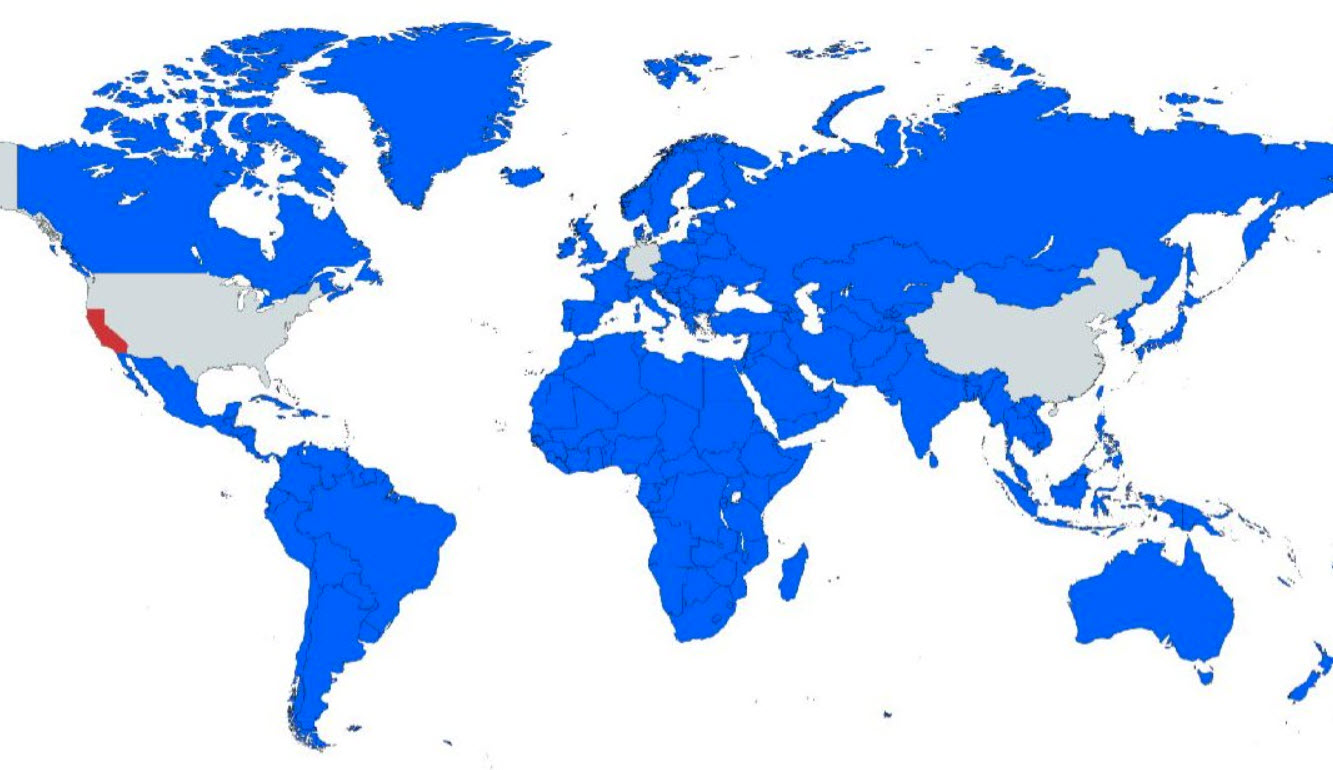
To state it simply: California just surpassed Japan in 2025. There are only three countries with a larger economy than California. Those are the United States without California, China and Germany. And we only have to gain $500 billion to catch up with Germany. It won’t take us long.
In January 2024, Donald Trump posted on Truth Social, attributing the stock market’s record highs to his favorable polling against President Joe Biden. He claimed that investors were optimistic about his potential return to the White House, stating:
THIS IS THE TRUMP STOCK MARKET BECAUSE MY POLLS AGAINST BIDEN ARE SO GOOD THAT INVESTORS ARE PROJECTING THAT I WILL WIN, AND THAT WILL DRIVE THE MARKET UP.
Trump also remarked that “everything else is terrible,” referencing inflation and geopolitical concerns. He suggested that the market’s performance was driven by expectations of his victory, despite not providing evidence to support this claim.
During a Fox News town hall on January 10, 2024, Trump asserted that the stock market was rising due to his lead in the polls and warning of a potential crash if he did not win the upcoming election.
Now, in April 2025, following a significant stock market downturn attributed to his administration’s aggressive tariff policies, Donald Trump shifted responsibility again to Joe Biden. Trump now referred to the declining market as the result of a “Biden Overhang,” suggesting that the economic challenges were inherited from the previous administration.
What a bunch of nonsense coming out of our president’s mouth. Let me get this straight. When the market was great, it was his win, even though Biden had been president for over 3 years then. When the market is terrible now, it’s Biden’s fault, even though Trump has been president for more than 3 months, and the DJIA was at 43,487 on January 20, 2025, when Biden’s term ended.
Joe Biden built a great economy. He brought us out of the Covid pandemic, lowered the Trump inflation, his policies brought manufacturing back to America, brought unemployment to historic lows, increased GDP every quarter, created 17 million new jobs and had the stock market at record highs. It took Donald Trump just three months to destroy all of that. And he has the gall to blame Biden for it.
Remember when Trump kept complaining that the economic disaster of 2020, following the Covid-19 pandemic outbreak, was Biden’s fault, even though he was president then?
How stupid does he think we are?
Stephen Miller had a yelling match with a host on Fox News because we have a trade deficit with Japan in the automobile industry.
In 2024, the United States imported approximately $25.6 billion worth of motor cars and vehicles from Germany and $40.8 billion from Japan, with U.S. exports in cars to those two countries being significantly lower. Our deficit with Germany was $17 billion and Japan $39 billion.
Why is that?
It’s because German and Japanese drivers don’t want American cars. They are essentially not good enough, and too large. They don’t want to drive around in F-150 pickups and huge SUV’s or Chevy Impalas. And as of late, Germans don’t want to drive in Teslas anymore, but that is for a different reason.
And then there are the relative sizes of the countries. There are just way more American drivers that want to drive German and Japanese cars than there are total drivers in Germany and Japan. A trade deficit in this sector is inevitable.
If Miller thinks that tariffs will make any difference in these facts, he is dreaming. No tariffs are going to make Germans want to drive American cars. If you make German cars really expensive in the U.S., we won’t be driving as many German cars, I grant you that, and it may dampen the trade deficit a little.
But in the end, other countries are going to buy American stuff if it’s inexpensive, and if it’s good. It’s going to take a very, very long time before American cars will be attractive in Europe or Asia, no matter what our internal fiscal machinations will be.
No propaganda will fix reality.
Several economic studies conducted by distinguished economists and prestigious institutions have analyzed the impact of tariffs on the economy, consistently finding that tariffs tend to have negative effects. Here is a list of 10 notable studies that ChatGPT pulled for me in 3 seconds:
“Are Tariffs Bad for Growth? Yes, Say Five Decades of Data from 150 Countries”: Authored by Davide Furceri, Swarnali A. Hannan, Jonathan D. Ostry, and Andrew K. Rose, this study analyzed data from 151 countries over the period 1963–2014. The researchers found that increases in import tariffs are associated with significant and persistent declines in output growth. Specifically, a one standard deviation increase in the tariff rate (approximately 3.6 percentage points) leads to about a 0.4% decline in output five years later. The study attributes this decline to reduced labor efficiency, real exchange rate appreciation, and higher production costs due to increased prices of imported inputs.
“Macroeconomic Consequences of Tariffs”: In this working paper, Davide Furceri, Swarnali A. Hannan, Jonathan D. Ostry, and Andrew K. Rose expanded on their previous research to explore the broader macroeconomic effects of tariffs. They found that higher tariffs lead to declines in output, productivity, and employment, as well as increases in inequality. The study underscores that the negative effects of tariffs are both economically and statistically significant.
“International Trade, Distortions and Long-Run Economic Growth”: Jong-Wha Lee examined how trade distortions, such as tariffs, impact long-term economic growth. The study concluded that tariffs and exchange controls generate cross-country divergences in growth rates and per capita income over extended periods, highlighting the detrimental effects of trade barriers on economic development. IMF
“The Effects of Tariffs and Trade Barriers in CBO’s Projections”: The Congressional Budget Office analyzed the impact of tariffs implemented since January 2018, finding that these trade barriers reduced the level of real U.S. GDP by roughly 0.3 percent by 2020. The study highlighted that tariffs raise domestic prices, thereby reducing consumers’ purchasing power and increasing business investment costs. Congressional Budget Office
“The Macroeconomic Consequences of Import Tariffs and Trade Policy Uncertainty”: Lukas Boer and Malte Rieth estimated the macroeconomic effects of import tariffs and trade policy uncertainty in the United States. Their findings indicate that tariff shocks depress trade, investment, and output persistently, suggesting that protectionist measures have adverse economic consequences. IMF
“Tariffs Do More Harm Than Good at Home”: Maurice Obstfeld discussed how tariffs, while intended to protect domestic industries, can be broadly contractionary, reducing output, investment, and employment in the economy. The study emphasized that such negative effects occur even if trade partners do not retaliate with tariffs of their own. IMF
“Macroeconomic Consequences of Tariffs”: The Cato Institute reviewed empirical studies and found that tariff increases lead to declines in output and productivity in the medium term, as well as increases in unemployment and inequality. The study highlighted that tariffs do not improve the trade balance and often result in real exchange rate appreciation. IMF eLibrary+2Cato Institute+2IMF+2
“The Return to Protectionism”: Economists Pablo D. Fajgelbaum, Pinelopi K. Goldberg, Patrick J. Kennedy, and Amit K. Khandelwal examined the effects of the 2018 trade war on the U.S. economy. Their analysis revealed that the tariffs led to higher import prices, resulting in increased costs for consumers and businesses. The study concluded that the tariffs imposed during this period caused substantial welfare losses for the U.S. economy.
“The Impact of the 2018 Trade War on U.S. Prices and Welfare”: Researchers Mary Amiti, Stephen J. Redding, and David E. Weinstein analyzed the price effects of the 2018 tariffs. They found that the full incidence of the tariffs was passed on to U.S. importers and consumers, leading to higher prices and reduced welfare. The study emphasizes that the tariffs did not lead to a reduction in foreign export prices, meaning U.S. entities bore the entire cost.
“Macroeconomic Consequences of Tariffs”: In this working paper, Davide Furceri, Swarnali A. Hannan, Jonathan D. Ostry, and Andrew K. Rose expanded on their previous research to explore the broader macroeconomic effects of tariffs. They found that higher tariffs lead to declines in output, productivity, and employment, as well as increases in inequality. The study underscores that the negative effects of tariffs are both economically and statistically significant.
These studies collectively provide robust evidence that tariffs tend to have adverse effects on economic growth, productivity, employment, and consumer welfare.
Do you want me to cite not 10 but 200? I can keep going. It’ll just take a few more seconds.
Senator Kennedy – are your staffers asleep?
On April 5, 2025, Fox News host Jeanine Pirro said:
“I don’t really care about my 401(k) today. You know why? Not that I can afford it, not that it isn’t important, not that I’m not at a point in my life when I should be worried about my 401(k) because I am, but this is what I believe. I believe in this man.”
On April 3, 2025, Commerce Secretary Howard Lutnick said:
Let Donald Trump run the global economy. He knows what he’s doing. He’s been talking about it for 35 years.
That got me thinking and researching. What were the 10 largest Dow Jones Industrial Average (DJIA) drops since it started on May 26, 1896?
Here is what I found:
| Date | DOW Drop | President | Party | Comment |
|---|---|---|---|---|
| 10/19/1987 | 22.5% | Reagan | Republican | Black Monday |
| 3/16/2020 | 12.9% | Trump | Republican | Covid-19 |
| 10/28/1929 | 12.8% | Hoover | Republican | Start of Great Depression |
| 10/29/1929 | 11.7% | Hoover | Republican | Great Depression |
| 12/18/1899 | 8.7% | McKinley | Republican | |
| 3/14/1907 | 8.3% | Roosevelt | Republican | |
| 10/26/1987 | 8.0% | Reagan | Republican | After Black Monday |
| 10/15/2008 | 7.9% | Bush | Republican | Financial Crisis |
| 9/26/1955 | 6.5% | Eisenhower | Republican | |
| 4/4/2025 | 5.5% | Trump | Republican | Tariff War |
| Date | DOW Drop | President | Party | Comment |
|---|---|---|---|---|
| 3/16/2020 | 2,997.1 | Trump | Republican | Covid-19 |
| 3/12/2020 | 2,352.6 | Trump | Republican | Covid-19 |
| 4/4/2025 | 2,231.0 | Trump | Republican | Tariff War |
| 4/3/2025 | 1,679.1 | Trump | Republican | Tariff War |
| 2/5/2018 | 1,175.2 | Trump | Republican | Inflation during Trump |
| 2/8/2018 | 1,032.8 | Trump | Republican | Inflation during Trump |
| 9/29/2008 | 777.6 | Bush | Republican | Financial Crisis |
| 10/15/2008 | 733.0 | Bush | Republican | Financial Crisis |
| 9/17/2001 | 684.8 | Bush | Republican | |
| 12/1/2008 | 679.9 | Bush | Republican | Recession Fears |
Notice that every row in both tables are exclusively by Republican presidents.
Notice also that Trump’s name appears more on these two charts than any other.
This is the same man who has bankrupted several casinos and has been convicted of fraud (Trump University for one).
Jeanine Pirro, are you sure you want to trust this man?
Howard Lutnick, are you sure Trump knows what he is doing just because he’s been talking about it for 35 years?

Here is where 50% of the GDP of the United States is generated. The orange spots are all the cities.
Remember the election map? Every one of these orange spots was on the blue map. Every. One. Of. Them.
These are just the numbers, not the fluff of what they are telling us.
Do you see a pattern here?
In the 1990, one of my colleagues, a software engineer, was adamant about boycotting Chinese products. At the time she said that the Chinese were using child and slave labor in their factories, and she considered it her duty to not buy Chinese products. I always respected her for that, and in those years I started looking at “Made in …” labels on products.
Much has changed over the last three decades since. I am currently working on a number of projects. For parts, equipment and tools, I go to Amazon, since I can’t find most of the stuff I need, at least in the sizes and configurations required, in local stores. Just in the last couple of weeks, I have bought garden hoses, pumps, AC to DC converters, angle brackets, shelves, shelf brackets, trash bags, a belt sanding machine and a few other odds and ends.

I am checking the labels, and every product I have bought from Amazon is made in China. Every single one of them. Whether that be electronics, hardware, household items, no matter what, it’s made in China. Our entire consumer economy seems to be based on manufacturing in China.
I realize that this is not a current or recent trend. Thirty years ago, before Amazon existed, one of the statistics I remember reading, was that 80% of all goods sold at Walmart were made in China. At the time, Walmart was the main supplier to the American middle class. This trend of outsourcing our manufacturing to China has been going on for decades and we haven’t done anything to stop it – probably the opposite is true.
I don’t think Trump’s tariffs will work. If you need a drill, and nobody in the United States builds a drill, and they all come from China, you’re going to have to buy that one, and pay the tariff. It does not create an incentive to build the drill here. And even if we turned this trend around now, it would take at least several more decades before we’d see tangible results, and we’d purchase products from Amazon that were made in the USA.
I admit that I am not offering any solution here, I am just making an observation of facts that we should all be aware of. We have created a problem for ourselves that simple slogans like Make America Great Again are not going to solve. It will take much more effort, require creativity, and many years of persistent policy action.
Today I checked my stock ticker:
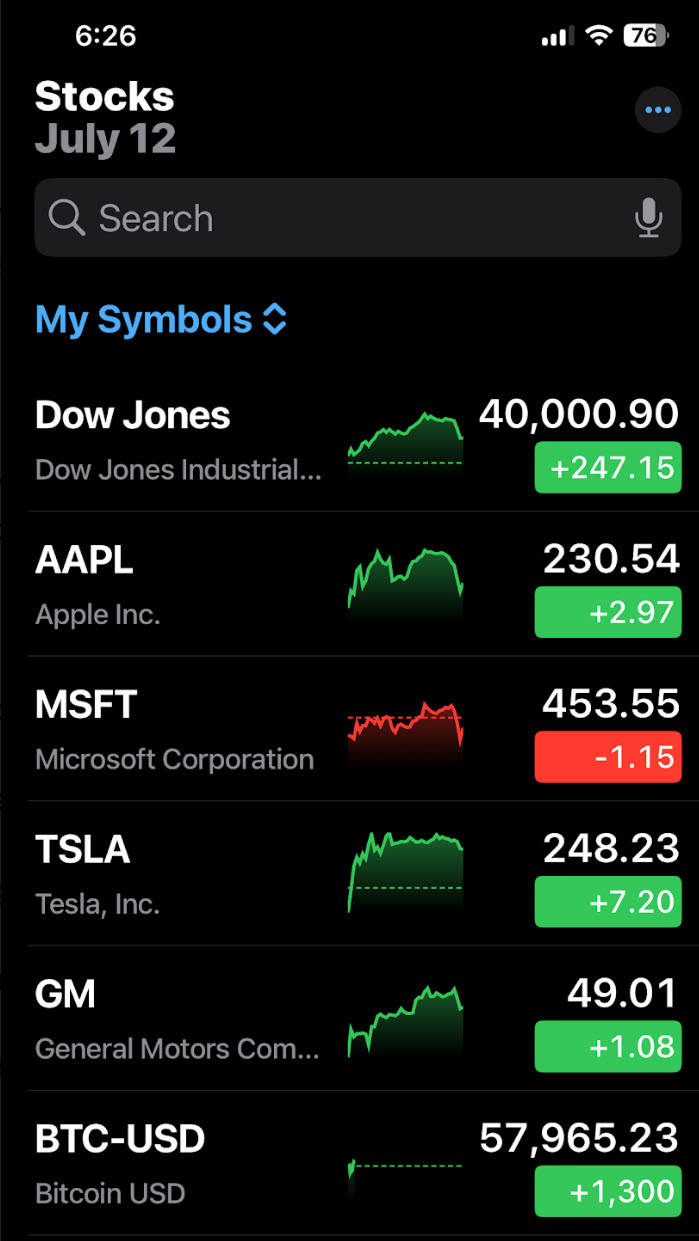
The Dow Jones is at 40,000.
At the end of Trump’s term, the Dow was at 30,930.52. Trump’s legacy for investors was his aggressive corporate tax cuts and his hands-off approach to regulation. Corporate profits did well.
Trump famously predicted that the stock market would crash if Biden won the election. That hasn’t happened. The economy has performed fine under Biden, given where it was when he started, in the doldrums of the pandemic.
Yep, I am better off.
A few days ago I drove from Memphis to Oklahoma City, crossing through Tennessee, Arkansas and Oklahoma. Here was the price of gas in Memphis:

After just filling up my tank the week before in Barstow, California, at $6.49/gallon, this seems out of this world.
Is it time to leave California?
I have written several posts in 2015 with the subject of waste of food. Here are links to both of them:
Child Hunger and Banquet Food Waste
Today I received an email from a reader who works on a university project about world hunger, who asked me to attach this information to my posts.
You can find that information at this link: World Hunger Facts and Statistics as well as at the bottom of the two other posts.
It has been eight years since I wrote these posts, and things have not gotten better. Due to impending climate disaster, there will be millions of climate refugees searching for “higher ground” and there will be crop failures all around the world which will exacerbate hunger. I welcome the research, the activism and the initiative of the new generation and university projects like the one my reader quoted. She took the time to search old posts and contact the writers – that takes work, and I applaud it.
Thank you, Debbie.
Now that the Trump administration is coming to an end, and Republicans have lost control of the Senate, we can be sure that the political right will all of a sudden start focusing on the national debt, and will blame the Biden administration for spending money like “drunken sailors” every step of the way. I predict that the debt ceiling, a word that never even was uttered in the last four years, will be a continuing battle, and every time we want to do something for the middle class we’ll be told that we “can’t afford it, look at the debt!”
Here is the reality of the debt:

Then when Trump took over, he promised that he’d eliminate the debt over eight years. That did not happen. The graph, as we can see above, continued right on upward at the same slope as during the Obama years. The Trump tax cut put a little spike into it, but in general, it does not seem to have affected the slope of the increase much at all.
Of course, then came the pandemic and all bets are off about the long-term result and the slope of that curve.
In summary, Trump did not do anything to reduce the debt, let alone eliminate it. But overall, he didn’t increase it beyond the trajectory that was already underway.
The GOP blocked the current relief bill, since, per McCarthy, it contributes to the ballooning deficit.
I am not one for advocating deficits. However, after eight years of blasting Obama for increasing the deficit, Trump has added more deficit in the last four years than Obama ever did. And Trump did not have to dig out of an economic crisis. No Republicans appeared to even pronounce the word “deficit” during the last four years of profligate spending and tax giveaways to the rich.
But now that Democrats will be in charge again, the deficit is all of a sudden a word again. Obama took over an economy in shambles and rebuilt it. His crime: The recovery was “too slow.” He increased the deficit, and we heard about it every day. Biden now takes over an economy in shambles, as well as a public health catastrophe, all created by the incompetence of Trump, and we’re worried about the deficit again?
Give me a break!