Movie Review: CODA (2021)

Alright, before I get into the movie itself, it’s important to note that CODA is a “highly decorated movie” with three Oscars.

First, it won Best Picture of the Year, and by doing so it became the first movie produced by a streaming service to win Best Picture. This is an Apple Original Film, which by itself boggles my mind. I still remember when Apple became a company in 1976. Who would have thought that the company would eventually become the most valuable company on the planet – and, as a computer company, it would produce Oscar-winning movies?

Second, it won Best Adapted Screenplay by Sian Heder.

And finally, Best Performance by an Actor in a Supporting Role for Troy Kotsur, who is also the first ever deaf actor to win an Oscar.

And boy did he win that Oscar, alone for the “my balls are on fire” scene at the doctor’s office.

I watched this movie on the airplane from London to New York, starting about two hours into the flight. The windows were all darkened, I sat in a window seat in the exit row, headphones on, and I was outright crying during the ending scene, when Ruby, the lead, sang Clouds From Both Sides Now in the ending scene. The man next to me was into his own movie and so I had my privacy. After wiping my eyes dry when it was over, I pulled up the window shades and looked down on the clouds of Greenland – from above.

I didn’t know what CODA was all about when I picked the movie, I just knew it had won awards. I also didn’t know what CODA even meant, until I actually did the research to write this review now. It means “Child of Deaf Adults.”

Ruby Rossi (Emilia Jones) is the only hearing person in her family. Both her parents and her brother are completely deaf. They operate a fishing boat. Ruby goes out with them early in the morning, they bring in their catch, they take it to the market, where Ruby leads a key role as the family’s communicator and negotiator, all before she gets ready to go to high school.

While life as a fishing family is hard, not only brutally hard and dangerous work on a boat, but also hard to make ends meet in a fickle market, the Rossi family is happy. The parents are madly in love and can’t seem to keep their hands off each other. They have wild sex in their bedroom with no thought to the fact that Ruby can hear the ruckus all over the house.

But what could Ruby possibly be interested in for her own life that is about as far removed from the appreciation of her family as it can get? Ruby has a passion and great talent for singing. Her parents need her on the boat and for the family business, and Ruby wants to pursue a life, passion and career that they can’t even comprehend, let alone appreciate?

So here you have it all, a powerful story, an emotional subject, a clash of cultures, and world-class acting – yes, a deaf man acting as a deaf man. It does not get any better than that.

I have seen clouds from both sides now….

Movie Review: Top Gun – Maverick (2022)

Captain Pete “Maverick” Mitchell (Tom Cruise) is one of the Navy’s most decorated and skilled aviators after thirty years of flying fighter planes. Most of his companions from his years at the Top Gun school outrank him by two or three stars. He has purposely dodged being promoted to admiral so he could remain in flying status.

As one of the most skilled test pilots, he is called in to lead a mission in the Middle East that is nearly impossible. He trains a group of pilots half his age, but he uses his maverick instincts, much to the dismay and disapproval of his superiors.

Top Gun is a well-crafted sequel to the original 1986 movie. It’s full of tense flying scenes and I am sure any aspiring or actual pilot will very much enjoy it. I have to admit that the movie far exceeded my expectations. I enjoyed the story, the cinematography, the sound track and the acting. Even the plot made sense and tied very well back to the 1986 edition, with some of the key characters woven into it now.

Of course, I had to disregard a number of impossibilities, one of which I’ll describe here without it being a spoiler. At the beginning of the movie, Maverick makes a record-breaking flight on a new concept aircraft similar to the famed SR-71, only with today’s technology. To advance in the contract, the plane has to meet a milestone of flying Mach 10 – which is ten times the speed of sound. For comparison, the SR-71 holds the aircraft speed record of Mach 3.3 at an altitude of 85,000 feet. At that speed, the aircraft heats up the 450 degrees F near the back of the aircraft. When fired upon, it can simply outrun the missiles shot at it. Well, Maverick reaches Mach 10.3 when the aircraft breaks up. In the next scene, he is walking into a restaurant in the desert, a little battered up, helmet in hand, asking for a glass of water.

Needless to say, the human body would be torn apart by the g-forces and then burned to a crisp flying near space at Mach 10 without the protection of an aircraft around it. There is no way Maverick could have survived the fall from that altitude and speed to see another day. But it’s Top Gun, right, and we like our heroes.

Once I discounted all the crazy impossible stuff, what’s left was a very enjoyable movie that kept me at the edge of my seat.

You gotta go!

Movie Review: The Adam Project (2022)

In 2050, time travel exists, and fighter jets can travel in time. Adam Reed is a pilot, trying to get to 2018, to save the future, but he crash-lands in 2022, conveniently in the backyard of his childhood home, where he meets his 12-year-old self. The two set out to fix a complicated future.

None of this makes much sense. The movie is an excuse for lots of Matrix-like action and video game scenes. There are even storm troopers who are wearing silver suits instead of white ones, but who are also just expendable ray gun fodder.

I was tempted to turn it off and leave it, but when I was half-way through, since it was, after all, a time travel flick, I stayed and watched it to the end.

Guess what, Adam fixed the future by fixing the past.

Book Review: The Vanished Birds – by Simon Jimenez

The Vanished Birds is the debut novel of Simon Jimenez. It is a big novel, dealing with humanity and its place in a world where star travel is commonplace, where there are many worlds populated by humans, and where large corporations are the de-facto governments that set all the rules and have ultimate power over the people.

The central character is Nia, a young female captain of a trader star ship with a crew of just a handful of people, a pilot, an engineer, a maintenance tech, a doctor, and someone in charge of cargo. Star ships travel through “folds” which are a sort of hyperspace where time is distorted like it would be at relativistic speeds.

Kaeda, a young boy on an agricultural planet meets Nia for the first time when he is 7 years old. She gives him a flute, which he treasures. The ship only stays for a day to take on cargo, and then leaves, to come back 15 years later, on the next “shipment day.” That’s how long it takes for the round trip. However, on board the ship, only 8 months pass. When Nia returns 8 months later, Kaeda is now 22 and they start a love-affair – at least so Kaeda thinks. Within a few years of Nia’s time, she sees him a few more times as he ages, and Kaeda’s entire live passes. He is an old man the last time she visits.

There is also an Asian engineer named Fumiko, who designs space stations. And there is a mute boy who apparently has  extraordinary powers.

As you might guess, this book is definitely a space opera that speculates on humanity’s distant future and extraordinary technology. It’s a large book with big ideas. Interestingly, there are no intelligent aliens in this world, which seems strange, given the scope of humanity’s reach.

I liked the concepts, I enjoyed reading it, but I would not classify it as a great novel, even through it was nominated for a number of awards.

AFS Reunion in Croatia

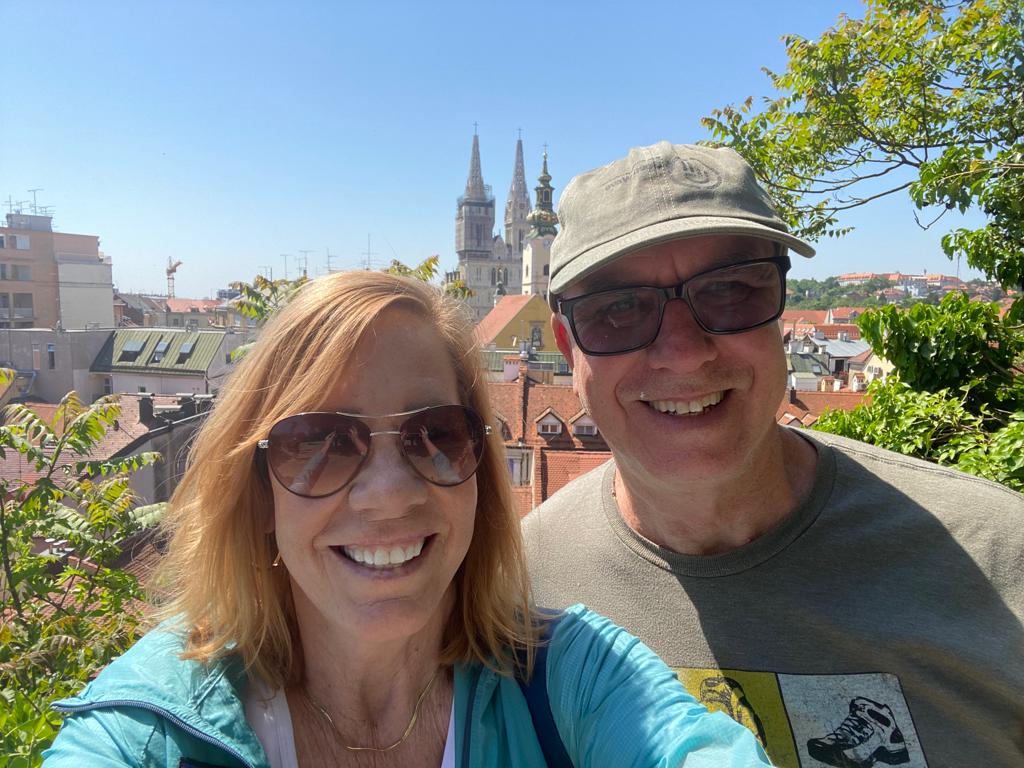
About 30 former AFS exchange students in 1974 from over 14 different countries, many with their spouses, had a reunion in Croatia this week.

We came to this reunion from Denmark, Germany, Switzerland, Austria, Croatia, England, Luxembourg, Guatemala, Costa Rica, Brazil, Argentina, Chile, Thailand and the US. I maybe forgetting a country or two.

We’re all 64 or 65 years old, and share one life-changing experience, a year abroad in the US with the AFS program. Here is a group picture.

Here are some of us on our first day in the country getting some much needed refreshments.

Here is a shot of us at the initial welcome dinner in Zagreb, the capital of Croatia.

For about 10 days, all these 65-year-olds were 18 again.

Movie Review: Death on the Nile

Hercule Poirot (Kenneth Branagh) is a Belgian veteran of World War I. He is on vacation in Egypt in the company of an elite group of travelers. When a murder takes place on their boat, he makes it his mission to investigate the case and hopefully solve it. It was not clear to me why a fellow traveler can just appoint himself to law enforcement, but that’s just a fine point. It’s a movie, right?

Of course, the cinematography is amazing. Who is not impressed with the backdrop of the pyramids of Giza? There are even some pictures of people climbing the pyramids. Everyone is always impeccably dressed in white suits and colorful, elaborate dresses and hats. If I traveled in Egypt, I’d be wearing a T-shirt, khakis and sandals or hiking boots. The movie makes a strong impression of the period which is sometime after WW I.

While the story is sometimes cheesy and stilted, the glamor makes up for it, and the plot is very carefully constructed, as is almost always the case with a murder mystery. We have seen hundreds of whodunnit movies, and this is just another one. It follows all the tricks and the playbook.

Still, it’s a great movie and an adventure to watch.


3.5 stars

Book Review: Timeline – by Michael Crichton

Timeline was first published in 1999 and, having read most of Crichton’s books, I head read it right away. I remembered it vaguely as a time travel thriller. So I picked it back up again a couple of weeks ago.

In France, a group of archeologists are studying a medieval village, complete with two castles and a monastery. All the buildings are ruins, of course, but they have a rich history dating back to the 14th century, while the Hundred Years’ War was raging, and England was routinely attacking and invading France.

Their research is being funded by a multinational corporation. The company is led by a self-obsessed science tycoon in his mid thirties. It has developed a technology based on quantum science that allows them to travel in time. When one of the archeologists goes back to 1357 and does not come back, the company coerces some of the young scientists to follow him and bring him back.

To avoid anachronisms, they are not allowed to bring any technology, modern weapons or any objects from the future. When they arrive, practically in the middle of a battle, trouble starts quickly and the race to get back home begins.

Timeline is less of a time travel novel, and more a historical novel. The majority of the story takes place during a mere 39 hours starting on April 7, 1357. The protagonists have to battle knights, solve riddles, and play the opposing parties of the war. The whole thing is reminiscent of an episode of the modern television series The Amazing Race: “And now the contestants have to invent gunpowder to impress Lord Oliver. They only have two hours to do it or they’ll be thrown in the dungeon and miss their chance to make it to the next stop.”

Timeline is a historical thriller with a neat plot twist, where scientists get to visit the heyday of the castles, the ruins of which they study in the 21st century.

Movie Review: Mystic River (2003)

Mystic River is an old masterpiece. I had watched it when it first came out, and while I remembered it “was a good movie,” I had forgotten what it was about.

Sean Penn won an Oscar for best actor in a leading role, and Tim Robbins for best actor in a supporting role.

The story is about three friends from a rough neighborhood in Boston who were best friends as boys. Jimmy Marcus (Sean Penn) was an ex-convict when his daughter Katie was murdered. His friend Dave (Tim Robbins), a blue-collar worker, saw Katie last, making a fool of herself late at night, dancing on the bar in a local watering hole. His other friend was Sean (Kevin Bacon), who happened to be a homicide detective, and he was put on the case. As the three childhood friends deal with this tragedy each in their own way, events unfold that pit them against each other.

There is a backstory, which is woven into the main plot. It turns out that Dave was abducted by child molesters one afternoon in the summer of 1975, when the three boys played in the streets. After days of sexual abuse he escaped and returned, but things were never quite the same for the three friends. The demons of the summer of 1975 come to haunt all three of them when Jimmy’s daughter was killed.

About the Peaceful Transfer of Power

All my adult life I have observed the quadrennial presidential elections. My chosen candidates did not always win. But I always enjoyed watching the festivities of the inaugurations. Invariably, some news anchor would comment that in this country, for over two hundred years, we have been able to witness the peaceful transfer of power. I remember bring proud of that, being proud of being a citizen of a nation that was founded on the principles of democracy and the peaceful transfer of power since the 18th century. There was no other nation like this on the planet, and there had never before been one.

We can’t say that anymore.

We can’t feel that way anymore.

That notion has been destroyed. And a little bit of our nation has died with it.

Book Review: The Spaceship in the Stone – by Igor Nikolic

Michael Freeman is an ex-special forces soldier who was injured in the war and is now a disabled veteran. He loses his job and his girlfriend, and he wants to get away to “find himself.”

He was raised by his grandfather in a self-sufficient cabin in the woods. His grandfather has long passed, and Michael goes back to the cabin to get away from it all – with a few six-packs of beer.

When he hikes in the woods behind his cabin, he suddenly falls into a sinkhole or hidden cave, gets hurt badly and passes out. Nobody knows where he is.

When he wakes up he finds himself in a very different world. It turns out he fell onto a hidden spaceship in the rocks below the woods, which has been there for thousands of years, governed by an artificial intelligence, and powered by nano-technology.

Within a few days, Michael, the jaded disabled veteran, turns into a superhero with true superpowers and a mission to change the world with access to all this alien technology.

Of course, soon bad guys show up from all sides making things challenging. Michael assembles a team of ex-soldiers and the battle starts.

The Spaceship in the Stone is a cartoonish fantasy story, of course with a sequel. The characters are wooden, the dialog stilted, the plot contrived and the entire story just over the top.

I finished reading it, though, mildly enjoyed it, but quickly forgot most of the details within the next few days. I was not interested enough to bother picking up Book 2 of “The Space Legacy.”


Overdramatization of a Riot?

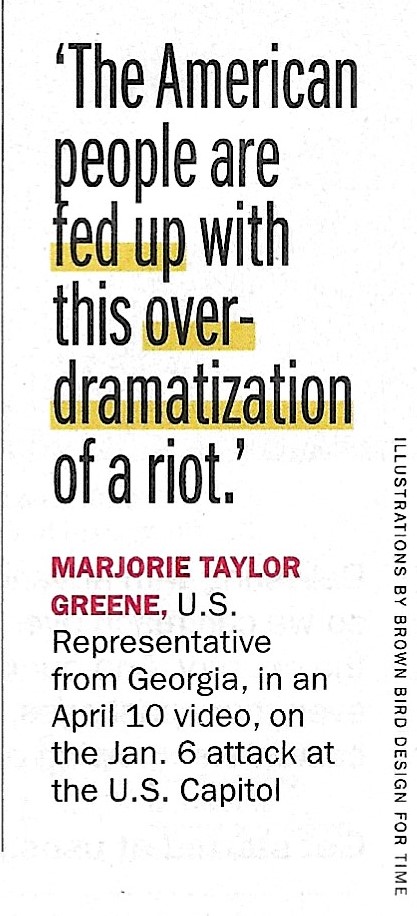
The clip on the left is from Time Magazine, April 25, 2022, page 6.

U. S. Representative Marjorie Taylor Green stated that “The American people are fed up with this over-dramatization of a riot.”

I can’t speak for the American people, other than I am one of them – ex pluribus unum.

Say I took a crow bar, or a sledge hammer, or perhaps even a weapon, and I went down to my local municipal government building – and I am not even talking about the U.S. Capitol or any State Capitol. Then when I got to the locked door, I’d just beat it in. If there were security guards or police, I’d pepper spray them or beat them with the crow bar.

If I did that, chances are that I’d not survive, because I’d be shot down in hail of bullets. If I did survive, I’d rot in jail for the better part of a year until I got my trial, and then I’d lose and – at my age – spend the rest of my life in prison.

Now if I did this same thing along with the 2,000 people who have entered the Capitol on January 6, the whole thing would go away because it’s an overdramatization of a riot?

I am not buying it.

I am in favor of every one of those people that committed violence entering the Capitol that day to do their time.

Those in our government, particularly those elected officials, in the legislative and executive branch who incited this should also be held accountable.

Hiking the Palomar Mountain Overview Loop

Today I hiked the Palomar Mountain Overview Loop, which is #17 in Sheri McGregor’s book 60 Hikes within 60 Miles of San Diego.

But before I started, I decided to not use the regular paved road up to Palomar that everyone takes. I took the Nate Harrison Grade Road, which is unpaved and winds it way up the mountain from Pala on the southwest slope.

The road is fairly well graded in the lower sections.

It was a cloudy and cold morning. Looking down into the valley, I often could not see anything but clouds.

In the higher sections, the road got quite rough. I would not want to do it without 4-wheel-drive.

But with a high lift and large tires, my Mojave was just purring up the mountain. It was made for this. Here it is parked by the edge, with sky all behind it.

Once I got to the higher elevations, the clouds thinned out, and the sky was bright blue.

Once I reached the state park at the top, I noticed a tribute plaque to the California Conservation Corps, or CCC as we call it. My son Devin has worked for the CCC many years and is an avid conservationist. He follows a long tradition of Californians dedicated to the preservation of the beauty of our land.

Finally I got to the trailhead.

There is a short spur of paved road that I walked down, and then I turned right onto the trail.

Here is the map of my hike. I followed it exactly as the book described it, starting at the parking area indicated on the red bubble of the map on the bottom. There is also a parking area in the Upper Doane Valley, right by Doane Pond. That’s where most people start that hike. But I’ll get to that.


I hiked the loop counterclockwise, turning right. On the map, you can see yellow, orange and red where I hiked fast, and green and blue where I hiked slowly, and dark blue where I stood and caught my breath. As you can see, I hiked fast in the first half because it was all downhill. I started at about 5,200 feet and Doane Pond is at about 4,500 feet elevation. But then, from the pond forward, it was all uphill and quite steep in sections!

If I had started out at the pond, I would have first gone uphill, and then downhill, which is more like a normal hike on a mountain.

Shortly after starting out, there is a very nice view of the world-famous Palomar Observatory in the distance:

The trail is quite shaded most of the way. Here is a typical view.

And another view:

At one point there is a section of old fence that has all but disintegrated. Time kills all fences in the wilderness.

Down in the valley, the trails are a little more level and are skirted by pleasant meadows on both sides.

Here is a nice view of Doane Pond from the south side. Behind the trees in the center is the main parking lot from which most folks start this hike. But even today, an a holiday weekend Saturday, I only saw another five to ten people on the trail. It was very quiet.

My hike was four miles long (it felt longer for some reason) and took me exactly two hours. I took ample breaks to snack, catch my breath, and take pictures. When I finally got back to the car, heading down for the main road, I pulled over once more and took one photo from the crest of the mountain down into Pauma Valley far below.

The Palomar Mountain Overview Loop Trail is a nice, moderate hike, with a good elevation change to get your pump moving. And if you have an offroad vehicle, I can recommend taking the Nate Harrison Grade Road up. I saw not a single other car on that road on my way up.

Book Review: Conrad’s Time Machine – by Leo Frankowski

The friends and former roommates with the strange names of Tom Kolczyskrenski (try to pronounce that), Ian McTavish and Jim Hasenpfeffer get together for a motorcycle cruise across the country.

Tom is an Air Force grunt with a genius IQ and an affinity for electronics.

Ian got his degree in mechanical engineering and has a lucrative job with GM.

Jim got his Ph.D. in behavioral science and is studying the social interactions of motorcycle gangs.

When the three are on the road, they hear an explosion nearby and happen to be the first ones at the scene, before any rescue services arrive. They find a perfectly hemispherical hole in the ground where a house used to be, and the former contents of the hole appearing in the surrounding area over time.

Long story short, they discover the plans for a technology that eventually ends up creating a time machine. And thus the three misfits decide that they are going to get very rich.

Frankowski is a good story teller. It’s a lighthearted tale that does not take itself too seriously. The characters are funny and a bit cartoonish. They talk with each other like no real people would talk. Either the author intends it that way, or he is really poor with creating dialog. I think it’s the former.

This book is full of casual time travel stunts in everyday life. It creates a new universe, of course so there can be more books in the series. Frankowski writes a lot of books in series, but the naming conventions are somewhat confusing. For instance, there is no Conrad in this book at all, and I can’t quite understand where the title comes from.

In summary, it’s a fun, lighthearted read with a lot of speculative science ideas and perfected time travel. The story is enjoyable, a crack-up even, albeit a bit hokey.

You might enjoy it. I myself won’t be reading any more Frankowski books, though.

Book Review: Farnham’s Freehold – by Robert A. Heinlein

It’s the early 1960ies somewhere in Colorado near a military facility.

Hugh Farnham is a fifty-ish former soldier with an alcoholic and self-indulgent wife and two grown children. Like many of his contemporaries during the cold war, he is worried about nuclear war and has built a fully stocked bomb shelter under the ground in his back yard. One evening, when both his children are home, and his daughter brought a girlfriend, they play Bridge when suddenly the alarm is broadcast. There are incoming ballistic missiles. “This is not a test!”

Hugh and his family and friends, along with their negro house employee, move into the bomb shelter just in time to avoid the first nuclear blast right above them. Now Hugh’s planning and survivalist skills come into play.

** Minor Spoilers Follow **

There are several blasts. The last is the most severe, and somehow the bomb shelter along with all its occupants is catapulted some 2,000 years into the future. American (or what’s left of it) society at that time is very, very different. Eventually the Farnhams find themselves taken prisoner and enslaved. In the effort of trying to cope with their hopeless situation, they learn more and more about the local customs, traditions, science and history. Hugh is a free spirit who never gives up hope, and he meticulously plans his escape.

I read Farnham’s Freehold many years ago, but I had forgotten just about everything about it. A friend recommended it as a classic Heinlein with time travel (albeit involuntary) as a central plot construct. We all know that Heinlein was a master of his craft, and Farnham’s Freehold is no exception. In typical Heinlein style, there is very little exposition. The characters talk constantly, and through dialog Heinlein tells the story. Everything comes to life. Of course, there is some nudity and sex – there always seems to be in Heinlein novels. The plot is meticulously crafted.

Have you ever found yourself reading the beginning of a book sort of absentmindedly, because you can’t get into it, but as you progress, you get pulled in? And then, when you get toward the end, you realize you missed something  at the beginning, so you stop where you are and start over again? Well, that’s exactly what happened to me. Once I got to page 322, I just had to check the beginning, and I went back to read the first 40 pages again, and sure enough, there were significant events there that contributed to the story that I had missed. Generally, when that happens to me with a book, it’s a pretty good one.

Farnham’s Freehold is an apocalyptic tome, a survivalist story, a time jump into a distant future with a very alien culture, and a neat plot twist at the end that makes it all worthwhile.