Movie Review: Edge of Tomorrow (2014)

Aliens have attacked the earth. Their military superiority is unmatched by anything humanity can come up with.

Major William Cage (Tom Cruise) is a public relations officer who is, against his own will, thrown into front-line combat in a suicide mission. Once in battle, he dies within minutes. But without explanation, he wakes up a day before the battle, and has to relive that day. He dies again, the wakes up again. He is basically a time traveler, reliving the same day, sort of like Groundhog Day, the famous 1993 movie with Bill Murray. Each time he learns from the previous death experience and lives a little longer, adjusting his strategy as he goes. He teams up with another fellow time traveler and warrior, Rita Vrataski (Emily Blunt) and the two team up, looping in time, for their and mankind’s survival.

As the plot develops, we learn that it’s the aliens who actually are able to control time, causing the time loops Cage and Vrataski have to grapple with.

The application of time travel concepts in this movie is definitely unique, except for the fact that it’s basically the same concept as applied in Groundhog Day, where the protagonist, without explanation, has to relive the same day over and over again.

Edge of Tomorrow is definitely a time travel movie worth watching.

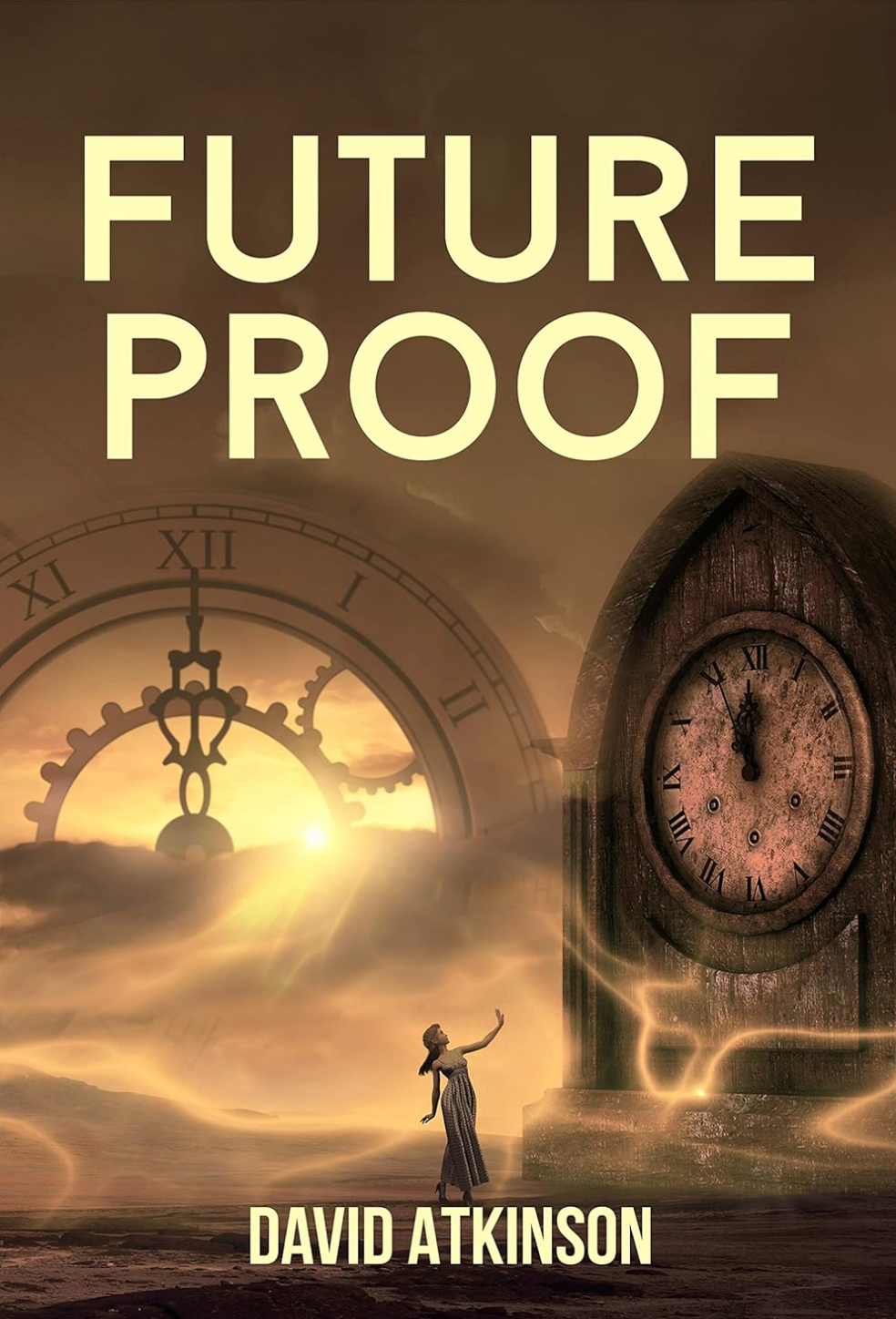
Book Review: Future Proof – by David Atkinson

Sam Harris is a washed-up loser. He is unhealthy and grossly overweight, living in a trashed apartment, from which he is getting evicted. His assigned social worker transfers him to an experimental counseling program. All he has to do is to agree with the treatments, and in exchange he get a clean bed, three meals a day and – counseling. Since he does not have any other options, he agrees.

We learn that is childhood was not a happy one. He was severely bullied in school and never really recovered. None of his relationships worked out for him.

During the first medical treatment, he gets an injection which puts him to sleep. He has an ultra-vivid dream, placing him back into the elementary school, right into a situation where we was abused by several bullies. With his adult brain, memories and experiences in place, his 6-year-old self defends himself against the bullies. Eventually, when that fateful day is over and he goes to sleep, he wakes up again on the treatment bed in the facility.

He quickly discovers that things are different. First and foremost, he is no longer fat. He has a trim and fit body, and the memories of being bullied are gone. Everyone else, however, does not notice any changes. The therapists never knew him as overweight. They don’t recognize the changes. Over the next few days he realizes that he actually time-traveled into his childhood for a day and the changes he made at that pivotal time, like standing up to the bullies, made him a different person and changed the timeline of the rest of the world around him.

Figuring  that nobody will believe him, he keeps the secret to himself, with further plans for more changes during his next therapy trip.

But how much can he change without severely affecting world history?

Future Proof is a unique time travel story where time travel occurs in an unusual way. That gives it a unique spice. The author’s writing is easy to read and cleverly narrated. It’s overall a well-crafted novel and one of the better time travel stories I have read.

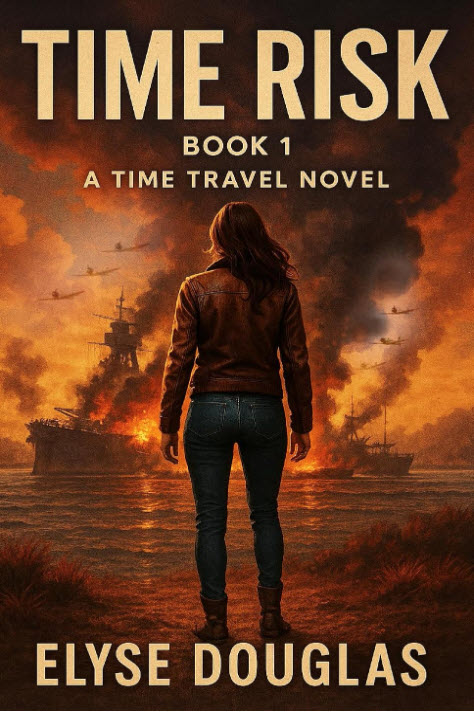
Book Review: Time Risk – by Elyse Douglas

Time Risk is a suspenseful time travel novel.

Andrew Whitlock’s father died during the Japanese attack on Pearl Harbor. He was one of the few pilots who made it off the ground, but he was shot down nonetheless. Andrew was an infant. His mother died soon after, and Andrew grew up in an orphanage. Despite his unfortunate early childhood, Andrew grew up to be a technology billionaire. He spent his life and career building a time travel machine.

Rachel Hunt is a former police homicide detective who is looking for work when Andrew’s men come knocking. They recruit her to travel back in time to Honolulu, arriving days before the Japanese attack. Her mission is to save Andrew’s father by keeping him from flying that morning.

When she arrives in Oahu, things immediately do not go according to plan, and soon Navel Intelligence and the local police are looking for her. She is hunted by the authorities as well as local thugs who are trying to make a few bucks. Things escalate quickly, and Rachel has to decide whether she is going to stick with her mission and save Andrew’s father, or whether she should just try to prevent the attack on Pearl Harbor altogether, and in the process change the history of the world.

The author’s name “Elyse Douglas” is the pen name for the married writing team Elyse Parmentier and Douglas Pennington. They specialize in time travel romance, women’s fiction and mystery. This is the first book of Elyse Douglas I have read.

Time Risk is a fast paced action thriller and a clever time travel story. I was ambivalent about it in the beginning, but it grew on me as it progressed, to the point where I am now considering reading some of the other books in the series, all time travel assignments of Rachel Hunt.

Book Review: The Time-Traveling Estate Agent – by Dale Bradford

Last Sunday I was on a Vietnam Airlines plane on the tarmac in Saigon, waiting for the boarding to complete, before starting the very long journey home to California. I had stocked up on Kindle books for the trip, just finishing up Book 2 of Asimov’s Foundation series, with Book 3 already downloaded so I’d have ample reading material. I decided to check my email one last time before I’d switch my iPhone to airplane mode when I saw an email from a stranger named Dale Bradford that started out with:

Please excuse me contacting you out of the blue, but I found you online while looking for reviewers of time travel books and after exploring your site I see you have reviewed a whopping 63 titles.

As I have said many times in these pages before, I can’t resist a time-travel novel.  I quickly downloaded The Time-Traveling Estate Agent to my phone, put aside Asimov and started reading about a guy named Eric Meek, a 60-year-old real estate agent in a small Welsh town in the United Kingdom. The book occupied my time on the plane when I was not sleeping or eating, and I finished it shortly after I got home to San Diego. According to the author, I was probably the first person in the United States to read it. Little did he know, but I was probably the ONLY person ever in Vietnam, and then Korea at my stopover, to read it. Thanks, Dale, for letting me have the honor.

The story jumps between December 2019 and July 3, 1976, presumably the hottest day in the UK in the twentieth century. Eric, in his position as an estate agent (that’s what they apparently call “real estate agents” in the UK) is listing the house of his former physics teacher, Mr. Freeman. It turns out, Freeman, while tinkering in his garage, accidentally created a wormhole, or portal, to a specific place, his garage, and a specific time, July 3, 1976. Eric discovers the portal coincidentally and walks through it, without the permission of Freeman. He is in for a surprise.

July 3, 1976 also happens to be the worst day of Eric’s life as a 16-year-old boy who lives across the street from the Freeman house and the curious garage. The story is about Eric trying to change his own life and the lives of some of the people, including some girls, close to him. We learn about Eric’s first love, his challenging relationship with his father, the people he worked with as a young man, and eventually as the owner of the real estate agency Barrington Meek. He tries to make some wrongs right.

I found the book entertaining, and the author did a good job coming up with a time-travel methodology that makes sense and is consistent. Some of the language, this being written by a UK author, cracked me up. For instance, one woman says: “I was only pulling your pisser….” What the heck does that mean? I had to look it up:

Literally pull my pisser is to masturbate. But nowadays the expression someone is pulling my pisser is used with the meaning of someone is messing with me.

There are many other doozies like this in the book. But that’s ok. It made it somewhat exotic for me. There were very few grammatical errors that I found. The only one was where a character quotes “in vino veritus” which is Latin and means “in the wine is the truth.” But I happen to have studied Latin for many years and I know it’s really “in vino veritas.” And that’s all I found, so that’s pretty good.

The interactions of the main characters are sometimes a bit choppy. For example, when we first meet Mr. Freeman, his is a belligerent and cantankerous old man, ready to call the police to have Eric thrown out for trespassing. But within just a few short sentences and arguments from Eric, he turns around and they start being best buddies, drinking together, and Freeman literally offers all the details about the time portal to Eric. This just would not happen in real life. The same thing for Mrs. Freeman. She has lived with her husband for some 50 years, in a house that had a time portal in the garage for 43 of those years, and she has no idea what is going on in that garage. Seriously, Eric, a total stranger, just walks in and goes through the portal, when Mrs. Freeman does not even know it’s there. This story is full of unreal scenarios like that, and it makes it – well – not real.

There is another time-travel book where there is a portal that goes back in time to a very specific and fixed time and place. That is Stephen King’s 11/22/63.  King does a masterful job in that story with time travel mechanics much like those in this book. I gave 11/22/63 three stars.

The author of The Time-Traveling Estate Agent could have worked on the dialog and basic premises a bit more, perhaps added 50 to 100 pages to the length of the book, and made it much more believable. As it is, I found it too abrupt and therefore distracting. But the “whodunnit” questions kept me turning the pages and I finished the book. I enjoyed a fairly satisfying ending.


 

Book Review: The Man Who Folded Himself – by David Gerrold

David Gerrold wrote The Man Who Folded Himself first in 1973. There are additional revisions in 2003, that mention the American Airlines flight 191 crash of May 1979 and of course, 9/11 in 2001, both events that hadn’t happened yet in 1973.

In the foreword, Robert J. Sawyer, a science fiction writer himself, praises the novel and cites it as the book that got him started as a science fiction writer. Reviewers call it the best time travel story of all time. It was definitely the first truly unique one since H.G. Wells’ novel in 1895.

Dan Eakins inherits a time machine from his uncle, who served as his guardian. It comes with instructions, and it’s truly powerful without limits. He can basically transport himself back and forth to any point in time.  This means he can change history, if that’s what he wants to do. He can get rich by betting on the horse he knows will win the race from reading tomorrow’s paper. And, most central to the plot, he can run into himself by visiting his own apartment tomorrow, where the tomorrow version of himself is living.

This creates a truly complex plot and a story line that is very difficult to follow.

In the end, there isn’t much going on, and all the alternative selves he meets are not just confusing us, the reader, but himself.

If you are into time travel stories, I say this is a must-read, not because it’s a good story or particularly well-written, but because it pioneers the genre and sets the stage for many future time travel novels that make more sense, are more entertaining and realistic, and where more is actually going on.

The book is only 130 pages long, and I read it on a single flight from Hawai’i to California.


I Am Listed in Top 25 Time Travel Book Blogs

I received a surprise email from feedspot.com advising me that my blog was listed in the Top 25 Time Travel Book Blogs. Check this out – I am number 19.

Top 25 Time Travel Book Blogs

I didn’t expect that I would be listed there, so I checked. Going onto the Book Reviews tab in my block, you can type “Time Travel” into the search box on that page, and it’ll return 62 results. Yes, apparently I have read, reviewed and rated 62 time travel books thus far, and that would be a significant enough body of work to be on that list. Maybe it warrants another post summarizing all 62 reviews, perhaps listing them by rating. But’s for another day.

Anyway, thanks to the guys at Feedstop for the plug. I am honored.

Book Review: Yestertime – by Andew Cunningham

Ray Burton, a journalist from Florida, travels to Flagstaff, Arizona to support a good friend who is dying of cancer. After his friend dies, he drives to the outskirts of the city to visit Hollow Rock, a ghost town. By accident he stumbles into a hidden cave where he finds a trunk left by a man named Stan Hooper in 1870. Along with some old belongings, there is a note, and a camera with several memory cards. Clearly, that can’t be. So Ray picks up the trunk and drives it home to Florida. When he starts researching the name Stan Hooper online, he soon gets a visit from a couple of goons with the NSA.

This is a very poorly written book, and I am not worried about giving away some of the plot – it’s so inane anyway. There are time portals sprinkled around the world that are one-way. In other words, you can go from the cave in Flagstaff to the bustling western mining town of Hollow Rock just by walking through a passage in the cave. But you can never go back. The only way out is another portal to another time. You hope you can find your way back home, but none of the characters traveling in time ever do.

We never find out who built the portals and why, but a group of six people in the year 2105 figured it out and started traveling the portals – why? – that’s not clear. There seems to be no mission. They are not allowed to tell anyone about the portals, and they are willing to just kill one another for blabbing, but still, they all blab. That’s how Stan Hooper started traveling, and that’s how Ray got involved.

The book has no end. It just stops suddenly, and it’s an obvious setup for a sequel or a series. I won’t read the next books since there isn’t enough of a story to keep me interested.

The author does not seem to know how to tell a story. He doesn’t show the reader. He tells the reader. The book is mostly exposition, with some terrible dialog sprinkled in. The characters, including the protagonist, are all shallow and non-descript. Even their names are boring: Mitch, Herb, Max, Stan, Alan, Hal, Natalie, Jim.

He likes the characters to kiss: “…he said, smothering her in kisses…” or “…in his arms and kissed her deeply….” or “…her arms around me and kissed me hard on the lips….” All the kisses are “deep” and “hard.” Of course there is also sex, but the way it’s told is too weird:

Natalie and I were becoming closer with each day. She was as genuine a person as I could have hoped for. Being around her made me understand why she had wanted to escape the movie world. But she also seemed to genuinely have feelings for me, even though I was almost twenty years older than her. Just as she had the first night, the second night back in the cabin she had slept with me on the floor. No sex, just companionship and the need to be close. There was something more, but we’d only known each other for a few days, so I guess I’d see where it led.

Oh, well, it led to more of the same.

One strange coincidence: This book plays a lot in and around Flagstaff, Arizona, and I actually was in Flagstaff last Saturday when I read the final chapter of Yestertime. After I closed the book in my Kindle, I went over to Google Maps and searched for Hollow Rock, just in case. I might have wanted to search for the cave.

I didn’t find any Hollow Rock.

Book Review: The Unusual Second Life of Thomas Weaver – by Shawn Inmon

In 1976, Thomas Weaver is a sophomore student at Middle Falls High School. He is a socially awkward kid with mediocre grades. His father abandoned the family several years before. His mother raises him and his brother Zack, a senior, as a single mom working as a nurse. Zack is a star of the high school athletic team and one of the most popular kids in school.

One day Zack invites his younger brother to a party. There is heavy drinking going on, and Zack passes out cold. Thomas drags him into the passenger seat of Zack’s Camaro. Even though he only has a learner’s permit, he decides to drive the two of them home. Due to Thomas’ inexperience as a driver, the car spins out of control, flips a few times and when it’s all over, Thomas walks away and his brother, who was flung out of the car during the flips, is dead.

Neither Thomas nor his mother ever get over the loss. He ends up an alcoholic without a job at age 54 and decides to end it all by a massive overdose of pain pills.

And then – he wakes up in his 15-year-old body in the spring of 1976 in his old bedroom. After the initial shock, he realizes that he has a chance to do it all over again, and his most important goal is not to kill Zack this time around. But the business of changing history is not that simple.

I enjoyed reading this story. When I was done, I realized that the author has made a series out of this concept of people reliving their lives, and there are 18 standalone books, all part of the Middle Falls series, apparently all based on this premise. I am sure many of them will be quite entertaining. But one is enough for me.

Book Review: Split Second – by Douglas E. Richards

A brilliant physicist discovers that he can transport matter back in time, but only by 45.15 millionths of a second. That does not seem like a capability a that has any practical applications. However, as soon as the physicist sends an email to a close associate asking him to check his math, he and his girlfriend are abducted by a black operations team.

While that does seem like really bad news, it quickly gets worse, when the government team gets attacked on route by another force, which results in a gun battle that kills everyone but the girlfriend, who barely escapes. She hires a private detective to help her figure out what is going on.

What could possibly be so important that the government is literally willing to kill for it in cold blood?

Douglas E. Richards knows how to write page turners. His heroes are the most brilliant in their fields in the world. His villains are the most ruthless.

The concept of time travel in Split Second is based on leaving a copy of an object in the same space, while the earth moves to a different space in a given time interval. The earth rotates in 24 hours, which means that any point on its surface moves faster than a jet plane toward the east. The earth also circles around the sun in 365 days. The sun circles around the center of the galaxy once in about 250 million years. And our entire galaxy moves in yet another direction in space. Physicists have determined that this means that you and I move about 242 miles per second. This means that we, and any object, move about 58 feet in 45 microseconds. With the technology these guys invented, you can make a duplicate of any object and have it appear 58 feet away from where you copied it. It’s all very complicated and makes for a good story.

But somehow the author glossed over the minor point that the direction of the duplication always needs to trail the movement of the earth in the universe, which is in a constant direction. So as the earth rotates, this can be up, or down, or towards the west or east or anything in between. It can’t be controlled.

Yes, this is science fiction and you just have to accept that there is some magic tech involved. However, it bothered me that a book based on this much Einsteinian thought experimentation left this minor detail out of the equation. It kept getting in my way as I followed the plot.

Richards lives in San Diego, and so do I. This means that many of the locales he uses are very familiar to me and I can actually almost follow along, from Torrey Pines to San Ysidro, from Camp Pendleton to Orange County. Most importantly, I have spend a lot of time hiking and off-roading on Palomar Mountain, which is an important location in the plot of this story, and I therefore had very vivid and clear pictures in my head as I read the book.

I enjoyed Split Second enough to read it within a few days while traveling. I bought the second book in the series titled Time Frame since I was sure I’d want to know how the story continues. But after reading a few dozen pages into the sequel I quickly lost interest. I am sure it’s also a very fast-paced plot but I just wasn’t interested in reading more about this specific cast of characters and I decided not to read the next one after all.

Book Review: Sea of Tranquility – by Emily St. John Mandel

Sea of Tranquility is a misleading title for this book. This is a book about a pandemic (which came out just in April of 2022) which is meaningful as we all have learned a thing or two about pandemics in the last few years. It’s a book about time travel with an unusual twist, and of course it was the time travel part that got my attention first. It has very little to do with what we associate with the Sea of Tranquility, the location of the Apollo 11 moon landing, other than there are several moon bases near that location by the year 2200, two of which play a major role in the plot.

It’s also about the idea or concept that our entire world is just a simulation, an elaborate video game that someone or something else is playing.

The story starts in 1912 with the hapless son of a British aristocrat who has been sent to exile in British Columbia, and plays in part in the late 20th century, and then again in early 2200 and 2400.

There really is not one single protagonist to follow. It’s a group of people and it takes some time for the tale’s threads to get woven together into a consistent tapestry, but in the end it all makes sense.

It made me marvel about what it would be like to live on the moon and it provides some good and descriptive passages. It’s a quick read, and I enjoyed the book.


Movie Review: The Adam Project (2022)

In 2050, time travel exists, and fighter jets can travel in time. Adam Reed is a pilot, trying to get to 2018, to save the future, but he crash-lands in 2022, conveniently in the backyard of his childhood home, where he meets his 12-year-old self. The two set out to fix a complicated future.

None of this makes much sense. The movie is an excuse for lots of Matrix-like action and video game scenes. There are even storm troopers who are wearing silver suits instead of white ones, but who are also just expendable ray gun fodder.

I was tempted to turn it off and leave it, but when I was half-way through, since it was, after all, a time travel flick, I stayed and watched it to the end.

Guess what, Adam fixed the future by fixing the past.

Book Review: Timeline – by Michael Crichton

Timeline was first published in 1999 and, having read most of Crichton’s books, I head read it right away. I remembered it vaguely as a time travel thriller. So I picked it back up again a couple of weeks ago.

In France, a group of archeologists are studying a medieval village, complete with two castles and a monastery. All the buildings are ruins, of course, but they have a rich history dating back to the 14th century, while the Hundred Years’ War was raging, and England was routinely attacking and invading France.

Their research is being funded by a multinational corporation. The company is led by a self-obsessed science tycoon in his mid thirties. It has developed a technology based on quantum science that allows them to travel in time. When one of the archeologists goes back to 1357 and does not come back, the company coerces some of the young scientists to follow him and bring him back.

To avoid anachronisms, they are not allowed to bring any technology, modern weapons or any objects from the future. When they arrive, practically in the middle of a battle, trouble starts quickly and the race to get back home begins.

Timeline is less of a time travel novel, and more a historical novel. The majority of the story takes place during a mere 39 hours starting on April 7, 1357. The protagonists have to battle knights, solve riddles, and play the opposing parties of the war. The whole thing is reminiscent of an episode of the modern television series The Amazing Race: “And now the contestants have to invent gunpowder to impress Lord Oliver. They only have two hours to do it or they’ll be thrown in the dungeon and miss their chance to make it to the next stop.”

Timeline is a historical thriller with a neat plot twist, where scientists get to visit the heyday of the castles, the ruins of which they study in the 21st century.

Book Review: Conrad’s Time Machine – by Leo Frankowski

The friends and former roommates with the strange names of Tom Kolczyskrenski (try to pronounce that), Ian McTavish and Jim Hasenpfeffer get together for a motorcycle cruise across the country.

Tom is an Air Force grunt with a genius IQ and an affinity for electronics.

Ian got his degree in mechanical engineering and has a lucrative job with GM.

Jim got his Ph.D. in behavioral science and is studying the social interactions of motorcycle gangs.

When the three are on the road, they hear an explosion nearby and happen to be the first ones at the scene, before any rescue services arrive. They find a perfectly hemispherical hole in the ground where a house used to be, and the former contents of the hole appearing in the surrounding area over time.

Long story short, they discover the plans for a technology that eventually ends up creating a time machine. And thus the three misfits decide that they are going to get very rich.

Frankowski is a good story teller. It’s a lighthearted tale that does not take itself too seriously. The characters are funny and a bit cartoonish. They talk with each other like no real people would talk. Either the author intends it that way, or he is really poor with creating dialog. I think it’s the former.

This book is full of casual time travel stunts in everyday life. It creates a new universe, of course so there can be more books in the series. Frankowski writes a lot of books in series, but the naming conventions are somewhat confusing. For instance, there is no Conrad in this book at all, and I can’t quite understand where the title comes from.

In summary, it’s a fun, lighthearted read with a lot of speculative science ideas and perfected time travel. The story is enjoyable, a crack-up even, albeit a bit hokey.

You might enjoy it. I myself won’t be reading any more Frankowski books, though.

Book Review: Farnham’s Freehold – by Robert A. Heinlein

It’s the early 1960ies somewhere in Colorado near a military facility.

Hugh Farnham is a fifty-ish former soldier with an alcoholic and self-indulgent wife and two grown children. Like many of his contemporaries during the cold war, he is worried about nuclear war and has built a fully stocked bomb shelter under the ground in his back yard. One evening, when both his children are home, and his daughter brought a girlfriend, they play Bridge when suddenly the alarm is broadcast. There are incoming ballistic missiles. “This is not a test!”

Hugh and his family and friends, along with their negro house employee, move into the bomb shelter just in time to avoid the first nuclear blast right above them. Now Hugh’s planning and survivalist skills come into play.

** Minor Spoilers Follow **

There are several blasts. The last is the most severe, and somehow the bomb shelter along with all its occupants is catapulted some 2,000 years into the future. American (or what’s left of it) society at that time is very, very different. Eventually the Farnhams find themselves taken prisoner and enslaved. In the effort of trying to cope with their hopeless situation, they learn more and more about the local customs, traditions, science and history. Hugh is a free spirit who never gives up hope, and he meticulously plans his escape.

I read Farnham’s Freehold many years ago, but I had forgotten just about everything about it. A friend recommended it as a classic Heinlein with time travel (albeit involuntary) as a central plot construct. We all know that Heinlein was a master of his craft, and Farnham’s Freehold is no exception. In typical Heinlein style, there is very little exposition. The characters talk constantly, and through dialog Heinlein tells the story. Everything comes to life. Of course, there is some nudity and sex – there always seems to be in Heinlein novels. The plot is meticulously crafted.

Have you ever found yourself reading the beginning of a book sort of absentmindedly, because you can’t get into it, but as you progress, you get pulled in? And then, when you get toward the end, you realize you missed something  at the beginning, so you stop where you are and start over again? Well, that’s exactly what happened to me. Once I got to page 322, I just had to check the beginning, and I went back to read the first 40 pages again, and sure enough, there were significant events there that contributed to the story that I had missed. Generally, when that happens to me with a book, it’s a pretty good one.

Farnham’s Freehold is an apocalyptic tome, a survivalist story, a time jump into a distant future with a very alien culture, and a neat plot twist at the end that makes it all worthwhile.

Book Review: Time Tunnel: The Eclipse – by Richard Todd

It is 1890. Annika finds herself without a transponder, which is the device she needs to return home to her own time in 2008. Stranded in time, with no way to go home, she makes the best of her situation and fights for the Sioux. She has a little help, because Kyle left his backpack on the counter in a bar when it disappeared. The bag contained his laptop which had basically all human knowledge as of 2008 on its hard drive (go figure how that would be possible).

This is book three out of three in the Time Tunnel series by Richard Todd. There is a little time travel plot twist here, but otherwise it’s just an alternate history story reminiscent of the trilogy by S.M. Stirling starting with Island in the Sea of Time.

I can recommend that series highly. In comparison, Time Tunnel: The Eclipse is a simple-minded tale of alternate history in a world where the United States disintegrates from internal strife and Nazi Germany and Imperial Japan rule the world outside of America.

Todd’s character development devolves in this third book. Most of the characters do stuff and react in ways that do not make much sense and seem very unrealistic. I got the feeling that the author just wanted to hurry and wrap this series up.

I finished reading this book simply because I had invested time in the first two of the series and I wanted to learn what would happen to Annika. However, the third book didn’t add anything new other than a neat plot twist at the end.