Book Review: Time Tunnel: The Empire – by Richard Todd

Kyle Mason changed world history in Book 1 when he prevented 9/11. His wife Padma, who had died in 9/11, was alive again when he returned. Since Kyle and Padma knew the future between 2001 and 2008, they started a company and became fabulously wealthy by playing the stock market (Apple, for example) and capitalizing on the 2008 market crash. Padma and Kyle were the world’s first and only trillionaires. Padma, the face of their company, essentially “bought” the U.S. government and the country openly called her the Empress of America. She was running things.

That backdrop raised authoritarian opposition, ending in an eventual coup d’etat in America and totalitarian rule. One day emperors, the next day fugitives, Padma and Kyle retrenched to the time tunnel complex in Las Vegas. As government forces chased them down, they hurriedly escaped into time. Without proper navigation, they ended up in 1890 in South Dakota, just before the massacre at Wounded Knee. It was time for Kyle to change the nation’s history again.

Most of the story takes place in Sioux country. The plot, while sometimes contrived, kept me turning the pages. When I was done, I picked up Book 3 right away.


Book Review: Time Tunnel: The Twin Towers – by Richard Todd

The story starts in the morning of September 10, 2001 in New York City. Kyle Mason, a major in the Special Forces, has just married Padma Mahajan, who works on the 105th floor of the World Trade Center. She is an investment banker for Cantor Fitzgerald. They are staying in a hotel in SoHo, and out their window they can see the Twin Towers. Padma leaves to get Starbucks, while Kyle takes a shower. When he gets out, a mysterious figure appears in the mirror behind him.

Vignettes reach back to 1947 when supposedly UFOs crashed in Roswell, New Mexico. There are episodes of the story in the 1950s, 1960s, 1970s and through the years, culminating in 2008 when a handful of brilliant scientists, sheltered and covered by the U.S. Army in Area 51, finally develop a working time machine.

Richard Todd is a good story teller and he creates credible characters, with good realistic dialog, and a fast-paced plot. I enjoyed reading this book until the last sentence, at which time I decided to buy Book 2 of the 3-book series.


Book Review: Time of Death – by Nathan Van Coops

A young widow hires Greyson Travers, a private detective, to investigate the suicide of her husband. Since she does not believe her husband would commit suicide, she thinks it was murder, but she has no proof. Travers has a great reputation for solving crimes, so she hires him to figure out what happened.

What she does not know, of course, is that Travers is a time traveler. Rather than figuring out what might have happened, he simply goes back to the time and place of the crime and watches it happen. What could be simpler?

He quickly realizes that the crime is much more complicated than it appears, and there are other time-traveling criminals involved.  He quickly finds himself ensnared by the mob and some very dangerous characters who use time travel to commit crimes.

Greyson Travers is the son of Ben and Mym Travers of Van Coops’ In Time Like These series of books, all of which I found highly readable. It is not necessary to read those books before enjoying Time of Death. It stands alone, and the author slowly introduces the concepts of time travel of the In Times Like These universe without it getting in our faces.

I have read all of those books, and if you’re interested, here is a summary of my reviews. You can click on the titles to jump right to them.

Nathan Van Coops Agent of Time Fiction Time Travel 2 Dec 13, 2020
Nathan Van Coops The Warp Clock Fiction Time Travel 3 Oct 9, 2018
Nathan Van Coops The Day after Never Fiction Time Travel 2 Jan 2, 2017
Nathan Van Coops The Chronothon Fiction Time Travel 3 Dec 3, 2016
Nathan Van Coops In Times Like These Fiction Time Travel 3 Oct 31, 2016

Time of Death is basically a murder mystery and it deals with a heist.

There was only one issue I had with the plot. The mob figures in the story have the ability to travel in time, but they organize this weird heist to collect cash from a casino. Seriously, if I were a time traveler, it would be so much easier to get rich, without hurting anyone, without cheating anyone else. Why not go back to 1980 and buy some Apple stock? Then come back to 2022 and enjoy the fruits of that decision. Oh well, there would be no murder mystery then.

I enjoyed all of Nathan Van Coops’ books, and I rated them all between 2 and 3 stars. They are always very readable and fast-paced. Time of Death is a fairly short book and a quick, fun read.

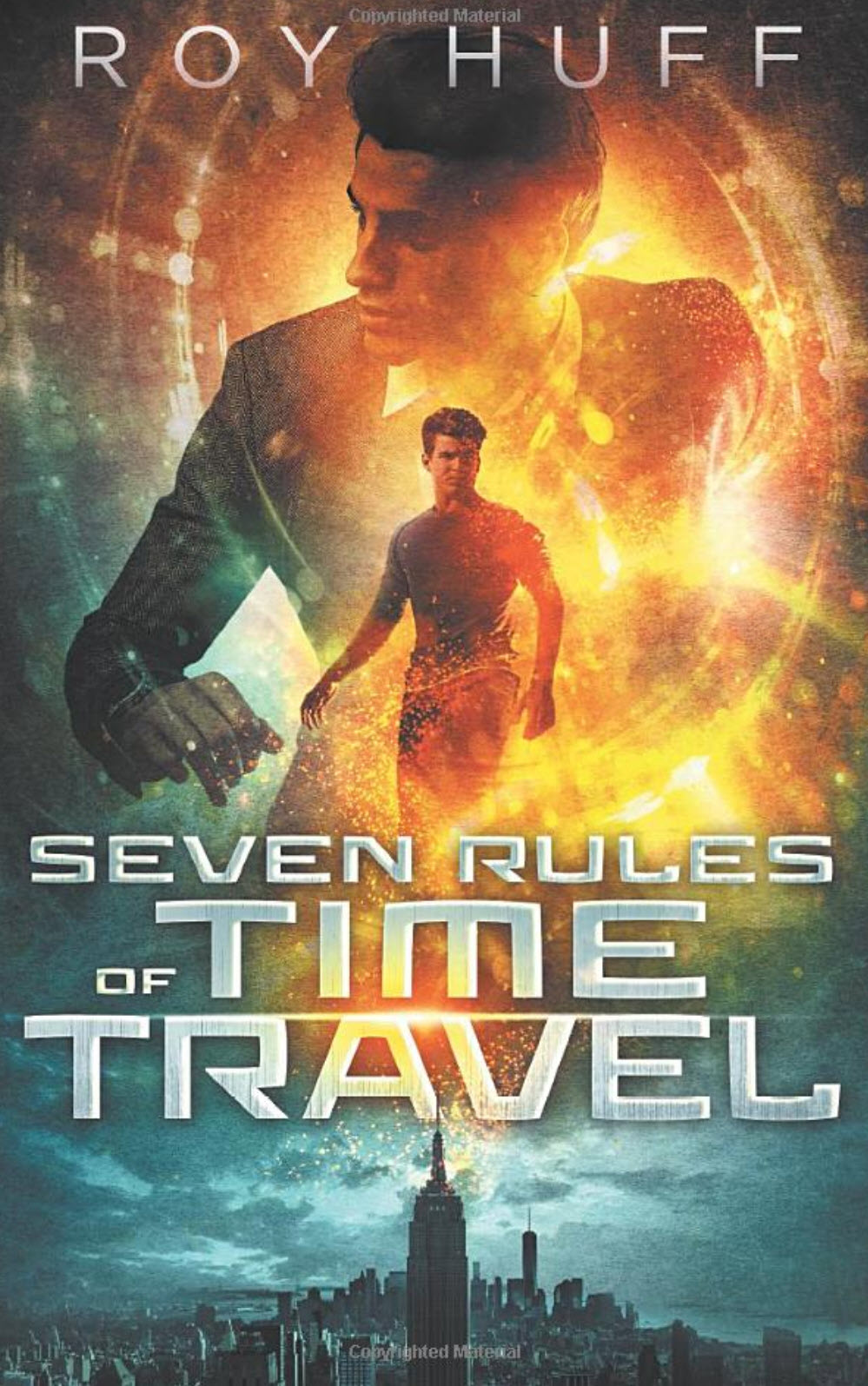
Book Review: Seven Rules of Time Travel – by Roy Huff

This story tries to speculate what it would be like to change the past. Quinn Black wakes up one morning, goes to work, and along the way witnesses a terrible accident in which is boss and friend dies in front of his eyes.

The next day, he  wakes up again at the same time, and makes small changes, but can’t avoid the inevitable outcome. Groundhog Day – they made a movie about this decades ago.

Quinn realizes that he can just will himself to any day or time, generally in the past that he can remember, and relive it. However, when he goes back to his youth to meet up with his best friend, he is not the old Quinn, he is the old Quinn in the young Quinn’s body of that time.

The “rules” of time travel are very nebulous in this story, and it’s not very scientific.

I simply got bored and lost interest. I read 104 out of the 307 pages, stopped at 33%, never to go back.

I usually force myself to finish a book, but some are so bad, I can’t do it. That’s why I have a category “books not finished reading” that you can search and see all the other ones.

Consistent with my own rules for reviews, I do not rate a book I didn’t finish.

As far as time travel stories are concerned, I recommend you skip this book, and its sequel. There is nothing original or even remotely interesting here.


Book Review: Agent of Time – by Nathan Van Coops

It’s 1985 in St. Petersburg, Florida. Rookie Special Agent Stella York is one of the first female FBI agents, and she does not have the support of her peers or her superiors. Yet, the case she is put on is completely baffling.

Two dead men are found in a van that crashed into a power pole, yet the power pole does not show any damage, while the van is totaled. The van is a GMC model nobody has ever heard of in 1985. Furthermore, the license plate expiration sticker shows “10.”

One of the dead men’s fingerprints are an exact match with those of a prison guard at a local prison – which is impossible. Then, during a chase on I-275 North, she witnesses the gory death of a suspect in a car accident, yet, she runs into him very much alive a day later. Nothing makes sense, until one of the witnesses opens up to her and tells her that she’s dealing with time travelers. From the chronological point of view, events seem to happen out of order.

Agent York is losing all her professional credibility when she approaches her superiors with her theory.

Agent of Time plays in Nathan Van Coops’ universe of the In Times Like These, a series of books I have read. See the reviews here:

In Times Like These

The Chronothon

The Day After Never

The Warp Clock

More specifically, Agent of Time plays within the In Times Like These story. I have read prequels to successful books before, and they are usually entertaining, because I know the world that comes after the prequel ends. But I have never read a book that plays “within the original story.”

If you have read the hugely famous Harry Potter series of books, you will understand what “Muggles” are. In Harry Potter, the action takes place among people who are involved in magic: wizards, sorcerers, and the like. Everyone knows that magic is real, and understands its rules. Muggles are the regular people, like you and I, who do not have magical talents and in almost all cases do not believe in magic and do not know it’s going on all around us – well – at least in the Harry Potter universe.

In Nathan Van Coops’ books, the action takes place among people who routinely travel in time. They take it for granted, and they use it creatively. But the rest of us, the time-Muggles, have no idea time travel is possible, it’s happening, and it’s routine for some people. Agent of Time plays parallel to the story of In Times Like These, but it is told from the point of view of time-Muggles like Stella York. What would it look like if there were time travelers amongst us, doing their things, and what would it be like if there were time traveling criminals?

You don’t need to have read In Times Like These to understand Agent of Time, but you will enjoy it MUCH more if you have. I would recommend that you read In Times Like These first, then read Agent of Time, and you’ll have the best experience.

Agent of Time is a short book of only 137 pages. It was free on Amazon. I literally read the whole thing in one day, yesterday. The author probably was in a rush to get it out, because it fell kind of short. The ending was somewhat abrupt, probably setting us up for the next Stella York story, the time-Muggle. But it’s a good addition to the series, and Van Coops is still, in my opinion, one of the strongest writers in the genre.


 

Movie Review: 41

41 is a pretty bad movie title for an amateur movie. You have to actually watch it to understand what it is.

Aidan is a college student to seems to go through the motions in his life without a lot of enthusiasm. One morning, after class, somebody that looks like himself, walks up to him and tells him not to go to the Heathscape Hotel.

Of course, that’s like somebody telling you not to think of a yellow elephant. So Aiden ends up going to the Heathscape Hotel and through a few strange events discovers that in room 41 (hence the title of the movie) in the bathroom, there is a time-portal. All he has to do is pull back the linoleum in the corner of the bathroom, climb into the hole for a moment, pull himself back out, and he arrives – yesterday.

Since it’s yesterday, he can now leave the room, if he makes it past any potential occupants in the hotel room itself, walk downstairs and find himself. After all, he should remember what he did yesterday, and then find himself. However, if there is somebody in the room and he can’t leave the bathroom – no problem – just climb back under the floor for a second, come back out yesterday again, which, of course, is now the day before yesterday of the original day.

By going back in time, he is trying to prevent the death of his girlfriend in a gruesome car accident while he was driving, but he does not seem to succeed.

41 is actually a pretty good time travel story, albeit with one plot problem: If you can only travel back, you create another copy of yourself every time you do it, and you really never come back to the present. This conundrum isn’t solved in this movie, but it has a pretty neat twist at the end that makes it a worthwhile story, so much so, that you’ll be tempted to want to watch it again to make sure what you saw was what actually happened.

The acting is poor, the production is skimpy, and the plot is full of major holes, but there is one hole in a bathroom in room 41 that makes it all worthwhile.


Movie Review: Alistair1918

It’s 2015 in Los Angeles. Poppy (Annie K. McVey) and her film crew are working on a documentary of homelessness in Los Angeles. As they walk the streets and parks where homeless people abound, they get approached by a man in an antique woolen brown uniform who speaks with an English accent. His name is Alistair (Guy Birtwhistle). He asks for their help. He is quick, in a nonchalant way, to tell his story: The last thing he remembers was being in the trenches in World War I in 1918, when a grenade hit. He flew through the air, and ended up landing on top of a shipping container in an industrial section of Los Angeles. He’s been here for a month and literally learned to live off the land, mostly by trapping squirrels in the park, which he roasts and eats.

He has a wife and a life in 1918, and he wants to get back. The film crew has a hard time believing him, and for the most part think he is a mentally ill person with a fantastic imagination. Only Poppy wants to believe him. She starts taking him in and tries to help him on his journey back.

Alistair1918 is a simple time travel story with an unlikely and far-fetched plot. But it works. Alistair acts like a man catapulted 100 years into the future, although he picks up modern skills astonishingly quickly. He seems to teach himself typing and learning how to use a computer and the Internet in record time. Cameras seem to come naturally to him. He is an excellent map reader and he seems to be able to figure calculations on the movement of worm holes (which are needed for time travel) very quickly. While the time travel technology is somewhat hokey, it works in this movie. The ending is surprisingly satisfying.

This is definitely a low-budget film, and as such quite successful. It was completed in 2015. Guy Birtwhistle wrote and produced the movie, and also starred as the male lead, Alistair. Annie K. McVey directed the movie, and also starred as the female lead, Poppy. With only a handful other actors, and very simple scenery, I would say Alistair 1918 is a successful, quirky, but enjoyable time travel movie.

Movie Review: Chronological Order

Usually I put a photograph here that represents the movie, and if I can’t find a good one, at least the movie poster is better than nothing. I could not find any images for Chronological Order. Rotten Tomatoes does not have it listed at all, and IMDb has a listing with a few details, the trailer, but no images at all. And there are no images to be found relating to this movie in a Google image search.

That all tells you something, I guess.

This 2010 movie is about a guy named Guy – how creative – (Brett Jacobsen) who lives somewhere in a beach town in Southern California. All the scenes looked eerily familiar. Somehow, we never find out exactly how and why he is rich. Rich enough to have nothing to do. He has a lawyer named Murray (Vic Stagliano) who is also his best, and apparently only friend. There is also a dad that is part of the picture. Guy does not seem brilliant enough to have made his own money and sold out, and he also didn’t inherit it from his father, because we find out that he supports his father. But be that as it may.

One day Guy walks along the ocean and a door (with hinges and a door knob) washes up on the beach in front of him. We see him take the door home. It’s not clear how he manages that, since his only means of transportation is a bicycle. He must have walked home with the door, but that leaves the question on how he then got the bicycle home. I guess he made two trips.  The movie is full of plot holes like this.

Don’t ask how, but he figures out that when he mounts the door and walks through it, he travels back in time. This enables him to stalk himself in the past and leave notes for himself, presumably to change his life.

This is a bad movie, with a seriously flawed plot, poor execution, pretty bad and stilted acting, unrealistic dialog, especially between Guy and his father, and not much of a story line to follow.

I would normally give it one star at best, but I boosted it by a half, because of three small reasons: (1) I did chuckle occasionally about the quirky scenes with the door, (2) it’s a time travel story and I have an affinity for those, and (3), I found the score (the music) actually quirky and a bit refreshing.

Now don’t all run to Amazon Prime to watch this masterpiece, unless, of course, you’re time travel buffs. Then you have to.

Movie Review: Peggy Sue Got Married

Peggy Sue (Kathleen Turner) is a middle-aged woman in 1985 who attends her 25th high school reunion. She has just separated from her husband Charlie (Nicolas Cage) who is also a member of her class. She runs into him at the reunion. The reunion does not turn out well for her, and she faints – and wakes up in high school in 1960, just before her own graduation. While she is her mature self, nobody else notices anything unusual and everyone treats her just like the teenager she is. She has all the knowledge she has gained throughout her life. After the initial shock and some adjustment, she realizes she might just have a chance to change things this time around. Of course, she treats cheating Charlie accordingly. But things get complicated quickly as one might expect.

Peggy Sue Got Married is a Francis Coppola film of 1986 that I had never before watched. Recently, during a Zoom meeting with a number of friends from high school in a virtual reunion, one of them brought up this movie as a nostalgic time travel story centered around reunions. That was the trigger for me to find and watch it.

I found it interesting that it came out right around the same time as the famous Back to the Future trilogy started, namely in 1985. There, Marty goes back 30 years into the past, to 1955, where Peggy Sue makes it to 1960. The experiences are quite similar in high school during that era.

I enjoyed the nostalgia of Peggy Sue Got Married. The movie has a lot of great scenes, it’s a little sappy at times, but the happy ending make it all worthwhile. If you haven’t seen it, I do recommend you find and watch it.

Wouldn’t it be nice to be able to do it all over again? Would you, if you could?

Movie Review: Beyond the Time Barrier


United States Air Force Major William Allison (Robert Clarke) is a fighter pilot in 1960. His mission is to fly the X-80, which is actually an F-102/F106 figher, up to 500,000 feet to “the edge of outer space” at supersonic speeds as a first ever.

During the trip, he breaks through a “time warp” and ends up landing on the same airfield, now abandoned and derelict, in the year 2024.

He finds the world destroyed by a plague in 1971, which leaves all humans sterilized and infertile. Most humans are now mutants and devolved, they are deaf-mute, and society lives in underground cities. When they realize the Major comes from a time before the plague, they want him to sire offspring with the only fertile human left alive, the lovely Princess Trirene (Darlene Tompkins).

But the Major has no interest in serving as a stud. He thinks it’s better for him and the world to return to 1960, if that is even possible, and warn his compatriots of the upcoming plague and prevent it altogether, thus altering history.

Beyond the Time Barrier is a really bad movie. Of course, being made in 1960, it was in black and white, and the orchestral sound track is awful. There are no special effects whatsoever. We see the F-102 take off shot in stock footage, then it becomes a plastic model that floats in front of a fake star-studded sky. Imagine Godzilla being represented by a 12-inch plastic toy that hops around in a movie set – that’s how realistic this all looks.

But well, such was the technology in the 1960s, and that’s what science fiction movies were like. I vaguely remember watching a movie like this as a small child, showing a flight to the moon, ten years before that actually happened, and years before President Kennedy’s announced commitment for the Apollo program. I was fascinated when the astronauts stepped out of the rocket that had landed tail first on the moon.

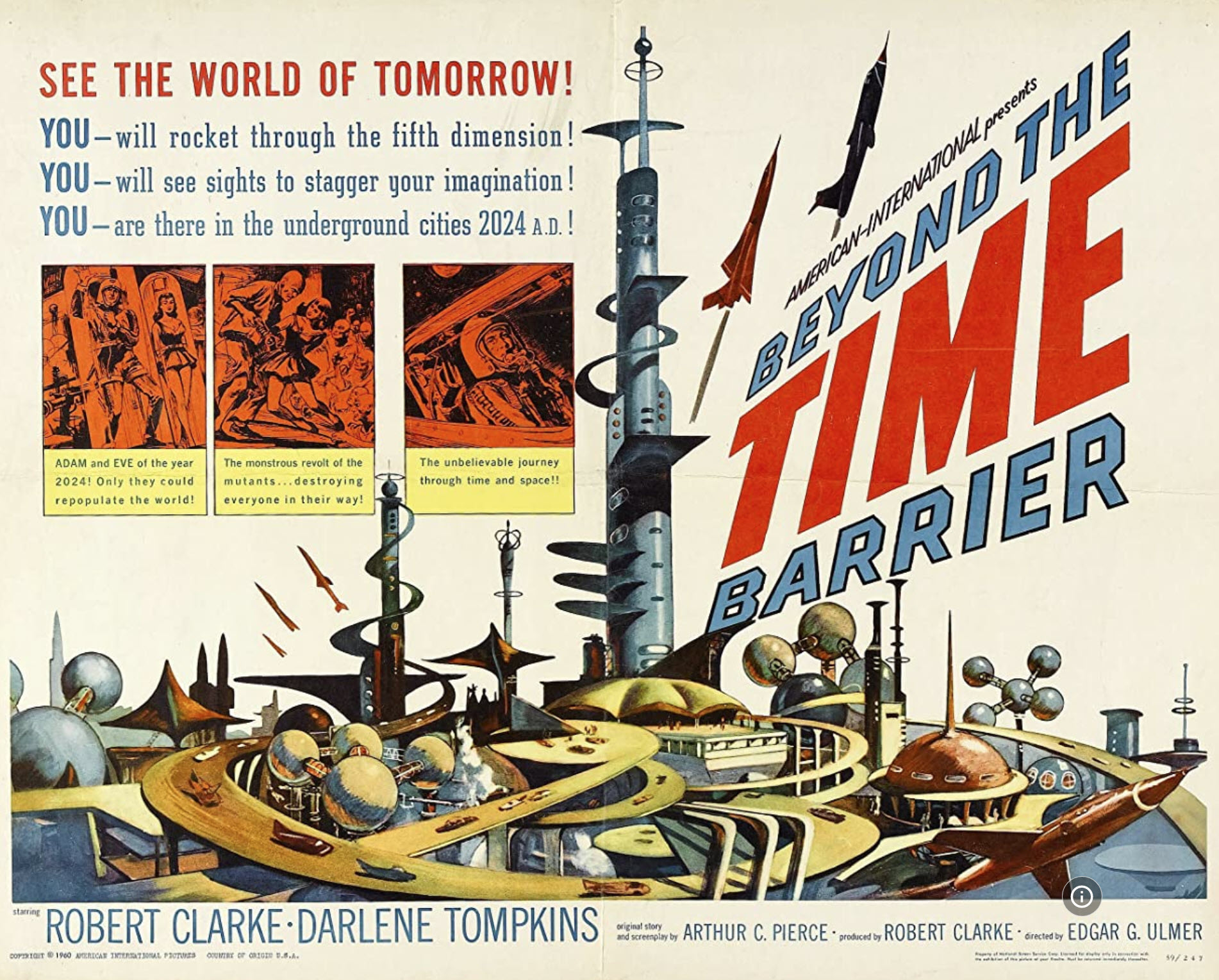
The most fascinating part about Beyond the Time Barrier is how the science fiction crowd of 1960 imagined the far distant future 64 years hence in 2024. You can see some of their musings on the movie poster above. It is entertaining being here in 2020 and writing this review just four years before the target time of 2024, which to them seemed utterly utopian. I wonder what they would have thought of a blogger in 2020 writing about their movie?

The technology they envisioned is nothing like the technology that actually happened. All their “futuristic gadgets” are just crude 1960 technology made out to be incomprehensible. They didn’t anticipate miniaturization of any kind or any computer technology at all for that matter.

I always find it uniquely entertaining to see a movie after the future it predicts has already happened, like watching Back to the Future after the year 2015, the farthest into the future Marty travels, or reading Orwell’s 1984 now, almost 40 years after the envisioned distant future.

And that experience brings Beyond the Time Barrier from zero stars to half a star.

Movie Review: Timestalkers

Timestalkers is a time travel science fiction flick of the worst kind. Surprisingly, it was made in 1987, and I thought it was more like 1967. I watched it because I could not sleep the other night after midnight, so I got up and flipped through the channels and Amazon Prime thought I’d be interested in this.

Scott (Willam Devane) is a history professor in California in 1986 and an Old West aficionado. He likes to go to auctions and pick up antiques and curiosity items from the 19th century. He comes across a photo from 1886 where he notices a handgun that appears to be an anachronism.  Through his research he attracts a woman (Lauren Hutton) who eventually turns out to be a time traveler from the year 2586. She is on a mission to stop another rogue scientist from her time (Klaus Kinski) who is back in the Old West trying to change history. As the two battle, Scott is drawn into the conflict, resulting in a shootout at a robbery of a stage coach that carries U.S. President Grover Cleveland.

Timestalkers is bad from the credits on and all the way though. The acting is terrible and the story lame. Obviously, they didn’t have the special effects we are used to now in movies, so the time travel episodes and scenes are hokey and annoying.

There is nothing of value here, nothing that adds to the genre of time travel stories or movies, and definitely nothing you want to devote an hour an 40 minutes to, unless of course, it’s after midnight, you can’t sleep, and you’re a time travel buff like me.


Movie Review: Making Time

Nick is a young scientist who has always been obsessed with building a time machine. He was first in his class in high school, went on to study physics and lives in a modern house in the suburbs in Michigan. His focus is on his job, and he neglects his friends, and most importantly, Jess, his wife. She has stood with him and supported him through five years of courtship and another seven years of marriage, when by 2019, she has had enough. She leaves him, and the day she serves him with the divorce papers, she also brings a box of stuff that belongs to him.

Most notably, it contains a pocket watch she gave him on their 5th anniversary of their relationship, the day he had proposed to her. That’s the watch he’s holding up on the movie poster above. When she brings it back to him along with the divorce papers, he calls it “junk” since it hardly works, they get into an argument, and she smashes it with a hammer before she leaves the house .

That very night, federal agents from the Department of Energy bust into his house, act like they’re going to arrest him, and eventually make him an offer to buy his time machine. It’s not clear how they knew it was working, and it’s also not clear how Nick would be so obtuse about that fact with his wife, who has spent years of her life supporting him in this quest. Eventually, he leads the feds down into his basement. The lead agent is Dr. Kent, a physicist who, upon seeing the time machine, seems to immediately understand how it works, and within minutes Nick and Kent are on their way seven years into the past.

Through some amazing coincidence, they arrive in his basement seven years earlier just before his anniversary party, to which he has invited some of his friends and sister, without telling his wife, because he wants to mark the occasion by proposing marriage to her with his friends present. The arrival of the time travelers pops the breakers in his house in the basement, and Nick from seven years ago comes down to check on what’s going on. Nick meets Nick, and things get complicated fast after that.

Let me just say that the busted pocket watch serves a plot need, similar to how the watch in the classic time travel movie Somewhere in Time made us all marvel: where did the watch come from?

Making Time is a cute time travel movie, but the acting is sophomoric, the plot silly and oversimplified, and the entire story is therefore not credible. The federal agents are outright caricatures, the cast of friends somewhat confusing, and the two-scene structure of now and seven years ago is too obvious for a simple plot skeleton without enough meat on the bones. And the depiction of the time machine is comical and ridiculous.

As I said: Cute. But if you’re a time travel story buff like I, you gotta watch it.


Book Review: Beyond Broadhall – by Keith A. Pearson

Just three days ago I finished reading and reviewed The ’86 Fix. It’s a time travel story, and I gave it a pretty dismal review and only one and a half stars. The story was “okay” but the ending was so bad, it really disappointed me. That’s when I realized I was simply set up for a sequel. When I wrote that review, I stated that I wasn’t going to read any more books by this author, let alone the sequel.

But since I was interested in what might happen to Craig Pelling next, just for kicks, I downloaded the preview anyway. After reading about five percent of the book, I changed my mind. Beyond Broadhall is the sequel to The ’86 Fix.

I just finished it, and it’s a better book. It’s getting 2.5 stars.

The story picks up right where the first book stops. It’s now 2017. Craig is in a mental hospital, basically imprisoned, for eleven months, while counselors and psychiatrists try to figure out what’s wrong with him and set him on a course to release him into society.

As soon as Craig is free, he starts researching, trying to find his parents, his wife Megan, his coworkers, and his nemesis Marcus. He realizes that rather than “fixing” things during his visit to 1986, he did far more damage to many innocent people’s lives than he could ever have dreamed. As revelation after revelation comes to him, he gets more and more disturbed – and wiser. When he finds his father, who is now a very decent man, and very helpful to his cause, he figures out that he didn’t really need to go to the past to “fix” things. He has the power right here and now.

Here is the problem with The ’86 Fix and Beyond Broadhall. They are not really two books. They are one book. The author should have put them together back to back, making them twice as long. Then he should have edited out about 25% of the fluff and boring stuff that wasn’t necessary, and it would have been a surprisingly entertaining and complete story. The total letdown of the first book, the terrible ending, would have just been one setback to the protagonist in the middle of the story, and it would not have been that bothersome. It would have also saved the author some awkward “backfilling” he had to do to give the reader of the second book enough knowledge for it to stand on its own. But then, I do not believe that anyone would read the second book without having read the first one.

I don’t have a problem with series of books. Some are done quite well. For instance, the Harry Potter books are a good example, or the “Pillars” series by Ken Follett. Each book can stand on its own. You don’t have to read the first one to enjoy the second one, even though in most cases, people will read them in sequence.

The ’86 Fix and Beyond Broadhall are not two separate books. They are one longer book with some boring passages, but a pretty entertaining story.

My advice to the author would have been to repackage the two into one.

So, if you want to read a low-tech time travel story that provides some lessons about what life is all about and how the decisions we make affect us and all those around us, buy both of those books, and read them back to back, without skipping a beat between the two. And you’ll have yourself a comfortable read.

Book Review: The ’86 Fix – by Keith A. Pearson

Craig Pelling is a 46-year-old man in England in 2016. He lives in alcohol-soft middle-age, to use a Pink Floyd phrase. He is pudgy, balding, out of shape, lazy and overall a fairly unlikable character. He has lived for more than 20 years in a love-less marriage, and his career, by his own standards, has been lackluster. When an old high school classmate and bully of his becomes his new boss, his whole world comes crashing down.

His parents are moving out of their house into a retirement home and ask him to come home and clean out his childhood room. When he turns on the computer, something surreal happens and he is transported back into this 16-year-old body. He gets to spend a weekend as his teenage self, with his middle-aged man’s experiences and knowledge of his future. He is determined to set some things right. Can he fix his life, and the lives of those around him? He definitely tries.

The first half of the book is describing Craig’s failures and current situation in 2016. It’s kind of slow and boring, being the fairly unlikeable character that he is. At about the mid-point he performs the time travel, and things get much more interesting. The pace picks up.

But the ending is terrible. Readers want to see the hero win, they want an upbeat story. The ending is deflating and depressing, and it becomes obvious that the writer simply set us up to read the sequel.

In addition to lack of editing regarding the plot, and the marketing of the book, it also has a good number of grammatical errors that somewhat distracted me. I was going rate this book two out of four stars, but the horrible ending just depressed me and I am downgrading it to 1.5 stars.

But that’s apparently not going to stop me from buying Beyond Broadhall, the sequel. I want to know what happens to Craig next.