Movie Review: A Walk in the Woods

A Walk in the Woods

Many years ago I read the book A Walk in the Woods by Bill Bryson. It’s one of those books that you can randomly open up at any page, point to any paragraph and start reading, and within a few seconds you crack up and often laugh out loud. It’s one of the funniest books ever.

The movie is about Bryson (Robert Redford), a writer who decides to hike the Appalachian Trail (the AT), and can’t find anybody to hike with him, except his cantankerous, out of shape friend Katz (Nick Nolte). So they go off and hike into the woods, where they encounter odd characters, rain, snow, endless woods, priceless vistas and the bottoms of their souls. There is something in hiking that opens up a man. Bryson and Katz are going through some good male bonding out in the elements.

The movie A Walk in the Woods is nothing like the book. The funny scenes are a bit predictable and slapsticky. And the story, while cute, doesn’t much follow the book at all, other than both are about hiking. In the end, that’s what it’s all about, and I would not be surprised if the southern terminus of the AT were not swamped next spring with lots of Bryson and Katz pairs, at least for the first few days.

Two stars for the movie, and half a star because it’s about hiking. Hey, I can do that!

Rating - Two and a Half Stars

Book Review: Aurora – by Kim Stanley Robinson

Aurora1

Aurora is a powerful, well done, highly readable and very thought-provoking generation ship story.

In the year 2545, a star ship leaves Earth with about 2000 people on board on a one-way trip to the star system Tau Ceti (which is interestingly a common destination in science fiction stories for interstellar travels). Tau Ceti is about 12 light years from Earth. The ship travels at about 10% of the speed of light. Figuring acceleration and deceleration, the trip takes about 170 years one way.

This of course means that the original crew lives their entire lives on board the ship. They know they never will arrive themselves. Actually, it will be their great-great-great-grandchildren who will be alive when the ship arrives at Tau Ceti. Generations are born, live their entire lives on the ship, and die, never knowing another world.

Putting this into perspective today, if we were on a ship arriving at the new star now, it would have left Earth sometime around twenty years before the American Civil War. The implications are mind-boggling, and Kim Stanley Robinson does an excellent job describing the society and the culture of the people onboard. He also describes the ship very explicitly and in far more detail than I have seen in many other generation ship stories.

The main story line actually begins about twenty years before scheduled arrival at Tau Ceti. It is mankind’s first excursion to another star system. The inhabitants of the ship do not know what to expect, but they know there is no possible return. The ship is a century and a half old, and things are breaking down. There are constant emergencies related to the ship and its life support systems. When they finally arrive, things don’t go exactly how it was planned, and how could they?

The author meticulously explores the social and moral implications of interstellar travel, and what it would do to the psyche of the travelers.

*** Spoilers Below This Point ***

When the ship arrives, and things don’t go well, some of the crew wants to stay in the Tau Ceti system, and others want to return to Earth. This divides the book into almost two completely different halves. The story abandons those that stay at Tau Ceti. We never hear about them, and the story follows the returning crew. By using advanced cryogenics, they sleep through the trip, and the generation that left Tau Ceti arrives back at Earth about 200 years later, or around the year 2900. They have significant challenges decelerating at the solar system. The speculations about the speed of the ship as it enters the solar system at 3% of light speed are fascinating all by themselves.

After enormous challenges are overcome to decelerate, the travelers actually arrive on Earth. The last ten percent of the book then waxes philosophically about their readjustment, which I actually found quite boring and in retrospect completely unnecessary. The book could have been ten percent shorter and thus probably better. The Earth episodes could have been shortened to a few pages. So the last 10% of the book brought it down by about a star in my rating.

*** End of Spoilers ***

Regardless, Aurora is an education about generation ships, and therefore a must-read for anyone interested in the subject.

Rating - Two and a Half Stars


I am obviously interested. Other generation ship stories I have read and reviewed in this blog are listed here:

Ship of Fools – by Richard Paul Russo

Non-Stop – by Brian W. Aldiss

Orphans of the Sky – by Robert A. Heinlein

The Dark Beyond the Stars – by Frank M. Robinson

Lungfish – by John Brunner

Seed of Light – by Edmund Cooper

Tau Ceti – by Kevin J. Anderson

Ark – by Stephen Baxter

I am sure there were more in earlier years, which I have forgotten about. If any reader remembers another generation ship novel, let me know, and I’ll read and review it here.

Movie Review: The Gift

The Gift

Simon and Robyn just moved to Los Angeles where Simon has a new executive job. Things are going well for them. As they get situated, they run into Gordo, one of Simon’s high school classmates.

Simon does not seem to recognize him at first. Gordo welcomes the couple into the community and drops off a gift at their doorstep. It seems strange to them, but harmless at first.

Then, while Simon is at work, Gordo shows up unannounced and befriends Robyn. She starts to suspect that there is something between the two men beneath the surface that she does not understand.

How well does she actually know her own husband? As the digs deeper into the past, she finds some unsettling truths that bring havoc into their lives.

The Gift is a mystery thriller and very highly rated by the reviews. It is very well done. I was captivated by the story and intrigued to find out what actually happened. This is an entertaining movie that you won’t regret seeing.

Rating - Two and a Half Stars

Book Review: Foothold – by Dennis Ingram

Foothold

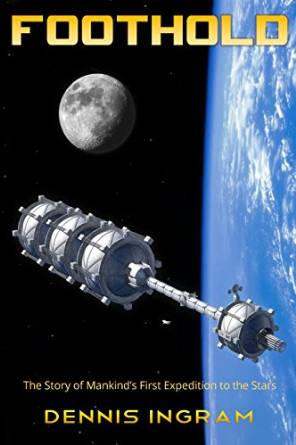
It’s 2063, and Earth is headed for runaway global warming. The Hope is the first starship built by mankind to travel to Tau Ceti, a star 12 light years away, where astronomers have found several candidates of planets that could support human life. Eight humans are on board the ship, four couples, carefully selected by the international community for their educational background, their genetic makeup, and their psychological profiles to go on a one-way journey to Tau Ceti to start the first ever human colony in another star system.

The Hope is a spaceship designed for this trip. It can reach a speed of 40% of the speed of light and this make the trip in about 40 years. A technology called stasis was invented to basically freeze time to a standstill in phone-booth sized devices, where the humans on board can remain while the automated ship completes the journey.

That is if nothing goes wrong.

The first half of the book is about the journey, and the second about the colonization of the planet they end up finding. Interwoven into the story is Earth history and the rapid degradation into global disaster brought on by runaway global warming. There is a sinister part of the story where a tycoon on Earth essentially hijacks the next star ship for his own imperial plans.

As I read Foothold, I could not figure out why the tycoon story was part of the plot, until I got to the end where I learned that the plot isn’t getting resolved but the whole thing is a setup for a sequel.

The sequel notwithstanding, Foothold is a good, riveting sci-fi read. It kept me turning the pages. However, there were a few things about the book that bothered me:

The technology, for being only 50 years in the future, was just too unbelievable. Fabricators, which are basically 3-D printers into which you just have to feed raw materials (iron ore, etc.) just didn’t make sense to me. The fabricators were able to build robots that could autonomously build habitats, launch mining operations, and the like. The statis chambers, while a neat trick in themselves, just seemed too convenient. Most of the technology just seemed too deus-ex-machina-like to strike me as feasible within the next 50 years. The eight human protagonists also seemed too much like super people to seem real.

Finally, unfortunately as it is common with self-published authors, grammar errors abounded, particularly in the second half of the book. I appreciate that the authors do this all themselves. Don’t they have a friend or two who can read their books before they publish them to get the gross grammatical errors taken care of? I am sure I found at least 50 sentences that just didn’t make sense. The author should eliminate those obvious errors before he asks readers to pay money for his book.

I enjoyed Foothold, but not enough to want to spend the time to read the sequel The Seasoning.

Rating - Two and a Half Stars

Movie Review: Still Alice

Still AliceAlice Howland (Julianne Moore) is a renowned professor of cognitive science and linguistics. Her husband John (Alec Baldwin) is a successful physician. They have three grown kids, stellar careers and an exciting future ahead of them. Suddenly Alice notices that she forgets words.

She has herself checked out and is diagnosed with Early-Onset Alzheimer’s Disease. Everything comes crashing down. Her struggle, her fight for the normalcy of her life, is frightening.

I have often worried about my memory. It used to be almost infallible, and I could memorize anything I wanted to: long lists of items in the military, poems, songs, foreign vocabulary and speeches in Toastmasters. After turning 50, I found that occasionally I can’t even remember names of famous actors, like – Alec Baldwin. The names would be ‘on the tip of my tongue’ but nonetheless completely inaccessible. This was a frightening discovery and it has often given me reason to pause.

Watching Still Alice reminded me of this sign of aging that we all eventually experience. Our bodies can’t do what they used to be able to, and the same happens to our minds. For most of us.

For Alice, however, the diagnosis is unforgiving. She knows she is sinking into the abyss of losing her memory, her cognition, and in the process – herself. This movie is about how she deals with it.

Frightening, that’s the word that comes to mind. Frightening.

Rating - Two and a Half Stars


Book Review: Ship of Fools – by Richard Paul Russo

Ship_of_Fools,_Richard_Paul_Russo_(book_cover)

For many centuries, the starship Argonos, with thousands of people on board, has traveled between the stars looking for a planet to colonize. None has worked out. They never once encountered any alien civilization. About 275 years ago, there was a revolution on board which ultimately upset the balance of power and also destroyed the logs and records of the ship. Nobody knows how old the ship is, how long it has traveled, and where it has been.

Its society has fractured into the downsiders, those people born and living in the lower decks of the ship, where farming and labor takes place, and the upsiders, who are the crew, the educated and the religious elites. The Catholic church is strong and thriving. There is even a cathedral on board.

For the first time in recent memory, they find a planet that looks promising. They land to explore it, and in the process find a gruesome and shocking surprise. Eventually, a transmission from the planet into space leads the Argonos to an alien ship in deep space. They explore and find disconcerting evidence of what many call evil.

Bartolomeo Aguilera is the narrator of the story. He is the confidant of the captain of the Argonos, but an outsider in general, disliked by the elite as well as the workers. Through his narration we learn about the realities of life on the ship, where everyone on board was born on board and has lived their entire lives on board. They know no other life. The church teaches that the ship has existed forever.

I loved the first half of Ship of Fools. The story of the lives of the inhabitants is engaging and thought-provoking. I didn’t care much for the endless sections of religious exposition. The bishop of the Argonos and one of its priests are major protagonists, and their points of view and dialog keeps drawing the story into religious confusion and anachronisms.

When the ship reaches the alien vessel, the story becomes boring and pointless, and the climax really never gets resolved. There are two threads to the ending, and neither is completed. Perhaps the author wanted to set us up for a sequel. This was written in 2001, and it’s now 2015, and there isn’t one.

I had this book at three stars or above, until the second half just took a nosedive and left everything just – uninteresting.

Nevertheless, for lovers of generation ship stories, it is still a must-read.

Rating - Two and a Half Stars

Book Review: Tau Zero – by Poul Anderson

Tau ZeroIn the nearer future, about a century from now, humanity builds starships. The Leonora Christine is the seventh ship of its generation, and she getting ready to depart. The world selects 50 people, 25 males and 25 females, to travel to the third planet of Beta Virginis, which has previously been visited by a robotic probe and found highly likely to be habitable. Beta Virginis is about 50 light years away. To get there, at the speed of light, would take 50 years, if anything could travel that fast. To send a message back to Earth once they got there, would take another 50 years. So a hundred years later, the descendants of the star farers would first find out about the fate of the crew.

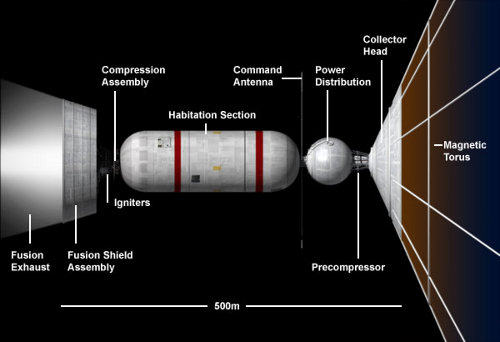
The Leonora Christine is a starship based on the Bussard ramjet concept. The ship scoops up interstellar molecules in a large magnetic funnel it pushes ahead of itself and converts this matter into energy for its reaction drive. Here is the description of the Leonora Christine in Chapter 2:

 Her hull was a conoid, tapering toward the bow. Its burnished smoothness seemed ornamented rather than broken by the exterior fittings. These were locks and hatches; sensors for instruments; housings for the two boats that would make the planet-falls for which she herself was not designed; and the web of the Bussard drive, now folded flat. The base of the conoid was quite broad, since it contained the reaction mass among other things; but the length was too great for this to be particularly noticeable.

At the top of the dagger blade, a structure fanned out which you might have imagined to be the guard of a basket hilt. Its rim supported eight skeletal cylinders pointing aft. These were the thrust tubes, that acclerated the reaction mass backward when the ship moved at merely interplanetary speeds. The ‘basket’ enclosed their controls and power plant.

Beyond this, darker in hue, extended the haft of the dagger, ending finally in an intricate pommel. The latter was the Bussard engine; the rest was shielding against its radiation when it should be activated.

At an acceleration of 1g, the ship can accelerate to relativistic speeds (close to light speed) within about one year. Based on Einsteinean physics, onboard time slows down drastically as an object nears light speed. Decades go by on earth while the people on the ship may experience only a few months, or days, or minutes – depending on how close to light speed the vessel travels.

On the way to their destination the ship encounters an unexpected obstacle in form of a dense cloud of matter. As they hit it, some damage is done to the decelerator. In essence, the ship going effectively at light speed has lost its brakes. It can’t stop once it gets to its destination. They have to come up with an alternative plan.

The result is a cosmic journey where the ship travels through entire galaxies (which would take 100,000 years) while the passengers experience it as a mere turbulence lasting a few seconds, speed bumps in star travel. They end up going to the edge of the universe and time itself.

Tau Zero is a very hard science fiction story. Anderson spends time on his character development, but for the most part they are caricature-like and the human side story, while important, is secondary. The scientific concepts he illustrates blow the mind.

ramjet-side-text
Concept by space artist Adrian Mann

The technical concepts for the ramjet are described at Centauri Dreams for those of you that are interested. The Bussard ramjet is also described in this post Cruising the Infinite, among a number of other star travel technologies.

Conceptually, approaching light speed, the ship gets ever more massive, and time slows ever more down. So the trip between two galaxies that are 50 million light years apart could be perceived as taking a day on the ship – depending on how close to light speed the ship travels. The result, of course, is that from the viewpoint of the rest of the universe, the ship is traveling for 50 million years.

Anderson uses these relativistic concepts throughout Tau Zero. It is intense scientific reading. It needs to be read slowly, except for the human-interaction parts, which seem hokey in comparison. I skimmed over those.

Written in 1970 (45 years go!), Tau Zero is the time dilation book of all time dilation books. I recommend it for hard science fiction aficionados only. Everyone else will be totally lost.

For me, I am in awe.

Rating - Two and a Half Stars


Book Review: Wreckage – by Emily Bleeker

WreckageMargaret won a trip to the South Pacific with a companion. She chose Lillian, her daughter-in-law. The two women are on a small jet plane on the way to Fiji.

Dave is the public relations man hired by the company to escort the women on their trip. Theresa is the flight attendant. And Kent is the pilot.

The plane hits a storm, loses an engine and eventually performs a crash landing in the ocean. Theresa is dead – she was not strapped in when turbulence hit. The other four survive and float in the plane’s life raft in the vast Pacific, with a small first aid kit, and one 16 ounce bottle of water.

Eventually the raft arrives at a small, uninhabited island, and the four of them start the battle for survival. Only Lillian and Dave survive and are eventually rescued, almost two years later.

Wreckage is about survival, love, passion, fear and choices in life. Half the book plays in the present, after Lillian and Dave have been rescued, and what happens when they try to fit back into their old lives, with their spouses and families, who had long thought them dead. The other half of the book is told by Lillian and Dave as they experience the plane wreck, and their Robinson Crusoe life on the island.

The story switches back and forth between the two perspectives. The present story is told in the past tense (ironically), while the past story is told in the present tense. I found this jarring and it disrupted things for me. I have never before read a book where the present is told in the past tense, third person, while the past is told in the present tense, first person. Lillian and Dave both get turns, telling their experiences and feelings on the island.

Wreckage is a story that had me turning the pages and kept me wanting to know what happened next. But the organization of the book was not very fortunate. It distracted. I never quite got used to constantly having the change back and forth between the third person and the first person. That part didn’t work for me, and it definitely resulted in one less star overall.

Otherwise, Wreckage is a well-crafted mystery story of survival and life choices.

Rating - Two and a Half Stars


Movie Review: A Night in Old Mexico

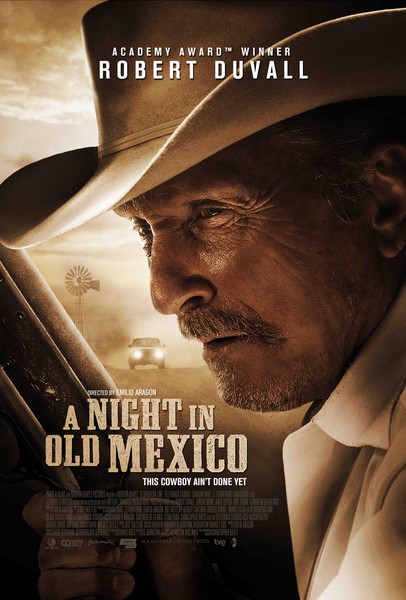
Old MexicoRed Bovie (Robert Duvall) is a cantankerous farmer in Texas who just lost his farm, the farm that his daddy worked, and his granddaddy, and his great-granddaddy. He took out a loan and lack of rain for a few seasons wiped him out. The land will become a housing development.

Red is depressed.  He thinks of taking his own life, when his grandson Gally (Jeremy Irvine) whom he has never met, shows up unannounced.

Red and Gally jump into his aging Cadillac and head for Mexico. On the way, a couple of thugs who have just killed a man for a backpack full of drug money, start harassing them. Things get complicated quickly when they arrive in a Mexican border town and start partaking in the nightlife, especially when Patty (Angie Cepeda) hooks up with them in her quest for a better life.

This is a movie apparently written for Robert Duvall to show off his crotchety side. The story never quite feels real and it feeds off all the stereotypes we have of Mexican border towns.

It made me think about life, the dreams of my youth and the inevitable disappointment of my journey, as I watched a grandfather take stock of his life, and a grandson trying to figure out what to do with his.

It made me think about the circle of life.

Rating - Two and a Half Stars

Book Review: Departure – by A.G. Riddle

Departure200 passengers board a Boeing 777 in New York, bound for London. The plane crashes in the woods somewhere in England. Nick Stone has the presence of mind and courage of spirit to get right to work helping his fellow survivors rescue as many of the victims who didn’t die. Harper Lane is a young British writer who finds herself in the middle of  the rescue, against her better judgment. Sabrina Schröder is a German research physician and the only doctor on board, with plenty to do patching up the injured passengers with not much more than a first aid kit and very little medicine. Yul Tan is a Chinese-American computer scientist who is on the cusp on inventing the next generation of the Internet.

When days go by and no rescue crews show up, these four unlikely protagonists quickly discover that the world they landed in is not quite right. As they slowly unravel what happened to them, they are thrown into a conflict much larger than they could possibly have dreamed.

Departure is an “accidental time travel” story, meticulously plotted and told in the first person by Harper and Nick, alternating, in journal-style. To make it even more unusual, the story is told in the present tense. This gives the action intense urgency and realism.

After recently reading a few amateurish novels that lacked editing, this was refreshing. Not a grammar error to be found, not a word missing or misspelled anywhere to distract me.

I have to say, however, that while the first third of the book was a page turner, the rest of the book, with perhaps the exception on the last 5%, was too contrived for me. There was lots of action, lots of intricate story development and plot, sometimes to the point where it was hard to follow. I must admit there were sections when I just skimmed and turned the pages to make it through those boring – or rather – overdeveloped parts so I could get on with it.

Overall, Departure was a fun, quick read, and it helped that it was about time travel.

Rating - Two and a Half Stars

Movie Review: The Equalizer

Equalizer

McCall (Denzel Washington) is a mysterious loner. He lives a quiet, simple life of a working man. He works at Home Mart (which looks exactly like a Home Depot), spends his free time reading classics and frequents a diner when he can’t sleep at night, which seems every night.

But occasionally skills show through that are far from the ordinary. McCall helps underdogs and he stands up against predators. In the picture above, the guy with the hoodie (did it have to be a hoodie?) is holding up a cashier at Home Mart and after he gets the money from the cash register, he asks for her diamond heirloom ring. McCall happens to witness the event, assesses the situation, and advises the cashier to give up the ring. Not long after, Hoodie finds out that this time he has messed with the wrong guy.

Teri (Chloë Grace Moretz) is a hapless prostitute that keeps showing up at the diner night after night. McCall doesn’t see the prostitute, but a helpless, lost and very young girl. When he finds out she is under the control of ruthless Russian gangsters, he takes his savings and decides to buy her freedom. With an envelope of cash, he walks alone and unarmed into the gangster den. When the Russians don’t take the offer, they also find out that they have messed with the wrong guy.

This starts an all-out war between one man (it’s like Rambo) and the entire Russian mafia, reaching from New York all the way to Moscow.

I don’t know too much about the Russian mafia, thank goodness, but the way it is portrayed in this movie scares me. It is organized in a military fashion, supported by the highest levels in Russia, utterly brutal, and with complete disregard for the rights we Americans take for granted. Seeing entire warehouses full of American cash on pallets ready to be shipped to Russia, money from drugs, prostitution, and extortion of all types illustrates the magnitude of the operations. I don’t know if this is really going on, but if it is – it’s staggering.

I happened to read the article Killer Business – An investor turned activist outfoxes the oligarchs in Russia in Time Magazine of March 2, 2015, page 100, just a few days after watching The Equalizer, and that article confirmed my assumptions.

Russia appears to be a completely corrupt nation, all the way to Putin, its president, who many assume to be the “richest man in the world” simply because the oligarchs all pay him off so he props up their criminal activities, at home in Russia, sucking the Russian people dry, and in the west, sponsoring the activities of the Russian mafia.

This is a topic for another post someday. Back to The Equalizer.

Highly entertaining, this is a Rambo-like movie with more subtle sentiment but plenty of action and violence, stacked with really bad villains and a flawless hero to root for.

And finally, I’ll never see a Home Depot in exactly the same way again. Now I see all the weapons.

Rating - Two and a Half Stars


Movie Review: Into the Woods

Into the Woods

The witch (Meryl Streep) has put a curse on her neighbor, the baker and his wife (James Corden & Emily Blunt), preventing them from ever having a child. She commands them to get her a cow as white as milk, a red cape, hair yellow as corn and a golden slipper.

This weaves together the Brothers Grimm fairy tales of Jack and the Beanstalk, for the cow, Little Red Riding Hood for the cape, Rapunzel for the hair and Cinderella for the shoe.

Into the Woods is a musical, where most of the dialog is sung, with complex melodies, and orchestral background music, that makes all the songs sound alike. Unlike other musicals, where you can walk out with an earworm in your head, because it’s comprised of distinct songs, when you walk out of Into the Woods, singing “Into the Woods” is all you can do.

The musical dialog is fresh and sometimes humorous, and the acting quite entertaining. The scenes and costumes are elaborate. I was skeptical when I first started watching, but the story and the way it is presented is so different, so unique, and so elaborate in its own way, I actually enjoyed it all the way through the two hours and five minutes runtime. To me, it was enjoyable, solid entertainment, something very different from the normal movie experience. Something unique.

Rating - Two and a Half Stars

Movie Review: The Good Lie

The Good Lie

The 1983 civil war in Sudan orphaned thousands of children. They went on walks across deserts and savannahs, to find refuge barefoot, with no support, no adults, and seemingly no valid goals, for hundreds of miles, only to be turned away at their destinations.

The Good Lie follows a group of boys and girls, and later men and women, as they eventually found shelter in a refugee camp. Fifteen years later a humanitarian effort brought 3,600 of the lost children, now young adults, to America.

How do you transplant a person with that background to St. Louis, Missouri so they could find jobs and start new lives?

Culture shock always makes good subjects for movies. The Good Lie is a feel-good movie about culture shock in the most extreme possible. It’s a movie I watched for the story. When the credits rolled, I felt grateful for my own comparatively simple and straightforward life.

Rating - Two and a Half Stars

Movie Review: Big Eyes

BigEyesWe went to see Big Eyes on New Year’s Eve. As we drove home around 10pm, ready to pop a bottle of champagne, I wanted to do one thing: Go into my studio and paint.

Big Eyes is a dramatization of the real life story of Walter and Margaret Keane in the early 1960s. I don’t have an opinion about Margaret Keane’s paintings and their value as art. But, boy, was she prolific. She cranked out lots of paintings, where I am lucky do finish three or four a year!

The story is a simple one: Margaret (Amy Adams) was recently divorced with a young daughter, trying to make a living in San Francisco as an artist in the 1950s, an age when women in business were not yet taken seriously. At an outdoor art show Walter Keane (Christoph Waltz), who exhibited his work next to her, charmed her sufficiently that within a few months they were married.

Walter was not much of an artist, but he was a master salesman and showman. Once he figured out he could sell his wife’s work by claiming it as his own, their fortunes started to improve. Soon he was a celebrity, and she was a prisoner in her own life. The lies and the fraud were so enormous, there seemed to be no way out.

The movie Big Eyes starts out a little slow in the beginning but picks up speed nicely. Margaret’s doom, gloom and suffering is clearly coming through Amy Adams’ acting. However, Waltz seems way over the top. It’s almost like watching a goofy cartoon character when he gets moving, particularly during the court scenes in the latter part of the film. I found his performance unreal and distracting from the pace and feeling of the rest of the movie. It was like having Jim Carrey do his cartoon stuff in a serious film. When I researched about Walter Keane later, I found that the real-life Margaret said that he was even more loony than Waltz portrayed him in the movie. Here is an article a lot of background information, including pictures of the real Keanes back in the 1960s.

Now back to painting…

Rating - Two and a Half Stars

Movie Review: Wild

Wild2

I went to see Wild because it was the top-rated movie this Christmas season, with 92% on the Tomatometer.

Wild is a movie about hiking the Pacific Crest Trail, or PCT, as it is commonly called. That’s how it’s presented.

But that’s not really what it is. Wild is a movie about a young woman growing up in middle America with disadvantages, lots and lots of disadvantages.

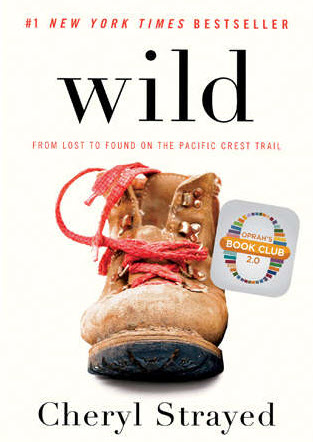
The movie is based on the book of the same name by Cheryl Strayed that came out a few years ago.
Wild1

I never read the book. Checking the cover, and trusting the reputation of Oprah’s Book Club, I decided that this was a chick book and it wasn’t for me.

I entered the theater to watch the movie only because of all the choices it was the highest rated. You might say I entered with prejudices.

Cheryl (Reese Witherspoon) and her little brother grew up mostly with their single mom Bobbi (Laura Dern), who left her abusive husband when the children were little. They were poor, mom working waitressing jobs just to keep things together. Bobbi got cancer at the age of 45 and died rapidly. The children tried to cope, each in their own way. Cheryl ruined her own marriage through her adulterous ways.  After her divorce she skided into self-destruction, seeking abusive male relationships, descending into the fog of the drug culture all the way to shooting up heroin. Somehow she decided to pull herself up by her bootstraps and hike a portion of the PCT. The hike of over 100 days was supposed to clear her foggy mind and extract the demons that haunted her life.

The movie starts out with hiking scenes, but is constantly interspersed with flashbacks to Cheryl’s childhood, youth and young adult life of self-abuse. The flashbacks are sometimes only seconds long. While lots of flashbacks in a movie sometimes make it disjointed, it actually works quite well here, since the scenery of the two lives are so vastly different.

The scenes on the trail are nature, tents, backpacks, mountains, meadows, snow. Unmistakably the present. The scenes in the flashbacks are mom, children, naked bodies, drugs, wife beater guys and life in run down houses. So I always knew what part of the story we were in without getting confused.

Being a hiker, I looked forward to the hiking parts, but hiking is basically boring, hours and hours of setting one foot in front of the other, surrounded by breathtaking scenery that you don’t even see, because you are hungry, thirsty, tired, and can’t wait for the next four miles to be over so you finally reach your destination and camp. Hiking does not an exciting movie make.

But the parts about flashback life are more interesting. Sex, drugs, illness, drama, all makes for a story to tell. So it is not surprising that’s what the movie makers focused on to move the story along. And it worked. Getting some frontal nudity of Reese Witherspoon probably also attracted a viewer or two.

Cheryl “only” hiked a part of the PCT, about 1,000 miles, from the Mojave desert to the Bridge of the Gods, the cross-over from Oregon to Washington. The actual Pacific Crest Trail is a 2,650-mile ribbon of dirt and rock that runs from Mexico to Canada through California, Oregon and Washington. If you want to learn about what it’s really like to hike the PCT, you can check out the following blogs, all by people who hiked it just this past 2014 season.

  • Carrot Quinn – hiked the PCT in 2014, then the lowest to highest (L2H) from Death Valley to the peak of Mt. Whitney in 6 days, and is now on the Florida trail, hiking 800 miles from the southern tip of Florida through the swampland north.
  • Not a Chance – hiked the PCT in 2014, then with Carrot the L2H, and is now hiking the Te Araroa, 1800 miles from the northern to the southern tip of New Zealand.
  • Twinkle – hiked the PCT south to north in 2014, ended in September, flew to Maine, and hiked a large part of the Appalachian Trail (AT) north to south, ending late in November. He hiked 4,400 miles between March and November 2014.

These people didn’t hike 1,000 miles in 100 days, they hiked the full PCT 2,650 miles in 110 days, give or take a few. These are the badasses of ultra-light long-distance hikers, and their blogs are enlightening. This is where you learn about hiking.

But this is not a review of long distance hiking, it’s a review of the movie Wild. Cheryl Strayed, with her book and this movie, has put some spunk into PCT hiking, I am sure, and there probably are a number of people who went on the trail due to it. Not a Chance, somewhere, says that people keep asking her if she knew Cheryl Strayed, and she keeps answering “Cheryl hiked the PCT in 1992 when I was a toddler!”

The hikers I listed here didn’t affect the image of the PCT anywhere near how Cheryl did with her book and now movie. But then, Cheryl didn’t start out her hike wanting to affect hiking, the PCT, or the hiking world. Her story was about overcoming the demons of life. We are not all lucky enough to be born into affluent and functional families, with clean college educations, parents that can afford to send us to Harvard or Stanford. Many, many of us are born into much less fortunate environments. So it was for Cheryl. She chose hiking to expel the demons, and it seems she was successful.

And, in the process, she greatly popularized the PCT.

Wild is a wild ride, with stunning scenery, some suspense, good entertainment value, and no doubt a learning experience for viewers – particularly those that know nothing about hiking.

Rating - Two and a Half Stars