Book Review: Full Measure – by T. Jefferson Parker

Full MeasureFull Measure is a novel set in Fallbrook, California. You might ask why this matters? Every novel is set somewhere!

For me, Fallbrook is more significant. I lived in Fallbrook a full third of my life, 18 years in all. My children grew up there from infancy and graduated in Fallbrook High School. I ran for the high school board. I started a business in Fallbrook that was a successful icon on Main Street for many years until we moved it closer to the city. I know hundreds of people there. I know all the streets, many of the businesses and all the outlying areas from my many bicycle rides around town.

The author of Full Measure obviously knows Fallbrook extremely well. The story is about Patrick Norris, a 22-year-old U.S. Marine who has just returned from a 13-month tour of duty in Afghanistan and Iraq. He comes home to a family on the breaking point. His brother Ted, at age 26, is a misfit who cannot find his place in life. His parents, Caroline and Archie, are avocado farmers. Just a week before Patrick came home, a huge wildfire swept through town and all but obliterated their groves, threatening financial ruin just before retirement age. Patrick has no interest in farming and would rather be a fishing boat captain out on the San Diego Bay for tourists. But his father calls on his sense of duty to stay with the family in their hour of need.

Patrick has his own ghosts that haunt him. Nightmares of reliving the deaths of his buddies in the war don’t let go. Flashbacks to exploding IEDs and comrades torn apart jump up at him at the most inconvenient times. Does Patrick have the strength to keep his sanity, back home in idyllic Fallbrook, while the country does not know how to deal with veterans and the town is coming apart at the seams?

Parker places the story smack in the middle of Fallbrook. Many Fallbrook businesses are part of the picture. The CVS drugstore, Major Market, KFC on Mission Road, and the well-known Café des Artistes. There are literally hundreds of references to actual, real Fallbrook locations throughout the story. He describes drives on Mission and Main, down Ammunition and back over down to the High School, past Los Jilgueros nature preserve, left on Stage Coach and then up “Holy Hill” or what I used to call “Church Row.” He does make up some businesses, particularly those that are important to the plot. He also invents a city council and a mayor. Fallbrook does not actually have a mayor and a city council, or at least it did not have any when I still lived there in 2006.

Nevertheless, I have never read a novel before where my mind’s eye literally followed along. The writer didn’t have to explain and “show” me much. When he talked about the trailer park opposite the Post Office on Mission, I knew exactly what he meant. I could see it. He described how the park smelled of KFC, and indeed, I have ridden my bike past there and it does smell like KFC because it’s downwind from the restaurant.

I enjoyed reading Full Measure very much, but I wonder if it was because it’s set in a town I know so well? Would I have kept turning the pages for the merits of the story, if it had been set in some town in New Mexico or Missouri instead? I don’t know.

The plot is well-woven and there are some twists and surprises. The author does a pretty good job with the conundrum our nation finds itself in, sending its young people into overseas wars without convincing them that they are actually protecting the homeland. They come home broken, their friends maimed or dead or crazy, and they can’t find themselves back “home” in Fallbrook and thousands of small towns all over the country. That’s what the author wants to show.

Iris, one of the protagonists explains to Patrick how she came to live in Fallbrook:

I drove around the whole county for two weeks, looking for just the right place to find a rental and a job. And of all the extra cool places in San Diego County, I picked Fallbrook, which is the most like Kenton, Ohio.

— page 159

That quote rang out to me, because some thirty years ago, I did just that: came to San Diego, drove around the whole county for weeks and eventually found Fallbrook as the place to raise a family.

Everyone who lives or lived in Fallbrook must read this book. They will get a kick out of it.

Rating: ** 1/2 (out of 4)

Book Review: Almost Adam – by Petru Popescu

AlmostAdam

What if a tract of land in western Kenya had remained untouched by humanity and influences of evolution and essentially remained stuck in the Pliocene (1.5 – 5.0 million years ago), complete with living tribes of australopithecus afarensis?

Ken Lauder, the protagonist in Almost Adam, is an anthropologist who works with his Kenyan friend Ngili in a remote area. They come across foot prints and fossils that indicate that there might be ancestors of humanity living right now.

The story involves much scientific explanation and a lot of speculation into what life might have been like for early humans living in the Pliocene. It also delves deeply into African politics (albeit fictitious) and scientific competition and intrigue.

The result is a complex story full of youthful dreamers, murderous villains and a lot of sexual tension. I enjoyed the bush episodes the most, where we followed Ken into the savannah and bush, watching him slowly lose his modernism and turning into a prehistoric human full of the raw emotions and needs, consumed by the simple and vital needs of finding food, water, shelter and fighting off foes of all kinds.

I could have done without all the complicated machinations of Kenyan politics and the lives of the elite. The most difficult character to accept was Cyril Anderson, supposedly a world-renowned anthropologist, but a maniacal egotist who does not think twice before stealing the finds of others and taking the credit, and who is willing to kill to meet his endless need for glory and fame. The Cyril character was just too far-fetched for me to accept and therefore never seemed real.

Almost Adam is a very entertaining and educational story about the dawn of humanity. The book is 600 pages long and my only criticism is that it was probably too long. Popescu could have told the same story with the same impact in 400 pages.

However, I learned a lot about the evolutionary development of human genitalia. Did you know why the modern human vagina is forward facing and not exposed to the back? Why do modern apes have large testicles and very small penises, and why are human penises so disproportionately large? Popescu knows a lot about penises and why size matters. If you also want to know, you will just have to read Almost Adam.

Rating : ** 1/2 (out of 4)


Book Review: The Dark Beyond the Stars – by Frank M. Robinson

Dark Beyond the StarsThe Astron is a starship sent by the governments of Earth with a mission to find other life, and hopefully intelligence, in the universe. The ship is about 500 meters long with habitat for a crew of 900 people in three main cylinders, each holding life support, educational facilities, habitats, hydroponics, and anything else a crew might need that leaves the earth knowing they themselves won’t come back. When the ship leaves, it’s the shining result of human technology. Gleaming bulkheads, stainless steel fixtures, chrome embellishments, artificial reality  enhancements, libraries, gymnasiums, and of course a full complement of scientific equipment. Since the mission is to discover life, they carry a huge hanger with landers, rovers, space suits and  ny equipment they might need to explore planets.

The story starts about 2,000 years after the ship has left the Earth. Over 100 generations have lived and died. Imagine being born in a world that is a spaceship that has been traveling for 2,000 years, with all knowledge of 100 generations of ancestors living their entire lives on the ship. After 2,000 years, the Astron is no longer a gleaming beacon of high technology. It’s bulkheads are rusted and caked with dirt. Dust and grime covers all surfaces. The smell of oil and human sweat permeates the air. Two of the three habitat cylinders have been abandoned for more than a thousand years, cannibalized and shut off. The crew is only about 300 people. Resources are scarce. When something breaks, they have to resort to cannibalizing something else to try to fix it.  Equipment no longer functions, spacesuits fall apart during missions, tethers break. They have visited 1,500 planets and have not found as much as even microscopic signs of life.

The captain, obsessed with the mission, wants to break out of the current sidearm of the Milky Way, the one our Earth is part of, and fly across The Dark Beyond the Stars to another arm where he expects that older stars in more dense fields give a better chance for finding life. However, it may take another 3,000 years to cross the Dark before they can explore again, another 150 generations of humans have to live and die only for the journey. Can the Astron even sustain such a trip? The current generation seems to have lost the will for the mission, and mutiny is in the stale air.

Published in 1991, the author only knew about the calculations of the odds of other life in the universe that were prevalent then, mostly based on the famous Drake Equation. He did not benefit from current planet findings in 2013, where astronomers are coming to the conclusion that planets are abundant in the universe and we are finding exoplanets at the rate of several a day. Written today, this novel would have to have a somewhat different premise, but it works with the 1991 angle.

The first 90% of the novel moved a little too slowly for me. The author does not spend much time on hard science fiction. The Astron moves at relativistic speeds between stars, but he never seems to consider acceleration and deceleration. Other than when exercising in a rotating gymnasium, the crew lives in free fall all the time. This would defy the concept of acceleration and deceleration when approaching planetary systems. While the author told of endless and somewhat repetitious crew politics for hundreds of pages, I would have liked more detail about the Astron, and more description of the scientific concepts applied. My anticipated rating of the book was therefore going to be mediocre.

Then plot twists in the last 10% of the book stepped up the action and inspired my imagination, and after I could not put the book down for the last 30 or so pages, I can’t help but increase my rating by half a star.

I love generation ship stories. It’s one of my favorite sub-genre of science fiction. This book is a generation ship story through and through.

Rating: ** 1/2

Book Review: The Time Traveler’s Apprentice – by Kelly Grant

ApprenticeThe Time Traveler’s Apprentice is a young adult novel about a Simon Grant, a boy who becomes the helper and apprentice of Professor Moira Ananke, who is a museum curator, historic researcher and expert time traveler.

For reasons he can’t explain, Simon is thrown back through time to 12th century England during the reign of King Henry II and his Queen Eleanor. He meets up with a number of characters and quickly gets embroiled in the local politics and the mystery of the death of a famous cleric, Bishop Thomas Becket.

The novel is based on many historical facts and brings alive the daily workings of life in the 12th century. We learn how people lived, what they ate, how they traveled, how they thought, and most of all, how their politics worked. It reminded me a little of the famous Pillars of the Earth books by Ken Follett.

However, this book is written for young adults, so it just skims the surface compared with Pillars.

Well-structured suspense kept me reading chapter after chapter. Having just finished another time travel book littered with grammar and spelling errors, this one was pure delight in comparison. There was absolutely nothing wrong with this book.

It’s a quick, fast-paced read, flawlessly structured, and full of suspense.

It even comes with a teacher’s resource book that contains language arts and social science activities for each chapter of the novel. The activities vary greatly and expand on the historic premise of the book, exposing students to primary source material, reading charts and tables, and incorporating differentiated activities for teaching reading comprehension.

Clearly, the author is a history teacher and her objective is to bring history alive for young readers, and she succeeded.

I picked it up as a time travel book, but there really isn’t any time travel involved. It’s more about what would happen if a 21st century boy in England were suddenly whisked away into the England of the 12th century. He does not travel, he just appears there, and then the story continues in that era.

Rating: ** 1/2

Book Review: Of Human Bondage – by W. Somerset Maugham

OfHumanBondagePhilip Carey is born around 1880 in England. By age nine he has lost both of his parents and is sent to live with his childless uncle and aunt at a vicarage. Philip has a club foot, which he calls his deformity. It shapes his thinking through his early years as he grows up in boarding schools and is routinely ridiculed by his peers.

He inherits a small fortune from his parents which has to last him through his youth and education. As he comes of age, without a strong guardian, he drifts from one adventure to the next.

As a youth he drops out of school and travels to Germany to study. When he gets tired of that life, he spends a few years in Paris trying to become a painter, until he learns that he does not really have any talent.

Finally he goes back to London and enters medical school.

While getting an education and pursuing cultural and intellectual goals through the people he associates with, he is getting drawn into an abusive and hopeless love relationship with a waitress without class, aspiration, intelligence or any other perceptible positive attributes. This relationship torments him over a period of years, drains him of his limited funds and almost ruins him at the end.

As he nears age 30, he manages to finish medical school. He realizes it’s time for him to make some sense of his life.

Of Human Bondage is a long book of 555 pages, and it seemed endless while I read it and quite boring in some passages. There is really not much of a plot, but endless narration and exposition, accompanied by little dialog. The reader lives inside of Philip’s head most of the time, and is forced to follow along with his juvenile thinking and illogical reasoning.

Philip is a hapless, conniving, and flawed character, and I found him one of the least likable protagonists I have encountered. In real life, I don’t think I’d want to be around him or know him. For the most part, I thought of him as a damned fool.

Reading this book, I learned much about life in England at the end of the 19th century, the division of the classes, the lives of the working class, and the aspirations of the upper class, whose goals are being artists, intellectuals, writers and who somehow see themselves as a class of humans above everyone else – until their money runs out.

The Modern Library ranked Of Human Bondage No. 66 on its list of the 100 best English-language novels of the 20th century. Published in 1915, the work is obviously autobiographical, even though Maugham said: “This is a novel, not an autobiography, though much in it is autobiographical, more is pure invention.”

For instance, Maugham had a difficult childhood after losing his mother when he was a little boy at age 10 and being sent to his childless uncle and aunt. His uncle was emotionally cold. Likewise, Philip Carey lost both parent by age nine and had to live with his uncle, a heartless, cold, overly religious and stingy man.

Maugham had a strong speech impediment, a stammer that haunted him all his life. Philip had a club foot.

Maugham didn’t want to become a lawyer like other men in his family. He eventually trained and qualified as a doctor. Philip didn’t want to become a clergyman. After trying to become an artist, and discovering he didn’t have any talent, he trained and qualified as a doctor in the end.

There are many passages where Maugham writes intensely about Philip’s thinking and feeling, so intensely that it seems very real.

Maugham was one of the most popular writers of his era and reputedly the highest paid author during the 1930s.

Of Human Bondage is a very long, sometimes tedious novel, and difficult to read because of the general lack of likability of most of its characters. However, it captivated me and I kept reading, thinking about how challenging life was for working people in those days in England, the world’s superpower of the time.

I have grown through reading Of Human Bondage.

Book Review: Out of Time – Five Tales of Time Travel

Out-Of-Time-Final-Full-205x300Out of Time is a collection of five time travel stories. I found each of them fascinating in its own way. Of course, being written by five different emerging authors, the writing style, content and character of the stories vary.

The five authors are:

All profits from the sale of this book are donated to Doctors Without Borders.

Being a time travel aficionado, I enjoyed this book very much.

Rating: **1/2

Book Review: The Mine – by John A. Heldt

The MineJoel Smith is a 21-year-old college student from Seattle, on a trip with a friend visiting Yellowstone in May of 2000. On the way back, outside Helena, Montana, he decides on a whim to explore an abandoned gold mine. While his impatient buddy waits at the car, he enters the mine, finds a mysteriously glowing cavern, sees a rattle snake, drops his flashlight and as he withdraws he bumps his head and passes out.

When he comes to, he walks back out of the mine and finds a different world. He soon figures out that it is May 1941. His cell phone is useless, his 2000 vintage money is funny-money, and his clothes are definitely wrong for the period.

He rides a freight train from Helena to Seattle and soon starts a new life. In his circle of friends he even meets his own grandmother as a young college girl. Eventually he falls in love with a girl named Grace, who is engaged to another man.

He does not know if his trip was one-way. But he does know his sports trivia, which enables him to gamble and win money. He also knows that on December 7, 1941, the Japanese would attack Pearl Harbor and the lives of Americans would change drastically.

Joel is careful not to change the past and history, since it might affect his own existence, particularly when he is hanging around with his own grandmother.

The Mine is a romance novel. The author spends a lot of time weaving the web of the complex social lives of a group of 1941 college kids that Joel finds himself surrounded by. Those college kids have relationships, they fall in love, and in lust, and things don’t always end up clean.

The book is very well narrated, containing just the right amount of dialog versus exposition, and it moves along at a good, steady pace. The only distractions I noticed were the frequent use of trite clichés. For instance, Joel never just put on jeans. He always “threw on a pair of jeans.” Joel’s 2000 girlfriend Jana “was as good as it got.” Road signs were “small potatoes.” The author used these types of hackneyed expressions often enough that I found it distracting.

Also, Joel was a bit too much of a superman. Landing in 1941, he becomes a crack furniture salesman overnight. He seems to have a photographic memory of sports trivia and statistics. He is super good-looking so all the girls are attracted to him at first sight. He is a great fist fighter. And he is very sensitive and a great friend to everyone. He falls madly in love with Grace, but when it becomes time to leave her, it seems to not be a very difficult decision. All through the story, Joel is somewhat too good to be true.

Overall, The Mine is a very entertaining story, a well told and expertly paced time travel tale with a romantic twist, or perhaps more aptly: romance with a time travel twist.

Rating: ** 1/2

Book Review: Time Change – Book Two – by Alex Myers

Time-Change-Book-Two-Alex-MyersI read this book immediately after Book One, convinced by a twist at the end. Book Two was a different experience than Book One.

Jack was back in 1856, and his task was preventing the Civil War. Again he met with many of the luminaries of the period. There were battle scenes, with Jack right in the middle of them. The bad guys were really evil, Nazi style, with human experiments and torture. Through a network of spies and thugs, they stole industrial secrets, kidnapped people, and killed whenever it suited their need. Interestingly, the bad guys were also the Southerners, versus the Yankees, trying to hold on to their system of slavery pre-Civil War.

I felt that this one, like Book One, was also written somewhat awkwardly, the writing style showing some signs of immaturity. The writer often told us what was happening, rather than showing us. This means that the book could have been longer, more elaborate, and probably more enjoyable, with better dialog and better exposition.

For instance, Frances Sanger, the second most important character in the story, was a young woman who was, we think, infatuated with Jack. But the way she acted throughout the story simply didn’t make much sense. She was portrayed as very bright, helping her father and uncle in the family business, buying real estate for stores all over the country, as far away from Virginia as Chicago and New York. So she should have been an experienced traveler, negotiator and executive. However, when she saw Jack with a young girl in a restaurant, she freaked out and acted like a junior high school girl, running to her daddy and crying about it. Frances Sanger, due to behavior like this example, just didn’t appear to me as a rounded, real person, but as an accessory to move a plot along.

And the plot, finally, was what kept me reading. I loved the story, and I particularly loved the ending. I would tell the reluctant reader to keep slogging through the first 90% of the book because the last 10% make it worthwhile and now I am waiting for the third book in the series.

This brings me to my final complaint: The time change books are, apparently, a  trilogy. I think this story would work better as one consolidated book, be it a thousand pages, if necessary. Time Change – Book Two, as I describe it here does not stand alone. I don’t think a reader could make much sense of it, let along like it and the plot, without reading Book One first. This disconnect between a series of books is much stronger here than in other similar works, like for instance those of S.M. Stirling, where the stories build on previous books, but each book can be read on its own.

All said and done – I am now waiting for Time Change – Book Three.

Rating: ** 1/2

Book Review: Time Change – Book One – by Alex Myers

Time-Change-Book-One-Alex-Myers-187x300I honestly don’t remember how I came to buy Time Change by Alex Myers. Somewhere, on some blog, I must have read about it. Since it was a time travel book, and I hunt for time travel books, it was not hard to make the decision to buy after reading a few reviews and the free sample.

Jack Riggs is a nondescript teacher in Norfolk, Virginia in 2012. The relationship between him and his girlfriend is not going so well, when one night she picks him up and gives him a ride in her car. Outside is a violent thunderstorm with torrential rain and heavy lightning. They get into an argument. The girlfriend is driving too fast  for the weather, fueled by her anger about him. They get into an accident. Lights off.

Jack wakes up in a meadow in bright sunshine in a place he does not recognize. He is largely unharmed. He recognizes nothing. He still has his iPhone. No bars. No GPS. Only the local apps still work. So he decides to get up and start walking. Eventually he finds a house.

He soon realizes something enormous has happened. He is outside of Norfolk in 1856, a few years before the Civil War.

Jack eventually realizes that there are hundreds of books on his iPhone that he can use for reference, and he quickly leverages his knowledge of science, history, nutrition and health. He becomes wealthy and famous and soon hobnobs with the luminaries of that time, including Abe Lincoln, Mark Twain, John Deere and many others.

As the story unraveled, I was a bit disappointed. I realized that it really wasn’t a time travel story per se, but a story of one man catapulted into the past without any way to get back, reminiscent of S.M. Stirling’s books like Island in the Sea of Time. The author explores what it would be like for a man with an iPhone to be thrown into the middle of the nineteenth century.

The writing seemed awkward at times; I felt like I was reading a book without really being captivated by the story and the dialog. Perhaps it was due to the author often telling the reader, rather than showing him. Nevertheless, even though it was not really a time travel story, I stuck with it. The story engaged me sufficiently to keep me interested. But I didn’t think I’d go get the sequel, book two, to read. I’d end it with book one and move on in my reading list.

Then there was a twist at the end that changed my mind, almost forced my hand. I closed book one and immediately downloaded book two – and started reading.

Nice job, Alex Myers. Good ending. You roped me in.

Rating: ** 1/2

Book Review: Bones of the Earth – by Michael Swanwick

Bones SwanwickBones of the Earth is a science fiction and time travel story, where the time travel is fundamentally central to the plot. Being a time travel story buff, I was surprised that it took me so long to discover this book; it came out 2002.

The protagonist is a paleontologist who gets an offer to travel to the distant past to study dinosaurs in the flesh. Time travel is a gift from non-humans (we only find out later in the book from whom exactly) and is provided to humanity only with certain strings attached, the main one being:  humans are understandably not allowed to create time paradoxes.

Just because it’s not allowed does not mean it does not happen, and as a result, things get complicated very quickly.

Bones of the Earth is a page-turner from the first page on, mostly due to the subject matter. I very much enjoyed reading about researchers being able to study dinosaur behavior first-hand, like in Jurassic Park. I don’t know if Swanwick is a scientist himself, but he seems to know a lot about science in general and paleontology specifically. Either he is an expert himself (which I could not ascertain from the information about him available online) or he has excellent sources and he did great research.

The problem with this book is that I could simply not follow the plot.  Not only does the point of view of the novel shift around, the time shifts, and the causality shifts constantly, due to time travel. So something happening in 2034 is the cause of a result occurring 100 million years in the past or 100 million years in the future. I found myself getting lost quite often, and I simply trusted the writer to keep things straight, even though I could not follow it all the time. I would have to read the book again, and draw a plot diagram just to keep it straight – the writer must have done that himself.

Confusing or not, this book is the most time traveling book of all time traveling books.

Rating:  ** 1/2

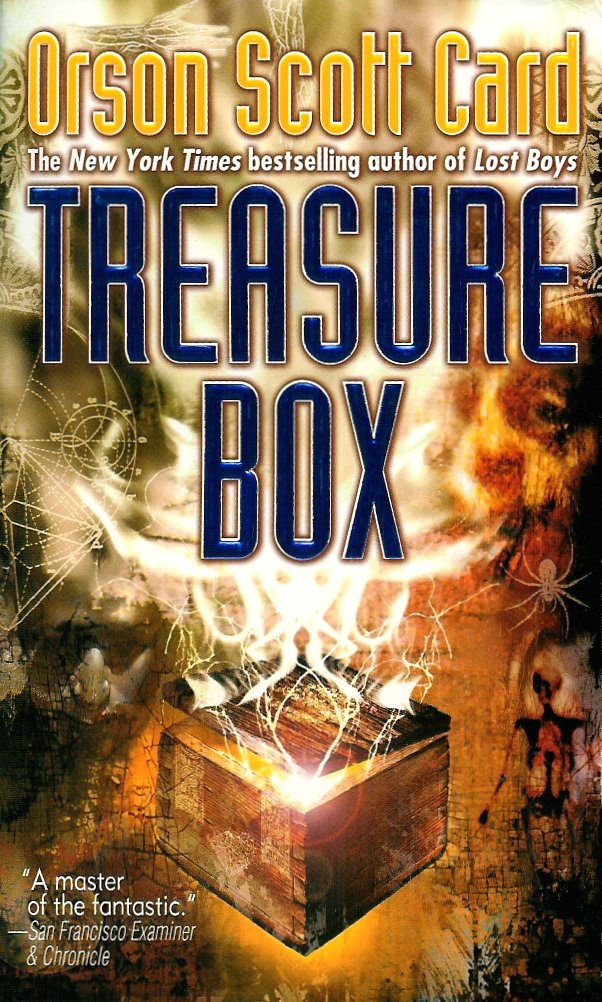
Book Review: Treasure Box – by Orson Scott Card

TreasureBoxWe think of Orson Scott Card as a science fiction writer, the most famous of his books being Ender’s Game.

Treasure Box, in contrast, is a witch and magic mystery novel. It plays in the early Internet days of about 1996 (the book was published in 1997). The hero is Quentin Fears (rhymes with pierce) who is a software mogul fashioned after Bill Gates (since in 1996, we didn’t know the Google guys yet, Yahoo! was just a startup, and Zuckerberg was just 12 years old).

Quentin loses his sister, five years his senior, when she was a teenager. He never quite gets over it. He grows up to be a computer programmer and through luck and circumstance becomes immensely successful. Like a lot of nerds, however, he is socially inept. Eventually he finds Madeleine, apparently by chance, and falls deeply in love with her. She is the perfect woman. Beautiful, extremely smart, superb in bed, a star on the social scene. They get married quickly and plan their lives together. Life is perfect for Quentin.

Whenever something is too good to be true, maybe it’s not true. When Madeleine takes Quentin to meet his her family in a small town along the Hudson north of New York City, odd things start happening.

Turn on the magic. Evil magic that is….

I read Treasure Box when it first came out and I remembered liking it. But I had completely forgotten everything about it. I just knew it was not a science fiction book. So I picked it up again now.

It starts slowly. The first 100 pages seem stilted, staged, perhaps not very interesting. Only later do all the events in the first part of the book become important and things get wrapped up nicely. Treasure Box is pure entertainment. Orson Scott Card plays with witchcraft, dark magic, illusion, and what those concepts would do in a modern world of cell phones, computers, air travel and modern lifestyles. It’s a quick read and a good page turner to wile away the hours perhaps during a long flight or sitting by the beach on vacation.

Book Review: Reflections of Toddsville – by Hollie Van Horne

reflections-of-toddsvilleIn romance novels, men always wrap women into their strong arms. When lovers undress each other, they kiss every inch of flesh as they do it. A man’s hair is often unkempt. Lips are burning. Bodies are vulnerable.

I suffocated his mouth with my burning lips. He wanted no more movement from my vulnerable body. I was to remain powerless. No hint of speed lay in his temptations. My suitor’s sensuous snare of his captive was slow, measured, and calculated for mutual pleasure.

One by one he undid my stockings from their garters, rolled them down my thighs, then tossed them to the floor. I could hear my heart pounding and feel my temperature skyrocketing.

What possesses me to read this stuff? I could feel my temperature skyrocketing???

That’s what romance novels are like. I picked this one up some time ago because it had a central plot of time travel. The time travel in this novel, at first, seems like a contrived plot twist only to send the heroine from the current time of 1997 back to 1897 into the Victorian era in upstate New York. But as the story rolls on, the time travel aspect actually becomes more intricate and once I was about halfway through the book of 414 pages, I kept turning the pages with interest and suspense.

Let me get this straight – I did kind of fast forward through the romance slush – that did nothing for me. However, the descriptions of the locales, in and around Cooperstown, New York and Otsego County were excellent. I always felt like I was right there with the characters. It was a well-woven plot with a satisfying central time travel theme.

Gertrude Johnson lives in Brooklyn, New York in 1997. She is 28 years old and a famous romance novelist. To get away from the hustle, her agent sends her to a cabin in upstate New York by Cooperstown for the summer. One night she falls asleep in her cabin, only to wake up at 2:00am with a strange man in bed. The two are baffled. They quickly discover that she is now in 1897 and must cope with the fact that she is in a strange world with nothing but a flowery nightgown and her memories.  The two hit it off. Gertrude’s love life is about to change.

I read this as a hardcopy book, published by Time Travelers LLC in 2000. There were a surprising number of editorial errors, from misspellings of words, to faulty grammar and punctuation, to beginner’s errors like wrong plurals. For instance, the plural of session is sessions, not “session’s.” Things like that just should not happen, and especially not to the degree they happen in this book.

I enjoyed Reflections of Toddsville, but I won’t read any more books of Hollie Van Horne.

Rating: ** 1/2

Book Review: Emotional Intelligence 2.0 – by Travis Bradberry and Jean Greaves

emotional intelligenceA number of years ago a colleague suggested I read Emotional Intelligence. I never did pick up the book. When 2.0 came out I remembered that recommendation and I bought the book.

I pretty much read it cover to cover over lunch while eating out alone during a business trip. I found myself flipping through pages quickly, skimming the material, not because I didn’t find it interesting, but rather because I felt like I knew most of the points, and I didn’t need the anecdotes and stories designed to make the ideas come to life.

If every idea had been listed as a bullet point, or on a flash card, I would have gotten the same value out of it. This is not to say that there isn’t valuable material here. I simply either knew the material, or didn’t feel knowing it made enough of a difference.

I read the whole book, where the term “read” might be stretching it just a bit. If a reader has trouble connecting with people at work, or focusing his career, or simply wants to understand himself better, this is a good book to start with. The online test is designed to illuminate a person’s inner makeup and help in self-understanding.

It’s a quick, entertaining read, and a classic for any self-help-fanatic.

Rating: ** 1/2


Book Review: The Postman – by David Brin

Some years ago there was a movie titled “The Postman” with Kevin Costner that was loosely based on this novel by science fiction writer David Brin.

There is nothing science fiction about The Postman. It’s a post-apocalyptic story that plays in Oregon.

The book was first copyrighted in 1985 and Brin, being a science fiction writer, created an all-out nuclear war that took place in the early 1990-ies and that brought down civilization worldwide.

I like to read science fiction written about a time way in the future from the writer’s present perspective, which also happens to be the present time for me. To do that, you have to not read a new book for 25 or more years.

This story takes place in the 2010 to 2012 timeframe, referencing the war that took place 16 years before the start of the story.

The immediate aftermath of the war caused a three-year-winter and lawlessness. Massive extinction took crops, animals and people. In the U.S., the government collapsed, and civilization was reduced to marauding bands of violent survivalists and homesteaders who sometimes banded together for mutual support and protection in small communities.

Gordon Krantz, the protagonist, is a lone survivor who wandered from St. Paul all the way to eastern Oregon over a period of 16 years, keeping a journal of his travels, surviving somehow off the scraps left by a looted civilization. When the story begins he is robbed of all his possessions by bandits that outnumbered and outgunned him. Faced with imminent death from freezing and starvation in winter in the mountains in eastern Oregon, he must get creative quickly.

When he stumbles upon a corpse of a former postman in a Post Office Jeep, he takes the uniform for warmth and the bag as a container – and then he has an idea that changes his life and that of all the people he encounters.

Like in most apocalypse stories, there must be some evil besides just the natural disasters that cause impossible situations for the people. In Stephen King’s The Stand, that’s Randall Flagg, the dark lord that takes over Las Vegas and builds an evil empire. In The Postman, the evil people are, ironically, the remaining militant survivalists who concentrated in the Pacific Northwest before the war, digging bunkers, hoarding supplies and ammunition, training in hunting and warfare, with the sole objective to survive in the case of a holocaust. As it turns out, the survivalists, due to competition with each other, pretty much kill each other off, but in the end, after things settle down, they have coalesced into an empire of abuse, slavery, and exploitation – feudalism in the American mainland. And they go to war against the villages and settlements who try to survive against all odds and build a new civilization.

Gordon, unwittingly and not really a hero, through the circumstances he creates for himself, becomes key to the solution of this conflict.

The Postman is a captivating read, stronger in the first two-thirds of the book which deals with his discoveries. Things get complicated in the end, and the climax is somewhat quick with a deus-ex-machina-flavored solution in the end.

Overall, The Postman is a good, credible and entertaining story of a post-apocalyptic America.

Rating: ** 1/2

Book Review: Great by Choice – by Jim Collins and Morton T. Hansen

Another hit by Jim Collins and team.

I read Good to Great some years ago and then made it required reading for all team members in our company. The vocabulary we gained, the concepts we learned, are still permeating the organization today. Everyone knows what it means to turn the flywheel.

In Great by Choice, Collins again analyzes a set of companies and illustrates his point with examples taken from areas of life very removed from business. Among others, he tells stories about Roald Amundson’s expedition to the South Pole and contrasting and comparing it to business practices of companies today.

Collins’ academic style, his meticulously researched findings, and his colloquial way of wrapping his conclusions into stories makes for very easy reading. I learned a lot, and I found myself motivated to excel in business.

Rating: ** 1/2