Book Review: Reykjavík – by Ragnar Jónasson and Katrín Jakobsdóttir

The story starts in Iceland in 1956, when Lára, a fifteen-year-old girl from Reykjavík takes a job as a housekeeper for the summer at the cabin of a young professional couple on the island of Videy, off the coast of Reykjavík.

When Lára disappears one day without a trace, her employers claim innocence and say that she just quit and left. The investigation goes nowhere, but the policeman who initially investigated the disappearance remains haunted by the case for decades.

In 1986, a young journalist named Valur Robertsson takes up the case and decides to dig deeper than anyone before. This was during the summer when the city of Reykjavík celebrated its 200th anniversary, and when the famous summit of Reagan and Gorbachev in Iceland took place. Valur gets close to solving the case, when we learn that somebody is desperate to keep the truth from coming out.

Reykjavík is a Who Dunnit story in the tradition of Agatha Christie. It so turns out that one of the co-authors, Ragnar Jónasson, started his writing career when he was still a teenager translating Agatha Christie novels into Icelandic.

As in any Who Dunnit story, I kept with it, turning the pages, but I never really got into the writing. The entire novel reads like a newspaper article. The book is 95% exposition, with very little dialog and not much action. When there is action, it often does not move the story along and there are many interactions between characters that are there for no reason but to fill pages.

I kept having the feeling that the author does not really know how journalism or police investigations work. The descriptions seem very much on the surface, like my writing would be if I were to describe action in a hospital emergency room, an environment I know nothing about. It would seem very superficial, and any medical professional would know immediately that I don’t know what I am talking about.

Overall, Reykjavík is not a pleasant read. The only reason I kept going was to find out Who Dunnit and my commitment to myself to try, really try, to finish every book I start.

Having recently been in Reykjavík, I enjoyed reading about the locales as they were forty years ago. That was the primary reason for me to pick up the book in the first place.

I don’t think I’ll read any more of Jónasson’s novels.

Book Review: The Man Who Folded Himself – by David Gerrold

David Gerrold wrote The Man Who Folded Himself first in 1973. There are additional revisions in 2003, that mention the American Airlines flight 191 crash of May 1979 and of course, 9/11 in 2001, both events that hadn’t happened yet in 1973.

In the foreword, Robert J. Sawyer, a science fiction writer himself, praises the novel and cites it as the book that got him started as a science fiction writer. Reviewers call it the best time travel story of all time. It was definitely the first truly unique one since H.G. Wells’ novel in 1895.

Dan Eakins inherits a time machine from his uncle, who served as his guardian. It comes with instructions, and it’s truly powerful without limits. He can basically transport himself back and forth to any point in time.  This means he can change history, if that’s what he wants to do. He can get rich by betting on the horse he knows will win the race from reading tomorrow’s paper. And, most central to the plot, he can run into himself by visiting his own apartment tomorrow, where the tomorrow version of himself is living.

This creates a truly complex plot and a story line that is very difficult to follow.

In the end, there isn’t much going on, and all the alternative selves he meets are not just confusing us, the reader, but himself.

If you are into time travel stories, I say this is a must-read, not because it’s a good story or particularly well-written, but because it pioneers the genre and sets the stage for many future time travel novels that make more sense, are more entertaining and realistic, and where more is actually going on.

The book is only 130 pages long, and I read it on a single flight from Hawai’i to California.


Book Review: Clowns – by Peter Cawdron

This book caught my attention because it was a “first contact” (with aliens) book. After further research I learned that Cawdron has written many independent first contact books. This one was pretty bad, so I am not sure I will bother with any of the others.

Breezy is a Secret Service agent with a fast trigger finger. Olivia is a call girl who just made a deep fake sex movie to frame an important person. Then there is Buster, a clown and a mysterious “good guy” all around who seems to have a lot of power, influence and abilities. Oh, and there are aliens, too, who have a strong interest in human psychology and the welfare of the human race.

It’s an oddly action-packed story, told in the present tense, which give it a fast pace. You get into the thinking of the protagonists, and there lies the problem. The author is basically lecturing about his political views all throughout the story, and he is in the process forgetting to tell us a story. Most of the action is short, interleaved with endless exposition about various political views. He obviously has a problem with capitalism, is worried about climate change, corruption in the highest levels of government, the America military machine, abuse of women throughout the world, and so on.

He projects an aura of moral superiority which will turn many readers off. I don’t disagree with him on many of those views, but of course half of his readers will. By being so much in our face with politics, the story gets buried, and all those opposing his views will feel insulted. I only felt lectured to.

After the book ends, there is an Epilogue, which basically tells you all you need to know. It’s a cheap way out. He seems to have realized that the book’s story is weak, so he has to button it all up in a tell-all epilogue. There is also an Afterword, where he discusses all the major concepts as well as his various political views and statements.

As a result, you don’t really need to read the book. Just read the Afterword. You’ll get everything out of the book that there is, and you don’t have to read a bad book all the way through. In a way, the author provides the Cliff Notes right in the book.

Movie Review: Leave the World Behind (2023)

Amanda Sanford (Julia Roberts) is an advertising executive in New York City. Her husband Clay (Ethan Hawke) is a college professor. One morning, Amanda wakes up and decides she needs to get out of the city in a hurry just to get away for a few days. With their two teenage kids, they drive out to Long Island where they rented a luxury house for the weekend.

As soon as they get there, things start going wrong. No Internet, which drives the kids crazy. No television, no cell phone signal. Apparently some unprecedented blackout has befallen the city – but for some strange reason the lights are still on.

Just as they settle down for the night, somebody knocks on the door. The owner of the home (Mahersala Ali) and his daughter are asking to spend the night. They can’t make it back to the city with the outage going on, and it’s their house, after all.

Quickly, strange things start happening. An oil tanker beaches itself, planes crash, apparent sonic booms break windows, wild deer start hanging around the house, flamingos swim in the pool and Tesla cars without drivers crash themselves into each other.

Leave the World Behind is a wanna-be doomsday movie that does not convince. The plot holes are huge, the acting is terrible and amateurish, even though there are some big name actors, like Julia Roberts, Ethan Hawke and Kevin Bacon.

At the end, when the movie was over, I had literally forgotten the title within minutes, and I had to look it up again just to put together this review.

You can definitely pass on this one. You’re not missing anything at all.


Book Review: Yestertime – by Andew Cunningham

Ray Burton, a journalist from Florida, travels to Flagstaff, Arizona to support a good friend who is dying of cancer. After his friend dies, he drives to the outskirts of the city to visit Hollow Rock, a ghost town. By accident he stumbles into a hidden cave where he finds a trunk left by a man named Stan Hooper in 1870. Along with some old belongings, there is a note, and a camera with several memory cards. Clearly, that can’t be. So Ray picks up the trunk and drives it home to Florida. When he starts researching the name Stan Hooper online, he soon gets a visit from a couple of goons with the NSA.

This is a very poorly written book, and I am not worried about giving away some of the plot – it’s so inane anyway. There are time portals sprinkled around the world that are one-way. In other words, you can go from the cave in Flagstaff to the bustling western mining town of Hollow Rock just by walking through a passage in the cave. But you can never go back. The only way out is another portal to another time. You hope you can find your way back home, but none of the characters traveling in time ever do.

We never find out who built the portals and why, but a group of six people in the year 2105 figured it out and started traveling the portals – why? – that’s not clear. There seems to be no mission. They are not allowed to tell anyone about the portals, and they are willing to just kill one another for blabbing, but still, they all blab. That’s how Stan Hooper started traveling, and that’s how Ray got involved.

The book has no end. It just stops suddenly, and it’s an obvious setup for a sequel or a series. I won’t read the next books since there isn’t enough of a story to keep me interested.

The author does not seem to know how to tell a story. He doesn’t show the reader. He tells the reader. The book is mostly exposition, with some terrible dialog sprinkled in. The characters, including the protagonist, are all shallow and non-descript. Even their names are boring: Mitch, Herb, Max, Stan, Alan, Hal, Natalie, Jim.

He likes the characters to kiss: “…he said, smothering her in kisses…” or “…in his arms and kissed her deeply….” or “…her arms around me and kissed me hard on the lips….” All the kisses are “deep” and “hard.” Of course there is also sex, but the way it’s told is too weird:

Natalie and I were becoming closer with each day. She was as genuine a person as I could have hoped for. Being around her made me understand why she had wanted to escape the movie world. But she also seemed to genuinely have feelings for me, even though I was almost twenty years older than her. Just as she had the first night, the second night back in the cabin she had slept with me on the floor. No sex, just companionship and the need to be close. There was something more, but we’d only known each other for a few days, so I guess I’d see where it led.

Oh, well, it led to more of the same.

One strange coincidence: This book plays a lot in and around Flagstaff, Arizona, and I actually was in Flagstaff last Saturday when I read the final chapter of Yestertime. After I closed the book in my Kindle, I went over to Google Maps and searched for Hollow Rock, just in case. I might have wanted to search for the cave.

I didn’t find any Hollow Rock.

Movie Review: Tower Heist (2011)

Josh Kovak (Ben Stiller) is the manager of a high-rise condo in New York. The owner of the building, Arthur Shaw (Alan Alda) lives in the penthouse on the top floor, complete with a rooftop swimming pool.

It turns out that Shaw is arrested for fraud. When the dust settles, it becomes clear to the employees, from manager to doorman, that the pension fund they entrusted to their high-living landlord and employer, is gone. Shaw is ruthless.

A group of the employees recruit Slide (Eddie Murphy), a common street hustler, to help them steal their own money back. That’s how the Tower Heist gets started.

This is a light comedy, and it’s actually entertaining to watch, as all movies with Eddie Murphy generally are. But you can’t take it seriously, the plot twists are over the top, and at the end, it all seems a little silly.

That’s what we got when we flipped through Netflix for “something to watch.” We had a couple of light, entertaining hours.


Movie Review: White Noise (2022)

The IMDb description of this movie talks about the dramatization of a contemporary American family’s attempt to deal with everyday life. But the movie plays in the early 1970s, which I would hardly characterize as contemporary.

It has some hilarious moments, but for the most part, this is just a bizarre dark comedy without a consistent storyline or plot. There are three distinct phases in the film: The first one introduces us to the family and its various dysfunctions. He is a college professor who is not sure about his career and where he is going with it, and the rest of the family follows suit. The second section deals with a toxic chemical emergency in their immediate neighborhood. And finally, when that is dealt with, in the third phase we go on to a bizarre drug abuse story with an unlikely ending.

Let’s all sing and dance in the grocery store!

Definitely, definitely don’t bother.

Movie Review: The Adam Project (2022)

In 2050, time travel exists, and fighter jets can travel in time. Adam Reed is a pilot, trying to get to 2018, to save the future, but he crash-lands in 2022, conveniently in the backyard of his childhood home, where he meets his 12-year-old self. The two set out to fix a complicated future.

None of this makes much sense. The movie is an excuse for lots of Matrix-like action and video game scenes. There are even storm troopers who are wearing silver suits instead of white ones, but who are also just expendable ray gun fodder.

I was tempted to turn it off and leave it, but when I was half-way through, since it was, after all, a time travel flick, I stayed and watched it to the end.

Guess what, Adam fixed the future by fixing the past.

Book Review: Mission One – by Samuel Best

Jeff Dolan works for a private space firm as an astronaut. The CEO is a young entrepreneur, and his general manager a shrewd operator. There are also other private competitors. NASA is only a shadow of its former self. Now they are on the way to the Saturn moon Titan. It’s a race.

Shortly after departure from earth, a terrible technical accident occurs putting the entire mission in jeopardy. They manage to salvage the ship and continue to go to Titan. Eventually they figure out there was sabotage and the company apparently is putting more value on the mission than their lives.

Once they get to Saturn, they quickly discover that “something” is already there, something apparently not man-made.

Mission One is a first-contact story.

Generally I love first-contact stories, but this one has so many flaws, it didn’t work for me.

*** Some spoilers after this ***

The company’s CEO is being blackmailed by the general manager, who basically hires a swat team and takes over the company at gunpoint. That’s just not how business  works. The writer apparently has not worked in an entrepreneurial company.

The spaceship has a limited amount of fuel. Fuel is being calculated all the time in this story, particularly after the malfunction. But it seems to be all about what they call “major burns” which suck away all the fuel. So they are planning on coming home from Titan with one major burn left in the tank. Somehow they never seem to care about deceleration. The ship goes to Titan in record time but does not seem to have to decelerate there. The ship uses up its last major burn coming home from Titan. How does it slow down when it gets to the halfway point?

You might say that’s not so important. I agree, it could be excused, if the ship were to be a Starship Enterprise-type ship with basically magic technology. But this story presents itself as a science-based science fiction tale, but its science does not hold water whatsoever. In contrast, Andy Weir does a great job in The Martian and Project Hail Mary in that regard.

Another plot component is related to the distance between Saturn and Earth, which is currently around 88 minutes. It varies widely depending on the position of the two planets in their orbits. However, no matter how far, it’s a long time and you can’t have any real-time communication. However, conveniently, once they are within reach of the alien artifact in orbit around Titan, they have instantaneous communications between Earth and the ship in orbit around Titan. Somehow, the artifact makes this possible, and nobody seems to be surprised about that. Again, magic technology that just does not make sense in this context.

Overall, there is nothing wrong with using magic technology to build a plot, if it’s done right. In this case, it just never made sense and I felt that the magic was too distracting to be convincing, and it constantly reminded me that I was reading a book. I never got into the book.

Movie Review: Europa Report (2013)

Jupiter’s moon Europa is widely thought to have the conditions to support life, particularly when we discovered a vast ocean of liquid water below the moon’s solid crust of ice.

When unmanned probes return data suggesting that single-celled life exists, Earth sends a mission to to Jupiter to explore. Six astronauts embark on the mission. They eventually land on Europa and conduct “moon walks.” As it happens, an alien environment hosts surprises that they cannot have expected, and things start going wrong very fast.

Europa Report is a hard science fiction story on a low budget.

The space scenes during the journey, the realistic-seeming set in the space ship (see picture above of a cockpit cam), and the various extra-vehicular activities are neat to watch. The movie is trying to remain within the realm of today’s science, with not too much fiction. And that works.

The movie is not as satisfying to watch as I expected it to be.

It gets a solid one star in my ratings.

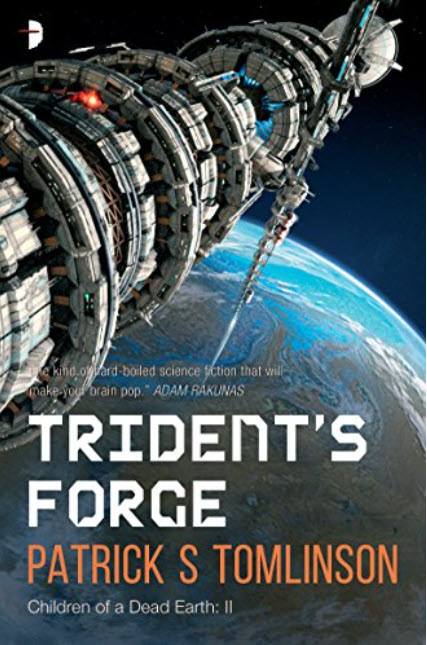
Book Review: Trident’s Forge – by Patrick S. Tomlinson

Trident’s Forge is Book 2 in Tomlinson’s series Children of a Dead Earth. Just yesterday I reviewed Book 1 here.

I wasn’t going to read the sequel, since the original book, a generation ship story, wasn’t all that exciting. However, the author roped me in with a few teaser chapters at the end of Book 1 and I read it anyway.

In Trident’s Forge, we meet the characters from The Ark again about three years after landing on the planet they call Gaia orbiting Tau Ceti. Mankind has gained a tenuous foothold. But on another continent on the planet, there is already a sentient race, they call them the Atlantians.

These aliens are slightly larger than humans, but humanoid with a head, two arms and legs, and very pliable, seemingly boneless bodies. It’s kind of strange that the author didn’t do a better job of describing how the aliens look. In my mind, they were simply big, gangly humans from the Bronze age.

Trident’s Forge is a First Contact story, albeit not one of the better ones I have read. The aliens are just like humans, with the same emotions, feelings, even reflexes. Other than looking a little different, and speaking a different language, they are just humans in costumes, and as a result, not very intriguing as aliens.

The story is another conspiracy story. Humanity has brought its worst attributes with them, including the greed of the elite class that will do anything to get rich and powerful at the expense of everyone else, including an entire sentient race. It’s a fast-moving story, quite readable, but unfortunately not very memorable.

I won’t be reading Book 3, even through I thumbed through the teaser chapters. There are too many other books on my reading shelf, and there is too little time left.

Bookreview: Earthbound – by Joe Haldeman

Earthbound is the third in Haldeman’s “bound” trilogy. The first two were Marsbound and Starbound, which I have recently reviewed. I gave them only two stars and one star respectively, and usually I would not read any more books of a series that I rated so poorly. But I made an exception with Earthbound, because I wanted to know what happened next.

In Marsbound, the protagonists traveled to Mars, found Martians, came back to earth orbit quarantine, discovered an alien race with seemingly godlike powers, and were attacked by these aliens.

In Starbound, a group of seven humans and two Martians were sent to the star of the aliens, 25 lightyears away, as ambassadors for the human race. They got there and came back, but not much happened otherwise.

In Earthbound, the group that came back from traveling to and from the alien star for more than 50 years, who had aged only a few years due the time distortion factor that applies at relativistic speeds, found itself stranded on a military base in California. The evil aliens had turned off everything electric in the world. It’s not explained how they did that, and it’s certainly not clear what alien reasoning has made them do that, other than they don’t like other races who can become dangerous by acquiring technology. So Earthbound is really not a science fiction story anymore, but an Armageddon tale of survival in a world that has been thrown back to the technology of the 1800s, however, with a supply of guns and ammunition available in the late 2100s.

Nothing much happened in Earthbound otherwise.

Book Review: Starbound – by Joe Haldeman

Starbound picks up where Marsbound stopped. Humanity has decided to send a starship to Wolf 25, the home world of The Others.

The starship uses the “free energy” concept provided by The Others through the Martians to create a matter – anti-matter reaction engine. However, for that it needs reaction mass, which it obtains from a large ice asteroid. The asteroid is large enough to provide mass to travel the 25 light years to Wolf 25 and back with mass to spare. The ship accelerates at 1g all the way to the half-way point, at which time it will have reached more than 90% of the speed of light, when it turns around and then decelerates for the second half of the trip. Due to the relativistic speed, the crew will only age 6 years during the more than 25-year journey.

They should be able to meet The Others, and come back, all over the course of a little more than 12 years in their own lives, while more than 50 years will have passed on Earth.

Along the way, unexpected events change their plans and the “meeting” with The Others is not quite what they expected.

While the premise is exciting, and the first journey of a crewed trip to another star could be exciting, the author does not take advantage of the opportunity. There are conceptual problems with the plot, and the story-telling is stilted.

There are some concepts that just don’t make sense. For instance, the ship accelerates at 1g for half the trip. However, anyone studying relativity and doing the pretty simple math will realize that, from Earth’s frame of reference, if you’re accelerating at a constant rate of 1g, then you would reach near the speed of light in about one year. Why keep accelerating after that, particularly when there is a significant plot point about the Martians really suffering in the 1g Earth-standard gravity. They could have turned the engine off after one year, and they would arrive only very marginally later, after turning the engine on for braking again one year out. The whole thing just didn’t add up.

Another massive plot hole is that the entire premise is that the limit of the speed of light affects all races, including The Others. They can’t travel any faster than anyone else. However, somehow they are able to cause terrible destruction to humanity seemingly instantaneously, as the plot of the story will tell.

Yes, you may say this is science fiction, and the author has to right to make up the technology. But this does not work if on one side the author goes to great lengths building a world around the limitations and effects of general relativity, but on the other hand seems to break those rules in deus ex machina fashion all throughout the plot.

Finally, let’s talk about the crew. Humanity sends seven humans and two Martians as the world’s ambassadors to another star to meet a known very hostile race. Leaving the two Martians alone, the human crew consists of two married couples. The first are Carmen Dula and Paul Collier of Marsbound. The other are Meryl and Moonboy, the two xenologists of Marsbound. Then apparently to make things interesting, they add a triad (marriage of three) with two male “spies” and their mutual wife, Elza, who is a medical doctor who also happens to be a nymphomaniac. This causes all sorts of friction as she sleeps her way through the crew within the first few weeks. Why in the world would humanity set up a team of star travelers who would be cooped up in a spaceship tin-can for 12 years and not make sure there will be sexual stability for the journey? I assume it’s for plot purposes, so there is plenty of sex sprinkled into the story. I might add that the sex really does not work in this story.

The author also applies a strange concept of using three different narrators, switching between chapters. One is Carmen, the other in Namir, one of the spies, and the third is Fly-in-Amber, one of the Martians. I don’t see why that was necessary, as it didn’t add anything to the story as far as I could tell. But it was confusing, since I had to figure out who was talking every time a new chapter started with the protagonist speaking in the first person. He could have put the name of the narrator into the chapter title and made it a little more straightforward.

Starbound is a tale with a lot of possibilities, but those are completely wasted. Haldeman is a good story teller, and I enjoy his novels, but this one is just too poorly crafted and constructed, with a far-fetched a plot that I simply was not able to buy into.

Book Review: A Maze of Stars – by John Brunner

The only other Brunner story I ever read was Lungfish, and here is my review.

Brunner wrote A Maze of Stars in 1991.

Somewhere, sometime in the distant future, humanity has left its birth world, Earth, and developed a starship with a mission of seeding new planets with humanity. After initial robotic missions, “the Ship” takes a load of humans and seeds about 600 planets in “the arm of stars” or just called “the Arm.”

There are about six hundred thousand stars visited by man, and sixty thousand have planets hospitable to life, six thousand have developed life and six hundred have been seeded with humanity. Only about 60 of those are fairly successful, and most of them are in some state of devolution.

The Ship is artificially intelligent and has become sentient. It’s been about 500 years since the planets were seeded, and the ship is on an endless loop, visiting the planets clandestinely and observing the outcome. The only problem is, the ship’s jumps through hyperspace, called tachyonic space in this book, result in various jumps in time in addition to space. The ship can’t control the time jumps. So it sometimes “remembers” the future of a planet it is visiting, because it has been there “before” which was far in the future.

Are you confused yet? I certainly was.

A Maze of Stars has a solid and interesting premise, basically observing what happens to humanity in adverse conditions, left to its own devices. Each planet is different. The ship visits the planets undetected, and it has this amazing technology that it can project itself as a realistic human being on the planet itself and interact with the people. It can also “remote view” scenes on the planet and be an observer. Finally, it can show such remote viewings to its passengers, sort of like an immersion movie.

One interesting premise is that most of the planets are hyper-concerned about germs, diseases and viruses that might come from other planets that they have no defense against. Much of the inter-planet trade or exchange is therefore blocked by the various planets, and interaction is severely minimized.

All of this sounds very interesting, but Brunner has made it completely boring and a real slog to read. Nothing happens. The ship simply visits one planet with a weird name after another. We observe pointless vignettes of action by cardboard characters that appear in one chapter only to completely disappear in the next. There is no story, there is no plot, there is no common thread, there is no suspense. And when there is an opportunity to make it interesting, Brunner misses it. For instance, he describes weird mutations but does not “describe” them leaving the reader helpless. He mentions exotic extraterrestrial animals, but does not even attempt to describe what they actually look like. And there are no sentient aliens in this story, even among 600 seeded planets – not one intelligent alien culture that has productively interacted with humanity.

A Maze of Stars is full of interesting concepts, each worth a book of its own, but none of them explored in any detail. The printed edition of the book was 393 pages long. I read the Kindle digital version, and it seemed like two volumes of War and Peace back to back – endless. It slowed down my reading and made me thirst for novels that actually have some plot, some story that keeps turning the pages.


Movie Review: Creep

Aaron is a freelance videographer. He answers an ad on Craigslist for a one-day job to videotape a man dying from brain cancer, who wants to leave a video journal of one day of his life for his unborn son. The instructions are for Aaron to tape himself driving up to the mountains. When he arrives and meets the man who hired him, Joseph, things turn creepy right away, and get more and more uncomfortable for Aaron as the day progresses. When Aaron is ready to leave in the evening, he can’t find his keys. Joseph convinces him In the next few days, the learns that the job wasn’t quite what he thought is was.

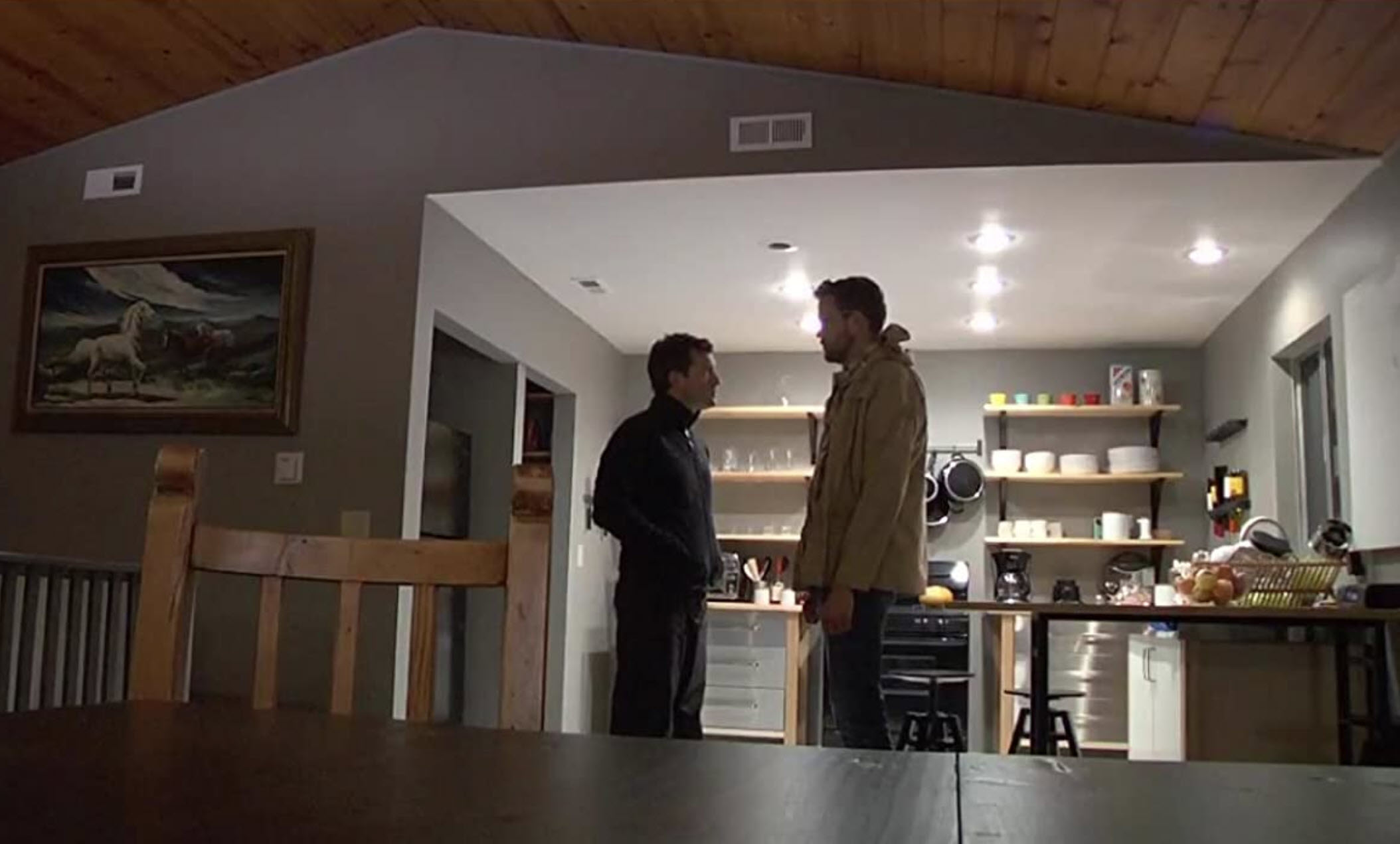
Creep is the 2014 movie we ended up choosing to watch on Halloween night, when the pandemic kept the streets empty of trick-or-treaters, and we were looking for a scary movie. There are exactly two actors in this movie, Aaron (Patrick Brice) and Joseph (Mark Duplass). It could have been a play.

This film would not win awards in cinematography, since the entire movie is filmed by a hand-held video camera. You hardly ever see both actors in the same frame, since one of them always holds to camera, consistent with the plot. The picture is always shaky, to the point where I felt dizzy at times. Creep got 89% from the critics on the Tomatometer, but I have to say I just found it – well – creepy. Being what it was, I expected that axe in the front yard of  the house in the mountains to have some role in the movie, and indeed it did in the end. But Creep did not draw me in. I watched it from a distance, so to say, as an exercise, rather than a movie I was drawn into by anything it offered. No music, bad pictures, shaky frames, very unlikable characters, silly plot, none of it spoke to me. While it didn’t specify the location, the scenery looked a lot like Big Bear, California to me, and I could relate to the cabin, having rented some there from time to time, and trails in the woods, and the scenes by the lake.

If you want to see a weird and creepy movie, do watch Creep, but don’t expect to write home about it afterwards.