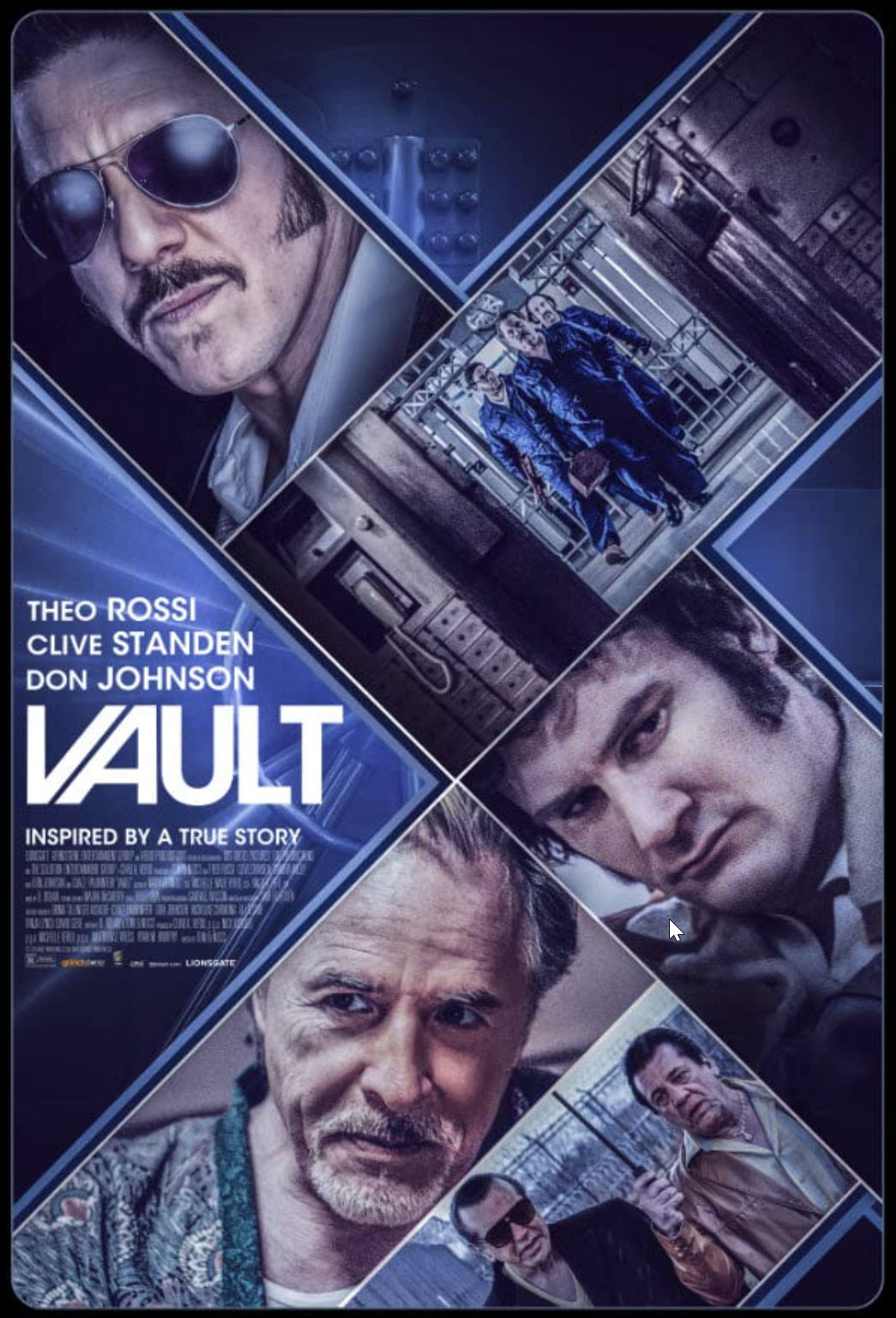
Movie Review: Vault

It’s 1975 in Rhode Island. Small-time thugs Deuce (Theo Rossi) and Chucky (Clive Standen) are holding up pawn shops and jewelry stores, when they get the idea to rob two banks in the same day. But for that, they need help. They join forces with Gerry Ouimette (Don Johnson), also called “The Frenchman” in mob circles. Deuce and Chucky quickly get sucked into the New England mob underworld, where bosses run their empires out of prison cells.

Rather than robbing banks, Gerry has bigger plans, like stealing thirty million dollars directly from the mob by taking down a private vault hidden in a Providence fur storage business. This eventually turns out to be one of the largest heists in U.S. history.

Based on a true story, Vault is a view into the world of the mob in the 1970ies, and the life and times of the people getting sucked up by that world, including the women that somehow find it desirable to get involved with these guys. Vault is entertaining, at times comical and definitely thought-provoking.

After watching this movie, I was glad to go to bed in my middle-class house in my middle-class world.

Whew.


Movie Review: Freedom Writers

It is the time after the Los Angeles Riots in 1992. Erin Gruwell (Hilary Swank) is a young and idealistic teacher who leaves her safe hometown of Newport Beach to teach freshman and sophomore English at Woodrow Wilson High School in Long Beach. The school has just implemented a voluntary integration program, and gang violence in the community is terrorizing the school. The Latinos hate the blacks, the Cambodians hate the Latinos, every group hates every other group, and the white minority is drowned out. Every kids knows somebody who has been killed by gang violence. The students are un-teachable. None of them have any respect for Ms. Gruwell.

When she intercepts a racist drawing one day, she uses it to teach the kids about the Holocaust. Slowly, one student at a time, she wins them over. She asks them to write journals about their lives and experiences, and slowly she wins their trust. To finance materials and field trips, she takes on a second and third job. In the process, she loses her husband. Only her father sticks with her and supports her endeavor. One by one, she brings the students together and  they transcend their former boundaries and hate. The students become friends, and they revere Ms. G, as they endearingly call her.

Freedom Writers is not just a movie about a high school teacher, it’s about America locked in diversity and divide, trying to overcome the differences, and growing as a microcosm – a single class of kids – and as a nation.

Freedom Writers is an uplifting story that left me feeling enriched and inspired.

Visiting Arcosanti in 2020

Arcosanti is an “experimental city” in the desert about 70 miles north of Phoenix, Arizona. It is a spatial experiment and urban laboratory built by more than 8,000 participants, mostly volunteers and workshop members from all around the world over a 50 year period. The first buildings were erected in 1970.

Arcosanti is focused on innovative design, environmental accountability and experimental learning. It is home to a small but vibrant community of currently about 75 people, living and working in various mixed-use buildings and public spaces.

The project was started by the visionary architect Paolo Soleri (1919 – 2013) who was the leading force behind the project for most if his life, starting in the 1950s.

You can find out more about many of the details at arcosanti.org or, more factual, at the wikipedia page.

The first time I visited Arcosanti was in 1978, over 42 years ago. I went back a few times through 1984, but have not been back there since then. I have no pictures from those visits, only distant memories and impressions.

I remember thinking at the time that it was an interesting and admirable experiment in design and living, run but a group of hippies and idealists, but that it would never “get off the ground.” In the early years it didn’t change much.

So I was definitely interested in what I would find now in 2020.

We arrived at 9:00am on Friday morning, after a few miles off the I-17 freeway, driving down a dusty washboard dirt road through the desert. The parking lot was still empty. Our car was the only one there.

The path down to the visitor center was not too friendly, with decrepit benches and weeds that hadn’t been trimmed in years.

Here is the entrance to the visitor center.

Arcosanti makes a significant portion of its revenue from the sale of bells, both clay bells and copper bells. Prices range from $50 up to many hundreds of dollars for the larger and more elaborate ones. There are many to choose from in the gallery on the main entry floor.

We signed up for a guided tour of the entire facility, where  we saw the main buildings and learned about their use. Above is the “Apse” which is a half-dome that serves as the shop for where the clay bells are made.

Then there are the iconic arches, which is the feature that every visitor to Arcosanti will remember forever. These arches were there when I first visited, and they are still there now, and they look exactly the same, perhaps a bit more weathered and worn, but still carrying the “unfinished look” they had over 40 years ago.

Here is the amphitheater and some living quarters behind it.
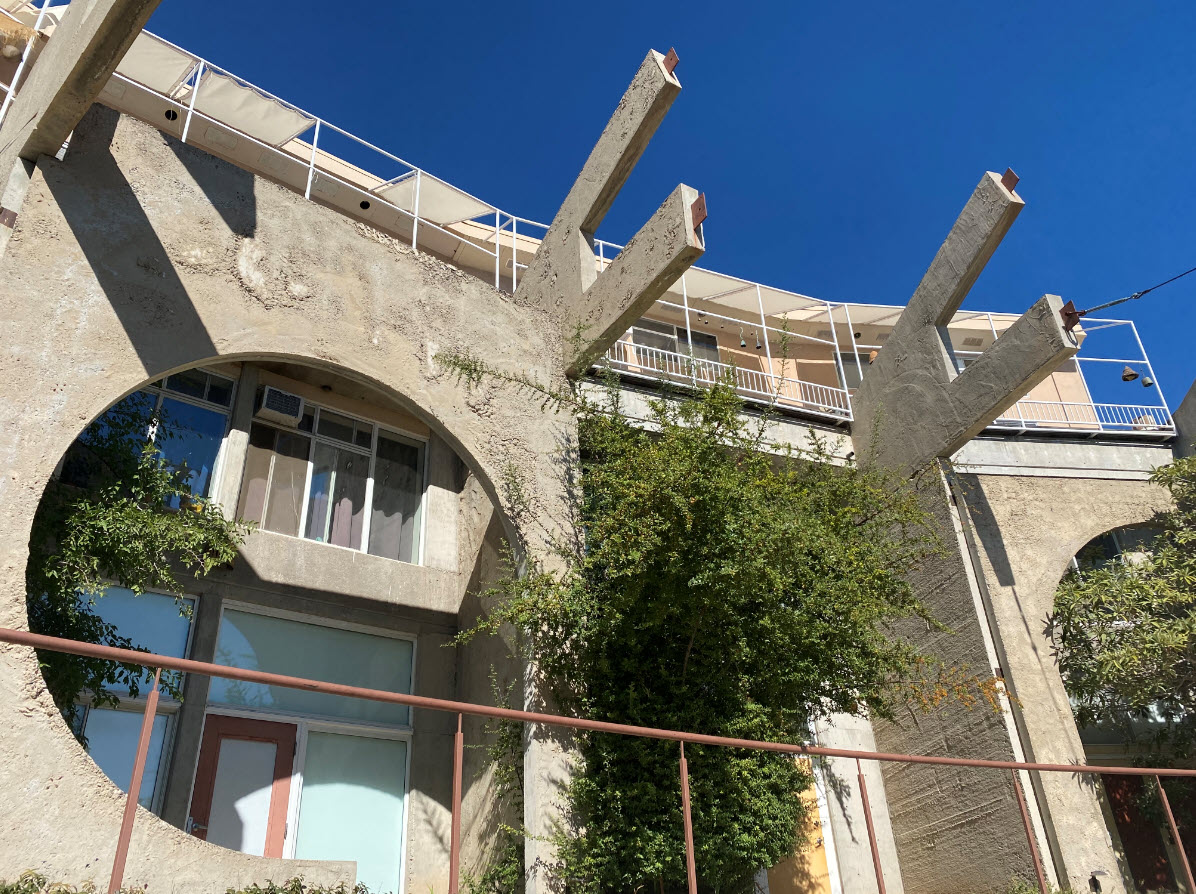
Looking up, you can see the attachments for the canopy over the amphitheater that has never been completed.

More living quarters, and a greenhouse in the back.

Here is a view of the foundry, a domed building with offices and living quarters close by. The main central area is where the copper bells are poured in sand forms.

Our tour lasted about an hour and a half and ended in the cafeteria, a few levels below the gallery in the main visitor building.

Here

Here is a view out the cafeteria window to the south.


Another view. The cafeteria also serves as a display area for artists to show and sell their pottery, jewelry, garments and many other objects.

The community attracts about 40,000 visitors every year.

The existing structures at Arcosanti are meant to begin to provide for the complete needs of a community. They include: a five-story visitors’ center/cafe/gift shop; a bronze-casting apse; a ceramics apse; two large barrel vaults; a ring of apartment residences and quasi-public spaces around an outdoor amphitheater; a community swimming pool; an office complex, above which is an apartment that was originally Soleri’s suite. A two-bedroom “Sky Suite” occupies the highest point in the complex; it, as well as a set of rooms below the pool, is available for overnight guests. Most of the buildings have accessible roofs.

— Wikipedia

Of all the buildings there, the last one was completed in 1989. This means that for over 30 years, no new construction has been undertaken and the community has not grown.

Arcosanti looked unfinished and untenable in 1978, and it still looks exactly that way now. It’s an experiment that never quite got off the ground when the founder and visionary was driving it. Now that Soleri is no longer alive, I wonder if there is enough will and stamina to keep it growing.

When Arcosanti was home to a few dozen people in 1978, I thought it would be home to hundreds, or thousands, in the years to come, as their plans indicated. That has not happened as of now in 2020.

I wonder what will happen in the next 40 years? Of course, I will never know.

But I am sure there will be an Arcosanti, baking in the Arizona desert sun, for many decades to come, and visitors will take home the beautiful bells. Here is ours, gracing our patio at home:

If you have the chance to stop by, I recommend you do so.
Capital One Monitoring my Tips

Last weekend we went out to dinner at Vintana’s, one of the best restaurants in Escondido. It has a large outdoor patio, and in the fall sunset of Southern California, it does not get any better than that.

We also have a restaurant “passport” card, which gives us one entrée for free. With prices being in the $30 for $40 per dish, that is not an insignificant discount. After drinks, an appetizer, and two entrées, with the discount applied, the bill still came to about $80.

I want to support our restaurant community, I want to support our service staff who work hard under difficult conditions, so I boosted the normal tip of about 20% much higher, tipping like I would have done for the full-cost dinner, without the discount.

A day later I received the above email from my credit card company, asking whether I really meant to give a 37% tip at Vinana’s. My credit card company is looking out for me. If this had been a mistake, I would have been able to correct it. That was actually impressive to me. On the other hand, it made it clear that I am being watched, and that my activities, including my spending habits, are predictable and are being monitored.

I feel good, and I feel concerned, at the same time.

But the tip stands. Our server did an excellent job.

Our Response to the Michigan Would-Be Kidnappers

Here are the mugshots of 10 of the 13 would-be Michigan kidnappers.

People who are planning on kidnapping an American Governor and possibly executing her are called terrorists. Since we usually associate terrorism with foreigners, we have narrowed the term down to “domestic terrorists.”

Here are pictures of domestic terrorists. They are all white. I don’t know these 10 men, but I do know our media calls them “white supremacists.” I am actually curious about what goes on in the head of somebody who plans to kidnap and possibly execute a governor. I would like to have a conversation, maybe over a beer in the backyard. What would be their persuasive argument?

But this post is not about the would-be kidnappers. It’s about how our president responded to their story.

If these 10 people where Muslims, with dark beards and Arab head dress, our president would have responded with a further escalation of the ban of all Muslims in this country, and every Muslim American would have had to pay for it with abuse, discrimination, assault in public and pure fear for their safety.

If these 10 people were Hispanic, our president would have told us the Mexicans are murderers, rapists, criminals and needed to be deported, and – by the way – we need to build that wall. All Hispanics would have been further injured and damaged.

If these 10 people were Black, all black people would have been denigrated and the entire black-lives-matter movement would have been attacked as anarchist. The president would have blamed the black community for their crimes.

But these men are all white.

So the president attacked their victim, the Governor of Michigan. Apparently she had it coming.


Trump: Hillary is A Wonderful Woman

Hillary Clinton, Donny Jr., Eric and me. The First Lady is a wonderful woman who has handled pressure incredibly well.

— Donald Trump


Voting by Mail in California

I have voted.

I have voted by mail for at least the last 20 years.

This year, it’s more controlled than ever. I signed up for tracking of my ballot, and I am getting texts every step of the way. I received a text when my ballot was mailed to me. I filled it out on Tuesday and dropped it into the mailbox down the street.

Today I got this text:

I am not sure it could get any better than that. California can do it. Why can’t all states do this?

We are registered by our driver’s licenses, passports, social security numbers, and all out banking methods. We have a registry of voters in every state, it’s called the “Registrar of Voters.” A simple ballot tracking system would make voting safe, speedy and efficient, and every vote can be counted.

But then again, the NRA does not want a national registry of gun ownership. I wonder why.

And it appears the GOP does not want safe, expeditious and effective ballot tracking. I wonder why.

Book Review: Disloyal – by Michael Cohen

When Disloyal came out I knew I had to read it. Who is this most powerful of Trump’s enablers? Who is this guy that I read about long before Trump’s announcement of his candidacy, the ruthless wolverine who came after Trump’s victims and threatened to ruin them if they even tried to assert their rights?

When the White House found out that Cohen was writing this book, they tried everything they could to stop him from publishing it. It was going to be a sensational tell-all book.

Well, it is.

Cohen was there from the beginning. He knows Trump intimately, and he was his most loyal and effective confidante and protector. To understand Trump, we need to read Disloyal, because it tells what it was like to work for Trump.

Here is an excerpt:

We all flew to Green Bay, Wisconsin for the event titled Trump: The New Owner of WWE Raw. All of us invited were eager to experience what we knew was going to be a wild, fun night. In the dressing room under the stadium, we could hear the mounting noise of the crowd coming in, and it was obvious that the place was going to be sold out, not to mention the huge pay-per-view audience. This was when Don Jr. spoke out of turn, at least in the eyes of his taskmaster father. “Hey, Dad, are you nervous?” he asked. “What did you say?” Trump asked, his face reddening. “I’m going in front of millions of people. What kind of stupid fucking question is that? Get out of here.”

We all stood in awkward silence, staring at our shoes, feeling sorry for the son and his perfectly innocent question.

“God damn it,” Trump said with a heavy sigh, as if his son wasn’t present. “The kid has the worst fucking judgment of anyone I have ever met. What a stupid thing to say—to put that thought in my head.” Don Jr. said nothing, also inspecting his shoes, and no doubt desperate to flee. The hurt was evident in his face and demeanor, even though this was hardly the first time I’d heard Trump insult his son and remark on his supposed lack of intelligence. I often wondered why the son stayed around in the face of the abuse of his father, though I knew the answer, because Don Jr. had told me the story.

— Cohen, Michael. Disloyal: A Memoir: The True Story of the Former Personal Attorney to President Donald J. Trump (pp. 83-84). Skyhorse. Kindle Edition.

Obviously, the White House said that Cohen is a liar – and he is, by his own admission – but when you read his story, it’s obvious that he is not making this stuff up. He just tells it like it was, like a journal entry, and he doesn’t really “blast” Trump either. He just describes, almost soberly, some of his more atrocious deeds. The personality of Trump comes out, similar to how it came out in Mary Trump’s book Too Much and Never Enough.

Most of all I was struck with the realization that Trump USED Cohen, over and over again, until — suddenly — when Cohen fell due to his covering for Trump, he was no longer useful to him. Trump immediately disowned and abandoned him. Cohen is now in prison (at this time serving his sentence under house-arrest) and Trump is — still — in the White House. Trump uses people, everyone, his wife, his children, his best friends, his relatives, his employees, his vendors and contractors, and now the entire population of the United States, to serve him. Cohen’s book shows how he does that.

Michael Cohen’s book is not a “great book” or an exceptional memoir. It is a sober book, well told, revealing, and it shows us what Trump really is: a fraud.

Movie Review: Beyond the Time Barrier


United States Air Force Major William Allison (Robert Clarke) is a fighter pilot in 1960. His mission is to fly the X-80, which is actually an F-102/F106 figher, up to 500,000 feet to “the edge of outer space” at supersonic speeds as a first ever.

During the trip, he breaks through a “time warp” and ends up landing on the same airfield, now abandoned and derelict, in the year 2024.

He finds the world destroyed by a plague in 1971, which leaves all humans sterilized and infertile. Most humans are now mutants and devolved, they are deaf-mute, and society lives in underground cities. When they realize the Major comes from a time before the plague, they want him to sire offspring with the only fertile human left alive, the lovely Princess Trirene (Darlene Tompkins).

But the Major has no interest in serving as a stud. He thinks it’s better for him and the world to return to 1960, if that is even possible, and warn his compatriots of the upcoming plague and prevent it altogether, thus altering history.

Beyond the Time Barrier is a really bad movie. Of course, being made in 1960, it was in black and white, and the orchestral sound track is awful. There are no special effects whatsoever. We see the F-102 take off shot in stock footage, then it becomes a plastic model that floats in front of a fake star-studded sky. Imagine Godzilla being represented by a 12-inch plastic toy that hops around in a movie set – that’s how realistic this all looks.

But well, such was the technology in the 1960s, and that’s what science fiction movies were like. I vaguely remember watching a movie like this as a small child, showing a flight to the moon, ten years before that actually happened, and years before President Kennedy’s announced commitment for the Apollo program. I was fascinated when the astronauts stepped out of the rocket that had landed tail first on the moon.

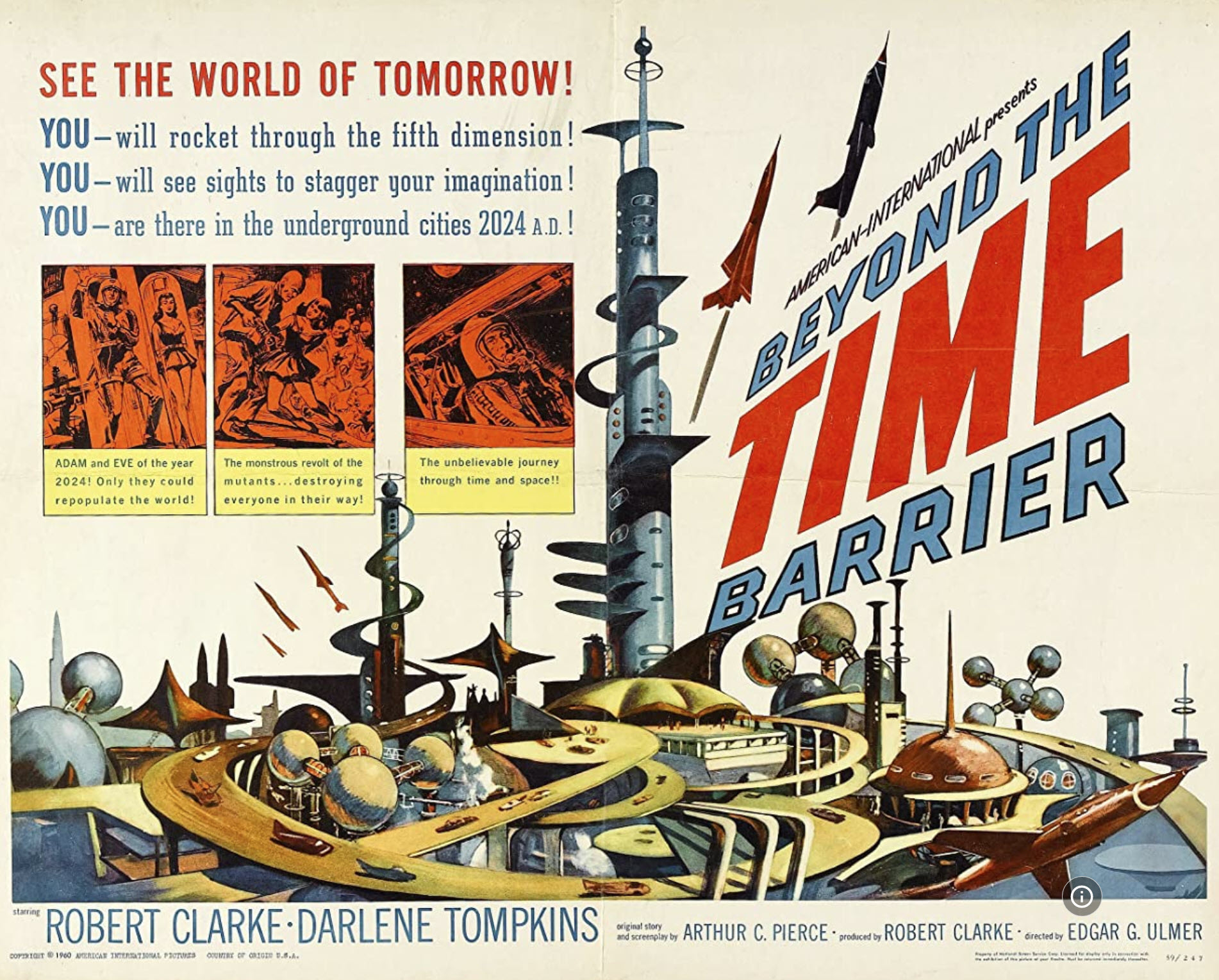
The most fascinating part about Beyond the Time Barrier is how the science fiction crowd of 1960 imagined the far distant future 64 years hence in 2024. You can see some of their musings on the movie poster above. It is entertaining being here in 2020 and writing this review just four years before the target time of 2024, which to them seemed utterly utopian. I wonder what they would have thought of a blogger in 2020 writing about their movie?

The technology they envisioned is nothing like the technology that actually happened. All their “futuristic gadgets” are just crude 1960 technology made out to be incomprehensible. They didn’t anticipate miniaturization of any kind or any computer technology at all for that matter.

I always find it uniquely entertaining to see a movie after the future it predicts has already happened, like watching Back to the Future after the year 2015, the farthest into the future Marty travels, or reading Orwell’s 1984 now, almost 40 years after the envisioned distant future.

And that experience brings Beyond the Time Barrier from zero stars to half a star.

Welcome to October 1st – 98 Degrees Fahrenheit

Looking out our window this afternoon to our shaded porch, it was 98 degrees F.

For my European readers, that’s 37 degrees C.

In the shade.

On October 1st.

California is burning.

And it has nothing to do with our not raking leaves in the forests.

Most of California is desert, not forests, anyway.

Hot.


Donald Trump Cheating on a Poll – by Michael Cohen

I am reading Michael Cohen’s book right now, and one of the most revealing and interesting chapters to me what Chapter Ten – How to Fix a Poll. It’s not a widely known incident or story, but it tells more about Trump than many of the other stories and scandals that we have heard about.

In 2014, Trump was starting to get serious about running for office, and he wanted his image to be one of a highly respected and famous business man and real estate developer. Around that time, CNBC was celebrating its 25th anniversary as a network, and to do so it was conducting an online poll to determine the twenty-five most influential business people alive. The poll stated that “he or she should have altered business, commerce, management or human behavior – in other words, the person should be responsible for ushering meaningful change, with business being the primary sphere of influence.” Trump was one of the two hundred business people listed as contenders.

Inside the Trump organization, his secretary emailed everyone she could to click on the hyperlink to elevate the boss’ profile.

That is ludicrous to begin with. If I did that in my company, my employees would laugh at me.

But it seems to have been normal at the Trump Organization. They figured that if everyone “inside” were to vote on their computer, their phone, their tablets, the tablets of their kids, etc., it would be enough to get him into the top 10. When CNBC first started publishing results, Trump was near the very bottom, like 187 out of 200. Trump was reportedly pissed. He printed out the results grid, marked it up with a Sharpie and called Cohen: “What can we do about this poll? I am at the bottom of the fucking list. Check into this immediately and let me know.”

Cohen called an IT friend for help. His company knew what to do. They bought several batches of IP addresses to hide the fake polls, and inserted the votes to drive up Trump’s numbers. Their goal was to get him to number 9. Trump wanted number 1, but they thought nobody would believe it and it would create too much scrutiny. The IP addresses cost $7,500 for batches of 100,000, and they needed several. Trump approved the purchase.

They pulled it off, and Trump made number 9 on the list. He was all excited, had hundreds of copies of the list printed, sent it to all his friends and contacts to gloat, and distributed it to his visitors in his office.

Then CNBC completely removed him, no answers given. While Cohen never did find out what happened, CNBC had the right to do so. Being an IT guy myself, it’s obvious that CNBC figured out the fraud and without making much fanfare about it, which they could have, they simply removed him completely.

Trump was furious. He ended up not even paying the consulting firm that had pulled it off. He stiffed them for their services and for the purchases of the IP addresses. After all “they didn’t deliver the objective” so why should he pay them?

He was so incensed, he wanted Cohen to call the president of CNBC and tell him they’d sue him if they didn’t restore his rightful slot.

Think about that for a minute. Here is a business man that is so obsessed with his image that he is willing to openly cheat in a poll. Then he “wins” and is delighted. That’s like a boy scout stealing a trophy and showing it off as his own. Then, when the fraud is discovered, and the trophy is taken away, he is indignant, actually personally offended. The world has it out for him. He obviously believed himself that he “deserved” that award and it was taken away from him. Not only did he cheat, but he himself believed that he earned it.

If any school boy between age six and twelve did this, we would reprimand him.

But Donald Trump did this in 2014. That is the kind of man we elected for President of the United States.