Book Review: Never Flinch – by Stephen King

When you pick up a Stephen King novel you know you will be entertained. King is an excellent story-teller, and his characters always come out clear and real. The amount of detail is almost overwhelming, like watching an IMAX film in a high-resolution theater. You are right in the middle of it.

In Never Flinch, King tells the intertwining story of one serial killer with daddy issues, and one vigilante religious nut who is out to silence a woman’s rights activist by trying to kill her. The plot lines are intricate and carefully crafted. The story takes place in Iowa (mostly) in today’s world.

King has always been good about weaving in current events. Trump is in the story, so is JD Vance, the characters use the latest technologies, iPhones, social media and web sites. You can tell on every page that this plays right now. It becomes real.

The story itself is a crime thriller. He narrates it in the present tense, switching between the different characters and going deep into their psyches. King highlights the issues of religious zealous activism, people damaged by their  incompetent and outright abusive parents and the matter of abortion rights in the age of post-Dobbs.

I gave it only 2.5 stars for several reasons: The story itself, while it gave me some insight, didn’t really teach me anything. It’s just a thriller. I found no redeeming literary value. But this is Stephen King. He wrote many books that were much better overall, and this one was okay, but definitely not even in his top five, in my opinion.

In summary, Never Flinch is superb, vivid and masterfully told entertainment, and entertainment only.

Priorities of the Veterans Administration

Today I received an email from the Veterans Administration (VA) about two things:

It invited me to celebrate the Army’s 250th Birthday by attending a free festival and parade in Washington, D.C.

In the same email, it advised me of facts about erectile dysfunction and how to treat it.

I am not sure which one caught my eye first.

Oh, Chicago!

I have been to Chicago hundreds of times over the last twenty years, but always just for layovers in O’Hare. The last time I remember walking the city streets was perhaps in 2004 or 2005, a very long time ago — until today.

I had a little extra time in my schedule this afternoon and I decided to check out the Art Institute of Chicago, which was just a couple of blocks away from my hotel. Here is the main entrance on South Michigan Avenue:
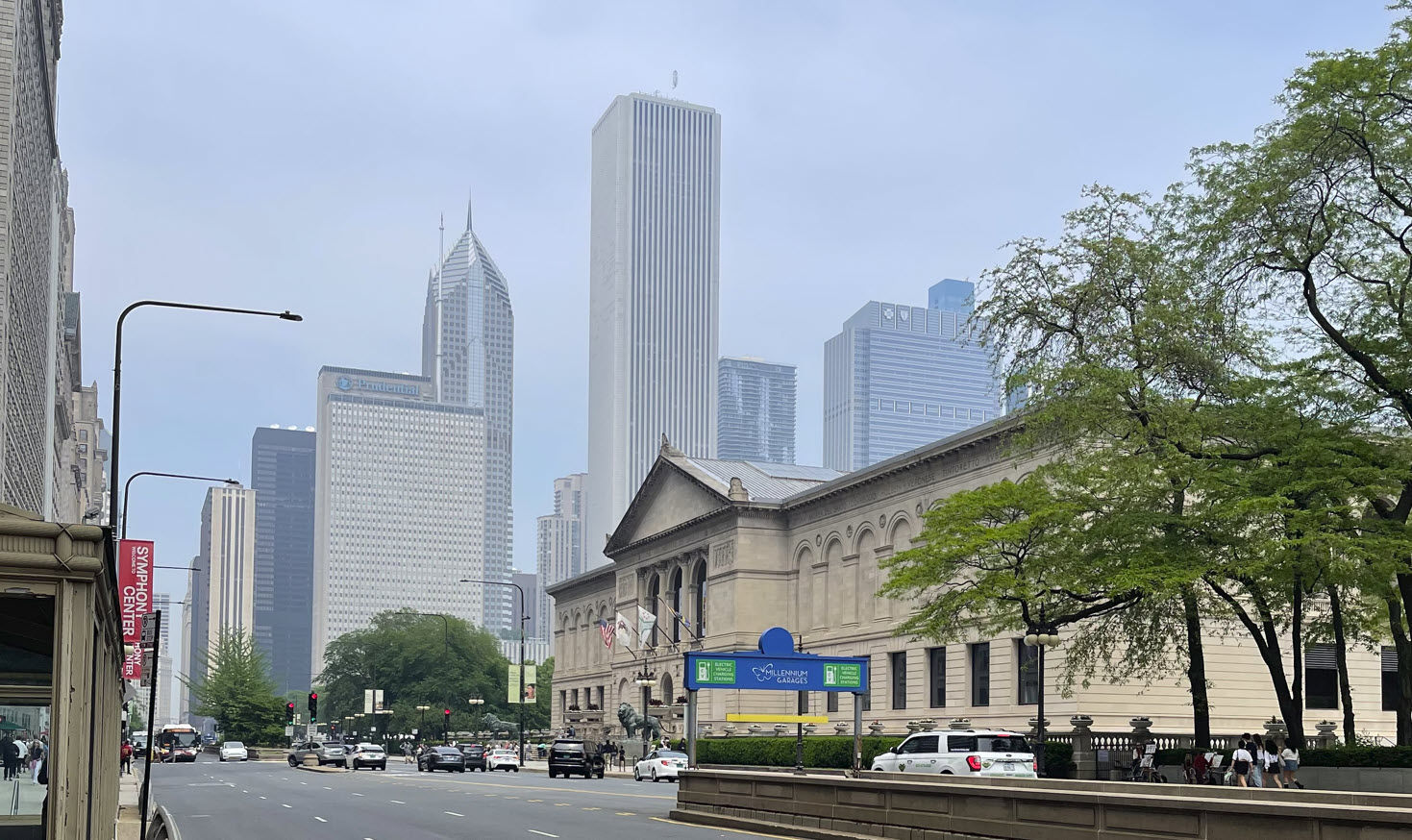
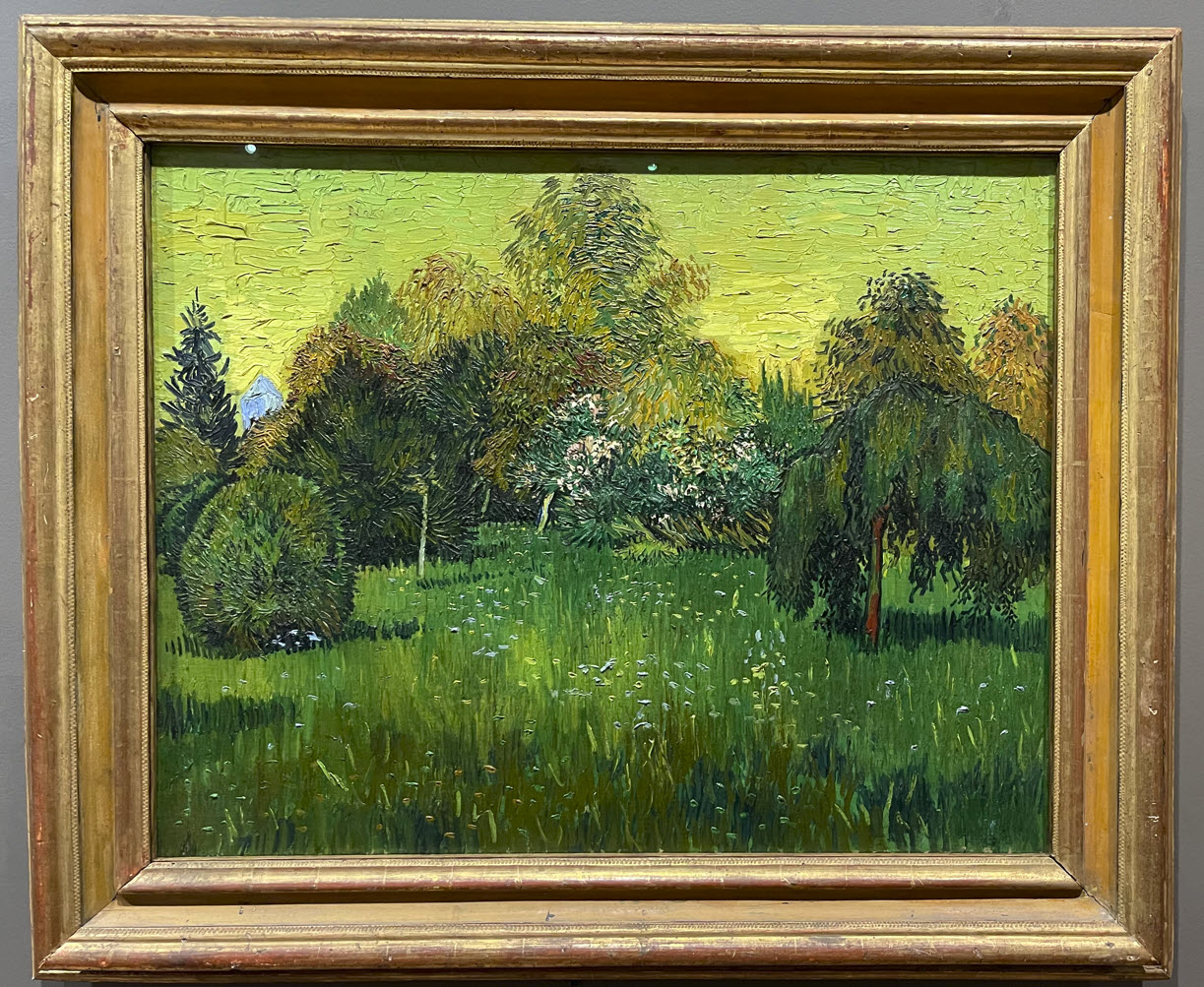
I was very impressed. The Institute is a very nice museum, not at all crowded or tight. And the art was amazing. Mind you, I was just at the Louvre last summer, and I am not comparing the two museums in terms of scale. But I loved the museum itself, and the variety and quality of the art. There were many famous pieces that I had only seen in books before, and there were more works from van Gogh than one usually sees in an American museum. With van Gogh, I always want to take photos of them all, but I had to hold myself back, and only show this one here:

The Poet’s Garden.
After several hours and thousands of steps, when my eyes were full and my feet hurt, I left and sat down on the stairs in front of the main entrance. When I looked up, I saw the Willis Tower, formerly the Sears Tower until it was sold in 2009.
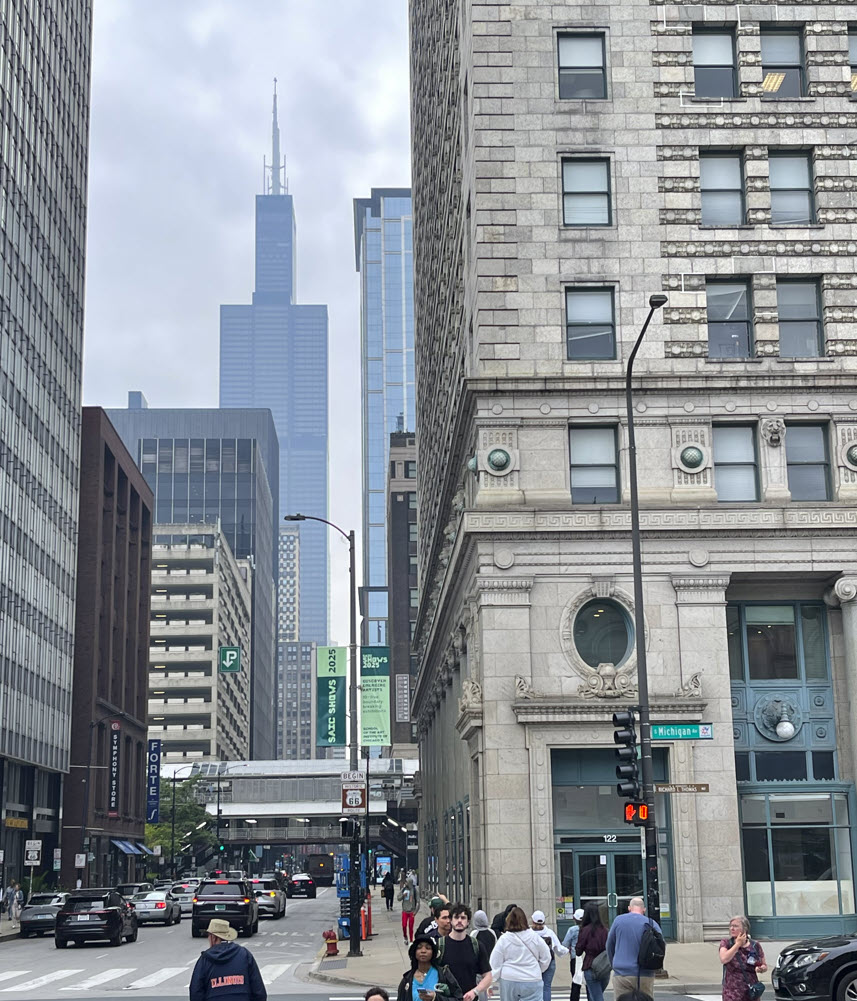
With a height to the roof of 1,450 feet and 1,729 feet including the antenna, this was the highest building in the world from 1973, when it was completed, until 1998, when the Petronas Towers were built in Malaysia. It is still the tallest building in Chicago today.

Here is a better view from a different angle, a few blocks away:

A block in the other direction is the Millennium Park. One of the attractions there is the Jay Pritzker Pavillion:
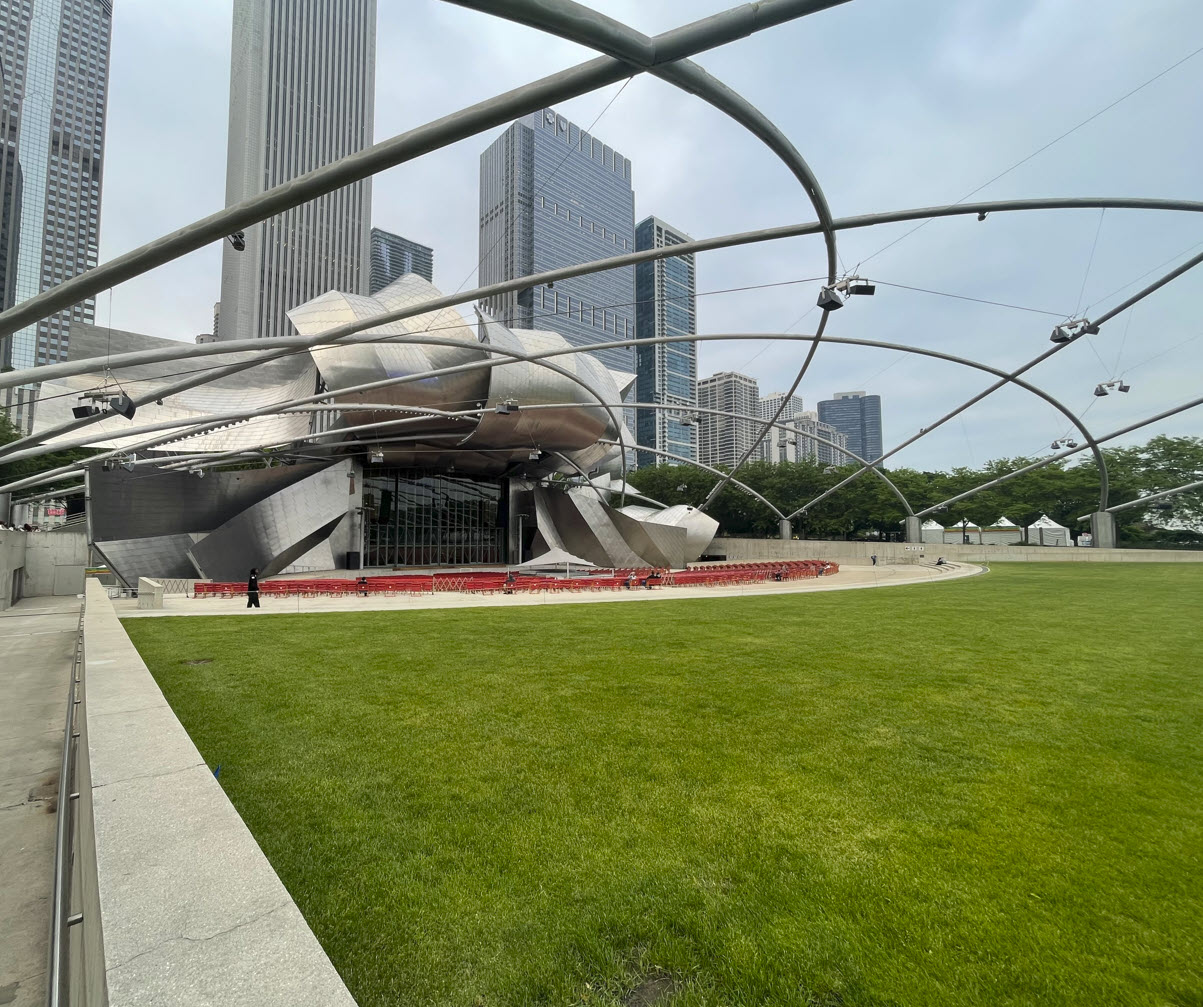
It is an outdoor theater. There are seats in the front area (the red row) that looks small from where I took the picture, but it actually contains 4,000 fixed seats down there. In addition, there is a 95,000 square foot lawn that can accommodate an additional 7,000 people. 
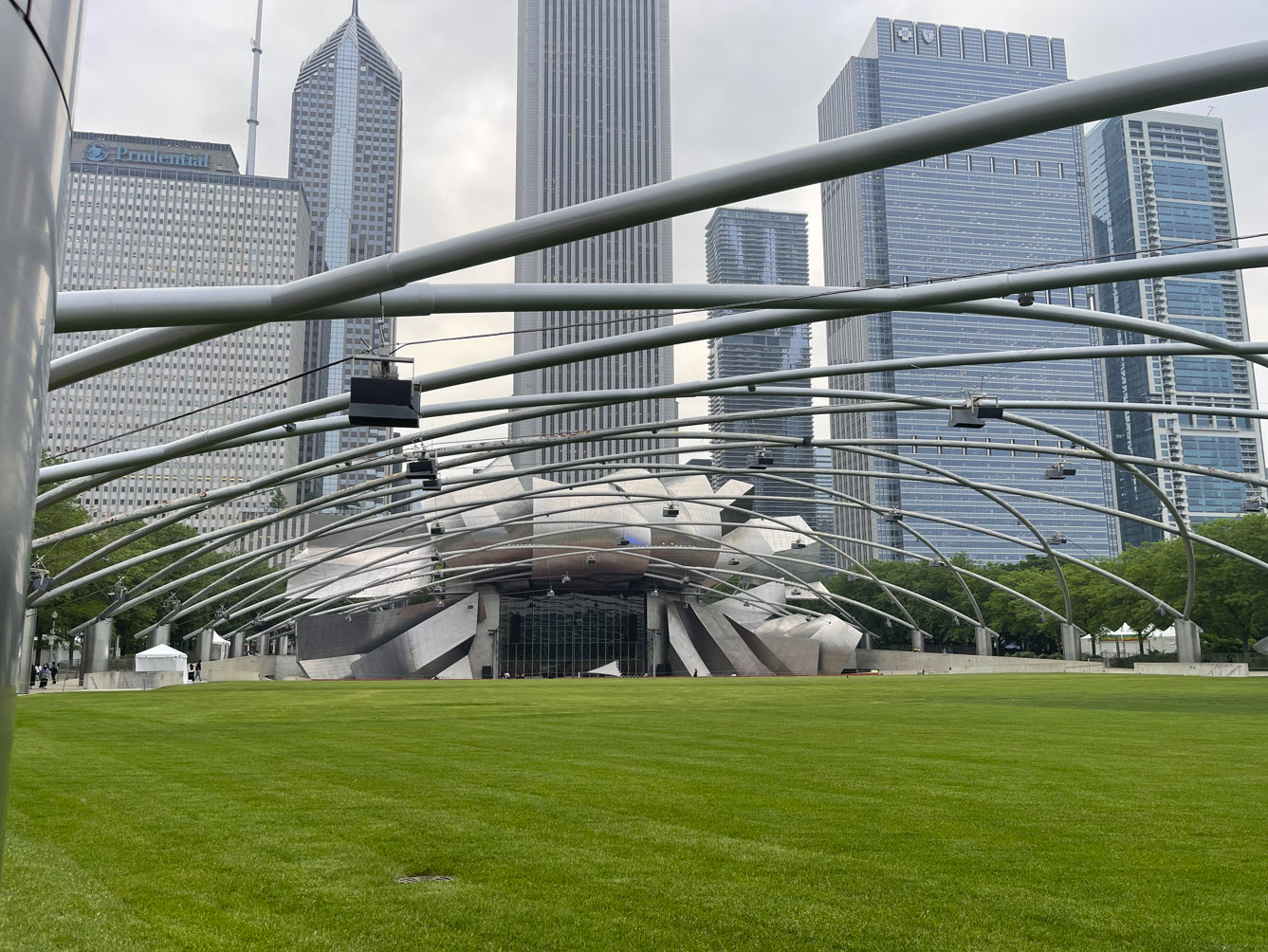
Here is another photo of the great lawn from further back. This venue reminds me a bit of the Rady Shell in San Diego. We were just there last week for a concert of Hauser (which deserves a post of its own). The Rady Shell has 4,516 fixed seats, with the possibility of increasing to 6,000 for certain events and standing-room-only shows accommodating 8,500. So the two venues are quite similar. 

Another attraction at the Millennium Park is Cloud Gate, which is affectionally called “the Bean.”
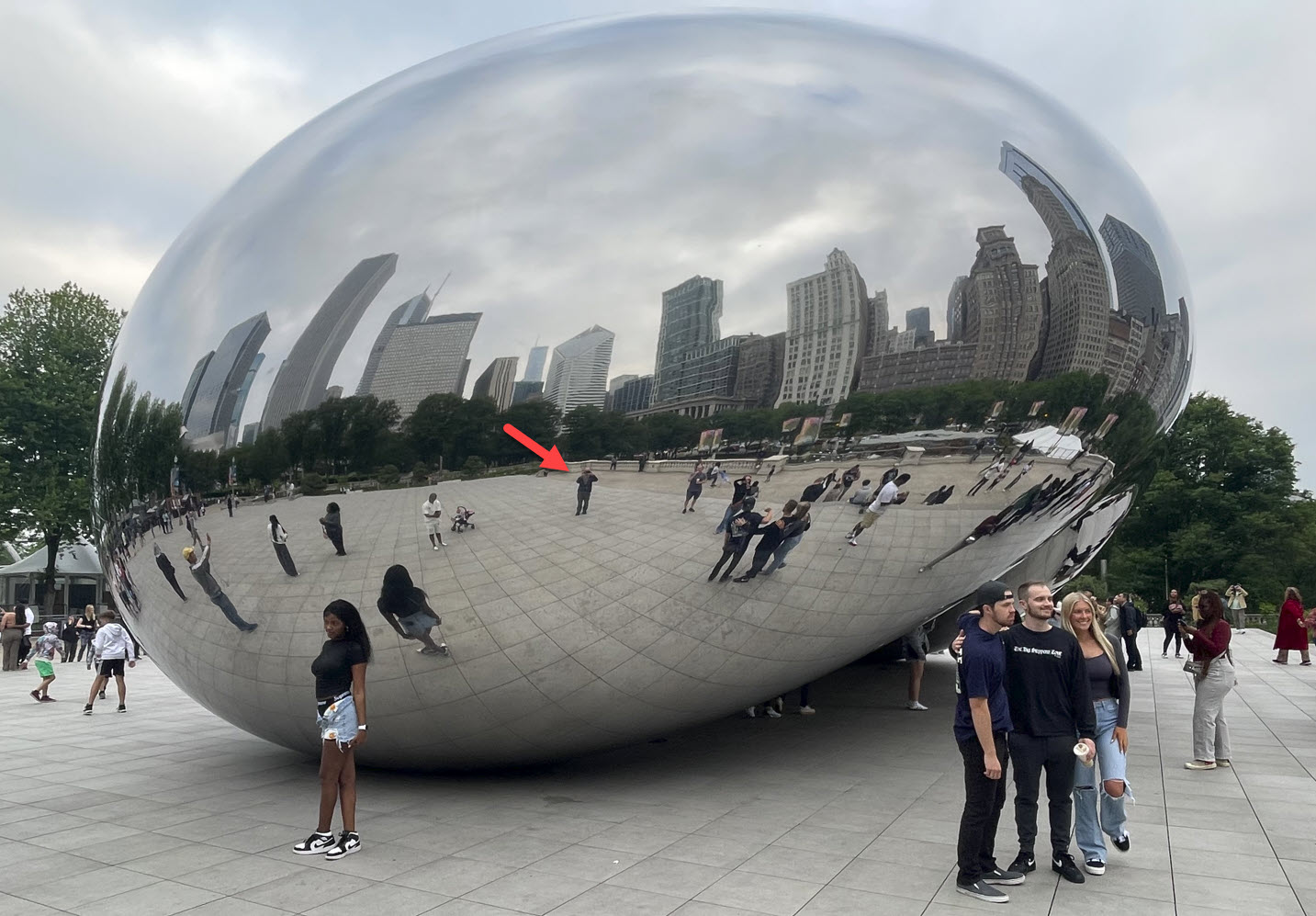
This iconic sculpture was created by British-Indian artist Anish Kapoor and has become one of Chicago’s most photographed landmarks. The sculpture measures approximately 66 feet long, 42 feet wide, and 33 feet high, weighing around 110 tons. It is made of 168 stainless steel plates welded together.

I took the above picture and you can see me in the reflection at the red arrow. Due to the distortion, I look much farther away than I actually am. I was no more than 30 feet from the object.
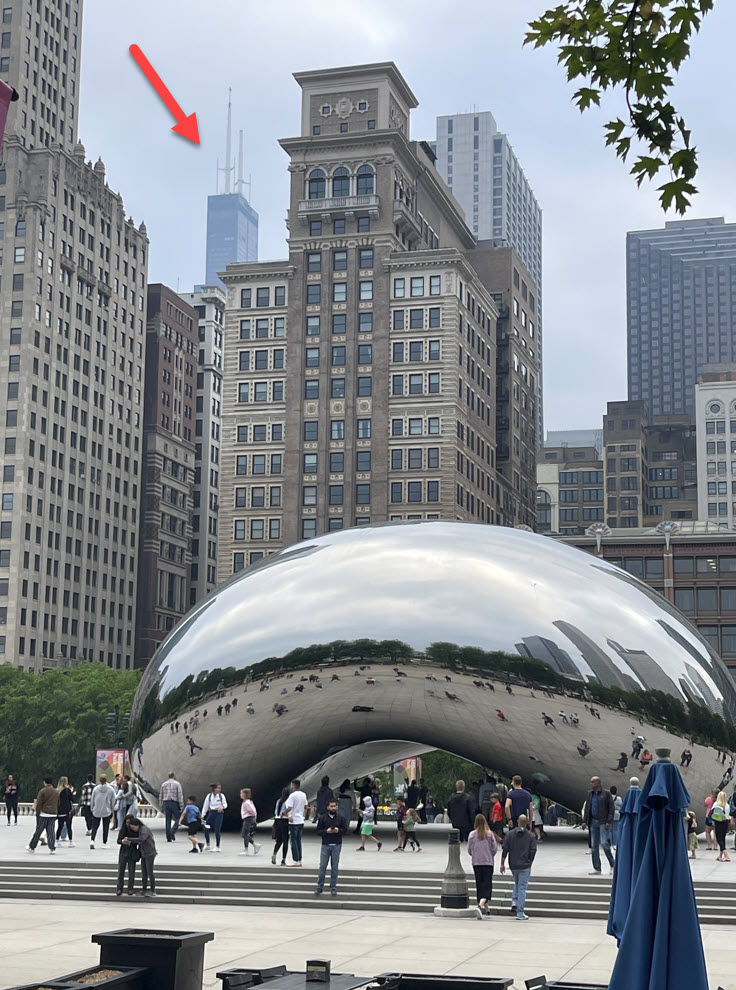
The above photo shows the Bean from another angle. You can see you can go under it, and it’s just as shiny and reflective there, and it really dazzles the eyes, resulting in some disorientation walking under it. Incidentally, above in the distance (red arrow) you see another view of the top of the Willis Tower.

Finally, on my walk back to the hotel, I could not help but noticing the ubiquitous name we can’t seem to get away from nowadays:

The Trump International Hotel and Tower is a skyscraper condo-hotel. The building is a 100-story structure, which reaches a height of 1,388 feet including its spire, its roof topping out at 1,169 feet.

I can’t quite end a post about Chicago with a paragraph about a Trump property, so I will revisit one more painting from the Art Institute: American Gothic by Grant Wood, 1930.
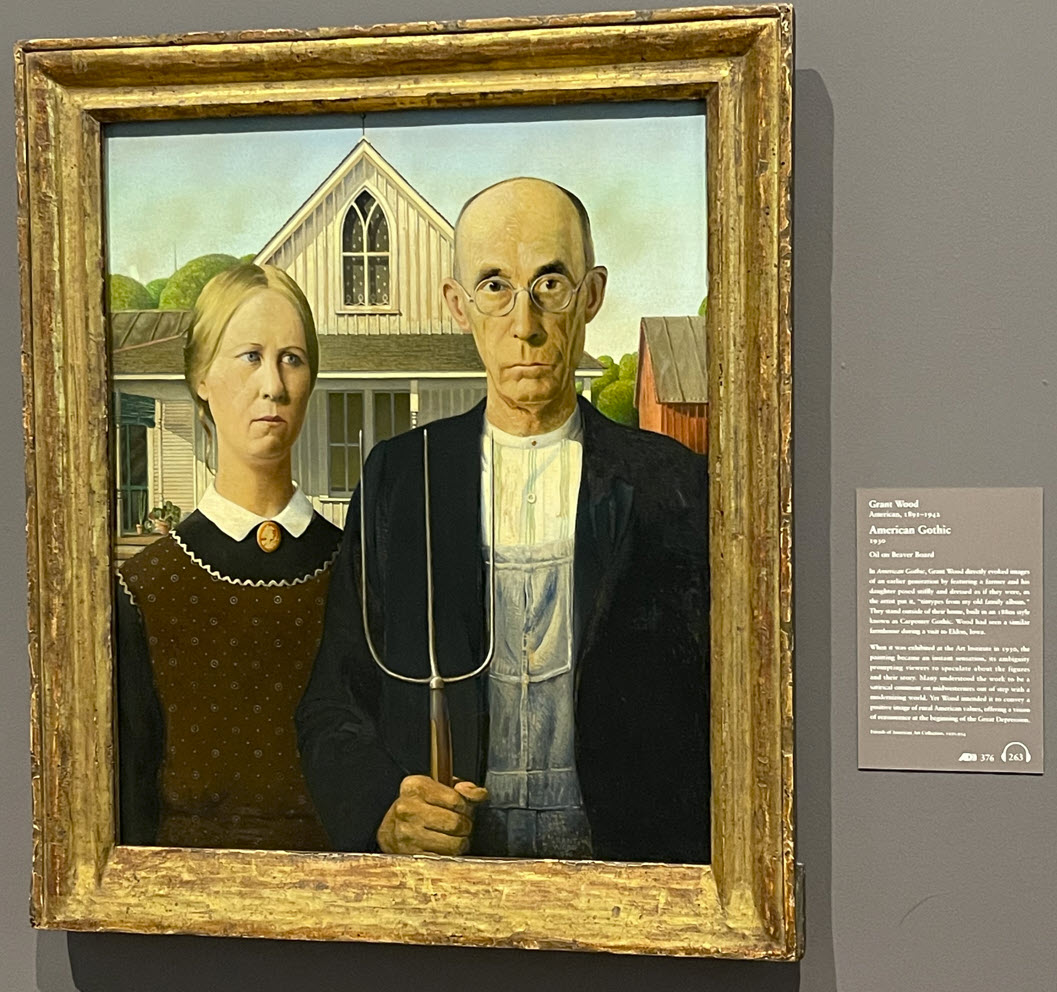
This painting was the inspiration for my own version, titled Pitchfork, which I painted in 2014, featuring my daughter and son-in-law:

This will make for a happy ending of this post.


A Message from a Fellow AFSer

I was an AFS exchange student in 1974/75. Christine Lagarde, President of the European Central Bank, was an AFSer in 1973/74. Here is a message from her congratulating AFS to its 75th anniversary.

I would not be the person I am today, not even close, if I had not had the AFS experience, studying one year in an American High School as a teenager. The AFS year was by far the most pivotal experience of my life.

The Marks on Our Potatoes

In the winter, some of our red potatoes in the pantry got old and started sprouting, so we planted them in one of our planters. Last month, we had a harvest. It felt great digging with our bare hands into the soft soil and finding the potatoes, one at a time.

Here is a picture of the planter, after we had reseeded it with carrots this time.

The harvest was amazing. We got at least 30 potatoes, a few of them small, but some of them full sized. Here are some of the larger ones:

Then I noticed that each potato had a mark on it. I can’t figure out how this happened. They were not smashed against the planter, and its walls are smooth. There are no features that would cause these repeatable marks. If you don’t see it, look at  this one closeup:

The marks are not the result of some tool that we used to get them out of the ground. We used our bare hands for every one of them.

I looked at red potatoes at the store and found no marks on any of them.

Does anyone have any idea what might be causing these marks?

Book Review: Colony One Mars – by Gerald M. Kilby

The first human colony on Mars consisted of a number of habitats and 54 colonists. An intense, 6-month-long dust storm covered all the solar panels and destroyed much of the facility. After all contact was lost, and satellite imagery showed much of the facility destroyed, it took several years before a new mission could be launched to investigate what might have happened.

Six astronauts eventually landed nearby and started investigating. What they found was not quite what they expected. In particular, apparently there were survivors. Quickly, however, some of the crew members started getting ill, experienced psychotic episodes and started turning against each other.

Colony One Mars is the first book of a series of six books. I knew that when I picked it up. After reading, I now realize that it’s not really a book, but the first chapter of a long book of six chapters. There is no real resolution, no end, many questions remain unanswered, and yes, you want to pick up the next book. And I guess that is the point.

However, it is just not good enough a story that I want to spend more time on it. This book reminded me of The Object by Joshua T. Calvert, which I reviewed about a year ago, where I said this verbatim:

Without spoiling the book for you, I just have to add that it’s always baffling when there is a space mission where Earth selects its best and brightest to go to meet an alien vessel, and those brilliant super astronauts do really, really stupid things once they are out there on their own. Perhaps that makes for an exciting plot, but for me it’s just distracting. These people are idiots out there, and when I read the story, it does not draw me in. It loses me and I want it to just move on and be done.

The only difference is that the mission does not visit an alien vessel, it visits a derelict colony on Mars, but the mission participants are for the most part cardboard characters with no real personalities. There is a female Ph.D. biologist who is the protagonist. The mission commander and the first officer are both one-dimensional humans who seem to be built just for the simple plot of this book. The author really does not bother to build characters for the entire crew. They are just there to move things along.

There is a commercial faction on Earth who pulls the financial strings of the mission, called COM, which stands for “Colony One Mars.” There are board members who are pure evil, motivated only by money, who are the actual culprits and who use people as expendable pawns in their game of riches.

Interestingly, there is a character named Leon Maximus, who is introduced here:

Leon Maximus, on the other hand, Peter admired. He was motivated by a seemingly sincere desire to advance human civilization. To make it an interplanetary species. To establish a Planet B, as he liked to call it. He was a rare breed indeed. None of this would have been possible if it were not for him and his genius. His company had developed the rocket technology to get the first colonists to Mars. Still, it was a slow tedious process. It was an eight month trip and, with the way the planets orbited each other, a tight two year launch window.

Kilby, Gerald M.. Colony One Mars: Fast Paced Scifi Thriller (Colony Mars Series Book 1) (pp. 80-81). Outer Planet Media. Kindle Edition.

You can move the letters of Leon around and match them to a real person in our time who is obsessed with colonizing Mars.

There are a lot of raving reviews out there about this hard science fiction book and it being a page-turner. Well, I turned the pages all the way through, but it’s really a story that is very contrived and just not all that interesting. If you want a real Mars story, you need to read The Martian, by Andy Weir.

Colony One Mars is the first book of a series, but I won’t read the other five.


Book Review: Tell Me How It Ends – by Valeria Luiselli

Valeria Luiselli is an immigrant from Mexico. She lives in New York with her husband and daughter. Early in her career as a writer, while she was still in the process of seeking her own Green Card, she was hired by the federal immigration court in New York to translate for child asylum seekers. The book was written in the 2014 – 2016 timeframe, before Trump came to office, while the Obama administration was still dealing with the refuge crisis at the southern border of the United States. There is also a postscript dated 2017, just as the book was published, and Trump’s first administration had taken over.

She illustrates, in the words of children as young as three or four years old, up to teenagers, how the American court system handles the crisis. Why are thousands of unaccompanied children arriving at the border, where they are giving themselves up to the immigration authorities? What are their motivations? Why are they here, and what is their fate when they are here?

Tell Me How It Ends is a powerful indictment of the American immigration policy. The children are the victims. Yet, they are  the ones whose lives are destroyed before they ever have a chance to grow up. It deals with the source of the problem in the first place, the utter violence and lawlessness in the Central American countries where the children come from, and it all traces right back to American drug use and consumption of drugs coming from Central America, and the thriving arms trade of American weapons back to those countries.

It is ironic to read this book now, eight years after it was first published, while the Trump Administration is applying a radial approach to solving the problem, deporting the most vulnerable and innocent victims of the whole malaise that causes this problem in the first place, demonizing the victims.

As I see it, particularly after reading Tell Me How It Ends, what they are doing now is not going to fix the problem whatsoever. It will just cause immense harm to those families and children affected directly. History will not judge us favorably for these years and these actions under our watch.

The book is only 99 pages long. I read it in hardcopy. I don’t have solutions. But I have a better understanding of why, and I can only fathom the immense damage that is being inflicted on a whole generation of Latin American children.

Tell me how it ends, because I do not know!

Book Review: The Reader – by Bernhard Schlink

Hanna is a 37-year-old woman who lives alone in a German city after World War II. Michael is a 15-year-old school boy. Chance and fate brings the two together. Teenage hormones and puppy love drive the boy, and an erotic affair quickly evolves between the two. They spend a year or so meeting up at her apartment, after her work, and after his school. He reads classic novels out loud for her, then they shower, then they have sex, then they snooze, and then he goes home to his unsuspecting parents and siblings.

One day Hanna disappears without a trace. Michael at first has a difficult time dealing with that, but in time he gets over it. He goes on and eventually becomes a lawyer. Then, suddenly and unexpectedly, he sees Hanna as a defendant in a trial that he and his classmates are observing. The trial reveals to Michael that Hanna was a guard in a Nazi concentration camp during the war.

The Reader deals with the issue of government atrocities, and to me it was a very timely read. We are at a point in American history where the government seems to trample on its own Constitution, and for the sake of soundbites and news clips arrests its own citizens, apparently without due process, and sends them to offshore hellhole prisons. This situation remind me of what happened in Germany in the 1930 and through 1945. Germany killed over 6 million prisoners, mostly Jews, many of them were German citizens. I’d venture to say that Hitler himself didn’t kill a single person. Somehow he convinced an entire population to do his bidding, and his killing, and thousands of soldiers, guards, and SS troops thought it was okay to commit unspeakable atrocities against their own countrymen. I never understood how this was possible. Yet now, while we’re not killing people, we’re sending innocent people, children who are citizens of our country by birthright, and foreign students with legal visas, to prison camps. Is this a first step?

The Reader tackles this problem. What happens to the emotional life of a person who knows she has committed atrocities and has to live with it? It is a well-crafted novel, a love story of sorts, but difficult and emotional read.

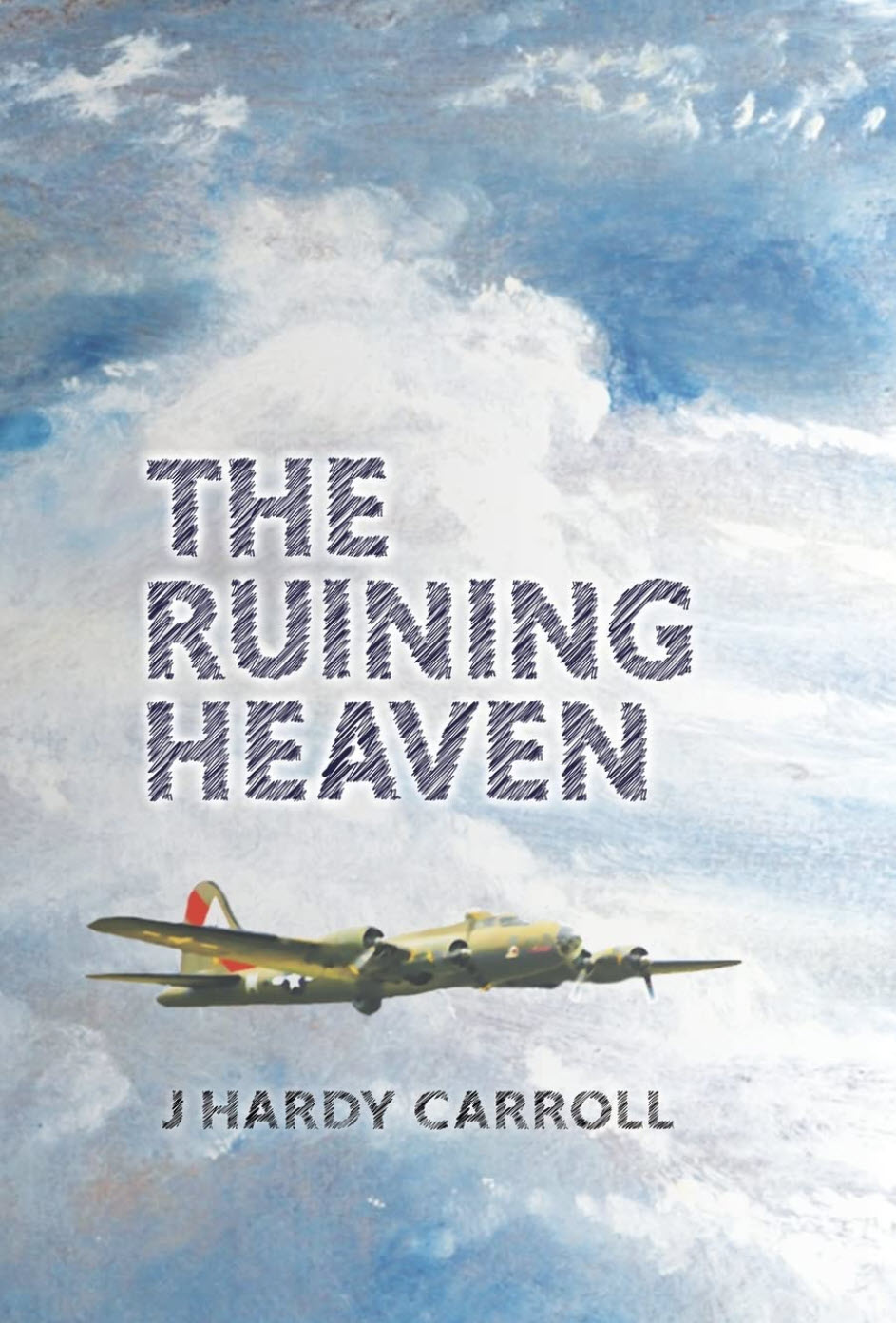
Book Review: The Ruining Heaven – by J. Hardy Carroll

I usually do not review books twice, let alone change my rating, but I am making an exception here with The Ruining Heaven. To explain, I have to backtrack to September 2015, when I first reviewed Hawser, by J Hardy Carroll. I stand by my review at that that time, so I won’t repeat it here, but I am upgrading my rating to four out of four stars.

I came across my review of Hawser by accident, following some comments in my blog, and I found myself in a memory block. While I had read the book, and reviewed it, and corresponded with the author directly about it, I oddly had no memory of  the details of the book. Granted, it’s been ten years, but you’d think I’d remember.

Nothing.

So I went to Amazon and tried to find it – but it did not appear to exist. Now I was really puzzled. How is it possible that I read a book, reviewed it, rated it highly, wrote a blog entry, and remembered nothing? And then the book does not seem to exist?

I then searched my emails for the author’s name and wrote to him. He responded within minutes, advised that he had edited the book and republished it under a new name, The Ruining Heaven. Oddly, the book is only available in paperback on Amazon, and since I am not reading hardcopy books anymore, I didn’t want to buy it in that format. Because by now I had decided that I’d have to reread this to figure out how I could possibly forget all about it. The author was kind enough to send me the Kindle version directly, along with two sequels (which I have not read yet).

Why did I forget all about it? It’s a very poignant story, particularly as some of the action takes place in wartime Germany, namely Silesia, where my own father was a child refugee during that exact time. The emotional damage inflicted on him from those experiences are still haunting him today, at age 89, and he keeps retelling the horrors he lived through. Ironically, I finished reading The Ruining Heaven while in a hotel room in Germany just a few days ago, right after having just talked to my father about just those times.

Why did I forget all about it? Two thoughts:

First, when you read as many books as I do, of as many different genres, it’s apparently possible to move on to the next one and erase the previous one. Sometimes, once I write the review, it frees me up to move on. There are only  that many grey cells available as I get older, and I need to clear the slate.

Second, the subject matter in the book is highly disturbing. War stories are never pleasant, and this one is crushing on many levels. Just like we tend to forget the hard periods in our lives, the embarrassing moments, the challenging episodes, as a natural block for our sanity, I may have blocked out most of this book just to protect myself and move on to better things.

Either way, The Ruining Heaven is a powerful war story. I thank the author for sending me the book and I highly recommend it, paperback and all.

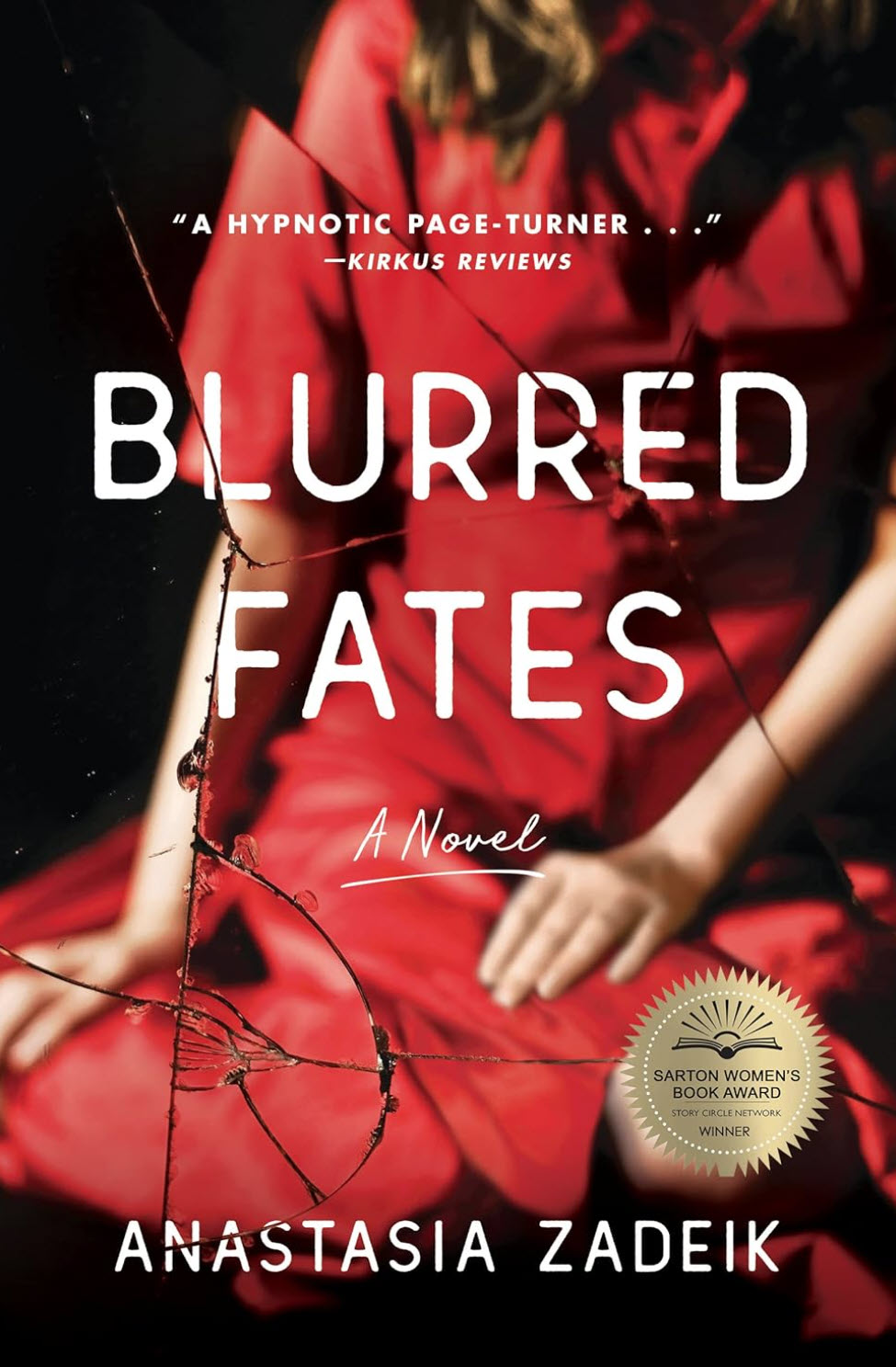
Book Review: Blurred Fates – by Anastasia Zadeik

From the outside it would look as if Kate Whittier was living a dream life in Southern California. Her husband is a successful businessman from an old-money New England family. They have two well-adjusted kids in elementary and middle school. She lives in a gorgeous home in a gated community north of San Diego. Her life revolves around her family and their friends. Taking the kids to soccer practice and games, attending family parties, taking walks along the San Diego beaches.

But Kate feels like an impostor in her own life. She comes from a broken family, and there are enough nightmares in her past that she has hidden her childhood and youth from all her friends and her husband. She thinks they don’t know who she is, the believes she is living a lie, and has been doing that for decades.

When her husband suddenly confesses to a sexual indiscretion, her life comes crashing down, and the lies and deceptions no longer hold up. In a matter of days, her peaceful and successful life unravels into a maelstrom of emotional chaos, confusion and even amnesia. While she is vulnerable and exposed, the demons of her past come knocking, and suddenly there seems to be no way out.

I would not normally pick up this book to read. The cover does not talk to me, and the description on the back is not about a subject I would choose read a novel about. But the paths of books into my life are sometimes mysterious, and I definitely  like to pick up material at random just to open my horizon.

My wife is in a book club of about a dozen women.  They read a book a month, and then meet and discuss it over dinner at one of their homes. Sometimes I read their book, if it’s the kind that interests me. Last month, they read Anastasia Zadeik’s second book,  The Other Side of Nothing. It turns out that one of the members knew the author and invited her to the book club meeting discussing that book. She came, and apparently they had a great meeting, the author posted about it in her Instagram page later, and left some hardcopies of her first novel with them, autographed. When my wife brought one of the copies home, I picked it up and started reading that night on the couch, and — could not put it down.

Blurred Fates is Zadeik’s first novel. I have read and reviewed the first works of other authors, sometimes by their personal invitations. (If you review as many books as I do, sometimes authors send you their books and ask for reviews. I have had a few of those). Blurred Fates stands out among first novels for a number of reasons:

It is impeccably edited. There isn’t a typo, there aren’t any grammatical errors that I noticed.

It is written in the first person present tense, which is unusual. But it also creates a sense of pace and urgency. Everything is happening right in front of the reader. It it hard to write that way, but Zadeik pulls it off effortlessly. I was right there with her all along, inside Kate’s head.

Being in someone’s head, in their thoughts, can be exhausting for the reader. I believe it’s also hard to write that way. But even with those challenges, Kate’s emotional and psychological turmoil never seems unreal. As a reader, you become Kate, and you feel her anguish and terror.

The author did a remarkable job with this novel. I am sure her second one, The Other Side of Nothing, is just as good.

Blurred Fates is a well-structured story about a subject of our times, namely rape, sexual abuse, domestic violence and child abandonment, and the permanent, lifelong psychological trauma that victims have to live with. With that, the author takes on a challenging subject and handles it well.

I also enjoyed her description of Kate’s life in San Diego. I live here, and I felt like I have been at her house and her community. I have driven by the soccer practices that she went to. I have shopped at the Vons and gone to the same Starbucks she is describing. And I have been to the same beaches. Those images and feelings brought it home even more vivid and clear than otherwise. This story played in my neighborhood.

I finished the book last night – I cranked through the last third of the book, and when I closed it and looked up, it was 1:25am. Need I point out: It’s a page turner.


Trump Taking Credit for the Stock Market – or NOT

In January 2024, Donald Trump posted on Truth Social, attributing the stock market’s record highs to his favorable polling against President Joe Biden. He claimed that investors were optimistic about his potential return to the White House, stating:

THIS IS THE TRUMP STOCK MARKET BECAUSE MY POLLS AGAINST BIDEN ARE SO GOOD THAT INVESTORS ARE PROJECTING THAT I WILL WIN, AND THAT WILL DRIVE THE MARKET UP.

Trump also remarked that “everything else is terrible,” referencing inflation and geopolitical concerns. He suggested that the market’s performance was driven by expectations of his victory, despite not providing evidence to support this claim.

During a Fox News town hall on January 10, 2024, Trump asserted that the stock market was rising due to his lead in the polls and warning of a potential crash if he did not win the upcoming election.

Now, in April 2025, following a significant stock market downturn attributed to his administration’s aggressive tariff policies, Donald Trump shifted responsibility again to Joe Biden.  Trump now referred to the declining market as the result of a “Biden Overhang,” suggesting that the economic challenges were inherited from the previous administration.

What a bunch of nonsense coming out of our president’s mouth. Let me get this straight. When the market was great, it was his win, even though Biden had been president for over 3 years then. When the market is terrible now, it’s Biden’s fault, even though Trump has been president for more than 3 months, and the DJIA was at 43,487 on January 20, 2025, when Biden’s term ended.

Joe Biden built a great economy. He brought us out of the Covid pandemic, lowered the Trump inflation, his policies brought manufacturing back to America, brought unemployment to historic lows, increased GDP every quarter, created 17 million new jobs and had the stock market at record highs. It took Donald Trump just three months to destroy all of that. And he has the gall to blame Biden for it.

Remember when Trump kept complaining that the economic disaster of 2020, following the Covid-19 pandemic outbreak, was Biden’s fault, even though he was president then?

How stupid does he think we are?

Throwing Away Our Cell Phones – Take Three

It just occurred to me that I have posted in this blog for almost 18 years. For nostalgia reasons, I thought I should check the very first entry. Here it is:

Throwing Away Our Cell Phones

On June 29, 2007, Apple released its first iPhone. The phone I described in the first post of this blog was a flip phone by Motorola. I didn’t pick up the iPhone until some years later. I went through the Droid phone first which came out in November 2009. It had a hard keyboard under the screen.

I just checked,  and ​as of April 2025, it’s estimated that approximately 400,000 smartphones are retired daily in the United States. This figure is derived from annual estimates suggesting that around 151 million smartphones are discarded each year, equating to roughly 400,000 per day. So the numbers really haven’t changed much. 

Smartphones are larger, but more flat. So I’d say they pretty much still would fill up a school bus … every day.

Idiots in Federal Government

The idiocy in our current federal government is staggering. Here is our Secretary of Health and Human Services, talking about autistic children:

And these are kids who will never pay taxes, they’ll never hold a job, they’ll never play baseball, they’ll never write a poem. They’ll never go out on a date. Many of them will never use a toilet unassisted.

He has obviously never met an autistic person.

What is he going to suggest next? Maybe the best thing to do is to send them all to a camp? Let’s call it a concentration camp. Maybe we should open one in El Salvador, “the Savior,” where they’ll be well taken care of?

This is wisdom from the “Pro-Life” faction of our political landscape.

The Lady Buddha Statue in Da Nang

Outside of Na Nang, in Vietnam, visible across the bay, is the giant and magnificent statue of the Lady Buddha, tượng phật bà quan âm in Vietnamese. You can see the statue in a picture my wife took from the rooftop bar in our hotel on the right side of the image. You can click on the photo to zoom in.

The statue is 67 meters (220 feet) tall, which is about the height of a 22-story building, or something along the height of the neighboring hotels on the left of the photo. It is the tallest Buddha statue in Vietnam. For comparison, Christ the Redeemer, the famous statue in Rio, is 38 meters tall, including the pedestal, which is 8 meters by itself.  At 67 meters, the Lady Buddha is almost twice that tall.

It towers on top of a hill on the Sơn Trà Peninsula in the Monkey Mountains of Da Nang. As we were walking up to it, suddenly it came into view from behind some trees and it’s truly awe inspiring.

Then, finally, after a short walk, we were in front of it.

There is a little shrine underneath inside of it, and there are 17 floors inside of it. Access is restricted or only open during certain ceremonies or with permission. Each floor is dedicated to a different Buddha or Bodhisattva, with small altars and statues. These floors are like small shrines or prayer rooms stacked vertically within the statue. Of course, there are no windows, so it’s probably pretty claustrophobic in there. I didn’t get to go up.

I read one travel blogger claim that the statue is carved from a single block of marble. That is wrong. It would not be possible to carve something this big on site, or transport, let alone make it hollow. It is primarily constructed from reinforced concrete, combining traditional Vietnamese Buddhist architecture with modern design elements.  However, skilled artisans from the nearby Non Nuoc Marble Village were involved in its creation, contributing their craftsmanship to the intricate details of the statue.

We went to Non Nuoc. It is amazing by itself. There are many nearby quarries with excellent marble, and the artisans are very prolific. There are scores of shops, entire warehouses, full of art. Here is a snapshot from one such shop. The yellow building is their showroom.

At the Lady Buddha, here is one more shot with me in it.

The area is called the monkey mountains, and indeed, the trees surrounding the park are inhabited by monkeys.

Finally, before leaving, I looked out over the bay, and here is a parting shot back to the city of Da Nang, with its characteristic high rise hotels, one of which was ours, lining the beach. From there is where we took the first picture in  this post, pointed here.

Movie Review: The Ballad of Wallis Island (2025)

I review every movie I watch, and the reviews are all here. But when you scan for movies, you’ll notice that I don’t have too many reviews lately. That means I am not doing much watching these days. I am also not checking on what’s playing, most of the time.

Last weekend, my wife decided she wanted to take me to the movies. She picked one, didn’t tell me what it was, and I walked into the theater not having any idea about what I was going to see.

There is a remote island somewhere in the U.K. that can be reached only by small boats with outboard motors. There isn’t even a dock, so visitors have to get off the boat while the surf is rocking it, stepping knee deep, or worse, into the ocean.  That’s how remote Wallis Island is. There is a little general store, and a lone phone booth, and a villa on top of the bluff. Charles lives alone in the villa. His wife died some years ago. He can afford the villa because he won the lottery.

His favorite musicians are the folk duo McGwyer Mortimer. Herb McGwyer is a songwriter, singer and performer. He is still active as a musician, with an agent and a career, but slightly past his prime. Nell Mortimer was his partner, a singer and piano player. They recorded many albums together in their day, and they were lovers. Something caused them to split up years ago, and they went their separate ways.

Charles hires them for one private gig on the island. Herb is going there to perform to a party of “less than a hundred people” but he does not know Nell is also coming. Over a few days of acclimating, Herb realizes that the gig has exactly one – and only one – person in the audience: Charles. When Nell shows up, the boundaries between making music and romance quickly blur, and emotions run wild.

The Ballad of Wallis Island is a delightful story about artists on the other side of their prime, about lost love and nostalgic longing, about the quirkiness of life on a lonely island, about human emotions and passion. There is humor, but it’s quirky humor, and there are songs that resonate with the soul.

I loved every minute of it. I want my wife take me on more “blind movie” dates.