“Nobody Knows the Impact of the Tariffs” – Bullshit

GOP Senator Kennedy said that nobody knows what the impact of these tariffs is going to be on the economy.

Several economic studies conducted by distinguished economists and prestigious institutions have analyzed the impact of tariffs on the economy, consistently finding that tariffs tend to have negative effects. Here is a list of 10 notable studies that ChatGPT pulled for me in 3 seconds:

  1. “Are Tariffs Bad for Growth? Yes, Say Five Decades of Data from 150 Countries”: Authored by Davide Furceri, Swarnali A. Hannan, Jonathan D. Ostry, and Andrew K. Rose, this study analyzed data from 151 countries over the period 1963–2014. The researchers found that increases in import tariffs are associated with significant and persistent declines in output growth. Specifically, a one standard deviation increase in the tariff rate (approximately 3.6 percentage points) leads to about a 0.4% decline in output five years later. The study attributes this decline to reduced labor efficiency, real exchange rate appreciation, and higher production costs due to increased prices of imported inputs.

  2. “Macroeconomic Consequences of Tariffs”: In this working paper, Davide Furceri, Swarnali A. Hannan, Jonathan D. Ostry, and Andrew K. Rose expanded on their previous research to explore the broader macroeconomic effects of tariffs. They found that higher tariffs lead to declines in output, productivity, and employment, as well as increases in inequality. The study underscores that the negative effects of tariffs are both economically and statistically significant.

  3. “International Trade, Distortions and Long-Run Economic Growth”: Jong-Wha Lee examined how trade distortions, such as tariffs, impact long-term economic growth. The study concluded that tariffs and exchange controls generate cross-country divergences in growth rates and per capita income over extended periods, highlighting the detrimental effects of trade barriers on economic development.IMF

  4. “The Effects of Tariffs and Trade Barriers in CBO’s Projections”: The Congressional Budget Office analyzed the impact of tariffs implemented since January 2018, finding that these trade barriers reduced the level of real U.S. GDP by roughly 0.3 percent by 2020. The study highlighted that tariffs raise domestic prices, thereby reducing consumers’ purchasing power and increasing business investment costs.Congressional Budget Office

  5. “The Macroeconomic Consequences of Import Tariffs and Trade Policy Uncertainty”: Lukas Boer and Malte Rieth estimated the macroeconomic effects of import tariffs and trade policy uncertainty in the United States. Their findings indicate that tariff shocks depress trade, investment, and output persistently, suggesting that protectionist measures have adverse economic consequences.IMF

  6. “Tariffs Do More Harm Than Good at Home”: Maurice Obstfeld discussed how tariffs, while intended to protect domestic industries, can be broadly contractionary, reducing output, investment, and employment in the economy. The study emphasized that such negative effects occur even if trade partners do not retaliate with tariffs of their own.IMF

  7. “Macroeconomic Consequences of Tariffs”: The Cato Institute reviewed empirical studies and found that tariff increases lead to declines in output and productivity in the medium term, as well as increases in unemployment and inequality. The study highlighted that tariffs do not improve the trade balance and often result in real exchange rate appreciation.IMF eLibrary+2Cato Institute+2IMF+2

  8. “The Return to Protectionism”: Economists Pablo D. Fajgelbaum, Pinelopi K. Goldberg, Patrick J. Kennedy, and Amit K. Khandelwal examined the effects of the 2018 trade war on the U.S. economy. Their analysis revealed that the tariffs led to higher import prices, resulting in increased costs for consumers and businesses. The study concluded that the tariffs imposed during this period caused substantial welfare losses for the U.S. economy.

  9. “The Impact of the 2018 Trade War on U.S. Prices and Welfare”: Researchers Mary Amiti, Stephen J. Redding, and David E. Weinstein analyzed the price effects of the 2018 tariffs. They found that the full incidence of the tariffs was passed on to U.S. importers and consumers, leading to higher prices and reduced welfare. The study emphasizes that the tariffs did not lead to a reduction in foreign export prices, meaning U.S. entities bore the entire cost.

  10. “Macroeconomic Consequences of Tariffs”: In this working paper, Davide Furceri, Swarnali A. Hannan, Jonathan D. Ostry, and Andrew K. Rose expanded on their previous research to explore the broader macroeconomic effects of tariffs. They found that higher tariffs lead to declines in output, productivity, and employment, as well as increases in inequality. The study underscores that the negative effects of tariffs are both economically and statistically significant.

These studies collectively provide robust evidence that tariffs tend to have adverse effects on economic growth, productivity, employment, and consumer welfare.

Do you want me to cite not 10 but 200? I can keep going. It’ll just take a few more seconds.

Senator Kennedy – are your staffers asleep?

Movie Review: Absolution (2024)

Liam Neeson plays an unnamed thug, a grizzled gangster and former boxer in Boston. He does thug jobs for a local small-time crime boss. He realizes that he is approaching the end of his “career” because he keeps forgetting basic stuff, like the names of his friends and places he was supposed to go. He has himself checked by a doctor and finds out he has Chronic Traumatic Encephalopathy (CTE), a progressive neurodegenerative disease caused by repetitive brain trauma, such as concussions from boxing. There is no cure and no treatment. The doctor tells him it will just get worse. He won’t live long.

As a result, he tries to get his affairs in order. He finds a girlfriend who has her own ghosts but somehow sees a kindred spirit in him. He has a daughter whom he abandoned in his younger years and she has a son. The daughter wants nothing to do with him, but he manages to get a connection with the grandson and he tries to redeem himself.

But the underworld has him solidly in its grip, and he can’t escape.

Absolution is not a Liam Neeson old hero action movie. It’s a slow study of an aging gangster with no place to go. As such, it is difficult to watch. There is not much of a story, or lesson, or feel-good spirit. The thug has a bad life, and it’s not getting better.

Absolution is boring and deeply depressing film.

Due Process in the United States

If you violated the law, you are not entitled to due process.
– Rep. Victoria Spartz, March 2024

An elected official, sworn to uphold the Constitution, said that people, in this case illegal aliens who violated asylum laws, are not entitled to due process.

This is wrong.

Due process exists specifically to protect those accused of violating the law. The Bill of Rights contains more provisions safeguarding the rights of the accused than on any other subject. The government can deprive you of liberty through due process, but it cannot deprive you of due process itself. In the United States, due process is not a revocable privilege. It is an irrevocable right.

Due process is the mechanism by which we determine whether someone did violate the law. It’s the protection we guarantee before we investigate and convict. That’s the whole point. We’re not supposed to arrest people, skip the trial, and make them disappear. Immigrants are detained indefinitely without hearings, or sent to overseas prisons. Protesters and students are punished based on accusations, not findings. Politicians, like Spartz in this case, make accusations without basis in fact.

What if you are wrongly arrested because somebody erroneously accused you, or because you had the wrong tattoo, or because you were at the wrong place at the wrong time? It happened recently to a few cases that attracted national attention. To how many people did it happen that we’ll never hear from again?

We will never know.

It could be you or me next. Think about that.

We can’t cherry-pick the Constitution based on who we like or what someone is accused of doing. I still remember a guy I worked with back in the 1990ies. Let’s call him Rick. He was a Second Amendment enthusiast. When I simply suggested, even back then, that we should ban assault weapons, that we should have universal background checks, he would be furious because, according to him: “You are trampling on our sacred document, the Constitution!”

At the time, I was trampling, just by suggesting common sense solutions.

Are we not trampling now?

The DJIA under Trump

On April 5, 2025, Fox News host Jeanine Pirro said:

“I don’t really care about my 401(k) today. You know why? Not that I can afford it, not that it isn’t important, not that I’m not at a point in my life when I should be worried about my 401(k) because I am, but this is what I believe. I believe in this man.”

On April 3, 2025, Commerce Secretary Howard Lutnick said:

Let Donald Trump run the global economy. He knows what he’s doing. He’s been talking about it for 35 years.

That got me thinking and researching. What were the 10 largest Dow Jones Industrial Average (DJIA) drops since it started on May 26, 1896?

Here is what I found:

DOW Percentage Drops by President and Party
DateDOW DropPresidentPartyComment
10/19/198722.5%ReaganRepublicanBlack Monday
3/16/202012.9%TrumpRepublicanCovid-19
10/28/192912.8%HooverRepublicanStart of Great Depression
10/29/192911.7%HooverRepublicanGreat Depression
12/18/18998.7%McKinleyRepublican
3/14/19078.3%RooseveltRepublican
10/26/19878.0%ReaganRepublicanAfter Black Monday
10/15/20087.9%BushRepublicanFinancial Crisis
9/26/19556.5%EisenhowerRepublican
4/4/20255.5%TrumpRepublicanTariff War
DOW Point Drops by President
DateDOW DropPresidentPartyComment
3/16/20202,997.1TrumpRepublicanCovid-19
3/12/20202,352.6TrumpRepublicanCovid-19
4/4/20252,231.0TrumpRepublicanTariff War
4/3/20251,679.1TrumpRepublicanTariff War
2/5/20181,175.2TrumpRepublicanInflation during Trump
2/8/20181,032.8TrumpRepublicanInflation during Trump
9/29/2008777.6BushRepublicanFinancial Crisis
10/15/2008733.0BushRepublicanFinancial Crisis
9/17/2001684.8BushRepublican
12/1/2008679.9BushRepublicanRecession Fears

Notice that every row in both tables are exclusively by Republican presidents.

Notice also that Trump’s name appears more on these two charts than any other.

This is the same man who has bankrupted several casinos and has been convicted of fraud (Trump University for one).

Jeanine Pirro, are you sure you want to trust this man?

Howard Lutnick, are you sure Trump knows what he is doing just because he’s been talking about it for 35 years?


Movie Review: My Penguin Friend (2024)

My Penguin Friend is inspired by a true story.

A young Brazilian fisherman named João lives with his young wife Maria and their young son Miguel in a picturesque fishing village. On his birthday, Miguel asks to go out fishing with this father. The weather is not good, but João can’t say no to his son, and they row out. Soon a storm overtakes them and in the struggle to survive and get back, Miguel drowns. João’s heart is broken. 

The story skips forward several decades, and João and Maria still live in the same house. They are old now, but it appears that they have not touched Miguel’s room. They live in eternal grief with no apparent joy left in their lives. Just the hard work of a fisherman. 

One day, João rescues an injured penguin from an oil slick, brings him home, carefully cleans his coat, and feeds him back to strength. The penguin stays for a while, recovering, and a village girl gives him the name Dindim. Maria is not all that happy about the new pet in her kitchen, but she sees João blossoming with joy about being able to care for an animal that needs help. 

Penguins are migrant birds, and one day Dindim leaves for the south. To everyone’s surprise, and most of all to João’s, Dindim comes back the following winter to stay. And the next winter. João’s life is transformed. He has a penguin friend. 

I found out later on IMDb that 10 rescue penguins portrayed Dindim in the movie. Approximately 80% of the scenes feature real penguins. For the remaining 20%, where real penguins would face safety risks, CGI was used for 15% of the shots, while animatronics accounted for the final 5%.

This is a feel-good movie with a simple message, a little corny at times, but a nice change to the usually Hollywood fare of fast action and superheroes. It’s just about a man and his penguin friend.

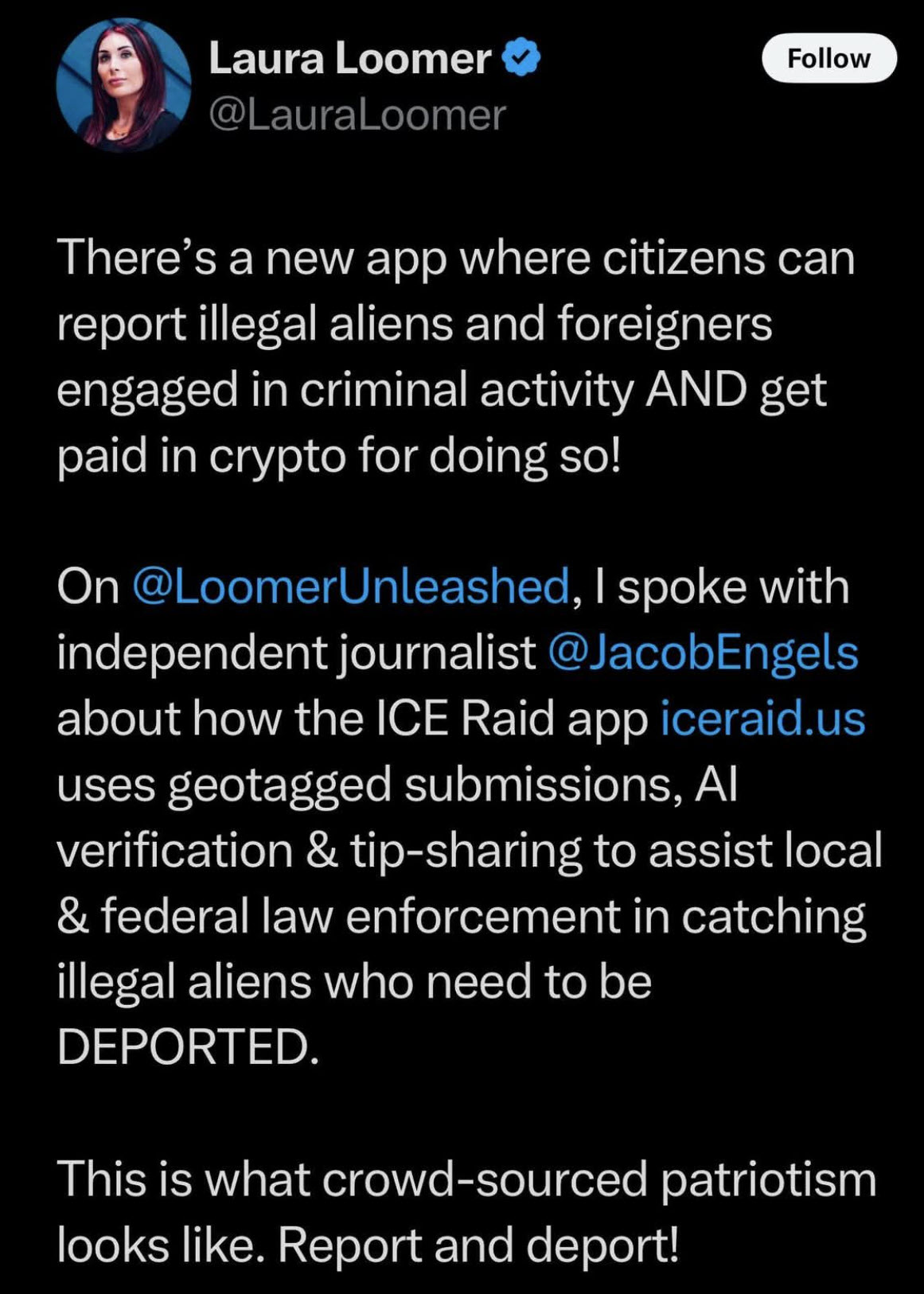
Loomer is Looming

Here is a most disconcerting app which invites citizens to snitch on citizens.

Who is Laura Loomer anyway:

former Republican congressional candidateLoomer is known for promoting conspiracy theories as well as anti-immigrant and anti-Muslim views.

While it seems like a good idea, I would like to remind you that this is the kind of thing that was done by authoritarian and fascist regimes throughout recent history. Portugal from 1948 to 1974 comes to mind. Personism in Argentina in 1943. I don’t even have to list today’s Russia, China and North Korea.

East Germany is a great example for just this kind of problem. One in 50 East German citizens was an informer to the Stasi. This kind of activity creates  distrust in the population. Everyone starts being afraid of everyone else for fear they could say something, make some statement, that would later be misinterpreted.

Right now it’s about “catching illegal aliens” per Loomer. What are we going to do if it suddenly starts being about artists whose work is considered anti-American as defined by the government? What are we going to do if it starts being about homosexual marriages? What are we going to do if it starts being about atheists?

Right now, they are coming for “them” where “them” are illegal aliens.

What are you going to do when they start coming for you?

Yes, let’s start snitching on each other!

This is some really scary shit going on!

The State or Fate of Tourism in the United States

We have a lot of overseas friends in all five continents.

Here is a message we received today from a friend in Europe that we have traveled with quite a few times before:

As regards to travel to the U.S., this administration makes us feel unwelcome with a hostile undertone. I’ve canceled my upcoming Florida trip. Let me say that I am a big fan of transatlantic cooperation. I love the America I used to know, and I am aware that many/most Americans didn’t vote for this shit show, but until decency, truthfulness, reliability and democracy is restored, I’ll be on the fence watching.

This is not the only person I have received such comments from. We were both in Asia and Europe within the last six weeks, and everyone talks this way. On top of all that, the draconian cuts inflicted on the U.S. Park Service, causing uncertainty and lack of control at America’s National Parks, will result in massive lack of tourism this year. Our National Parks are one of the world’s most attractive sets of destinations, and people save for many years for a trip to Yellowstone, Yosemite or the Grand Canyon. Our National Park System is the best in the world. It brings in $55 billion in revenue a year and costs only $3 billion. The whole thing makes no sense to me. The only person who would order such a thing is someone who manages a casino, basically a money machine, to bankruptcy. Tourists right now don’t even know if they will be able to get into the park when they arrive. It’s just not worth it to a lot of foreigners.

The problem is that stability is not restored by rescinding an Executive Order. Decency is earned over years, or even decades. You don’t get a reputation of decency back just because you had an election. And reliability is destroyed for a generation, at least. The word of the United States mattered. Now, you cannot trust that word. Ask the Afghan interpreters who were abandoned or deported. Ask the foreign students with the wrong skin color who disappeared from their colleges this spring.

The summer tourist season will be adversely affected, and everyone and every company that feeds it will suffer this year.


The Narrow Houses of Vietnam

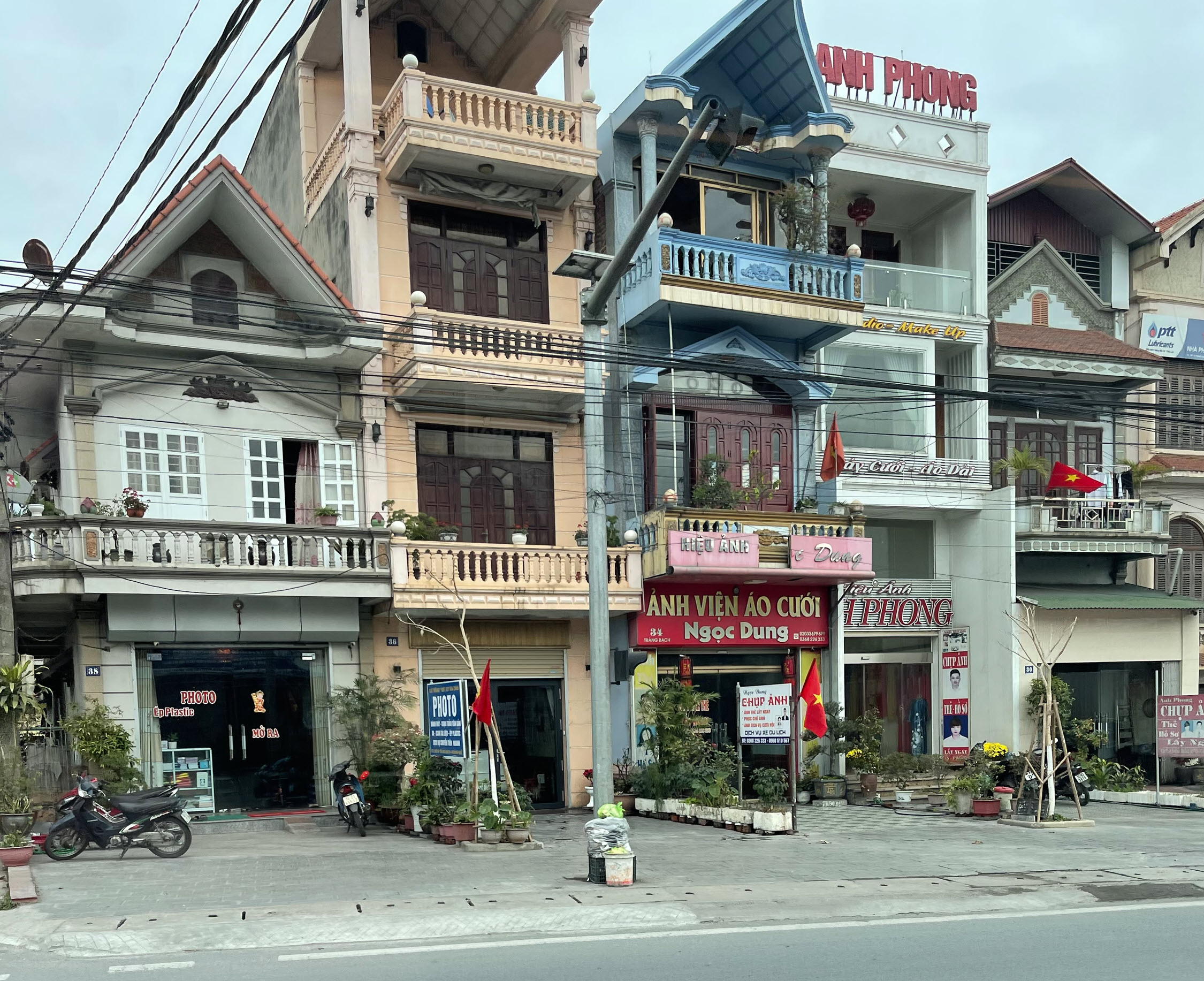
The street picture is very different in Vietnam from what we are used to here in the United States.

Real estate taxes are levied on lot size, which means that narrow and tall houses on small lots are prevalent, both in the cities as well as in the villages. It makes for some strange views.

I took the photo above from a moving bus as we went through a village in the country. This is a very typical view on the main street of any village in Vietnam. People work where they live. For instance, the peach-colored house second from the left has four stories. The bottom is usually a garage-type floor with a rollup door,  where the family conducts its business, whatever that might be. It could be a shop, a restaurant, a tire store, a butcher shop. Much of the family living also takes place there, and on the sidewalk in front of the house. Often you can them burning their trash in a barrel on the sidewalk in front of the shop. There are stairs in the back of the house that lead up to the upper floors, each of which consists basically of one room. You often see balconies, which just extend the living area.

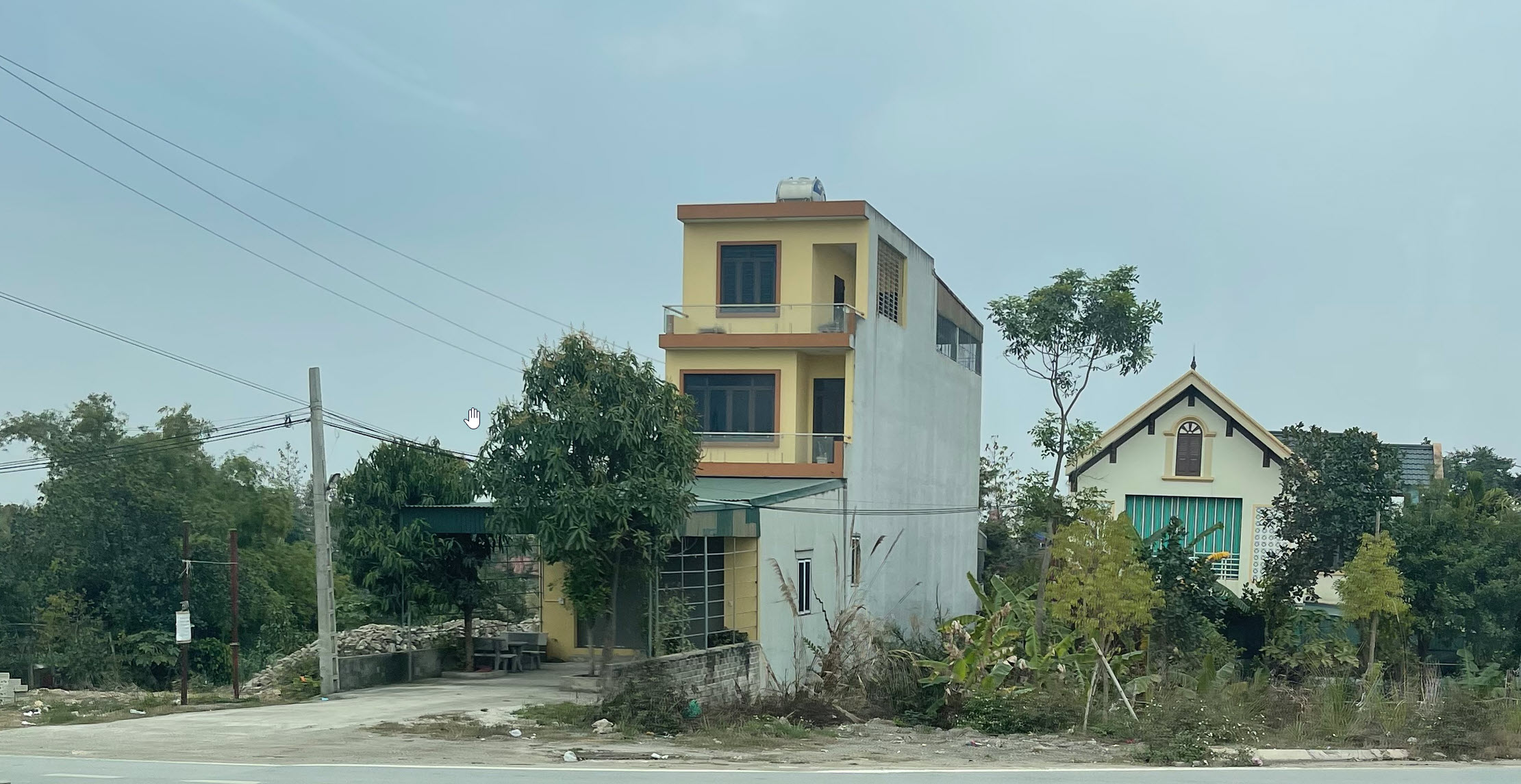
Here is another such view. You can again see the narrow houses, with bare, unpainted side walls, since the neighbor’s house, should he build upward, would cover that wall. There are never any windows on the sides.

Here is another shot of the same row of homes.

Way out in the country, these narrow houses take on an almost grotesque view. I saw many four-story buildings with blank walls on both sides, one room wide, surrounded by nothing but empty lots. But if you only own a lot the width of one garage, that’s all you can build.

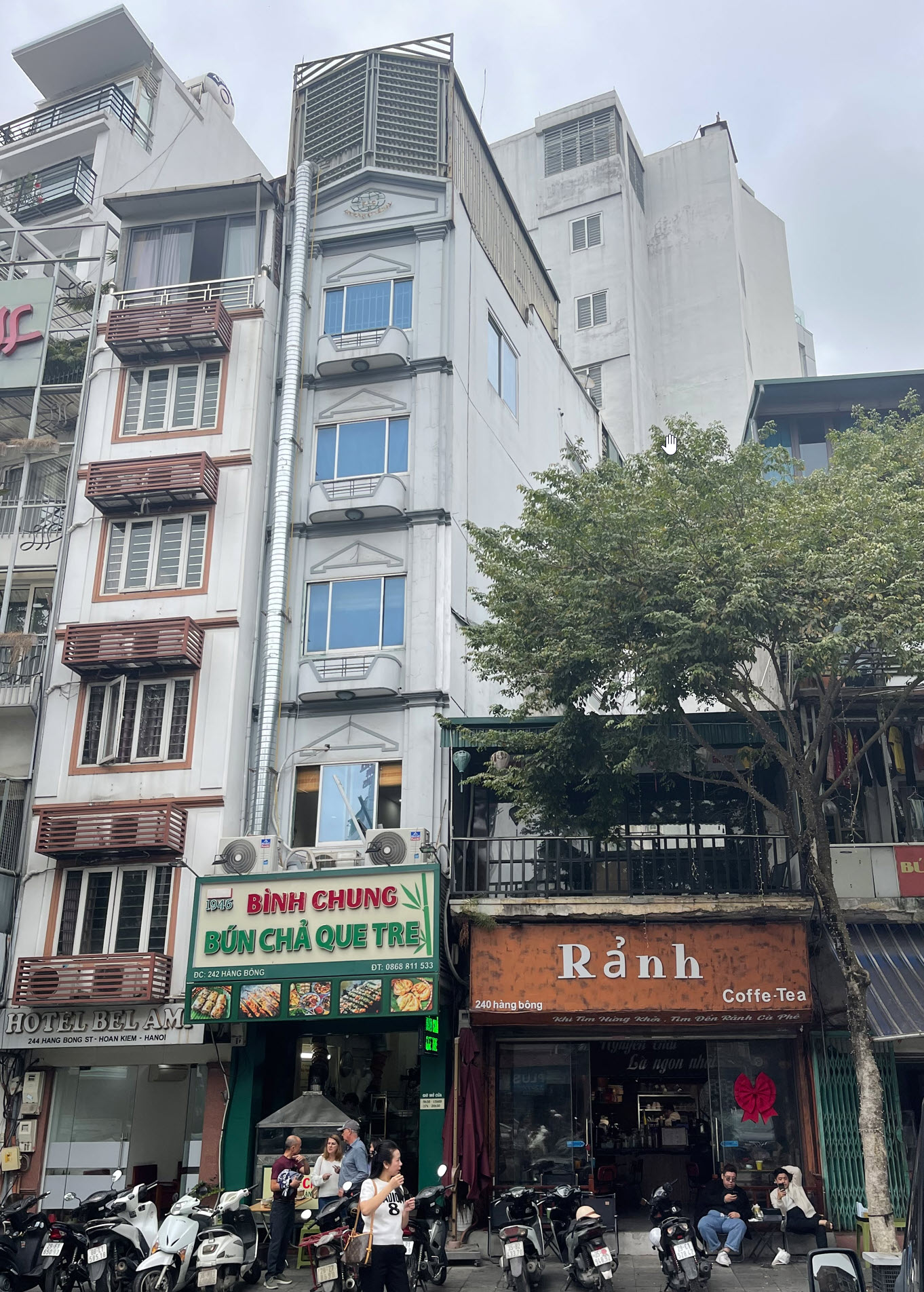
Here is a view in the city of Hanoi. Binh Chung is a restaurant where we ate. We walked into the entry hall, went to the back where the stairs were, and walked up a flight of stairs. We ate in the room just above the sign.

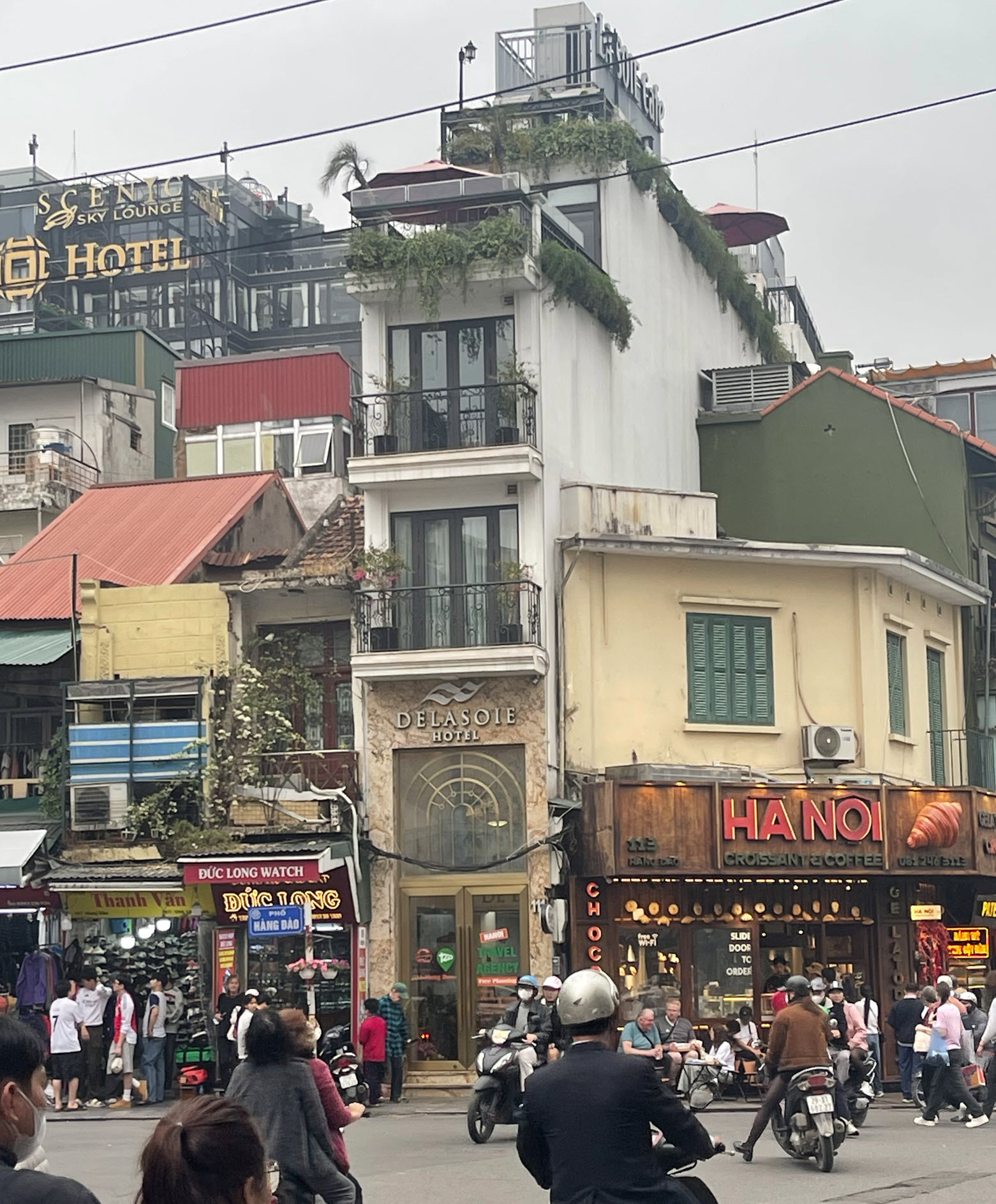
Another street view in Hanoi. A narrow hotel, the De La Sole Hotel. It can’t have too many rooms in that narrow tower.

I will always remember Vietnam as the country of the narrow, tall houses.


And Then They Came for Me…

I lifted the post below from the Facebook feed of Matt Mikalados:

This is Rumeysa Ozturk, a Fulbright scholar from Turkey who is studying for her doctorate at Tufts University.
Last night, six masked men walked up to her in a residential neighborhood, grabbed her, and whisked her away in unmarked cars. Bystanders asked the men who they were and why they wore masks and they said “We’re the police.”
One of the neighbors caught it on his security camera and has shared truly chilling photos of a young woman being surrounded and bundled off into a car.
Like previous illegal ICE arrests of recent days there have been no charges filed. Her lawyer quickly filed with a judge to prevent her being moved out of state, which the judge approved, but as of today the ICE tracking tool shows her at a privately run prison in Louisiana, not in Massachusetts where she was taken. Her lawyers have not been allowed to speak to her.
Unlike other recent arrests, Ozturk was NOT heavily involved in protest actions on her campus or elsewhere.
I’ve been told that in some of the other egregious ICE actions of recent weeks that it’s “not a free speech issue” because these people are “terrorists” and “supporters of Hamas” (NONE of which has been proven *or even charged* by the US government) AND YET… the best guess right now as to why this woman’s visa was revoked and she was arrested is that she put her name on an op-ed in her school paper.
The op-ed had controversial statements like “We, as graduate students, affirm the equal dignity and humanity of all people.”
So, to recap:
– A young, intelligent woman who is studying in the US legally
– Wrote an op-ed
– Got arrested by masked men and had her visa revoked
– Was removed from the state despite a court order saying she was not to be removed
– Has not been allowed to contact her lawyers
One of Rumeysa’s friends, a professor at Northeastern, describes her as a “soft spoken, kind, and gentle soul.” He said that not only was she not antisemitic, and not racist, he said that in the ten years he’s known her she’s not spoken badly to anyone at all.
It seems like in every way, Rumeysa Ozturk is the kind of person we should want in the United States. Kind, intelligent, law-abiding. Instead we’ve violated her rights and our own values, abducted her with masked secret police, incarcerated her without any charges, kept her from her lawyers, and disobeyed court orders about where she’s to be kept.
I’ve heard some people saying lately that there’s no reason to be concerned, because immigrants don’t have the same rights as citizens, and honestly I find this more stomach-churning than some of the directly racist or xenophobic things I’ve seen people say. Why on earth are people defending the government that’s harming people instead of the vulnerable people being harmed?
I will promise you this: when a government starts violating rights of the vulnerable, it doesn’t stop with a single population of people.
This is another truly disturbing action by the US government and by ICE. If you’re an American citizen, please make some noise about this to your reps, and check in on your friends who are vulnerable to this same kind of xenophobic totalitarian rights violations.

This whole episode reminds me of a post I wrote in 2017.

First they came for the Socialists, and I did not speak out– Because I was not a Socialist.

Then they came for the Trade Unionists, and I did not speak out– Because I was not a Trade Unionist.

Then they came for the Jews, and I did not speak out– Because I was not a Jew.

Then they came for me–and there was no one left to speak for me.

— Martin Niemöller, a Nazi dissident

Today in the United States, we apparently have men in black uniforms, claiming to be police, wearing masks, arresting people and hauling them off with no due process. The victims are not allowed to talk to their lawyers, they are not charged with any crime, they are removed.

Rumeysa Ozturk may be a scholar from Turkey. She may or may not have proper papers to be here. But she does not get a chance to prove that if she is not allowed to work with her lawyer.

It does not matter what you look like, what your reality is, what your rights are, if you are a citizen or not.

I happen to be a citizen. But I don’t carry proof of that with me when I go to the grocery store. If men in black masks can grab me on the street and haul me away and send me to some prison in Louisiana because they don’t like a post I wrote on this blog, and don’t allow me to talk to my lawyer, I am toast. You might never see me again.

Then they came for me, and there was no one left to speak for me.

That started happening in Nazi Germany within just a couple of months of Hitler taking power in January 1933. It did not end well.

Apparently it started happening in the United States in January 2025.

Will they come for me?

Movie Review: Good One

Sam is a well-adjusted 17-year-old high school girl. Her father invites her to go on a backpacking trip in the Catskills, a couple of hours north of New York City. Scheduled to come with them are Chris’ best friend Matt, and his teenage son. But during the morning of the departure, Matt and his son have a huge fight, and Matt ends up going alone. His marriage is shot, and his son is suffering from it.

During the trip Matt and Chris are the immature ones, and Sam keeps an even keel. What 17-year-old girl wants to go hiking with her middle-age dad and his friend? Sam apparently does, and she actually enjoys herself. Until Matt does something very wrong.

Good One is a slow-moving film. I have hiked in the Catskills and the Adirondacks. It’s remote, green, muggy, buggy, often muddy, with rough trails and steep hills. It’s a place to get away from it all. Good One brings that to us. There is no sound track. Just crickets and frogs and bugs and talking. Most of the talking is done by the two men, unloading their problems, their regrets, their hurts, and the girl does most of the listening. The movie creates this slow walking mood that gradually turns into unease.

Then Sam takes charge.

United States GDP 50/50

Here is where 50% of the GDP of the United States is generated. The orange spots are all the cities.

Remember the election map? Every one of these orange spots was on the blue map.  Every. One.  Of. Them.

Call Me a Pissed-Off Liberal

I just heard about a poll that the approval rating of Democrats is at an all-time low. And no, it wasn’t Trump saying that.

I don’t belong to any party. I am registered as an Independent. However, I have never in my life voted for a Republican for president. I guess you can call me a liberal. I came close in 2008 with John McCain, but when he picked Palin that shut me down instantly, and then Obama rose, and that made it easy.

Today I am a pissed-off liberal. I get text solicitations every day by the likes of Mark Kelly, Jon Ossoff, Chuck Schumer, Bernie Sanders, Nancy Pelosi, Hakim Jeffries and dozens of others asking me for contributions to help them save democracy. This after the thousands of dollars I sent in increments of $25, $50 or $100 to anyone asking me in 2024 leading up to the election. Where did that money go? It resulted in the worst showing in decades against an opponent that should have been an easy one to pick off.

They had their chance before the election, and they failed. They didn’t read the public sentiment correctly, and now they are acting like it’s just money to correct that. I see the weakest Democratic Party I have ever seen. There is no star, there is no leader. After the stunt Chuck Schumer pulled with the funding vote, showing no fight, I am supposed to believe this party knows what it is doing? And don’t get me started on Fetterman.

I am not sure what the answer is, but 77 million voters wanted Trump to do what he is doing right now. It does not feel right to me. But I am not seeing anyone showing backbone and standing up for the other 75 million that didn’t agree.

Call me a pissed-off liberal.

Polydactyly

Polydactyly, meaning “many fingers or toes,” is a congenital condition where individuals are born with one or more extra digits on their hands or feet. It can occur on its own or be associated with other genetic syndromes. I had never met anyone like this until now.

When we were in Vietnam, we took a little bamboo boat ride. These are traditional round boats that you can use to paddle up and down a river. One of the rowers was doing some stunts in the middle of the river, and when my wife climbed out of his boat she looked down and noticed “a lot of toes.” She made a comment, and we subsequently discovered that the man had six toes on each foot and six fingers on each hand.

We hadn’t really noticed it, until my wife pointed it out. It’s not like he made an effort to show that off, but when we realized it he was more than happy to pose. I am sure he knew an extra tip was involved.

When I googled the condition, I learned that there are many different  types. The one our friend above exhibits is quite rare, where all digits are fully developed and functional. Worldwide, polydactyly occurs in about 1 in 500 to 1000 births. That’s a lot more than I would have thought. It’s obviously not something we look for when we meet somebody, and it’s not something people would necessarily point out about themselves.

We enjoyed meeting our friend above and got his permission to take a picture.

Trash in Vietnam

Vietnam is definitely a developing nation. There are some beautiful and scenic places, some ancient historical treasures, and the people are friendly and humble.

But the country has a problem with trash. Maybe it’s because there is no infrastructure to dispose of it, or it’s just habit, but there is trash everywhere.

I noticed it the minute we stepped out of the airport terminal in the evening in Hanoi. There was smoke in the air. I later figured out that it’s because people are burning trash, in their yards, in the fields, on the sidewalks in front of their houses and shops in barrels, on the pavement, sometimes on the grass in the parks.

There are many beautiful places, homes, shops, and right next door on an empty lot there are weeds, bushes, and large piles of open trash. For every nice place, there are five trashy places.

I took the photo below when I walked along the beach – to the right – in the evening. The sidewalk was full of trash. The fishing gear to the right belongs to some fisherman who will come back in the morning and use it, but the sidewalk is just covered with trash.

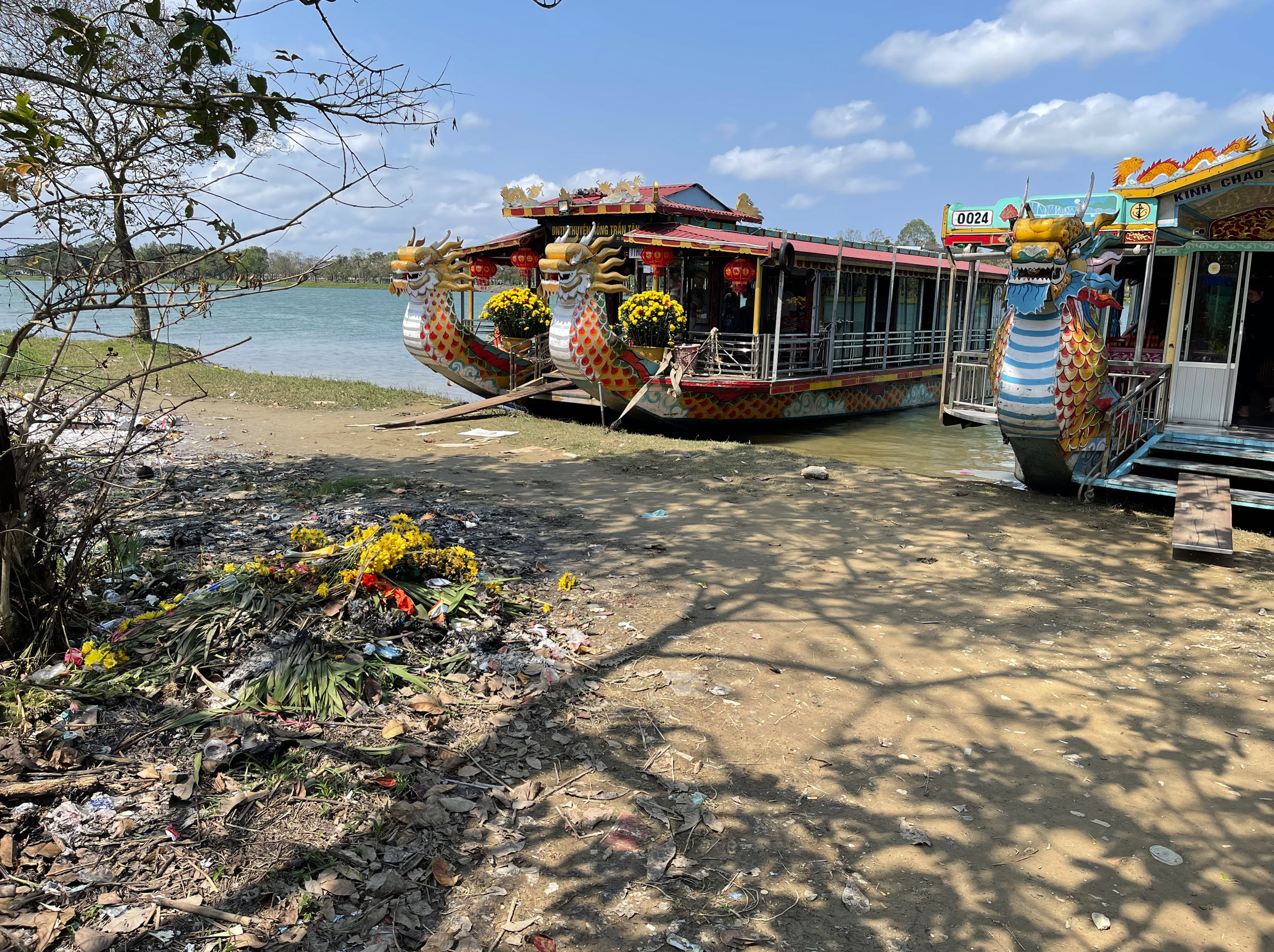
We took a boat ride down a river in a city. As we got off the boat (in the back), we walked by piles of trash accumulated over a long period along the area where the boats dock to let off the tourists. This does not seem to bother anybody. It’s obviously been there a long time.

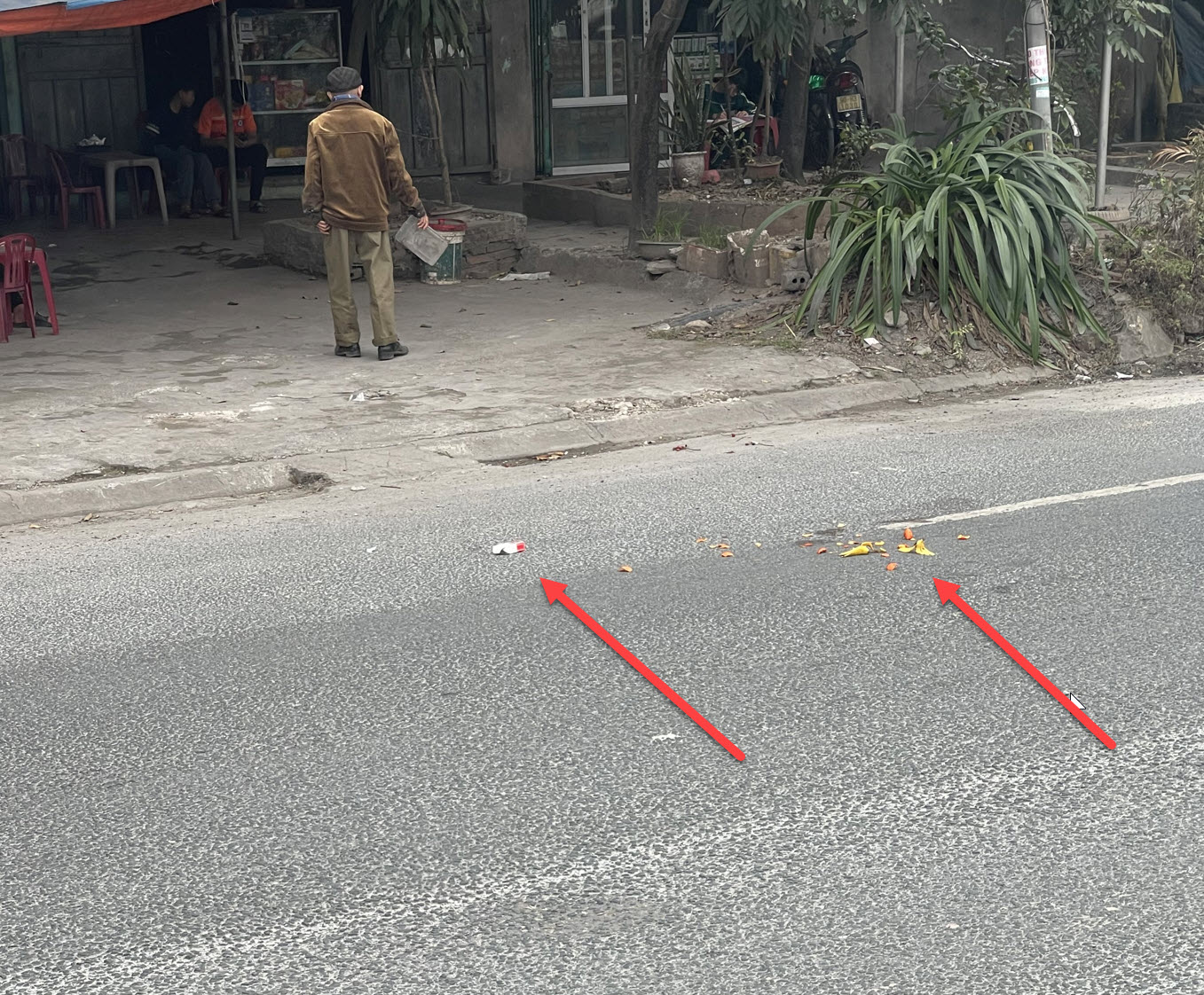
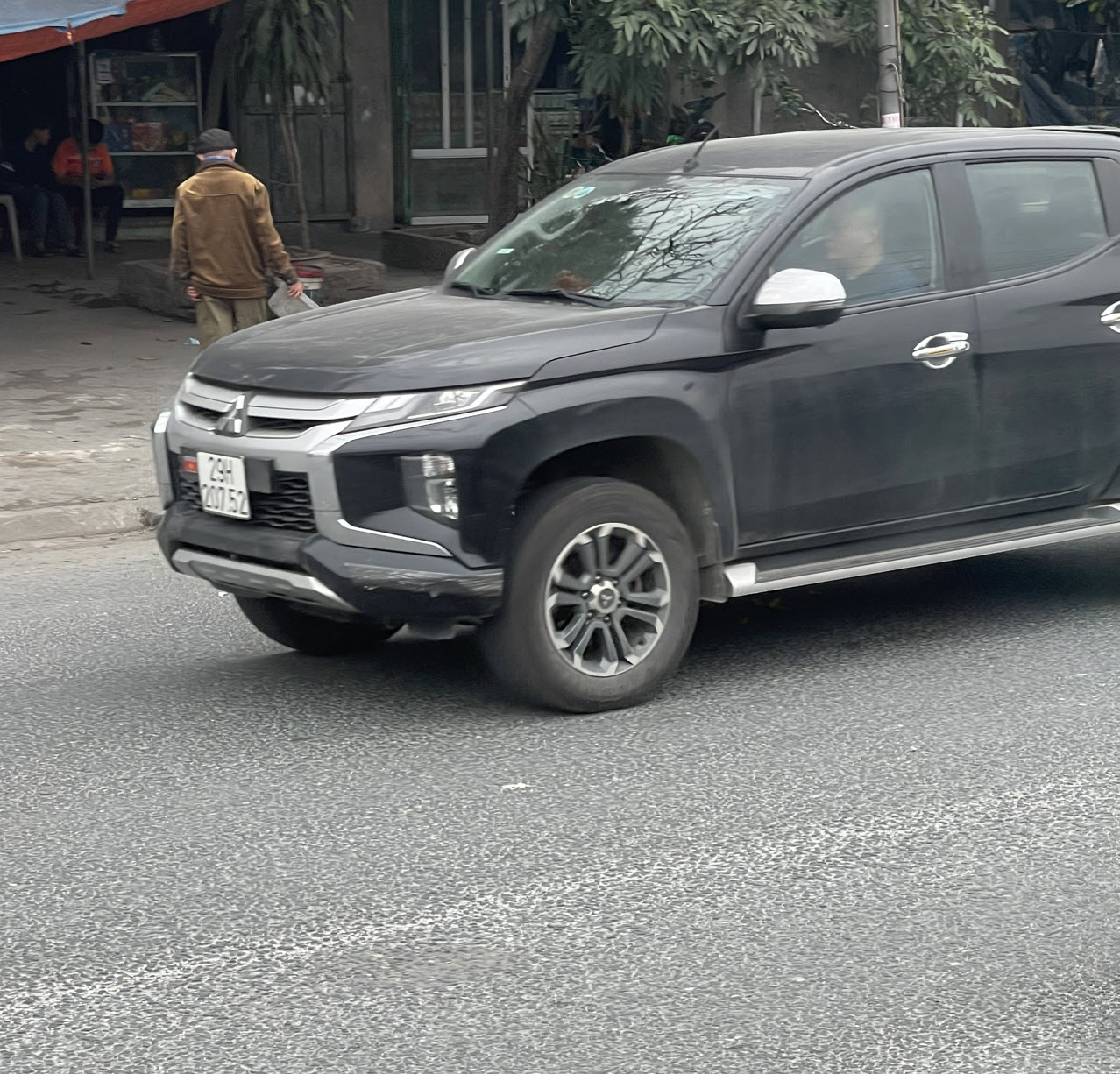
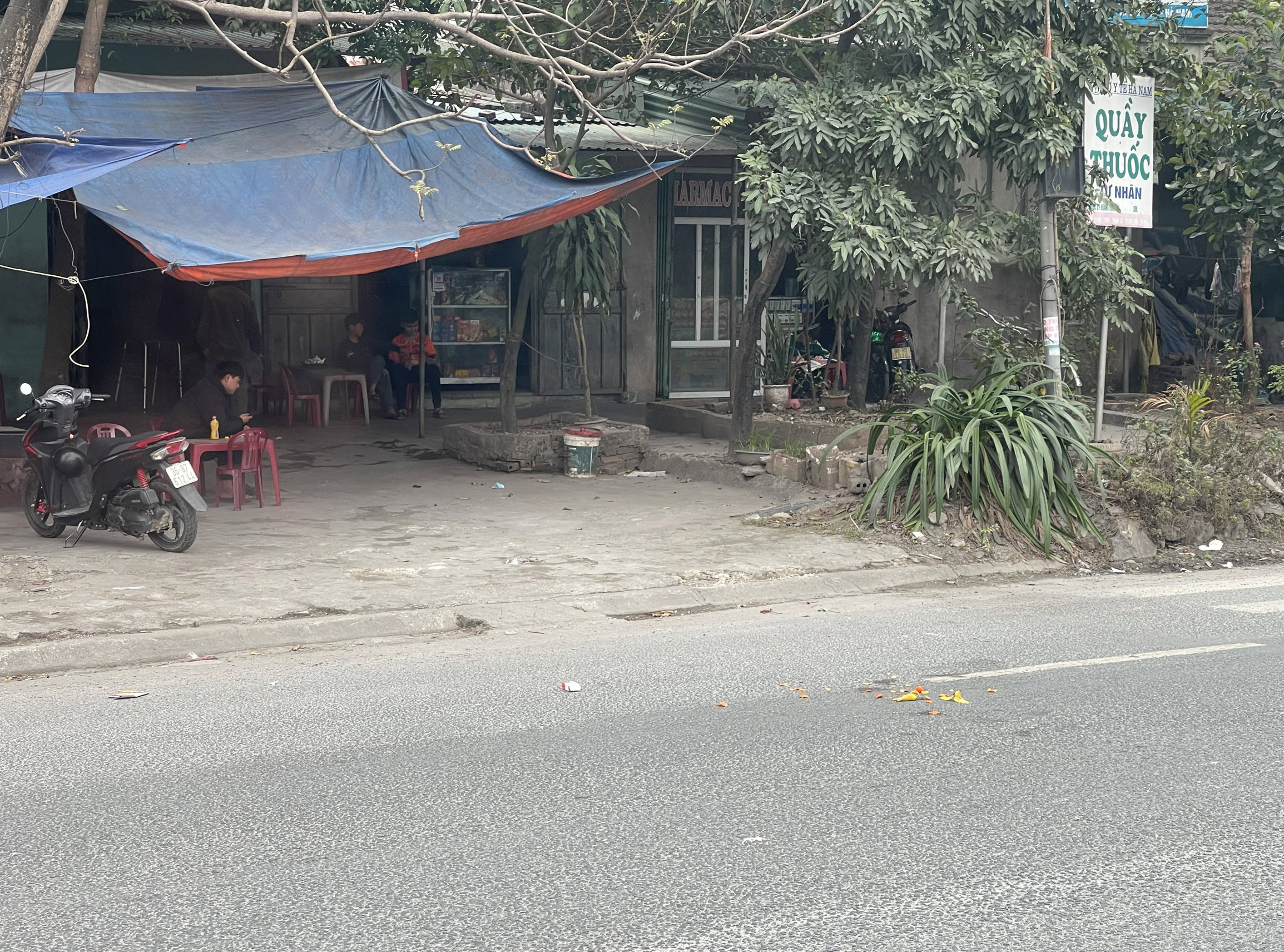
At one time I was sitting in our bus while we were waiting at a red light in a town in the country. All of a sudden an old man walked out into the street and dumped a plastic container full of trash into the middle of the road and just casually walked back into his shop. You can see him here walking back. I was stunned. It took me a few seconds to grab my phone to take this picture. I didn’t catch him in the act. As you can see, it not just perishable garbage, like banana  peels and other organic stuff, it’s also paper like a cigarette box on the left.

He obviously did it because he knew that the constant traffic would basically grind the trash to pieces in a short time. As you can see, the first car drove right over it.

Here is the trash after a few cars did their work. The man is back in his shop, business as usual.

I was dumbfounded, but then again, the other option he probably has is to collect it all in a barrel and set that on fire once a week.

There was garbage everywhere, and there was always smoke from the incessant burning of garbage, both in the cities and in the countryside.

It’s easy for me to to indignant and judgmental about this, but I ask myself: If I lived there, and there was nobody that came to to my house with a truck once a week to pick up my trash, like it’s done here, what would I do?