Inadequacies of the Garmin Instinct Watch

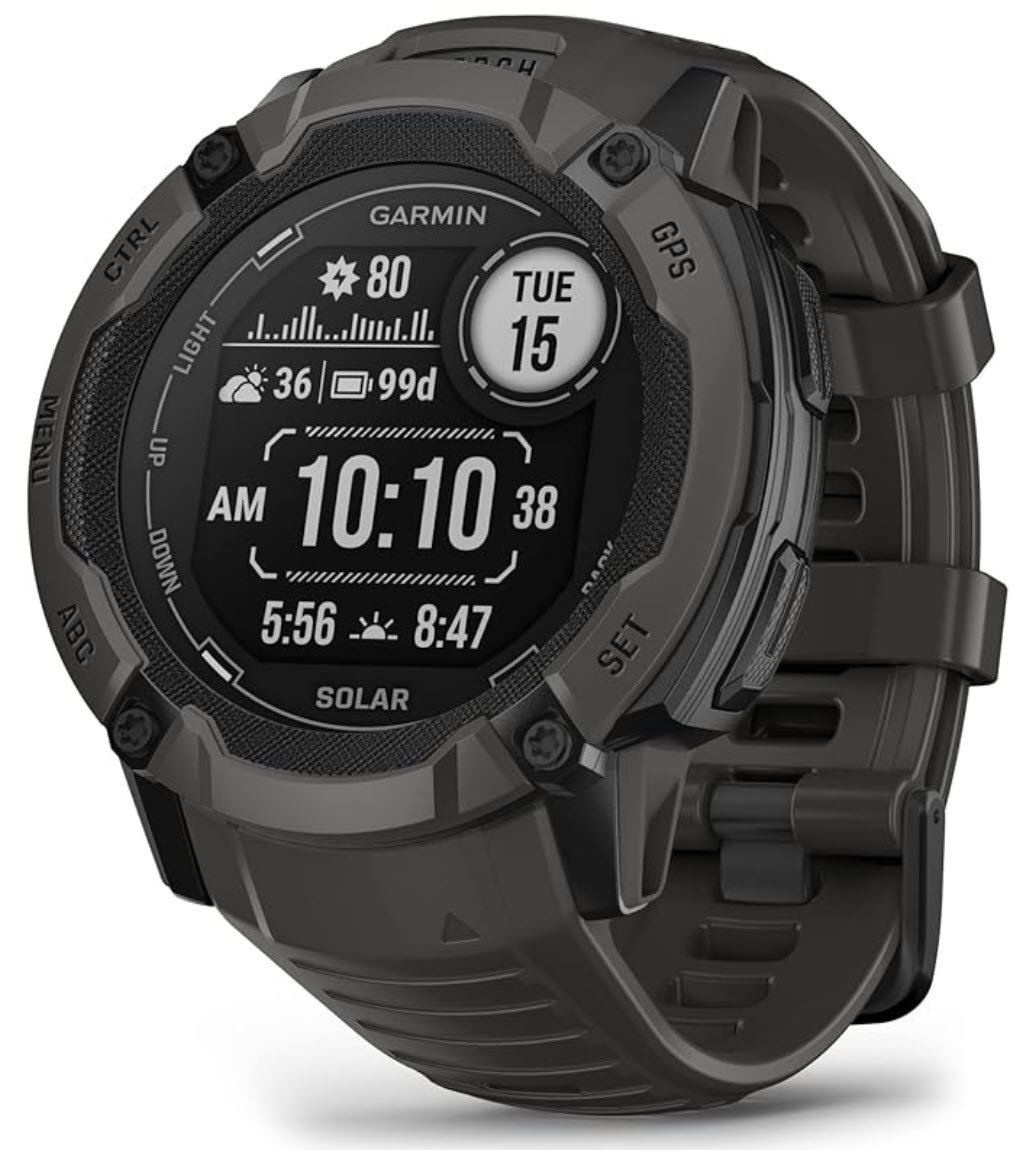
I have a Garmin Instinct 2X  Solar watch (software version 16.11).
I have had it for about 15 months, and I had the previous Garmin Instinct for over three years before that. Both watches have the same basic problems that I find annoying.

I use the watch only for exercise. I don’t wear it all the time, partly because it’s bulky and the rubber armband is itchy and does not fit well, no matter how I adjust it. I put the watch on before I walk, hike or bike and then track my activity. It syncs with the Garmin Connect app which gives me a full log of all activities, maps and statistics. When walking or biking, I don’t really need the GPS capabilities, but when hiking they are critical in the event I get lost. Besides being a tracker, it’s also a normal watch and shows the time of day as a default.

I have three main gripes with it.

Time Zone Adjustment is Painful.

Within the last 12 months I have hiked in Europe, Iceland, Hawaii and Vietnam and three different time zones in the US. When I travel between time zones, the watch never seems to follow automatically, even though my setting says it should. I have to go outside, choose an activity, let it try to get satellites, and after minutes of walking around, holding up my arm, trying to avoid trees and buildings, I can get it to set. Without making this effort, the watch will stay in the previous time zone.

My iPhone seems to have no problem finding its time zone instantly within the airplane before I even get off. How can a $500 plus device specialized for GPS not find its time zone?

The Heart Rate Monitor is Flakey.

In all my activities I show my heart rate in the upper right circle. At my age that is critical for measuring my performance and making sure that I stay within the range I need to be safe. For instance, when I hike uphill in the mountains, if I am not careful, my heart rate will go over 150 which is not sustainable for me. Same with mountain biking during climbs. I glance at my watch and pace my activity.

For some reason, from time to time, the heart rate shows way off, like 40 points lower than it should be. I know immediately that it’s wrong, of course. So I stop and fiddle with it, adjusting the arm band, wiping the back where it touches my skin, moving it around. Nothing seems to work. Then it eventually jumps back to where it should be, but sometimes it doesn’t. My old watch did that, and I thought I had a dud, so I bought the Instinct 2 just to correct that. But unfortunately, both watches exhibit the same identical behavior. It’s obviously a design problem.

The Elevation Sensor is Weak

Another big reason why I have the Instinct is that I want to know my elevation, particularly when hiking or mountain biking. I often go pretty high, and knowing where I am is important to me. So elevation is always displayed in my activities.

Over the years, I have learned that it varies widely, by a swing of maybe 500 feet. I have tried to turn it on and off, to no avail. It says it needs to be out in the open when I do it. I don’t usually turn it on in the house or car, but when I am ready to move. The default elevation is often ludicrously off. For instance, I will be at sea level, walking by the ocean, and it indicates 250 feet elevation. It will off both high or low. There is a way to manually calibrate the elevation. That makes sense when I am at my house (where I know how high I am) or at the ocean, but otherwise I have to know it, before I can set it. It kind of beats the purpose. Once it is set, it stays set and remains fairly reliable, but as soon as I turn it off, all bets are off again.

My iPhone has an Altimeter app which reliably determines my elevation to within +/- 10 feet. It even works inside buildings. I have even tested that in high rise hotels. I have started using my iPhone to determine the elevation and then manually calibrating my Instinct watch. How can a $500 plus device specialized for GPS not find the correct elevation on its own if a general purpose smartphone can do it?

Summary

I like Garmin products, they are designed for the outdoorsman like me. But I marvel how Garmin get away with such inadequacies, particularly when a smartphone app performs much better with these tasks.

One positive for the Instinct 2X – the battery life is phenomenal. It lasts a whole month or more the way I use it. That’s where it beats the smartphone. I can rely on there being power for days out in the wilderness, when my iPhone will long have died.


Trump is the Mule

I recently re-read Isaac Asimov’s  Foundation Trilogy. Here is my review.

There is a key character that appears in book 2 of the trilogy, called “the Mule.”

This is a mutant human, who has the ability to control other people’s emotions. He can inflict joy, pleasure, but also grief, sadness and pain. By influencing people’s emotional lives, he controls them. Within just a few years of discovering his power, he becomes the master of the universe. He conquers fleets, planets, and eventually becomes the ruler of the entire Empire, all within a span of just about 10 years.

The Mule is so successful because he is unique  (a mutant) and unlike anyone else. Nobody saw him coming, nobody predicted him, and there were no defenses against him. When humanity figured out what was going on, it was too late. They were all under his control.

Eventually, the Mule died and there was no successor. Nobody like him was around, and gradually the world regained its former balance – politics as usual.

Donald Trump is the Mule.

If you have read the Foundation Trilogy, you will know what I mean.

Book Review: Foundation Trilogy – by Isaac Asimov

Isaac Asimov published the Foundation Trilogy in the early 1950ies.

  • Book 1: Foundation (1951)
  • Book 2: Foundation and Empire (1952)
  • Book 3: Second Foundation (1953)

I first read the three books some 40 years ago in my twenties, but I only had vague memories. I remember them being good and, at the time, iconic. When a friend recently made a reference to them I decided to read them again. Usually I review books individually, but after reading the full trilogy, I came to the conclusion that they need to be combined. The books don’t stand on their own. The trilogy is really just one very long book.

Asimov added several more books to the series, two prequels and two sequels:

  • Book 4: Foundation’s Edge (1982) – sequel
  • Book 5: Foundation and Earth (1986) – sequel
  • Book 6: Prelude to Foundation (1988) – prequel
  • Book 7: Forward the Foundation (1993) – prequel

Book 7  was published after Asimov’s death in 1992.

I have not read any of the other four.

The trilogy plays about 10,000 years in the future. Humanity has invented interstellar travel by using ships that can make hyperspace jumps to travel the vast distances between stars.

The population of the galaxy at that  time is estimated to be quintillions of people, living on about 20 million planets which they call “worlds.” The capital of the Galactic Empire is the planet Trantor, which is completely covered by a gigantic city and has a population of approximately 40 billion people. The Empire is at a breaking point. The mathematician Hari Seldon invents the science of psychohistory, which allows him to predict the future. He creates a foundation of scientists with the objective to rebuild a new empire out of the chaos and lawlessness of millennia of anarchy.

Asimov builds a world, a universe, a psychology and a political system in the Foundation Trilogy. What strikes me reading it now in 2025 is that it is really not a science fiction story, but a story of politics. The Galactic Empire could be the Roman Empire, or even the United States of today. In the Foundation Trilogy, people live on planets, but they could just as well live in city states of the Roman Empire. The people travel on spaceships, but the technology is mysterious and not really described. Asimov refers to “nuclear” energy as the solution to all energy problems. The spaceships just seem to be able to travel vast distances without needing to take on fuel – because they have “nuclear” engines. The Foundation is the preeminent power in the Galaxy because it’s the only political entity that still knows to to control nuclear energy. There is no time dilation since the ships seem to just make jumps but never really accelerate in normal space. He does not bother to explain any of this technology. It is simply the basis of the story, which is mostly told via dialog between key characters. There are also no computers, and there is no Internet. Messages are sent via vacuum tubes, like those we still see in bank drive-ins. The Foundation Trilogy is a political novel, not a science fiction story. Another thing that I found odd is that there are absolutely no aliens in this universe. You’d think that Asimov would have assumed that there are alien civilizations amongst the 20 million inhabited worlds, but there is not a single alien in the entire story.

Essentially, Asimov wrote the Foundation Trilogy as a political saga in “space” based on the knowledge he had in the 1940ies.

I am pretty sure that if I had rated the trilogy when I first read it 40 years ago in the 1980ies, I would have given it three stars. But today, I found it fairly uninteresting, not particularly suspenseful, with hokey science and an inadequate depiction of a space-traveling society. That maxes out at 1.5 stars.


The Deficit and the Unique Skills of the Republicans

These are just the numbers, not the fluff of what they are telling us.

  • Jimmy Carter added $25 billion to the deficit.
  • Ronald Reagan added $74 billion. That seemed bad at the time.
  • George H.W. Bush added $102 billion.
  • Bill Clinton reduced the deficit by $383 billion, leaving the budget in surplus when he left office.
  • George W. Bush added $1.54 trillion to the deficit.
  • Barack Obama got the deficit down to $585 billion; that is, he reduced it by $825 billion.
  • Donald Trump added $2.1 trillion to the deficit.
  • Joe Biden reduced the deficit by about $942 billion.

Do you see a pattern here?

The Nightmare Traffic in Vietnam

One of the most powerful impressions of Vietnam is undoubtedly its traffic. Per our guide, the metropolitan area of Hanoi has 8.5 million people and over 6 million motorcycles. They all seem to be on the road at all times. The ratio of motorcycles to cars is at least 30 to 1. They overpower all streets and alleys.

All vehicles, be it buses, trucks, cars, motorcycles and bikes do not stop for pedestrians, even at crosswalks. The only way to cross any road is to just step into traffic, hold up your hand (that helps a little) and walk. I have learned that you can’t look at the traffic or make eye contact. My human reflex makes me stop when I see a bus heading straight for me. But that’s a mistake. The bus expects me to move at my current speed and the driver therefore adjusts his speed and direction to avoid me. If I suddenly stop in panic, all hell breaks loose up-traffic and bad things happen. You just go, go, go. It’s better to go in a group of people, since there is power in the masses.

Most intersections, even with multiple lanes in all directions, do not have traffic lights. So the cross traffic of all types just enters the intersection and eventually makes it across. The cross traffic swims around it like a school of fish in the ocean.

It takes some getting used to. I am amazed that there are not more accidents. I only saw one motorcycle fallen in two weeks.

The following are two videos I took at random spots in Hanoi. Just put them into full screen mode on your browser and watch. Check out the people crossing the streets. Watch the cross traffic make its way. And be amazed.

Here is another one:

You can see all kinds of things on those motorcycles. Here is a woman with a load of ducks that rode next to our bus for quite a while.

I didn’t get a video, but we saw one with two pigs (dead pigs) on the back. We also saw entire pieces of furniture on the backs of motorcycles, usually too late to get the camera out to catch them.

There are many people who commute with their families. Click on the image below, zoom in and check how many kids you can find on the bikes.

Often we saw four people on a motorcycle, with both parents being on their phones, either navigating or watching videos.

Here is a father with a baby between his legs and a kid behind him.

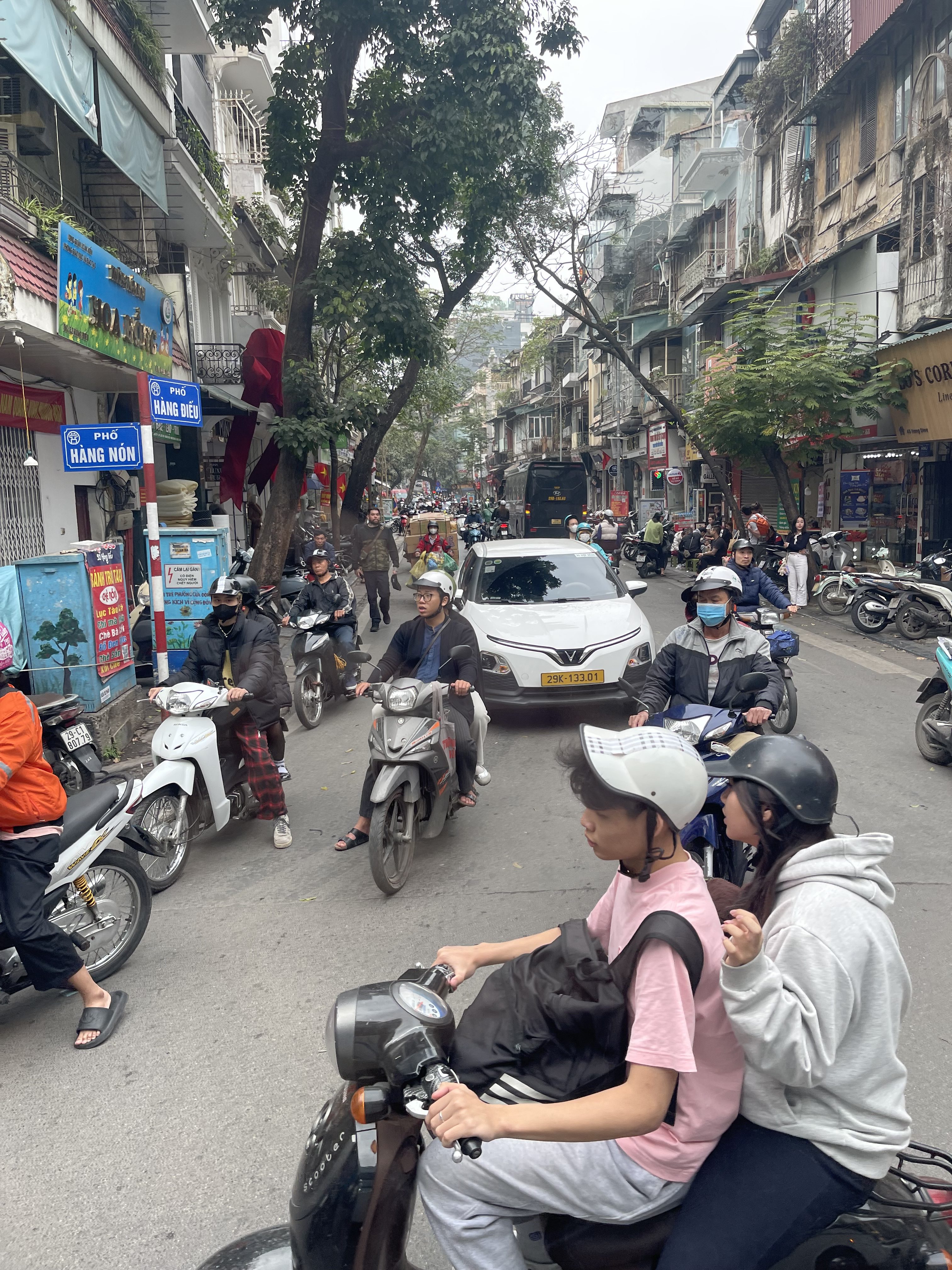
Here is another typical street scene in Hanoi. Every street, every alley, looks like this.


Traffic in Vietnam is unique, chaotic, terrifying and fascinating all at once. I might note that we didn’t see any rental car counters at the various airports we flew in and out of, including Hanoi, Saigon and Da Nang. What tourist would be able to drive there anyway?

The rental car companies seem to know.

Vietnam Trip: Visiting the Hỏa Lò Prison in Hanoi

During our recent trip to Vietnam, we visited the Hỏa Lò Prison in Hanoi. Of all the wonderful things and experiences during this trip I could, and eventually will, report about, why am I picking the visit to a prison as the first topic?

Hỏa Lò was a prison in Hanoi originally used by the French colonists for political prisoners, and later by North Vietnam for U.S. prisoners of war during the Vietnam War. In America we know it as the Hanoi Hilton. The prison is a museum today, run by the Vietnamese government. Here is my entry ticket:

The exhibits spend much time and effort on the period of the French colonial suppression of the Vietnamese people and the brutality of the colonists against dissidents. The French behaved like dictators do: they built prison camps and sent those that didn’t think like them to those camps and subjected them to terrible atrocities, including starvation, torture and eventual death. The prison also has a section about the American POWs during the Vietnam war, but it is somewhat smaller and less focused. This is not surprising. The prison was used by French against the Vietnamese, but later by the Vietnamese against the Americans. You want to focus on what they did to you, not what you did to them.

One of our first guides was a young woman in her thirties who took us past the prison on a city tour and mentioned that the prison was used to detain American pilots. She actually said that “Vietnam took good care of those prisoners during the war.” This happened early during our trip, before it had sunk in that I was in a communist country where the people could definitely not speak freely, and in particular tour guides were likely briefed on what they should say about controversial topics. I quickly realized that I needed to remember that our guides were young people, born decades after the war, in a controlled society. It was not their fault that the opinions they needed parrot didn’t always align with the reality as I knew it. Arguing or debating points of view would not make sense in that context, so I learned how to listen carefully and digest the information later.

To illustrate my point, here is a sign in the exhibit about female prisoners. Pay attention to the tone of the message:

A visit to the prison was not part of the agenda of our trip. When we learned how close we were, we asked our guide to make room on the schedule, and we squeezed in a 90-minute visit to the museum. For me it was one of the highlights of a two-week visit in Vietnam, albeit a depressing one.

This is because I was always very interested in the lore of the Hanoi Hilton. Many books have been written about it, and one that stands out for me is John McCain’s autobiography Faith of my Fathers, which he wrote in 1999 when he first ran for president. I read it in 2008 when McCain ran for president (again) against Obama. Here is my review. I gave it four stars.

There is a lake in the heart of Hanoi, known as Hoan Kiem Lake. It’s also known as Sword Lake, Lake of the Returned Sword, or Tả Vọng Lake. In the book, McCain describes how he got shot down over Hanoi and as his bad luck would have it, that’s where he crashed. He almost drowned before some fishermen rescued him.

When we arrived in Hanoi, we stayed at the Pan Pacific Hotel, which you can see in the photo below,  and it happens to be right on the shores of that lake.

It was eerie for me to walk along this lake in the morning after breakfast, remembering the story of McCain’s capture.

Here is an excerpt of my book review:

With two broken arms and one broken leg, he was beaten and tortured during the first few months, without any adequate medical care and only minimal and eventually botched operations on his leg. His arms were never set properly. Several times his arms and legs were refractured when he was beaten. He spent most of his years in captivity on crutches, due to his bad right leg. Medical care was withheld as a torture method. The prisoners were tortured initially to obtain military information about the initiatives of the war, from the newly captured prisoners that would have such information. Later they were tortured to extract video taped footage to be used for propaganda. The Vietnamese wanted to show the world how injust the war was by turning public opinion globally and in the US against the war. This could be done by having American officers make anti-war and unpatriotic statements, supposedly by their own volition. This hardly ever happened. The code of honor required that the prisoners endured terrible torture without ever breaking.

Prisoners were not allowed to communicate. They were kept in solitary confinement for months and sometimes years on end. When caught communicating, they were beaten for days and punished by being thown into squalid cells of 6 foot by 3 foot and no ventilation or sanitary measures for months. Health care and nutrition was completely inadequate, and some prisoners died from disease. At one time McCain describes being punished by standing, facing a corner, for more than two days. When he finally collapsed, he was beaten again for not following the rules.

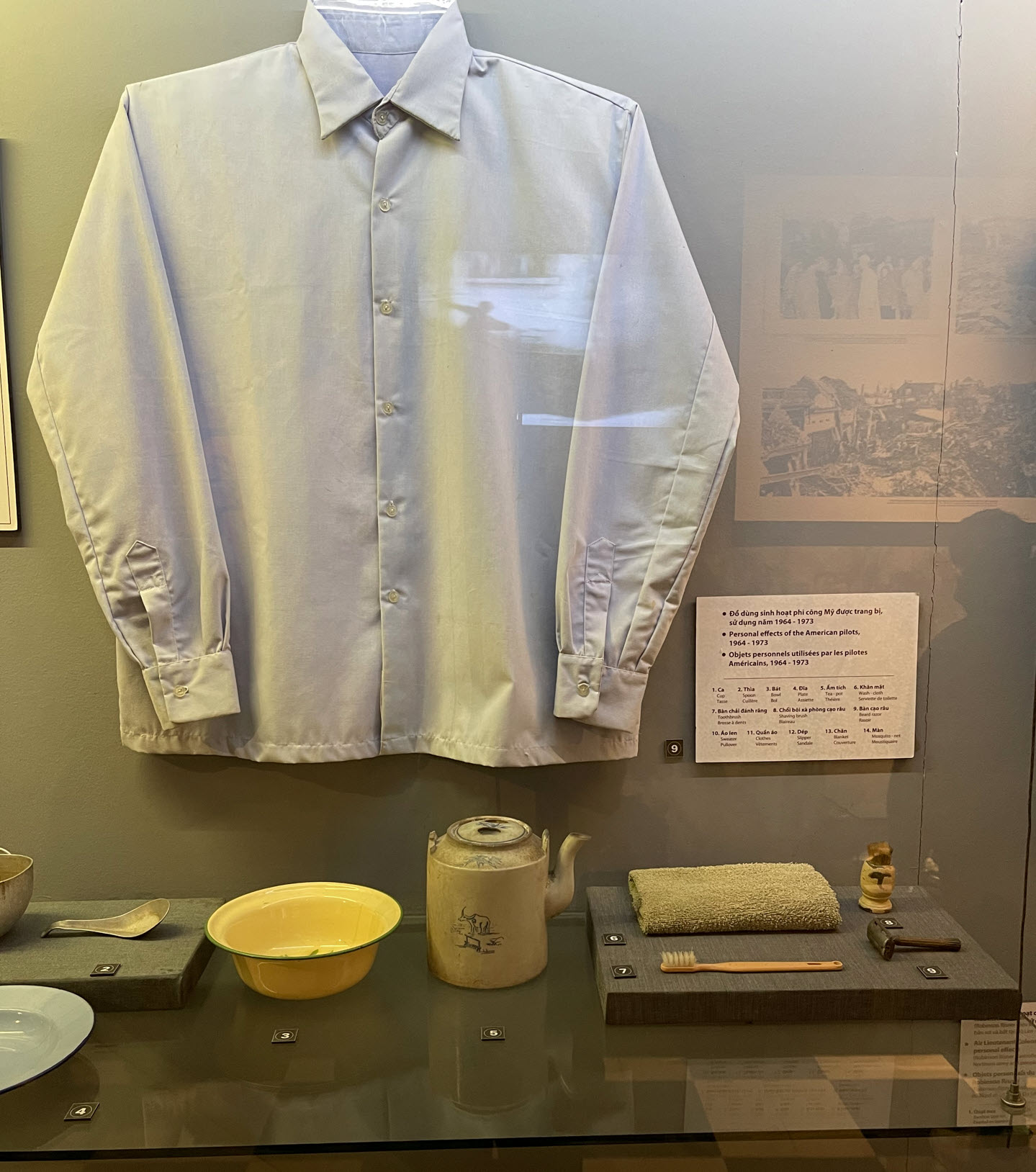
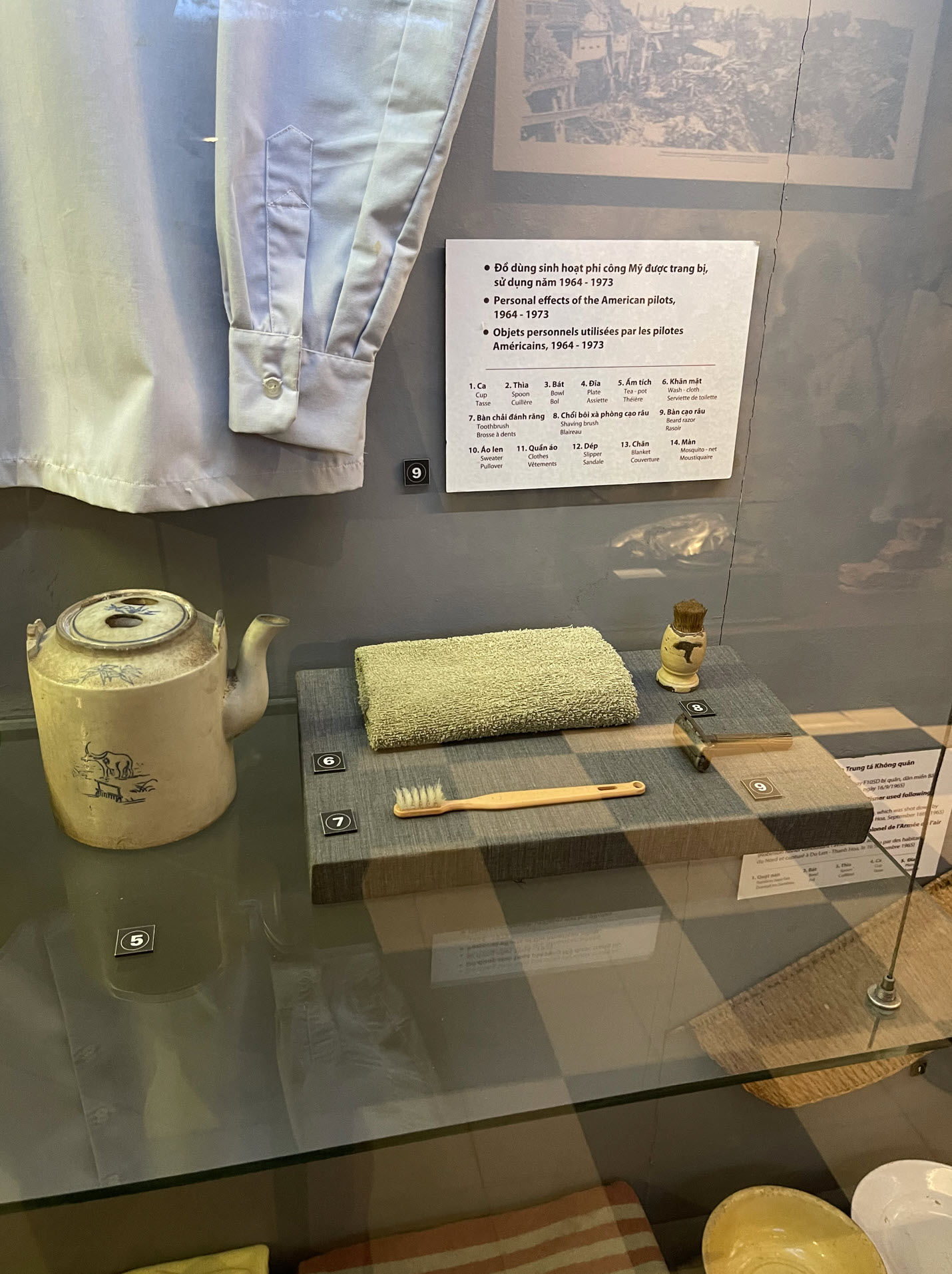
I highly recommend reading Faith of my Fathers to anyone wanting to understand the man John McCain and the experiences of a prisoner of war. If you only read one chapter, read the one about “John McCain’s Towel.” I will do that myself, now that I have been in the Hanoi Hilton, where the ghosts of the American prisoners from over 50 years ago still haunt the walls, and where I saw the infamous towel, as part of the gear issued to the prisoners, in this exhibit:

Above you see some of the gear given to the prisoners. On the right side you can see the towel. Since I knew its significance when I was there, I took a close up of that exhibit:

Here are some additional exhibits about individual prisoners. The one about McCain is a larger one, of course, due to his notoriety as a presidential candidate later in his life.

Here is a picture of McCain when we visited Vietnam in 2000 and toured the prison where he was captive and tortured for almost seven years.

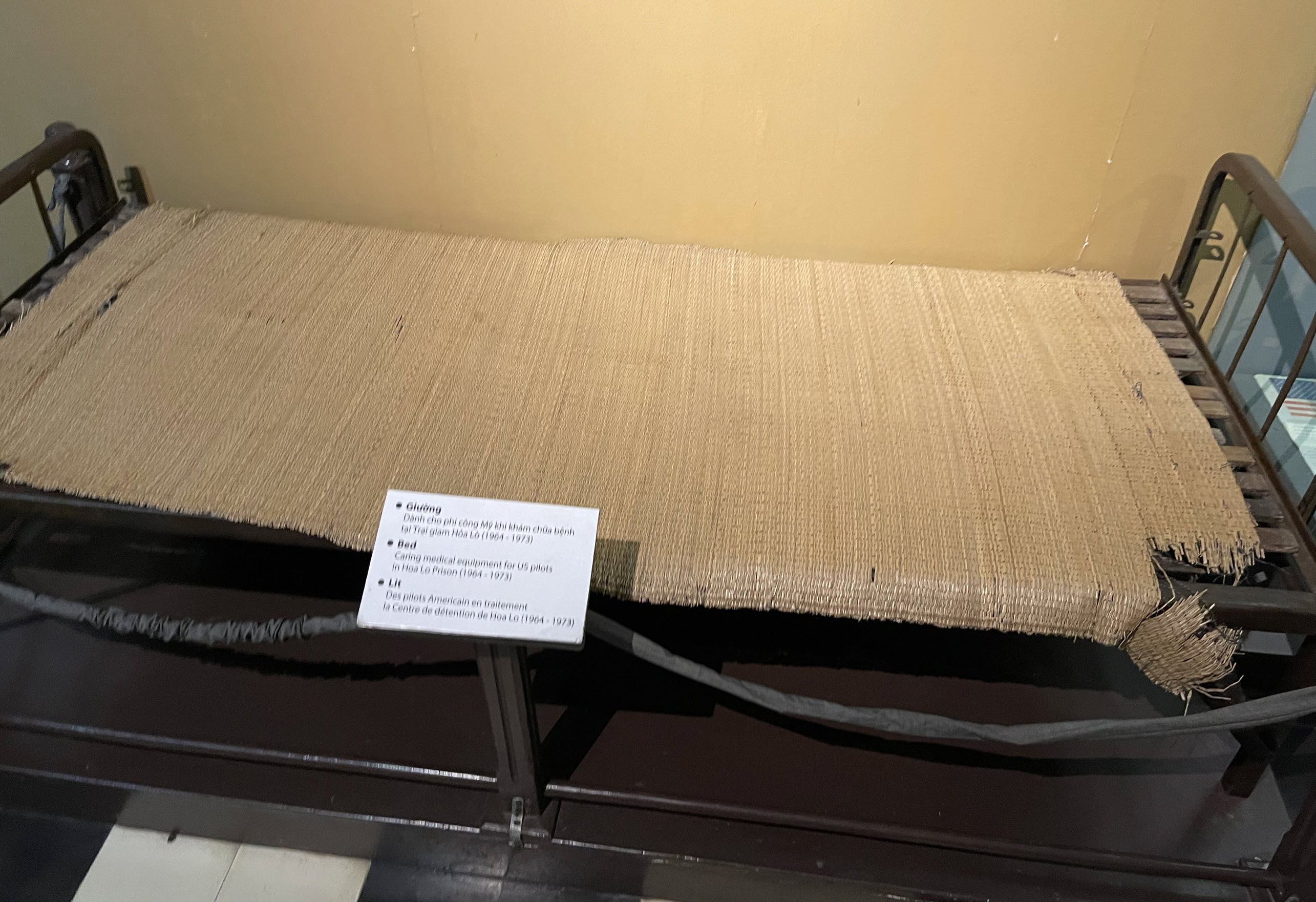
Here is a picture of the beds of the American prisoners.

In contrast, the image below shows how Vietnamese prisoners were shackled in endless rows during the colonial period. Remember, the crime of these men was that they didn’t think the Vietnamese people should be ruled by the French.

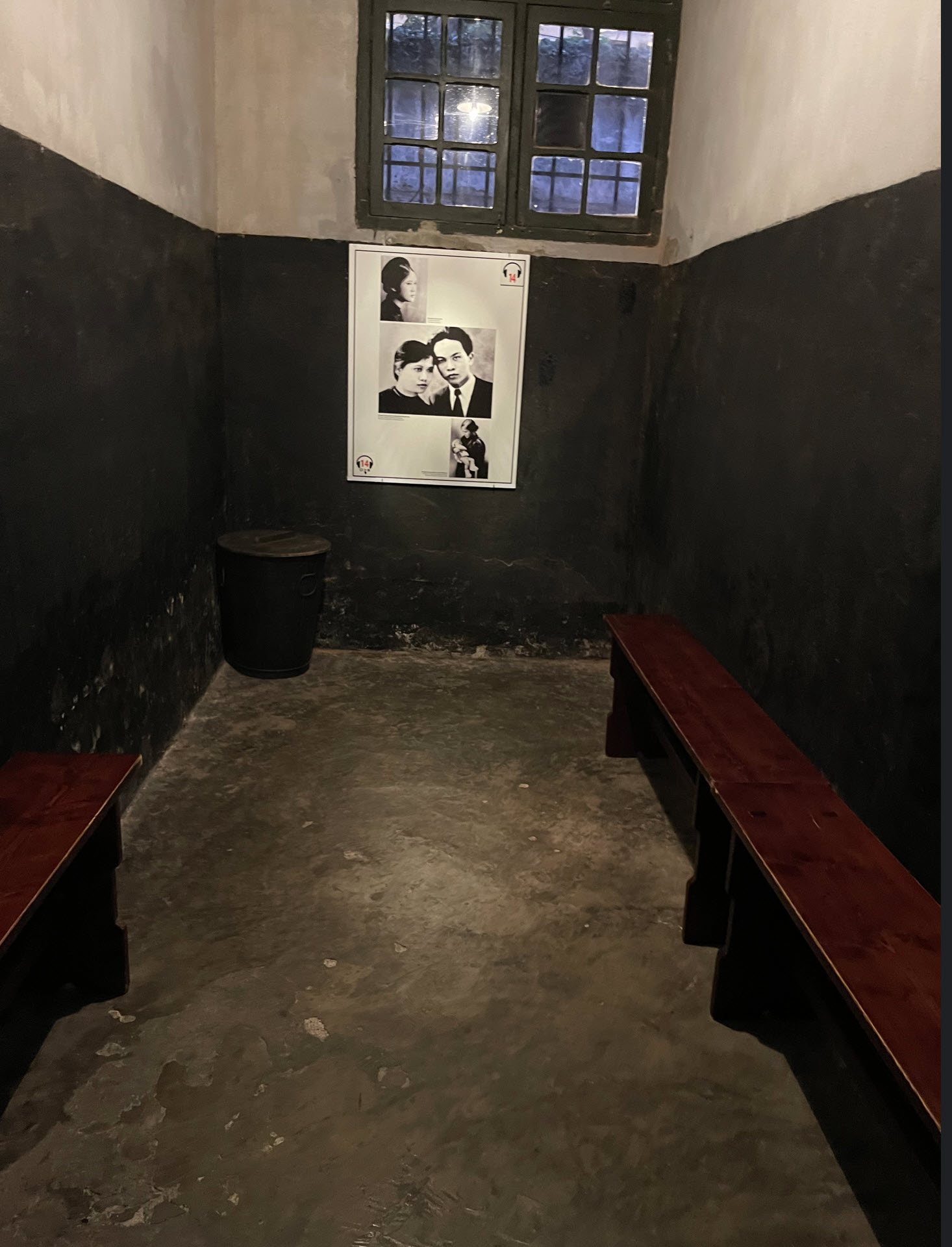
Here is a typical cell in the Hanoi Hilton.

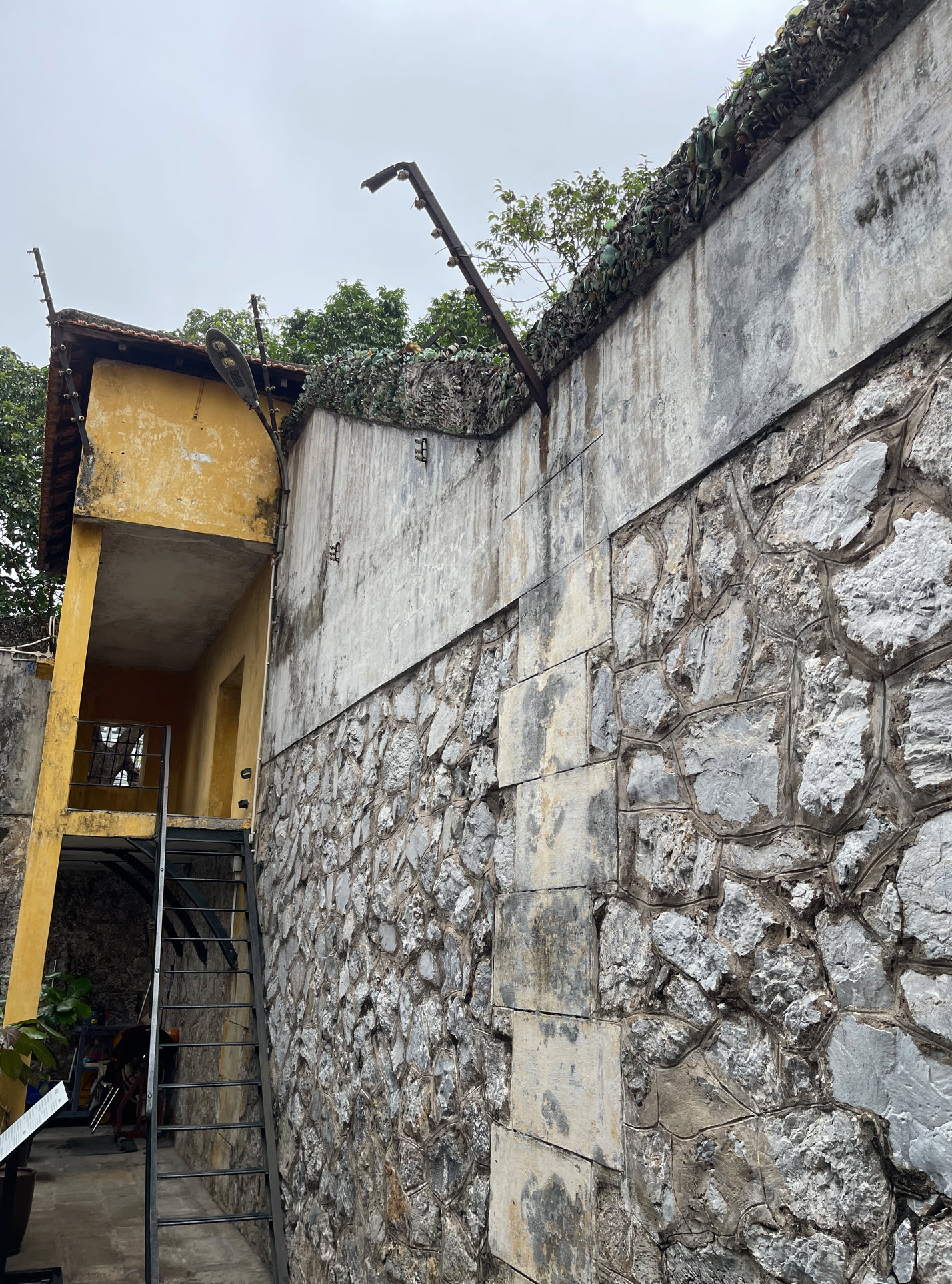
Below is a section of the prison wall from the inside. On top there is barbed wire, sometimes electric wire, but the wall is also covered with shards of glass cemented along the top.

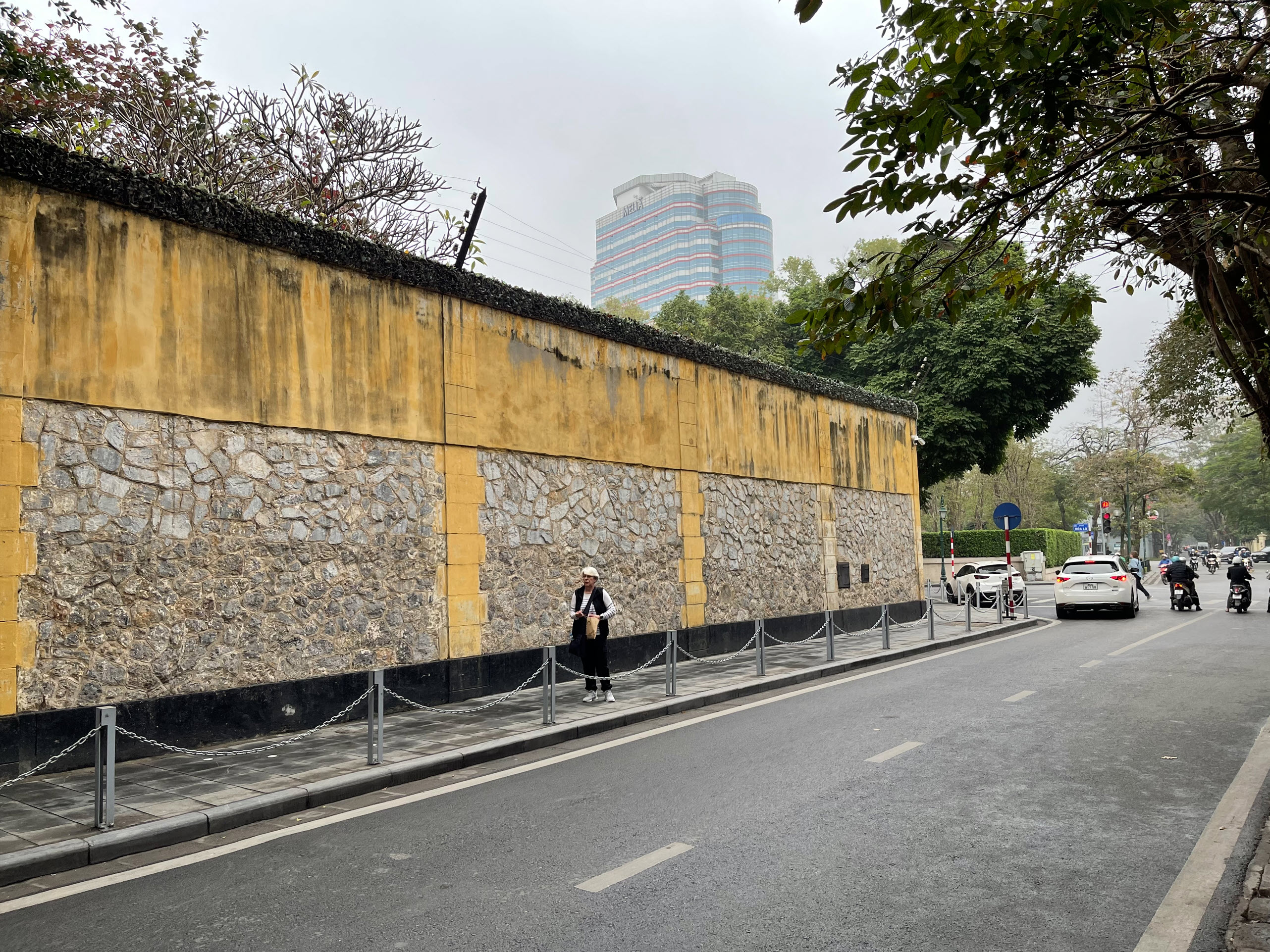
This is the same wall from the outside.

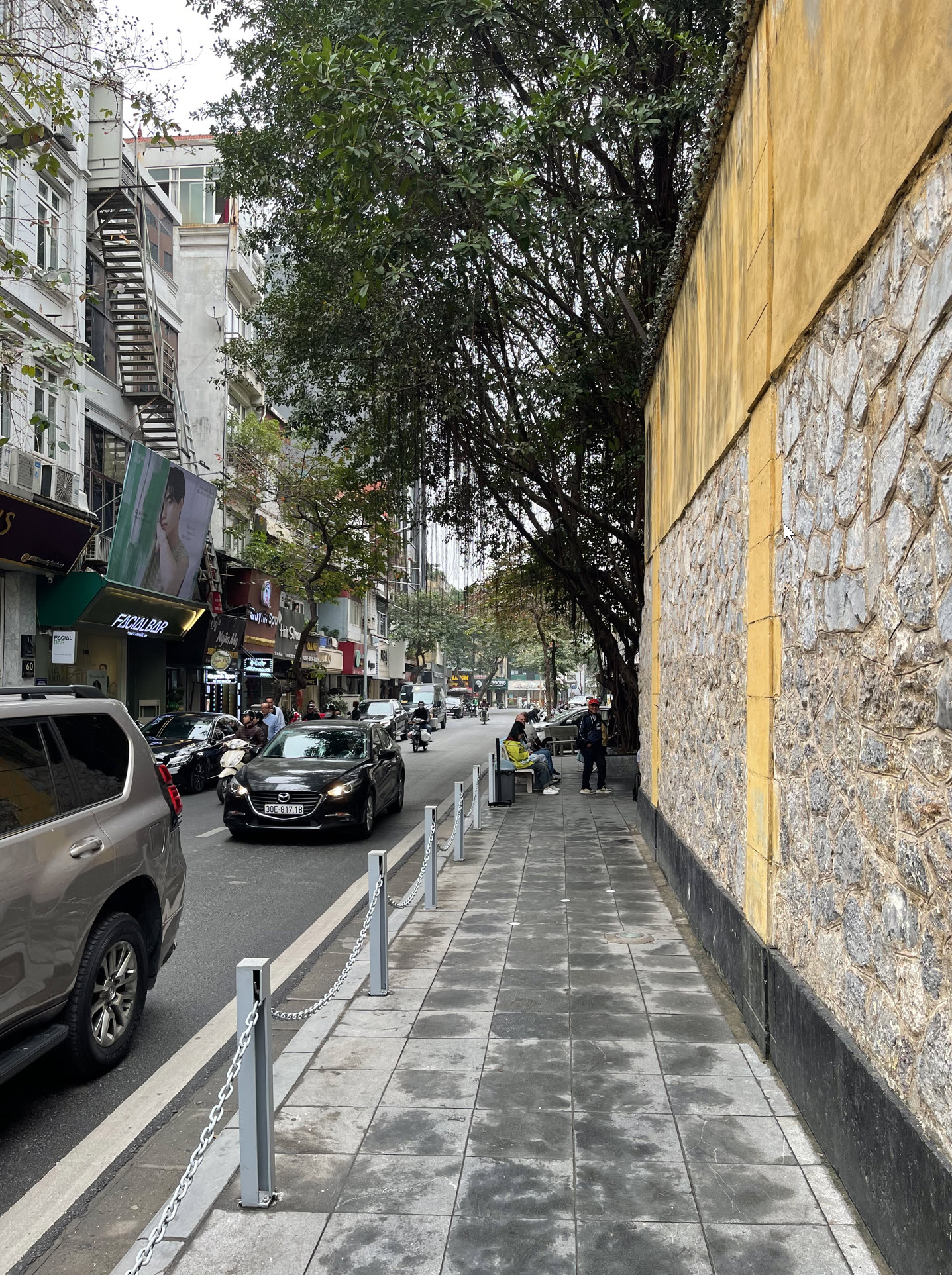
The prison is in the middle of the city, surrounded by the hustle and bustle of Hanoi. If you didn’t know what you are looking at, you would walk right past.

On the other side of the wall you find hotels, little shops, cafes and restaurants.

I wonder what it must have been like to be imprisoned for years behind these walls hearing and feeling the pulsating heart of the city all around you?

Book Review: The Elephant Whisperer – by Lawrence Anthony

With a group of friends we are in the process of planning a wilderness tour to Africa. One of the ladies mentioned that she had read The Elephant Whisperer and that had made her really interested. So I picked up the book.

Promptly, it put the bug in me too.

The author, Lawrence Anthony, is an animal conservationist. He bought a game reserve in Zululand in South Africa, named Thula Thula. There are no wild elephants left in that part of Africa. When he received a call about a small herd of elephants that had turned rogue and needed a home, he could not refuse. If he hadn’t accepted, the elephants would have been put down.

He took them in, not knowing how difficult it would be to host a herd of wild elephants and all the challenges that come with it. In the years that followed, he created a unique personal bond with the herd, and particularly with Nana, the matriarch.

Reading the book, I realized I had no idea what wild elephants were like, how dangerous they were, and how challenging it was to coexist with them. It definitely helped me prepare myself mentally for a trip into the bush, and I will have a completely different appreciation of the giant animals than I would have had before. I am now looking forward to the trip, which won’t be until about May 2026.

The Elephant Whisperer is a must-read book for anyone interested in animal preservation and protection, game reserves, animal intelligence, nature, and Africa.

Book Review: The Time-Traveling Estate Agent – by Dale Bradford

Last Sunday I was on a Vietnam Airlines plane on the tarmac in Saigon, waiting for the boarding to complete, before starting the very long journey home to California. I had stocked up on Kindle books for the trip, just finishing up Book 2 of Asimov’s Foundation series, with Book 3 already downloaded so I’d have ample reading material. I decided to check my email one last time before I’d switch my iPhone to airplane mode when I saw an email from a stranger named Dale Bradford that started out with:

Please excuse me contacting you out of the blue, but I found you online while looking for reviewers of time travel books and after exploring your site I see you have reviewed a whopping 63 titles.

As I have said many times in these pages before, I can’t resist a time-travel novel.  I quickly downloaded The Time-Traveling Estate Agent to my phone, put aside Asimov and started reading about a guy named Eric Meek, a 60-year-old real estate agent in a small Welsh town in the United Kingdom. The book occupied my time on the plane when I was not sleeping or eating, and I finished it shortly after I got home to San Diego. According to the author, I was probably the first person in the United States to read it. Little did he know, but I was probably the ONLY person ever in Vietnam, and then Korea at my stopover, to read it. Thanks, Dale, for letting me have the honor.

The story jumps between December 2019 and July 3, 1976, presumably the hottest day in the UK in the twentieth century. Eric, in his position as an estate agent (that’s what they apparently call “real estate agents” in the UK) is listing the house of his former physics teacher, Mr. Freeman. It turns out, Freeman, while tinkering in his garage, accidentally created a wormhole, or portal, to a specific place, his garage, and a specific time, July 3, 1976. Eric discovers the portal coincidentally and walks through it, without the permission of Freeman. He is in for a surprise.

July 3, 1976 also happens to be the worst day of Eric’s life as a 16-year-old boy who lives across the street from the Freeman house and the curious garage. The story is about Eric trying to change his own life and the lives of some of the people, including some girls, close to him. We learn about Eric’s first love, his challenging relationship with his father, the people he worked with as a young man, and eventually as the owner of the real estate agency Barrington Meek. He tries to make some wrongs right.

I found the book entertaining, and the author did a good job coming up with a time-travel methodology that makes sense and is consistent. Some of the language, this being written by a UK author, cracked me up. For instance, one woman says: “I was only pulling your pisser….” What the heck does that mean? I had to look it up:

Literally pull my pisser is to masturbate. But nowadays the expression someone is pulling my pisser is used with the meaning of someone is messing with me.

There are many other doozies like this in the book. But that’s ok. It made it somewhat exotic for me. There were very few grammatical errors that I found. The only one was where a character quotes “in vino veritus” which is Latin and means “in the wine is the truth.” But I happen to have studied Latin for many years and I know it’s really “in vino veritas.” And that’s all I found, so that’s pretty good.

The interactions of the main characters are sometimes a bit choppy. For example, when we first meet Mr. Freeman, his is a belligerent and cantankerous old man, ready to call the police to have Eric thrown out for trespassing. But within just a few short sentences and arguments from Eric, he turns around and they start being best buddies, drinking together, and Freeman literally offers all the details about the time portal to Eric. This just would not happen in real life. The same thing for Mrs. Freeman. She has lived with her husband for some 50 years, in a house that had a time portal in the garage for 43 of those years, and she has no idea what is going on in that garage. Seriously, Eric, a total stranger, just walks in and goes through the portal, when Mrs. Freeman does not even know it’s there. This story is full of unreal scenarios like that, and it makes it – well – not real.

There is another time-travel book where there is a portal that goes back in time to a very specific and fixed time and place. That is Stephen King’s 11/22/63.  King does a masterful job in that story with time travel mechanics much like those in this book. I gave 11/22/63 three stars.

The author of The Time-Traveling Estate Agent could have worked on the dialog and basic premises a bit more, perhaps added 50 to 100 pages to the length of the book, and made it much more believable. As it is, I found it too abrupt and therefore distracting. But the “whodunnit” questions kept me turning the pages and I finished the book. I enjoyed a fairly satisfying ending.


Riding my Bike to Stanley Peak

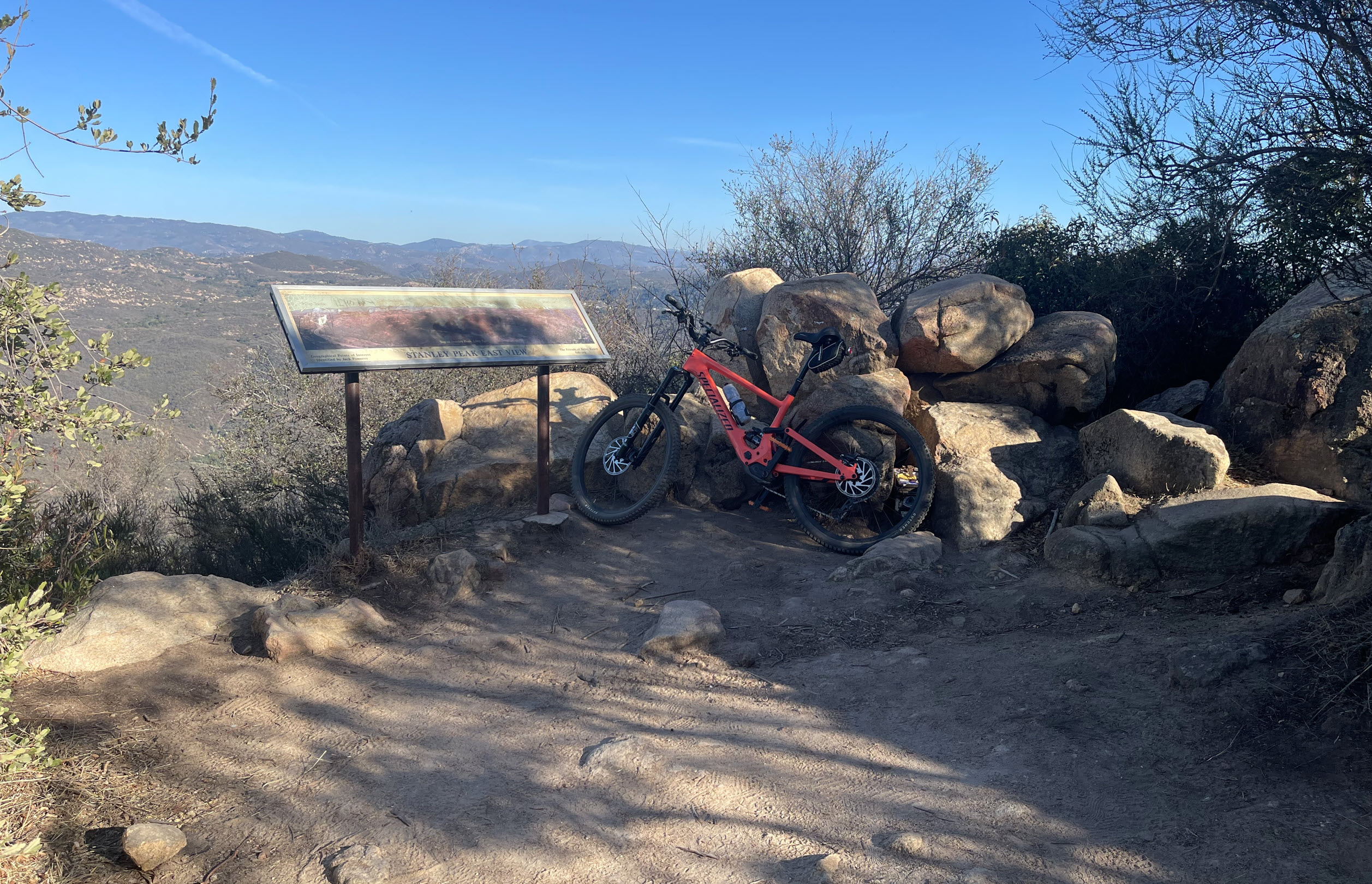
This afternoon it was nice and sunny, and I decided to take bike ride up to Stanley Peak, one of the prominent mountains in Daley Ranch in Escondido. It was a 11.67 mile ride round trip. I go hiking and biking there quite often, but today I thought I’d take a few pictures to share.

Here is a map of my trip. I went up the mountain and then did a counter-clock-wise loop. Blue is slow (up the hill) and red is fast (coasting downhill).

I can literally do this ride from my front door.

There were some recent mountain lion sightings, so there are warning signs around the park to make people aware. In all the years of my hiking, I have never seen a mountain lion, even though I know they are there. However, yesterday I was really lucky (on another ride in Daley Ranch). I saw two Lynxes. One was an adult, about  the size of a coyote, with the characteristic pointy ears and the short tail. Its fur was grey-brown. Since I was on my bike, I was not able to stop and get my phone out to take a picture in time, before I disappeared. Then, a bit later I saw a juvenile lynx. It was about the size of a very large cat with the same color fur as the adult. Again, no pictures.

The trail up on the mountain gets quite rough.

Toward the top, the trail was steep enough I had to push my bike.

Finally, at the top, at 1,970 feet altitude.

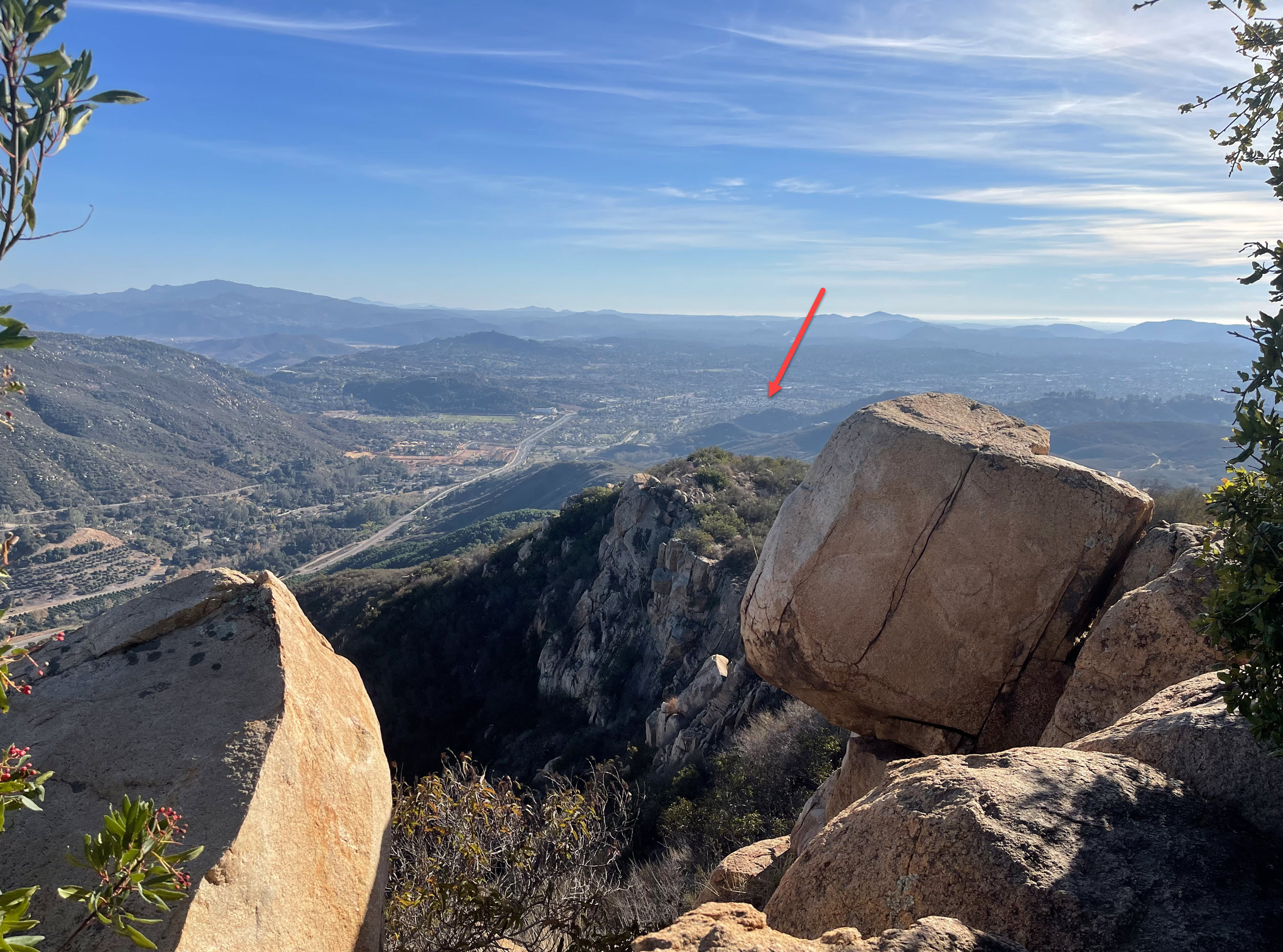
The views are  great. This is looking south to Escondido from the top of Stanley Peak. The arrow points to a little nubby which is the mountain right behind our house. Our house can’t be seen from the peak, it’s behind that mountain. On the left you can see the road up to Valley Center, which you can also see on the map above on the right side.

Here is a view looking straight north from the same spot. The large ridge in the distance is Palomar Mountain, home of the famous observatory.

On the way back down I just had to take this picture of one of my favorite spots on this trail, an idyllic mountain pond.  There is all kinds of wildlife here, and I am sure it’s a great watering spot for the big cats, the mountain lion and the lynx.

I feel very fortunate that I can literally hike or bike to this wilderness area from my front door. It’s a very different world up there.

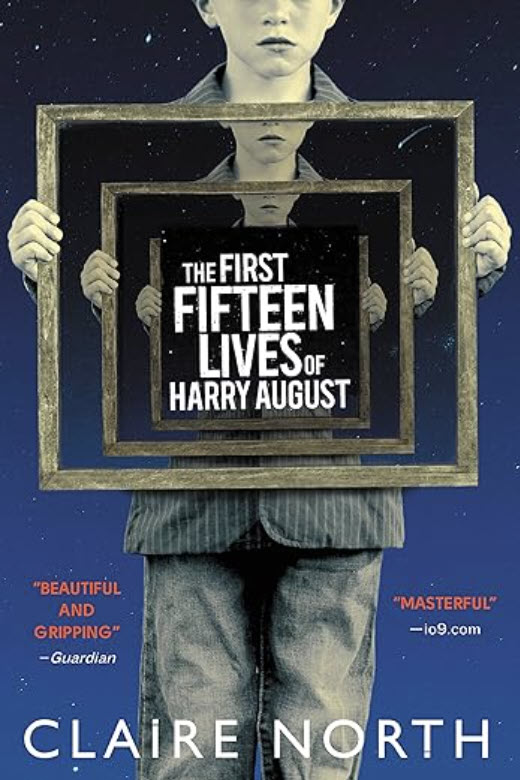
Book Review: The First Fifteen Lives of Harry August – by Claire North

The premise is that there are people who die and then come back, with all their memories intact for another life. It’s always the same life, born to the same parents, growing up in the same era in the same time of history. Harry August is such a person.

Of course, in his second life, he figures out that he is much smarter, since he knows the future and he tries to manipulate it. After a few lives he becomes a medical doctor. Imagine a 6-year-old child with the knowledge of a medical doctor. But changing history to your advantage does not always work out as expected.

There are many other people, all throughout history, who are like Harry. They form a club called the Chronos Club and they can communicate up and down the eras. A young child just born can give a message to an old person who is about to die. When that person is young again in his next life, 80 years earlier, as a child, he passes the message to another old person, and so on. They can pass messages to ancient Rome that way and beyond.

It’s an interesting premise, but I just never got into the story enough to care about what happens next, and how it all wraps up. I made it to Chapter 35 about 35% into the book when I finally gave up. I had lost interest and found myself reading only to get through the book.

The writer tells vignettes from different lives in different chapters, not necessarily in chronological order. This makes it difficult to keep track of what is actually going on, never mind that the story is distributed over the first fifteen lives. I am sure it may get more interesting, and I am sure there will be plot twists eventually, but I lost my will. There are other books to read.

As always, when I don’t finish reading a book I refrain from rating it.

Modern Slavery Is Now Worse Than Ever

Many years ago, in 2013, I wrote a post titled “What’s Your Slavery Footprint” where I said:

How many leather shoes are in your closet? How many gadgets do you own? Do you use coffee? Do you have jewels? Silver or gold?

Today I should be adding:

Do you use an electric or hybrid vehicle? Do you use a battery storage device?

Today I was contacted by one of the people who found my 2013 post about slavery and she sent me a comprehensive article by Arnold Mutinda about modern slavery. The details presented are amazing and the facts put in front of us astounding. Here is the link:

What Is Modern Slavery: A Comprehensive Research

One of the gravest offenders is the Democratic Republic of Congo (DRC) and the biggest contributor to the phenomenon is the infamous cobalt mining in the country. Congo produces over 70% of the world’s cobalt. China controls around 75% of the global cobalt production and around 90% of China’s cobalt comes from the DRC.

Congolese miners are often children, abducted by militia and forced to work in the mines, digging tunnels by hand without securing them using beams. Miners sometimes get buried alive. They often work 12-hour shifts with only one break, six days in a row.

In 2016 , the provincial governor of Kolwezi confirmed that children worked in the cobalt mines but that the government was “too poor” to address the issue. Of course, conditions like this are ripe for abuse by the industrialized nations where markets and profits count above everything else, and where human rights are viewed by the prevailing governments as secondary objectives at best. This counts for China, and unfortunately also the United States.

As a consumer I am pretty powerless. I am writing this post on a set of gadgets that use many microchips and batteries, which consume rare earth minerals, lithium and cobalt from the DRC. There is a hybrid car in my garage with a lithium-based battery. By doing this, I am abusing some child in the Congo. Make no mistake about it, I am NOT providing a livelihood or income to the child miner. I am using up the child until he or she can no longer work and becomes expendable.

Living the “the first world” and listening to “America First” soundbites all day long, it is easy to forget that we are building our lifestyles on the backs of the poor of the rest of the world.

Slaves are worse off than just the poor. They are nothing but tools. I urge you to read What is Modern Slavery and make up your own mind.

Also, there is a category selector in this blog where you can select “Slavery” and it shows you a plethora of posts I wrote over the years about slavery, including book reviews, movie reviews, article references and general opinion pieces.

Trump Pardons Ross Ulbricht

In the first few days of his second presidency, Trump pardoned Ross Ulbricht. This created a news media frenzy. Ross Ulbricht was arguably one of the most successful American drug dealers of all time. He was serving a life sentence after he was convicted and had been in prison for 11 years.

It reminded me of the book, American Kingpin, by Nick Bilton, which I read and reviewed here in 2018. I thought you might be interested in Ulbricht’s story. Click on the link below for my review:

American Kingpin – by Nick Bilton

It is a very readable book, a page-turner, and more relevant today now that we know that one of the most successful drug dealers of all time is back out on the street, thanks to the Law-and-Order-President.

Painting: Fence – trying to “paint” with wood strips

I wanted to try a new kind of medium for art. Painting with wood strips. I call it “lath art.”  Here is my first attempt:

I titled it Fence.

The work is 36″ by 24″. I painted individual strips of wood, each 1.5 inches wide, using acrylic paint. Then I glued them on an art board. This was tricky, too, since the strips tend to warp, and when I applied glue, they liked to slip around. The fence post is a vertical slanted strip, so I had to use a spindle sander to smooth the edges, and of course cut the grass strips at a slight angle. I bought a whole box of eight clamps and made vertical braces to hold the strips down while I waited for the glue to dry. The process of gluing took several days, waiting for a section to try before moving on to the next one. Then I used an engraver to cut into the wood for the flower stems and the barbed wires. Another new tool. Finally, I painted on top of the painted strips to give it the final look.

I am glad I tried this, but found it was a lot of work, more expensive than just a canvas painting for all the materials, and it’s heavy, due to the wooden frame and all the laths. But I am happy with the results. I am not sure I want to try this again. It was a beast to make.

The Ember Cup – A Solution to a Problem I Didn’t Know I Had

Friends told us about the nifty Ember cups they had, and I got all excited. It’s a cup that keeps your coffee at a predetermined temperature. For a coffee sipper like me, that looked like something I had to have.

My wife bought it for me:

Amazon.com: Ember Temperature Control Smart Mug 2, 14 Oz, App-Controlled Heated Coffee Mug with 80 Min Battery Life and Improved Design, Black: Home & Kitchen

Here I am all excited when I received it:

It comes with the Ember app for my phone. In the app I can monitor its charge status and set default parameters like my preferred temperature. It also sends notifications when your coffee reaches the right temperature and other conditions.

When I first used it the next morning, I was all excited. My drip coffee maker keeps the temperature at 157° F. I learned that from the Ember app when I filled the cup from the coffee pot. The ideal default temperature in the Ember cup is 135° F. For the next while, the cup didn’t really do any warming, but it waited for the coffee to “cool” to 135° F.  When it eventually got to that temperature, it sent a notification to my phone. Now here is the kicker: The battery life of the cup is about 80 minutes. By the time I was through my first cup of coffee for the day, I was down to about 30% battery capacity and the cup really hadn’t done any warming. The coffee just cooled all by itself. When I was ready for my second cup, the charge was gone and I had to put it back on the charger for an hour and a half.

After just drinking one cup of coffee, which, granted, never cooled below 135° F, I was left with a beautiful, heavy, copper-colored metal coffee cup that cost $160, and I experienced range-anxiety.

I came to the conclusion that the Ember cup is a solution to a problem that really does not exist, and with a charge capacity of only 80 minutes, not even an effective one. It’s a perfect white elephant, albeit an expensive one.

We returned the cup and I deleted the app.