Nuclear Waste at the Decommissioned San Onofre Power Plant

Anyone ever driving north on I-5 would have noticed that domes of the San Onofre nuclear power plant. Here is a quick snapshot out the moving car window.
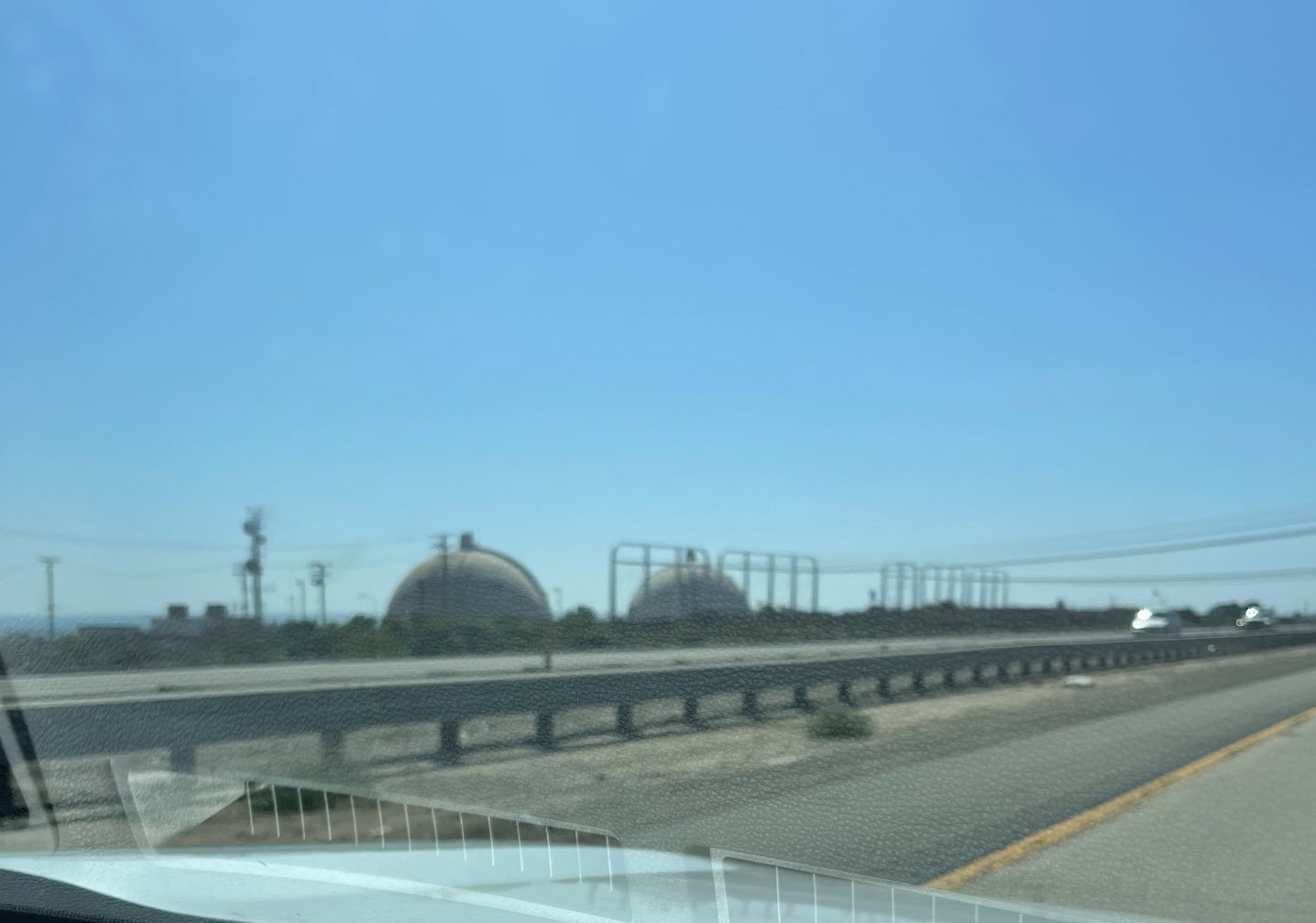
It is now decommissioned, but there are still approximately 4,000 tons (nearly 3.6 million pounds) of spent nuclear fuel, over 3,963 fuel assemblies, stored at the site. These assemblies are used uranium fuel rods, which is high-level radioactive waste, that remains extremely hazardous even years after removal. Exposure without shielding can be fatal in a short time.

The waste is stored in thin-walled steel canisters, which are ½–⅝ inches thick, which is about the size of the diameter of a dime. The containers are vulnerable to chloride-induced stress-corrosion cracks due to salt air, and the cracks can’t be repaired or inspected effectively after the drums are stored. They are located about 100 feet from the Pacific Ocean, on a coastal bluff. The risk from sea-level rise, just regular normal erosion, tsunamis, and seismic activity, is high. If you ever lived near the Pacific and you had a barbeque unit on your porch, you will have noticed that the salty air reclaims those back to the earth in just a few years. They basically dissolve. Steel drums are not the same thing as barbeque units, but you get my idea.

Coastal permits allow up to approximately 136 canisters; the site received a 13-year permit extension through 2035, with annual reviews of structural and environmental health.

Regulatory agencies have repeatedly extended storage as there is no federal repository for high‑level waste. Nuclear Waste Policy Act (1982) mandated creation of a permanent site at Yucca Mountain, but that project was defunded in 2010. There is currently no plan for a permanent solution for nuclear waste in the United States.

Ultimately, high-level waste requires a deep geological repository, meaning it must be buried hundreds of meters underground in stable rock formations, with multiple natural and engineered barriers, and designed for containment over tens of thousands to a million years. No such U.S. facility exists yet. There is currently no plan for a permanent solution for nuclear waste in the United States.

Nine million people live within 50 miles of the San Onofre site. I am one of them. If just a single canister were to rupture, depending on the wind and weather conditions, and assuming our illustrious government were to take responsibility and actually warn us, 9 million people would potentially have to be evacuated – permanently.

Now that I made your day, let’s go back to focusing on what really matters in this country, like ostracizing transsexual people, cutting Medicaid, pardoning convicted criminals, and arresting and deporting non-white people.

Trump Pardons Ross Ulbricht

In the first few days of his second presidency, Trump pardoned Ross Ulbricht. This created a news media frenzy. Ross Ulbricht was arguably one of the most successful American drug dealers of all time. He was serving a life sentence after he was convicted and had been in prison for 11 years.

It reminded me of the book, American Kingpin, by Nick Bilton, which I read and reviewed here in 2018. I thought you might be interested in Ulbricht’s story. Click on the link below for my review:

American Kingpin – by Nick Bilton

It is a very readable book, a page-turner, and more relevant today now that we know that one of the most successful drug dealers of all time is back out on the street, thanks to the Law-and-Order-President.

The Future is Here

George Jetson - Wikipedia

I just realized that George Jetson was born in 2022.

The farthest in the future that Marty McFly visited was 2015.

We have arrived. The future is here.

Water on Earth

There are a number of images circulating online about what the earth would look like without water. Here is one of them:


Picture Credit: Graphic by Howard Perlman, USGS. Globe Illustration by Jack Cook, Woods Hole Oceanographic Institution. [click to enlarge]
There are three blue spheres in this image. The large one, with a diameter of just over 860 miles, represents a bubble containing all the water on earth. The smaller one to the right is a sphere of about 169.5 miles, and it represents all the freshwater on earth, most of which is underground. The smallest bubble, which you’d probably miss if I didn’t put the red arrow there to point to it, is a sphere of about 34.9 miles. That represents all the freshwater in lakes, rivers and streams. That’s what we have to water our crops, our lawns, our golf courses, wash our cars, cook our rice and — drink!

There is something wrong with this graphic. It looks like you can see the ridges along the continents. Those are actually grossly exaggerated.

If the earth were reduced to the size of a bowling ball, and you’d swipe your fingertips over Mt. Everest, you would not feel the mountain. It would not be noticeable as a feature on the bowling ball. Likewise, if you were to scratch your fingernails over the Grand Canyon, you would not get caught in it. You would not even feel it. The earth without water reduced to the size of a bowling ball would be smoother than a real bowling ball, which has an occasional scratch here and there from normal use. The scratches on that real bowling ball, using that scale, are deeper than the deepest ocean trenches are on earth.


Cruising Then and Now

Picture Credit – reddit – link to access

We have been conditioned to think of the Titanic as a – well – titanic ship. Here is a scaled view showing the Titanic in front of a modern cruise ship.

Just How Big is the Milky Way?

If the earth were the size of the period at the end of this sentence, then the Milky Way would be the size of the continental United States.

That big.

At that scale, the Andromeda Galaxy would be a pinwheel about twice the size of the continental United States, floating about 40,000 miles out in space, or about a quarter of the way to the moon.

Now look at the earth again:  —>  .

The Beautiful Words for Butterfly

Today during a walk it occurred to me that the word for butterfly is seemingly beautiful in all the languages, at least the ones I know:

  • Butterfly – English
  • Papillon – French
  • Schmetterling – German
  • Mariposa – Spanish
  • Papillio – Latin
  • Kamehameha – Hawaiian
  • 蝶 – Japanese (pronounced CHO)

How cool are those words?

Montana Geography Lesson

The south-east corner of Montana is closer to Texas than to the north-west corner of Montana. I know you’re all going to run and check your maps now.

Surprising Facts of Geography

  • The closest state to Africa is Maine.
  • Alaska is the northernmost, westernmost, and easternmost U.S. state.
  • The southeast corner of Montana is much closer to Texas than to the northwest corner of Montana.
  • Reno, Nevada is further West than Los Angeles, California. Check it out here.
  • Spokane, Washington is further west than San Diego, if only by a third of a degree (117.4250 West  vs. 117.1625 West)
  • Mountain City, Tennessee is closer to Canada than it is to Memphis, Tennessee. Check it out here.
  • Alaska is the westernmost, northernmost and easternmost state in the U.S.
  • All of South America is east of Ohio, or Atlanta, Georgia, for that matter.
  • Rome is further north than New York City.
  • Regensburg, Germany is on the 49th degree latitude, the same as the long, straight border of the United States and Canada. This means that all of the continental United States is south of Regensburg, Germany.

A Rock from Mars

image_2153_1-Nakhla-meteorite
[image credit: NASA]
A rock formed on Mars 1.38 billion years ago. About 11 million years ago, an impact event on Mars ejected this rock from the Martian surface. It then circled the sun along with Mars and Earth for 11 million years. On June 28, 1911, it “rained” down to Earth along with a number of other meteorites near El-Nakhla in Egypt. The meteorites are now called the Nakhla meteorites.

I was born some 45 years after it crashed and was collected, and I now get to marvel about it. The simple fact that we even know this, and can establish this much detail about the history of this one rock is fascinating.

Dust in the wind, we are.


Multiple fragments of the Nakhla meteorite fell to Earth on June 28, 1911 near the village of El-Nakhla in Egypt. Its crystallization age has been determined to be 1.38 billion years.

About 11 million years ago, an impact event ejected this rock from the Martian surface, after which it traveled through space and crashed into our planet in 1911.

The Birth of a Logo

In 1822, Rowland Hussey Macy was born on Nantucket Island, Massachusetts. At the age of 15 he hired on at the whaling ship Emily Morgan. As sailors often got tattoos, and still do today, Rowland had a red star tattooed on his hand. After he left whaling at age 21, between 1843 and 1855, he opened four retail dry goods stores to serve the mill industry employees of the Haverhill, Massachusetts area. All those stores failed, but he learned from his mistakes.

In 1858 he moved to New York City and established a new store named R.H Macy Dry Goods at Sixth Avenue on the corner of 14th Street in Manhattan. On the first day of business, his sales totaled $11.08.

The tattoo on his hand became the logo of his company.

Macys


Need Husband to Bring Home Milk? – Call the Radio Station

When browsing Reddit today I learned something about how people communicate with family in remote parts of the world. Here is a girl from Australia that grew up on a very remote island in the Solomon Islands (tropical islands east of Papua New Guinea). Here is her account:

We don’t have phones but we do have battery powered radios. Normally if we are coming we have to tell that station to broadcast our arrival. What will happen is at maybe 6 I think, they have a messages segment. If your family is lucky, they will hear that you’re coming on so and so date and prepare for your arrival. Funny story about this. My sister and her husband traveled there and the radio host got the wrong date. So my sister and her husband arrived but there was no one there to pick them up. They were lucky enough to catch a ride with some other people but we were very surprised when we saw them walking up the shore.

Then somebody responded from Manitoba, Canada, not so far away from us at all:

Oh my god, that’s the exact same system we use on the reserve here in Manitoba, Canada. If you need your husband to stop and buy milk before he comes home, you call the radio station and they stop the music to broadcast your message. Need the kids to come home now that it’s dark? Call the radio station. So crazy to think we’re similar in some way to a tiny village in a rainforest. That’s what happens when your community is small and intimate, I guess. And poor.
I am going to call KPBS now and tell them about this.

My Life in Weeks

hourglass, sandglass, sand timer, sand clockThe weeks just slip by. I enjoy my work and I enjoy my leisure activities. Like most people, I start my work week on Monday and the days roll by. Since I have always enjoyed my work, I never succumbed to the “Thank God it’s Friday” attitude that seems so pervasive in our popular culture.

I sometimes marvel at the Facebook entries of young people and how they look forward to hump day (Wednesday) because it’s closer to Friday, which signals the start of a weekend that goes by too quickly.

As a business executive, I have noticed over the years that I have conflicting priorities regarding weeks and their passage.

Since there is always good news in the future, like the signing of a new contract, the meeting of a major milestone and the associated progress payment and resulting positive cash flow, I find myself waiting for next week, next month, and next quarter – so the good event can happen. It’s like waiting for my birthday or Christmas as a child, except it’s constant and ongoing. I am basically wishing my life away by looking forward to these future events.

On the other hand, as the weeks roll by, I am critically aware of how I am getting older, how the top of the hourglass now has much less sand in it than the bottom. I don’t want the weeks to pass. I want the days to last longer. I don’t want the end of the month to come because that’s when the rent and the other bills are due.

Today I came across this wonderful article that helped me visualize my life in weeks on the WaitButWhy blog:

If you multiply the volume of a .05 carat diamond by the number of weeks in 90 years (4,680), it adds up to just under a tablespoon.

This just blew me away, as did most of the charts of this wonderful article. It should be required reading for every young person. If you’re under 30 now,  and you are reading this, do yourself a favor and check out Your Life in Weeks. It will change the way you think and it may well change what you do when you get up after reading this post.

And if you’re older, like me, it will do the same.


Visualizing 50 Billion Dollars

In this video, Neil deGrasse Tyson tries to put into perspective how much $50 billion is – in his unique, clever way. You have to watch it.

However, after Neil’s clever video, I couldn’t help myself:

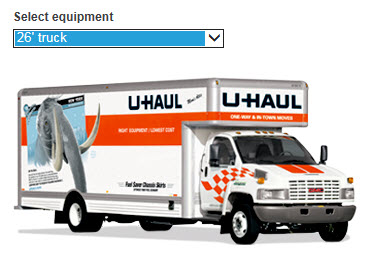
Cash-UHaul This is the largest U-Haul trailer you can rent – the 26-footer. Most of us have been inside one of those before. I certainly have. I once moved across the country in one of those. They are huge.

Now say you filled it up with one-dollar bills, from bottom to top, even in mother’s attic. The bills are not just stuffed in, they are neatly stacked and carefully arranged to get as many into the truck as possible.

How many trucks would you need to haul $50 billion?

You would need 1,245 U-Haul trucks (yes one thousand two hundred and forty five) to haul 50 billion dollars.