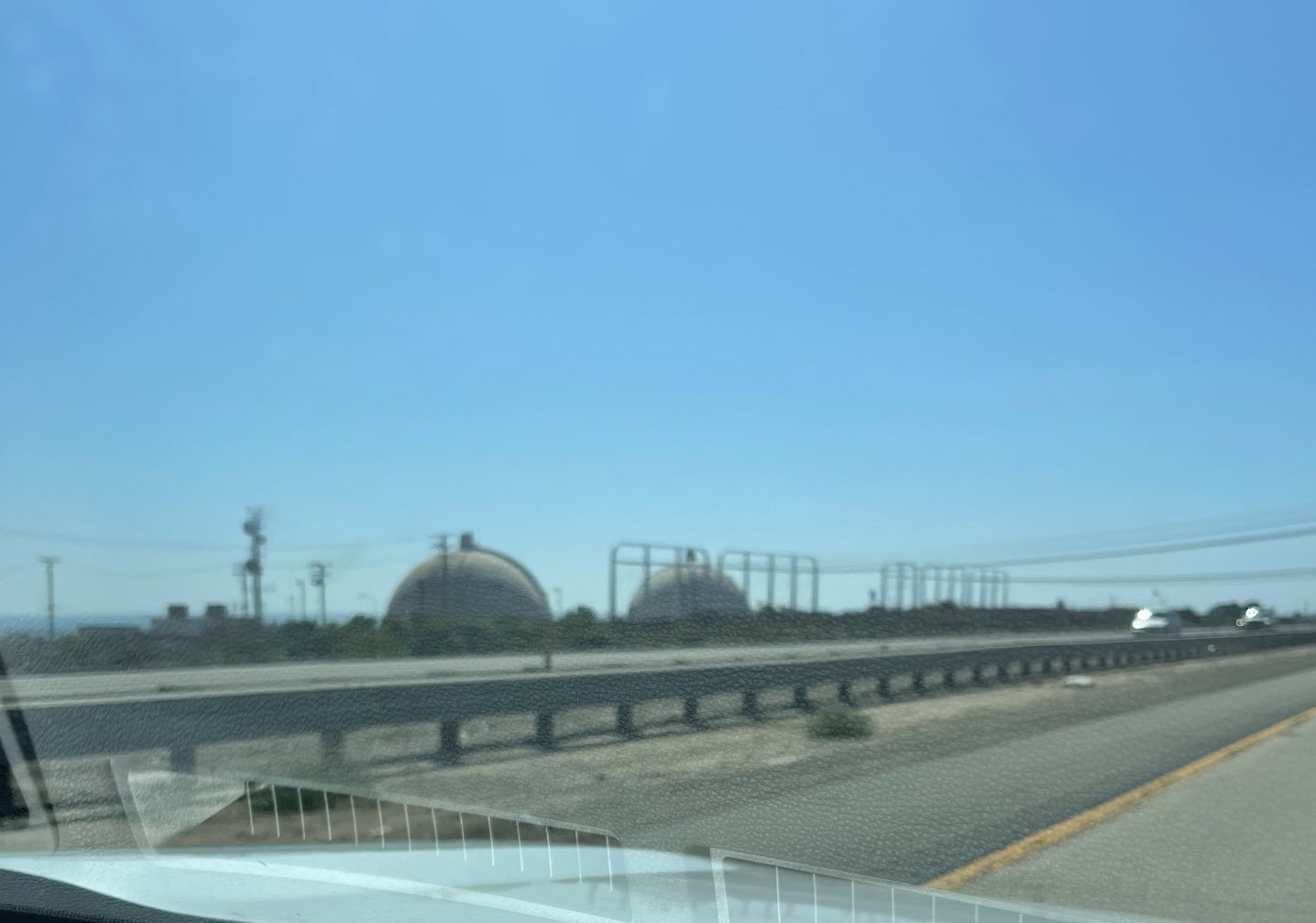
Anyone ever driving north on I-5 would have noticed that domes of the San Onofre nuclear power plant. Here is a quick snapshot out the moving car window.
It is now decommissioned, but there are still approximately 4,000 tons (nearly 3.6 million pounds) of spent nuclear fuel, over 3,963 fuel assemblies, stored at the site. These assemblies are used uranium fuel rods, which is high-level radioactive waste, that remains extremely hazardous even years after removal. Exposure without shielding can be fatal in a short time.
The waste is stored in thin-walled steel canisters, which are ½–⅝ inches thick, which is about the size of the diameter of a dime. The containers are vulnerable to chloride-induced stress-corrosion cracks due to salt air, and the cracks can’t be repaired or inspected effectively after the drums are stored. They are located about 100 feet from the Pacific Ocean, on a coastal bluff. The risk from sea-level rise, just regular normal erosion, tsunamis, and seismic activity, is high. If you ever lived near the Pacific and you had a barbeque unit on your porch, you will have noticed that the salty air reclaims those back to the earth in just a few years. They basically dissolve. Steel drums are not the same thing as barbeque units, but you get my idea.
Coastal permits allow up to approximately 136 canisters; the site received a 13-year permit extension through 2035, with annual reviews of structural and environmental health.
Regulatory agencies have repeatedly extended storage as there is no federal repository for high‑level waste. Nuclear Waste Policy Act (1982) mandated creation of a permanent site at Yucca Mountain, but that project was defunded in 2010. There is currently no plan for a permanent solution for nuclear waste in the United States.
Ultimately, high-level waste requires a deep geological repository, meaning it must be buried hundreds of meters underground in stable rock formations, with multiple natural and engineered barriers, and designed for containment over tens of thousands to a million years. No such U.S. facility exists yet. There is currently no plan for a permanent solution for nuclear waste in the United States.
Nine million people live within 50 miles of the San Onofre site. I am one of them. If just a single canister were to rupture, depending on the wind and weather conditions, and assuming our illustrious government were to take responsibility and actually warn us, 9 million people would potentially have to be evacuated – permanently.
Now that I made your day, let’s go back to focusing on what really matters in this country, like ostracizing transsexual people, cutting Medicaid, pardoning convicted criminals, and arresting and deporting non-white people.
Sigh. Cherish the Day. Seems tomorrow could be worse.