In the Vice Presidential debate, Mike Pence mentioned “the war on coal” several times. I had not heard that term before. All I knew was that coal was a major polluting agent and we were doing well by steering our economy away from it. Yes, coal workers would be suffering, just like tobacco workers suffered before them, and blacksmiths when horses were phased out of city traffic. The time of coal is over. Now all we have to do it convince China to do the same.
PENCE: The economy has stagnated under President Barack Obama, with the Democrat waging a “war on coal.”
THE FACTS: The coal industry is struggling, but the Indiana governor incorrectly blamed its woes solely on new federal regulations, omitting the effects of steep competition from cheap natural gas.
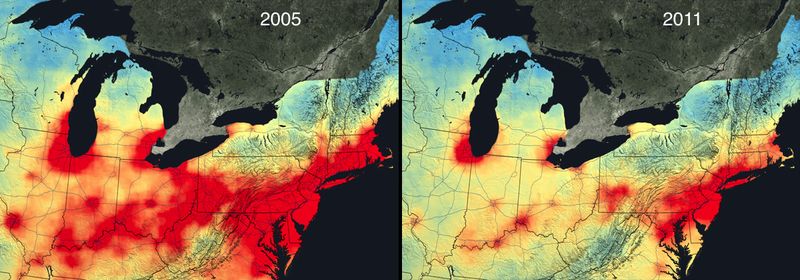
[click to enlarge; picture credit: NASA]The red areas are smog in 2005 and 2011.
It shows nitrogen dioxide, which we produce in gasoline engines in cars and trucks, and by burning coal in power plants. Due to work by the EPA, which first started curbing nitrogen dioxide in 1971, its concentrations have been falling over time.
Power plants have installed scrubbers to remove pollutants from their smokestacks, and car manufacturers have adopted catalytic converters. Since 2005, electric utilities have reduced burning of coal and gone to the cleaner natural gas. Our air is much better today than it was 10 years ago, and much better than 30 years ago.
Do we really believe this would have happened without the EPA?
Yet, there is Ted Cruz who yells he wants to abolish the EPA because it is a “job killer.”
One must wonder about the sanity of these people. During the Obama years, we have added over 14 million jobs in an unprecedented job growth period of 70 uninterrupted months. We have created way more jobs than were destroyed during the Bush years, particularly toward the end, when the economy crashed.
Yet, somehow, the EPA is killing jobs.
Do we really want to remove the EPA, start burning coal again, subsidize petroleum companies, and turn the yellow and blue areas read again on the map above?
Because that’s exactly what would happen.
I vote that we keep the EPA. It’s doing a remarkable job in our country, and with the “job killing” that’s going on (adding 14 million in 70 months) I am fine with it continuing to “kill jobs” at that rate.
Every year when we get a delivery of telephone books I get angry, since I pick them up at the door and toss them straight into the recycle bin. What a colossal waste! They are printed and then distributed by hand to households. How expensive that must be. But nobody seems to use them anymore. It’s been at least 20 years that I actually opened up a telephone book. But I get them every year.
This year was even worse. The book must have been delivered at our gate on Saturday afternoon. Then it rained overnight. Today, I picked up a soggy phone book and before I tossed it into the recycle bin which is a few feet from our gate, I decided to take a picture:
I got frustrated about this and checked online. Most of the links are about “recycling” phone books. What the heck? Why recycle. Why not just print stop printing them, and producing them on demand when somebody actually asks for one? Who is paying for this? I am sure we consumers are, somehow.
Whenever the Republican candidates trumpet on stage that the EPA is the first agency they want to abolish, it has the most adverse effect on me.
Just watch what happened in Flint, Michigan. The city decided to save money and use water from the Flint river, rather than Lake Huron, for the city’s water source about two years ago. The Flint river is so corrosive that it rusted and corroded the lead pipes that distribute the water. With the corrosion, lead levels 20 times the safe amount were in the city water. Eventually, a local pediatrician figured it out. Then came the cover-up by the city, before that finally crumbled, and now the news comes out.
But back to the EPA. We have the EPA to hold people and businesses accountable. Without the EPA, factories would be free to dump poison into the rivers and into the air. Without the EPA, industry would be free to rape the land and its people. And don’t tell me that industry would volunteer to “be good.”
Just read up and see what kinds of pollution we had before the EPA (before 1970). The country was polluted. But then again, just go to Mexico, or India, or Brazil, or China – to see real pollution. Then come back and tell me you want to abolish the EPA.
It’s strange how the same people that keep harping about the legacy we leave for our children are also those that wouldn’t mind pumping more CO2 into the air, allow pollution into the rivers, and open up national parks for logging and mining.
I lifted the section below from a Facebook feed by Schwarzenegger. I didn’t want to just share the feed. There were too many idiotic comments by brilliant and successful experts on energy below the feed – I could not stand it. So here it is, sanitized and quarantined, for your reading:
I don’t give a **** if we agree about climate change.
Arnold Schwarzenegger· Monday, December 7, 2015
I see your questions.
Each and every time I post on my Facebook page or tweet about my crusade for a clean energy future, I see them.
There are always a few of you, asking why we should care about the temperature rising, or questioning the science of climate change.
I want you to know that I hear you. Even those of you who say renewable energy is a conspiracy. Even those who say climate change is a hoax. Even those of you who use four letter words.
I’ve heard all of your questions, and now I have three questions for you.
Let’s put climate change aside for a minute. In fact, let’s assume you’re right.
First – do you believe it is acceptable that 7 million people die every year from pollution? That’s more than murders, suicides, and car accidents – combined.
Every day, 19,000 people die from pollution from fossil fuels. Do you accept those deaths? Do you accept that children all over the world have to grow up breathing with inhalers?
Now, my second question: do you believe coal and oil will be the fuels of the future?
Besides the fact that fossil fuels destroy our lungs, everyone agrees that eventually they will run out. What’s your plan then?
I, personally, want a plan. I don’t want to be like the last horse and buggy salesman who was holding out as cars took over the roads. I don’t want to be the last investor in Blockbuster as Netflix emerged. That’s exactly what is going to happen to fossil fuels.
A clean energy future is a wise investment, and anyone who tells you otherwise is either wrong, or lying. Either way, I wouldn’t take their investment advice.
Renewable energy is great for the economy, and you don’t have to take my word for it. California has some of the most revolutionary environmental laws in the United States, we get 40% of our power from renewables, and we are 40% more energy efficient than the rest of the country. We were an early-adopter of a clean energy future.
Our economy has not suffered. In fact, our economy in California is growing faster than the U.S. economy. We lead the nation in manufacturing, agriculture, tourism, entertainment, high tech, biotech, and, of course, green tech.
I have a final question, and it will take some imagination.
There are two doors. Behind Door Number One is a completely sealed room, with a regular, gasoline-fueled car. Behind Door Number Two is an identical, completely sealed room, with an electric car. Both engines are running full blast.
I want you to pick a door to open, and enter the room and shut the door behind you. You have to stay in the room you choose for one hour. You cannot turn off the engine. You do not get a gas mask.
I’m guessing you chose the Door Number Two, with the electric car, right? Door number one is a fatal choice – who would ever want to breathe those fumes?
This is the choice the world is making right now.
To use one of the four-letter words all of you commenters love, I don’t give a damn if you believe in climate change. I couldn’t care less if you’re concerned about temperatures rising or melting glaciers. It doesn’t matter to me which of us is right about the science.
I just hope that you’ll join me in opening Door Number Two, to a smarter, cleaner, healthier, more profitable energy future.
Here is a study by the International Monetary Fund analyzing how large global energy subsidies are. This includes coal, oil and gas. The number is staggering: $5.3 trillion in 2015. That amounts to about 6.5% of the global GDP. About half of that is in emerging Asia, which includes China, and is boosted by the heavy use of coal in that part of the world. In the United States alone, the amount estimated for 2015 is $700 billion.
Subsidies are money that our governments take away from citizens in form of taxes and give to private and nationalized large corporations to do with as they please. Those corporations exist to make money by selling their products. They don’t exist to worry about what air our children breathe in 20 years and our grandchildren in 50. They don’t exist to worry about Pacific islands sinking under the sea. They don’t exist to worry about Miami, New York, and Tokyo being under water by 2100. There is no incentive for them to keep the environment clean, the rivers pristine, and wildlife alive. By definition, corporate organizations exist to make money and worry about nothing else. Yet, we give them the people’s money, every day.
How much is $5.3 trillion?
You can read the chart, but the bottom line is the most staggering one: The world’s taxpayers spend $168,000 a second, every second, day and night, year after year, to prop up oil companies. Yes, that’s Shell, Exxon, BP and many others. These are the same companies that make unbelievable profits. Shell’s profit alone in 2012 was $26.8 billion.
We are being brainwashed every day by our very own media and politicians to hate the word “redistribution” since it connotes socialism. The entire food stamps budget in the U.S. for 2015 is $84 billion, and it was cut significantly. Everyone seems to hate food stamps, even though is is an impactful and effective program, and has a surprisingly low fraud rate with more than 99% of benefits going to eligible households. In 2013 alone, it lifted nearly 5 million people above the poverty line, including about 2.1 million children.
We don’t like redistribution of tax dollars of $84 billion to the poor and their children. Yet, we seem to have no problem handing $700 billion to the oil companies in the U.S. alone. That’s almost 10 times as much as the entire food stamp program.
Giving tax money to corporations, any corporations, is wrong. Giving it to oil companies is immoral.
Why don’t we just stop this nonsense? Bernie Sanders has proposed an End Polluter Welfare Act, which he says would cut $135 billion of U.S. subsidies for fossil fuel companies over the next decade. It doesn’t seem like a big enough cut to me, but it’s a start.
I think I’ll donate another $35 to Bernie Sanders right now.
I found it funny that the website banner of the Kansas Department for Children and Families shows a family on a green field with a – WINDMILL.
Kansas is the state where Sam Brownback is the governor. Kansas is the home state of Koch Industries, one of the largest private companies in the United States and heavily invested in fossil fuel endeavors, including gas, pipelines, oil and coal.
Yet, there is a windmill on the website. Who’d have guessed it?
According to the World Wildlife Foundation, in 2014 the total population of African elephants was estimated to be around 700,000, and the Asian elephant population was estimated to be around 32,000. The population of African elephants in Southern Africa is large and expanding, with more than 300,000 within the region; Botswana has 200,000 and Zimbabwe 80,000. Large populations of elephants are confined to well-protected areas. However, conservative estimates were that 23,000 African elephants were killed by poachers in 2013 and less than 20% of the African elephant range was under formal protection.
In 2013 alone, over 1,000 park rangers were killed while attempting to defend African elephants from poachers. The elephant is a terribly endangered animal and it may only be a few more decades before there are no more wild elephants left.
Imagine my surprise when I found this advertisement in the October 2015 Robb Report Collection edition:
This is a magazine for the very rich. It is full of articles and advertisements for super cars, private jets, 3rd homes in remote islands, art and culture, and – apparently – big game hunting.
It is beyond my comprehension how BigGame.org can position itself as a conservation and education organization, when it’s really just a club for big game hunters – the Dallas Safari Club.
It makes it sound like killing elephants is a noble and worthy endeavor.
Tell me what you will, we can educate and observe completely without shooting a single elephant for sport. Making it sound like hunters are the good guys in this terribly destructive game is simply irresponsible.
Hunting big game for sport is as outdated as slavery. What exactly are “hunters’ rights” that need to be protected? Sounds kind of like protecting the rights of slave owners to me.
Elephants, along with whales and apes, are the most intelligent creatures on this planet, and we’re wiping them out – for sport (in the case of big game hunting) and the relentless greed for ivory in mostly Asian markets.
We humans have a responsibility to protect our fellow intelligences.
I just found out through this article that mammoth tusks are being dug out of the thawing permafrost in the arctic by the thousands. They are sold to the ivory carving industry in China at $1,900 per kilogram. The growing Chinese middle class has a voracious appetite for ivory jewelry. Paleontologists are suggesting that this perfectly legal practice should become illegal to protect the not yet extinct elephant.
There are several statements of fact in this article that I found alarming:
I didn’t know there was such a thing as an “ivory carving industry.” Of course, now that I think about it, it makes sense, but it had never crossed my mind before.
The elephant is doomed. The Chinese are just starting to get wealthy, and there are many of them. The ivory carving industry isn’t going to back off as long as a single tusk remains. The country where reportedly 4,000 people die every day because of air pollution isn’t going to care about regulating its consumption of a commodity that is harvested in another continent on the other side of the globe. As long as there are Chinese with money, elephants will be hunted – more than ever, as they become more rare and therefore more expensive.
Global warming is thawing the permafrost. A few decades ago it was difficult to find any mammoths. Now, it seems, you can go out there with a shovel and dig for tusks and sell them for a fortune. There is a significant movement still in the United States and the rest of the world that is “denying” global warming. They say that just because glaciers are melting at unprecedented rates, and permafrost is melting in the arctic, it does not mean that the warming is man-made. It’s just a natural occurrence, like it has happened many times in history. The fact that it’s been 800,000 years since we had 400 ppm of CO2 in the atmosphere, as we do now, is not enough evidence. Since it’s not man-made, why worry about it. Keep burning that oil!
I am at a loss for suggestions on how to save the elephant, other than save some DNA so we can clone them later, along with the mammoth.
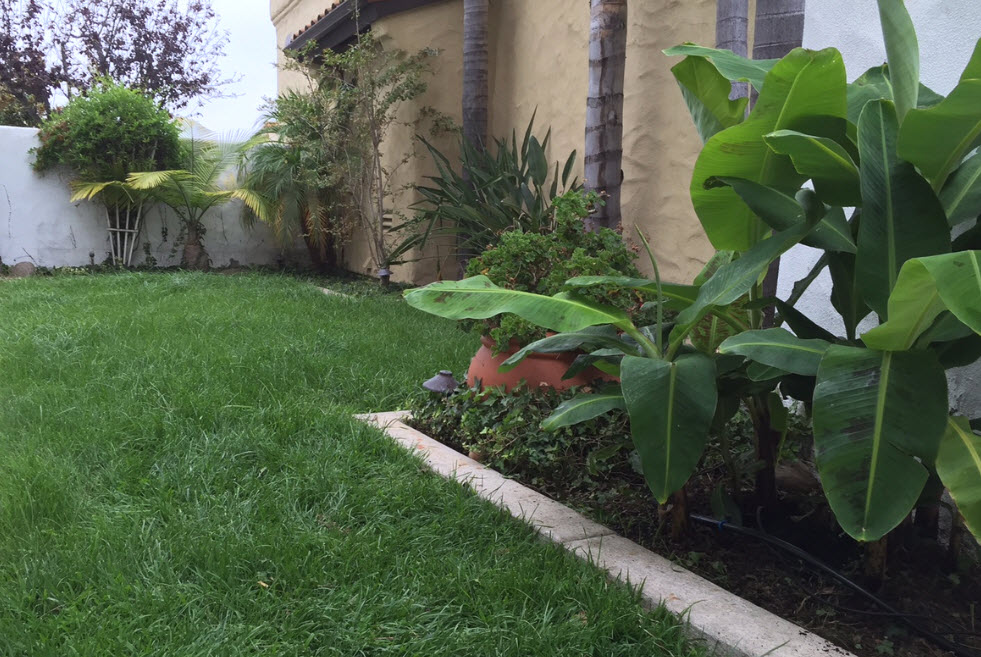
This shows our grass and banana trees on the right as of this morning. This spring, we put on new grass seed, fertilized with Miracle Grow, and did hand spot watering on the brown spots. The thunderstorms we had in the last few weeks helped too. Even though our water consumption is the lowest ever, due to severe restrictions because of the terrible drought in California, the lawn has never looked this good before.
We don’t show this off, and fortunately, our little front yard is walled off from the street. But we enjoy the green. Pssst, don’t tell anyone!
The USDA recently approved that it’s ok for U.S. chicken to be shipped to China for processing, then shipped back to the U.S. for human consumption. This was previously not done because it was not seen as economically feasible. As it turns out, it’s already being done for some seafood, like salmon and crab from Alaska.
“Economically, it doesn’t make much sense,” Super said. “Think about it: Chinese company would have to purchase frozen chicken in the United States, pay to ship it 7,000 miles, unload it, transport it to a processing plant, unpack it, cut it up, process/cook it, freeze it, repack it, transport it back to a port, then ship it another 7,000 miles. I don’t know how anyone could make a profit doing that.”
Apparently it makes sense now. This is alarming, however, in light of the horrible Chinese food safety conditions. The USDA has no way of overseeing how clean some food processing plant in some backwater of China is.
This means that we’re not only outsourcing our manufacturing now, and our pollution with it, but we’re also starting to outsource our processing labor and services. Pretty soon we’ll fly to China to get a hair cut. Hey, it makes sense.
I am not in favor of excessive regulation. But we have the USDA in place to protect us from bad food products. Remember the toxic drywall from China a few years ago? Tens of thousands of houses were built with drywall that started to stink after a couple of years. Now we’re shipping our chicken to China so Chinese hands can touch them, before they show up in our children’s school lunches?
We need to figure out how to do things cheaper in the United States, or we’ll be a second-rate consumer nation completely under the economic and nutritional control of others, China foremost.
Make no mistake about it in this upcoming presidential election season: This is about jobs in the United States. Every chicken processing job is now at risk.
The whales are so smart they know that even if they hear the cranes coming up the pathway [to lift them out of the pool] or certainly if they see them, they won’t separate, they won’t allow it to happen because they know the possibility … that one of the members of their family or their social group could be taken away from them. … You’ll [hear] extremely upset vocalizations from whales that are … being taken away, and then the whales that they’re being taken away from.
This reminds me of the practice in human slavery, when female slaves were forced to “breed” children so they could be sold off as quickly as possible for profit.
SeaWorld has never really recovered after its drop in stock price and popularity resulting from the movie Blackfish. Recently I have seen prime-time TV advertisement by SeaWorld defending its practices.
Recently, when picking someone up at the San Diego Airport, I noticed that the entire front row of parking spaces, nearest the terminal, were Electric Vehicle Parking only.
You can drive up in your electric car, plug in, and go into the terminal. It made me want to have an electric car.
Recently I read the book The World Without Us, where I learned that basically every piece of plastic we have created since about the 1960s ends up either in a landfill, or in the ocean. Much of the plastic floats. Some of it looks like it disintegrates, but it really doesn’t. It just turns into ever smaller globules of plastic that live practically forever.
Sometimes, when I know I will be home alone after work, and I know there is nothing at home to eat, and I don’t want to bother preparing anything, I may stop at Kentucky Fried Chicken for some takeout. I’ll order a two-piece meal, original style, breast and wing, with potato wedges and coleslaw for about $6.75. The attendant hands me a plastic bag that contains my order.
When I get home and when I am done eating, I am left with:
One, sometimes two, sometimes even more than two sporks. Those are the plastic spoon/fork combinations they give out. Each of the sporks is wrapped by itself in a little clear plastic sheath along with a napkin.
One or several containers of honey in plastic restaurant packets which I don’t use because I eat my biscuits dry.
A mini Tupperware-like container with a lid in which my coleslaw came.
Five to fifteen extra napkins that the attendant threw into the bag just to be sure I had enough – which I’ll save in our napkin holder for the future.
A cardboard box that contained the food.
A cardboard container that held the potato wedges.
The big plastic bag the whole thing came in.
Once when I bought a meal for two, I got 17 sporks in the bag:
I know I can save the sporks, but for what? I didn’t need them in the first place, and we will never have enough picnics to ever need them. Unless I want to start a KFC spork collection, which I don’t. So they go into the trash, along with the cardboard boxes, the bag, the container, and even the honey packets.
Never to be used again. Never to have been used. In a landfill. A million years from how, some archeologist will dig out a layer of rock and find these 17 sporks, along with my coleslaw container and its lid, in the plastic bag.
If I eat in a fast-food place once every week of my life, and if I become 80 years old, and if I use only one plastic utensil for that meal that gets thrown out, I use up 4160 of them. That’s how many weeks there are in 80 years. Not a lot, huh? If 7 billion people in the world were to use up one plastic utensil a week, that would be 28 trillion of them in the environment. 28 trillion plastic utensils, maybe used once. 28 million million of them.
So now I think about that every time I take a plastic utensil to use for one meal, one piece of cake, one small container of coleslaw, or just to stir my coffee.
What a phenomenal waste!
I am an accidental polluter.
[Edit: the term “trash” here means “recycled trash” in California. However, I am not sure I fully trust the recycling system – I wonder if they give tours so we can follow the sporks through the process….]
Imagine all the people in the world disappeared today. Gone. I recognize this is a hypothetical scenario, one that has a low likelihood of happening, but — it could happen. An Ebola-like plague could sweep the world and eradicate the human race in a matter of a few weeks. There have been doomsday books, like Stephen King’s The Stand that were based on just that premise. My favorite book about this subject is Earth Abides by George Stewart. Both novels start out with just about all people dead, and one single survivor eventually finding another one, starting the long process of building a new world from scratch and from the ruins of the old world.
The World Without Us is not a novel. It is a speculative work taking on many of the controversies of our society, including overpopulation, climate change and runaway pollution. Every chapter explores, from its own viewpoint, what it would be like if humans simply were no longer here.
Here is an example. What would happen in New York City if humans disappeared. Surprisingly, the city would come to pieces very quickly, must faster than other places out west.
Schuber peers down into a square pit beneath the Van Siclen Avenue station in Brooklyn, where each minute 650 gallons of natural groundwater gush from the bedrock. Gesturing over the roaring cascade, he indicates four submersible cast-iron pumps that take turns laboring against gravity to stay ahead. Such pumps run on electricity. When the power fails, things can get difficult very fast. Following the World Trade Center attack, an emergency pump train bearing a jumbo portable diesel generator pumped out 27 times the volume of Shea Stadium. Had the Hudson River actually burst through the PATH train tunnels that connect New York’s subways to New Jersey, as was greatly feared, the pump train— and possibly much of the city— would simply have been overwhelmed.
Weisman, Alan (2007-07-10). The World Without Us (p. 25). St. Martin’s Press. Kindle Edition.
650 gallons of natural groundwater run into that one subway station every minute, and pumps must keep running 24 hours a day to keep it try. When the power runs out (and that’s another chapter), in a half hour the water would be high enough to flood the tracks and trains could no longer pass. In 36 hours the entire subways system would fill up. Weisman goes on:
Even if it weren’t raining, with subway pumps stilled, that would take no more than a couple of days, they estimate. At that point, water would start sluicing away soil under the pavement. Before long, streets start to crater. With no one unclogging sewers, some new watercourses form on the surface. Others appear suddenly as waterlogged subway ceilings collapse. Within 20 years, the water-soaked steel columns that support the street above the East Side’s 4, 5, and 6 trains corrode and buckle. As Lexington Avenue caves in, it becomes a river.
Weisman, Alan (2007-07-10). The World Without Us (pp. 25-26). St. Martin’s Press. Kindle Edition.
This is just about one of our great cities.
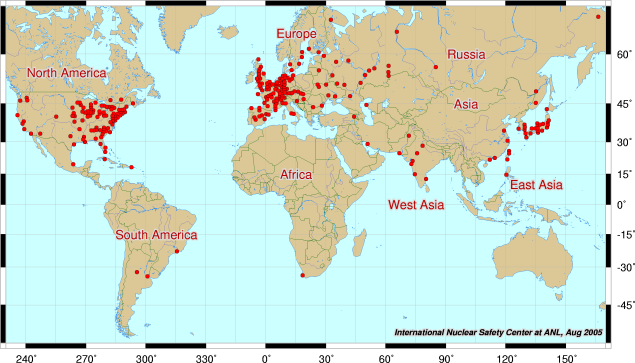
There are 441 operating nuclear power plants in the world. Without the regulating eye of humans, many of these plants would go through some form of catastrophic failure and eventual meltdown. Imagine 441 Chernobyls around the world. Check out this map and find how close you live to one? Hey Australia! Safest place on Earth in case of a meltdown.
Source: International Nuclear Safety Center at Argonne National Laboratory.
This map is from 2005, I could not find a newer one, but given how long it takes to build such a plant, and considering that they are not building many more, it’s pretty close.
The World Without Us was published in 2007. Given today’s pace of development, and pollution in China (check out this link and be shocked), and runaway fossil-fuel-burning, things are much worse than described by Weisman in 2007, when there were only 6.5 billion people on the planet, rather than seven.
We’re adding one million people to the planet every four days.
The World Without Us reads like a fast-paced thriller, where the bad guys are out the make the world go away. As I read the book, I realized that I was in it, and it wasn’t a thriller, it wasn’t a novel, it was a giant reality show, and my life, and the life of my children, and their children, was on the line.
Don’t you understand what I’m tryin’ to say
Can’t you feel the fears I’m feelin’ today?
If the button is pushed, there’s no runnin’ away
There’ll be no one to save with the world in a grave
Take a look around you boy, it’s bound to scare you boy