Idiots in Federal Government

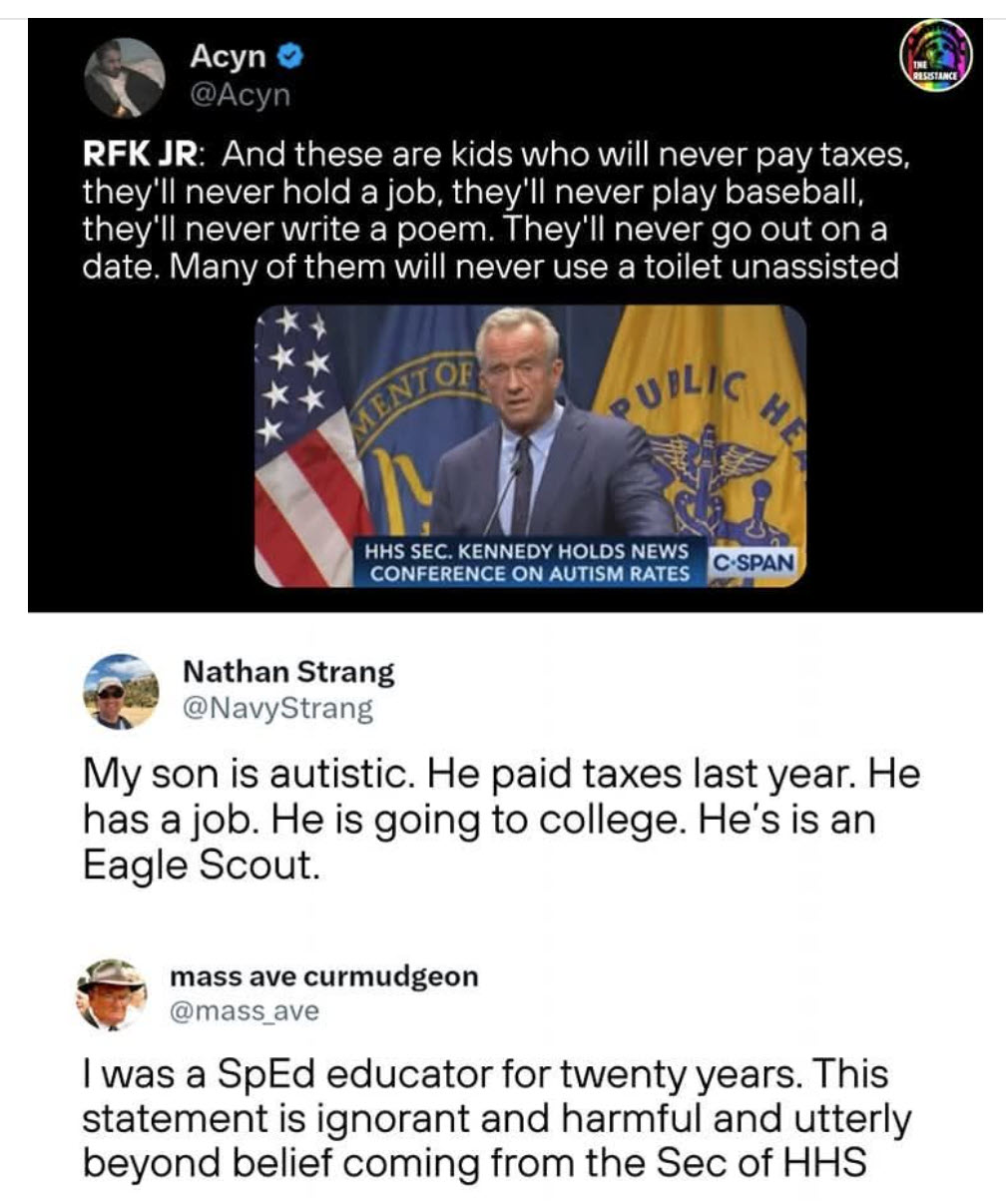
The idiocy in our current federal government is staggering. Here is our Secretary of Health and Human Services, talking about autistic children:

And these are kids who will never pay taxes, they’ll never hold a job, they’ll never play baseball, they’ll never write a poem. They’ll never go out on a date. Many of them will never use a toilet unassisted.

He has obviously never met an autistic person.

What is he going to suggest next? Maybe the best thing to do is to send them all to a camp? Let’s call it a concentration camp. Maybe we should open one in El Salvador, “the Savior,” where they’ll be well taken care of?

This is wisdom from the “Pro-Life” faction of our political landscape.

Alexei Navalny’s Death and the Credibility of the World’s Press

We all shook today when we found out that Alexei Navalny died in a Russian prison. The news reverberated throughout the world and in Russia itself.  All I know about Navalny I have learned through his portrayal in the western media. This includes statements about Navalny’s character by Ambassador Michael McFaul, who knew Navalny personally and considered him a friend.

Digging deeper, particularly in circles of Russians, Navalny does not appear to be the knight in shining armor that we all think we know. Apparently, many Russians do not support Navalny and even consider him to be further on the right than Putin.

Here is an interesting article in the Workers World, which gives an entirely different viewpoint of Navalny, his history, and his status.

Alexei Navalny: Why is Biden supporting a Russian fascist? – Workers World

I might warn you, if you have never read anything in Workers World: It is the official newspaper of the Workers World Party (WWP), a communist party in the United States. So you might take its content with a grain of salt. Even in this article they denounce capitalism as a systemic tool of abuse of workers.

I have to state and admit that I do not have more information than what I read in the western media and what sources like Workers World downplay as western liberal propaganda.

If you are interested in learning more about Russia, its propaganda machine, its disinformation engine and its brutal oppression of political opponents, pick up the book Red Notice by Bill Browder.

This experience highlights to me how little we actually know about what is really going on in the world. It does not surprise me when I hear that 70 million people, many of whom consume only information propagated by Fox News, plan on voting for candidate Trump in the next election. They can’t help it. It’s all they know.

Just like I can’t help it. I am not sure I know what Navalny really stood for in Russia, and how much of what I read in opposing articles like the one I linked to above is reality, or just another flavor of Russian propaganda.

This shows how hugely important it is to have a free press and have a choice so we can choose as unbiased a source as we can.

Book Review: The Armor of Light – by Ken Follett

The Armor of Light is the 5th book in the Pillars of the Earth series.

The story plays in England, centered around Kingsbridge, in the 1770ies and goes through the Napoleonic Wars all the way to Waterloo in 1815. That was a period in western history when a new era of manufacturing disrupted the status quo. The wool industry in England was upset first by spinning machines, then automated looms. Workers who were used to making a living spinning and weaving now found themselves displaced. The entire establishment, the legal system, and the class system of common men and aristocracy by birth was rigged against the worker.

Follett tells the story through the eyes of a handful of people who lived through that era. One of the young boys whose father died through the negligence and arrogance of the son of their landlord grows up to be a brilliant engineer. He eventually joins the army and goes to war on the continent, as an aide to the Duke of Wellington, who is most famous for defeating Napoleon in Waterloo. Right after I had finished reading The Armor of Light I went to see the movie Napoleon, and I enjoyed the scenery and graphical images of war in Waterloo that I had just read about in this book. The book and the movie complemented each other for me.

Through the experiences of the various protagonists we learn about the plight of the working class and the immense injustices inflicted upon the hapless and unfortunate during that period of history.

As with the previous books of the series, the Kingsbridge Cathedral with the pillars of the earth is still there, many centuries after is was built by John the Builder. But the people who live in Kingsbridge are all new. There really isn’t any continuity other than it’s the same town.

I don’t know why the book is called The Armor of Light. I can’t seem to remember the title and I kept having to look it up when someone asked me what book I was reading at the time. The obscure and hard to remember title notwithstanding, I loved reading every page, and as it is always with Follett books, I learned an immense amount of history of the time that I would otherwise not have known about. When I put a Follett book down I always think to myself: So much to learn, so little time.

If you have read the Pillars series, you will like The Armor of Light. If you have not read the series, I recommend you start with Pillars of the Earth and work your way through the five books.

Book Review: The Mapmaker’s Daughter – by Clare Marchant

The Mapmaker’s Daughter is a book of historical fiction that plays in England and partly in Holland in the 1580 time period.

Frieda Ortelius as a young girl in Holland when her parents are brutally killed by the Spanish as part of the Inquisition. The Catholics (the Spanish) were killing Protestants during that time, and one of the havens for Protestants was England, ruled then by Queen Elizabeth I.

Frieda escapes and makes a life for herself with her seafaring husband in London. She comes from a family of mapmakers, and she learns the trade and excels so much that she catches the attention of the Queen. During a time of war with the Spanish, Francis Drake was a privateer working for the English crown. Queen Elizabeth eventually commissions Frieda to create a detailed map of the south of England to help Drake in the fight against the Spanish.

This is all good historical fiction, and I learned a lot about the period and how the people suffered from the Inquisition and the tyranny of the Spanish.

However, interwoven between the chapters about Frieda’s life and story is another story in the present day: Robyn Willoughby is a thirty-six-year-old woman who works in her father’s antique map store when they find a blood-stained map they cannot identify. Robyn goes on a quest to find out. However, along with Robyn comes Robyn’s husband Nate, who vanished seven years before during a solo around the world sailing race. The Vendée Globe is the greatest sailing race round the world, solo, non-stop and without assistance, and it is also by far the most dangerous of all sailing adventures.

Throughout the entire book, Robyn pines after Nate and the pain she goes through even after seven years fills the chapters in this book. At first I thought there must be some plot twist that would explain the presence of Nate as a significant protagonist in this story, but sadly, there wasn’t any. While I am sure his death was tragic, and while I am sure his wife suffered, none of that had anything to do with this story and it simply resulted in more words on the pages that didn’t move anything along.

As a matter of my opinion, the author could have left Robyn out of the book altogether without loss of impact. Of course, the book would have only been half as long.

But as the Germans like to say: In der Kürze liegt die Würze.

All in all, an interesting historical novel with way, way, way too much fluff that did nothing but water it down and make it longer.


By the way, if you are interested in learning more about the Vendée Globe, there are several books that tell a riveting story:

Godforsaken Sea: The True Story of a Race Through the World’s Most Dangerous Waters

I read Godforsaken Sea many years ago before I had started doing my book reviews, so I can’t show you that. But it’s an amazing read about the 1996-97 race. Another book about the same race is Alone: The True Story of the Man Who Fought the Sharks, Waves, and Weather of the South Atlantic – by Michael Calvin. I have not yet read Alone.

When in Dallas

After 40 or so years of visiting the Dallas area, with literally hundreds of layovers at the Dallas/Fort Worth airport, I have never actually been in downtown Dallas, until today.

This morning I woke up at my hotel at 1700 Commerce Street. It was going to be a hot day, so a morning walk at 7:00am seemed like the right thing. I was within a mile of the spot where President John F. Kennedy was assassinated. I walked down Main Street heading east and soon reached the famed, or infamous, Dealey Plaza. Here is a map, and the red arrow shows the exact location of Kennedy’s death.

I was there around 7:00 in the morning and there were no tourists yet. It was all empty and quiet. Later in the day this area gets quite busy with many tourists walking around and taking pictures. I avoided all that by being there early.

The above photograph shows the location of Kennedy’s death (red arrow) and the window where the shooter sat (blue arrow). The address of the building is 411 Elm Street in Dallas. It was a book depository in 1963.

Here is another view from a little further away. You can see there was hardly any traffic that early in the morning.

Here is another view of the same spot, this time from the center of Dealey Plaza. If you click on my photograph and zoom in where the arrow points you may see a white X that is actually marked on the street on the very spot.

Bob Dylan wrote a very moving song in his last album Rough and Rowdy Ways titled Murder Most Foul. The song is about the Kennedy assassination.

Twas a dark day in Dallas, November ’63A day that will live on in infamyPresident Kennedy was a-ridin’ highGood day to be livin’ and a good day to die

You can find the full lyrics here. I recommend you listen to the song. I can’t post it here for copyright reasons.

The sixth and seventh floor of the former book depository are now a museum named The Sixth Floor Museum. It opens at 10:00am, so I had to come back later to visit the museum. I it did not regret it. There are countless exhibits of posters, photographs and audiovisuals.

This picture shows an exact copy of the rifle that was used. The actual rifle that killed the president is at the National Archives.

And most eerie and deeply disturbing, here is the window from where the shot was fired. The area is enclosed by glass in the museum, and the book boxes are of course staged. There were book boxes the shooter used to rest the rifle.

I stood there for quite a while and let it sink in. This very spot was the place where U.S. history changed when a popular president was killed by a loser with a cheap gun.

I still remember the day. I was six years old and I had just started second grade in elementary school in Germany. My mother told me about what happened before I went to school. She wanted me to be informed in the event that the teacher brought it up.

When I was in the museum I watched some video clips of the day’s events. There were the ominous clips of the motorcade rolling down Main Street in Dallas, literally Kennedy’s last minutes alive, showing him waving to the crowds on both sides of the streets. Then the car reached Dealey Plaza and turned right onto North Houston Street before turning left again onto Elm Street to the fateful spot. I looked up and saw the building and the window where the shooter sat that very moment. He was not visible, but the window was definitely open – this was just seconds before.

In another clip, it showed the Kennedys arriving on Air Force One at Dallas Love Field that morning. It showed Jackie in the now famous bright pink outfit coming out of the plane and walking down the stairs, followed by the president. Lyndon Johnson greeted them. Eventually Kennedy entered the open limousine. As it pulled away, there was a Texas Lone Star flag behind the car, and right next to that flag was a Confederate Flag.

And that also made me stop and think.


Visiting Hemingway’s House in Key West

Last week we visited Key West, Florida, for a few days. There are two very famous Key West citizens whose presence is felt all over the island. One is Jimmy Buffett, the American singer and songwriter, author, actor and businessman, who is best known for his music, which often portrays an “island escapism” lifestyle. He started his career partly in Key West, and “Buffett-stuff” is all over the island. The other famous Key West citizen is Ernest Hemingway, who lived there in the 1930ies.

We visited Hemingway’s house, which is now a well-preserved museum dedicated to his life and legacy. Here is a view of the house.

I found it riveting to be walking through the rooms where he lived, including his bedroom and the master bathroom, the sleeping quarters for the nanny, and the room where his kids slept.

But most inspiring was seeing his writing studio. Here I am at the foot of the stairs. The studio door is at the top of the stairs above my head:

Here is another view of the building from the other side:

I was able to enter the studio. I was alone while there, behind a fence to keep out tourists, of course. I had plenty of time to just reflect.

This room, museum staff told us, is largely untouched as it was when Hemingway wrote there in the 1930ies. This is his actual chair and table. You can see one of the 54 cats on the property under the chair on the left. It is said that all the cats are descendants of Hemingway’s cats. He went up into that studio before breakfast every day to write at least 700 words. 70 percent of Hemingway’s work was written in this room, including the following novels:

  • A Farewell to Arms
  • Death in the Afternoon
  • Green Hills of Africa
  • To Have and Have Not
  • The Fifth Column
  • For Whom the Bell Tolls
  • Snows of Kilimanjaro

It turns out, I have only read one Hemingway book: The Old Man and the Sea, and I have read that several times. I have no review of it published here, since the readings were all before 2007 when I started this blog.  I once tried to read The Sun Also Rises, but could not finish it. Here is my short review.

Being in that studio inspired me, and I decided to give it another shot and read some Hemingway.

After the visit to the Hemingway house, we went across the street to climb the historic lighthouse:

Here is a look back to Hemingway’s property from the top of the lighthouse:

If you find yourself visiting Key West, I strongly recommend you visit this museum. The entry fee is $18 per person – cash only – yes, but it’s well worth it.

Regensburg was one of the Largest Cities in Europe in 1050

Largest Cities in 1050 in Europe and North Africa – Click for Credit in Reddit

I found this map in a Reddit post. Please note that the post itself has way more information in the comments than I could possibly provide here.

What struck me about this is that Regensburg was the largest city in Germany, and one of the nine largest cities in Europe altogether. I grew up in Regensburg, and I know the city well. I always knew it was one of the oldest cities in Germany. Incidentally, it was also one of the few that did not get bombed out in WW II, so many of the old churches and buildings are still intact. I remember clearly as a boy walking the city and never being much impressed with the “Altstadt” – the old town, but that’s what I had grown up with, so I knew of no other reality.

I have a few photographs I took during a visit in March of 2014 . Here is the center of the city with the famous cathedral. The towers are 100 meters high.

Regensburg City Center seen from the Danube

The very oldest settlements of the city can be dated back to 5,000 years BC.  Regenburg was a Roman fort with the name of Castra Regina 2,000 years ago. There are still remnants of the old city wall in downtown, right there for anyone to view – and touch. As a child, I was not impressed much, but as an adult, and particularly an American, going back and  walking the old city streets, I always have a sense of awe.

Regensburg is located at the northernmost tip of the Danube. It is navigable there, but only for a few miles upstream before it gets too rough. Two smaller rivers, the Regen and the Naab, join the Danube at Regensburg from the north. Due to this important strategic location, on the trade routes between Paris, Kiev and south to Venice, the city was an important crossroads and a center of trade for millennia. With a population of over 40,000, the wealthy city was larger than Rome, Paris and Cologne at that time.

It’s astonishing that Rome didn’t even make this list. Rome had a population of about 30,000 then, down from more than a million in the heyday of the Roman empire. Baghdad was the largest city of all on this map.

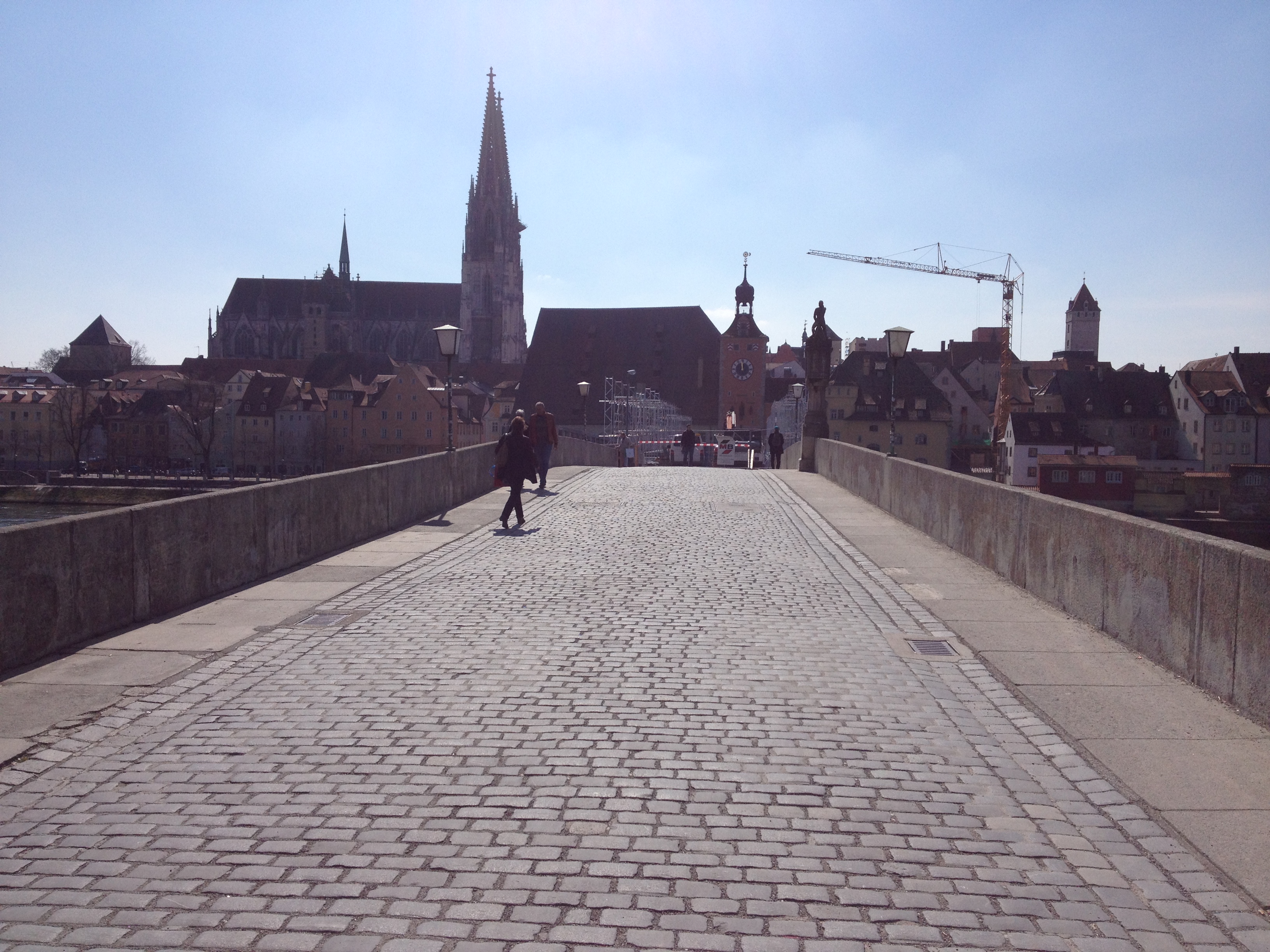
In 1135, a stone bridge was erected there called die Steinerne Brücke, which is still standing to this day. When I was a boy, there was still two-way automobile traffic allowed across the bridge, but it was closed decades ago and only left open to foot traffic. I walk over the bridge wrapped in nostalgia every time I visit Regensburg nowadays. Here is a photo I took in 2014, walking on the bridge:

Regensburg from the Old Stone Bridge

At the northern end of the stone bridge is the old historic sausage kitchen, called die Historische Wurstküchl. At an age of 500 years it is one of the oldest continuously operating restaurants in Europe. They make their bratwurst the same way now they did 500 years ago, and I recommend a visit to any tourist. One notable fact is that the restaurant gets flooded every few decades, with the water of the Danube reaching halfway up the first story of the building. When you look carefully on their website, you will see some signs in the restaurant, showing how high the water was:

In the above picture, you can see my red arrow pointing on a plaque in the wall: Wasserhöhe means water level. The date of March 27, 1988 shows when the water was up to that point. But this has been going on for centuries as the Danube floods from time to time, and they just clean up and continue with business.

Here is one more view of the city from the bridge:

Regensburg

And that’s what went through my mind when I stumbled across that Reddit post.

Book Review: Time Tunnel: The Eclipse – by Richard Todd

It is 1890. Annika finds herself without a transponder, which is the device she needs to return home to her own time in 2008. Stranded in time, with no way to go home, she makes the best of her situation and fights for the Sioux. She has a little help, because Kyle left his backpack on the counter in a bar when it disappeared. The bag contained his laptop which had basically all human knowledge as of 2008 on its hard drive (go figure how that would be possible).

This is book three out of three in the Time Tunnel series by Richard Todd. There is a little time travel plot twist here, but otherwise it’s just an alternate history story reminiscent of the trilogy by S.M. Stirling starting with Island in the Sea of Time.

I can recommend that series highly. In comparison, Time Tunnel: The Eclipse is a simple-minded tale of alternate history in a world where the United States disintegrates from internal strife and Nazi Germany and Imperial Japan rule the world outside of America.

Todd’s character development devolves in this third book. Most of the characters do stuff and react in ways that do not make much sense and seem very unrealistic. I got the feeling that the author just wanted to hurry and wrap this series up.

I finished reading this book simply because I had invested time in the first two of the series and I wanted to learn what would happen to Annika. However, the third book didn’t add anything new other than a neat plot twist at the end.


A Day in the Life of Refugees

It was winter. The mother was 35 years old. Her husband was gone, fighting in the war. She had five children. The oldest daughter was 9, her oldest son was 8, and there were three younger daughters. With them was her mother, the children’s grandmother. They packed up a few suitcases with the most important belongings and they left their home. They locked the door. They headed west. They never saw their house, their home, again.

The year was 1945.

The town was Breslau, then Germany, now inside Poland.

The mother was my paternal grandmother. She would die in childbirth two years later.

The 8-year-old boy was my father.

The invading force they were fleeing from, closing in on Germany, were the Russians.

My father is still alive today. He knows what these thousands of fleeing Ukrainian families feel like today.

Book Review: Hawaii – by James Michener

I first read this book in 1993 during my first ever trip to Hawaii. It’s a long book and I didn’t finish it during the one-week trip, but brought it home with me and worked through it. I had good memories of the epic stories.

So this year, on another trip to Hawaii, I decided to read the book a second time.

I enjoyed the introductory chapter of the formation of the Hawaiian Islands millions of years ago. The book brings to life how the islands were formed and how its flora and fauna became established. That chapter of the book is priceless and I still think about it every time I visit the Islands.

The next section describes in detail the lives of the islanders in Bora Bora and the surrounding islands in the South Pacific thousands of years ago. We learn what their lives were like, driven by superstition, and brutal beyond belief, particularly in their paradise-like environment. We find out what might have motivated those early islanders to make a trip by canoe, thousands of miles to the north, to eventually find and settle Hawaii.

I also enjoyed the journey of the missionaries from England in the early part of the nineteenth century, by brig, round Cape Horn and eventually to Hawaii. The book describes in excruciating detail the difficulties seamen encountered trying to round Cape Horn. The only other book that comes close to that I have read is Two Years Before the Mast by Richard Henry Dana – which I very highly recommend – particularly if you are a Southern Californian. You’ll never see the California coast the same way again after reading Dana.

When the missionaries finally arrived in Hawaii, at Lahaina in Maui, they immediately set to work destroying the culture and spiritual world of the natives, forcing the exploitative practices of the Christian religion upon the people. Descriptions of their methods and practices further foster my dislike of religions in general.

Abner Hale is the lead missionary on Maui, and he is a hapless, rigid puritan with a chip on his shoulder. Nobody likes him, but his relentless drive, and his industrious nature, get things done and moving forward. He hounds the natives and emotionally brutalizes them.

And then I got bored with the book. The religious lecturing goes on for dozens and dozens of pages, and at 25% I finally gave up. I remember it’s an epic work, I remember enjoying the book over 25 years ago, but those memories are not strong enough for me to endure another 75%. There are other things to read.

Not star-rated because I didn’t finish reading the book.


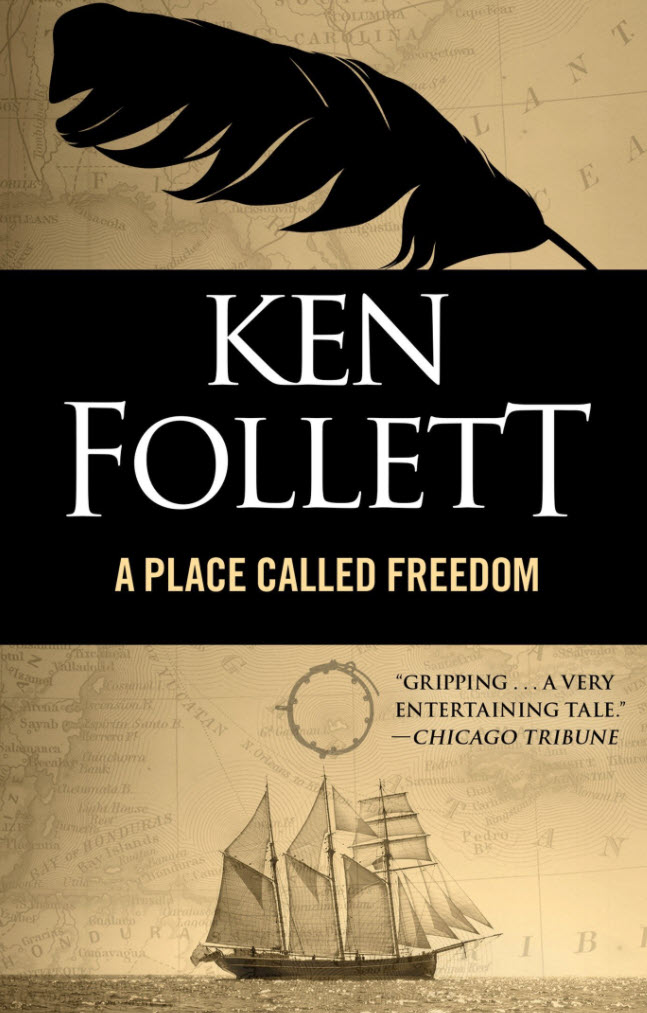
Book Review: A Place Called Freedom – by Ken Follett

Twenty-one-year-old Mack McAsh and his twin sister are trapped working in the coal mines in Scotland in 1766. Coal miners work under the harshest possible conditions. The men go to work early in the morning and labor in the mines, picking the coal from assigned spots deep underground. The women and children then haul the coal on their backs up rickety staircases in the shafts. All day long. Every day except Sunday. Miners also have no way out. Often, through complex laws, they become lifelong slaves of the mine owners.

Lizzie Hallim is noble-born and therefore has a very different kind of life. However, while the miner’s oppression is simple, the fate of a noblewoman out of favor can be complex and just as brutal.

Mack escapes this fate and tries to make it on his own, first by escaping to London, then, through circuitous ways to the New World, a plantation in Virginia.

A Place Called Freedom follows these protagonists on their journey to escape injustice during a time of revolution. They are searching for a better life, a simple life, but above all, a life of freedom.

Movie Review: Oliver (1968) – by Jean Claude Volgo

Oliver!

Columbia Pictures, 1968, 2 hours

Music and Lyrics by Lionel Bart

Directed by Carol Reed

Starring Ron Moody and Oliver Reed


Among English novelists of the 19th century, Charles Dickens indisputably ranks as the most astute social satirist of his age.  The appalling living conditions of the lower classes in Victorian England had resulted from the rapid economic transformation of society in the Industrial Age.  The most vulnerable were the poor and, in particular, young orphans whose plight Dickens depicts in several of his writings in realistic and unsanitized detail. The scathing satire flowing from his pen would target the class of powerful industrialists and snobbish élite who were mercilessly exploiting the less fortunate members of society.

Oliver Twist would advance the literary career of Charles Dickens not only as the most popular novelist of his day but also as a relentless critic of his contemporaries.  His appeal to readers across cultures is due to his deft portrayal of memorable characters: Oliver, the pitiable orphan; Fagin, the conniving swindler; Nancy, the kind wench; Bill, the ruthless criminal.   These archetypal players in a Dickensian drama breathe life into a convoluted maze of subplots, leaving readers to wonder how an orphan’s journey through life, starting in despair, may yet conclude in hope.

The novel evolved from serialized monthly installments published in a popular magazine. It finally appeared in book form, after two years, in three volumes! Its length was due to subplots that are usually left out in most film adaptations (except for a recent miniseries). The central storyline is compressed even more in the musical Oliver! and its film version, entertaining audiences with delightful song-and-dance numbers which have become part of the repertoire of  tunes from modern musicals.

The film would garner an Academy Award for Best Picture, and five other awards from a total of eleven nominations.  It is worth noting that the spotlight of this musical drama has always fallen on the British actor, Ron Moody, who would go on to win multiple awards as Best Actor for his flawless portrayal of the cunning Fagin (his signature role in a long acting career, on stage and on screen).  The demanding portrayal of the brutal Bill Sikes, the arch villain of  Dickens’ novel, falls upon the matchless British actor, Oliver Reed.

The Old Bank Vault

Today I went to the local locksmith shop to get a copy of a key. I saw this sitting in the middle of the shop:

I didn’t have a banana with me for scale, but the white paper on top is a normal sheet of 8.5 x 11 paper. The top of it reached about to the level of my belt.

We are looking at a bank vault from circa 1853. To put it in perspective, this was before Abraham Lincoln was president. The vault is made of solid manganese and weighs over 4,500 pounds. The design of the vault was to direct the shock of a dynamite blast away from the vault, thus ensuring anything inside would be protected. The inside of the vault is only about 12 by 12 inches, about enough room for a basketball.

Those cowboy bank robbers of the west must have had a hard time with a vault that weighed 4,500 pounds and couldn’t be blasted open with dynamite. Try to put that on the back of a horse!

Movie Review: The Dig

It’s 1939 in England, and the start of World War II hangs heavy in the air. Edith Pretty (Carey Mulligan) is a wealthy but ailing widow who lives on an estate in Suffolk. In her fields are “mounds” of earth that have been there throughout history. She hires Basil Brown (Ralph Fiennes), a professional “excavator” who takes on the job of digging into the mounds to see what might be buried beneath.

When Mr. Brown discovers the outline of a buried ship, the local archeological establishment sniffs fame and starts taking over the dig, not wanting to leave the results and the laurels to who they consider an amateur. They eventually dig out a 27-meter long Anglo-Saxon ship and an assortment of buried treasures from the 6th century, a time in history that we normally call the Dark Ages. After this find, the archeologist calls it “Dark Ages no more.”

The Dig deals with family, working and class relationships in English society. It is set in front of the backdrop of the country preparing for war with Germany. Based on the true story of the Sutton Hoo treasures, dramatized by the 2007 novel The Dig by John Preston, the movie gives a romanticized view of rural life in pre-war England, along with all the fog, the rain, and the green countryside we expect to see.


I noticed in my WordPress reader that there are many other people who reviewed this movie just recently. It’s a 2021 release, and I am sure it’s because we’re all starved for NEW materials after the pandemic dark year. Here are some of the links I found:

The Dig – Review ‹ Just A Little Bit Random ‹ Reader — WordPress.com

The Dig (2021) ☆☆☆(3/4): Their friendship over burial mounds ‹ Seongyong’s Private Place ‹ Reader — WordPress.com

Film Review: The Dig (2021) ‹ Paris Franz ‹ Reader — WordPress.com

The Dig (2021) Review!! ‹ Welcome to Moviz Ark! ‹ Reader — WordPress.com

THE DIG*** Shallow ‹ Vagabond Shoes ‹ Reader — WordPress.com

The Dig ‹ The Silverback Digest ‹ Reader — WordPress.com

The Dig ‹ THE VIEW FROM THE TURRET ‹ Reader — WordPress.com

Exhuming emotion  ‹ Fremantle Herald Interactive ‹ Reader — WordPress.com

Review: The Dig ‹ A Few Good Reviews ‹ Reader — WordPress.com

Movie Review: The Dig ‹ Howard For Film ‹ Reader — WordPress.com

The Dig ‹ Lofty Music and Film ‹ Reader — WordPress.com

I imagine you have to be quite dedicated to read twelve reviews of the same movie, but I thought it might be an interesting experiment.