Saudi Women Are Not Allowed to Drive…

…because they might get raped by the roadside in the event their cars break down. At least that’s what this Saudi historian says to justify oppression of their females. He goes on to say that women in other countries, like the United States, drive because they don’t care about getting raped.

I wonder if he ever drove in the United States. Man, it’s Deliverance Country, alright. Yesterday, on my way home from work on I-15 South I saw three cars that broke down on the right side of the freeway, and male drivers just couldn’t help themselves. They pulled over and lined up all in sexual rage waiting for their turn to rape. Oh, the debauchery!

This makes me wonder who the Saudis think does the raping? It’s all the men that have to escort their wives, sisters and daughters, driving them around. When they don’t have females to chauffeur, they must be driving around themselves trying to find women by roadside that they might rape.

Religion makes people say and do the darndest things. I have never been to Saudi Arabia, and I don’t think I want to go. I don’t think I could handle all the raping.

Movie Review: The Imitation Game

Imitation Game

When I was a 14-year-old kid, years before personal computers came to be, I wired up logic boards by gluing Molex connectors on plywood and making AND, OR and XOR gates using simple wires. My inputs were toggle switches, my outputs were mini light bulbs, 8 or 16 of them in a row to show binary numbers, and the wiring was “designed” to implement the multiplication tables. I powered the whole thing using the transformer of my electric train set. I hadn’t figured out how to make memory work that way, but I had static calculating functionality. After a while, it got too tedious to actually wire my designs up. I knew I could do it, but I didn’t need to. I simply drew my designs on yellow pads and I knew I had the design of a functioning calculator, whether it ever lit up or not didn’t matter.

I had read about Alan Turing then. I knew he was this mathematical genius who also came up with the “Turning Test,” a method to test whether a computer was actually intelligent. Later as I became a “real” computer scientist I got to actually play with real boards, real computers and real machines.

When I saw Turing’s machine designed to break the Nazi Enigma encryption mechanism in the movie Imitation Game, I felt right at home; I almost experienced a throwback to my youth.

Imitation Game tells the story of the life of Alan Turing and it fills in all the blanks about him that I didn’t know. I knew the surface of his work, but I had no idea about the details, the complex character that he was, and the challenges he faced by being who he was. In his own quirky way, without ever getting credit for it, he apparently was responsible more than any general or head of state for shortening World War II by several years, as historians estimate.

Benedict Cumberbatch plays Turning with riveting intensity. We can feel his anxiety, his discomfort with people in social situation, and his awkwardness toward women. The battle to conquer the code and the race against death through daily destruction by the Nazis of English cities and ships, in the face of impossible odds, paces the movie along.

I learned much about Enigma and what it meant in the war, I saw the dawn of the computer age, and I experienced the life of one of the early pioneers of digital machines in living colors.

Rating - Three Stars


Our Unsuccessful War on Terror

The American taxpayers have spent almost $1.7 trillion on the “war on terror” in Iraq and Afghanistan.

De-Rugy-war-funding-chart-v1_0
source mercatus.org

Looking at the chart, it strikes me that most of the money, of course, went to the Department of Defense. Very little, the green bars, went to the Department of State and to aid. And the VA Medical bars are not even recognizable on the bottom.

Looking at the chart, I also notice that expenditures kept going up year after year during the Bush years, and down during the Obama years.

The “war on terror” was supposed to get rid of terrorism, or at least the threat of terrorism.

Yet, there are more terrorists now than ever. ISIS is trying to build a nation state based on terrorism. That’s far worse than anything we have ever had before. Some say we have created this situation with our war on terror. I don’t know if we did. But I do know there are now more terrorists, there are more attacks, and there are more terror-related atrocities than ever before.

We have gotten a very lousy return on our investment. I would venture to guess if we had spent $1.7 trillion in our own country in the last 14 years we’d be vastly better off today, and there would be less terrorists out there. We should have minded our own business.

I think about that as the warmongers (like McCain) are eager to get us militarily involved with the Russians in Ukraine.

Do we ever learn?

Books – Our Old Friends

Watership Down

My study/studio has a high row of built-in bookshelves all the way around the periphery. While the majority of my book collection rests in boxes in the garage, a few select ones, either those that I have recently read, or special books I have brought out because I want to read them again, sit on the shelves that surround me every day when I work.

When I sit at my desk while I talk on the phone, I like to throw up my feet, and lean back in my chair. As I look up, right above me, next to a recessed light, is my old copy of Watership Down. It has been resting there for years, to be picked up and read again. I don’t remember the last time I read it, but I am sure it’s been at least 25 years. That book, like many others, is an iconic old friend.

Today, when I browsed through the queued posts in my WordPress reader, I came to this blog entry by Emily J., where she shows her favorite books on a shelf high up in her bedroom. Immediately I noticed the first book there: Watership Down. Immediately I could relate, and then I read the whole post, which I might have missed otherwise.

Books, especially those we have read before, are our old friends. We have spent many hours with them, touching them, holding them, saving them, and looking at them. The color of the cover alone gave Watership Down away. Just like artwork on the covers of old vinyl record albums, the artwork on book covers, since we see it all the time, creates a mental association with the book itself, and we like the book for two reasons: Its content and its cover.

Sadly, I haven’t bought a hardcopy novel in at least four years. All my books are now stored in an account, and I can access them all from my Kindle, and even my smartphone, any time I want. I now prefer reading on my devices to holding a hardcopy book for a lot of reasons.

But I have no associations with the covers of the books. I don’t even know what they might look like in most cases. My Kindle books don’t sit around in my house and surprise me with their colors. I don’t recognize the books of others that they read in their Kindles, like I recognized Emily’s in her post. Our new books are detached from us. We still have relationships with them, but relationships of a different kind.

Where will all the knowledge of mankind go, when one day there is no more electricity, nobody charges Kindles anymore, and there are no hardcopy books? The danger is that we can all descend into the stone age within just a few weeks. But it won’t even have to be a civilization-killing catastrophe that ends it all. What happens when one day Amazon no longer exists?

That may seem like a shocking thought. I bet it hasn’t occurred to Jeff Bezos that one day Amazon will not exist. Or Google. Or Apple. How many companies do you know that are over 100 years old? Probably very few. One day, sooner or later, Amazon will encounter the same fate that mighty Kodak had to face. And it may not take 100 years. Where will all my books be then, when I can’t connect to Amazon and look them up?

Books were our old friends, but even old friends are not with us forever.

Biblical Atrocities: Lot’s Sheltering of the Angels

Here is an interesting segment from Genesis:

GENESIS 19

The two angels came to Sodom in the evening, and Lot was sitting in the gate of Sodom. When Lot saw them, he rose to meet them and bowed himself with his face to the earth and said, “My lords, please turn aside to your servant’s house and spend the night and wash your feet. Then you may rise up early and go on your way.” They said, “No; we will spend the night in the town square.” But he pressed them strongly; so they turned aside to him and entered his house. And he made them a feast and baked unleavened bread, and they ate. But before they lay down, the men of the city, the men of Sodom, both young and old, all the people to the last man, surrounded the house. And they called to Lot, “Where are the men who came to you tonight? Bring them out to us, that we may know them.”

— Crossway Bibles (2011-02-09). The Holy Bible, English Standard Version (with Cross-References) (Kindle Locations 1918-1938). Good News Publishers. Kindle Edition.

“Know them” in the bible means having sex. This is one of the passages where the term “sodomy” comes from. Of course, the raping of men, and particularly the systematic and institutional rape of young boys permeated humanity’s history, reaching from biblical times (see Genesis above), to ancient Egypt, where rich men kept harems of boys for their physical pleasure, into the Middle East of Marco Polo’s age (1200 AD) – and undoubtedly into modern times.

So Lot seems to have been a good guy by sheltering the angels from the men of Sodom who wanted to gang rape them. So far, so good.

But then Genesis continues:

Lot went out to the men at the entrance, shut the door after him, and said, “I beg you, my brothers, do not act so wickedly. Behold, I have two daughters who have not known any man. Let me bring them out to you, and do to them as you please. Only do nothing to these men, for they have come under the shelter of my roof.”

–Crossway Bibles (2011-02-09). The Holy Bible, English Standard Version (with Cross-References) (Kindle Locations 1939-1943). Good News Publishers. Kindle Edition.

So let’s get this straight: When the men of Sodom were about to break down Lot’s door, he held them off by telling them that he had two virgin daughters, and they were welcome to gang rape them instead. The daughters were worth less than the two guests under his roof.

The story meanders on, and eventually God destroys Sodom and Gomorrah by killing everyone.


The Atrocities of Religions

Barack Obama compared Christianity with Islam yesterday in a speech. He stated that Christianity, hundreds of years ago, committed terrible atrocities in the name of God. He probably didn’t mean it that way, but it came across as if he was rationalizing that radial Islam today is really not any different from Christianity 800 years ago.

Perhaps Obama is even correct. To the best of my understanding, what the Christians did in the name of God 800 years ago sounds a lot like what ISIS does today.

However, that was 800 years ago. We want to think that we have grown up as humanity since, and we measure ourselves against different standards. It also sounded like Obama tried to make it sound like ISIS is not so unusual after all.

There seems to be this fear of calling Islam what it is – a brutal, discriminating, violent and aggressive religion.

Let’s just compare two religions, Islam and Christianity in the last 10 years.

Islam:

  • Many members openly confess and announce that they want to kill as many infidels as they can.
  • Public beheadings and burnings of infidels – dozens.
  • Suicide bombers – hundreds.

Christianity:

  • Members opening announcing they want to kill infidels? None that I can think of. We have had a few nuts who killed abortion physicians in the name of God, but that’s about it.
  • Public beheadings and burnings – none.
  • Suicide bombers – none.

I am not a Christian, but I must say, in 2015, Christians are much less dangerous than Muslims, just judging from their actions and the results.

Muslims will argue that the West, lead by the U.S., has killed thousands of people in the middle east, and they will be right. The U.S. has killed far more Iraqis and Afghans than Iraqis and Afghans killed Americans, by an order of magnitude. However, the U.S. did this not because they are Christians, but because they believe they need to defend themselves against radical Islam.

Moderate and mainstream Muslims will argue that ISIS are not Muslims and they want nothing to do with them. Too bad, however, that ISIS does not agree with that. They think they are the true Muslims, and all the other ones are cowards.

So my conclusion:

Islam is obviously a lethal and dangerous religion that drives some of its members to do insane and brutal deeds, to the point of killing themselves. Islam is not good for life, health and the pursuit of happiness.

Visit from Marty McFly

It’s 2015, the year Marty McFly of Back to the Future visited in the distant future, from his home in 1985.

This evening, as I left my office, I noticed his tracks.

McFly

Hiking: Cactus to Clouds (C2C)

The Cactus to Clouds (C2C) trail is a hiking trail from Palm Springs, California to the San Jacinto Peak. This trail has the greatest elevation gain of any trail in the United States, and it is listed as number 5 by Backpacker Magazine in the list of America’s Hardest Day Hikes. The trail starts in Palm Springs behind the Art Museum at an elevation of 460 feet. San Jacinto Peak is at 10,834 feet, so the trail rises a total of about 10,300 feet.

Compare this to hiking from Whitney Portal, which is at 8,360 feet to the peak of Whitney, at 14,505 feet, so the climb is “only” 6,200 feet. Even the climb to the top of Mt. Everest from base camp is only 800 feet more elevation difference than the Cactus to Clouds.

You get the idea: You cannot climb more altitude in a day in a single hike than on this trail pretty much anywhere in the world. It’s formidable.

So at 6:00am in the morning on Super Bowl Sunday I got in my car and drove to Palm Springs with the intent of doing an “exploratory hike” of C2C. This is not the kind of hike you attempt unless you are extremely well prepared and very fit for climbing. I strongly believe in making exploratory forays into difficult hikes before I commit. My plan was to ascend as far as I could, given water, daylight and sheer stamina, and then turn around.

Here is the chart [click to enlarge] showing my trek – as far as I got. Map

The green arrow shows where the trailhead is. It is located right behind the parking lot of the Palm Springs Art Museum, and the trail at that point is called the Museum Trail. It is extremely steep as soon as you set foot on the trail, and it never lets up for a full hour and 1,000 feet elevation gain.

There is an alternative trail that starts at the red arrow a few blocks south, which probably is a bit milder. It is part of the Skyline Trail which meets the C2C after about a mile or so. I may try that one next time.
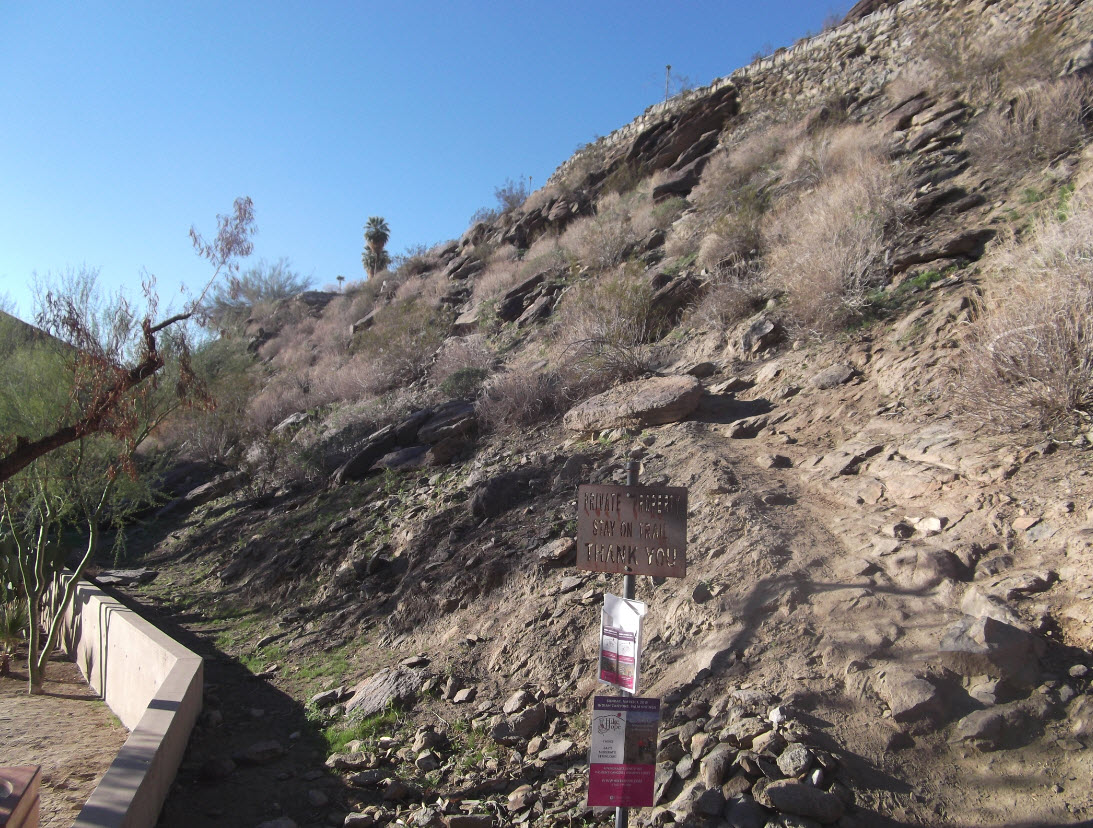
Trailhead

The picture above shows the trailhead behind the museum parking lot. The trail is extremely rough, rocky, and actually hard to find in the first mile. I was certainly off trail a number of times, scrambling through boulders, trying to find my way. They have small white blazes on rocks, but they are not steady and consistent enough to maintain a good trail. When in doubt, head straight up, and eventually you come across the trail again.
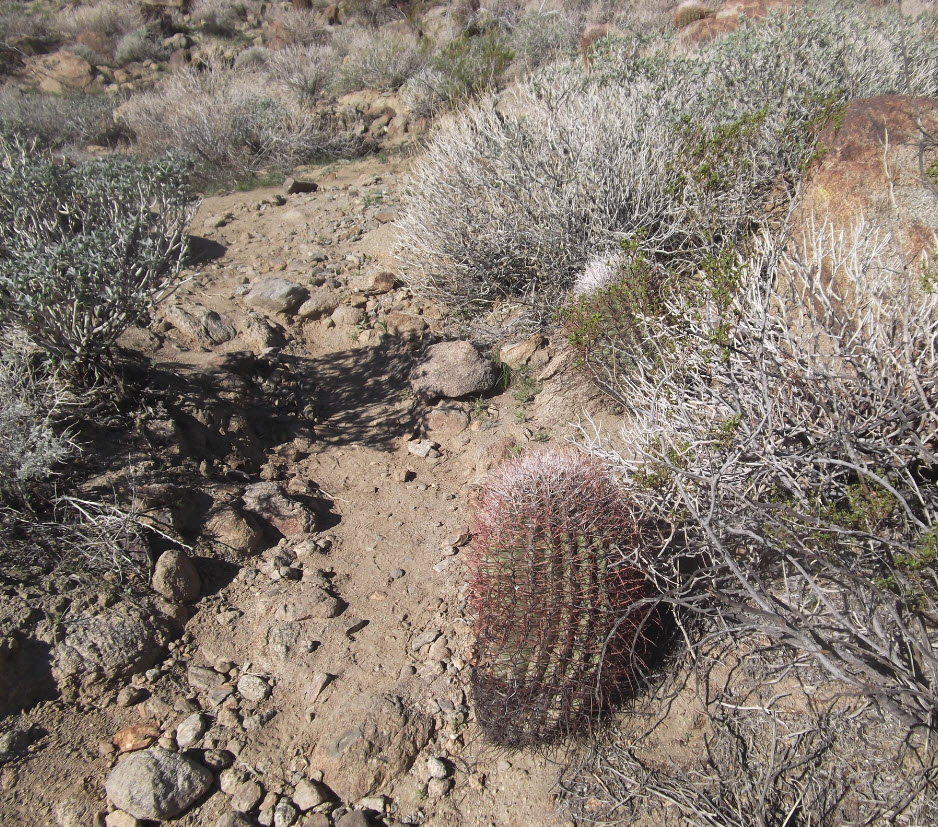
Cactus

This is why it’s called “Cactus” to Clouds.
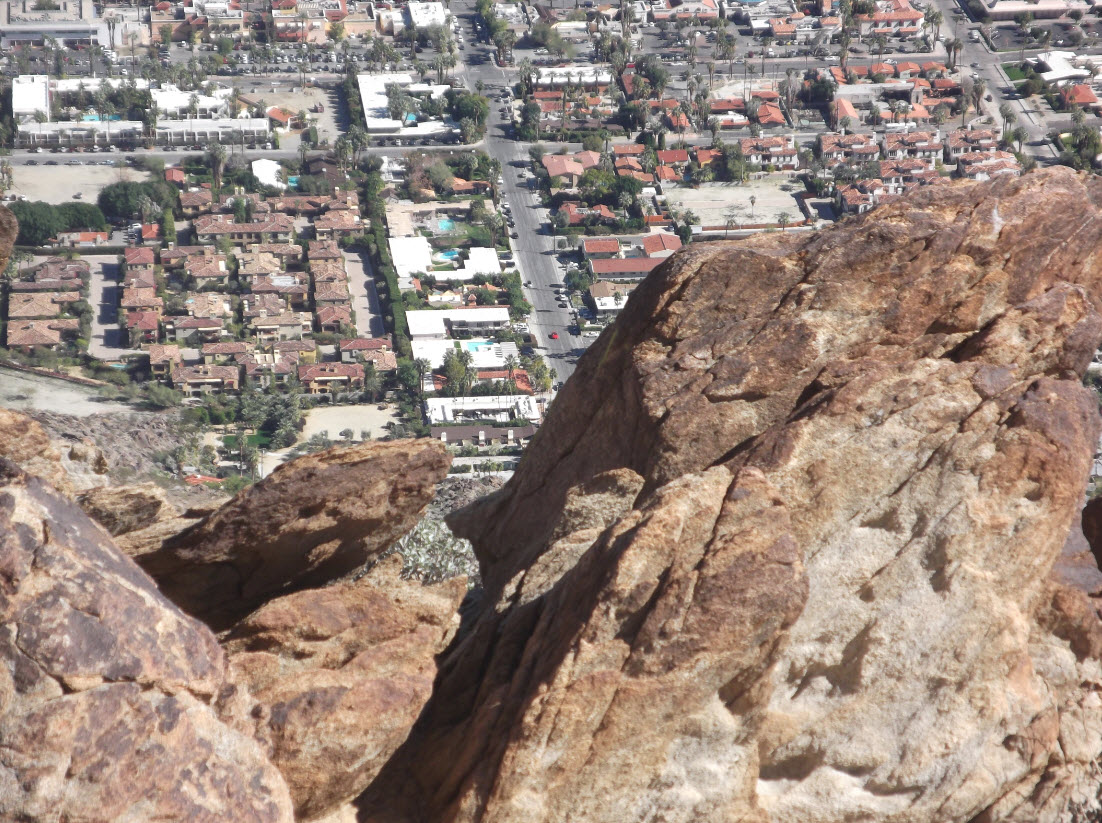
Looking Down

Looking down from about 800 feet up it seems almost precarious right over the city.

More looking down

Here are more views. I would not want to live in one of those houses below when an earthquake rattles this mountain and shakes some of these boulders loose.

Palm Springs Below

Looking north from about 1,500 feet up into the desert with Palm Springs below.

Rescue 1

After about an hour and a half, I got to the first “rescue box.” The sign says to not break the seal unless it’s an emergency, so I stayed away.

The rescue boxes are a grim reminder of those who have died or come near death on this harsh trail.  Inside supposedly are a telephone, water, and other essentials. I have heard that some people have raided these boxes even though there was not an emergency. Can you imagine getting here in a life-threatening situation and finding the box empty?

San Gorgonio

One I got a bit over 3,000 feet high, I was able to see the snow-covered peaks of San Gorgonio in the distance, the highest peak in Southern California.

Mountain Station

A bit further, and I was finally able to glimpse the mountain station in the distance. This is where the Palm Springs Aerial Tramway ends – which means it’s the first place where there is water (and beer – it’s a full mountain lodge with bar and restaurant) and a way down and out.

From where I am standing, that is still more than 5,000 feet up and about 7 miles away.

This is where I decided I had to turn around. I was at 3,500 feet elevation, I was 3.5 miles in from the trailhead, and I had hiked for 3.5 hours. You get the idea, one mile and 1,000 feet elevation per hour. It was close to noon, I had used up half my water, and close to half my daylight, and all my strength.

The C2C is a nasty trail where you quickly get to a point of no return. The only way out is continuing up the steep trail – and nature does not care if you have any more water. People have turned around too late, tried to hike back down, only to be overcome by the furnace of the desert heat. Heatstroke is the most common form of death on the C2C, followed, of course, by falls. In the winter the trail gets icy.

The day I was there it was iced up above 6,500 feet. I had no crampons, so if I had continued on, I would have run out of water at about 6,000 feet, with 2,600 more to climb before the mountain station, on an icy trail along steep cliffs. A very lethal combination.

I once got caught in ice in the Grand Canyon without crampons – never again.

But that’s why it’s called an exploratory hike. Time to turn around. I rested a bit, ate, drank some water, took in the panorama, and headed back down. It took me three more hours to get back down to the city. Very steep trails take as long to go down as they take to climb up – at least for me.

I was here

I looked back up from the trail to the highpoint that I had reached.

High Point

Later, from the car, I glanced back to the ridge and found the very spot that I had reached before I turned around.

Now I know how to conquer the C2C. It will take two more trips, at least:

Next time I need to leave at 3:00am with a headlamp, so I can ascend to about 3,500 feet before daylight. I have to carry at least 6 liters of water, perhaps 7. That should get me to the mountain station by about 1:00pm. That’s enough for that try. 8,000 feet up, in about 10 hours.

The following time, depending on how I did, I should be able to go the extra 5.5 miles from the mountain station to the San Jacinto Peak for the full 10,000 feet. I should be able to get there by 2:00pm, provided I leave at 2:00am from the valley. The problem is, there is no water on the peak, so I’ll have to carry enough to get up and back down to the mountain station, making for a 20 mile hike before I can take the tram down.

Summary:

The C2C is a badass day hike. Only experienced hikers should attempt this. I recommend an exploratory hike first, to get the lay of the land. This mountain commands respect.
Visualizing the Size of the Solar System

When I posted about visualizing the speed of light a couple of days ago, one of my readers pointed out another site that did a great job helping visualize the size of the solar system. If the moon is one pixel wide, what are the various sizes of the objects and their distances from each other. It starts out with the sun and you can scroll to the right to start getting to the planets. There is also a “speed of light” button on the right lower corner, the “C” button, which turns on auto scroll at the speed of light. Thanks, PS, for pointing out this site to me.

Visualize the Size of the Solar System by Clicking Here


Movie Review: The Guest

theguest

A soldier returned from the war and visited the home of a fallen friend way out in the country. He was humble and quiet, a bit shy, but he had promised his buddy that he would go to his home and tell his family that he loved them. So he kept his promise.

The family asked him to stay a few days, since he obviously had no specific plans, no place to go, and no vehicle. The soldier reluctantly stayed.

He made friends with the siblings and started hanging out with them.

Suddenly strange things started happening in the community. They quickly escalated to disaster.

The trailer for The Guest suggests this is a common story of a good man come home. But that’s not at all what it turns out to be. The caption “be careful who you let in” can’t be any more appropriate.

The story starts out slowly and quickly escalates into a cliffhanger, even an unlikely one. At the end, I felt entertained, but I knew I’d forget this movie within a few days.

Better write a review quickly.

Rating - One and a Half Stars

Visualizing the Speed of Light

Here is an amazing video that shows what it would be like to be sitting on a beam of light traveling away from the sun, flying by Mercury, Venus, Earth, some asteroids and finally arriving at Jupiter, 45 minutes later. It really gives a sense of the immense size of the solar system, not to mention the universe.