
“Those who can make you believe absurdities, can make you commit atrocities.”
— Voltaire
Category: Wisdom
Congressman Steve King’s Bigotry
Here is a sitting GOP congressman, on national TV, asking what minorities (by which he means non-whites) have done for civilization?
This has got to be the most arrogant and blatant racism I have ever heard from an elected official. He really believes this stuff?
First, whites are only about 17% of the world’s population, with 14% black and 60% Asian. Perhaps whites have built more tanks and rockets than other races, but they have also done their share of harm to the world (Hitler and Stalin come to mind).
Maybe King needs to travel more:
Travel is fatal to prejudice, bigotry and narrowmindedness … and many of our people need it solely on these accounts.
— Mark Twain
But justifying current discriminatory actions and outright racism based on made-up historic facts and subjective evaluation of the values of “contribution” to civilization is very despicable racism. It’s exactly what Hitler did to justify his deeds.
Way to go, GOP, way to go!
To the Young: It’s Your World Now
Most recent headlines are all focused on the Brexit vote. The voter turnout was 72.2%. They collectively voted that the 64 million people in the U.K should to leave the European Union. Afterwards, it became apparent that many people voted in protest because they didn’t think it would happen. Many didn’t even know what the European Union actually was.
Google reported a spike of searches for “European Union” right after the results were announced. Also, people googled for instructions to emigrate to Canada.
It sure looks like the people of the U.K. voted for something that they didn’t really want. Why?
Apparently the Brexit lobby was well funded, well organized and powerful. People vote for what they are told to vote for.
Young people in the U.K. overwhelmingly voted to stay in the Union.

Click on the chart above that links to a BBC article for a treasure trove of more statistics and information about the vote. This chart shows that the younger the people, the more likely they wanted to stay. But the old ones edged them out.
Bitter with the reality, they protested, and they won. The world lost 2 trillion dollars in value in the market. Even though the United States has nothing to do with this, our markets plunged and lost $800 billion overnight. The world is obviously connected. We here in the United States care about what happens in other countries and we know it affects us. The young people in the U.K. knew that, and they wanted to stay. After all, they have their entire lives in front of them. They are the ones that have to deal with the fallout of what their country has just done. The 65+ crowd won’t be here in a decade or two or three.
In the United States, the young people overwhelmingly chose Sanders as their candidate. Unfortunately, they did not prevail in the end. The message to young people is:
Get out in force and vote for what you believe in, because if you don’t, the old, the bitter, the disenchanted, and the stupid will overwhelm you and keep you down. Huge votes, like Brexit, or the upcoming U.S. presidential election, matter big time. You, the young, own the world and own the country. You, the young, have to live here for a long time. Don’t let the old, who have poisoned your environment, heated up your planet, installed reckless financial policies, set the legacy that you need to live with for all your lives. Take charge and make it your world, because it’s your world now.
Bukowski Full of Confidence

The problem with the world is that the intelligent people are full of doubts, while the stupid ones are full of confidence.
— Charles Bukowski
Coincidences around Gigs and Christian Morgenstern
In the last few weeks, a set of amazing coincidences came together around me that had me marveling enough to write a post about it. It all starts in 1973, when I was a 16-year-old high school student in Germany. I was in my room and somebody took a photograph of me – probably one of my siblings. In those days, we made photographs into slides. Slides are endemically difficult to thumb through and browse in an album, so they are often forgotten. I had no idea that this picture of me even existed. I have no recollection of it being taken. It was taken in my teenage-decorated room, where I had plastered the walls with my own artwork and knick-knacks.

I didn’t have this slide. One of my sisters, when moving house a few months ago in Germany, found it in one of her picture boxes. She, too, did not know how she came to have it, but she thought I’d like it and put it in an envelope and mailed it to me.
It was difficult to see what was on it. Trisha had it developed for me and “cleaned up.” Slides almost 45 years old have spots and marks. One day a few weeks ago she brought it home to me enlarged in print and framed. It was a surprise. Now I could finally look at it.
At this point is must digress for a minute for a backstory. I have written about getting rid of much of my old collection of hardcover books, as I outlined in this post of last winter. I have proceeded with that project, and many of my non-descript books, old paperbacks, outdated non-fiction books, and the like, are now gone. However, I have saved some of the treasures I have – and will always have, and some of those are resting, seemingly forever and untouched, on the shelves around me.
There is an old book of humorous poetry by the German poet Christian Morgenstern, born May 6, 1871 in Munich, and died in 1914 at age 42. The book’s title is Alle Galgenlieder (All Gallows Songs). Morgenstern is a little like a German Shel Silverstein, writing hilarious poems that make fun of human nature and ordinary situations.

You can see the little blue softcover book Alle Galgenlieder on the left side of this little section of my shelf, not four feet behind my head. The book has been sitting there for the last few years, pretty much untouched and unmoved. It’s in revered company, as you can see, with Moby Dick, Tristram Shandy, The Prophet, War and Peace, and The Count of Monte Cristo.
So where is the coincidence, you ask?
Well, there are very few books that I had in my youth and my childhood that I still have today. I never gave Galgenlieder much thought in the last 40 years, other than thinking of it as an ancient classic, and keeping it around.
Then I looked at the photograph made of the slide, and it hit me:
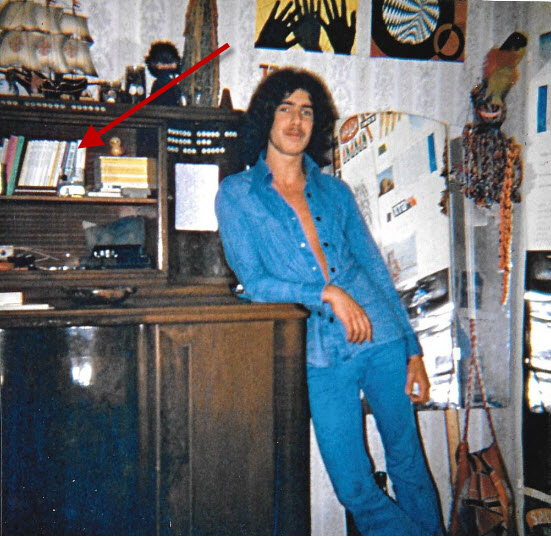
Here it is, on the shelf next to me, in a photograph I didn’t know even existed. Don’t ask me how I even made that connection. I just looked at the picture, the knick-knacks I had forgotten, and I noticed the book. I turned around in my chair, and here it was.

And that, I thought, was pretty cool.
But the story does not end here. Today, I came across a Reddit post about the prefix Hella.

You know, in the series of Mega, Giga, Tera, and so on, Hella is for one octillion. So I clicked on the link and came to this Wikipedia article, where the origins of some of the other prefixes are discussed. I scrolled around and got to the now ubiquitous Giga.
In the age of the iPhone and iPad, every grandmother knows what a Gig is – or at least acts like she does. Then I read about the origin of the prefix Giga, and was thunderstruck:
The prefix giga is usually pronounced /ˈɡɪɡə/ but sometimes /ˈdʒɪɡə/. According to the American writer Kevin Self, in the 1920s a German committee member of the International Electrotechnical Commission proposed giga as a prefix for 109, drawing on a verse (evidently “Anto-logie”) by the humorous poet Christian Morgenstern that appeared in the third (1908) edition of Galgenlieder (Gallows Songs).[6][7]
This suggests a hard German g was originally intended as the pronunciation. Self was unable to ascertain when the /dʒ/ (soft g) pronunciation was accepted, but as of 1995 current practice had returned to /ɡ/ (hard g).[8] [9]
So this claimed that Morgenstern first used the word Gig or Giga. Could that be true?
So I turned around, reached for my trusty Galgenlieder behind me, checked the index for Anto-Logie, and promptly found it on page 76:

Sure enough. Here it is.
A friend (KJ) emailed me an excellent translation by Max Knight:
Anto-logy
Of yore, on earth was dominant
the biggest mammal: the Gig-ant.
(“Gig” is a numeral so vast,
it’s been extinct for ages past.)
But off, like smoke, that vastness flew.
Time did abound, and numbers too,
until one day a tiny thing,
the Tweleph-ant, was chosen king.
Where is he now? Where is his throne?
In the museum pales his bone.
True, Mother Nature gave with grace
the Eleph-ant us in his place,
but, woe, that shooting anthropoid
called “Man”, in quest for tusks destroyed
him ere he could degenerate,
by stages, to an Ten-ant’s state.
And there it is, the story of coincidences:
Through this unlikely coincidence I learned the origin of Giga
From an old 19th century book by a German poet
That I didn’t realize I had near me
That I was reminded about by a slide over 40 years old
That my sister found when moving
In which I recognized a book
That I didn’t know I still had.
Holding Up the Constitution
Our nation was founded in 1776 and its constitution and many of the first amendments were crafted in the few decades before and after 1800. It goes without saying that our nation is based on an eighteenth-century agrarian society of a few million people in a colonial environment.
The constitution states that the Congress shall meet at least once a year, and such meetings shall begin at noon on the 3rd of January. Of course, in that time, when the only way to travel was by coach or horseback, and the trip from Massachusetts to Philadelphia took months under extreme conditions in the winter, congressmen and senators could not just fly in from their weekend outings to their home states.
Many of our constitutional clauses and the amendments, the second being one of them, are rooted in that environment.
They simply make no sense today. Our Supreme Court often has to deal with the interpretation of the laws our agrarian founders put in place, and how they apply in a modern society with encrypted computers, automatic weapons and Twitter.
Holding up and waving the Constitution can be used for and against just about every issue in that regard.
I have to leave the rest to the constitutional scholars.
A Giant Leap for Artificial Intelligence

When I was young, I was an avid Go player.
The game known in English as Go—Igo in Japanese, Weiqi in Chinese, Baduk in Korean—is not just more difficult and subtle than chess. It may also be the world’s oldest surviving game of pure mental skill. Devised in China at least 2,500 years ago, it had stirred enough interest by the time of the Han dynasty (206BC-220AD) to inspire poets, philosophers and strategic theorists.
— see this article in the Economist The Game to Beat All Games for more information about Go
The best players of Go are Japanese, Korean and Chinese. It is very different from chess, but definitely as challenging to learn to play well. Some chess players who learn Go eventually stay with Go over Chess. So it was with me. I learned Go at age 13, and never played chess again. By my mid twenties, I reached the level of 1-Dan, which is roughly the equivalent of a “black belt” in the game, and I was stronger than most people around me. I’d usually be amongst the 5 or 6 strongest people in town, wherever I lived. So pretty good, but by no means world-class or master level.
In 1980, I started working on a computer program to play Go, but never got beyond the rudimentary skills of just making legal moves. I followed computer Go over the years, and by about 1988 I lost interest, partly due to lack of progress, partly because I got too busy with life, raising a family, and making a living. Around that time I also abandoned playing Go altogether, and I am sure I fell severely in the ranks. It would take another year of practice now to get back up to my 1-Dan level.
I always knew that eventually somebody would come up with a computer program that would beat the strongest players in the world.
Without much popular fanfare, this happened last week. Google’s DeepMind, an artificial intelligence program, has won the first three matches out of five (two more to go), against Lee Se-dol, the strongest Go player in the world in Seoul. Here is an article about it.
As a computer programmer in my early years I worked on neural networks, automatic handwriting reading programs, and gaming, including Go. I have always followed the evolution of artificial intelligence. This was a major milestone.
There is now no more game left in the world where a computer cannot beat the best human players. Go was not won against the grand master like it was with chess, where the computer used a brute force technique to just evaluate all possible outcomes as deep as possible to outperform the human master. In Go, DeepMind uses neural networks and artificial learning to evaluate the game, which is way beyond brute force.
I therefore claim that 2016 is a watershed year in the evolution of artificial intelligence.
What happened last week is the artificial intelligence equivalent of Armstrong landing on the moon:
One small step for a computer, a giant leap for artificial intelligence.
Hinter Uns Mein Land – Behind Us My Country
Here is a video of a German language slam poem with a powerful impact. There are no English versions that I could find. The title is Behind Us My Country. If you know German, you must listen to every word. If you don’t know German, you should play a minute or so to get the cadence of the poem, and how the two speakers alternate.
Below is my translation. You can see the speaker on the right and the one on the left. Both tell their stories.
This is a powerful explanation of the complex sentiments of Germans toward refugees, that an American will likely not be able to understand.
But it rings true for me personally, as I am the son of a refugee myself and as my entire life, the person I am, is shaped in many ways by the experiences of my father who often might have said himself: Behind Us My Country.
Behind Us My Country
Everything I am was born there
Everything that was home to me
The square, where we children played
The smile of my first love
The apple tree in our park
And the little lake hidden behind the mountain
The hot tea on the tin tray
Creased story tellers
Laugh wrinkles decorate their faces
Chattering on the way home from school
Night was until the parents slept and then out again
The squeaking bicycle of my brother
The poems of Rudas
And the smell of wet lawn
Radios that despite tortured tuning still carry out the melodies
The singing of my sister in the morning
My mother, my mother with her eternal money worries
And I don’t know why: Ladybugs
All that was my home
All that way once my home
But I could not stay anymore
Behind us the war
The fresh grave of my parents
The last clump of dirt is still rolling off
It hasn’t found it final spot yet
So fresh is my mourning
And nothing has been digested
I could not stay any longer
The spoke of us as the living dead
Our people forced into trains that slid along in the smoke of the locomotives
Our doors smashed
Shopping windows in shards
Our parents intimidated, our siblings abuse
Cruel news from friends that were still there
Most had disappeared
It was impossible to stay, not another day
The next step in my city is the last step in my country
And the worst step then onto this rusty boat
Next we turn, then we hold on, and then it will sink
Turned over to the sea
In the ocean, without consolation
The moon hides behind the clouds
The night so dark, you see nothing
For hours, nothing
And when I close my eyes in the dark
I hear the voice of my mother
Around us the lord is only the sea
As if our boat was the heart of all things
I open my eyes and gaze toward the sky
Prayers are our sails
Life vests will take over the rest
But the hope they cannot carry
A man swims toward me
Here, take him, I can’t go on anymore
He is one year old and his name is Berstin
His father slides out of the vest into the eternal dark blue
That’s how I became father the first time
In the ocean
He handed him to me
The man in the vest gave me his inheritance
Arrived in exile, I learned quickly
the most important words are permit to day, sorry, and thank you
Arrived in exile I saw a family reunited after a long time
How the father wimpered out of good luck
Deep from inside with the shame of a man who seldom cries
I followed that family step by step
But only with my gaze
Arrived in exile
But the earth of home comes along on the soles of our feet
I am from there, and I have memories
I was born like people are born
I have a mother that loves me
And it breaks my heart
In the letters that she writes I can see how meanwhile her hand has a tremor
When I say homesick, I say dream
Because the old home hardly exists any longer
Do we stay here, do we become beach again?
Not quite sea, not quite land
Do we stay here, we become beach again.
Not quite sea, not quite land
Arrived in exile, a man welcomes me
The other waves foreign flags
Sometimes one feels the love, sometimes one feels the hate
They look at your head scarf
They look into my passport
But don’t be angry, forgive them
They forget the love, they forgot the love
I wish them peace
On the contrary, show them, stand up
Tear off our legs and we walk on our hands
Tear off our legs and we walk on our hands
We will make the best of our lives until our lives end
And who know, maybe one day I return home
I not everything will have changed
Perhaps I’ll see our old apple tree
Or the square with the brown rusty fence
And I hug my siblings and kiss my mother
And luck bites its little tooth into my heart
My name is Achmed Yusuf
Father of Berstin
And I am a refugee
I fled Syria
My name is Daniel Levie
I am a refugee
I fled Germany
The year is 2015
The year is 1938
Earth, Mars and Venus from Saturn
On July 19, 2013, the Cassini spacecraft slipped into the shadow of Saturn. With the bright light of the sun hidden behind the planet, it was able to point the camera at Saturn to take the first picture that showed Saturn, with Earth, Mars, Venus, seven of its moons and the rings, all in one shot. JPL source here.

It seems to me we should not make it unlivable by heating up its microscopically thin atmosphere by burning fossil fuels. Where would our grandchildren go?
From the Berkeley Hills – by George P. Elliott
In my book purging efforts, I came across a book of poetry titled From the Berkeley Hills by George P. Elliott. My friend Michael T. gave it to me on Christmas Eve 1976 at 11:00pm, as he signed the book inside the cover.
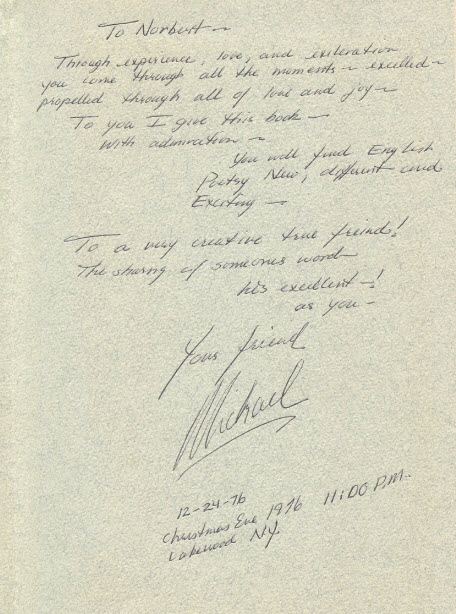
He gave me the book when the author was still alive. We were both boys only, just out of high school. That day, when he gave me that book, was likely the last time I ever saw him.
Yet, the friendships we form at that age last forever, and the books we sign for each other stay with us, until one day when we’re gone, our children pick them off dusty shelves, open the covers and wonder who “Michael” might have been. Then they might open up to page 46 and find:
At Midnight
My hemisphere puts on
Duncely dark again.
And what was it to me
What the world wore
So long as I had a girl
With a bed to her naked back?
So long: not long enough.
For recently myself
Have donned like a dunce hat
Doubt of the monstrous works
Twirling toward day. I,
Who could fall those mortal nights
Ignorantly into sleep,
This mortal night cannot.
Cornell University, Fox News and Occam’s Razor
Bill O’Reilly of Fox News noticed that according to a recent Cornell Sun newspaper report, 96 percent of the more than $600,000 in political donations from Cornell University faculty went to Democratic candidates. Only 15 of 323 donors gave money to “conservative” politicians.
So he sent in Jesse Watters to investigate. They are now insinuating that the “liberal professors” brainwash the students. Of course, that could be a fact.
But according to the principles of Occam’s Razor:
Pluralitas non est ponenda sine necessitate.
Boiled down to what it’s used for today:
When you have two competing theories that make exactly the same predictions, the simpler one is the better.
Might it be that smart people are more likely to vote Democrat? We know that scientists are, and non-religious people, and young people, and well-traveled people.
Now, how do we get them to vote?
Honoring Our Soldiers

We also have a general culture of venerating our soldiers and veterans. We thank them for their service, in public, whenever we can. The video below is an example.
Everyone in the United States, left, right, center, rich, poor, loves their soldiers and honors them. [Except, ironically, the V.A. which for some unexplained reason has waiting lists of years to help wounded veterans with their health problems – but that’s another story.]
I believe we in the United States are unique in the developed world with the way we treat our soldiers. We honor them. That is definitely not the case in other countries. I have first-hand experience with Germany. From a distance, and from popular culture, mostly based on the sick memories of World War II and Hitler’s excesses, one might think that Germans also hold their soldiers in high regard. But that is not so.
I should know. I wore the uniform of the German Air Force for four years as a young man. A German soldier was then, and I would expect this to be still true now, just another “worker.” Being in the military is a job, and often one that is associated with lack of education, lack of ambition and drive, even sometimes laziness. “Oh, you’re in the service?” The implication is that you don’t know what else to do, or don’t have any skills for a “real job.” Nobody would give up an airline seat for a soldier. Nobody would ever walk up to a soldier and thank him for his service. Nobody would applaud a traveling soldier.
Part of that may have to do with the fact that since 1945, German soldiers, with very, very few exceptions, haven’t seen battle. Germans don’t send their young people overseas to fight the fights of other countries. They don’t play world policeman. Being a grunt in the German military means you have a tedious and boring job of going through the motions, and counting the days left in your service. There is no danger of being sent to Iraq or any other place where bullets might fly and you might be killed or maimed in the service of your nation.
I have had casual contact with soldiers of France, the Netherlands, and Belgium, and have observed similar attitudes.
Being a soldier in the United States is associated with honor, courage, service, and duty – and rightly so. I can’t think of any other country that is willing to commit its youth just like we do, for other people’s causes.
Our soldiers deserve and have earned the veneration. I am not sure, however, if our politicians are making the right decisions and choices on their backs.
The American and the Mexican
An American investment banker was at the pier of a small coastal Mexican village when a small boat with just one fisherman docked. Inside the small boat were several large yellowfin tuna. The American complimented the Mexican on the quality of his fish and asked how long it took to catch them.
The Mexican replied, “only a little while. The American then asked why didn’t he stay out longer and catch more fish? The Mexican said he had enough to support his family’s immediate needs. The American then asked, “but what do you do with the rest of your time?”
The Mexican fisherman said, “I sleep late, fish a little, play with my children, take siestas with my wife, Maria, stroll into the village each evening where I sip wine, and play guitar with my amigos. I have a full and busy life.”
The American scoffed, “I am a Harvard MBA and could help you. You should spend more time fishing and with the proceeds, buy a bigger boat. With the proceeds from the bigger boat, you could buy several boats, eventually you would have a fleet of fishing boats. Instead of selling your catch to a middleman you would sell directly to the processor, eventually opening your own cannery. You would control the product, processing, and distribution. You would need to leave this small coastal fishing village and move to Mexico City, then LA and eventually New York City, where you will run your expanding enterprise.”
The Mexican fisherman asked, “But, how long will this all take?”
To which the American replied, “15 – 20 years.”
“But what then?” Asked the Mexican.
The American laughed and said, “That’s the best part. When the time is right you would announce an IPO and sell your company stock to the public and become very rich, you would make millions!”
“Millions – then what?”
The American said, “Then you would retire. Move to a small coastal fishing village where you would sleep late, fish a little, play with your kids, take siestas with your wife, stroll to the village in the evenings where you could sip wine and play your guitar with your amigos.”
AFS 40th Reunion in New York City
AFS is one of the world’s oldest and largest foreign exchange student organizations. The mission of AFS is to bring peace to the world, one person at a time. How can you be at war with Iran, if you have friends in Iran (I do). How can bigotry develop about Muslims if you have friendships with Muslims? How can you be against Hispanics when some of the greatest people you know are South Americans?
For the school year of 1974/75, I was one of over 2,000 students selected all over the world to spend a year in a U.S. high school. In those days, only about one out of 30 or more applicants were selected to participate in what turned out to be a life-changing experience for most of us.
We all arrived in August in New York at C.W. Post College (now Long Island University) for the initial orientation, and then we were bused all over the U.S. to spend our year in high school, before we departed on July 10, 1975, from C.W. Post again.
Recently a few dedicated people started organizing a Facebook group for our year. The group now has over 600 members (not bad for 2,000 participants). After organizing and planning for a year, 30 to 40 of us met last weekend in New York City for a four-day reunion. We chartered a bus to C.W. Post to see the hallowed grounds again that first received us over 40 years ago.
Here is Paulo, kissing the ground in front of Queens Hall, one of the dorms where we first stayed a life-time ago:

We did lots of sightseeing, picnicked in Central Park, went on a boat tour around Manhattan, and ate at many good restaurants. We visited the offices of AFS International and AFS USA, both in New York City, and the presidents of both organizations addressed our group and shared in discussions about the future of the program.
Most of us had never met before. But that didn’t stop us from connecting on a deep level immediately. We all knew that we had been at the same place at C.W. Post that day when we were teenagers, we all shared the same experiences and all our lives had been massively affected by AFS. Brand-new AFS experiences and friendships are developing.
Plans for the next reunion in Turkey in 2016 are already underway.
This video sums it up very well:
Indefinite Pessimism
August is coming up, and yes, Europeans go on vacation for a long time. Peter Thiel calls it “Europe’s famous vacation mania” in his book Zero to One, in the excerpt below:
Indefinite Pessimism
Every culture has a myth of decline from some golden age, and almost all peoples throughout history have been pessimists. Even today pessimism still dominates huge parts of the world. An indefinite pessimist looks out onto a bleak future, but he has no idea what to do about it. This describes Europe since the early 1970s, when the continent succumbed to undirected bureaucratic drift. Today the whole Eurozone is in slow-motion crisis, and nobody is in charge. The European Central Bank doesn’t stand for anything but improvisation: the U.S. Treasury prints “In God We Trust” on the dollar; the ECB might as well print “Kick the Can Down the Road” on the euro. Europeans just react to events as they happen and hope things don’t get worse. The indefinite pessimist can’t know whether the inevitable decline will be fast or slow, catastrophic or gradual. All he can do is wait for it to happen, so he might as well eat, drink, and be merry in the meantime: hence Europe’s famous vacation mania.
— Thiel, Peter; Masters, Blake (2014-09-16). Zero to One: Notes on Startups, or How to Build the Future (p. 63). The Crown Publishing Group. Kindle Edition.
I agree with him. I have sat in many a café in Germany and chatted with intellectuals, and the feeling of powerlessness when facing world affairs is overwhelming. Here is a nation that not so long ago wanted to rule the world and turned out to be one of the most aggressive of all, yet now it seems almost paralyzed.
But they all get many weeks of guaranteed paid vacation.
Vacation is an entitlement.
And that’s one of the reasons I am not there.