That’s the good thing about science: It’s true whether or not you believe in it.
— Astrophysicist Neal deGrasse-Tyson
Category: Science
Rumination about Planet Kepler 452b

The headline in USA Today was startling. A ‘Goldilocks’ planet was found, one that could harbor life as we know it, based on the fact that there could be liquid water on its surface. It’s a bit lager than Earth, approximately 12,700 miles in diameter, compared to Earth’s 7,926.
What the article didn’t say, however, is what it would be like to stand on that planet, earthlike or not. With a diameter this large, the volume of the planet would be about 4.3 times that of earth, so its mass would also be that much bigger.
Gravity is proportional to mass. This means that if you weigh 150 lbs on Earth, you’d weigh more than 4 times as much, over 600 lbs on 452b.
We couldn’t land there and be comfortable. Any beings used to that, probably squat end Jubba-like, would feel like bouncing balls on Earth.
The planet is 1,400 lightyears away. If beings on that planet sent us a message in the year 600, the message would arrive just about now.
To put the time into perspective: In the year 600, Pope Gregory the Great decreed “God Bless You” as the religiously correct response to a sneeze. In the year 600, quill pens, made from the outer feathers of crows and other large birds, became popular. Mohammed, the founder of Islam, was alive during that time.
Suppose we received a message from any 452b beings. If we responded now, our answer would reach them around the year 3,400.
If we could build a ship that could travel at a tenth the speed of light (which is way beyond our current capabilities), it would take the ship 14,000 years to get there.
I am ready to go. Where do I sign up?
Aiming for Pluto and Hitting It – the Incredible Size of Space

If you ever want to visualize the incredible size of just our solar system, and how it is almost completely empty, go to this website by Josh Worth.
On that site you can scroll from the sun to the various planets, and as you scroll, you “feel” how small the planets are and how far they are away. If the moon were the size of a pixel, as seen in the picture above, Earth would a tiny dot of a few pixels and about 35 millimeters away from the moon.
Pluto is smaller than the moon. The moon has a diameter of 3,474 km, and Pluto only 2,368 km. It’s only 18% the moon’s mass. So it would be smaller than a pixel, and could not even be seen on this scale.
However, on this scale, it would still be about 685 meters away from this point. That’s about a third of a mile or the length of about seven football fields.
So, if the Earth were the size of this dot on this picture, then Pluto would be a speck of dust a third of a mile away.
The New Horizons spacecraft left Earth in January 2006 and has traveled more than eight years. It’s the fastest human-made object ever, traveling about 100 times faster than a modern jetliner. And it has been on the way for eight years leaving that blue speck on the screen aiming for that speck of dust 685 meters away.
And it’s going to hit it three days from now.
Convergent Evolution and Humanoid Aliens
Stop picturing little green men in your mind whenever you talk about aliens because, according to Simon Conway Morris, a leading evolutionary biologist from the University of Cambridge, if aliens exist or we ever encountered them, they would look a lot like humans.
— Sparkonit (from the book The Runes of Evolution)
It has always bothered me that aliens in popular culture media more often than not are humanoid. This never made sense to me. Simon Conway Morris argues that similar conditions would result in a similar fauna on an alien planet, so the alpha predator that would eventually emerge and become sentient would be humanoid.
65 million years ago the Chicxulub asteroid effectively wiped out a majority of the fauna on earth. In particular, the entire dinosaur population did not survive. Scientists speculate that at that time dinosaurs like velociraptors may have been hunting in packs and coordinating their actions. Let’s assume for a minute that the asteroid didn’t hit the earth that day and missed it, and another one didn’t come in the next 65 million years, a quite possible scenario.
Velociraptors would have had millions of years to further hone their hunting skills. Perhaps they might have learned to use tools, first sticks of wood, sharpened at the end, as primitive daggers and later spears. It’s easy to imagine that they would have developed sufficient intelligence to make tools. After all, they had claws with opposable thumbs.
Mammals would never have dominated the earth, and primates may never have evolved superior intelligence. In that world, there would now be the descendants of those tool-making velociraptors as the alpha predators. Sorry, they would look lizard-like, not humanoid.
So, changing one minor detail about our planet’s history by diverting a chance asteroid encounter, a pivotal series of events would not have happened, and the likelihood of humanoid aliens would be minimized.
Introducing Wild Mustard – the Super Weed
I was at the market shopping for a steamed vegetable meal. I bought potatoes, carrots, broccoli, cauliflower, Brussels sprouts, zucchini, yellow squash, a couple of red onions and some red cabbage. Boring. The same old fare. I wished we could invent another vegetable, something exotic and new. Then I brushed away the thought. Nature only gave us these. It does not make any more.
When I got home, I researched vegetables, and there was a massive surprise in store for me.
In Southern California, wild mustard (Brassica) is a highly successful weed. It grows in all types of soils in the spring, it does not need much water. The leaves on the bottom are meaty and dark green, a little hard. The stems get very tall, chest-high in some cases, and are sprinkled with yellow flowers.
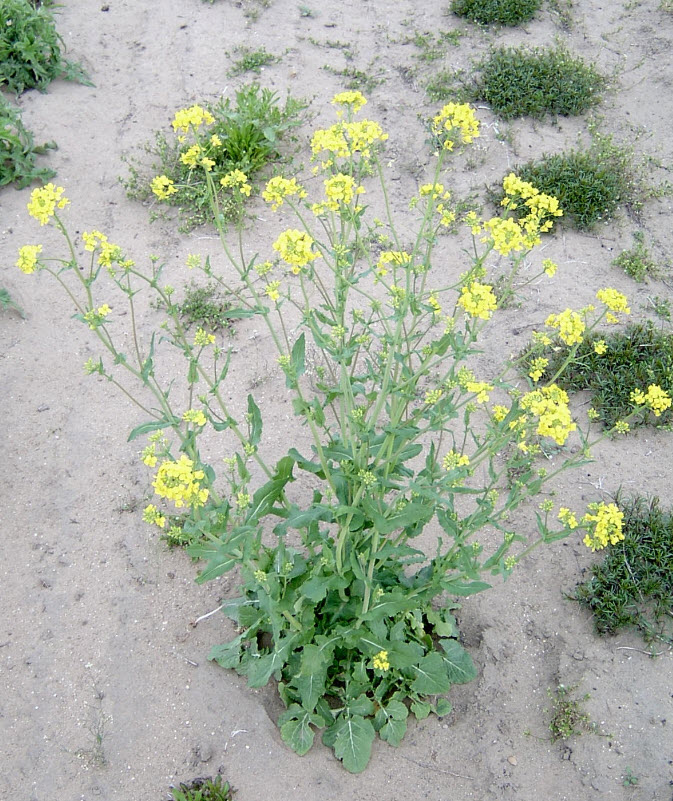
The mustard plant was well-established during Roman and Hellenistic times and it was cultivated in Europe and Asia, particularly on the slopes of the Himalayas. Lore has it that it was introduced to the Americas by the conquistadors and missionaries. Supposedly they planted the fast sprouting seeds to mark their trails. It created a yellow (brick) road along the routes they traveled. Now, a century or more later, in the spring and early summer, the California hills are covered with a yellow sheen of wild mustard. The yellow brick road has become a wall-to-wall carpet.
In America, it is considered an invasive weed in many areas. Each plant can produce thousands of seeds, so in areas where it encroaches on agricultural crops, it is considered a pest. It sure was when I had a large yard. There were mountains of the weed when I was done pulling them.
To my utter surprise, I just found out that wild mustard is the base plant from which many of our vegetables are derived by artificial selective breeding.

Many of the vegetables I bought at the market come from wild mustard, including cabbage, Brussels sprouts, broccoli, cauliflower. Others derived from wild mustard are kohlrabi, turnips and kale. Finally, mustard seed (duh) and rapeseed come from the wild mustard plant.
Let’s develop a new vegetable, shall we? I know what plant to start with.
American Anti-Intellectualism and the Software Industry
41% of Americans believe that definitely or probably humans and dinosaurs coexisted. Source.
A sitting congressman, Paul Broun, a medical doctor no less, told a crowd that evolution and the Big Bang were “lies straight from the pit of hell.” Source.
The chairman of the Senate environmental panel brought a snowball to the floor as evidence that climate change is a hoax. Source.
Congressman Todd Akin said it was his understanding from doctors that it’s rare for someone to become pregnant from rape. He said, “The female body has ways to try and shut that whole thing down.” Source.
By our public promotion of anti-intellectualism, this country is losing out to economic and cultural forces overseas. Our manufacturing jobs are moving overseas.
However, the world’s top brains are still coming to the United States to “make it here.”
Last week I attended an introductory meeting by a company that specializes in being a sales broker for software companies – Corum. In the room were about 40 or so founders or CEOs of local San Diego software companies. In the beginning, each of us stood up to introduce ourselves, our companies and our products in a 30-second elevator speech. I didn’t keep an exact tally, but about 75% of the executives were foreign-born. Of all the people introducing themselves, there were no more than ten who were obviously born and raised in the United States – the rest had some kind of accent – ironically – including myself.
This is admittedly a very small sample, and it’s anecdotal, but it was a striking realization to me: Foreigners come to the United States, start software companies, and then grow them and make them successful.
Where are the American born software business superstars?
They are apparently a minority.
Ted Cruz vs. Charles Bolden
Ted Cruz is trying to stop NASA from researching climate change.
The fact that Ted Cruz is Chair of the Commerce, Science and Transportation subcommittee in Congress is a travesty. He puts up a bogus chart, showing percentage increases or decreases of the budget of NASA with respect to four different parts of the mission of NASA. He disregards completely that percentages are meaningless without actual dollar values associated with them.
If I gave you an allowance of one dollar last year, and I take that dollar away, I cut your budget by 100%. If I gave your brother an allowance of $5 and I gave him the dollar I took away from you, I increased his budget by 20%. Talking only about percentages in this context is deceptive. That’s what Ted Cruz did with this chart.
This is not science, this is not finance, this is trying to dumb down the American public.
I have met Charles Bolden, when he was a mere NASA astronaut and space shuttle commander. Bolden is a remarkable man, and a brilliant technologist. He is the right man for the job of NASA administrator. He belongs in his position.
And Ted Cruz is a doofus.
Insight by David Brin
David Brin provides a rambling (in a good way) journey into all the neat stuff we’re into these days, and how Ted Cruz, who is an outspoken denier of anthropogenic climate change, is the chairman of the Senate’s Space and Science Committee. Enjoy David Brin’s musings at this link.
The Dance of Rhea and Dione

What a time we live in where we can see crystal clear images of moons of Saturn and its rings!
Book Review: Tau Zero – by Poul Anderson
 In the nearer future, about a century from now, humanity builds starships. The Leonora Christine is the seventh ship of its generation, and she getting ready to depart. The world selects 50 people, 25 males and 25 females, to travel to the third planet of Beta Virginis, which has previously been visited by a robotic probe and found highly likely to be habitable. Beta Virginis is about 50 light years away. To get there, at the speed of light, would take 50 years, if anything could travel that fast. To send a message back to Earth once they got there, would take another 50 years. So a hundred years later, the descendants of the star farers would first find out about the fate of the crew.
The Leonora Christine is a starship based on the Bussard ramjet concept. The ship scoops up interstellar molecules in a large magnetic funnel it pushes ahead of itself and converts this matter into energy for its reaction drive. Here is the description of the Leonora Christine in Chapter 2:
Her hull was a conoid, tapering toward the bow. Its burnished smoothness seemed ornamented rather than broken by the exterior fittings. These were locks and hatches; sensors for instruments; housings for the two boats that would make the planet-falls for which she herself was not designed; and the web of the Bussard drive, now folded flat. The base of the conoid was quite broad, since it contained the reaction mass among other things; but the length was too great for this to be particularly noticeable.
At the top of the dagger blade, a structure fanned out which you might have imagined to be the guard of a basket hilt. Its rim supported eight skeletal cylinders pointing aft. These were the thrust tubes, that acclerated the reaction mass backward when the ship moved at merely interplanetary speeds. The ‘basket’ enclosed their controls and power plant.
Beyond this, darker in hue, extended the haft of the dagger, ending finally in an intricate pommel. The latter was the Bussard engine; the rest was shielding against its radiation when it should be activated.
At an acceleration of 1g, the ship can accelerate to relativistic speeds (close to light speed) within about one year. Based on Einsteinean physics, onboard time slows down drastically as an object nears light speed. Decades go by on earth while the people on the ship may experience only a few months, or days, or minutes – depending on how close to light speed the vessel travels.
On the way to their destination the ship encounters an unexpected obstacle in form of a dense cloud of matter. As they hit it, some damage is done to the decelerator. In essence, the ship going effectively at light speed has lost its brakes. It can’t stop once it gets to its destination. They have to come up with an alternative plan.
The result is a cosmic journey where the ship travels through entire galaxies (which would take 100,000 years) while the passengers experience it as a mere turbulence lasting a few seconds, speed bumps in star travel. They end up going to the edge of the universe and time itself.
Tau Zero is a very hard science fiction story. Anderson spends time on his character development, but for the most part they are caricature-like and the human side story, while important, is secondary. The scientific concepts he illustrates blow the mind.
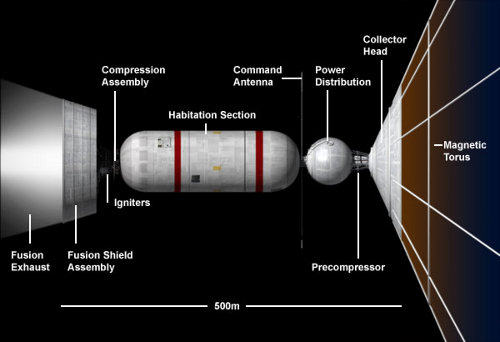
The technical concepts for the ramjet are described at Centauri Dreams for those of you that are interested. The Bussard ramjet is also described in this post Cruising the Infinite, among a number of other star travel technologies.
Conceptually, approaching light speed, the ship gets ever more massive, and time slows ever more down. So the trip between two galaxies that are 50 million light years apart could be perceived as taking a day on the ship – depending on how close to light speed the ship travels. The result, of course, is that from the viewpoint of the rest of the universe, the ship is traveling for 50 million years.
Anderson uses these relativistic concepts throughout Tau Zero. It is intense scientific reading. It needs to be read slowly, except for the human-interaction parts, which seem hokey in comparison. I skimmed over those.
Written in 1970 (45 years go!), Tau Zero is the time dilation book of all time dilation books. I recommend it for hard science fiction aficionados only. Everyone else will be totally lost.
For me, I am in awe.

Paying Homage to the Senator with the Snowball
 Senator Inhofe tried to make the case that global warming is fake because it is currently very cold in the Eastern United States. It is indeed right now unusually cold in the Eastern United States, but the planet on the whole is having an unusually warm year. We here in California have had unseasonably warm weather, but Inhofe probably hasn’t been here in a while. To make his point, he held up a snowball and dropped it on the Senate floor.
How can Senator Inhofe expect us to treat him with any respect?
Throwing that snowball would be like me holding up a Big Mac and claiming that world hunger doesn’t exist.
Senator Whitehouse does a wonderful job setting the Senate straight: You can believe every major American scientific society, or you can believe the senator with the snowball.
The scary thing is, Inhofe chairs the Senate’s Committee on Environment and Public Works. How likely is an Inhofe-chaired committee to pass well-designed environmental legislation?
How likely is the Republican Party to gain the respect of the educated and scientific community in our country with flag bearers – and snowball throwers – like Inhofe in the lead?
Ruminations on Self-Driving Cars
Exciting Times Ahead
I believe that over the next 20 years, self-driving cars are going to revolutionize they way our world works unlike any technology we have seen in a long time, since, maybe, cars themselves a hundred and twenty years ago.
The Challenges
I recently read that Google’s self-driving cars have already logged 700,000 miles on California roads without driver intervention. But there are many challenges ahead for them.
Here is an article about simple things Google’s self-driving cars can’t handle yet, including bad weather, potholes, roads that haven’t been googled yet and handling road construction.
Elsewhere I read that there are three challenges that may seem innocuous at first that really get in the way. First is dealing with an empty parking lot. Picture a shopping mall after hours. There are no reference points, just faded marks in the pavement. The cars supposedly don’t know what to do with that.
Another problem is driving into multi-level parking garages. I am not surprised. I know many humans that hate driving in parking garages. They are often very tight, usually poorly lit, and traffic rules don’t apply. It is never clear which way is up or down, and whether a path is one-way or two-way. How would a self-driving car be able to deal with that?
Finally, handling traffic lights with the rising or setting sun right behind them. I must admit, I also have problems with that. I remember times when only careful management of the visor, quick glances at the lights, and following the lead of other cars around me was able to get me across the intersections and hopefully out of the blast-zone of the setting sun. A camera alone on top of a self-driving car would not have a chance.
All these examples are formidable challenges for self-driving cars. But they all can be overcome, not necessarily by software and algorithms, but by infrastructure.
Infrastructure
When the telephone was first invented, many skeptics predicted that it would never work. After all, you’d have to run a wire to every house you want to call. That’s certainly never going to happen. Well, we all know that it actually did happen. Not only that, we have already leapfrogged that stage, and nowadays you don’t need to run a wire to a house anymore and still get telephone reception. The trick with making the telephone successful was not the technology of the phone itself, but the infrastructure around it: a wire to every house and every office in the country.
Before cars, when our only method of transportation was walking, riding a horse or a horse and buggy, the stage-coach concept revolutionized long-distance travel. The passengers rode in a comparatively comfortable closed cabin on cushioned seats, the cabin on strong springs, while a team of horses pulled the coach. The distance from station to station was just long enough for a team of horses to handle. The passengers reached the station, got refreshments while the horses were changed, and then traveled right on for the next station, and so on. Long distance travel in the horse and buggy age was not possible because of super horses, but because of the infrastructure of the properly spaced stations, and the people who serviced them.
When motor cars came about, critics said they would never work. You’d have to pave roads to everywhere you want to go. Besides, they’d break down in the middle of nowhere leaving you stranded all the time. And you’d have to put gasoline into them. You’d need filling stations all over the place. We all know that faster than anyone would have believed it, we built paved roads, interstate highways, gas stations are everywhere, and cars can go coast to coast without ever breaking down.
As traffic increased, the traffic policeman in the middle of the intersection directing the flow could no longer handle it and we invented traffic lights. Now traffic lights are everywhere, making mass automobile traffic possible.
It’s not the car that made the automobile society, it was the infrastructure built around the car.
What Robots Need
A self-driving car is a robot, before it is a car. Robots don’t need traffic lights. Robots don’t need white lines on the side of the road and double yellow ones in the middle. Robots don’t pass other robots in dangerous areas.
While we are currently in a transition period, and our robots need cameras to look at green and red traffic lights, sometimes outshone by the sun, this will not be the solution for the long-term.
Roads will be outfitted with electronic markers that give direction to cars. The robots will sense the edges of the roads by using such markers they can pick up at high speed, rather than having cameras try to find while lines or other obstacles.
The robots will have inter-robot communication. Cars next to each other will communicate with each other. This means that they will be able to drive 70 miles per hour bumper to bumper without jeopardizing anyone. They won’t need traffic lights in intersections. All the cars approaching from all directions will “negotiate” who goes first. Nobody will need to stop. Cars will simply zoom through in all directions, making sure that there is enough spacing for cross traffic. Stopping at red lights will become obsolete.
Freeways will not have two directions anymore. The cars will figure out how many lanes in each direction they need and just take them. Traffic will self-regulate.
Then, when a car gets to a point where it doesn’t know how to go on, it will simply pull over and issue the “take over, human” command. A joystick will pop out of the dashboard that will allow the human passenger in the car to guide the car up that dirt driveway, around the old oak tree, to grandmother’s house and safely park it in the grass without running over the flower beds.
Valet World
When our cars can handle themselves like this, we really don’t need parking lots anymore at airports, train stations, shopping malls or restaurants downtown. We will simply have our cars drop us off at the front door wherever we are going. Then the car will drive away to a parking garage that’s designed just for cars. The cars will stack themselves up like sardines. No humans will have to enter those garages, the doors of the cars don’t have to swing open, and the cars can simply sit in total darkness and wait until their humans are done with dinner, or shopping, or work, and call them back using their apps on their smart watches – or brain implants.
Cities will be clean again. The only cars on city streets will be those that are on their way to drop off or pick up their passengers. They will park in peripheral facilities away from the human activity.
If cars just come and pick us up and drop us off, why would we even need to own cars anymore? Cars could become just pods that pick us up at our houses or apartments and take us to the nearest mass transit station, or airport. On the other end of the mass-transit, we’d get off and another car would pick us up and take us where we’re going.
If we’re not going anywhere, we don’t need a car. So we won’t own any.
Cars will then likely just be electric. For longer road trips, it will work like the stage coaches. The car will take us as far as its charge allows it to go. It will find the nearest charging station. We’ll transfer to another car and on we’ll go.
Jetsons are Here
Our future with self-driving cars won’t be in Toyota Priuses with fancy software and camera and radar hood on top of the car. Our future won’t be flying cars like we all saw them with the Jetsons. Our future will be a different mass transit system altogether. And it won’t be the self-driving cars that make it all possible. It will be the infrastructure designed specifically for the robots.
Arthur C. Clarke – A True Visionary
See what Clarke predicted in 1976, 39 years ago. Few had that kind of foresight.
Visualizing the Speed of Light
Here is an amazing video that shows what it would be like to be sitting on a beam of light traveling away from the sun, flying by Mercury, Venus, Earth, some asteroids and finally arriving at Jupiter, 45 minutes later. It really gives a sense of the immense size of the solar system, not to mention the universe.
Wormhole to Another Galaxy
I found this post today that talks about a wormhole to another galaxy that might be located in the center of the Milky Way. It’s an interesting article, it makes for fun speculation, but it had a sentence in it that gave me pause:
“But there’s more. We could even travel through this tunnel, since, based on our calculations, it could be navigable. Just like the one we’ve all seen in the recent film Interstellar.”
I reviewed that movie and enjoyed it a lot. In it, astronauts traveled to Saturn to enter a wormhole that connected to another galaxy. You can travel to Saturn in a few years, as they did in Interstellar. However, to get to the wormhole in the center of the Milky Way, we’d have to travel about 26,000 light years first. At the speed of light, we’d get there in 26,000 years. With space travel technologies we have today, we could get there in a few million years at the very best.
So writing the nonchalant sentence “we could even travel through this tunnel” makes it look just a bit too simple for me.
The trip to the other galaxy through the worm hole and back would take longer than it took for our prehistoric ancestors to climb out of the trees, enter the savannahs and eventually become space travelers.