Trump Saluting General of North Korea in June 2018

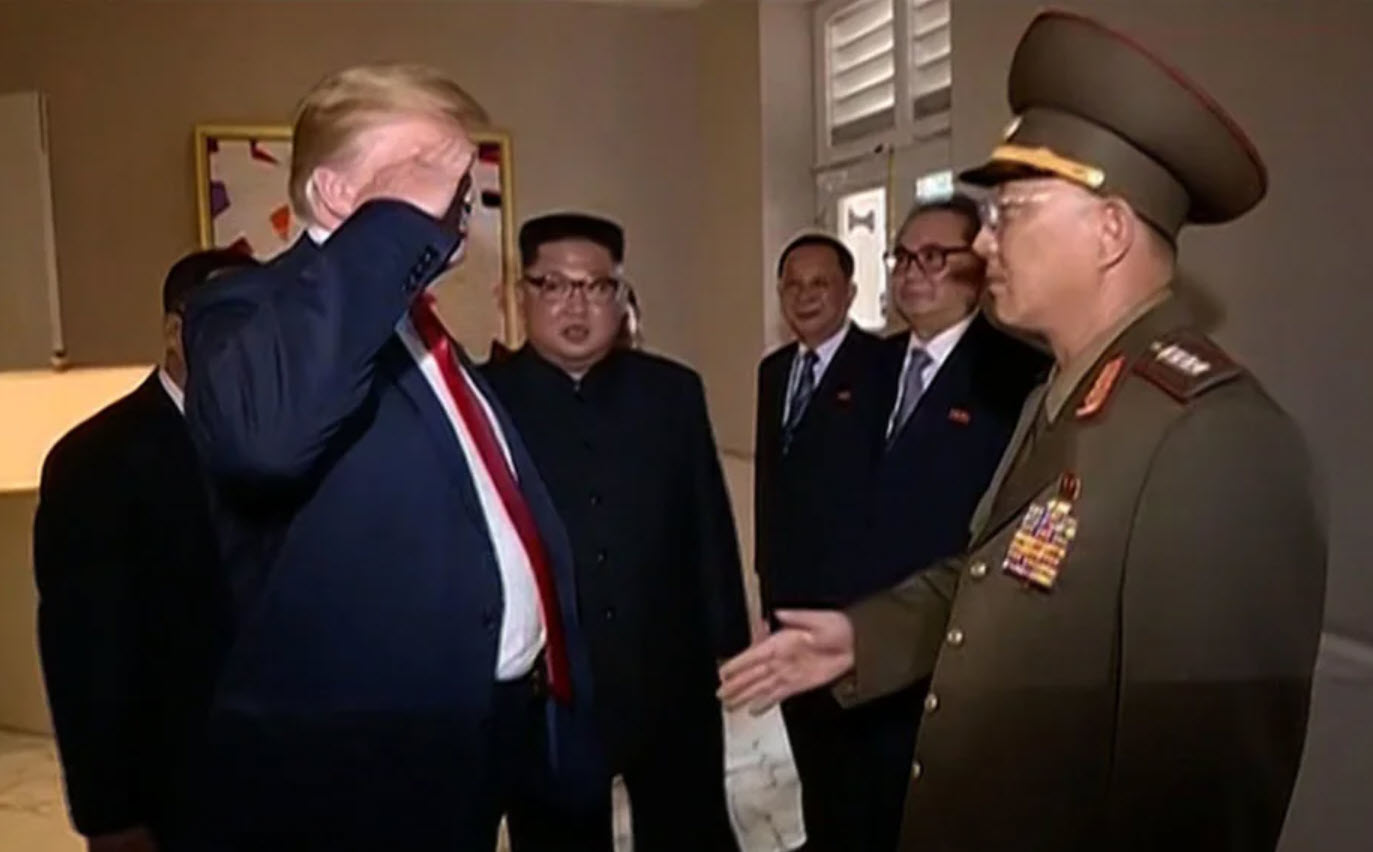
Here is President Trump on June 5, 2018, saluting to North Korean four-star  general No Kwang Chol.

Look at Jim Jong Un in the background. Even he looks like he can’t believe his eyes. This shows you how ignorant Trump is with respect to foreign policy and the role of the United States in the world. Trump should never have gone to North Korea, let alone salute its generals. This was an abomination and an embarrassment to our country.

It also shows where Trump’s respect lies.

In the spirit of fairness: remember when Obama bowed to Japanese emperor Akihito in 2009? The whole country went apeshit. Here is a post I wrote then.

I stand by the comments I made then.

I would so like to be able to vote for a leader in our country that I have some respect for.


When the Tigers Broke Free – My Perspective of Russia

Pink Floyd released the album The Final Cut in 1983, which contained When the Tigers Broke Free. I must have heard that song hundreds of times, and I still today, every time I hear it, my eyes well up with tears. Here it is. I suggest you read along with the lyrics for better understanding.

When the Tigers Broke Free

It was just before dawn
One miserable morning in black ‘forty four
When the forward commander
Was told to sit tight

When he asked that his men be withdrawn
And the Generals gave thanks
As the other ranks held back
The enemy tanks for a while

And the Anzio bridgehead
Was held for the price
Of a few hundred ordinary lives

And kind old King George
Sent mother a note
When he heard that father was gone

It was, I recall
In the form of a scroll
With gold leaf adorned
And I found it one day
In a drawer of old photographs, hidden away

And my eyes still grow damp to remember
His Majesty signed
With his own rubber stamp

It was dark all around
There was frost in the ground
When the tigers broke free
And no one survived
From the Royal Fusiliers Company Z

They were all left behind
Most of them dead
The rest of them dying
And that’s how the High Command
Took my daddy from me

As of now, British estimates put the number of Russians killed or wounded in Ukraine since February 2022 at about 500,000. Today, every day, we estimate that about 1,000 Russian soldiers are injured or killed in Ukraine. Russia is recruiting 25,000 to 30,000 soldiers a month. I am not counting Ukrainian soldiers here who are defending their country. The Russian men and boys are sent into a meatgrinder in a far-away country that has nothing to do with their own lives, security or safety, simply at the will and ego of one man.

Throughout history, rich and powerful men have sent other people’s daddies into the line of fire, into literal meatgrinders.

Napoleon, Hitler, Stalin, Putin!

We don’t learn and we keep doing it.

When the Tigers Broke Free!

The Devolution of Presidential Debates

I received the above text from Trump this morning.

I have watched all presidential debates since the Jimmy Carter years. Last night’s debate was the very worst one I have ever seen.

I am proud of my country, but after last night’s performance I am embarrassed for our country, not because “they don’t have any respect for us” as Trump spouted last night, but because out of 330 million people in the United States, THIS IS THE BEST we can come up with for two people for president? It is an abomination.

Trump was Trump. He does rallies all the time, where he spouts nonsense, gibberish, incoherent word salad, with no real objective other than hear himself talk. Last night’s debate was another Trump rally, this time with a gigantic, world-wide audience. Yes, thanks CNN for giving him this opportunity. Trump didn’t gain any voters last night. He didn’t answer any questions. He lied and misrepresented reality all night long. He insulted large swaths of people, me, an immigrant, included. Biden should have made short work of Trump last night.

Biden wasn’t Biden. This was arguably Biden’s most important 90 minutes of his career. Trump is a conman and an impostor. He has no agenda, other than enrich and glorify himself. That was obvious. Biden’s job was to show that. It should have been easy. But he could not handle it. I was dismayed within the first two minutes. I was afraid he might start to cry. He as a feeble, senile man desperately trying to hold his own. But he was obviously not up to the job. He came apart in front of the nation. Where was the Biden of the last state of the union address?

Out of 330 million people, these are our choices. Biden gets an F- from me for his performance last night. I myself could have done better. I could have walked up on that stage in my Birkenstocks, jeans and T-shirt and took care of Trump. All I needed to do is ten “table-topics.” For those of you who do not know the Toastmasters International program: A “table-topic” is a two-minute speech you give extemporaneously, without any preparation, without notes, and without knowing what the topic is going to be. Last night was basically ten table-topics, and I would have done just fine.

I would have answered every question the moderators asked. Even though I am not a politician, I know enough about the immigration crisis, the border, the pandemic, economics, taxes, and inflation that I could have given coherent answers in full sentences, with an introduction, a body and a conclusion, using up my 120 seconds. In the rebuttals I would have simply pointed out Trump’s hyperbolic distractions or outright lies and corrected the facts. Maybe I would not have scored A+, but I am sure I could have been in the B range. I am sure that there are another 10 million other Americans who could have done just as well as I would have.

President Biden is not up to the job anymore. In the most important 90 minutes of his career he could not perform. I do not trust him to handle Xi or Putin. I do not trust him in another debate with Trump. His senility is obvious. The emperor has no clothes.

Obama would have made mincemeat out of Trump. Pete Buttigieg would have eaten Trump alive. Go and watch some Buttigieg YouTube videos and observe how sharp and quick that man is. Gavin Newsom or Kamala Harris would have been orders of magnitudes more effective than Biden.

Instead, we got to watch in horror how Trump wiped the floor with Joe Biden last night.

What do we do now?

On My Commute Today – the White House

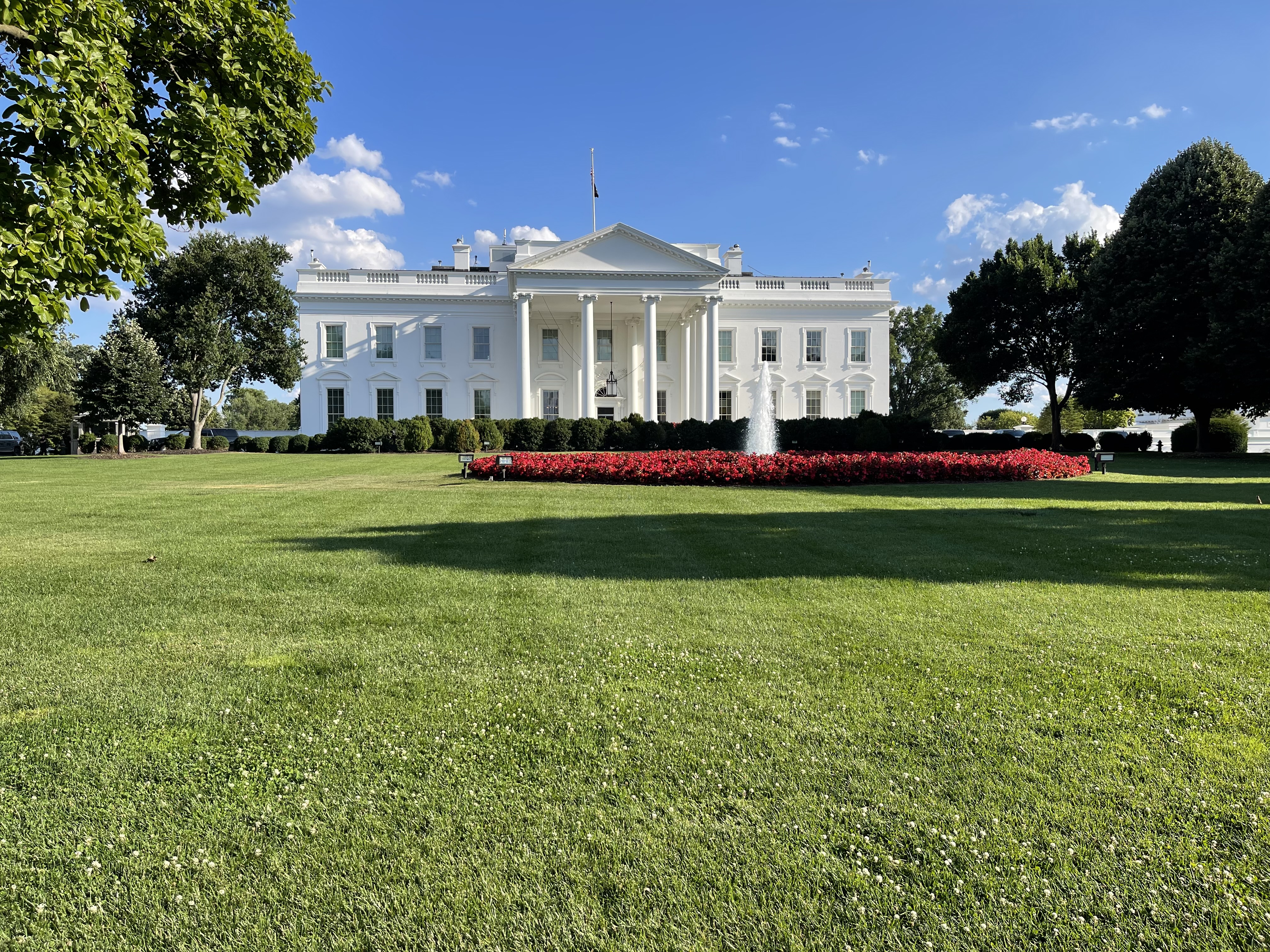
After an all-day summit meeting at the U.S. Chamber of Commerce, I walked across the street and through Lafayette Park on my way to an Uber. This was my view:

Not a bad way to end the work day.

Ten Commandments in Public Schools – Grooming

Here is a post from the ACLU:

These initiatives are about grooming our children, nothing more. It starts with a simple thing like posting the Ten Commandments of the Christian religion. Next they require children to attend bible schools. They are noticing that less and less young Americans are religious, and they think grooming from an early age on will fix that.

Mother Nature at Work

I just watched a safari video on Facebook. A buffalo mom just gave birth to a calf in the grass in the savannah. The slime from the afterbirth was still hanging from her rear. The calf was in the grass, trying to get up. A pack of lions attacked her from all sides. They were trying to carry away the calf but the mother fiercely defended it. As she attacked the lions with her horns, she repeatedly tripped over her half, which was struggling to get on its feet while being hit by the mother’s hooves and being bitten by lions, trying to pick it up. After a minute or so of fierce battle, the lions eventually got hold of the calf and started jumping on the back of the mother. Eventually five or six lions brought her down, one latched on to her throat and they all remained still, waiting for her to die. One of the lions dragged away the limp body of the newborn calf. This is when I could not watch anymore and I flipped away from the video.

All this, of course, was being witnessed by safari tourists in Jeeps from various angles.

Mother nature at work.

Some weeks ago I saw a safari photograph of a leopard carrying a dead monkey in its mouth, walking toward the camera. Obviously, it had just killed the monkey and was carrying it away, perhaps to feed its young. The gruesome part was this: On the belly of the dead mother monkey hung a baby monkey, very much alive, terror on its face, but hanging on.

Mother nature at work.

Sometimes when I am alone for lunch I will choose to just pick up a  simple meal from KFC – fried  chicken. As I eat the “breast and wing” I realize that someone or something had to die, just so I could have lunch. One life, one lunch.

Mother nature at work.

Then I came to thinking: Christians believe that God made the world. They call it intelligent design. If I were to design a world, and I had all the tools of the universe at my disposal, I think I’d design a world where something didn’t have to die for something else to eat. We call it the food chain. Many animals are designed to eat other animals. In the ocean, in the skies, on the savannahs, even outside my own driveway, when the coyotes catch a rabbit or when the owl nabs a gopher.

I think I’d come up with a better plan, where the beasts of the world would not have to eat each other. I’d design food that does not experience terror and does not have to run to survive. I’d design animals. And I’d design food. What we have in our world is not very intelligent design, and it’s definitely not compassionate design.

Rather, it’s mother nature at work.

Book Review: The Man Who Folded Himself – by David Gerrold

David Gerrold wrote The Man Who Folded Himself first in 1973. There are additional revisions in 2003, that mention the American Airlines flight 191 crash of May 1979 and of course, 9/11 in 2001, both events that hadn’t happened yet in 1973.

In the foreword, Robert J. Sawyer, a science fiction writer himself, praises the novel and cites it as the book that got him started as a science fiction writer. Reviewers call it the best time travel story of all time. It was definitely the first truly unique one since H.G. Wells’ novel in 1895.

Dan Eakins inherits a time machine from his uncle, who served as his guardian. It comes with instructions, and it’s truly powerful without limits. He can basically transport himself back and forth to any point in time.  This means he can change history, if that’s what he wants to do. He can get rich by betting on the horse he knows will win the race from reading tomorrow’s paper. And, most central to the plot, he can run into himself by visiting his own apartment tomorrow, where the tomorrow version of himself is living.

This creates a truly complex plot and a story line that is very difficult to follow.

In the end, there isn’t much going on, and all the alternative selves he meets are not just confusing us, the reader, but himself.

If you are into time travel stories, I say this is a must-read, not because it’s a good story or particularly well-written, but because it pioneers the genre and sets the stage for many future time travel novels that make more sense, are more entertaining and realistic, and where more is actually going on.

The book is only 130 pages long, and I read it on a single flight from Hawai’i to California.


Book Review: The Other Einstein – by Marie Benedict

The Other Einstein reads like an autobiographical journal, but it’s actually a fictionalized dramatization of the life of Mileva Maric, Albert Einstein’s first wife.

Milewa was a brilliant young Serbian woman who was admitted to study at the Swiss Federal Polytechnic, one of the world’s most prestigious scientific universities in Zürich in 1896. It was almost unheard of for women to study at universities in those days, and women scientists were even rarer. Her chosen field was Physics, and her special strength was mathematics. One of her classmates was a young physics student named Albert Einstein. Most of her peers kept their distance, but Albert seemed to like her.  She could hold her own in any scientific conversation, and she could outperform all of her classmates in math. Soon she earned the respect of her fellow students and her professors.

Albert courted Milewa, even though romance was last on her priorities. Soon his charm succeeded and they started dating, at least in secret. Eventually, though, she got pregnant out of wedlock, which at that time ruined a woman’s reputation and even caused shame for her whole family. She gave birth to her illegitimate daughter Lieserl at her parents’ house in secret. Albert never met Lieserl and he never acknowledged her existence. Lieserl died, presumably from Scarlet fever, before she was two years old.

They got married and had two more children. They collaborated on important scientific papers, including the Theory of Relativity that made Einstein famous and arguably the most recognized scientist and genius of all time.

The Other Einstein explores whether Milewa was just a sounding board for Albert, or if she did his math for him, or if she was an active participant and contributor to the famous work of Einstein without ever getting any credit.

She got lost in the enormous shadow of the famous and narcissistic Einstein, who, according to this story, cheated on her and seriously emotionally abused her. Over the years their marriage devolved and she divorced him.

I read Isaacson’s biography of Einstein in 2013. Here is my review. It is not clear whether Einstein was as abusive and self-absorbed as this novel depicts him. It certainly raises doubts about him. After reading The Other Einstein, I feel like I want to read the biography once again.


Hiking Hoapili Trail on Maui

Driving south from Kihei or Wailea, the scenery changes quickly from the island’s most exclusive resorts, like the Grand Wailea, to ever more rustic scenes, including the Makena beaches, and on to the Ahihi bay with its world-famous snorkeling spots. The road gets sketchier with every mile, crosses over long stretches of lava fields and eventually it becomes rough dirt. And then it finally ends. You can’t drive any further. There is a small rocky parking area at Hoapili trailhead.

The Hoapili Trail is an easy hike at the southern coast of Maui.

We got there early, around 8:00 am, and there were plenty of parking spots. It fills up quickly later in the day. On the hike out, we encountered no other hikers, except one other couple at the end of the trail. There were a few groups we met on the hike back.

The whole 3.3 mile round-trip hike took about 2.5 hours, which included breaks for snacks.

You do not want to do this hike without proper shoes. We both had our hiking boots. It would be outright dangerous with sandals. Don’t even think about it. You need at least a quart of water per person, and you need sunscreen or protective clothing.

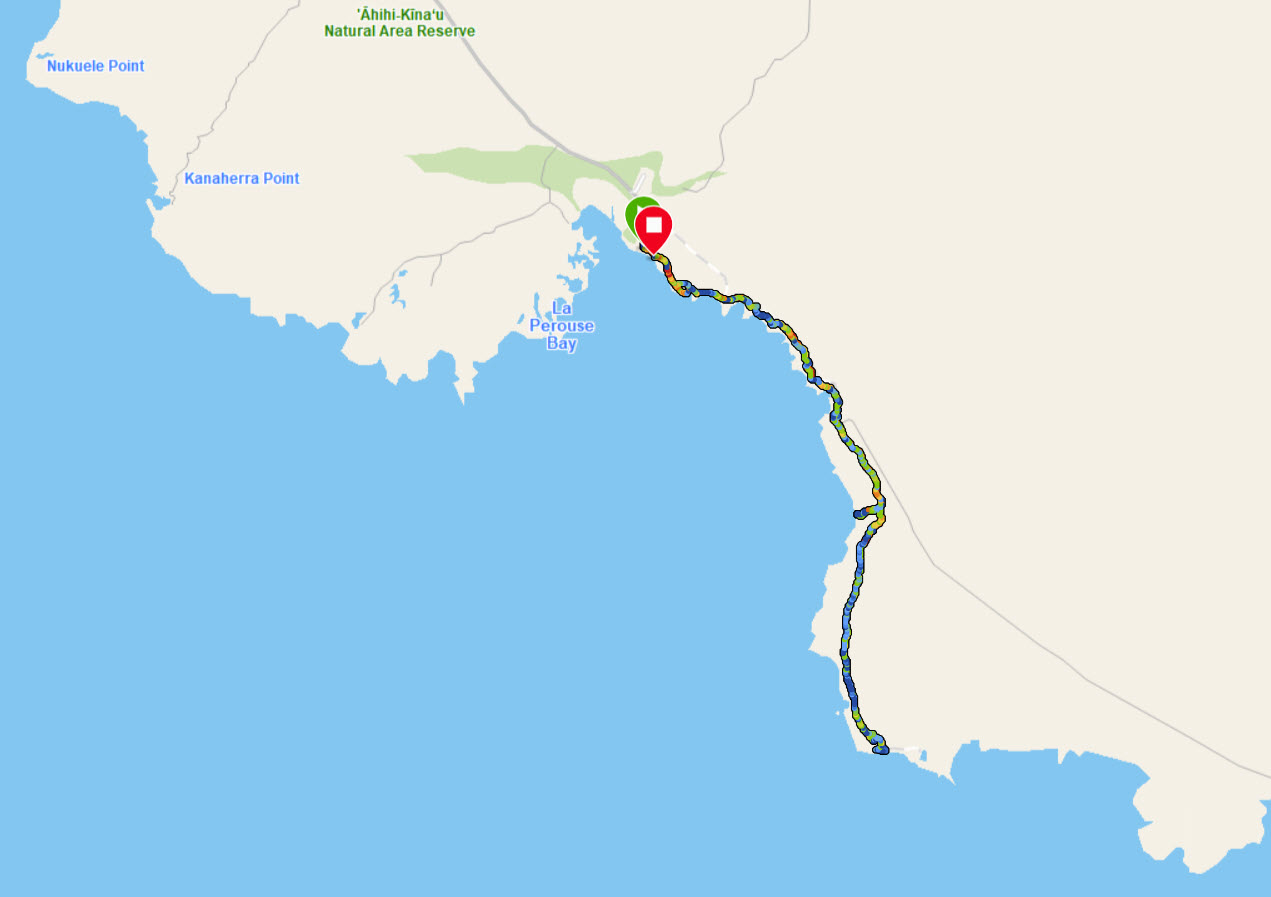
As the map shows, you go out and back on the same trail.  There are a few side loops, but we didn’t take any of those.

Here I am at the beginning section, before the trail reaches the lava fields.

And here is Trisha, coming up behind me.

There are dense and gnarly trees all around. The trail is pretty sketchy and sometimes tricky to find.

All along there are scenic views of great beaches, but really no good access to the water. The rocks are very sharp, the surf is rough, there really isn’t any convenient or safe access.

Right next to the beaches there are jungles everywhere. I am just glad there are no snakes in Hawai’i.

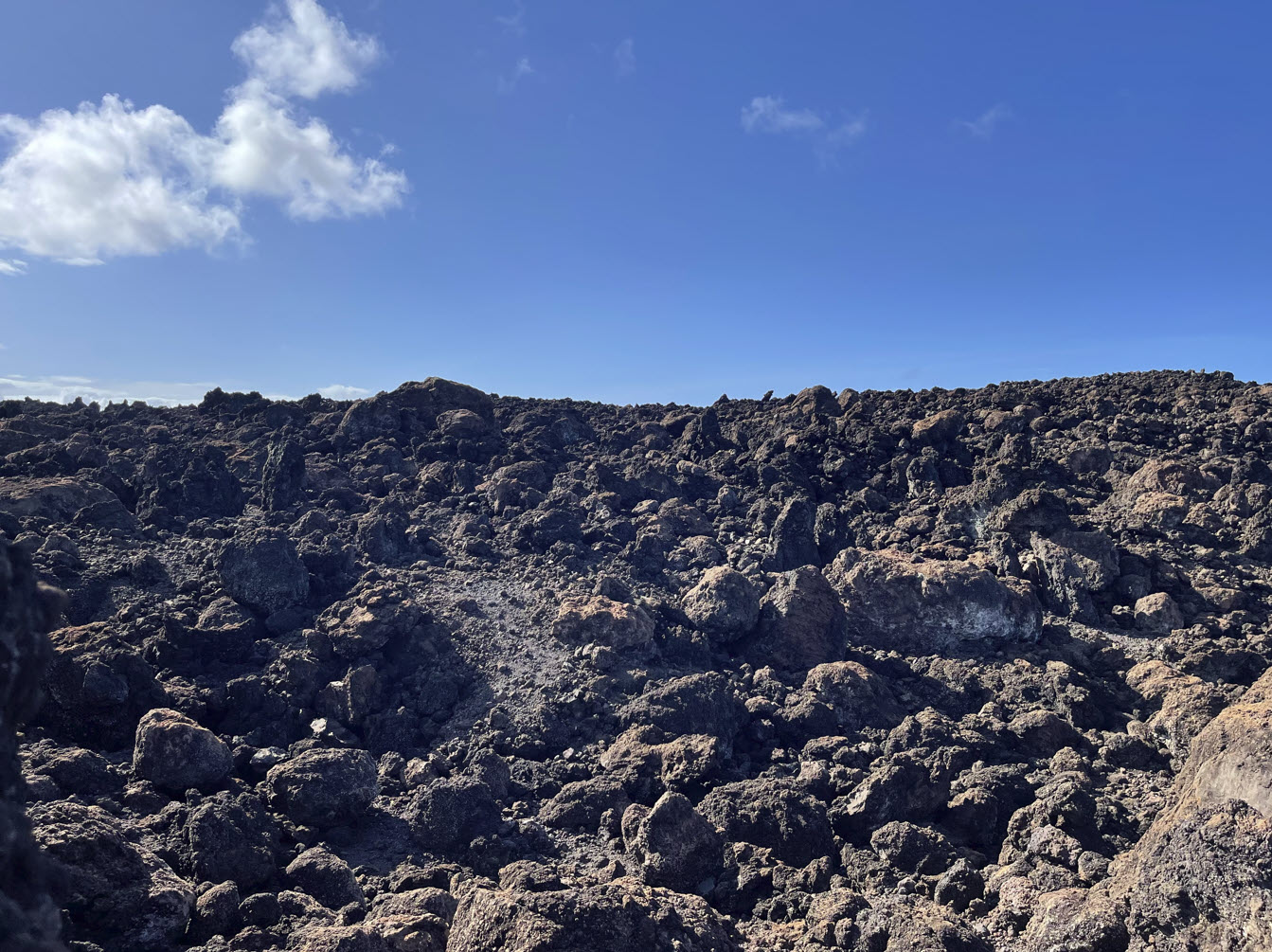
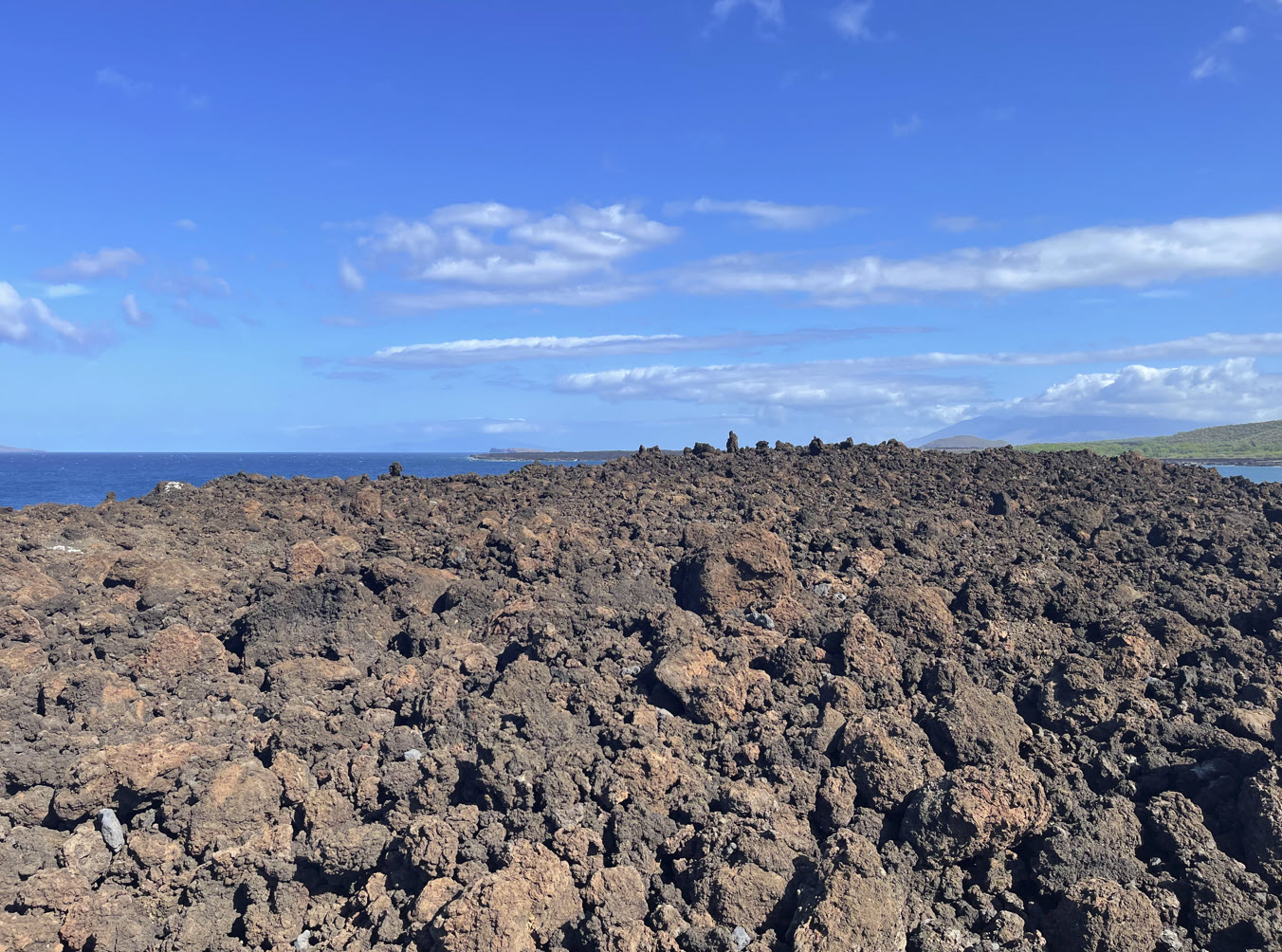
The trail traverses large lava fields. The rocks are sharp as knives and it’s best to stay on the trail.

Here is a look back on the trail across the lava flow, with Trisha for scale.

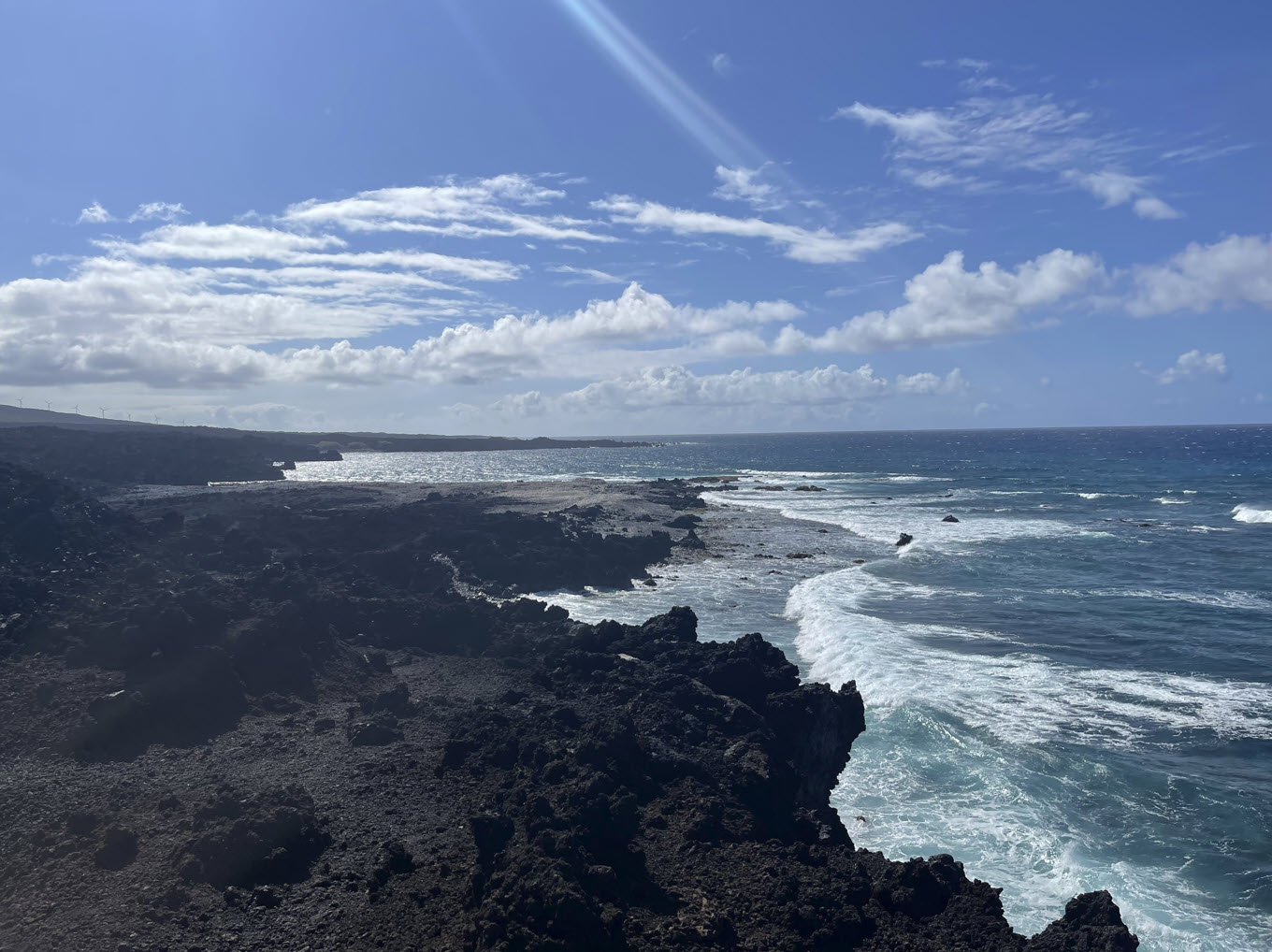
Looking west is the ocean.

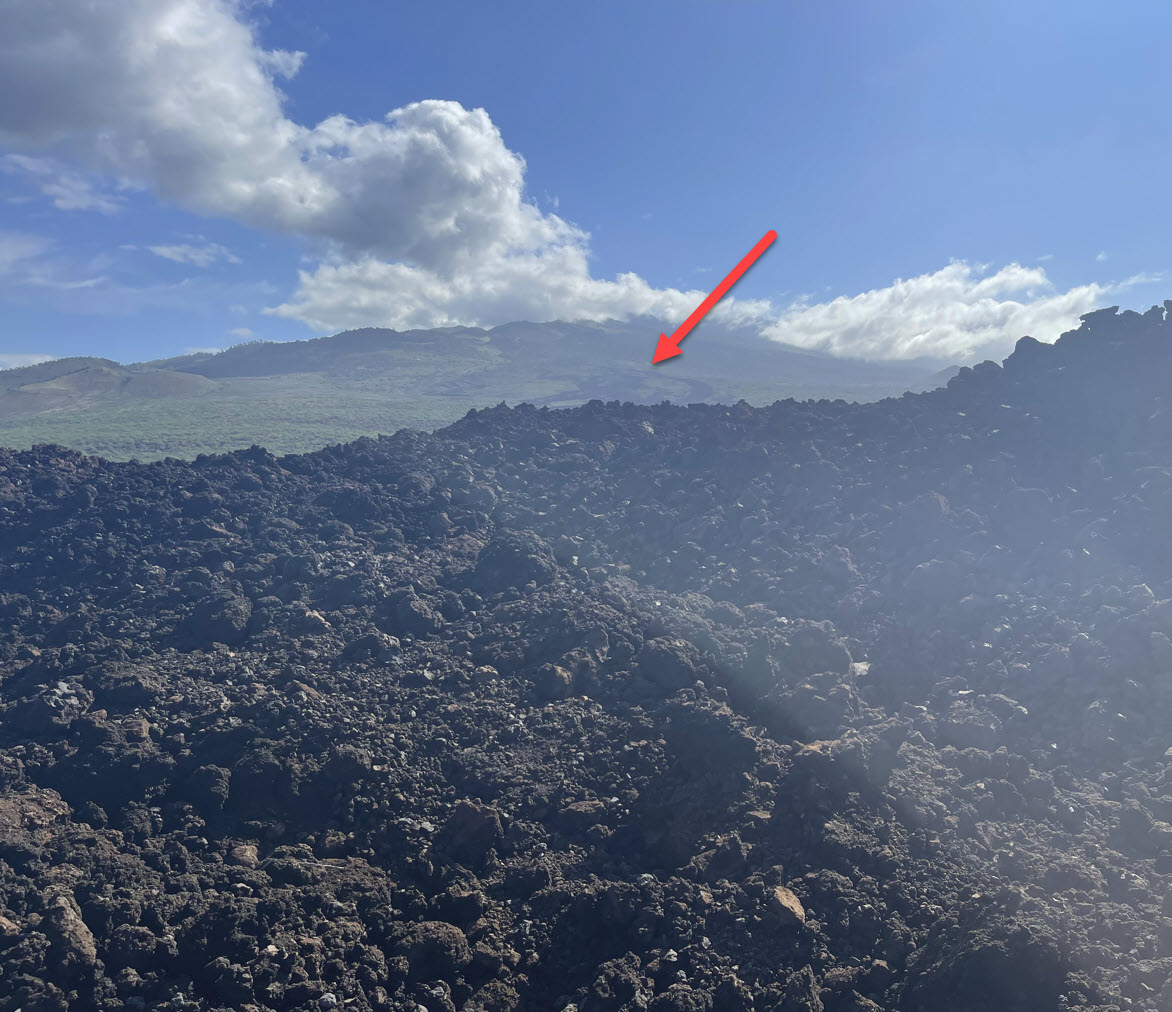
And looking east we can see the massive slopes of Haleakala, with the peak shrouded in clouds, as usual. When you look at the arrow you can see black streaks, which is part of the lava flow we’re standing on here, just way up on the mountain from where it originally came.

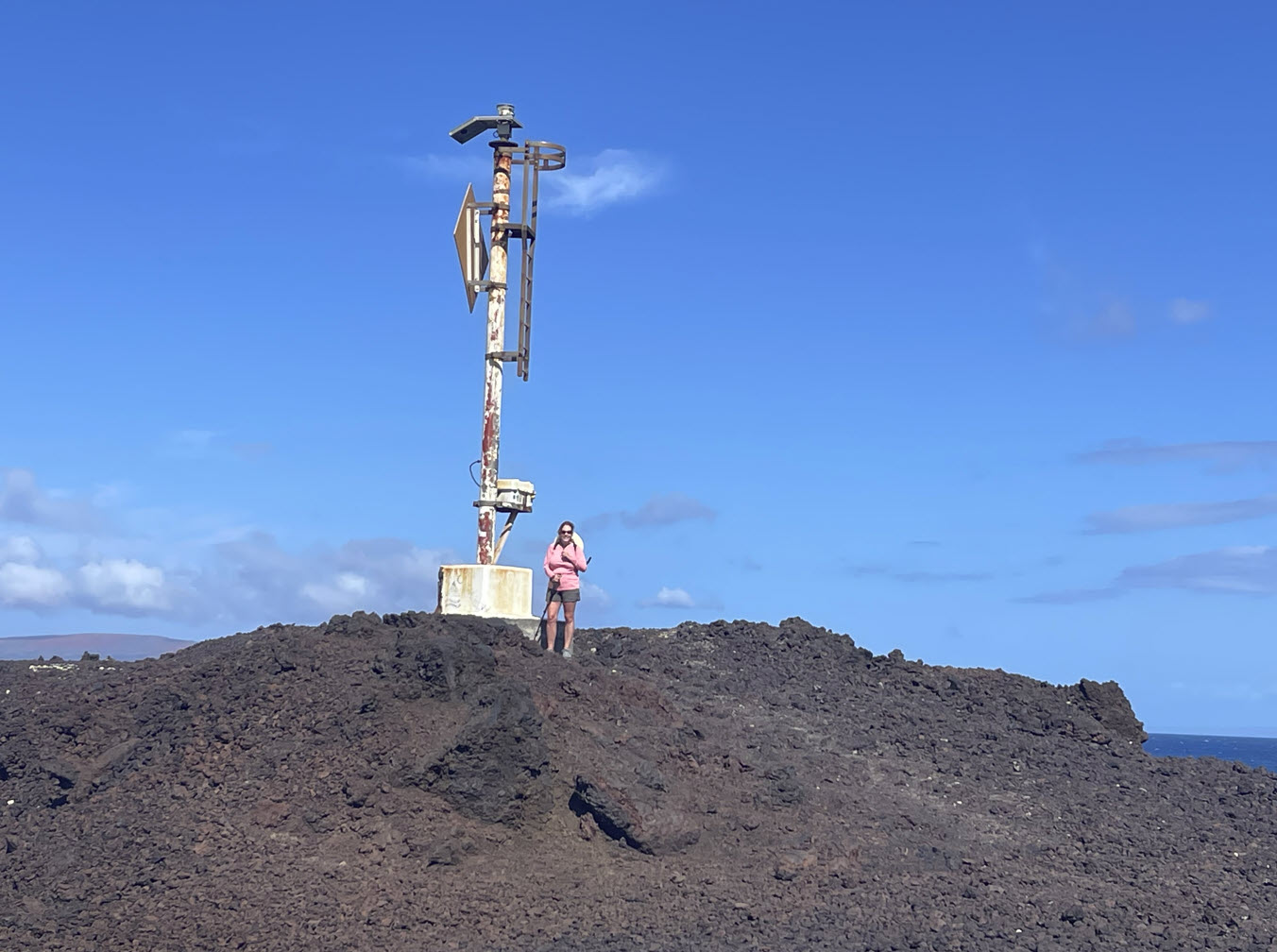
Finally, we arrive at the end of the trail. This is Hanamanioa Point.

The guide book says there is a lighthouse. It’s really a pole with a light on it.

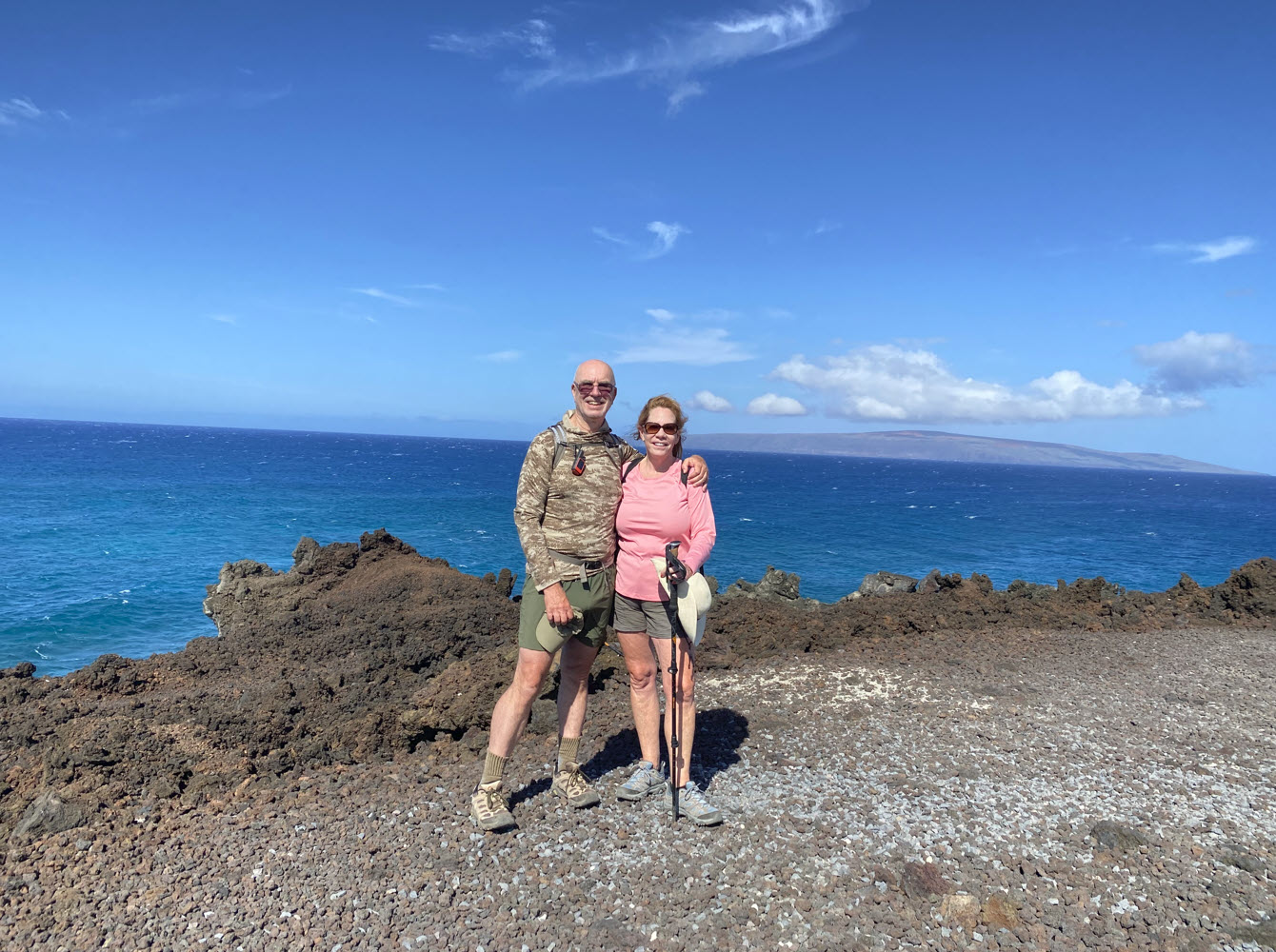
Here we are, the happy hikers. The only other person on the tail was resting there and took our picture. In the background you can see the island of Kaho’olawe. It is still uninhabited and off-limits after being used by the U.S. Navy during World War II for bombing practice.

On the hike back we were careful not to twist any ankles or fall on sharp rocks.

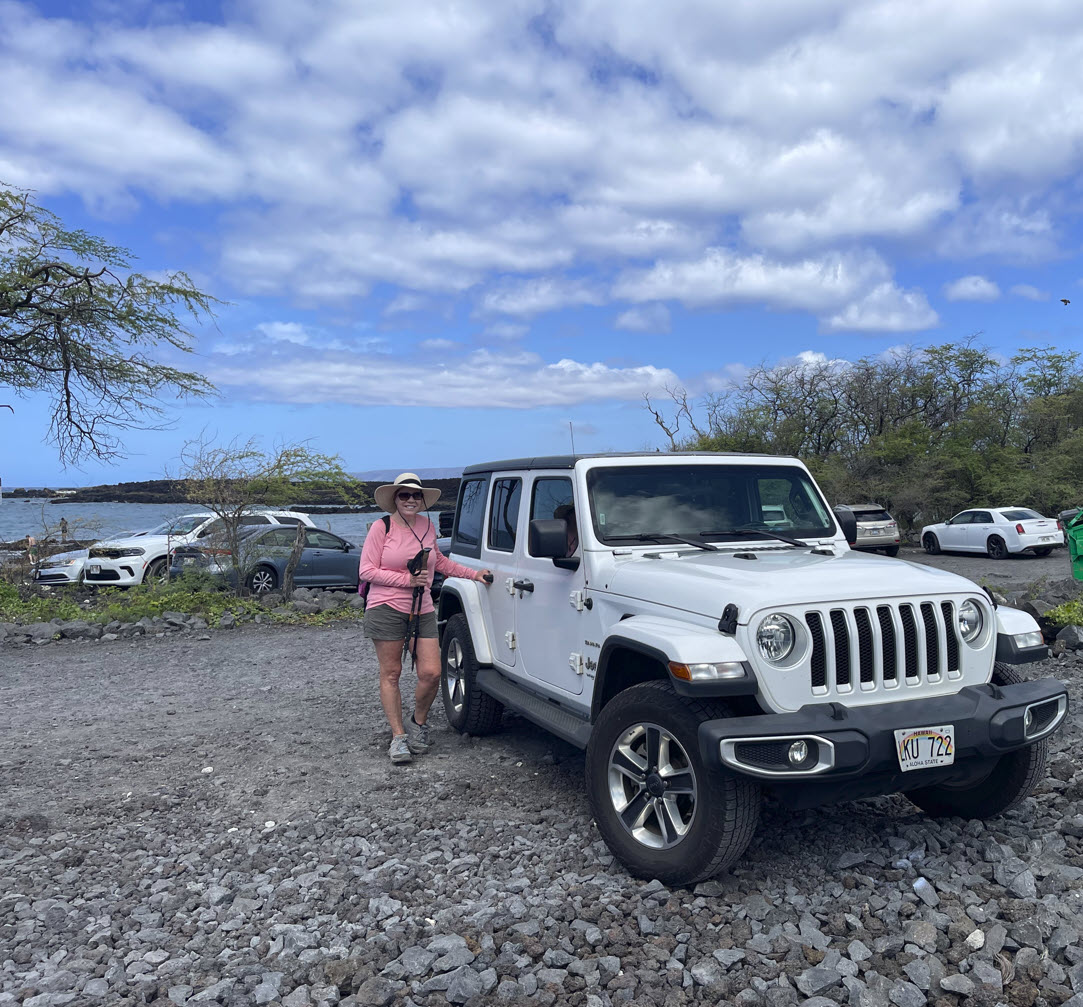
Here we are, back at the car, by around 10:30 am. The day was still young.


Hiking Across Haleakala Crater

After hiking the Halemau’u trail last June, I decided I wanted to hike through the whole crater from the peak and come back up on Halemau’u.

Last Sunday was the day. Trisha dropped me off at the peak of Haleakalā and I went on the approximately 12 mile hike, first descending from 10,000 feet down into the crater floor which is in the 6,500 to 7,500 foot range. At the end, of course, I would need to climb back out the 1,300 elevation change of the Halemau’u trail, ending back up at the trailhead at around 8,000 feet.

Here is the map of my hike. the green bubble is the starting point at the peak. The red bubble shows the Halemau’u trailhead.
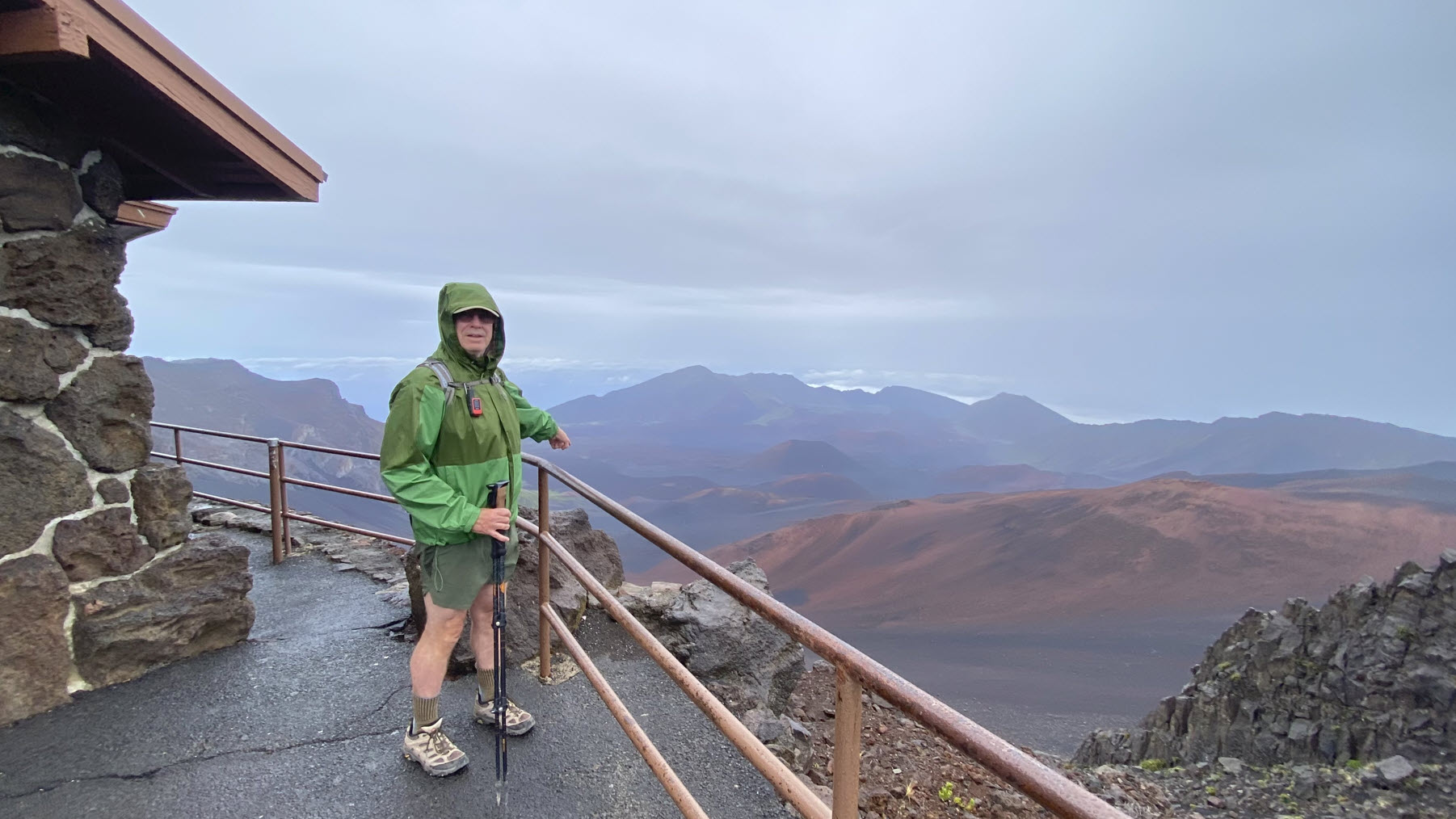
Here I am at 9:00 am. It was cold (in the 50ies) and raining when I left. I am just outside the ranger station at the top, pointing down into the crater. I am ready to go.

Here is a view of the crater wall looking south. I’ll be going down the red slope in the background.
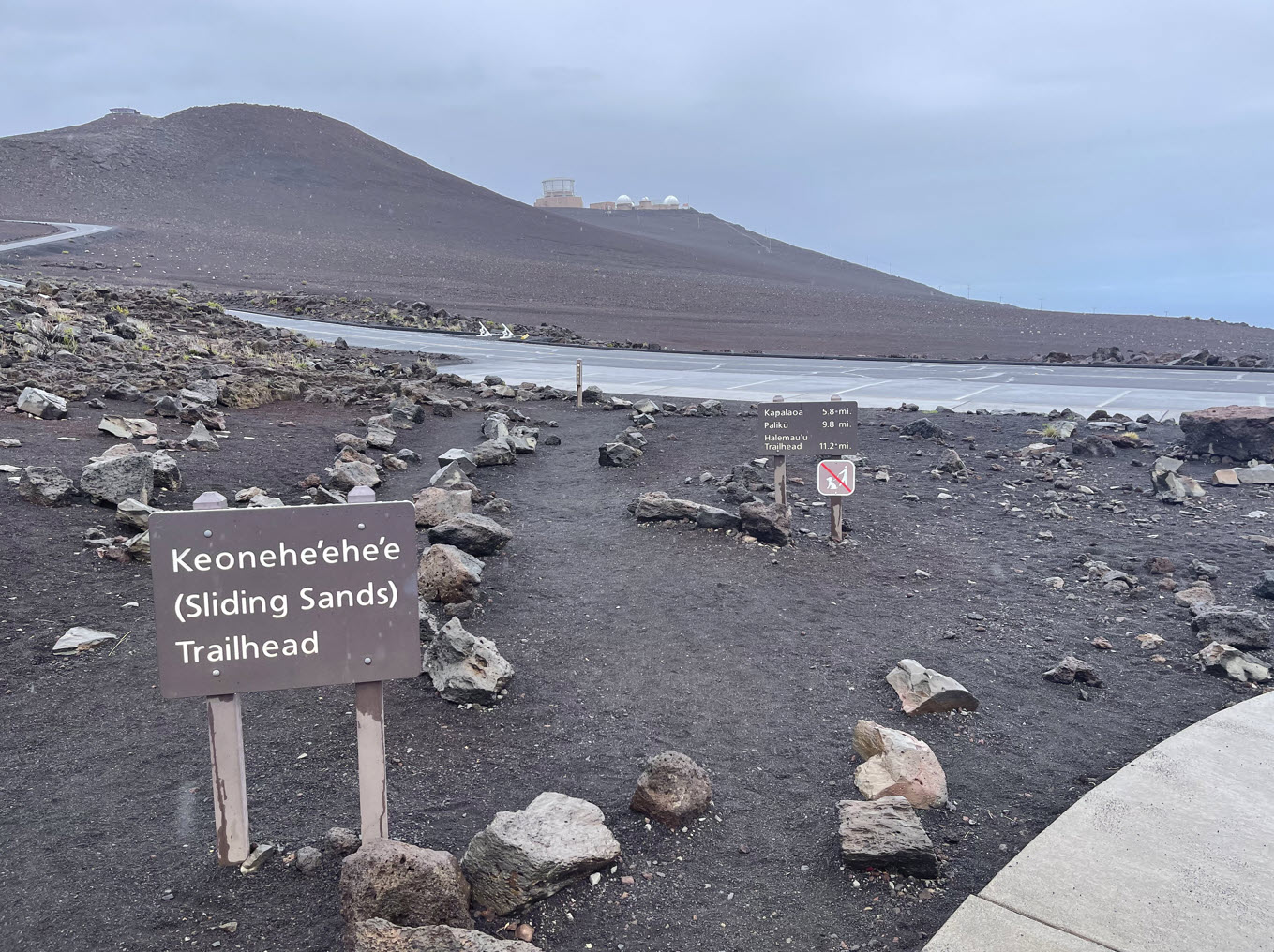
Right by the parking lot is the trailhead. In the background you can see the antennas and telescopes on the summit ridge. The U. S. Air Force operates the 3.6-meter, 75-ton Advanced Electro-Optical System, or AEOS, telescope on the summit of Haleakalā. It is the largest optical telescope in the Department of Defense.

The trail leads down the sandy slopes of the inner crater rim.
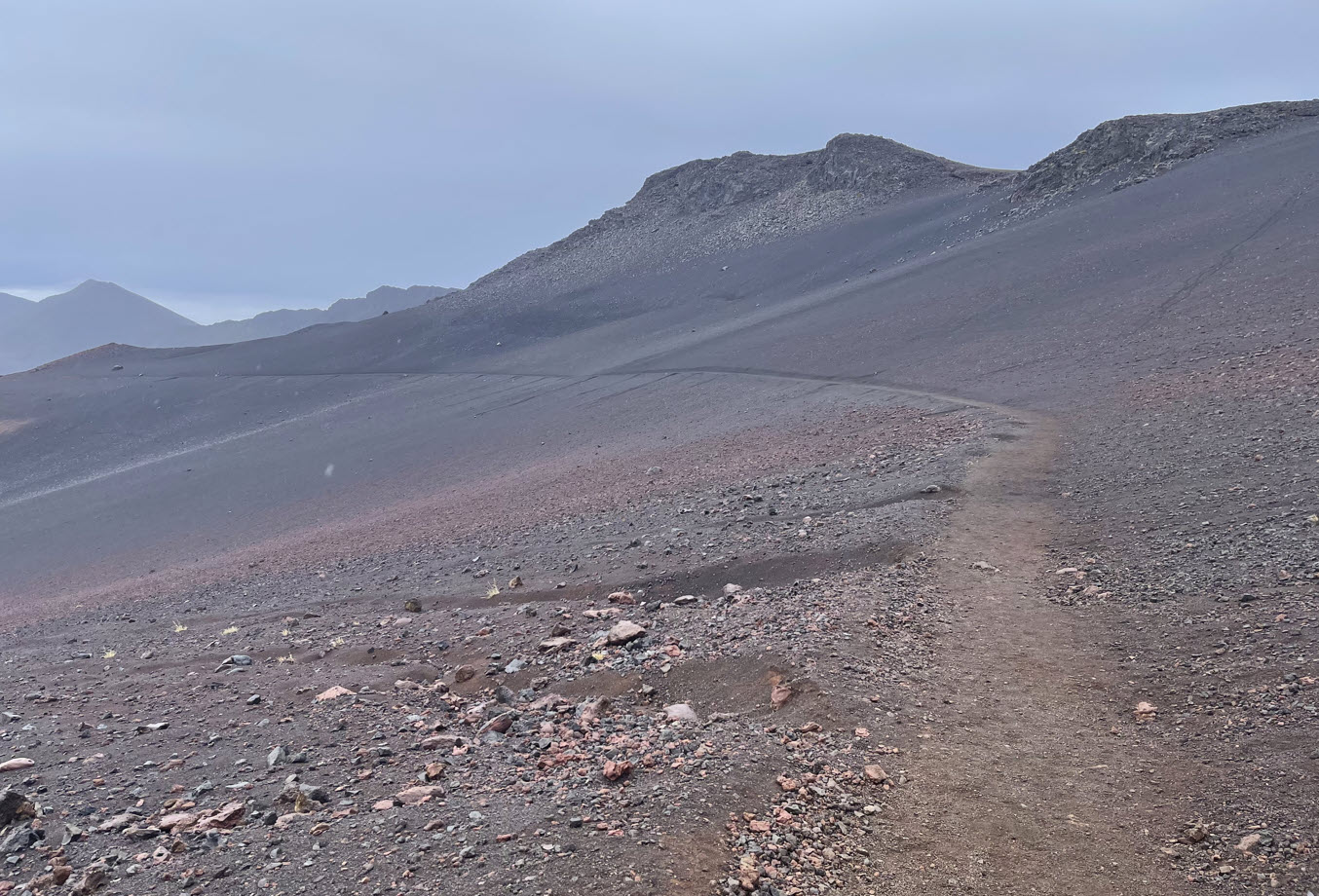
Without any vegetation at this altitude, you can see the trail stretching ahead for miles.
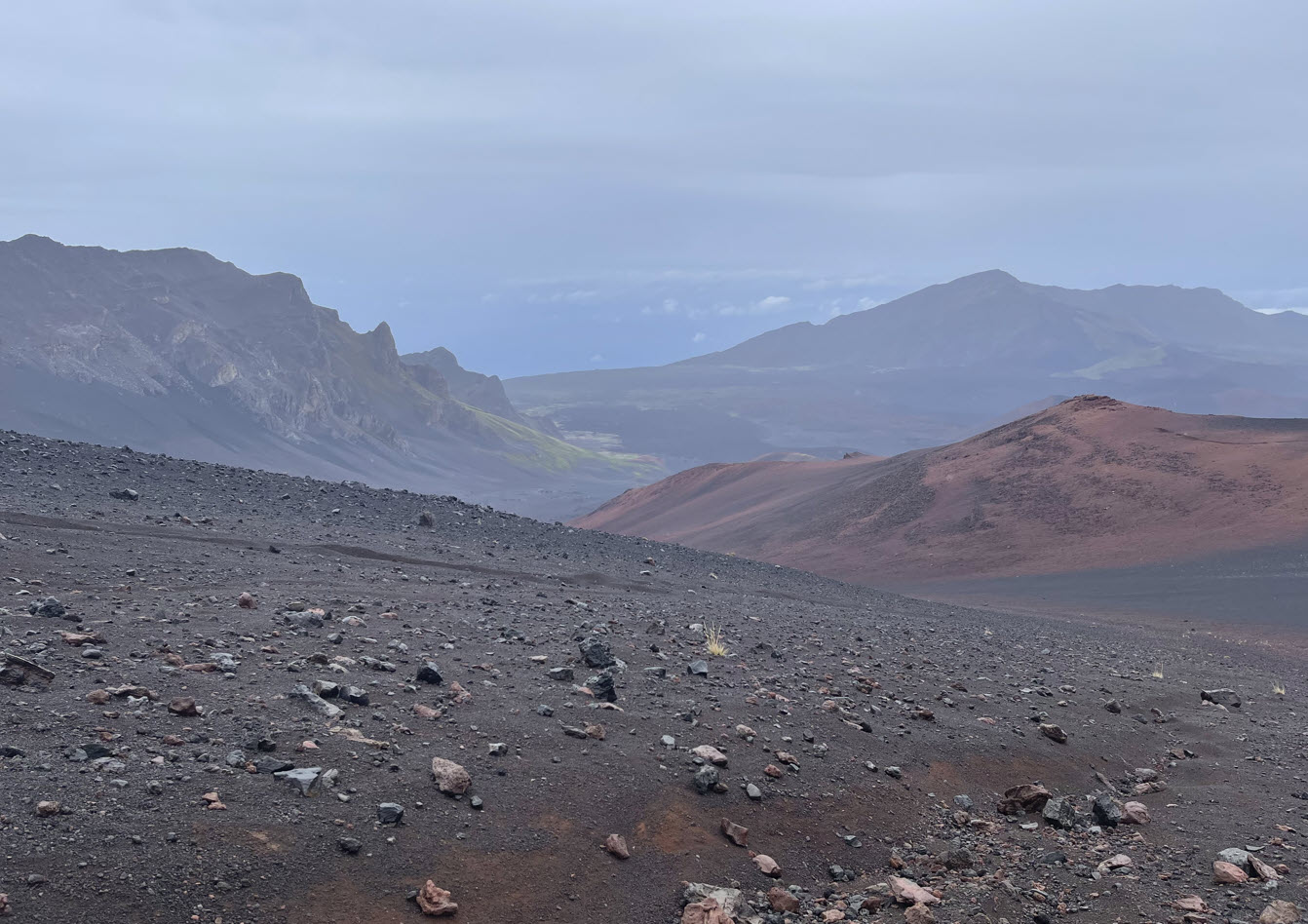
Here is a view north generally in the direction where I’ll be going. See the green slopes in the center of the picture? Those will be visible in other pictures later when I am behind those, looking back up. In the far distance, if it were not cloudy, we’d be able to see the ocean far below. But not on this day.

Here is my first look back up. You can see the building from where I stood in the first photograph above, pointing down.
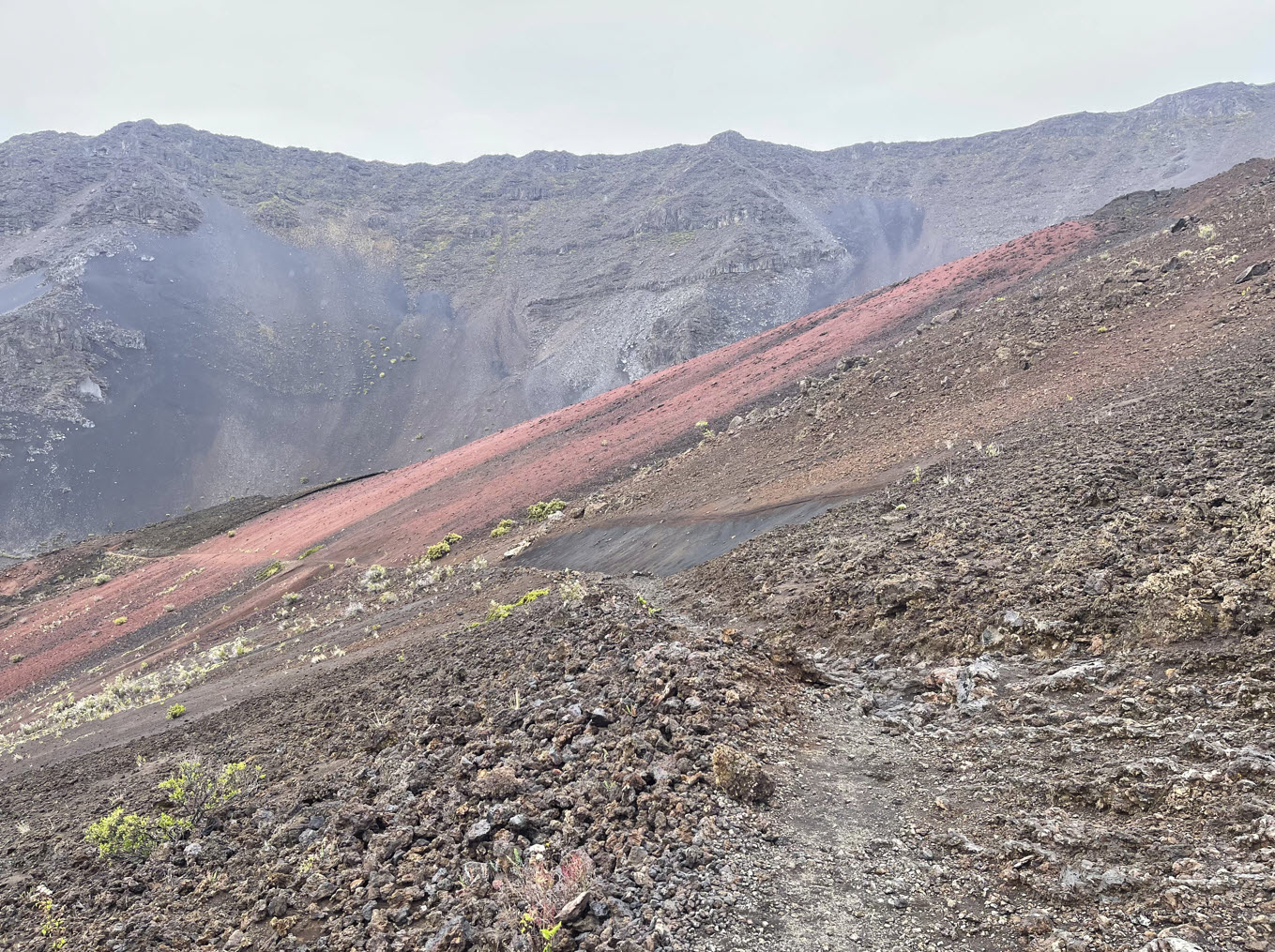
Massive walls of rock form the inner rim. The trail ranges from course sand to sharp rock.
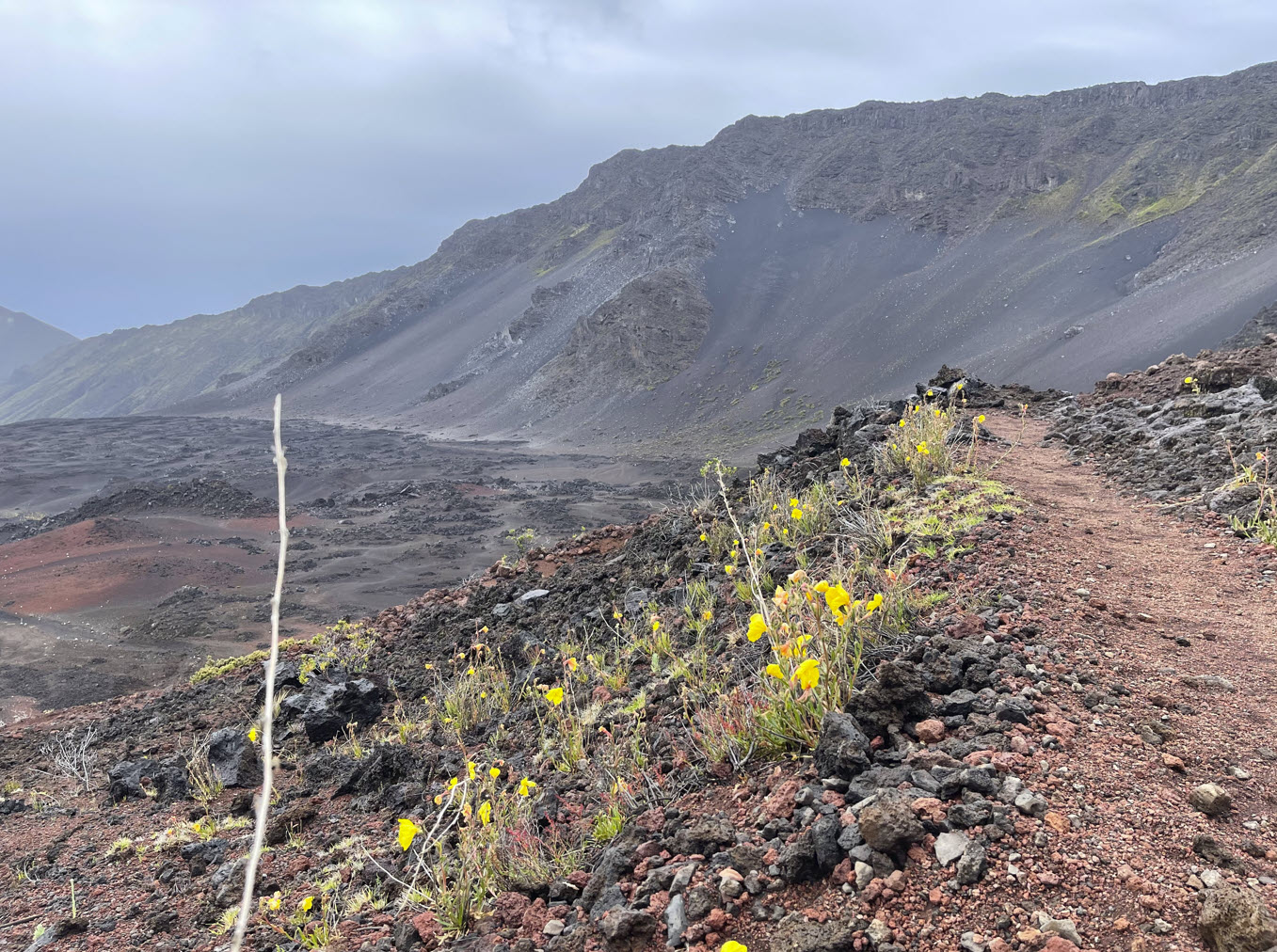
Beautiful yellow flowers seem to cling to life at this unforgiving altitude. They are called the evening primrose (oenothera biennia), which is a non-native species that seems to thrive in the harsh conditions high on the volcano.

The bright yellow flower can be seen along park roads and trails in the crater. It is native to eastern and central North America, where it is part of an ecosystem that helps to control it. In Haleakalā National Park, resource managers work hard to contain these and other invasives that are free from their natural controls.
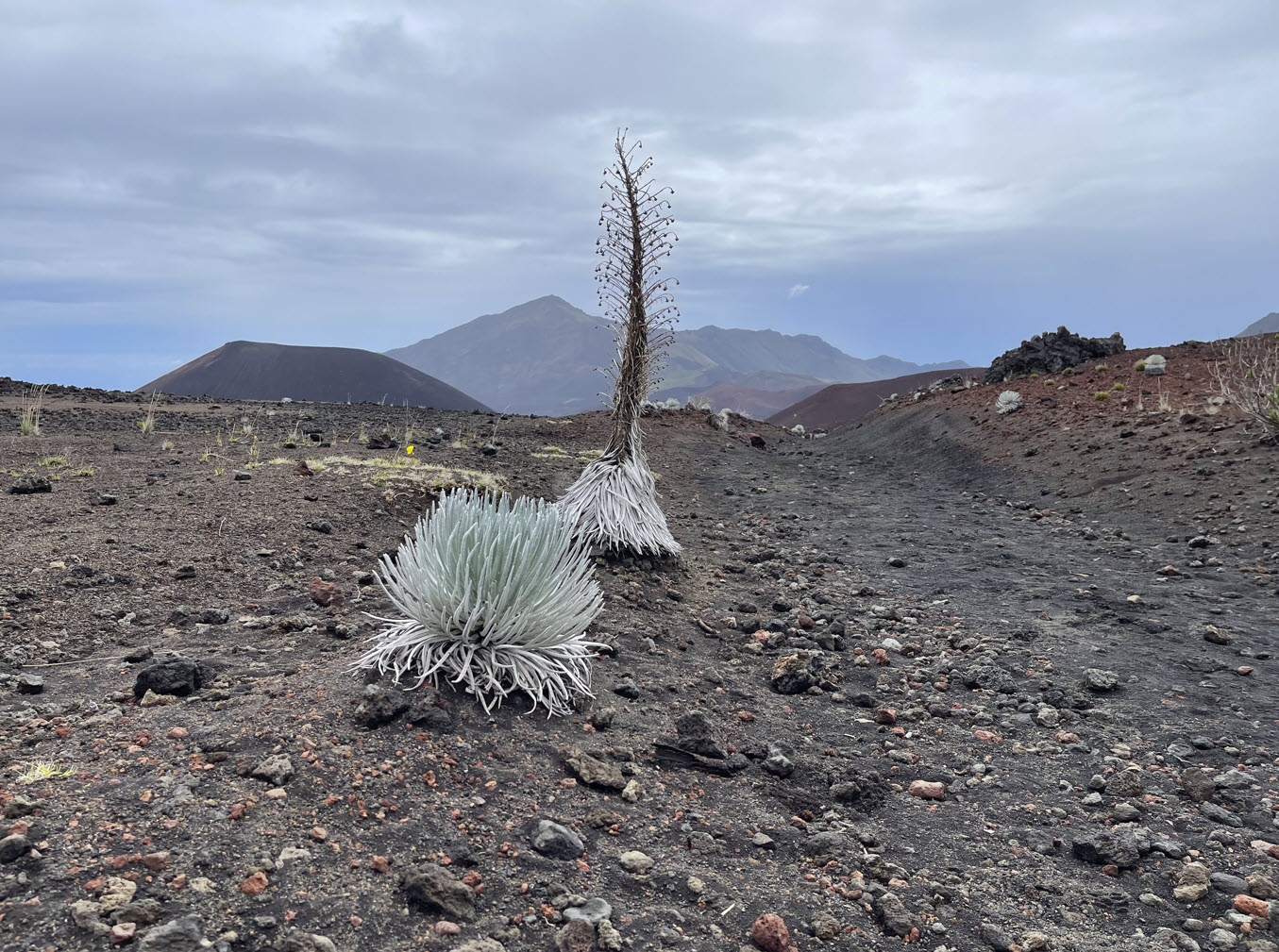
The Haleakalā silversword is a strikingly beautiful plant which is only found on the island of Maui at elevations above 6,900 feet on the summit depression, the rim summits, and surrounding slopes of the Haleakalā crater. It has been a threatened species since it was classified on May 15, 1992. Prior to that time, excessive grazing by cattle and goats, and vandalism inflicted by people in the 1920s, had caused its near extinction. Since strict monitoring and governmental protection took effect, the species’ recovery is considered a successful conservation story.

After the silversword blooms, the leaves die and form a cone on the bottom of the plant.

Here is my first look back up to the rim. The red arrow points to the ranger building, which is almost no longer discernible from this distance.
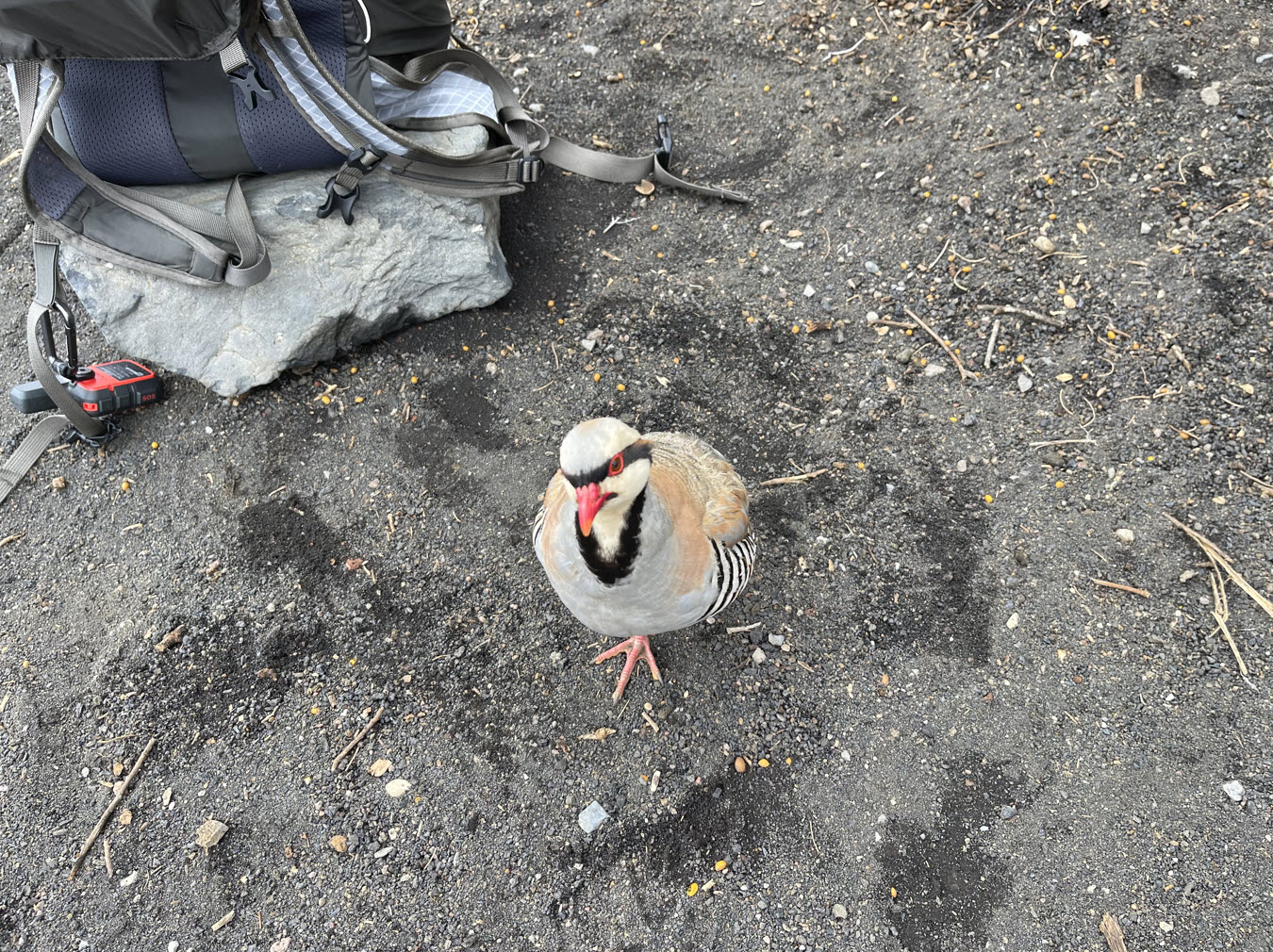
After about four miles I reached the crater floor at about 7,500 feet. I needed some rest. Immediately, these birds came up and walked right up and looked at me. Obviously, they had learned that people liked to feed birds. They were fearless.

I had to look them up: Introduced from Eurasia, the sandy-brown Chukar is a game bird that lives in high desert plains of western North America, as well as in Hawaii and New Zealand.

Here they are picking the crumbs I let them have.

Turning away from the birds and looking north, this was my view. In the distance on the red slopes you can see the thin faint line that is my trail.

Along this trail I came to a garden of silversword. It looked like an alien landscape. I could imagine some arachnoid alien coming toward me down the trail and I would not have been surprised.

Another look back across the crater floor to the rim in the west from where I came. The red arrow again points to the location of the ranger station. If I didn’t point it out it would not even be visible any more from this distance. As in all the photos, you can click on the picture and then zoom in.

The evening primrose seems to grow right out of the sheer volcanic rock, almost like a miracle.

Looking toward the north and down, this is where I am going. The slope in the back is where I will have to climb out of the crater once I get there.
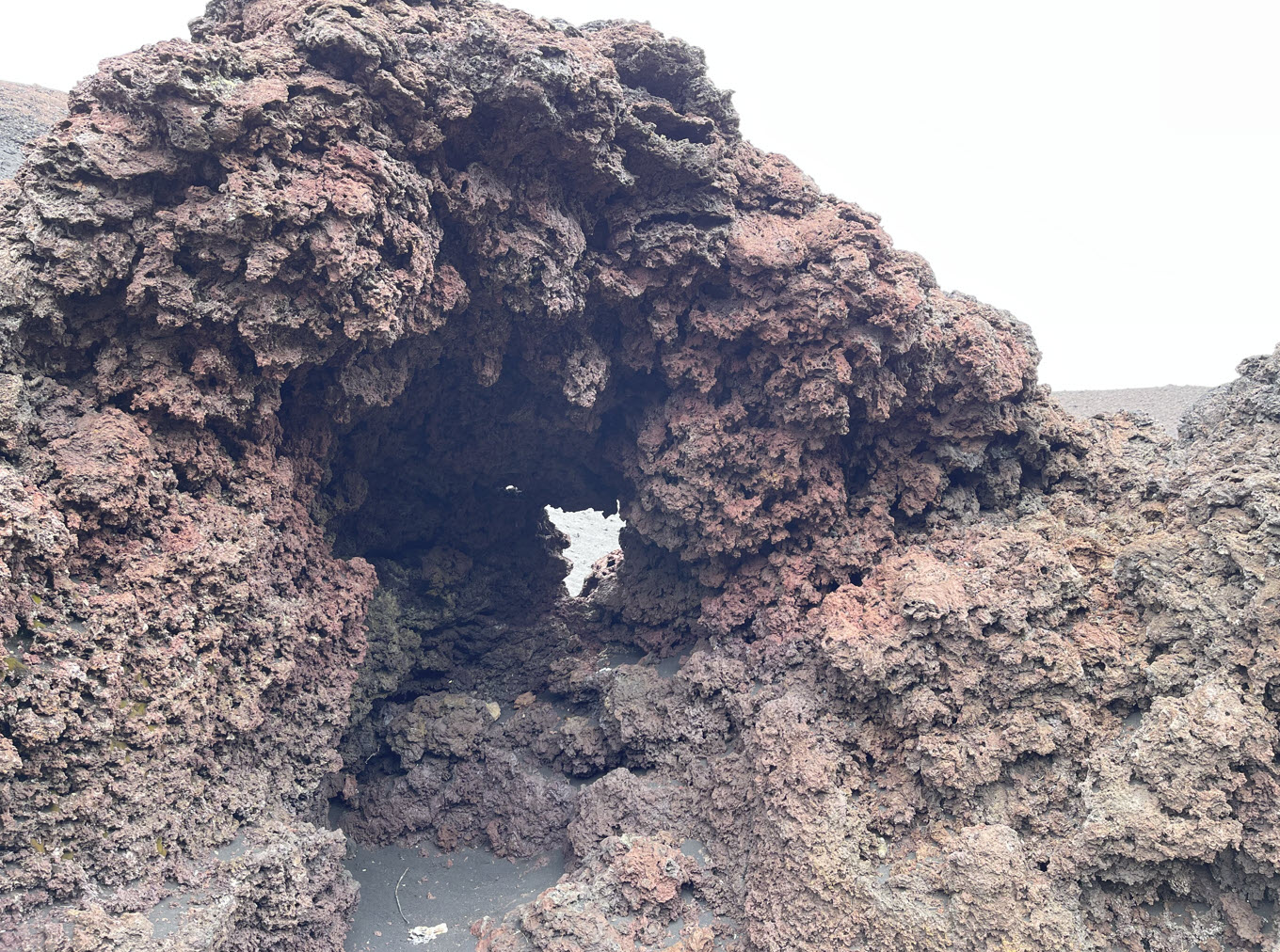
Along the way there are sometimes very strange lava formations. This is a little cave large enough so I could stand in it with a window on the other side.

And always, in all directions, I saw course sandy slopes that looked smooth from a distance but are often just millions of sharp volcanic rocks. The green spots on the rim are those that I pointed out at the beginning of this post, when I looked down on them from the distant rim behind.

Here is another shot of the ranger station at the red arrow and the green slopes.
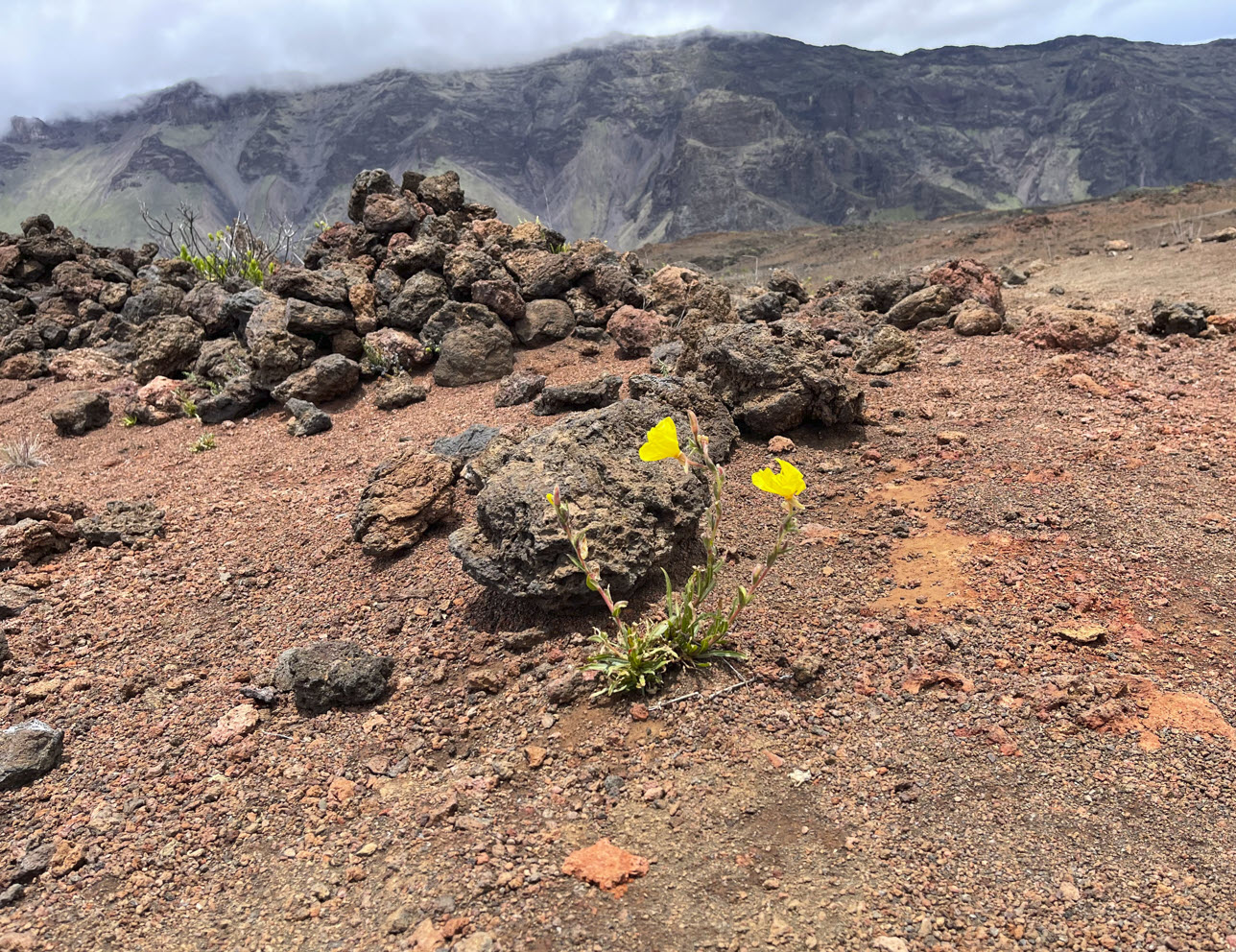
The stark, alien beauty of the Haleakalā crater is embodied in this photograph, with the lone flower in the foreground and the harsh environment it lives in.

Finally I am getting close to the other side. If you zoom in on the picture above, around where the red arrow is, you see the faint lines that are the switchbacks of the trail where I’ll be climbing out.
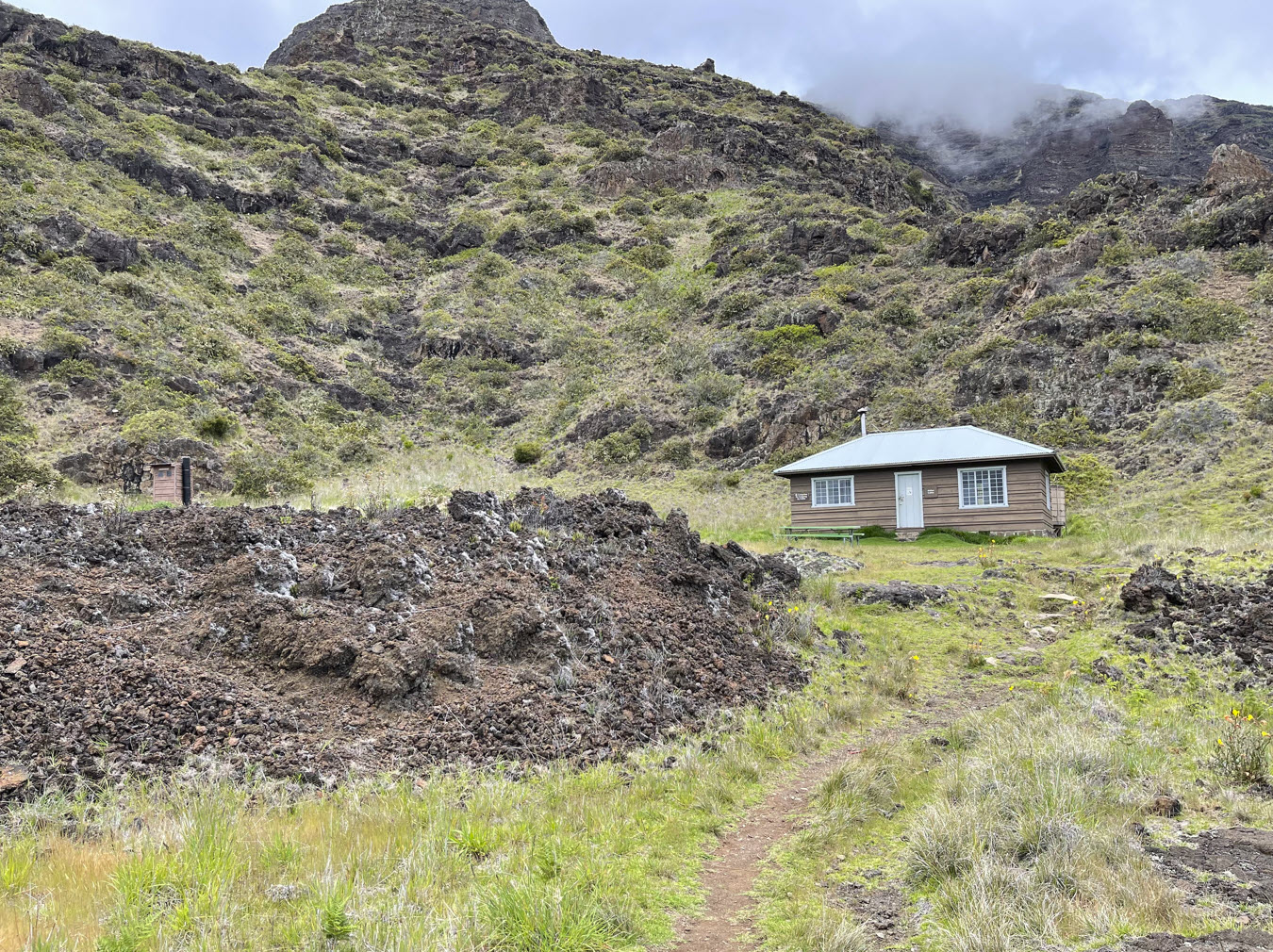
Before the climb, however, I took a rest stop at the Holua cabin and the little campground around it. There was nobody there.

Did I mention that on the entire trip so far I had encountered no more than perhaps five people in two groups? There was nobody on that side of the mountain. I saw some groups of casual hikers coming down and going up the Halemau’u slope, but that was the extent of other people.

The terrain on the way up along the switchbacks is very different. There is dense vegetation. It was raining lightly, and quick cold with stiff winds.
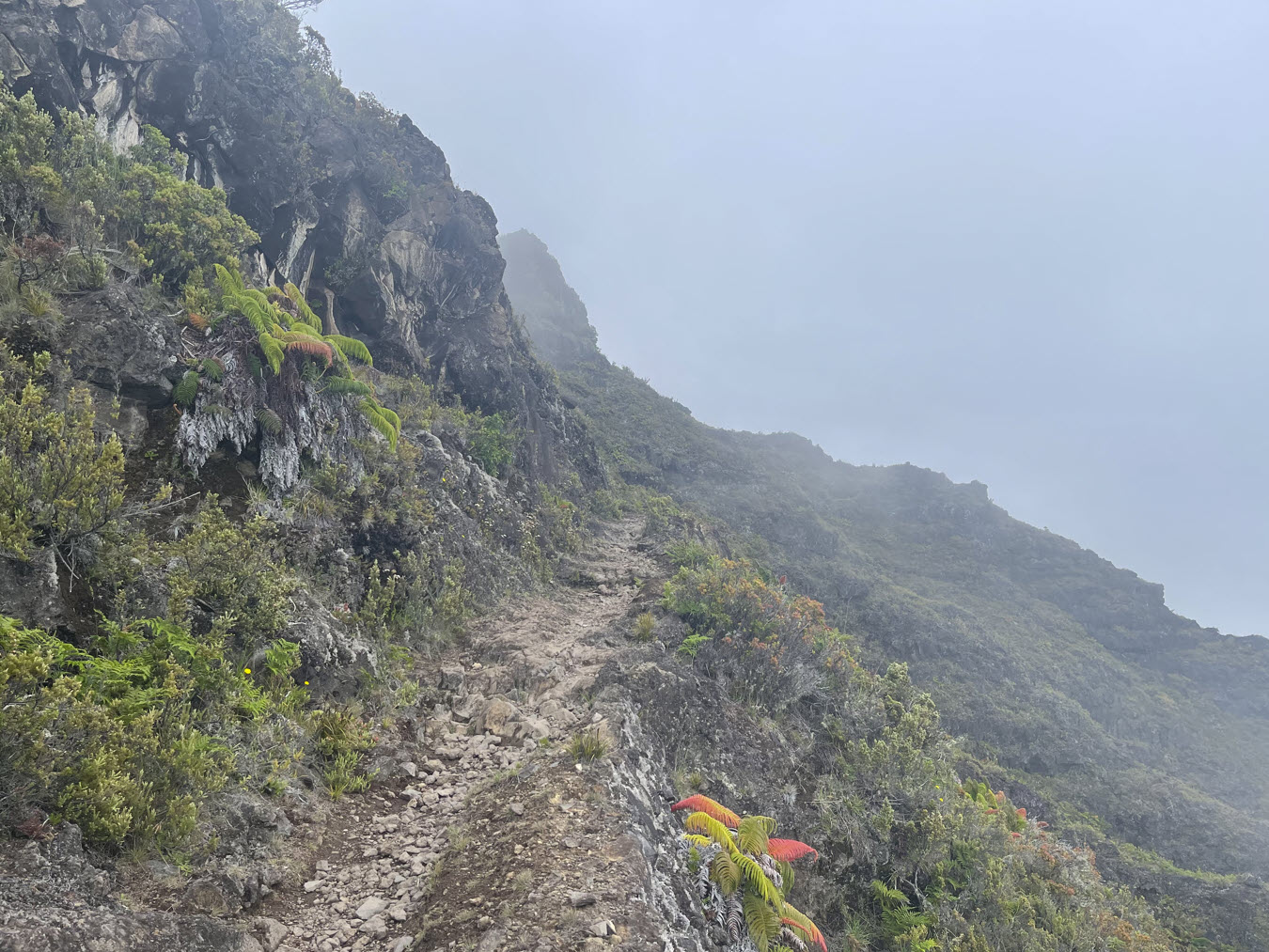
More views of the trails on the switchbacks up.

The park service installed fences to keep out goats and pigs, and keep people from falling down steep cliffs.

I am on the northside of the mountain, and I can get glimpses of the valley below.

Finally, after 12 miles of hiking, and a steep ascent for the last mile and a half, I saw the parking lot in the distance, where Trisha waited for me with the car.
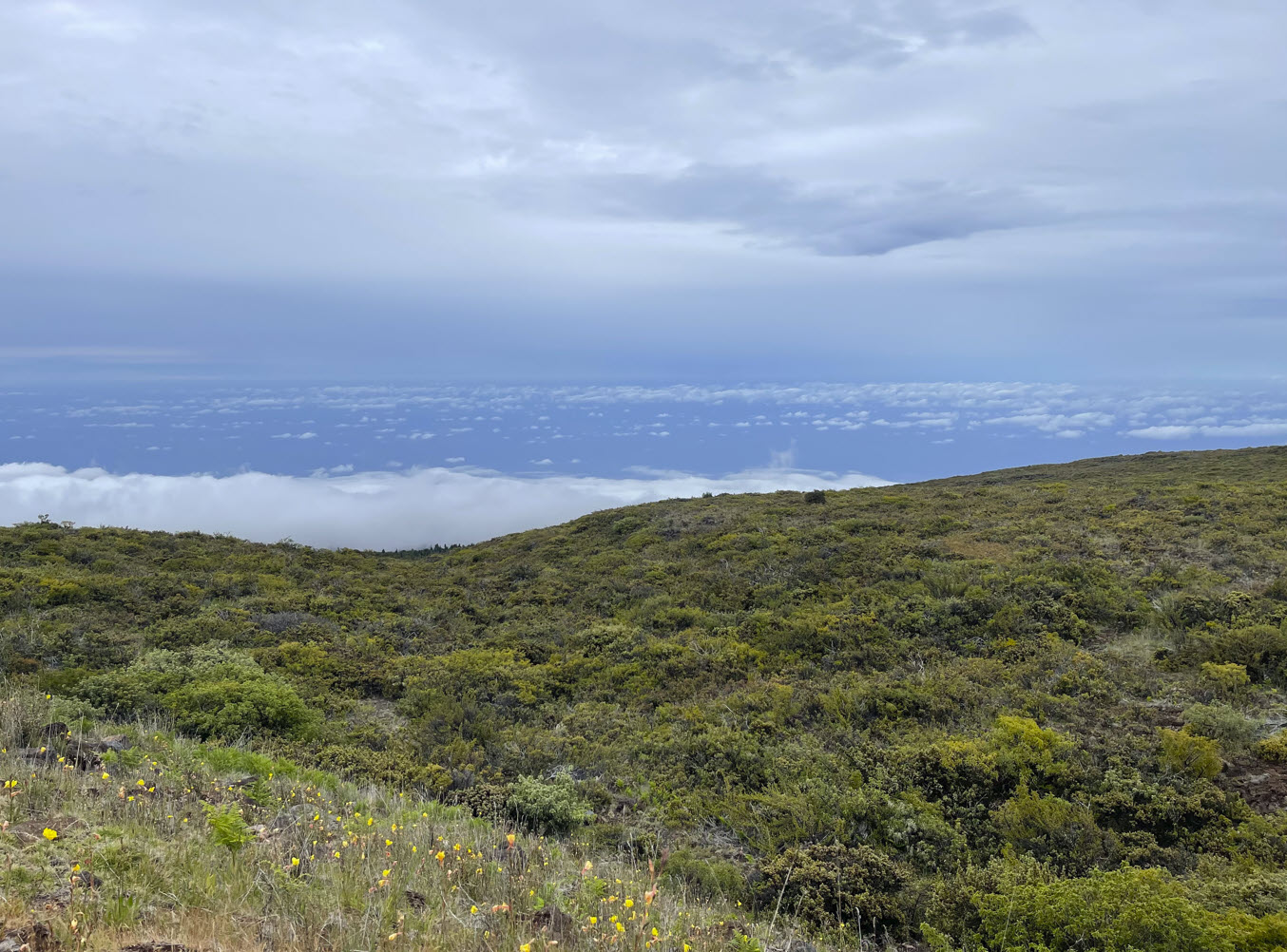
Here I am at the car, looking east for a parting shot, with the Pacific ocean 8,000 feet below. It’s about 3:00 pm. The full hike took me about six hours.

I think next year I’ll do the same trek, but the other way around. That will mean rather than dropping 2,000 feet, I’ll be climbing 2,000 feet. It’ll be a little slower.

I am already excited about it.
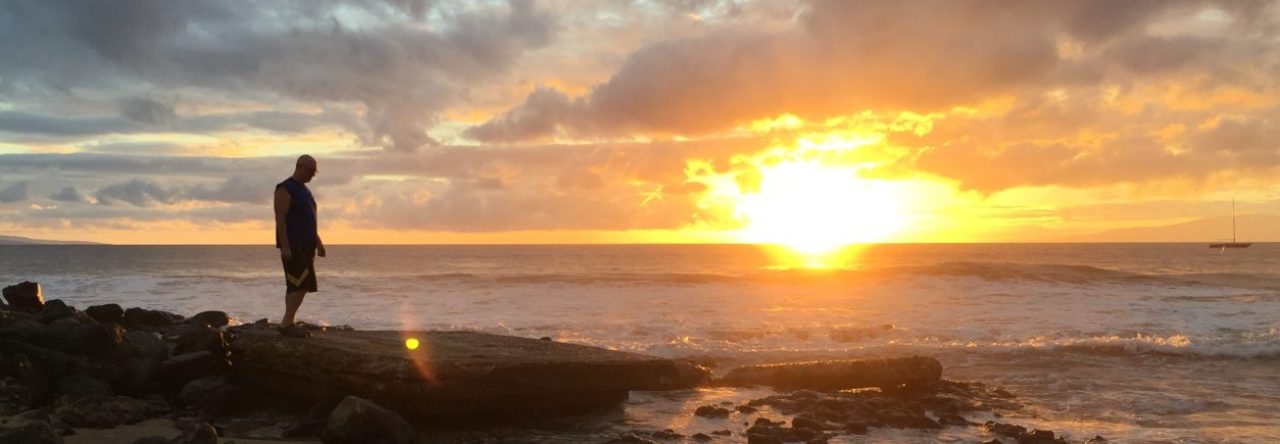


A Loaf of Norbert Bread

Trisha went on a walk this morning in Kihei on Maui. She stopped by a bakery and what did she see as the last loaf of bread on the shelf?

A loaf of Norbert bread. I had never seen that before. Neither had she. She brought it home.

I put on some butter and jam:

A loaf of bread has called me by name.

The Horrible Customer Service of American Airlines

Earlier this week there were headlines about the Biden administration passing a consumer protection law that, among other things, forced airlines to provide refunds in the case of cancellations. Some conservative politicians, like Ted Cruz,  didn’t seem to like this, which has me flummoxed.

I have a recent example of the abuse some airlines inflict on their passengers. Last month I had a flight scheduled from San Diego to Indianapolis. I had the flight booked months before, and the day of travel seemed to be a particularly bad-weather day back east. My flight was supposed to leave at around 10:00am. I had a layover of 90 minutes in Dallas, which is just the right amount of time. The incoming flight was delayed, so my departure was also delayed. Several times, each time by 30 minutes, and eventually I would get to Dallas after the connecting flight’s departure.

The gate agents were busy. I tried to rebook online, but the system didn’t work. I had to wait some 45 minutes in the priority line – no less – before I got to the front. It turned out there was no way for me to get to Indianapolis that day. I was prepared for that eventuality and had decided I’d cancel the trip. There was no point in me going if I didn’t make it there that day.

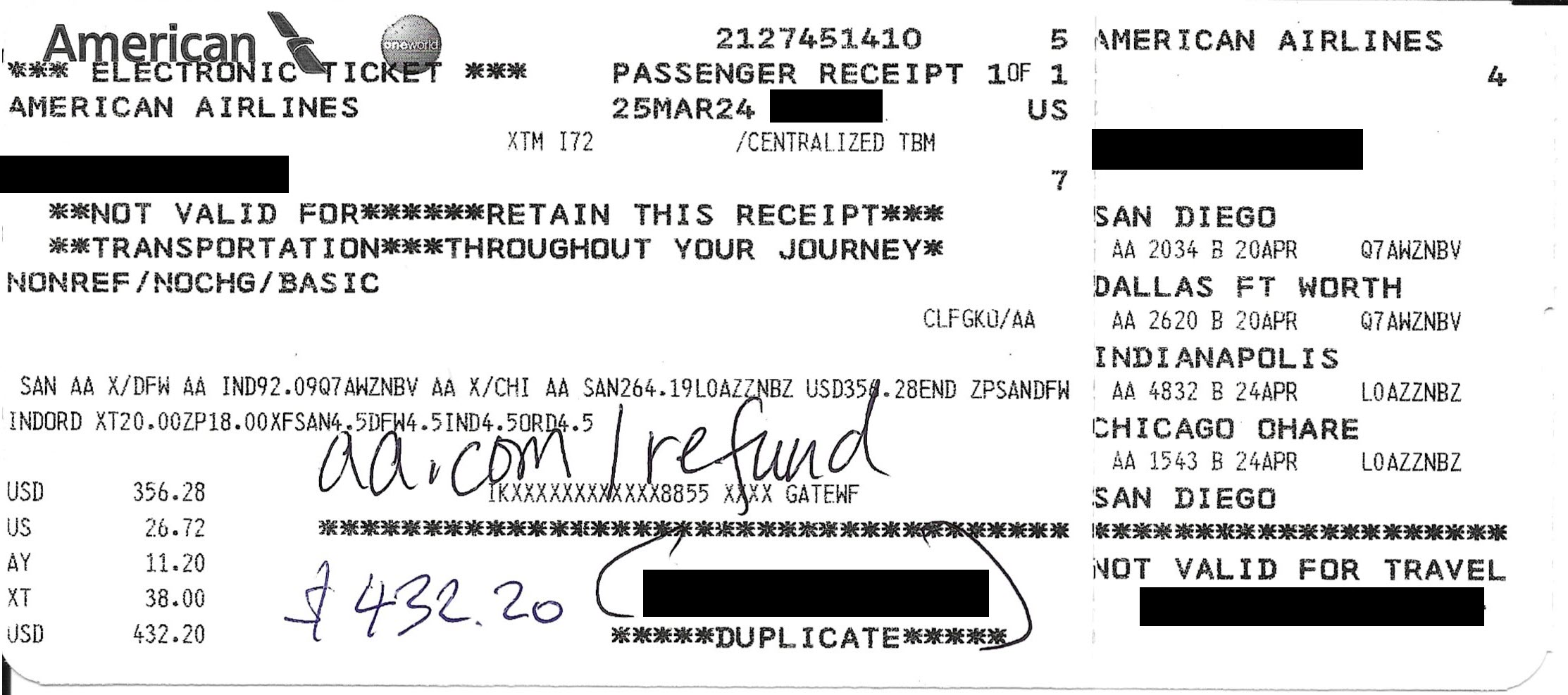
The agent gave me a paper voucher with a ticket number written on it and told me I had to go to aa.com/refunds to redeem it. This is what it looked like:

When I got home I went to the site, but it didn’t find my ticket. I saved it until I had to book another flight. That was this morning.

My flight today was over $800, so I wanted to apply the flight credit of $432.20 when I tried to make the payment.

Please note that there is no way to look up your existing flight credits when making a payment. You have to type it in. I didn’t have my paper ticket in my hand so I couldn’t do it.

I opened up another browser window, logged into my account a second time, found the flight credits page, and searched there:

Now it told me it couldn’t find it.

You get the idea. American Airlines goes out of its way to make it nearly impossible to claim refunds. I happened to be at my desk, and I have a drawer where I keep such papers. I tried to type the ticket number into the payment site, and it still would not accept it.

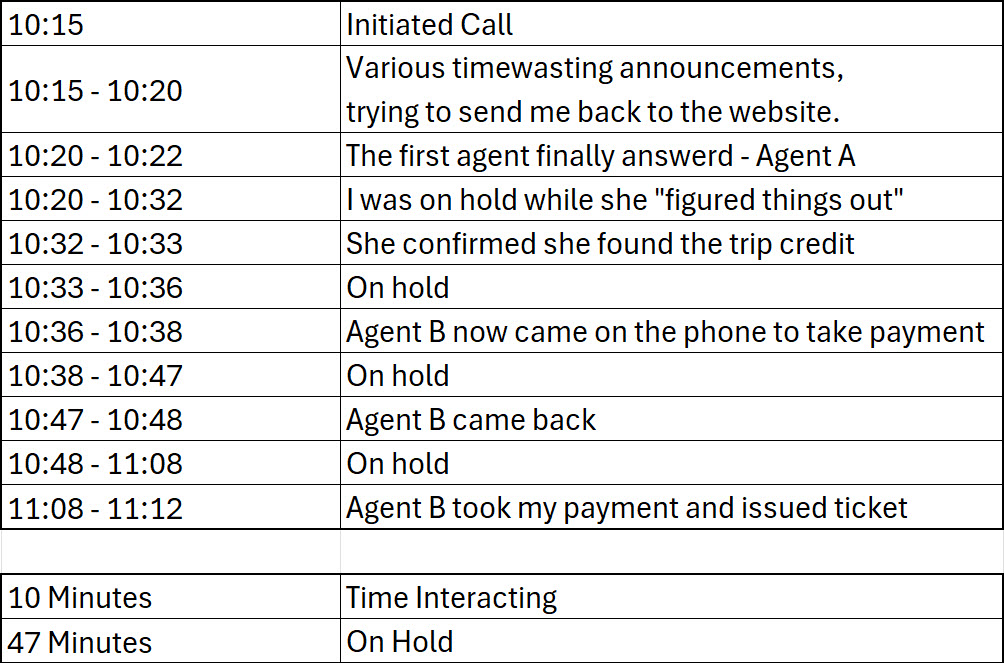
So I called the airline. Here is the call log I kept:As you can see, I had to wait about 5 minutes of the robot telling me I should be going to aa.com to work out my problems. Eventually I got an agent, and when I explained my issue, she put me on hold for 12 minutes. Then she came back and told me that she had found the ticket and was working on the credit. Three minutes later, after some clicking and switching where I was afraid it would hang up on me, another agent came on and I had to explain the whole thing again. That agent put me on hold for 10 minutes and told me they had worked it out, but then it took another 20 minutes on hold before she came back with a properly booked ticket.

All in all, I spent 47 minutes on hold listening to the robot drone on and on about how important their customers were to them. I spent about 10 minutes actually talking to two human operators.

I got my refund, and I got my ticket. Between trying it online myself, and getting help, it took about an hour and a half out of my day today to buy a ticket, which should be a 3-minute job.

I am a life-time Platinum member with American Airlines. I have flown almost 3 million miles with that airline alone. I know how the system works.  I have lots of experience with adverse travel situations. How is a less-savvy traveler going to cope with this? It’s very easy to forget about the travel credit after a few months. It’s also easy to throw up your hands and give up – and the airline wins.

I for one thank my government for putting the squeeze on airlines. If they cancel my flight, and I don’t rebook, my money should go back to my credit card that day.

Amazon can do it.

American Airlines can do it, too.

Now they have to.

Movie Review: The Ministry of Ungentlemanly Warfare (2024)

A group of renegade operatives is sent by Churchill himself to Africa to sabotage the Nazi U-Boat supply line. This is supposedly based on a true story that changed the course of the Allied war in the Atlantic before the United States joined in.

Think Ocean’s Eleven in Britain during World War II, except that they are not breaking into a casino, they are putting their lives on the line for their country. Since it’s a black operation, there is almost no way to win. If they fail, they get killed by the Nazis. If they succeed, they get arrested by their own country for disobeying orders.

Ungentlemanly Warfare is definitely an action movie. There is a lot of shooting and slicing and stabbing going on, where five fighters take on an entire army, sort of like in the Rambo movies. The heroes somehow never get killed, but they put away Nazis like I’d be swatting mosquitoes.

While it’s unrealistic, it’s surprisingly entertaining. I found myself rooting for the underdog as they fought against impossible odds to pull off a crazy plan that no sensible person would ever sign up for.

Could this really have been based on a true story? It made me want to look it up in the history books.

Book Review: Our Missing Hearts – by Celeste Ng

Bird Gardner is twelve years old and lives with his father, who used to be a linguist and college professor, but now works in a university library shelving books. They live in a small apartment in a dorm on campus. Bird’s mother Margaret, a Chinese-American poet, the daughter of immigrants from Hong Kong, disappeared when he was nine years old. He does not remember much about her and he resents her for abandoning them.

One day a mysterious letter arrives filled only with drawings and no words. Bird goes on a quest to find its meaning and eventually steals away to go on a trip to find his mother. When he finally finds her in New York City under mysterious circumstances, he learns of her love and her own private battle for justice and decency.

Our Missing Hearts plays in America of today, in an alternate society where there was a severe economic downturn, akin to the Great Depression, some fifteen years before the story starts. They called it The Crisis. Businesses failed, unemployment was rampant, many lost their homes, livelihoods, possessions and hope. The country needed a scapegoat, some explanation why things happened to them.

In Germany, in the 1930s, Hitler faced such a nation under such a crisis. He invented a scapegoat, somebody whose fault it was: The Jews. In the America of Our Missing Hearts, the leaders blamed the Chinese, and by association any Asian-Americans. Of course China was to blame for America’s demise. And as we reacted to Japanese-Americans in World War II, putting them into camps, so did America isolate Chinese-Americans in this story. Bird’s mother, being the daughter of Chinese immigrants, had the face that betrayed her origins. Her poetry, without being political, was misinterpreted as unpatriotic, and quickly banned.

The government started to separate children from their immigrant parents under the guise of protecting them from the unamerican influences of their parents. All this rings true. In 2018, the American government separated children and parents of immigrant families at the border. Their crimes: being children of parents desperate enough in their home countries to flee in search of better lives, safer lives and more prosperous lives. The American government told us that immigrants were taking away our jobs, they were animals, vermin, that had to be deported at a minimum. We were taking their children from them to protect the children. It’s now six years later, and there are still over 1,000 of those children who are not yet reunited with their families:

The Trump administration’s family separation policy remains a lasting and disgraceful legacy of that administration and of the United States as a nation. Under the policy, formally known as “Zero Tolerance,” the US government forcibly separated migrant children from their parents as a deliberate measure to deter others from attempting to migrate or seek asylum. Crueler still, the federal agencies that separated families failed to track which children were separated from which parents. In total, at least 5,569 children were separated from their parents or guardians under the Trump administration, a figure that includes separations during and after the formal zero tolerance policy. More than 1,000 children remain separated from their parents as of November 30, 2023. Out of these 1,000 children, the government’s Family Reunification Task Force still does not have any ability to contact 68 of the separated parents, further complicating the reunification process and prolonging families’ suffering.

ReliefWeb

Our Missing Hearts tells of the collective suffering that occurs in a society that suddenly decides that some subgroup is the reason why the society is in decline.

It happened before in many other countries, and it’s happening right now in the United States. Slowly, gradually, we are getting desensitized, and more and more of us are willing to commit atrocities in the name of our country.

…You won’t have a country anymore……

I Am Listed in Top 25 Time Travel Book Blogs

I received a surprise email from feedspot.com advising me that my blog was listed in the Top 25 Time Travel Book Blogs. Check this out – I am number 19.

Top 25 Time Travel Book Blogs

I didn’t expect that I would be listed there, so I checked. Going onto the Book Reviews tab in my block, you can type “Time Travel” into the search box on that page, and it’ll return 62 results. Yes, apparently I have read, reviewed and rated 62 time travel books thus far, and that would be a significant enough body of work to be on that list. Maybe it warrants another post summarizing all 62 reviews, perhaps listing them by rating. But’s for another day.

Anyway, thanks to the guys at Feedstop for the plug. I am honored.