
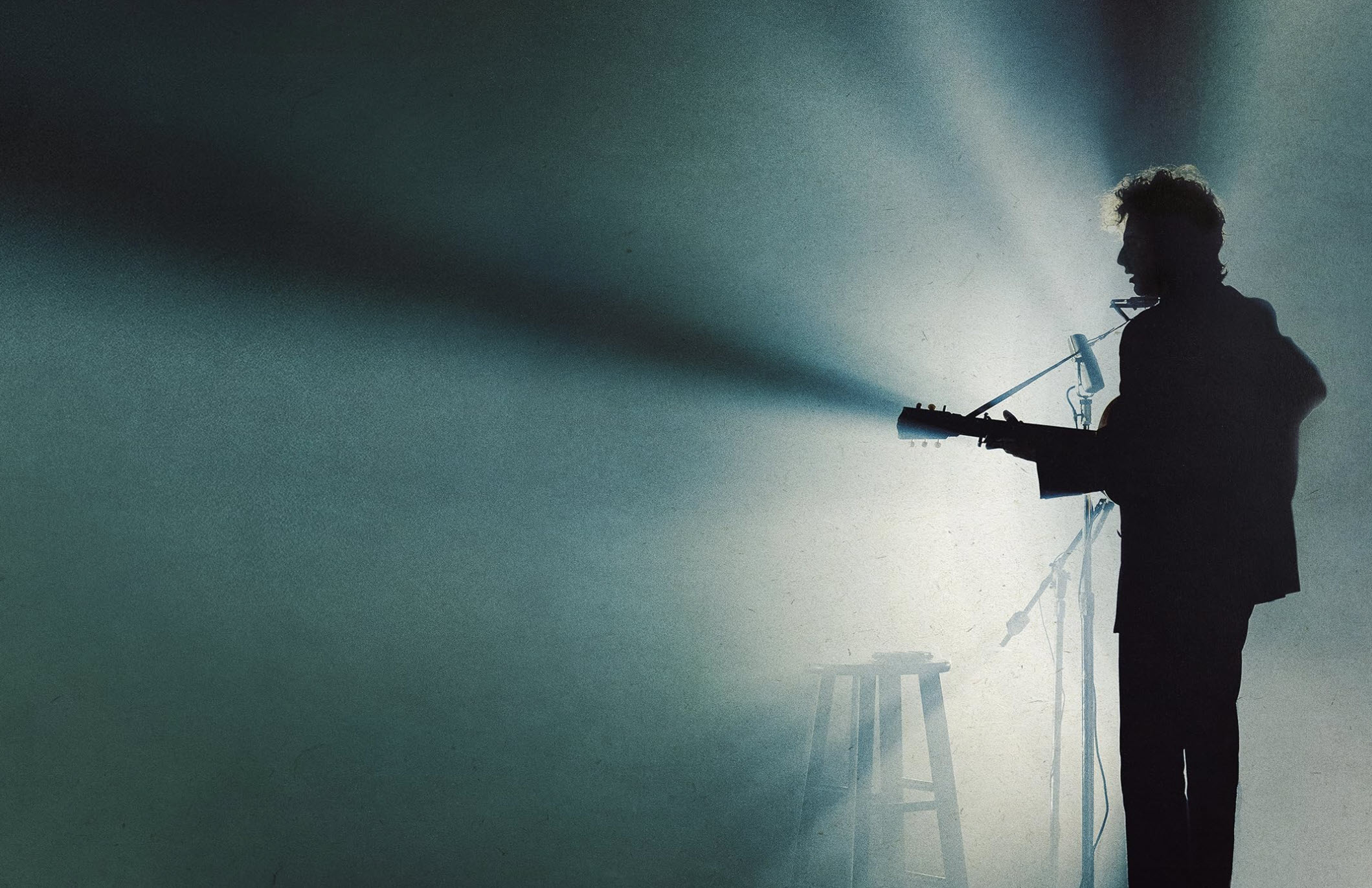
Movie Review: A Complete Unknown

When Bob Dylan arrived in New York City in 1961 he was 19 years old and a complete unknown.

That’s the start of the movie A Complete Unknown. I was too young then, not even five years old, so I didn’t witness that epoch of music. I didn’t really get into Bob Dylan music until I was about 14, around 1970. But ever since then, I would call Dylan my favorite musician, and I do it to this day. Many years ago I painted a Dylan portrait, as I liked to do with some of the iconic artists I admired (Beethoven, Henry Miller, Nietzsche). Dylan belonged in that collection.

Over the years, I accumulated pretty much all of Dylan’s vinyl records, and  lost them in later years during one of my moves.

When we entered the Regal movie theater on the afternoon on Christmas day, opening day for A Complete Unknown, all seats were full, and the average age of the moviegoers was probably around 75. We were on the younger side. And there it was quite obvious: Dylan had a momentous impact on not only the music of his generation, and many other musicians that followed him, but also on the emotional lives of his followers. When you search this blog for “Bob Dylan” you get dozens of entries returned, referring to movie and book reviews, and many other references to Dylan, and how he influenced my critical thinking, my artistic endeavors, and how his style affected my own poetry writing. I have to admit that I am not much of a musician; the only instrument I ever used was a harmonica – and fittingly, the first song I ever learned on the harmonica as a 16-year-old was Blowing in the Wind.

A Complete Unknown follows Dylan’s early career through his initial quest toward electric music during the iconic performance at the Newport folk music festival of 1965.

Timothée Chalamet plays Bob Dylan, and he does an amazing job. During the movie, he has to play and sing 13 Dylan songs. He practiced for over five years preparing for this so he could sing and play his own guitar as well as the harmonica. Dylan’s style on the harmonica is unique and unpredictable, and even that Chalamet mastered, along with the voice and the guitar. Noteworthy is also that Monica Barbaro, who played Joan Baez, also did her own singing and brought a convincing performance imitating the iconic singer’s unique voice.

How do you cram four extraordinary and foundational years of an iconic artist into a two hour movie without shaving off many details, like the massive influence of the Beatles on American music during the same period, and how that affected Dylan? You have to pick your battles and focus on the most poignant episodes and illustrative events. Those of us who are really interested in Dylan, the artist, have read numerous biographies for all the detail we need.

A Complete Unknown is just one more adventure to have when experiencing Dylan, the icon, and for me, this made a 4-star movie.


My Humble Tribute to Kris Kristofferson

Kris Kristofferson was always in my life.

He entered it with a bang with the movie A Star is Born, alongside Barbra Streisand, which remains one of my favorite. The soundtrack still haunts me and catapults me back to the early years of my adulthood. The last time I saw him was at a concert right here in Poway, California. It was a very small venue, we sat quite close. It was an unimposing, empty stage. There was a microphone, a chair and a stand with a bottle of  water. He was a thin and humble man, apologizing for his cold. He had to blow his nose on stage between songs. The only instrument was his guitar. That may have been some eight years ago.

When we were in Maui recently he had just played at a hall there, and we were sorry we had missed the date.

Kristofferson was an amazing and talented person. In San Mateo High School he wrote award-winning essays that were published in magazines. When he went to Pomona College, his achievements in rugby, American football and track and field got him to appear in Sports Illustrated on March 31, 1958. He graduated with a B.A. summa cum laude, in literature. Then he was awarded a Rhodes Scholarship and went to the University of Oxford. There he won awards for boxing (of all things), he played rugby for the college, and started writing songs. Soon he recorded records.

Under pressure from his family, he joined the U.S. Army, eventually became a captain and a helicopter pilot. He also completed Ranger School. When he was stationed in West Germany in the early 1960s, he resumed his music career and started a band. He was offered an assignment to teach literature at West Point, but turned it down.

He tried to get Johnny Cash to record a tape of his, but he didn’t get his attention. So he flew a helicopter and landed it on Cash’s lawn. With a beer in one hand and recordings in an other, he finally got his attention and his music career took off.

But that was not enough. He started acting and was quite successful in a number of films.

Finally, one of my readers just commented that he discovered John Prine and Steve Goodman. At this time in the late 60s, early 70s, Goodman and Prine were playing in small local clubs in Chicago. Not only did he have talent himself, he recognized it when he saw it.

In January 2021, Kristofferson announced his retirement. His final concert was held in Fort Pierce, Florida, at the Sunrise Theatre on February 5, 2020, accompanied by the Strangers.

This man was good at everything he touched!

It’s an astounding and intimidating resume. Per his Wikipedia page, he is said he would like the first three lines of Leonard Cohen’s “Bird on the Wire” on his tombstone:

Like a bird on the wire
Like a drunk in a midnight choir
I have tried in my way to be free

Kris Kristofferson died yesterday at his home in Maui. I will miss him.

When the Tigers Broke Free – My Perspective of Russia

Pink Floyd released the album The Final Cut in 1983, which contained When the Tigers Broke Free. I must have heard that song hundreds of times, and I still today, every time I hear it, my eyes well up with tears. Here it is. I suggest you read along with the lyrics for better understanding.

When the Tigers Broke Free

It was just before dawn
One miserable morning in black ‘forty four
When the forward commander
Was told to sit tight

When he asked that his men be withdrawn
And the Generals gave thanks
As the other ranks held back
The enemy tanks for a while

And the Anzio bridgehead
Was held for the price
Of a few hundred ordinary lives

And kind old King George
Sent mother a note
When he heard that father was gone

It was, I recall
In the form of a scroll
With gold leaf adorned
And I found it one day
In a drawer of old photographs, hidden away

And my eyes still grow damp to remember
His Majesty signed
With his own rubber stamp

It was dark all around
There was frost in the ground
When the tigers broke free
And no one survived
From the Royal Fusiliers Company Z

They were all left behind
Most of them dead
The rest of them dying
And that’s how the High Command
Took my daddy from me

As of now, British estimates put the number of Russians killed or wounded in Ukraine since February 2022 at about 500,000. Today, every day, we estimate that about 1,000 Russian soldiers are injured or killed in Ukraine. Russia is recruiting 25,000 to 30,000 soldiers a month. I am not counting Ukrainian soldiers here who are defending their country. The Russian men and boys are sent into a meatgrinder in a far-away country that has nothing to do with their own lives, security or safety, simply at the will and ego of one man.

Throughout history, rich and powerful men have sent other people’s daddies into the line of fire, into literal meatgrinders.

Napoleon, Hitler, Stalin, Putin!

We don’t learn and we keep doing it.

When the Tigers Broke Free!

Knock Three Times Fifty Years Later

Recently my wife mentioned the song Knock Three Times by Tony Orlando & Dawn in the course of a benign conversation. That comment jarred me, because I remembered the song from 1970, and I realized I had not heard it ever again since those years. So I went to YouTube and found this link:

This song was a hit song in my youth in Germany. I was 14 years old in 1970 and I didn’t know any English yet. I had just started learning first year English in school at that age. It was my third language. A lot of popular songs on the radio in Germany in the 1960s and 1970s were English (Beatles, Rolling Stones, etc.) and American. So we heard the songs all the time, we liked them, but we didn’t understand the lyrics. Listen to a popular song in a language you don’t know (like some of Andrea Bocelli if you don’t know Italian) and you will understand what I mean. You can enjoy a song, you can like a song, you can hum the melody, without ever knowing what it says.

So it was with me and Knock Three Times. I just listened to it now, more than 50 years later, for the first time, and I magically understood the words. It now has a whole new meaning.

This happened to me over the years from time to time, when I’d hear an old hit for the first time. Another recent such experience was with Seasons in the Sun by Terry Jacks:

This came out in the summer of 1974. By then I was in my 4th year of school English and I probably knew some of the words, like “we had joy, we had fun” but I definitely, positively didn’t understand the part with the starfish on the beach.

We had joy, we had funWe had seasons in the sunBut the stars we could reachWere just starfish on the beach

I remember loving that song, it had such a good beat, and it really personified summer for me in my youth. But when I recently listened to the words for the first time, I was sad and melancholy due to its message, but I also chuckled because the starfish chorus seemed kind of hokey to me.

It is definitely a very unique experience to listen to a trusty old song from your youth and understand the words for the first time 50 years later.

Concert Review: Bob Dylan, San Diego, June 18, 2022

Bob Dylan, being my preeminent favorite music artist, I have obviously seen him in concert many times over the years. He has a 60-year career already, getting close to Queen Elizabeth reign duration numbers, which by itself is amazing. How many artists today can say that? Yesterday, my wife gave me a Father’s Day present and took me to the Bob Dylan concert at the Civic Center in San Diego.

If you had told me when I was 15 as a schoolboy in Germany, when I bought my first harmonica and practiced playing Blowing in the Wind in the city park, that I’d be going to a concert to see that artist when he was 81 years old, I certainly would not have believed it.

The San Diego Civic Center is a beautiful venue for concerts, symphonic events, with great acoustics and a capacity of about 3,000 seats. When we first arrived, they scanned our tickets off our smartphones as it is done nowadays. But then they took our smartphones away and locked them into pouches we could not open. Before they did that, they had to write our seat numbers onto little slips of paper. Kind of beats the paperless ticket process and creates a bunch of jobs for the people who have to handle the crowds. Then as we entered the venue, we were without phones. I usually sit there and read my book while I wait for an event to start. With no phone, I didn’t know what time it was, I couldn’t read, and I could not take the customary snapshot of the stage that I would then post along with these words. But none of that has to do with Bob Dylan.

The crowd was mostly old. Lots of folks in their 60ies, 70ies and 80ies. Some young people, some children, but I am sure the average was in the 60ies. Lots of pony tails and tie die shirts. Dylan has a lot of dedicated fans, and he can pretty much do what he wants and get away with it.

My first Bob Dylan concert ever was in 1978,  when I was 22, in the stadium at Arizona State University with 60,000 of my best friends. The last one was at the San Diego Sports Arena maybe five years ago. It was bad. Dylan’s voice was completely shot. He only played the keyboard. The sound was terribly distorted in the arena and too loud. I remember walking out of the concert thinking that, well, that was Bob Dylan. I don’t have to go to his concerts anymore.

But then I went again yesterday at a much different venue. There were just six guys on the stage and played a bunch of songs I had never heard. Of course, that is because I had not bought or listened to his latest album Rough and Rowdy Ways. That’s what the concert was about, and if I did it again, I’d listen to this album a few times before going to the concert. My mistake.

Except for a single song, which Dylan sang out in the open, he was mostly hidden behind an upright piano for the entire concert, so we only saw his head. He hardly plays plays the guitar anymore. Between songs, he would step out for a few seconds to be seen by the audience. He never greeted us, never said a word, except at the very end when he introduced the band by their names. But that’s how Bob Dylan does concerts, and we’re used to it.

I recognized very few songs. Either it was obscure material, or new material. A few songs I recognized by the lyrics, like When I Paint my Masterpiece, but not the music. But Dylan sang, with his broken voice, and it was mostly melodic, with good projection, not too loud. He would whisper into the microphone and we understood the words, for the most part. It was a good concert with wonderful music, performed by a legend.

But I missed Bob Dylan. There was not a single one of his hits. Blowing in the Wind would have fit perfectly into this playbook. I could have have used It’s Alright Ma, I’m Only Bleeding, or of course the iconic Like a Rolling Stone to top it all off. That didn’t happen. Worse – in what seemed like the middle of the concert, when the audience got fired up and gave him a standing ovation for the previous song, the stage suddenly went dark, they walked off, and didn’t come back. He houselights went on and that was the end. No encore whatsoever. I didn’t even realize I was listening to the very last song. And then he was gone. No final bow. No final howling hymn. No Bob Dylan anywhere to be seen.

I didn’t know how to feel. I liked the concert. I liked the music. I liked the new, melodic Dylan. But in the end, I was let down. The concert ended like a popped birthday balloon and next thing I knew I was in the parking lot.


Willie Nelson in 1965

I had never seen images of Willie Nelson as a young man before. All I could ever remember is braids and a beard. Here is an early video.

I have to close my eyes when he sings and I get the familiar image of him in jeans and braids.

Movie Review: The Sapphires (2012)

In 1968, at the height of the Vietnam war, there is turmoil all over the world. The American military in in Vietnam, in search of morale boosters for the men, is looking for performance acts to tour the country and play music for the troops.

In Australia, Aboriginals had just secured the right to vote. We in America are focused on American injustice through the centuries, particularly in the genocidal crimes against Native Americans, and then, of course, on slavery and racial injustice that reaches into today. But most of us do not know or realize the suppression, humiliation and subjugation other indigenous peoples have suffered and are still suffering. And that brings us to the injustices against the Australian Aboriginals, one of the oldest cultures in the world.

The Sapphires introduces us to an Aboriginal Family in Australia in modern times – well, in 1968. “Coloreds” are not taken seriously. But there are four sisters, Cynthia, Gail, Julie and Kay, who love to sing, and through a coincidence, are discovered by Dave, a hapless musician and talent scout. He takes them under his somewhat less than impressive wing and signs them up to travel to Vietnam to sing for the American soldiers.

While it was not obvious to the girls what they were getting into, a trip to the bush in Vietnam was nothing like a normal music tour. Events take on their own life when bullets fly and bombs hit all around you without warning.

This movie is based on a true story. It celebrates the human spirit, family bonds, and music, and it portrays the lives of modern Aboriginals in Australia.

Ukelele Virtuoso Hawai’ian Taimane Gardner

Can you imagine a rendition of Stairway to Heaven played on a Ukelele?

I am sure you can’t. Neither could I.

Listen to Taimane Gardner and you’ll never look at your ukelele the same way again.


Der Mond ist Aufgegangen

Text from Musen Almanach (1779)[1] English translation by Margarete Münsterberg[5]

Der Mond ist aufgegangen
Die goldnen Sternlein prangen
Am Himmel hell und klar:
Der Wald steht schwarz und schweiget,
Und aus den Wiesen steiget
Der weiße Nebel wunderbar.

Wie ist die Welt so stille,
Und in der Dämmrung Hülle
So traulich und so hold!
Als eine stille Kammer,
Wo ihr des Tages Jammer
Verschlafen und vergessen sollt.

Seht ihr den Mond dort stehen?
Er ist nur halb zu sehen,
Und ist doch rund und schön.
So sind wohl manche Sachen,
Die wir getrost belachen,
Weil unsre Augen sie nicht sehn.

Wir stolze Menschenkinder
Sind eitel arme Sünder,
Und wissen gar nicht viel;
Wir spinnen Luftgespinste,
Und suchen viele Künste,
Und kommen weiter von dem Ziel.

Gott, laß uns dein Heil schauen,
Auf nichts vergänglichs trauen,
Nicht Eitelkeit uns freun!
Laß uns einfältig werden,
Und vor dir hier auf Erden
Wie Kinder fromm und fröhlich sein!

Wollst endlich sonder Grämen
Aus dieser Welt uns nehmen
Durch einen sanften Tod,
Und wenn du uns genommen,
Laß uns in Himmel kommen,
Du lieber treuer frommer Gott!

So legt euch denn, ihr Brüder,
In Gottes Namen nieder!
Kalt ist der Abendhauch.
Verschon’ uns Gott mit Strafen,
Und laß uns ruhig schlafen,
Und unsern kranken Nachbar auch!

The moon is risen, beaming,
The golden stars are gleaming
So brightly in the skies;
The hushed, black woods are dreaming,
The mists, like phantoms seeming,
From meadows magically rise.

How still the world reposes,
While twilight round it closes,
So peaceful and so fair!
A quiet room for sleeping,
Into oblivion steeping
The day’s distress and sober care.

Look at the moon so lonely!
One half is shining only,
Yet she is round and bright;
Thus oft we laugh unknowing
At things that are not showing,
That still are hidden from our sight.

We, with our proud endeavour,
Are poor vain sinners ever,
There’s little that we know.
Frail cobwebs we are spinning,
Our goal we are not winning,
But straying farther as we go.

God, make us see Thy glory,
Distrust things transitory,
Delight in nothing vain!
Lord, here on earth stand by us,
To make us glad and pious,
And artless children once again!

Grant that, without much grieving,
This world we may be leaving
In gentle death at last.
And then do not forsake us,
But into heaven take us,
Lord God, oh, hold us fast!

Lie down, my friends, reposing,
Your eyes in God’s name closing.
How cold the night-wind blew!
Oh God, Thine anger keeping,
Now grant us peaceful sleeping,
And our sick neighbour too.

Source: Lyrics from Wikipedia.

It is very difficult to translate poetry, requiring absolute command of BOTH languages and all their nuances. I have tried it before and my attempts have always been mediocre at best. Here is another poem expertly translated, Der Panther, which I posted in 2014. I very much admire Margarete Münsterberg’s translation shown here. It’s not just a translation, it’s definitely a poem in its own right.

Jerry Jeff Walker – RIP

I listened to Jerry Jeff Walker’s music a lot in the 1970ies. Nice road trip music. Ridin’ High was one of my favorites. Brings back memories of living in Arizona in 1978. He was a legend, and I will miss him.

I Remember Everything – by John Prine

Here is John Prine’s very last recording. He died on April 7, 2020 from Covid-19.

I miss him. We play his music a lot at our house, now more than ever.

Here in another one – Hello In There! which I posted in 2017 over three years ago.

John Prine in Critical Condition due to COVID-19

John Prine is one of my favorite singers and songwriters.

He is 72, and a lung cancer survivor. I so hope he makes it through!

https://www.cnn.com/2020/03/29/entertainment/john-prine-coronavirus/index.html

Hello in There – it’s so very appropriate right now:

After posting this, I found Joan Baez sending well wishes to John Prine, using the same song:

That he not Busy Being Born is Busy Dying – Bob Dylan

There are two sections in Dylan’s It’s Alright Ma (I’m Only Bleeding) that ring true over 50 years after they have been penned:

From the fool’s gold mouthpiece the hollow horn
Plays wasted words, proves to warn
That he not busy being born is busy dying

and

But even the president of the United States
Sometimes must have to stand naked


Enjoy a listen and read along with the lyrics below.


Darkness at the break of noon
Shadows even the silver spoon
The handmade blade, the child’s balloon
Eclipses both the sun and moon
To understand you know too soon
There is no sense in trying

As pointed threats, they bluff with scorn
Suicide remarks are torn
From the fool’s gold mouthpiece the hollow horn
Plays wasted words, proves to warn
That he not busy being born is busy dying

Temptation’s page flies out the door
You follow, find yourself at war
Watch waterfalls of pity roar
You feel to moan but unlike before
You discover that you’d just be one more
Person crying

So don’t fear if you hear
A foreign sound to your ear
It’s alright, Ma, I’m only sighing

As some warn victory, some downfall
Private reasons great or small
Can be seen in the eyes of those that call
To make all that should be killed to crawl
While others say don’t hate nothing at all
Except hatred

Disillusioned words like bullets bark
As human gods aim for their mark
Make everything from toy guns that spark
To flesh-colored Christs that glow in the dark
It’s easy to see without looking too far
That not much is really sacred

While preachers preach of evil fates
Teachers teach that knowledge waits
Can lead to hundred-dollar plates
Goodness hides behind its gates
But even the president of the United States
Sometimes must have to stand naked

An’ though the rules of the road have been lodged
It’s only people’s games that you’ve got to dodge
And it’s alright, Ma, I can make it

Advertising signs they con
You into thinking you’re the one
That can do what’s never been done
That can win what’s never been won
Meantime life outside goes on
All around you

You lose yourself, you reappear
You suddenly find you got nothing to fear
Alone you stand with nobody near
When a trembling distant voice, unclear
Startles your sleeping ears to hear
That somebody thinks they really found you

A question in your eyes is lit
Yet you know there is no answer fit
To satisfy, insure you not to quit
To keep it in your mind and not forget
That it is not he or she or them or it
That you belong to

Although the masters make the rules
For the wise men and the fools
I got nothing, Ma, to live up to

For them that must bow down to authority
That they do not respect in any degree
Who despise their jobs, their destinies
Speak jealously of them that are free
Cultivate their flowers to be
Nothing more than something they invest in

While some on principles baptized
To strict party platform ties
Social clubs in drag disguise
Outsiders they can freely criticize
Tell nothing except who to idolize
And then say God bless him

While one who sings with his tongue on fire
Gargles in the rat race choir
Bent out of shape from society’s pliers
Cares not to come up any higher
But rather get you down in the hole
That he’s in

But I mean no harm nor put fault
On anyone living in a vault
But it’s alright, Ma, if I can’t please him

Old lady judges watch people in pairs
Limited in sex, they dare
To tell fake morals, insult and stare
While money doesn’t talk, it swears
Obscenity, who really cares
Propaganda, all is phony

While them that defend what they cannot see
With a killer’s pride, security
It blows the minds most bitterly
For them that think death’s honesty
Won’t fall upon them naturally
Life sometimes must get lonely

My eyes collide head-on with stuffed
Graveyards, false goals (gods), I scuff
At pettiness which plays so rough
Walk upside-down inside handcuffs
Kick my legs to crash it off
Say okay, I have had enough, what else can you show me?

And if my thought-dreams could be seen
They’d probably put my head in a guillotine
But it’s alright, Ma, it’s life, and life only”