Here is a good article on the water problem in California. I have used the almond as an example. However, we grow rice, alfalfa, walnuts, and many other nuts and vegetables, all needing immense amounts of water. No – we can’t stop agriculture, of course not. But water should be traded like any commodity on the free market. If water were more expensive, we would not grow rice in California so we can ship it to Asia. That makes no sense.
After reading a science fiction book centered around the concept of a ramjet ship that could travel close to light speed (Tau Zero), I decided to go back to another favorite subject: generation ships. About three years ago to the day, I read Lungfish by John Brunner. This time I went back to one of the all-time classic authors: Robert Heinlein and his tale Orphans of the Sky.
The story takes place on a starship that has been en route so long, for so many generations, that Earth is a distant legend, the crew has forgotten why they are there and the entire universe they know about is the inside of the ship. Legends have developed around their mission, and religions have formed based on the old legends.
The ship is very old, and many sections have long been abandoned. Radiation damage has caused many births with deformities. The crew has realized that they can’t allow the mutants to live. However, over the centuries, mutants have escaped and reproduced on their own. They are called the “muties” and they live in the upper reaches of the ship, while the crew lives in the lower decks, and the two don’t really mix. If they do, it usually ends up in death for one or the other side.
One of the young crew members, Hugh, is adventurous and makes friends with the muties. Eventually he finds out more and more about the truth of the ship, its mission, and the reality of what the universe really is – not just a ship. He meets severe resistance from the ship’s political establishment and leadership. But eventually he sets in motion events that impact the entire ship.
Heinlein, true to his style, builds the story and the characters, and immerses the reader in the little universe that is the ship. Unfortunately, it all falls apart in the last 10% of the book. The ending, the solution, is completely inconsistent with the beginning and main body of the story and seems more of a deus ex machina solution to the plot than a real possibility. Orphans of the Sky is only 209 pages long, but could easily have been twice as long. The author could have built out the ending to a point where it made sense. The last 10 pages are completely unsatisfactory and unrealistic – and unfortunately they leave the lasting impression for the whole book – a good, fascinating concept, done haphazardly. It’s like Heinlein lost interest in the end and tried to wrap it up as quickly as he could.
If you like generation ship stories, this is still a must-read.
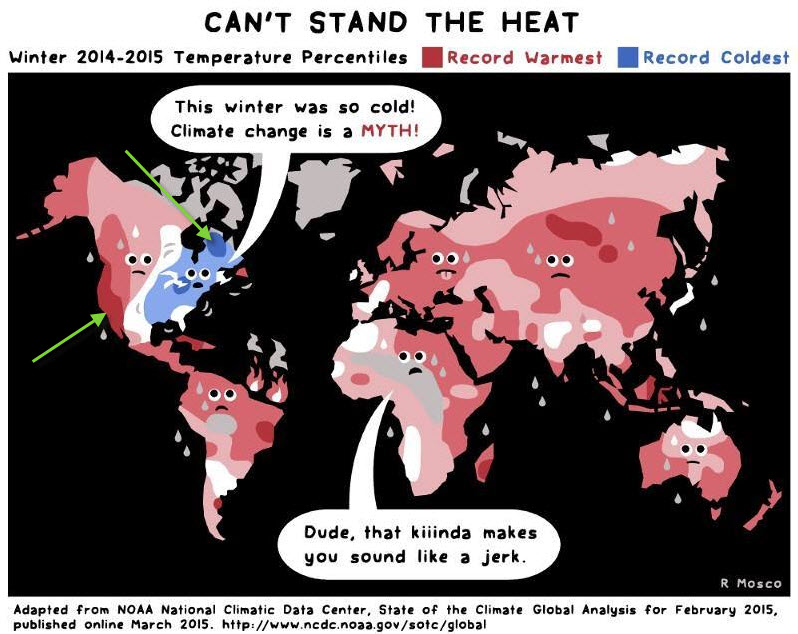
Climate is a matter of perspective. If you don’t travel much, you can easily get the wrong impression.
[click to enlarge]Our company has offices where the two green arrows are. The record coldest place and one of the record warmest places this winter. I don’t have to tell you what it was like a month ago to travel in 8 hours from the warm side to the cold side. Almost 100 degrees difference in temperature.
Today the governor of California went on national TV and told climate deniers to wake up and smell the drought. While this was theatrical and effective, it was no more or less showman-like than what the senator with the snowball did a month ago in Washington. Sorry, Mr. Brown, but the fact that it has been dry in California for a few years by itself if proves nothing about climate change. I would have expected more substance from our governor.
The drought in California is serious. I have never seen our lakes so low and our hills so brown. And I am very concerned about our water use.
This is the view I have when I back out of our garage. The gate in the middle of the picture is our front garden gate. Everything behind it is our responsibility to groom and water. The home owners association if responsible for everything in front of the gate. It’s lush and green, because it gets watered heavily, and much water runs off the driveway and down the gutter. Hundreds of houses in our neighborhood are watered this way. Millions of houses in California.
While I have the power to flush my toilet less, I am in dismay when I realize that a month of no toilets would probably save less water than is getting spread over my front lawn every day – and I have no control over that.
Here is the water usage in California:
This is worse than the 80/20 rule. 80% of our water in California goes into agriculture, and it produces 2% of our economic output.
Yet, the governor in his directive has targeted the 20% residential and industrial users to curb their water use by 25%, while the agricultural community is just given “guidelines.” This makes no sense to me.
It show how much water the entire city of Los Angeles uses in a year (about 0.8 billion cubic meters). Then it compares this to the amount of water needed to produce the walnuts exported overseas from California (1.0 billion cubic meters), and the water needed to produce the almonds exported overseas from California (2.3 billion cubic meters). Ten percent of all our water is used for almonds. Almonds cover 940,000 acres in California.
I say, we forget about producing almonds and shipping them to the rest of the world, and we have plenty of water for all the cities in California for a very long time.
None of this makes any sense to me.
Governor Brown, wake up and smell some common sense.
This is one of the strangest movies I have watched – sort of – in a very long time. It should have been called Incoherent Vice, because from the first minute on, and then slogging through 2 hours and 28 minutes, I never knew what was going on, and I really didn’t care. When I figured out it was going nowhere, I got up and cleaned the kitchen and did the dinner dishes, while the movie kept droning in the background. Then I went to the pool and swam five laps. I got back, took a shower, and sat down and watched the remaining hour. I hadn’t missed a thing.
Larry Doc Sportello (Joaquin Phoenix) is a private investigator who is trying to solve some problem I can’t figure out what it was. Groovy.
My recommendation – just watch the trailer – and you’re good. You save yourself two and a half hours of your life and the cost of the movie – and you’re not missing a thing.
The half a star is because a song from Neil Young’s album Harvest was in the soundtrack.
In the nearer future, about a century from now, humanity builds starships. The Leonora Christine is the seventh ship of its generation, and she getting ready to depart. The world selects 50 people, 25 males and 25 females, to travel to the third planet of Beta Virginis, which has previously been visited by a robotic probe and found highly likely to be habitable. Beta Virginis is about 50 light years away. To get there, at the speed of light, would take 50 years, if anything could travel that fast. To send a message back to Earth once they got there, would take another 50 years. So a hundred years later, the descendants of the star farers would first find out about the fate of the crew.
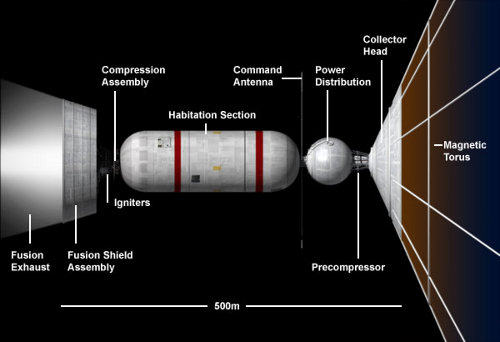
The Leonora Christine is a starship based on the Bussard ramjet concept. The ship scoops up interstellar molecules in a large magnetic funnel it pushes ahead of itself and converts this matter into energy for its reaction drive. Here is the description of the Leonora Christine in Chapter 2:
Her hull was a conoid, tapering toward the bow. Its burnished smoothness seemed ornamented rather than broken by the exterior fittings. These were locks and hatches; sensors for instruments; housings for the two boats that would make the planet-falls for which she herself was not designed; and the web of the Bussard drive, now folded flat. The base of the conoid was quite broad, since it contained the reaction mass among other things; but the length was too great for this to be particularly noticeable.
At the top of the dagger blade, a structure fanned out which you might have imagined to be the guard of a basket hilt. Its rim supported eight skeletal cylinders pointing aft. These were the thrust tubes, that acclerated the reaction mass backward when the ship moved at merely interplanetary speeds. The ‘basket’ enclosed their controls and power plant.
Beyond this, darker in hue, extended the haft of the dagger, ending finally in an intricate pommel. The latter was the Bussard engine; the rest was shielding against its radiation when it should be activated.
At an acceleration of 1g, the ship can accelerate to relativistic speeds (close to light speed) within about one year. Based on Einsteinean physics, onboard time slows down drastically as an object nears light speed. Decades go by on earth while the people on the ship may experience only a few months, or days, or minutes – depending on how close to light speed the vessel travels.
On the way to their destination the ship encounters an unexpected obstacle in form of a dense cloud of matter. As they hit it, some damage is done to the decelerator. In essence, the ship going effectively at light speed has lost its brakes. It can’t stop once it gets to its destination. They have to come up with an alternative plan.
The result is a cosmic journey where the ship travels through entire galaxies (which would take 100,000 years) while the passengers experience it as a mere turbulence lasting a few seconds, speed bumps in star travel. They end up going to the edge of the universe and time itself.
Tau Zero is a very hard science fiction story. Anderson spends time on his character development, but for the most part they are caricature-like and the human side story, while important, is secondary. The scientific concepts he illustrates blow the mind.
Concept by space artist Adrian Mann
The technical concepts for the ramjet are described at Centauri Dreams for those of you that are interested. The Bussard ramjet is also described in this post Cruising the Infinite, among a number of other star travel technologies.
Conceptually, approaching light speed, the ship gets ever more massive, and time slows ever more down. So the trip between two galaxies that are 50 million light years apart could be perceived as taking a day on the ship – depending on how close to light speed the ship travels. The result, of course, is that from the viewpoint of the rest of the universe, the ship is traveling for 50 million years.
Anderson uses these relativistic concepts throughout Tau Zero. It is intense scientific reading. It needs to be read slowly, except for the human-interaction parts, which seem hokey in comparison. I skimmed over those.
Written in 1970 (45 years go!), Tau Zero is the time dilation book of all time dilation books. I recommend it for hard science fiction aficionados only. Everyone else will be totally lost.
The little girl thinks the camera pointed at her is a weapon, so she surrenders.
The United Nations estimate that the Syrian civil war of four years has claimed more than 200,000 lives, including 10,000 children. Almost four million people are registered as refugees in neighbouring countries, and 6.5 million displaced within Syria.
And the dictator goes on 60 minutes in a suit and lisps that the people want him there.
I have always respected Southwest Airlines. That company does a lot of things right.
I flew back from San Jose to San Diego on Tuesday night on flight 255. I sat in the back of the plane, so I was one of the last few people to get off after we landed. As customary with Southwest, the flight attendants clean the airplane between flights. As the passengers deplane from the front, the flight attendants work their way back through the rows on both sides, rubber gloves on, with trash bags in hand. They pick up litter from the seats, floors and seat back pockets, and they fold the seatbelts so they look clean for the next group of passengers.
By doing this, I am sure, Southwest not only keeps the cost down by not needing separate cleaning crews, but they also have unparalleled turn-around time at airports. I have seen them land, deplane, board and leave in 30 minutes.
On flight 255 the other night, I noticed something new: The captain was cleaning the plane. He was working his way through the plane with rubber gloves on, chatting it up with the crew and greeting the passengers, as he cleaned the seats.
Margaret won a trip to the South Pacific with a companion. She chose Lillian, her daughter-in-law. The two women are on a small jet plane on the way to Fiji.
Dave is the public relations man hired by the company to escort the women on their trip. Theresa is the flight attendant. And Kent is the pilot.
The plane hits a storm, loses an engine and eventually performs a crash landing in the ocean. Theresa is dead – she was not strapped in when turbulence hit. The other four survive and float in the plane’s life raft in the vast Pacific, with a small first aid kit, and one 16 ounce bottle of water.
Eventually the raft arrives at a small, uninhabited island, and the four of them start the battle for survival. Only Lillian and Dave survive and are eventually rescued, almost two years later.
Wreckage is about survival, love, passion, fear and choices in life. Half the book plays in the present, after Lillian and Dave have been rescued, and what happens when they try to fit back into their old lives, with their spouses and families, who had long thought them dead. The other half of the book is told by Lillian and Dave as they experience the plane wreck, and their Robinson Crusoe life on the island.
The story switches back and forth between the two perspectives. The present story is told in the past tense (ironically), while the past story is told in the present tense. I found this jarring and it disrupted things for me. I have never before read a book where the present is told in the past tense, third person, while the past is told in the present tense, first person. Lillian and Dave both get turns, telling their experiences and feelings on the island.
Wreckage is a story that had me turning the pages and kept me wanting to know what happened next. But the organization of the book was not very fortunate. It distracted. I never quite got used to constantly having the change back and forth between the third person and the first person. That part didn’t work for me, and it definitely resulted in one less star overall.
Otherwise, Wreckage is a well-crafted mystery story of survival and life choices.