Book Review: Reflections of Toddsville – by Hollie Van Horne

reflections-of-toddsvilleIn romance novels, men always wrap women into their strong arms. When lovers undress each other, they kiss every inch of flesh as they do it. A man’s hair is often unkempt. Lips are burning. Bodies are vulnerable.

I suffocated his mouth with my burning lips. He wanted no more movement from my vulnerable body. I was to remain powerless. No hint of speed lay in his temptations. My suitor’s sensuous snare of his captive was slow, measured, and calculated for mutual pleasure.

One by one he undid my stockings from their garters, rolled them down my thighs, then tossed them to the floor. I could hear my heart pounding and feel my temperature skyrocketing.

What possesses me to read this stuff? I could feel my temperature skyrocketing???

That’s what romance novels are like. I picked this one up some time ago because it had a central plot of time travel. The time travel in this novel, at first, seems like a contrived plot twist only to send the heroine from the current time of 1997 back to 1897 into the Victorian era in upstate New York. But as the story rolls on, the time travel aspect actually becomes more intricate and once I was about halfway through the book of 414 pages, I kept turning the pages with interest and suspense.

Let me get this straight – I did kind of fast forward through the romance slush – that did nothing for me. However, the descriptions of the locales, in and around Cooperstown, New York and Otsego County were excellent. I always felt like I was right there with the characters. It was a well-woven plot with a satisfying central time travel theme.

Gertrude Johnson lives in Brooklyn, New York in 1997. She is 28 years old and a famous romance novelist. To get away from the hustle, her agent sends her to a cabin in upstate New York by Cooperstown for the summer. One night she falls asleep in her cabin, only to wake up at 2:00am with a strange man in bed. The two are baffled. They quickly discover that she is now in 1897 and must cope with the fact that she is in a strange world with nothing but a flowery nightgown and her memories.  The two hit it off. Gertrude’s love life is about to change.

I read this as a hardcopy book, published by Time Travelers LLC in 2000. There were a surprising number of editorial errors, from misspellings of words, to faulty grammar and punctuation, to beginner’s errors like wrong plurals. For instance, the plural of session is sessions, not “session’s.” Things like that just should not happen, and especially not to the degree they happen in this book.

I enjoyed Reflections of Toddsville, but I won’t read any more books of Hollie Van Horne.

Rating: ** 1/2

Book Review: Aurora: A Child of Two Worlds – by David A. Hardy

AuroraI would never have found this book, hadn’t its author posted a critical comment on my book review for Voyage by Stephen Baxter. I had too many other books to read and simply didn’t feel like finishing. David Hardy admonished me that I should not be reviewing a book I had not finished. That got my attention and I followed the author to his website and found that he was a famous science fiction artist and writer.

Voyage by Baxter is a story about alternate history, where humanity didn’t stop interplanetary travel after visiting the moon, but went on to Mars. Aurora by David Hardy deals with similar subject matter, and much of the action in the novel takes place on Mars. I can see why he found my post about Voyage.

In Aurora, a group of six astronaut scientists land on Mars with the objective of searching for traces of life. When they go about their business they are more successful than they could possibly have dreamt, as they find much more than traces. They uncover actual technological artifacts, apparently still in working order, and what looks like a flying saucer. The longer they look, the more surprises they find, and very soon they and all the scientists back on Earth at Mission Control are completely baffled. Nothing seems to make sense.

Aurora is an intricately designed story with a complex plot. I found the first ten percent of the book somewhat confusing. I didn’t quite get engaged. Fortunately, the author’s words rang in my head, ordering me to stick with it, and I did.

The pace picked up tremendously when the action on Mars started unfolding. Gradually the story pulled me in and I started turning the pages. It felt almost like the book took off the training wheels at that point and the action moved right along. The suspense in this novel didn’t come from danger to the protagonists, but from wanting to get answers to the impossible situation the astronauts encountered.

Anybody interested in interplanetary travel stories in the near future, as well as pseudo scientific topics like UFOs, dousing, extrasensory perception and telepathy, would certainly enjoy Aurora. The concepts the author introduces are thought-provoking. There is even an element of time travel involved, my all-time favorite science fiction topic. This book packs it all in. In the end, I will never think of Mars in quite the same way again.

When I was finally done reading, and the storyline had closed in on itself, I had the urge to go back and read the beginning again. Now it made sense. I have done that with other books occasionally. Here it did the trick. It all came together nicely.

Aurora is a fresh and unique story about aliens that are not so alien at all.

Rating: ***

Buy the book here.

Movie Review: Safety Not Guaranteed

I could not resist a movie with a time-travel concept. I never can.

A writer for a magazine, Jeff (Jake Johnson), and two interns, Darius (a girl) (Aubrey Plaza) and Arnau (Karan Soni) see the want-ad above and track down the guy that posted it. They find Kenneth (Mark Duplass), a quirky supermarket clerk who believes he invented a time machine.

Jeff is a slacker who wants to do the story only so he can hook up with an old high school girlfriend. Arnau is a virgin Indian geek who is hunched over his laptop (game grade) most of the time. Darius is an intense, sarcastic loner.

Kenneth is in the process of training up for the mission to go back to 2001, to make some changes. He lives in the woods, practices martial arts and gun fighting, and steals high-tech equipment from laser companies. In the process he not only attracts the magazine crew, but also government agents. It is Darius who ends up being Kenneth’s compatriot and partner, getting ready for the mission. As the story progresses, she finds that her reason to want to go back in time is similar to that of Kenneth. We find out that Kenneth is definitely paranoid and somewhat crazy.

Or is he?

An offbeat, low-budget movie from the producers of Little Miss Sunshine, Safety Not Guaranteed is delightfully entertaining and suspenseful. It sounds like a comedy, and there are definitely plenty of comedic moments, but it’s also a character study of lonely twenty-somethings in the torrents of life.

Being a time travel buff, wanted to see the time travel. The ending is surprising and leaves the possibilities open.

Rating: ***

Movie Review: Looper

It’s 2044 somewhere in America. Time travel has not yet been invented, but it will be by 2074. As soon as it’s invented it is made illegal. As with all prohibition, once something is illegal, it’s only accessible through crime and the mob. Gangsters in 2074 are as unimaginative as they are today, and the best use of an amazing technology like time travel they can come up with is disposal of enemies of the mob.

It appears that time travel is unidirectional; you can only go backwards. It also appears that you can only do it once. Once you are in the past, you are stuck there. Joe (Joseph Gordon-Levitt) is a time traveler, who came from 2074, sent by the bad guys to 2044. He is called a looper.

When the time comes, he drives an old pickup track out to the fields, spreads a plastic dropcloth and watches for the exact time for the stiff to arrive. The victim is sent back with a hood over his face. This way, neither the victim knows what’s happening, nor does the killer know the identity of the victim. At the predetermined time, out of thin air, the victim materializes. Joe stands there, shotgun aimed, and a split second after the victim appears he is killed and soon disposed of in an incinerator.

The loopers otherwise live normal lives. They grow old like all of us, and within 30 years they catch up to 2074, the time their younger selves left. At that time, the bad guys round up the loopers, and send THEM back in time once more, to be killed themselves. That’s called “closing the loop.”

When Joe reaches that age, he is Old Joe (Bruce Willis). Sure enough, one day Old Joe get gets rounded up by the mob and sent back in time.

There is a scene when Joe sits in a diner with Old Joe having a conversation about their shared life. As you might expect, things start getting very complicated.

Looper is a meticulously plotted time travel movie, which does not get caught up in the paradoxes of time travel, but uses them to build the story. 2044 (and 2074) is a wasteland, not much distinguishable from urban slums of today, except for the occasional strange machines like floating motorcycles. I enjoyed the movie, except for the endless and graphic violence. There was a lot of shooting going on, and the guns in this movie are LOUD. It’s a movie where just about all the characters are killers and therefore shooters.

Of course, there are a lot of loose ends, like why does Joe after looping, as he grows into Old Joe, not ever meet up with Young Joe before he looped? They were both there togther in the future world, and the growing Old Joe would have known about young boy Joe. But that’s outside of the plot of this movie – I just can’t help myself.

Oh, and I forgot to mention the TKs, or telekinesists, who can move objects with their minds and use that amazing skill to pick up chicks by floating quarters in bars.

Rating: ** 1/2

Book Review: ChronoSpace – by Allen Steele

ChronoSpace is a gripping, entertaining, captivating time-travel science fiction novel.

Steele wrote and published this novel in 2001. I bought the book then, and somehow I managed to read some way into it before putting it aside, perhaps to make time for something else that was more important at the time. I recognized some of the early passages, so I knew I had read the book, but I could not remember much of the plot. Little did I know that I had such a good time-travel book, unread, in my boxes of paperbacks in the garage!

Dr. David Zachary Murphy works for NASA in Washington, D.C. in 1998. He is a life-long science fiction aficionado, and an aspiring science fiction writer, but he is not good enough at fiction to pull it off. Instead, he writes speculative articles on scientific topics in magazines. When he one day speculates that flying saucers might actually be time ships, filled with human time travelers, the gets more attention than he bargained for.

The story moves around between 1937 on the famous doomed Hindenburg Nazi airship, 1998 when Murphy writes his story, 2024 and 2314, from where humans are leaving for time travel excursions. We get to go on time trips with the travelers and see them from the perspective of the locals. We watch as the smallest mistake causes a paradox, which causes a larger paradox, which results in a massive change of the entire chain of world events, affecting every human being.

How to  fix that if you’re the one who made the mistake?

Rating: ** 1/2

Book Review: 11/22/63 – by Stephen King

This is the fastest I have ever read an 850-page book. Stephen King is a master story-teller. Characters come alive in front of your eyes. I have read many of King’s books, and this is one of the best, right up there with The Stand. King does not make pretenses with his books; he simply entertains.

Many of Stephen King’s books are based on a simple premise: What If….

That applies to The Stand as well as Under The Dome, and of course 11/22/63. In this case, the question is: What if there were a time travel portal in the pantry of the local diner that allowed you to travel into the past and then come back. No explanation how this might be possible. It really does not matter. You have to accept this What If premise, and you have yourself a marvelous story.

I love time travel books, and this one reminded me of a few others, and particularly of Replay by Ken Grimwood. There are many similarities in the concept.

Al Templeton ran a diner in rural Maine. He discovered a time portal in his pantry that instantly transported him from the present back to an exact  time and date in September 1958. No matter how long he spent there, no matter what he did there, when he returned through the portal he’d be back exactly two minutes after he left.

Eventually he convinced his good friend Jake to travel back, wait 5 years in the past to prevent the assassination of Kennedy on 11/22/63.

This seems simple, when you know the history and the exact events of the assassination, but it turns out that the past is obdurate. It does not want to be changed, as Jake found out many times over.

11/22/63 is a history lesson, a love story, a time travel speculation and a tour de force action book all in one. I could not put it down. When I was done, I wanted it to go on.

Stephen King, Time Travel and Maui Trade Winds

I was on an airplane home from Florida last week. People were still getting on board, when I saw an article in the USA Today paper about Stephen King’s new book 11/22/63. The review said it was excellent, vintage Stephen King, and it was about time travel back to 1963 to prevent the assassination of John F. Kennedy.

Well, I can’t pass by a time travel book, and I can seldom pass by a Stephen King book.

I turned on my Kindle, turned on wireless, found the book and bought it, all in – I swear – less than 60 seconds. I put aside (in the Kindle this is easy) Evolution by Stephen Baxter for later, and started reading 11/22/63.

Since it’s a book of 850 pages in hardcopy, it will be a while before I am done. Great reading with the Maui trade winds blowing through my hair.

What hair?

Book Review: The Door into Summer – by Robert A. Heinlein

Here is a classic misleading book cover. Yes, there is a cat central to the plot in this book. There are also several women, one villain, Belle, and one heroine, Ricky. I don’t know who the woman on the cover art is supposed to be.

Heinlein lived from 1907 to 1988 and is widely recognized as the most influential science fiction writer of the 20th century. His classic Stranger in a Strange Land is probably his most famous work, but there are many others, and I have read most of them. His science fiction always focused on character development, and he is one of the few authors who, besides creating engaging and intriguing science fiction plots, also got into the human side of life. His characters kiss, get naked and have sex. There seem to be nudists in many of his plots, and there are some key nudist characters in The Door into Summer.

The story starts in 1970. Dan Davis is a genius engineer involved in robotics. He loves his cat Pete. Dan starts a successful and revolutionary robotics company named Hired Girl. The company specializes in household robots. He is vastly successful. Then he decides to take the Cold Sleep, which is a cryogenic sleep, allowing the person to arrest all body functions and wake up at some time in the future. He decides to sleep until the year 2000.  But before he does, he sets his affairs in order. What he does not realize soon enough is that his fiancée Belle and his buddy Miles are screwing him out of his company. And so the plot runs.

I don’t know how I missed reading this book during my heyday of reading Heinlein in the 1980-ies, but I did. It’s a time travel story, and a great one at that. I enjoyed it for that alone.

But more of a crack-up was the fact that Heinlein wrote The Door into Summer in 1957. So when he made it play initially in 1970, he basically put the story into the near future, assuming some improvements in science and engineering, resulting in Dan being an engineer in robotics. So we see what Heinlein thought the near future would bring by 1970.

But then, he had Dan sleep for 30 years until 2000. For Heinlein, 2000 from the perspective of 1957 was 43 years in the future – utopia for all practical purposes. To have Dan travel into the year 2000 was going into a fantastic future.

This is particularly enjoyable to watch for me from 2011 – a full eleven years after 2000, when 2000 is actually a long time ago already.

You’ll have to read The Door into Summer to find out what Heinlein thought 2000 would be like, but I’ll make a few observations that don’t spoil the story. Here is one segment in chapter IX:

I could have saved time by hiring a cab to jump me to Riverside, but I was handicapped by lack of cash. I was living in West Hollywood; the nearest twenty-four-hour bank was downtown and the Grand Circle of the Ways. So first I rode the Ways downtown and went to the bank for cash. One real improvement I had not appreciated up to then was the universal checkbook system; with a single cybernet as clearinghouse for the whole city and radioactive coding on my checkbook, I got cash laid in my palm as quickly there as I could have gotten it at my home bank across from Hired Girl, Inc.

Obviously, there were no automatic teller machines in 1957, so Heinlein could not predict them. His view of the banking system in 2000 is hilarious. In his 2000, there are still typewriters, but electric ones. He misses cell phones entirely. People still have to walk to pay phones to make calls. There is no Internet or anything like it, except perhaps the cybernet above for banks. There are no personal computers, and there are few computers at all. Research is still being done at the library and by going through archives.

Dan is inventing robots that do housework. But the robots can only understand rudimentary English in 2000, like: Go, No, Yes, Give Me, etc. They cannot understand spoken language, and when they have a problem, they hand a card with a printed error message to the user. No screens. He is also inventing a drafting machine, some mechanical apparatus that does engineering drawings. No Autocad, no screens, no mouse, no computers.

Cars have not changed that much. Clothes have. People wear synthetic material called Sticktite which appears to be some thin material that is stuck to the body. This apparently does not leave much to the imagination in terms of sexuality. But I wonder how the less attractive people deal with it.

There is a Great Los Angeles, a Great Asia Republic, and England is a province of Canada!

Finally, to make the plot work, a physicist has discovered rudimentary time travel, with some pitfalls built-in. But you have to find out for yourself how that works.

Overall, the story was pure Heinlein, the science fiction engaging, but the most fun was to see how one of our great science fiction writers saw the far distant future of 2000, from the vantage point of 1957.

Rating: ***

Book Review: Timelines – by Bob Blink

Good thing I do not judge a book by its cover, especially when it’s on the Kindle and it does not have a cover. I looked it up on Amazon. I’d almost be embarrassed being caught reading a hardcopy of Timelines in public with this cover art.

I wonder who Kelsey Giosso is, who got credit for the cover art? It makes the book look cartoonish, childish and hokey.

Notwithstanding the awful cover art, this is hands down the best time travel book, alien book and science fiction book I have read in a very long time. It appears to be Bob Blink’s first novel (at least I can’t find much about him online – yet). That will change.

Blink is a first-rate story-teller, who captured me with the first sentence and didn’t let me go for 598 pages. Unlike in other first books and particularly first science fiction tomes, where the action often floods and ebbs between frantic movement and boredom, in Timelines, things move along at a steady and pace, consistent and almost with a cadence.

Jim Crampton, the main narrator, is a science type who discovers a mysterious cave entrance while hiking outside Seattle. The cave turns out to be the entry portal to a large and advanced complex that allows him to travel through time, as far back as 52,000 years ago, and as far into the future as the year 7100.  For a year or so, it remains his secret. Eventually, he brings in other people and develops a team of experts that includes scientists, historians, computer experts and physicists who help study the technology. It turns out the time complex was established by an alien race with a far advanced technology. They try to understand the motives of the aliens, and as the story progresses, it appears more and more sinister.

Eventually, they decide to bring in the U.S. government for help. As they suspected, however, the government starts messing things up.

Minor spoiler alert: It’s funny to see how the U.S. government (the action plays in 2006), the various branches of the military and the bureaucracy jostle to get control of the technology away from Crampton and his team. I was amused how the U.S. bungles things. When the team approaches the Israelis for help, they don’t fool around, they get the job done Israeli-style, and eventually come through. The U.S. is doing nothing but messing things up.

Timelines spurred my imagination. At times I would put the book down, stare into space and just marvel at the possibilities. There are aliens involved, and there is no question about what they look like and what they can do. The time travel concepts are solid and well explained. This book shows well what just might happen if humans stumbled upon advanced technology that they don’t understand but by some coincident got a hold of.

There are a very few things I would suggest the author should correct: He overuses two trite expressions. First, one character or another keeps bringing somebody “up to speed” when the need to inform arises. People are being “brought up to speed” at least thirty times in the book to the point where the reader is tired of the phrase. Second, characters always seems to “grab” their food. They grab sandwiches on the way out, they grab a burger and fries, they grab a quick dinner. Too much grabbing of food.  There are also the usual Kindle editing errors, with word endings wrong or dropped off, that I would expect an editor to find before the book is sold – my usual Kindle criticism.

This book is a well-woven tale of complex plot twists and new surprises every few pages. It is told at just the right pace, the right mix of dialog and narrative, and it is completely satisfying. Too many science fiction books leave things unanswered and open, angling for sequel opportunities or simply getting out easy by employing science dei-ex-machina. Blink writes a conclusion that makes sense, ties off all the subplots, accounts for all the characters and makes sure that the all lived happily ever after.

Timelines is a formidably satisfying science fiction time travel story.

Rating: ***

Book Review: To Say Nothing of the Dog – by Connie Willis

I picked this book up after a coworker recommended the time travel books Blackout and All Clear by Connie Willis. When I read the Amazon reviews, I came across To Say Nothing of the Dog, and its reviews were consistently better. So I chose the safe way and picked it first.

When I buy a book in the bookstore, I always read a few pages, the first page, and a random one in the middle, to see if I am going to like  the style. Many a good-looking book does not pass that test and I put it back on the shelf, unpurchased.

With the Kindle, while it is possible to download a sample, I tend to not to do that, and buy books outright. I need to stop that. Rule 1 when buying eBooks:

Read the sample chapters before buying.

As I read the first chapter I discovered that I didn’t like Willis’ dialog heavy and somewhat rich style. There was so much going on, so much dialog, right in the first few pages, that I was thoroughly confused, and I started just skimming forward with the expectation that I would  not make it very far. Then things get clearer in the second chapter, so I continued, faithful reader that I am, and I lumbered forward into Chapter 4, 14% into the book. That’s when I gave up.

If you like time travel, this is a great, colorful, sometimes funny and probably very fulfilling story. It’s pure time travel, no doubt. But there were some things going on that seemed so dumb, so farfetched that I simply could not ignore them and I got yanked back from the world of  the book into the world of the book critic.  The book didn’t capture me, it kept pushing me out and then yelling “Look at me!”

For instance, fairly early in the story the protagonist Ned Henry is sent back to June 7, 1988 to Victorian England, near Oxford. He prepares for the trip in a rush, being outfitted with the right period wardrobe, luggage and money so he could pass for a “contemp” when he got there. In the hurry of the preparations, however, he misses the details of his actual mission, and when he get there, he does not know where he is and what he is supposed to do. This is good for interesting plot development and conflict initiation, but it’s just too incredible that an outfit designed for time travel with the technology and infrastructure to send countless agents into the past for many different missions, would not have a better process in place to brief its agents on the mission.

Ultimately, I am sure I could have finished reading the story with enjoyment, but with a reading list as large as mine and so little time, I decided to say bye to the writer Connie Willis right here.

Book Review: Pathfinder – by Orson Scott Card

I think of Card as a science fiction writer primarily, but he writes fantasy stories very well. Pathfinder is listed as a Young Adults book. Three of the main protagonists are kids aged 13 to 16, and the writing reminded me of Stephen King.

There are many flaws with this book, but several overarching facts made me love and savor it. First, I can’t get enough time travel books (just check my blog category for that), and Pathfinder is, above all, a story where time travel contributes to the plot in a major way. Second, I really like “ark” stories, where humans leave Earth for whatever reason in a one-way spaceship on a mission to colonize another world. Most of such stories focus on the building of the ark, the departure, and sometimes the trip itself. I have found myself yearning for an ark story that continues when the ark actually arrives at its destination, be it after a few years of travel including hyperspace jumps, or after generations of ship-bound human evolution.

Pathfinder describes the journey of the ark, albeit in an abbreviated and not well-developed format, and also focuses on what happens when a ship arrives at a target planet and colonizes it.

I will be careful not to place spoilers into my discussion here, but Card describes a human society that has developed after an interstellar trip on an alien and terra-formed world over a period of 12,000 years. Of course, the people have no memory of where they came from. There are religions and legends that developed.

Human “modern” history starts about 5,000 years ago, when writing was first developed and the first permanent monuments were built. For us on Earth, 2,000 year old events , say the Roman times, seem truly ancient history. But then, the pyramids were already 2,500 years old when the A.D. calendar started, ancient even then. 12,000 years is truly a long time for human society development and history.

We meet the main characters dealing with complications in their society after 12,000 years of isolated human society on an alien planet. Card gets us into the heads of the kids and their adult companions. The kids have “gifts” which allow them to manipulate space-time in unexpected ways. This brings the fantasy part into the story.

Card is not a strong hard science fiction writer. He does some hard science fiction here, but he does not do it convincingly. He discusses issues of terraforming a planet, but he glosses over so many details that it does not seem credible. Similarly, he describes a hyper-space jump of the ship, touching on hard science fiction concepts, but leaving them unresolved. But neither bothered me much. I just wanted the story to move on, and I suspect that’s what Card had in mind. He wanted to move along the plot, give the reader just enough background to figure out what was going on, but he wanted to focus on the time travel aspects of the plot.

That, too, is acceptable. There was just one problem: In the acknowledgement section, which read like an afterword, he actually finds a need to describe the science once more to inform the reader of what actually happened.  This tells me that Card himself realized that he didn’t do an adequate job telling the story in the first place.

Finally, the ending was a non-ending. Card just stopped writing. Clearly there is a sequel coming, because otherwise there would be too many questions unresolved. Of course, Card makes this statement about Pathfinder in his blog:

It’s the first volume of a saga about a young man, Rigg, who discovers that he and his friend Umbo have the power to fiddle with time. He also learns that he’s a member of the royal family, carried off as a baby and raised in a remote forest.

Overall, Pathfinder was a gripping work. I would not classify it as a Young Adults book. It’s classic science fiction / fantasy. It’s classic Orson Scott Card.

Rating: ***

Book Review: Against the Tide of Years – by S. M. Stirling

The second book of the Change trilogy by Stirling, following Island in the Sea of Time.

Good:

Stirling must have done deep research to write this trilogy. I learned a lot about the Bronze Age, how people lived then, thought, loved, feared, raised their families and how they died.

Stirling develops colorful and multi-dimensional characters that I could see and emphasize and identify with.

The underlying premise of a 20th century society (a small town’s worth) being thrown into 1250 B.C. and having to cope is a fascinating “what if” question and the development of the story, from the first through the second book, kept me turning pages without rest.

Bad:

There was not enough new material here compared to the first book. The battle scenes went on too long andwere too explicit. After a while they simply got boring. Stirling could have made the first book 100 pages longer and he would not have needed the second book.

To build on that thought: Each book in a trilogy must stand on its own. Clearly the author made an effort to give enough background to make this possible, I don’t think anyone that did not read the first book could have made too much sense of the second.  I would suspect that any reader that did not read the first book would be lost and would abandon this within the first 100 pages.

Ugly:

There was somewhat of a start of the second book, but there was no end. Somehow the story just fizzled out in the last 50 pages. There was the beginning of a climactic war between the rebel Walker and the Republic, along with the various middle eastern alliances the Republic had forged, but the war didn’t finish – or did I miss something. Ok, I know there is a third book, and I presume it’ll pick up after the second, and the whole thing will eventually get resolved. But then, why three books? Why didn’t Stirling just write one massive epic a la Pillars of  the Earth and be done with it?

This is not a trilogy. This is three books strung together.

Going Forward:

I have already bought the third book, so I am pretending that the second isn’t really done, and I am just going on. Since the books were written starting in 1998, with intervals of a year or so between them, the original readers must have been frustrated, having to wait a year to know what happens next. I can just go right on.

If I had not made the investment of  time of reading the second book, I would probably stop and not bother with 2 and 3 now.  But at this point, I want to know how it all gets wrapped up. If Stirling wraps this up, I’ll probably read other Stirling books in the future. If he does not wrap it up and leaves me hanging, I’ll probably be done.

But now – on to the third book.

Rating: *

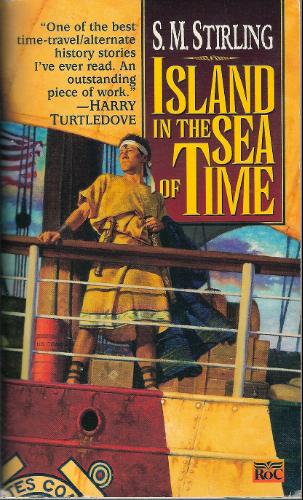
Book Review: Island in the Sea of Time – by S. M. Stirling

What would happen if you were suddenly flung back in time more  than 3,000 years with no warning and the clothes on your back? How long would you survive if there were no stores, no houses to find shelter in, and you didn’t know the language of  the people around you, if there were people around you?

I have backpacked enough, and I know that carrying a minimum load of survival gear, not including food, puts about 40  pounds on my back. That does not include weapons for hunting, as I’d have to live off the land. I would survive days, maybe weeks.

In Island in the Sea of Time, the island of Nantucket, off the coast of Massachusetts, experiences a strange and unexplained electrical storm after which its inhabitants realize something is very wrong with their world. An astronomer who happens to be researching on the island is able to conclude the year to be 1250 B.C. They fly across the water to Boston harbor and  find that Boston is simply not there. Only dense woods. As luck would have it, a U.S. Coast Guard training sailing ship happens to be near enough the island when “the Event” occurs that it comes along. This fact makes a huge difference for the survivability of the island, since they now have a seafaring vessel that can cross oceans, along with a fledgling military force of about  300 cadets, officers and crew.

This is reminiscent of another book I recently read, Stephen King’s Under the Dome, where a town of similar size was forced to deal with a totally impossible situation.

The book describes what would happen if the gasoline stored in the local gas station and in everyone’s cars was the last gasoline on the planet. How long would water keep running? How long would the electricity remain on? How long would the ammunition last? Would anarchy take over?

And what would happen to the rest of the world, happily in the Bronze age, if a 300 foot sailboat showed up off the shores one day, with people who could perform magic, with their weapons, with their healing power, and with their communications?

The main conflict arises when one of  the senior officers on the ship, Lieutenant William Walker, becomes rogue, breaks away, steals most of the weapons, and sails to England in a quest to become king. England in that period is populated by bands of superstitious and fierce warriors who raid one another periodically. Bring in modern weaponry and warfare techniques and see what happens.

Stirling appears preoccupied with female warriors and martial arts. One of the protagonists is the ship’s captain, Marian Alston, a female, lesbian martial artist and ninja warrior. This is a bit improbable, but  you get used to it. I guess it helps to write a good warrior story without having to create another Captain Bligh.

I will stop here.

S. M. Stirling tells a great alternative history and time travel story that kept me turning the pages and had me thirsting for more. Fortunately, it’s a trilogy and the next two books are already awaiting on my Kindle.

Rating: ***

Movie Review: Hot Tub Time Machine

It’s just a matter of time before this blogger, with an item named “Time Travel” in his categories, reviews this movie.

Three best friends, Adam (John Cusack), Lou (Rob Corddry) and Nick (Craig Robinson), forty-somethings reminiscent of The Hangover, Adam’s nephew Jacob (Clark Duke) in tow, spend a few days in a mountain resort. Other notable characters are the Repairman (Chevy Chase) and the Bellboy (Crispin Glover).

Lou is a stark raving lunatic alcoholic and drug addict with no regrets and a desperate lust for life. Adam is a professional just dumped by his girlfriend. Nick works at an animal clinic and is under the thumb of his wife, whom he dearly loves, but for whom he has given up all his dreams. And Jacob is so caught up in the virtual world of Second Life, vegetating in the basement of his uncle Adam’s house that he does not even notice that Adam’s girlfriend upstairs is moving out.

Lou drives home drunk, crashes into his garage, closes the garage door and passes out to rock music and alcohol in his car, engine unfortunately running. While it is not a suicide attempt, it looks exactly like one. So his best friends book a trip to the mountain resort where they used to hang out in the Eighties. 

A frantic debauchery in the hot tub turns supernatural when a power drink spills into the electronics and the four occupants are thrown back to 1986. It takes them a little while to figure it out, but once they do, we watch an amusing journey of the characters trying to avoid paradoxes, making sure that they relive history as they remember it without changing things to the effect that some of them might never be born, and finally trying to figure out how to get back to the present.

The movie does a nice job with the plot and the story line. There is a lot of humor.

In some areas it goes overboard, however, turning what could have been a good, enjoyable and intriguing movie into somewhat of a slapstick farce. There are scenes and sequences that are completely unnecessary. Some examples are projectile vomiting at one point, reminiscent of The Exorcist, and totally unrealistic. Another is strong foul language. We get the idea that these are guys bonding, but give me a break. You don’t need the “f” word three times in one sentence to get a realistic feeling of men having a good time. Then there is the scene where Lou loses a bet and has to give Nick a blowjob in front of a raging crowd. The whole scene does nothing to add to the plot or to the development of the characters at that time. It’s just tasteless.

Perhaps they were added to attract the teenage slapstick crowd, but all they did was lower the overall niveau of the film and definitely resulted in the removal of a star in my rating systems.

This is a pretty good and enjoyable movie, particularly when you rent it and didn’t spend ten dollars a head at the theater. It deals with a rich subject matter that could  have been much more refined and intriguing, but the film makers opted the easy way out and put in scores of grotesque Hollywood shock scenes to fill the time.

In summary, this is a reasonable movie that could have been much, much better.

Rating: **

Book Review: A Twist in Time – by Susan Squires

Look at the book cover above. Does it not reek of romance novel? Handsome hunk kisses girl with Golden Gate Bridge and sunset  in background. We can’t see his naked body, but believe me, it’s very much described in the book.

What possessed me to read a Susan Squires romance novel?

The answer is simple: I didn’t know who Susan Squires was, and since I don’t buy books in bookstores anymore, I don’t actually see the covers. This cover would definitely have kept me from picking up the book. Not a chance. I bought the book on my Kindle when it came up in a list of search results looking for “Time Travel” books. The cover was actually on the Kindle list on the left side, but the pictures are too small, black and white and undefined, that I missed it. They say you should not judge a book by its cover, but we all do.

A Twist In Time is a story about a young woman named Lucy with a degree in comparative literature who runs a bookstore in San Francisco. She speaks a number of languages, including Latin, which matters in the plot, and medieval Italian, which also matters. Her boyfriend is a scientist working at a supercollider. She comes across an original book by Leonardo da Vinci in which the shows the design of a time machine. As coincidence has it, the machine is at her boyfriend’s work. With him is an evil CIA operative who serves as a great villain who will stop at nothing to get the time machine.

Lucy gets to test the machine and promptly lands in the middle of a battle between Saxons and Vikings in 912 in England. Swords and blood are everywhere. Lucy gets back into the machine, but at the last minute a wounded Viking falls in with her and comes back to 2010. Since the machine follows where your thoughts want to take you, she ends up in San Francisco’s only trauma center emergency room.

What follows is a credible and suspense packed adventure. How will a 21st century American woman communicate with a 10th century Viking? Since she speaks some Latin, and he does too, it serves as a start. Of all the Vikings to run into, this one speaks several languages fluently, knows how to read and write (more than 600 years before Gutenberg’s printing press), is a superb sword fighter and warrior, but has a sensitive edge to be attractive to a modern woman.

Notwithstanding all that, the author does a good job depicting what their difficulties would be like. How would a Viking transported into San Francisco of today react to the world? I enjoyed the story, particularly the beginning and the end, but I could have lived without much of the middle.

What bothered me most was the endless sexual tension between her and the Viking. Ok, so there is this great-looking, tall, muscular, blond, bearded man with blue eyes and, according to Lucy, extremely attractive genitals. Yes, the author makes a point, over and over again, how Lucy is getting wet between her legs while she is dressing the Viking’s wounds with his “weapon” right there. The first few times I was able to understand that she had to describe that there would be sexual tension between the two, particularly when he was standing naked in front of her. But this went literally on and on. After a while, it got silly, and that’s when I realized that I was really reading a romance novel with a time travel twist, rather than a time travel novel with a little sex sprinkled in. After a hundred pages of building sexual tension, they finally did it. Hooyah. The earth shook. Squires described explicitly how it came about, pun intended.

Oh, well, if I had been a teenager, I’d have loved it. Perhaps if I’d had been a young woman, I’d probably have loved it too. How could I not be attracted to a naked, blond, buff, blue-eyed Viking with long hair and skinny braids on his temples? But I am neither of those two, and so I didn’t get much out of the whole sex thing. All I could think of was to get on with the story.

So yes, it was a time travel story with a time travel plot, but it was really a romance novel with an excuse. I definitely don’t need to read another Susan Squires book, even though I had a good time with this one.

Rating: **