Movie Review: Primer

This 2004 movie came to my attention through an email from Chelsea:

Okay, if you rent the movie “Primer” and can tell me exactly what happens in the last 10 minutes, you are a Sci Fi God. Haha.. but really.. you should Netflix it. I think you’d enjoy trying to figure it out.

Ah, a challenge. Science Fiction, love it. So I got the movie and watched it. Here goes:

Per Roger Ebert: Carruth wrote, directed and edited the movie, composed the score, and starred in it. The budget was reportedly around $7,000, but that was enough: The movie never looks cheap, because every shot looks as it must look. In a New York Times interview, Carruth said he filmed largely in his own garage, and at times he was no more sure what he was creating than his characters were. Primer won the award for best drama at Sundance 2004.

Two propeller-heads, Aaron and Abe, invent a device in Aaron’s garage, apparently after their regular jobs. They wear white shirts and ties through the entire movie. I wondered why they wouldn’t change into jeans and T-shirts for their moonlighting. The dialog is difficult to understand, since most of it is mumbled, sort of like engineers would talk to each other while working in their garage. The topics are highly scientific and engineering laden, and we understand very little, if anything at all. The device they come up with, cobbled together from copper tubing, sheet metal and circuit boards, ends up being a sort of a time machine. They don’t understand what they got, but before long they find themselves performing human experiments by subjecting themselves to the machine, while they really don’t know how it works, what exactly it does and what the dangers might be.

Things quickly get out of hand and the experiment runs away from them. They try to recover, but as in most if not all time travel stories, paradoxes create impossible situations, and we,  the viewers, have an impossible time following along, keeping all the threads of reality in line and tied together.

I must warn you: this is a complicated movie to watch. It’s very difficult to make sense of and follow, and I do not claim I have figured it all out. It was slow and boring, and the music got in the way. But I stuck with it just to give Chelsea her answer and earn my title as Sci Fi God. So here is the answer:

When you travel into the past, as the two guys do, if just by a few hours, you can go and hide behind a bush or a car, and see yourself walk into the building where the time machine is before you went into the time machine. So there is one of you going in, and one of you watching yourself going in. If the one that traveled into the past does not go back to the present (or his future), there are now two copies of the same person walking around, albeit separated in age by a few hours. One can go home to the wife, or the other. What happens if both do?

Both of these guys started messing with the machine on their own, without telling the other, so things quickly became confusing. Which was which? How many are there? Two? Three? More? Once it gets confused, there is no way to clear it up again. That’s what was going on in the last 10 minutes of the movie.  Utter confusion of reality.

An okay movie, but by far not the best time travel story I have read or seen.

Rating: **

Book Review: Time Travelers – by Peter Haining

Originally published as Timescapes: Stories of Time Travel, this book is now titled Time Travelers – Fiction in the Fourth Dimension and is edited and introduced  by Peter Haining. It is an anthology of  short stories by various authors on the subject of time travel. There are three sections in the book:

1. Back to the Present – comprised of nine stories by a variety of authors.

2. Journeys to the Past – another eight stories

3. History of the Future – seven more stories.

This is a sample platter of time travel literature, since some of the stories are sections of other works by many different authors. I tasted some truffles but also some stale brownies. Overall, this book is a great way to learn about authors without committing to reading their whole books. I knew some of the authors, of course, including:

  • Arthur C. Clarke
  • Isaac Asimov
  • Jack Finney
  • Frederik Pohl
  • Ray Bradbury
  • H. G. Wells (of course)
  • Robert A. Heinlein

Each story is introduced by a page or so by Haining, where he gives a background for the story, a little about the author, and the context in which the story was created. This helps a great deal.

It took me a long time to work through the book. It kept making its way back to the reading shelf. Some stories I only skimmed over when I lost interest. Some had me riveted. Most had me marveling about one of my favorite subjects – time travel.

Rating: **

Book Review: The Little Book – by Selden Edwards

Imagine, if you will, that you find yourself transported from 2009 to Vienna in 1897. Don’t ask how it’s possible. Just assume you are there. You go to the train station and take a train outside the city a couple of hours, and you get off in a small town named Lambach. It’s early afternoon on a weekday, and you wait in front of a nondescript house in a quaint neighborhood for a boy to come walking home from school. Here he comes. A skinny boy, darkish hair, fair complexion, a bit shy, with a book bag on his back. You let the boy pass. He greets you “Guten Tag” and you greet back. You know the boy’s name: Adolf Hitler.

You know that the boy would eventually grow up, enter politics, and through a series of maneuverings and sheer luck take control of Germany and bring about the death of upward of 10 million people, Jews in concentration camps, civilians on both sides killed, soldiers on both sides killed by the millions. Would you strangle the little boy right there on the sidewalk and save those 10 million lives and change history?

That’s the question Wheeler Burden had to ask himself in this magnificent story of time travel and history.

Somehow Wheeler and his father Dilly Burden end up transplanted in time, for reasons they themselves cannot understand, to Vienna in 1897. At that time, Vienna was at its pinnacle. It was a leading city in the arts, science, philosophy, music, writing and politics. Kaiser Franz Josef of Austria was still in power, and the Hapsburg empire was still thriving. Nobody but a few intellectuals realized that the empire would collapse within decades and practically disappear. Vienna, at that time, was very much the center of Europe.

The Burden family, starting with the matriarch, Wheeler’s grandmother and her husband Frank, is a prominent Boston society family that somehow descends on Vienna to make history. The plot is so intervowen and so full of surprises, that it’s difficult to describe. Let me just say that besides Adolf Hitler, there are other well known characters that participate in the story, including Winston Churchill, Sigmund Freud, Gustav Mahler, Richard Wagner (in reference only) and many more minor characters.

Wheeler is an American hero, a star student in secondary school, a Harvard graduate, a super baseball player, a rock star, a writer, a philosopher, a liar and impostor, and a time traveler. His father Dilly is just as illustrious. The entire Burden family is unreal. You wonder how the 20th century could have happened without them. But it’s a novel, so you accept it.

When you read a book you learn a lot about its author. To enjoy this book, you have to be interested in European history at the turn of the previous century. Edwards certainly know his history. I imagine he went to Harvard, since the university is too omnipresent in this story. He loves Vienna, its language and culture. He is definitely a baseball player. He knows a lot about psychoanalysis. And he is probably a snob. He worked on this book for over 30 years and it’s his debut novel. He does a good job, and there will be other books, if he can do another one before 30 more years go by.

Rating: ***

Frequency – the Movie

Flipping through the channels I stumbled upon the movie Frequency with Dennis Quaid that came out in 2000. It’s a time travel story where nobody actually travels, but a father and son team manage to manipulate the fabric of time to take out a serial killer and make their own family whole.

The time travel phemomenon is woven into a crime mystery story. The crime paces the action, and the time travel makes it unique.

Well, it’s not actually time travel. A father and son team, the son a cop in 2000, the father a firefighter in the late 1960 decade, both ham radio operators, discover that they can talk to each other over the radio through time after peculiar sun storm activity and atmospheric conditions that result in major northern lights all the way down in New York. They live in the same house, the father in 1968, with the son a little boy already bouncing around, and then the son in 2000, with his father passed away.

I won’t give the story away here. But my favorite scene is the passing of the wallet. The plot has finger prints of the perpetrator on the father’s wallet in 1968. The son needs those finger prints in 2000. How is he going to pass them to him? While they are talking on the radio, the son has the father put the wallet carefully into a plastic bag and seal it. The father knows of a loose floor board under a bay window seat. He hides the wallet there so it won’t be found for 30 years. The son then walks over to the window, lifts up the floor board and voila, in a dusty plastic bag is the father’s wallet. They lift the finger prints at the police lab, and the story moves on. This is one of the simplest yet most intriguing and delightful time travel effects I have seen in any movie.

If you have not seen Frequency, rent it, it’s well worth it.

Rating: ****

Movie Review: The Time Traveler’s Wife

I was skeptical when I heard that The Time Traveler’s Wife would become a movie. It’s such a complicated story. How could it not confuse the viewer?

I watched  the movie today, and I enjoyed it thoroughly. It was a well crafted movie that stayed close to the book’s plot and did not make any major changes. Yes, as always in movies, major details were omitted and the movie isn’t anywhere near as powerful as the book was. But I expected that.

Unlike other movies depicting time travel romantically, like Somewhere in Time, in this story time travel is extremely dangerous and hazardous. The traveler is not in control of the travel, it just happens spontaneously and he can’t take anything with him. So he pops up naked every time, and has to break into places to steal clothes, or get into fights to defend himself against hooligans that don’t like a naked guy appearing out of nowhere attacking them for their pants or wallet.

It is a love story. The protagonist, Henry, is a middle-aged man who first appears to a little girl, Clare, in a meadow near her house. Over the years he visits more often, and eventually they get married when they meet up in “real time.” From their normal lives, Henry makes involuntary excursions into the past and the future, at times visiting himself at different ages, putting together the complex tapestry of his own life.

This is a rich story, well told and crafted. If you enjoyed the book, you have to see the movie. If you didn’t read the book, enjoy the movie on its own merits.

Book Review: From Time to Time – by Jack Finney

This is the sequel to Time and Again which I reviewed not too long ago. Si Morley, the protagonist, has returned to the 1880s in New York City to marry Julia and start a family. But he is haunted about “the Project” where he learned time travel in the late 20th century, and he decides, with his wife’s permission, to go back and find out. He makes it back, meets Rube Prien, one of his associates, who wants him to go to the year 1912 and attempt to prevent World War I by manipulating just the right details in history at just the right time. Reluctantly, he decides to do it, and subsequently he spends most of his time in the 1912 era.

In the process of pursuing his mission, he ends up taking a ride on the Titanic from England to America. We all know what happened to the Titanic, so why would he do a thing like that? It was part of the mission. The key figure in the escalation that led to WW I was an aide to President Taft who happened to travel on the Titanic. Si knew which lifeboat would have room so he could save himself.

He also was with a female “companion” named the “Jotta Girl” which I won’t elaborate about here lest I spoil things for you. The two of them know that in order to change history, dangerous as it sounds, they need to make a slight course change in the Titanic’s path,  just a few feet, so it would miss the iceberg.  He and his companion accomplish exactly that by distracting the man at the great ship’s wheel just briefly, and they think they have accomplished it, until 11:20pm comes around on that fateful night.

Well, I can tell you that if Si and the Jotta Girl hadn’t messed with the course of the Titanic, it would have sailed right past the iceberg and arrived in New York a few days later. But the fact is, our time traveler was on board, and without even realizing it, it was he who ended up sealing the fate. The lesson is: don’t mess with history if you are a time traveler.

The neat thing about this story and Time and Again is that time travel is accomplished not by machines and energy, but by self-hypnosis, manipulating the surroundings, picking the exact time and place, and by pure skill. Once it’s described, it’s completely plausible, and as the reader you get immersed into the story accepting that Si can do this incredible thing. That’s where the magic starts.

I loved these two books.

Interestingly, and I didn’t know this until just now, Jack Finney is also the author of the novel “The Invasion of the Body Snatchers” which has me surprised. I just have to pick up a few more Finney books then.

Book Review: Time’s Eye – by Arthur C. Clarke and Stephen Baxter

A couple of weeks ago my sci-fi nut colleague suggested I might like this book. She will read this and not be offended. She is one of the few people I know who is a published author, and who knows other authors personally. In my book you qualify as a sci-fi nut if you have attended sci-fi conventions and sat at the breakfast table for kaffeeclatsch with Robert Forward, and have met Larry Niven and a host of other writers.

I am grateful to her for turning me on to Time’s Eye. This is the first book of the Time Odyssey trilogy, co-written by Clarke and Baxter. I already went down to the big Borders on Washington Street (I am still in Boston) and got the second book of the trilogy, which I will start reading on the plane home.

The time/space continuum experiences a “discontinuity” for reasons unexplained. Different parts of the earth shift to different times. If you were to be downtown Boston and you stood in front of Faneuil Hall during the “event” on May 21, 2009 at 4:00pm, you would see the sun shift all of a sudden if you ended up say at 10:35am on August 9, 1771. You would be surrounded by horses and buggies. If you were lucky you might spot John Adams walking upstairs for another of the famous fiery revolutionary debates that took place there at the “cradle of liberty.” And you’d be stuck there, in 1771, since the slice of earth where you stood shifted there.

As it turns out, the earth was shifted in many sections, to times as far back as two million years, and all they way forward to 2037. Say you took a buggy and horse from Boston and headed west, through the roads of Massachusetts of the 18th century, and you traveled long enough, you might end up on a slice of earth that shifted 10,000 years and you could run into a Mammoth or a saber tooth tiger.

Needless to say, it was a strange world for those stranded there. Most of the story takes place in what today are Afghanistan and the surrounding areas. Wouldn’t you know it, the two “greatest” conquerors of all time ended up alive at the same time, armies eventually crashing: Alexander the Great and Genghis Khan.

Quickly, how do these two relate on the timeline? My take was they both lived a long time ago. Alexander died in the year 323 B.C. and Genghis Khan died in the year 1227. That means that from Genghis Khan’s point of view, Alexander is twice as far away from him on the timeline as we are.  Yet, to us, both are ancient history. The amazing effects of temporal relativity continue to fascinate me.

In this story, a small and completely outnumbered minority of “moderns” including a few people from 2037, and a regiment of British soldiers from 1880 get thrown in with the ancient Macedonians under Alexander and a few others with the fierce and deadly Mongols. And they make do. What would you say if you were all of a sudden with Alexander the Great. That’s what this story is about.

There is a plot, there are questions that lead you to buy the next book, but overall it’s great speculative entertainment, and that’s why we buy science fiction.

Book Review: Forever – by Pete Hamill

Forever is a very different, very unusual story, mildly implausible, but delightfully entertaining. Overall an extraordinary read. Hamill published this novel in 2003, and while I call it a time travel book, it really isn’t, but yet, it is.

The protagonist is Cormac O’Connor. We follow his life, which starts in rural Ireland around 1720. His father is a blacksmith, a man of honor, who teaches his son well. Through injustice, hard luck and terrible conditions in Ireland in those years, he loses both his parents and travels to America, like so many Irish of those years. He ends up on Manhattan Island in 1740, and through a twist (a covenant) which I do not need to explain further, he lives – well – forever. He is a young man when he steps onto Manhattan, and the covenant requires that he never leave the island.

In 1740, New York is just the lower tip of the island of Manhattan. Further north is farmland. As the years progress, he learns all about the city, its joys, its successes, and its darkest secrets. We watch the history of the city unfold through the eyes of Cormac. He makes friends, lowly friends, and friends in very high places. They get older, and they pass. He has a reputation of seemingly never getting older. As his circle of friends move on and pass on, he finds new people, new women, new businesses, and he lives on.

The story finishes around 2002, with the attacks of September 11, 2001 becoming part of the story.

Pete Hamill is obviously an expert on New York City; he knows its history, its drama, it neighborhoods, its people, and it all comes to life in front of us.

Book Review: Time and Again – by Jack Finney

Another time travel story, this time set in New York City. Finney published this book in 1970, so the present is pre-personal computers, although the first moon-landing had already occurred. The New York City of Finney’s present time is one I recognize at the New York City of my own youth. His story, of course, does not reference the twin towers of the World Trade Center, since they were not completed until 1973.

Similar to the way Christopher Reeve traveled back in time in the 1980 movie “Somewhere in Time” by setting up an exact surrounding and setting his mind to the target time using hypnotic techniques, Si Morley, the protagonist of this story manages to travel back to New York of January 1882. Central to the story is also “The Dakota,” an apartment building on the west border of Central Park. Interestingly, the Dakota is today an exclusive apartment home. In 1980, John Lennon lived there when he was murdered outside of the front door. This is another fact that Finney could not have referenced, of course.

This is a different time travel story, insofar as there is no time machine at all, no technology to make it all happen. We get an in-depth view of life in New York in 1882, with some shocking imagery of poverty, brutally hard work, and the endless struggle to put food on the table, by the vast armies of the poor, as well as the privileged few in upper society.

For instance, a “driver” of a bus was a person that stood on the front platform of a wagon drawn by a team of horses. The passengers are in the bus, shielded somewhat from the elements. But the poor driver is outside, 14 hours a day, standing, driving horses, earning $1.90 a day.

Time and Again is full of descriptions of life in the 19th century in New York City, in rich detail, enough, you’d think, that you could time-travel there yourself.

Book Review: Replay – by Ken Grimwood

Here is a unique book in a number of respects:

  1. How I came to know about it, even though it was written in 1986.
  2. How it fits into my recent readings (time travel stories).
  3. How some of the effects in the book reminded me of effects in The Accidental Time Machine.
  4. How some of the passages remind me of my own life.

Over the holidays, my friend Brian and I talked about books, and he told me about Replay. I said I’d look for it, but as it goes with such conversations, I forgot the title and never ended up following through. One Monday morning I arrived at my desk and it was in my inbox. He must have come by my office and dropped it off for me while I was out of town.

I love reading stories with time travel or similar effects and this book fits the genre perfectly. If you search this blog for books, you will find The Fermata, Time Pressure, The Time Traveler’s Wife and The Accidental Time Machine, all out of that category. I’d love to write a book like this.

Now I have to talk about the effect. First, you must note that the author published the book in 1986, smack in the middle of the Reagan administration. The protagonist is Jeff Winston, a man born in 1945 who started going to college in 1963. He became a newspaper journalist, had a mediocre life, an unsatisfying marriage, mostly due to lack of resources. He died of a massive heart attack on October 18, 1988 at 1:06pm.

Much to his surprise and causing utter disorientation, he ‘wakes up’ in his college dorm room in 1963. After some serious confusion and bewilderment, he figures out that he is simply placed back in his old life, 25 years earlier, with all the characters of his old life still there, and they don’t have a clue. To them, this is just life. He, however, remembers everything. For instance, he remembers the outcome of a horse race with very long odds. So he scrapes up all the cash he can find, a few hundred dollars, bets it all on the horse, and wins $12,000. A few more bets on horses and the World Series, and he has a few million dollars. He does not have to try hard with the stock market before he is a very wealthy young man.

Eventually he makes his way to 1988 again, leading a totally different life this time around, only to die again and to wake up in 1963 a third time. There is a minor issue: there is ‘the skew.’ Every time he goes back in time he drops forward a little bit. So when he arrived in 1963 the first time, it was May 1963. The next time it was a few days later. Then it was months later, and so on. The replays kept getting shorter on a logarithmic scale. This is an interesting effect somewhat analogous to Haldeman’s Accidental Time Machine, where the jumps are on a linear multiple factor, both spatially as well as temporally.

I don’t want to tell you more about the story or the plot in case you want to read this, so I will leave it at this. But I do want to elaborate on how there are passages that remind me of my own life.

There is a subplot that involves dolphins and dolphin research, which was of particular interest to me in the 1988 time frame, when I was seriously considering going back to college for Cognitive Science. I wanted to use computer science (the field I was in), coupled with linguistics (having studied six languages myself) and alien intelligence (dolphins) to research human / dolphin communications. I never ended up in that field, partly due to lack of resolve on my part, and excuses that I had small children at the time that needed the attention, and economics – I couldn’t afford to take time off to start another career. During that time in my life, I read Dr. Lilly’s books on dolphin intelligence and studied up on his research of dolphin linguistics.

In Replay, one of the characters creates a major popular movie, named Starsea, that centers around dolphins, which in turn inspires a young student to study Lilly’s work, linguistics and computer science and work at U.C. San Diego in Marine Biology. Reading that was eerie, this could have been myself, and to think about Grimwood writing about that at the same time I was considering such a career, but finding out now, in 2009, had me marvel about synchronicity.

Incidentally, if you are interested in fascinating science fiction involving sentient dolphins, read David Brin’s uplift series, starting with Startide Rising.

Back to Replay: This was a hugely entertaining book, well written, an inspiring story with a good message to boot.


P.S. Ken Grimwood died of an apparent heart attack  at the age of 59 on June 6, 2003 at his home in Santa Barbara.

Book Review: The Accidental Time Machine – by Joe Haldeman

During my last evening in Tallahassee I stopped at the local Borders and picked up a few science fiction books from authors I had never considered or read before. Of course, I can never resist a time travel story, so when I saw The Accidental Time Machine, I was committed.

I needed a book for the trip back, so I started reading that night. I was planning on working during the next morning on the plane trip back. Usually I only read during takeoff and landing, when I can’t use the computer. But that never came about.  I read the book all the way through and I was done before I got home.

The story starts around 2050, when a graduate student at MIT, named Matt Fuller, builds a minor electronic device, a calibrator for something. But as luck would have it, there is a fault in one of the electronic components of the device, as we later learn, that is only manifested in the 5th dimension, which, of course, none of us have access to. The machine moves itself, and everything metal is connected to it,  and anything in that metal it’s connected to, in the first four dimensions, when the Reset button is pushed.

But there are enormous restrictions. The distance it moves forward in time and space is linear by a factor. So it jumps about 1 second the first time, which is when Matt notices that the box disappears and then reappears after a second. He does not trust his vision. The second time it’s gone for 12 seconds. He quickly figures out that the time distance increment is linear based on a factor of about 12, and if you do the math, it does not take long before a jump is 170 years, and then the next one 2000 years, and so on.

The second restriction is that the location, the first three dimensions, of the return is not identical to the one of departure either. It moves. During the one second jump, it was not noticeable, but during  the 12 second jump, it left the screws that attached it to the wooden base. Future jumps would eventually throw him into the  middle of traffic on a highway and much worse.

As Matt figures all this out, he tests the device first in the lab with a  turtle to make sure live creatures can survive the jump.  Then he takes his shoebox sized metal device, connects it with a cable and an alligator clip to the metal frame of a car, sits down in the car in his friend’s garage, pushes the button and disappears.

Being from MIT, his professor, whom he briefed with a note before departing, figured out where Matt would eventually land 15 years in the future. He’d spend the 15 years of waiting figuring out the exact location and point in time, and leaving nothing to chance, he has a stadium-type  reception structure built with a welcome committee, bands and other trappings of glory. Not to mention that he had secured the Nobel Prize in physics for himself in Matt’s absence.

I can’t tell you the whole story. You can imagine that Matt’s experiences get increasingly wild as he travels further and further out, and I enjoyed the ride tremendously. Unlike Spider Robinson’s Time Pressure, this does not fizzle for a minute, and you keep looking forward for the next push of the Reset button

Now I need to buy more Haldeman books.

Book Review: Time Pressure – by Spider Robinson

I first read this book in 1988 or 1989, just as it came out. I love time travel books, and I particularly liked this one. Spider Robinson (the creator of Callahan’s Tavern) is an excellent writer, who makes science fiction come to life in our world. So I found the book again on Amazon.com.

I remembered Time Pressure as such a book, and I enjoyed reading it again, for about the first third. Then it disintegrated into pseudo philosophical meanderings, hippie admiration and sexual musings. Robinson is one of the few science fiction authors who is not afraid to have sex in his stories. Heinlein is another, to a lesser degree.

I should have left the memories of Time Pressure alone. I had remembered the book as a great book, and I would have given it four stars without hesitation. Reading it again twenty years later, I realize I had forgotten most of the story, remembered only key snippets, and I have matured sufficiently that having sex with a telepathic time traveler, no matter how magnificent her breasts, is not sufficient to drive a story along and keep it meaningful.

It picks up again at the end, when it all comes to a conclusion we’re interested in.

I did enjoy the descriptions of hippie life in Nova Scotia in the 1970ies.

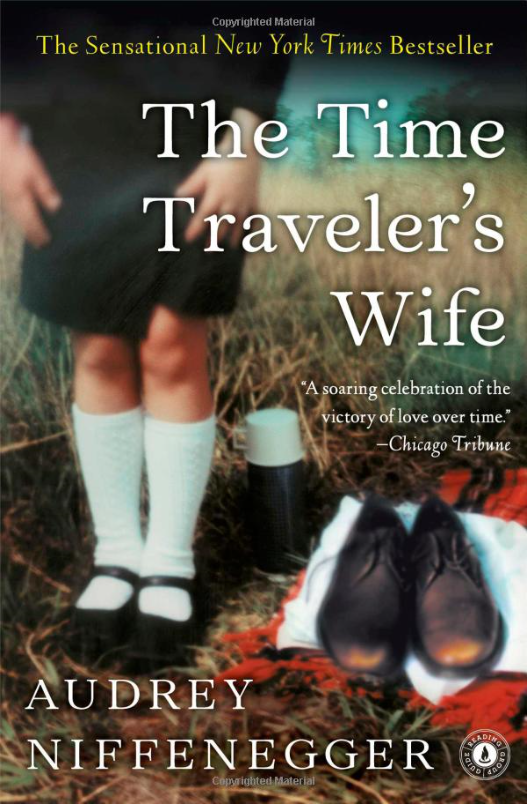
Book Review: The Time Traveler’s Wife – by Audrey Niffenegger

time-travelers-wifeThis book was the most delightful novel I have read in a long time. I give it four stars without hesitation. It is the kind of book where you are sad when it is over, because you miss the characters, the story and the world that it created for you. There aren’t many such books. Perhaps “The World According to Garp” was one of them; or “The Brothers Karamazov.”

It’s a true time traveling story, and I have an affinity for those. When I am in a bookstore and I pick up a book on time travel, whether it’s a science fiction novel or a non-fiction book about the subject, I usually do not have the strength to put it down. I buy it and I read it. Time travel has always fascinated me.

A few books of the genre I can recommend are Spider Robinson’s “Time Pressure” and Michael Crichton’s “Timeline.” Spider Robinson’s book inspired me to try my own pen at writing a book on the subject of time travel. For at least ten years I wrestled with the subject, searched for angles that would work for a novel, but never arrived at one I thought I could pull off. And here comes Niffenegger, with the perfect idea and flawless execution of the subject. Incidentally, Michael Crichton’s book is also a classic. Unfortunately, the popular movie with the same title, based on the book, did not turn out so successful, and if you saw it, it might color your perception of the book. Do not allow that to happen. Crichton did a wonderful job with Timeline. I highly recommend the novel.

But back to “The Time Traveler’s Wife.” There are two protagonists, Henry, the time traveler, and Clare, his wife. The story plays in the here and now, approximately the time of our lives, starting in the sixties, ending around 2007. The two main characters alternately narrate the story in the first person in the present tense. This is usually a difficult format for a novel to pull off successfully, but Niffenegger does it marvelously. When I think about it, the subject matter of time travel, where past, present and future are mixed, where it is difficult to maintain the chronology of a story line, if that is even possible, the present tense is about the only way to make it work.

Henry is seven years older than Clare. We know their year of birth. The narrative chapters always start out with the name of the narrator, the date and the respective ages of Henry and Clare. For instance, a chapter may start out as: Clare, November 15, 1995 (Clare is 25, Henry is 32). This shows us that they are living in their respective present times. Another chapter may start out as: Clare, July 1, 1985 (Clare is 15, Henry is 41). This shows that Henry is visiting Clare from 19 years in the future, since in the present he is only 22 when Clare is 15.

Through the book, we follow Clare through her life chronologically, but Henry shows up all over the place. He first appears in Clare’s life when she is a little girl of five years of age and he is a middle-aged man. This may all sound confusing, but Niffenegger does a wonderful job making it all plausible and within a very short time you get used to the strange perspective, time travel becomes commonplace and you follow the story for what it is, a neat extrapolation of the question: What would happen if time travel were possible?

There are some priceless concepts and scenes to elaborate on  them. I do not want to give away too many of them, but let me try one. Before I can explain, you need to understand that if a person can travel in time, there is nothing to stop him from visiting himself in the past or the future, for that matter. So he can be in one location two or more times. This happens quite frequently in this story.

When Henry is a teenager of age 16, he visits himself occasionally from just a few weeks or a few months in the future. So imagine two 16 year old Henrys with hormones raging. Since both Henrys are one and the same person, just a few weeks apart, they quickly figure out that they can partake in a unique form of masturbation by nonchalantly taking care of each other’s needs. Henry even states that this is quite convenient, and he is not homosexual in any way. It’s just a nice side benefit of time travel.

I could list many more such implausible situations that become completely acceptable once you start with the possibility of time travel, but I don’t want to spoil your reading experience. Niffenegger does a much better job in the book than I could ever do here.

So I recommend you buy this book and read it soon. It will also make a great present. A wonderful read, all the way from the first page to the last.

Rating - Four Stars