Just like I mentioned a few days ago in this post that I have traveled 30 years into the future, I just decided to go and check back into my youth. I still remember New Year’s Eve 1969. I was 13. I was looking forward to the brand-new decade, the Seventies.
I have a trusty iPad, and it has a time travel app. So I just went and spent that night again from 1969 to 1970. Here is the proof:
I figured 4:04pm on New Year’s Eve was a good time to travel to.
By 7:25am I thought it was time to come back and show the evidence.
While I was there, I tried to download Like a Bridge Over Troubled Water, but to my surprise, there was no Internet.
It’s now 2015, the year that Marty McFly in the movie Back to the Future traveled to, coming from 1985.
Did you notice that Marty’s family didn’t have Internet, or iPads, or digital devices of any kind, really?
It’s cool, though, to have traveled 30 years into the future. I am here. Just can’t go back, because I don’t have a DeLorean that flies and has a flux capacitor.
I think I’ll go down to Toys R Us and get myself a hoverboard tonight after work.
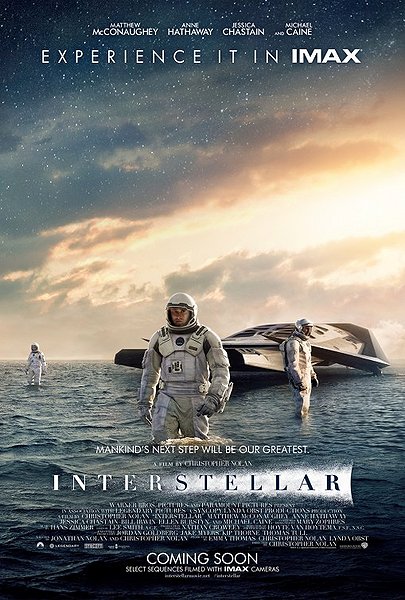
Cooper (Matthew McConaughey) is a reluctant farmer and former pilot and engineer somewhere in the Midwest, maybe Iowa. The Earth is breathing its last breaths and everyone knows that within another generation or two, it won’t be habitable anymore.
His precocious and science-minded 10-year-old daughter, Murph, thinks there is a ghost in her room and on her bookshelves. One day, during a dust storm, she detects binary patters in the sand that collected on the floor in her room. When they figure out the patterns are GPS coordinates, they get in the truck for a trip.
What they find at the end of that road trip is something neither of them could have possibly expected. It would soon changes both of their lives drastically.
It is my self-imposed policy not to write reviews that spoil the movie, and in this case, I find that a very difficult task. So I’ll stop right here talking about the plot or the story, but rather tell you what was in it for me – and what may not be in it for many other viewers.
Written and directed by Christopher Nolan, Interstellar is a huge science fiction epic with all the components that I love about science fiction. The problem with this film, if that actually is a problem, is that the viewer needs to have a solid background in a number of science fiction and science concepts to be able to understand the plot. The plot depends on those concepts. Viewers without that experience and knowledge would likely be lost and would not put the story together.
Be that as it may, for me, it was like Christmas of Science Fiction. It was all there.
Four and five dimensional spaces, tesseracts, and the phenomena a traveler along those dimensions might experience are central to the plot. A being that is able to travel in the fifth dimension, assuming time is the fourth, can roll time back and forth at will. Some of that happens in this movie.
I loved the realistic feeling of the interstellar space ship Endurance. The ship is basically a wheel that rotates at a speed of 5.6 times a minute to create an approximately earth-like gravity for the crew.
[credit: Karl Tate, Infographics Artist]At one point, there is an explosion on the ship and it starts spinning wildly out of control while nobody is on board. The crew is in a lander and their only chance of survival is to approach the spinning ship and match its rotation exactly, making the lander effectively spin like a top, while it slowly approaches the docking pad. I loved that scene. Matching velocities and rotations of independently spinning objects in space in one of my favorite space travel concepts. I can’t get enough of them.
Then there was time dilation. The Endurance had a crew of four. One stayed behind on the ship, while the other three went down to a planet in one of the landers. As it turns out, the planet was really close to a black hole, where gravity, time and space are sharply curved, causing the experience of time to change. One hour on the surface of the planet is equal to seven years on earth. If such a space traveler has any interest in coming home and seeing his family again, he can’t spend more than a few hours on that planet, lest they all be dead and gone. When they landed, things didn’t quite go right and they were delayed. When they eventually got back to the ship, their crew mate waiting for them for the few hours they were gone had aged 23 years.
There was Cooper Station, a huge generation ship, basically a spinning cylinder with human habitats inside of it, reminiscent of the Arthur C. Clarke’s Rama spacecraft.
There were a few hokey concepts too. For instance, the thought that we could ruin our own Earth in just a few decades from now so badly that an alien planet in another galaxy might be a better option seems very farfetched. But I could live with that.
I got a kick out of the ship’s robot, Interstellar‘s own version of R2D2, except really weird, too large and like a metal slab or a smart gravestone, that had me chuckle a few times.
And the music, the sound track, is superb: Hans Zimmer the greatest in the music business today. He gives another brilliant use of music to accentuate the drama.
Overall, watching Interstellar for me was just a lot of fun, one scene after the other. Science fiction came to life here, just like it should.
Science fiction doesn’t get any better than that – and don’t go if you’re not into that stuff. You won’t “get it.”
MASSIVE SPOILERS:
If you want to understand the various timelines, storylines, and general movie concepts, click on this link. It does an excellent job filling in the blanks if you watched the movie but didn’t get one thing or another.
I am going on a time trip. I need to borrow some weapon, though. Does somebody have any weapons I could use for a minute?
No matter how long I’ll be engaged down-time, I will return exactly one minute after I leave, so we could arrange that you come to my place with the weapons. You give me the weapons, you just wait for a minute until I come back from my time trip, and I’ll give you the weapons right back.
But first I need to write to this guy in Prince George, BC.
After saying that I would not read another Dan Simmons book after Phases of Gravity, I didn’t follow through when I picked up Hyperion, which was recommended by somebody on Reddit as “mindblowing.” So I went for it, but I didn’t first read my own review of Phases of Gravity again first.
Hyperion is actually not a bad science fiction book. Dan Simmons built a world here. The year is something between 2800 and 2900. The Earth no longer exists. It was swallowed by a black hole that humans created artificially during the “Big Mistake.” This drove humanity to leave the Earth in search of other planets to colonize.
Humans traveled initially by “slow” starships. Later they developed faster than light travel. Finally, the “farcasters” came along, which are basically teleportation portals that allow a person to go instantly from one place in the galaxy to another. They work like phone booths. You put in your charge card, type a destination code and step through the gate. You come out instantly on another planet.
One of the more exotic implementations of farcaster technology is a “house” with many rooms, each room on a different planet. Your living room can be on one planet, the bedroom on another, and so on. As you walk through the doors of the house, you are instantly transported perhaps hundreds of light years away. Of course, only very rich people can afford such a house.
But I digress. Hyperion is filled with neat concepts like farcasters. The story is a fairly silly one. An imminent war with a human splinter group, the Ousters, requires that a gang of pilgrims travel to the planet Hyperion to meet with the mysterious alien intelligence they call the Shrike. On the way, the seven pilgrims each tell their story. The stories are vastly different from one to the other, and they seem to exist only so the author can elaborate more on the details of the world he created. Yet they are intriguing enough to keep the reader’s attention.
The story itself, however, left me wanting. It just didn’t make any sense to me. It just meanders about to illustrate neat science fiction concepts. There really isn’t any ending. Obviously, the writer is building it for a series of books – and I definitely don’t care enough about the characters to want to read the next one.
Set mostly in Scotland in 2010, a small group of scientists create a computer controlled machine that can send messages back in time, initially only by a few minutes, later expanded to a day.
When they first demonstrate the machine to someone new, they pull a sheet of paper out of the computer’s printer, fold it over, and put it aside. Then they ask the person to type something into the computer, a string of digits, a sentence, anything they can think of. After the subject types the message and sends it, they show him the sheet of paper, which contains the exact message – sent back in time by about a minute. The subject is convinced. They clearly thought of the message after it was printed on the paper. It was sent back in time.
As they experiment with their new toy, unexpected things start happening, like a message from the future that warns them that the Earth might be destroyed unless they take specific action.
Paul Hogan writes “hard science fiction.” This means that he gets deep into the science and as a result, his fiction is sometimes too meticulous in detail. I don’t care about every minor hard scientific detail and all its underlying theory and background when I want to know what happens next in the story.
I do get a lot of enjoyment out of novels that paint a world decades in the future, with all the Jetson stuff and whizbang gadgets and science the author envisions.
However, it’s especially fun when I wait 35 years after such a book is written, which was the case with Thrice Upon a Time. Paul Hogan first published the novel Thrice Upon a Time in 1980. It plays in 2010, so Hogan shows us the world as he imagined it might be 30 years in his future. Of course, he didn’t think readers like me would wait 34 years to read the book for the first time, and thus have a way to compare his predictions to how things actually turned out.
To put things into perspective, in 1980, the IBM PC didn’t exist yet. The closest thing to a personal computer was the Apple II. The Digital Equipment Corporation (DEC) PDP-11 was the most popular mini computer. The very first fax machines started showing up in business after 1980. Commercial jet traffic was just as it is now, with the workhorse planes being the Boeing 737 and 707.
Hogan’s 2010 turns out to be way off the mark compared to what really happened.
The computer they are using is a DEC-22/40. It’s pretty much the same concept as the PDP-11 was thirty-five years ago, with terminals and printers hooked up. Of course, there was never another PDP after the PDP-11/70. The concept of personal computers does not exist in this story.
This picture from an alternate cover for the book shows a scientist in front of his computer terminal. It looks just like what I used when I worked on a PDP-11 back in 1981. We don’t find terminals like that anymore in 2014.
Politically, he didn’t predict the world to change. the U.S.S.R is still intact in 2010 and the geopolitical landscape is the same it was during the cold war in the 1980s.
There are no cell phones and definitely no smart phones in his 2010. To make a call, they have to go to a hardwired machine. Calls are forwarded to people all the time. They do have a video phone, and they can turn off the picture – like when they’re in the bathtub receiving a call.
There is no Internet. However, there is frequent mention of computer networks, where machines can connect to each other and exchange information.
But the multi-functional user interfaces are not there. There is a “scratchpad section” on the screen to write notes. There is a hardcopy slot that issues printouts from the screen.
Airlines have come a long way. Boeing has suborbital planes that can fly from the U.S. to London in less than an hour. Those are the airliners Hogan envisioned we’d use in 2010.
At one point, he talks about the Governor of California. He only refers to the governor by title. I wonder what we would have thought if he had known in 1980 that a famous body builder by the name of Schwarzenegger would be the Governor of California by 2010.
Overall, Thrice Upon a Time was a fun time-travel related story, too heavy on the science, making it somewhat slow and dry, but hilarious in its predictions of a future which is the past to us now.
I came across this time travel novel, and this author, by a review of Stephen King’s 11/22/63. Supposedly, Stephen King was inspired by this book and author and it helped with the idea for 11/22/63. I am not sure how true that anecdote is, but it was enough to inspire me to buy the book and read it. I was not disappointed. The book starts in 1979 in Belltower, Washington, a small, sleepy town not far from Seattle with this sentence:
Soon, the time traveler would face the necessity of his own death.
The pace never lets up. A Bridge of Years is the story of a few characters, each of them down on his luck, who come together in a house on Post Road in Belltower in 1989, to face a dangerous nemesis from the future, with no place to hide and a lot to lose. Most of the action occurs in 1989, likely because Robert Charles Wilson published the book in 1991. That was his present. But the story spans from 1962, to 1979, and then 1989, into the middle of the 21st century and it speculates on through the eons of human evolution. This is not just a book about time travel, but rather, time travel is the essence of the entire story and the plot. Time travel is the fabric of the structure of the novel itself. It’s one of the better ones of the genre, and I think I need to check out this author some more.
The Time Traveler’s Apprentice is a young adult novel about a Simon Grant, a boy who becomes the helper and apprentice of Professor Moira Ananke, who is a museum curator, historic researcher and expert time traveler.
For reasons he can’t explain, Simon is thrown back through time to 12th century England during the reign of King Henry II and his Queen Eleanor. He meets up with a number of characters and quickly gets embroiled in the local politics and the mystery of the death of a famous cleric, Bishop Thomas Becket.
The novel is based on many historical facts and brings alive the daily workings of life in the 12th century. We learn how people lived, what they ate, how they traveled, how they thought, and most of all, how their politics worked. It reminded me a little of the famous Pillars of the Earth books by Ken Follett.
However, this book is written for young adults, so it just skims the surface compared with Pillars.
Well-structured suspense kept me reading chapter after chapter. Having just finished another time travel book littered with grammar and spelling errors, this one was pure delight in comparison. There was absolutely nothing wrong with this book.
It’s a quick, fast-paced read, flawlessly structured, and full of suspense.
It even comes with a teacher’s resource book that contains language arts and social science activities for each chapter of the novel. The activities vary greatly and expand on the historic premise of the book, exposing students to primary source material, reading charts and tables, and incorporating differentiated activities for teaching reading comprehension.
Clearly, the author is a history teacher and her objective is to bring history alive for young readers, and she succeeded.
I picked it up as a time travel book, but there really isn’t any time travel involved. It’s more about what would happen if a 21st century boy in England were suddenly whisked away into the England of the 12th century. He does not travel, he just appears there, and then the story continues in that era.
T.I.M.E is a time travel novel that deals with United States history. T.I.M.E. stands for Temporal Intervention and Management of Events. This is a agency whose apparent mission is to fix up American history so it comes out better. Agents are sent back in time to pivotal events, like the assassination attempt on Reagan, to make minor corrections and manipulate the outcome. When the agents return back to their home time, they are the only ones that remember history the way it used to be – since they changed it and in the world they return to it’s the only history everyone knows.
When you ponder this it does not take long before paradoxes arise and things get quite complicated. But such is the nature of time travel stories, and that’s probably why I enjoy them so much.
This premise is a good one, and the book’s first chapter does a nice job in its execution. It lured me in.
As I went further into the book, however, I found a myriad of problems with it, and I would summarize it now as a clumsy work at best.
To begin with, there is no one protagonist, but there are three agents who sort of serve as the “lead character,” while none of them is well rounded enough to be able to keep them apart. It’s Peter, Jon and Sabrina. All three are cardboard characters. Sabrina, being the girl, is supposed to be really sexy, but the author does not show us, he tells us awkwardly by describing how Peter looks at her. Since none of the characters are noteworthy in any way, I didn’t find any reason to empathize with any one of them, or care about how things would go. It made for shallow reading.
The structure of the novel was odd. The first few chapters describe how the agents go back in time to “fix” history. There is never any explanation of how they get into the past and then back. They just seem to wake up in hotel rooms in the past. Then, later in the book the entire structure seems to change and at the end, the story unravels so it does not really end, but just kind of fizzles. It’s almost like the author got tired of it himself.
The book is littered with spelling errors, grammatical errors, missed words, fragmented sentences and strange constructs. I felt like I was the first person to ever read the book. Does Richard Wood not have any editor? If not, does he not have a friend who could at least read the book ONCE to get rid of the worst editing errors? At the beginning I started keeping track by making bookmarks, but there were so many errors, hundreds, I lost interest in doing that. After all, I am not the author’s editor, I am a paying reader. It’s not my job to correct his errors.
This lack of attention to detail annoyed me and distracted from the story. The author didn’t even care enough to proof-read his own book – but he expects us, the readers, to pay him money for the privilege.
Some Amazon reviewers expressed they were hoping for a sequel. For me, there was nothing in this story that would want me to read any more.
Out of Time is a collection of five time travel stories. I found each of them fascinating in its own way. Of course, being written by five different emerging authors, the writing style, content and character of the stories vary.
The concepts applied were pretty much the same as in The Mine.
In The Show, the author made a nice transition from the ending of The Mine, when we were told that Grace followed Joel “back to the future” but we were never witness to how it came about.
In The Show, the first chapters told Grace’s point of view, and it was quite entertaining.
Grace and Joel got married, had children, and it would have seemed that they lived happily ever after. Then something strange happened to Grace when they were out for a date at the Palladium Theater. Just like Joel was relocated to 1941 in the old mine, Grace was bumped to 1918. Like Joel found his grandmother as a young girl, Grace found her parents as teenagers and observed them actually meeting.
Most of the rest of the story was, to me, quite boring. The author sure likes his romance. His characters seem to do strange things when it comes to “love.” Joel in The Mine, and Grace in The Show, both got engaged to locals in the time they were visiting. Why would a person who is trapped and works on getting out of there get engaged? Why did neither tell their partner the truth about who they were, when they eventually had to anyway, just much harder?
If I don’t think of these books as time travel books but rather romances, everything falls in place. The women are all exceedingly beautiful. The men smart, strong, courageous and dashing. Whenever the men kiss, they “kiss tenderly.” The characters always profess their love after just a few weeks of knowing the other.
The stuff of romance.
There is nothing science fiction about Heldt’s time travel books. They are romances with time-plot-twist aspects, and those twists do work.
Joel Smith is a 21-year-old college student from Seattle, on a trip with a friend visiting Yellowstone in May of 2000. On the way back, outside Helena, Montana, he decides on a whim to explore an abandoned gold mine. While his impatient buddy waits at the car, he enters the mine, finds a mysteriously glowing cavern, sees a rattle snake, drops his flashlight and as he withdraws he bumps his head and passes out.
When he comes to, he walks back out of the mine and finds a different world. He soon figures out that it is May 1941. His cell phone is useless, his 2000 vintage money is funny-money, and his clothes are definitely wrong for the period.
He rides a freight train from Helena to Seattle and soon starts a new life. In his circle of friends he even meets his own grandmother as a young college girl. Eventually he falls in love with a girl named Grace, who is engaged to another man.
He does not know if his trip was one-way. But he does know his sports trivia, which enables him to gamble and win money. He also knows that on December 7, 1941, the Japanese would attack Pearl Harbor and the lives of Americans would change drastically.
Joel is careful not to change the past and history, since it might affect his own existence, particularly when he is hanging around with his own grandmother.
The Mine is a romance novel. The author spends a lot of time weaving the web of the complex social lives of a group of 1941 college kids that Joel finds himself surrounded by. Those college kids have relationships, they fall in love, and in lust, and things don’t always end up clean.
The book is very well narrated, containing just the right amount of dialog versus exposition, and it moves along at a good, steady pace. The only distractions I noticed were the frequent use of trite clichés. For instance, Joel never just put on jeans. He always “threw on a pair of jeans.” Joel’s 2000 girlfriend Jana “was as good as it got.” Road signs were “small potatoes.” The author used these types of hackneyed expressions often enough that I found it distracting.
Also, Joel was a bit too much of a superman. Landing in 1941, he becomes a crack furniture salesman overnight. He seems to have a photographic memory of sports trivia and statistics. He is super good-looking so all the girls are attracted to him at first sight. He is a great fist fighter. And he is very sensitive and a great friend to everyone. He falls madly in love with Grace, but when it becomes time to leave her, it seems to not be a very difficult decision. All through the story, Joel is somewhat too good to be true.
Overall, The Mine is a very entertaining story, a well told and expertly paced time travel tale with a romantic twist, or perhaps more aptly: romance with a time travel twist.
I read this book immediately after Book One, convinced by a twist at the end. Book Two was a different experience than Book One.
Jack was back in 1856, and his task was preventing the Civil War. Again he met with many of the luminaries of the period. There were battle scenes, with Jack right in the middle of them. The bad guys were really evil, Nazi style, with human experiments and torture. Through a network of spies and thugs, they stole industrial secrets, kidnapped people, and killed whenever it suited their need. Interestingly, the bad guys were also the Southerners, versus the Yankees, trying to hold on to their system of slavery pre-Civil War.
I felt that this one, like Book One, was also written somewhat awkwardly, the writing style showing some signs of immaturity. The writer often told us what was happening, rather than showing us. This means that the book could have been longer, more elaborate, and probably more enjoyable, with better dialog and better exposition.
For instance, Frances Sanger, the second most important character in the story, was a young woman who was, we think, infatuated with Jack. But the way she acted throughout the story simply didn’t make much sense. She was portrayed as very bright, helping her father and uncle in the family business, buying real estate for stores all over the country, as far away from Virginia as Chicago and New York. So she should have been an experienced traveler, negotiator and executive. However, when she saw Jack with a young girl in a restaurant, she freaked out and acted like a junior high school girl, running to her daddy and crying about it. Frances Sanger, due to behavior like this example, just didn’t appear to me as a rounded, real person, but as an accessory to move a plot along.
And the plot, finally, was what kept me reading. I loved the story, and I particularly loved the ending. I would tell the reluctant reader to keep slogging through the first 90% of the book because the last 10% make it worthwhile and now I am waiting for the third book in the series.
This brings me to my final complaint: The time change books are, apparently, a trilogy. I think this story would work better as one consolidated book, be it a thousand pages, if necessary. Time Change – Book Two, as I describe it here does not stand alone. I don’t think a reader could make much sense of it, let along like it and the plot, without reading Book One first. This disconnect between a series of books is much stronger here than in other similar works, like for instance those of S.M. Stirling, where the stories build on previous books, but each book can be read on its own.
All said and done – I am now waiting for Time Change – Book Three.
I honestly don’t remember how I came to buy Time Change by Alex Myers. Somewhere, on some blog, I must have read about it. Since it was a time travel book, and I hunt for time travel books, it was not hard to make the decision to buy after reading a few reviews and the free sample.
Jack Riggs is a nondescript teacher in Norfolk, Virginia in 2012. The relationship between him and his girlfriend is not going so well, when one night she picks him up and gives him a ride in her car. Outside is a violent thunderstorm with torrential rain and heavy lightning. They get into an argument. The girlfriend is driving too fast for the weather, fueled by her anger about him. They get into an accident. Lights off.
Jack wakes up in a meadow in bright sunshine in a place he does not recognize. He is largely unharmed. He recognizes nothing. He still has his iPhone. No bars. No GPS. Only the local apps still work. So he decides to get up and start walking. Eventually he finds a house.
He soon realizes something enormous has happened. He is outside of Norfolk in 1856, a few years before the Civil War.
Jack eventually realizes that there are hundreds of books on his iPhone that he can use for reference, and he quickly leverages his knowledge of science, history, nutrition and health. He becomes wealthy and famous and soon hobnobs with the luminaries of that time, including Abe Lincoln, Mark Twain, John Deere and many others.
As the story unraveled, I was a bit disappointed. I realized that it really wasn’t a time travel story per se, but a story of one man catapulted into the past without any way to get back, reminiscent of S.M. Stirling’s books like Island in the Sea of Time. The author explores what it would be like for a man with an iPhone to be thrown into the middle of the nineteenth century.
The writing seemed awkward at times; I felt like I was reading a book without really being captivated by the story and the dialog. Perhaps it was due to the author often telling the reader, rather than showing him. Nevertheless, even though it was not really a time travel story, I stuck with it. The story engaged me sufficiently to keep me interested. But I didn’t think I’d go get the sequel, book two, to read. I’d end it with book one and move on in my reading list.
Then there was a twist at the end that changed my mind, almost forced my hand. I closed book one and immediately downloaded book two – and started reading.
Nice job, Alex Myers. Good ending. You roped me in.
Bones of the Earth is a science fiction and time travel story, where the time travel is fundamentally central to the plot. Being a time travel story buff, I was surprised that it took me so long to discover this book; it came out 2002.
The protagonist is a paleontologist who gets an offer to travel to the distant past to study dinosaurs in the flesh. Time travel is a gift from non-humans (we only find out later in the book from whom exactly) and is provided to humanity only with certain strings attached, the main one being: humans are understandably not allowed to create time paradoxes.
Just because it’s not allowed does not mean it does not happen, and as a result, things get complicated very quickly.
Bones of the Earth is a page-turner from the first page on, mostly due to the subject matter. I very much enjoyed reading about researchers being able to study dinosaur behavior first-hand, like in Jurassic Park. I don’t know if Swanwick is a scientist himself, but he seems to know a lot about science in general and paleontology specifically. Either he is an expert himself (which I could not ascertain from the information about him available online) or he has excellent sources and he did great research.
The problem with this book is that I could simply not follow the plot. Not only does the point of view of the novel shift around, the time shifts, and the causality shifts constantly, due to time travel. So something happening in 2034 is the cause of a result occurring 100 million years in the past or 100 million years in the future. I found myself getting lost quite often, and I simply trusted the writer to keep things straight, even though I could not follow it all the time. I would have to read the book again, and draw a plot diagram just to keep it straight – the writer must have done that himself.
Confusing or not, this book is the most time traveling book of all time traveling books.