The Cost of War – Take Six

Click here to watch this clock ticking and tell me you don’t panic.
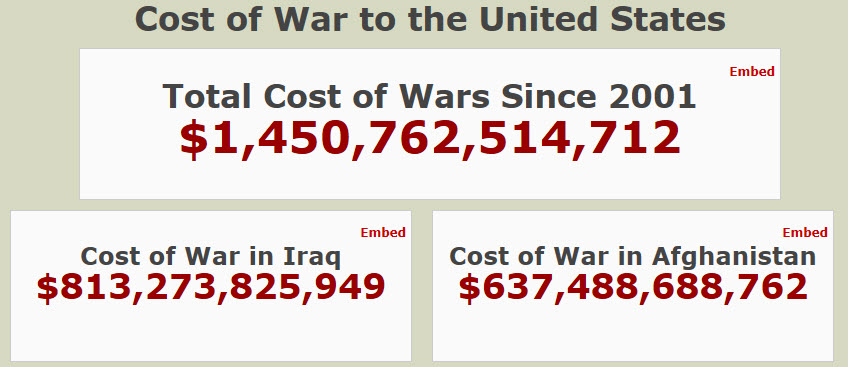
Cost of War

We could have paid out $4,620 to every man, woman and child in the United States.

We could have paid out $46,800 to every man, woman and child in Afghanistan or Iraq.

We could have paid $54 million to every secondary school in the United States.

We could have used $2.4 million to repair each and every bridge in the United States.


Costco Apples

Costco Apples

I have issues when something that grows on a tree comes in perfectly shaped hard clam shells.

Where did the apples go that were too large to fit into the bubbles?

Where did the apples go that were too small and would have bounced around?

Why are the apples all polished and waxed inside the clam shells?

How much oil was used to make these apple delivery devices that I use only once and then throw into my recycling bin?

Maybe, just maybe, I should stop buying apples at Costco and go the my neighborhood Sprouts, where I put them — oh irony: into a plastic bag —  and close them with a wire twist tie.

Smokey Joe Barton and our Friends at BP

220px-Joe_Barton_OfficialA son of Waco, Texas, Joe Barton was elected to the U.S. Congress in 1985 and has been reelected ever since, never with a majority of less than 60%. His nickname is “Smokey Joe” because of his environmental record.

This is the man who publicly apologized to BP because the U.S. government had asked BP to contribute to pay for the cleanup. This was when the Gulf oil spill was still pumping into the ocean. Even his fellow Republicans were dumbfounded when he did that.

Barton does not seem to have much of a grasp of science, but that does not stop him from putting in his opinions. For instance, at a hearing on renewable power, he raised the question of whether expanding wind power might actually cause the planet to heat up:

Wind is God’s way of balancing heat. Wind is the way you shift heat from areas where it’s hotter to areas where it’s cooler. That’s what wind is. Wouldn’t it be ironic if in the interest of global warming we mandated massive switches to energy, which is a finite resource, which slows the winds down, which causes the temperature to go up? Now, I’m not saying that’s going to happen, Mr. Chairman, but that is definitely something on the massive scale. I mean, it does make some sense. You stop something, you can’t transfer that heat, and the heat goes up. It’s just something to think about.

Here is something I would like you to think about, Mr. Barton: The BP oil spill was far worse than we knew. Here are some facts they don’t want us to know.

Three years after the disaster in the Gulf, BP’s horrifying cover-up is finally being exposed. The company pleaded guilty to 14 felonies, one of which included lying to Congress. They were fined $4.5 billion, more than anyone in history for an environmental disaster. 210 million gallons of Louisiana sweet crude gushed into the Gulf during the 87 days it took to plug the well. Check this report to find out how a ‘miracle dispersant’ not only damaged the Gulf ecosystem, but poisoned the cleanup workers as well.

With minds like Joe Barton watching out for us in the United States Congress, what’s there to worry about when large companies try to mess with us?

One Theft – And Three Thoughts

Stolen Laptop

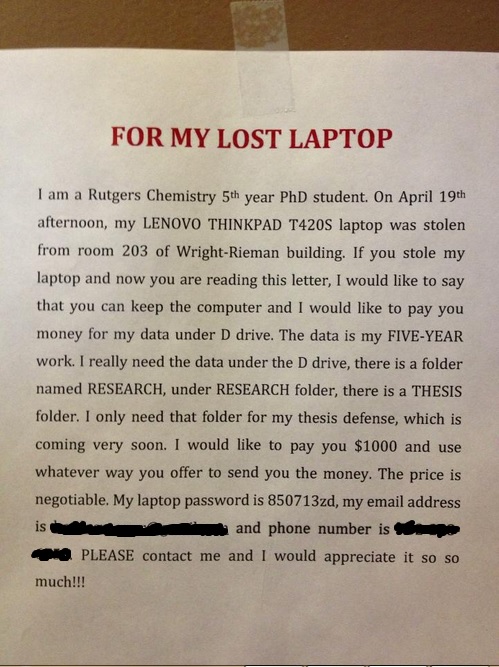
This note went viral yesterday. I saw it on several Facebook posts from different people. Clearly, the note tells a self-explanatory story. The poor guy lost years worth of irrecoverable work. I can imagine the sheer panic he is going through, as he is preparing for his dissertation defense.

There are three separate thoughts that this prompted in my mind. Here they are, one at a time:

Back Your Stuff Up!

The poor man did not back up his work. I know he is punishing himself right now, and he does not need my comments. But we all do this! We keep our photographs on our iPhones and forget to synchronize and save them somewhere, anywhere. We have precious videos of Joey’s first step and we save it on the hard-drive of our computer. We write our dissertations and we don’t keep a copy? Really?

Think about it, some of our most important valuables are not tangible anymore, and we save them in one vulnerable place. The man’s computer didn’t have to get stolen. He could have had a drive failure. Those things happen regularly. It is crucial to back up computers.

In my work, I often write proposals, concept documents and designs. I HATE doing things twice. Even two hours of writing that I lost and that I have to redo aggravate me to no end. So I make regular backups of the documents I work on, at a minimum daily, to the company server, so it’s safe, in case my machine breaks down, my disk dies, my computer goes up in smoke, I erase my own file by accident – which I have done quite often over the years, and – goodness – somebody steals my machine.

We used to have shoeboxes in attics that we found when our grandparents passed away. Our generation won’t leave those. Here are some more thoughts of mine to that effect, that I wrote down in 2007.

Theft of Electronics

Electronics gets stolen a lot these days. My daughter’s iPhone got stolen recently for the second time in 6 months. We now carry around with us these devices that cost $600 each and are highly mobile. This is almost unprecedented. Only jewelry (expensive jewelry) and watches (expensive watches like Rolexes) are similar. But who used to wear expensive jewelry or Rolexes on the bus to work, or at Costco on the way home, or at the farmer’s market, or at the fair. But now pretty much everyone carries with them a smart phone ranging in cost from $300 to $700. What a market for a pickpocket. I wonder if there are statistics on how many of these devices are stolen regularly? We used to file police reports when jewelry was stolen. Do people file a police report for an iPhone? I think not. The phone companies are probably the only ones that have the real statistics, if they even keep track of why you’re buying another one.

Breakdown of Civilization

You may wonder why this title belongs here. I recently gave a speech in a Toastmasters club where I talked about eBooks and how they are changing our world. One of my points was that by no longer putting words on physical paper, over time, the intellectual value of our civilization will mostly be stored – and backed up – on digital media. A few companies will own and store all the goods, and keep them safe. Over time, we’ll get used to that.

Then, a hundred years from now, one catastrophic event, like a comet strike, or one act of war that wipes out our ability to generate electricity so we can charge our e-readers, could throw us back into the stone age.

I know that penicillin can cure an infection like the black plague, but I don’t know how to make penicillin. Science, medicine, agriculture, literature of all kinds, all is written in books, and if those books evaporated one day because the electrical power was shut off for some reason for some period of time, our civilization would degrade to the level of the stone age in a generation or two.

CO2 Emissions due to Electric Vehicles

We cannot argue with the fact that Tesla has been in the headlines lately for several reasons. First, they announced that the company would be profitable this year and was on track paying back government loans earlier than planned. Second, they got the 2013 MotorTrend Car of the Year award.

Tesla
Tesla Model S

Opponents argue that electric vehicles, since they are powered by the public grid which is largely fueled by coal, emit twice the amount of CO2 that gasoline vehicles spew over their lifetime.

It turns out that this claim is incorrect, yet I admit that it is definitely not a simple calculation, and depending on the outcome one likes, one could come up with different results.

An electric vehicle in 2008, charged from the public grid, emitted indirectly 115 grams of CO2 per kilometer driven whereas a conventional U.S. gas-powered car emitted 250 grams of CO2 per kilometer, mostly out the tailpipe.

As the U.S. power grid is converted away from coal to wind, solar and other alternative and renewable power sources, this ratio got better with every year that has gone by since 2008 and it will continue to do so in the future.

In addition, Tesla is installing supercharging stations on major highways, where their cars can be re-charged halfway in 30 minutes – for free – giving a range of another 150 miles. The stations are completely solar-powered. Zero emissions when going to the superchargers.

30 minutes is a long time on a road trip, but the strategy of locating the stations near restaurants, shopping centers and other attractions allows customers to plug in their cars, go to lunch, get coffee and come back for another 2 hours of driving.

The Hotel Soap Travesty

SoapI spend about 60 to 80 nights in hotels every year. Given that some stays are for more than one night, I therefore estimate that I use about 50 hotel soap bars a year. Some of those are small, but some are quite substantial and elaborate.

About a year ago I put a little zip-lock bag into my wash kit so I could take those home, either to use, or to accumulate to see how much soap I personally wasted in a single year. The little box in the bathroom started filling up and eventually I threw it all out.

Soap BoxThis particular bar of soap in the picture is from the Embassy Suites. It’s actually fairly large, according to the box, 50 grams or 1.75 ounces of soap.

So let me step on my soapbox, literally  this time.

I recently read an unsettling book about children in the slums of India titled Behind the Beautiful Forevers.

Look at the little girl on the cover, sitting on her haunches in a pool of sewage. I believe that this bar of soap that I left in my hotel room this morning could wash this child for a month or more, keeping her clean and above all, much more healthy. Yet, I have no way to get this bar of soap into the hands of the child, just like I can’t deliver to India the pile of perfectly good food that the people at the table next to me just left on their plates and on the floor.

Behind the Beautiful ForeversIt is estimated that 1 million bars of soap are thrown away by hotels in the United States every day.

I personally, doing simple math, probably throw away ten times as much soap in hotels every year as I legitimately use at home  in my shower.  Due to the large amount of travel I do, I may not be a very representative example. But 1 million bars of soap is a lot of soap that is going to waste.

Researching this further, I found that there are movements underway to recover this. For instance, Clean the World is a foundation that does just this, collect slightly used bars of soap, cleans them and recycles them.

I found it somewhat astonishing they are actually worried about the “gently used” bars of soap harming the recipients.

Clean the World is committed to maintaining an environmentally and hygienically safe recycling process. As the world’s first, high volume soap recycler, Clean the World ensures that all bars of soap recycled and distributed domestically and abroad are completely safe and will not harm the end-user due to disease or pathogens that can be transmitted if proper re-purposing does not exist.

Read the book Behind the Beautiful Forevers and you will be convinced that if this little girl on the cover actually DID get a used bar of soap from the Embassy Suites into her hands, the last thing she’d do would be using it. She would trade it for money or something to eat, because she would look at a used bar of soap as something of a treasure, far higher in value than the bottle caps, pieces of plastic, glass and metal trash that she normally trades with.

Here is some more information in case you are interested in hotel waste recycling, something most of us don’t even give a second thought in this country of abundance.

And that’s why they call us Rich Americans. We can waste soap.

The Greenland Ice Sheet

Photo by Hannes Grobe, AWI

This is the village of Ittoqqortoormiit in Greenland, photo by Hannes Grobe. Not much growing going on. No wonder the people paint their houses colorfully. Things would be pretty bleak otherwise.

Greenland is the largest island in the world, located in the North Atlantic.

Greenland B

It is mostly covered by an ice sheet, which melts back in the summers and is replenished in the winters.

Greenland A

If the Greenland ice sheet were to melt completely, the sea level around the world would rise by 23 feet. Hundreds of coastal cities around the world would be abandoned. The rice-growing river deltas of Asia would be under water. Here in the U.S., most of Florida would be gone, Manhattan would be largely under water, and many of our great cities like Boston, Washington, Houston, Seattle, San Diego, Los Angeles,  San Francisco and Honolulu would be severely affected. I cannot imagine that civilization as we know it would be able to continue.

I think it’s safe to say that if we cannot mobilize and motivate ourselves to save the Greenland ice sheet we probably cannot save our civilization.

The U.S. climate change obfuscation movement still argues that it’s not humans that are changing the climate. It’s nature all by itself, and therefore we can just go on burning fossil fuels without worry.

According to a study by PricewaterhouseCoopers based on U.S. Bureau of Economic Analysis data, U.S. coal mining was responsible for 154,000 direct jobs and over 400,000 indirect jobs in 2008.

Interestingly, the same people in the U.S. Congress arguing that global warming is a hoax are also the ones that call it immoral that we leave debt to our descendants.

What is more immoral?

  • Not to curb coal burning and jeopardize some of the 550,000 jobs dependent on coal?
  • Directly cause the annihilation of all major U.S. coastal cities, displacing over 100 million people all within the current century?

I am sure it is hard to transition from a fossil fuel economy to a renewable energy economy. It too will create jobs, it’s not like the jobs go away, they are being moved around.

But it is harder to relocate 100 million people when our cities are flooded.

The only counter-argument the deniers have is that it’s not humans that are causing the warming, it’s nature alone. We just have to deal with the results.

Is it worth the bet?

I agree that it is immoral to leave impossible levels of debt to future generations.

I think that it is more immoral to trash the global ecosystem so far that sea levels rise by dozens of feet, if it indeed is avoidable.

I do not think it is immoral to transition jobs from fossil fuel burning to renewable energies, even if it comes with a short-term cost. It is an investment in our children’s future.

I agree we cannot do this alone. We need China, Russia, India, Brazil and Indonesia to go along with it. Note that I didn’t include Europe on that list. It seems there are very few deniers left in Europe. Somehow they “got it” already.

Maybe it’s because they’re all socialists, though.
Been Drinking Tap Water

For years now I have been drinking water from our kitchen tap without any filters. I cannot taste the difference between my tap water and bottled water, no matter what the brand. I am often embarrassed when a guest asks me for some water and I just go to the tap. They look at me funny. I feel like I have to explain.

The fact is, our entire bottled water industry is the result of a clever marketing ploy. Where were all these water bottles when I grew up in the 1970ies? Tap water was fine, and we didn’t have birth defects.

Here an excerpt by Brown:

In a world trying to stabilize climate, it is difficult to justify bottling water (often tap water to begin with), hauling it long distances, and then selling it for 1,000 times the price of water from the kitchen faucet. Although clever marketing has convinced many consumers that bottled water is safer and healthier than tap water, a detailed study by WWF found that in the United States and Europe there are more standards regulating the quality of tap water than there are for bottled water. In developing countries where water is unsafe, it is far cheaper to boil or filter water than to buy it in bottles. Manufacturing the nearly 28 billion plastic bottles used each year to package water in the United States alone requires the equivalent of 17 million barrels of oil. This—combined with the energy used to refrigerate and haul the bottled water in trucks, sometimes over hundreds of miles—means the U.S. bottled water industry consumes roughly 50 million barrels of oil per year, equal to 13 percent of U.S. oil imports from Saudi Arabia.

[Brown, Lester R. (2011-01-06). World on the Edge: How to Prevent Environmental and Economic Collapse (Kindle Locations 1649-1657). Norton.]

The scam is even worse at airports now. I bring the bottled water from the hotel or the store into the airport, and I have to toss it, just so I can spend $4 for a small bottle at Starbucks past security, so I have my provisions for the plane ride.

Bottled water sales hit a record high in volume in 2011.

Americans purchased 9.1 billion gallons of bottled water. Per capita consumption reached a new peak of 29.2 gallons, generating revenue of $21.7 billion. This is below the high of 2007, before bottled water companies had cut prices to adjust for the recession.

The U.S. is the largest consumer of bottled water in the world, with China and Mexico in the second and third spots. Unlike in Mexico and China, there is universal availability of safe tap water just about everywhere in the U.S., so all 28 billion bottles of water sold are essentially a waste.

I now I feel like a beer.

American Cars and the Bellies of African Children

The use of “biofuels” like ethanol has changed the economy of grain worldwide significantly. Corn farming in Iowa for ethanol is affecting the hungry bellies of children in Africa and Asia, whether we know it or not, and whether we like it or not.

The third source of demand growth emerged when the United States attempted to reduce its oil insecurity by converting grain into ethanol. The jump in U.S. gasoline prices to $3 per gallon that followed Hurricane Katrina in 2005 made it highly profitable to invest in ethanol distilleries in the United States. As a result, the growth in world grain demand, traditionally around 20 million tons per year, suddenly jumped to over 50 million tons in 2007 and again in 2008 as a huge fleet of new ethanol distilleries came online. This massive ethanol distillery investment in the United States launched an epic competition between cars and people for grain.

The conversion of grain to automotive fuel has continued to climb. Roughly 119 million tons of the 2009 U.S. grain harvest of 416 million tons went to ethanol distilleries, an amount that exceeds the grain harvests of Canada and Australia combined.

Even as these three sources of demand combined to drive up world consumption, speculators entered the fray. By buying grain futures and holding grain off the market, they further fueled the price rise.

On the supply side of the food equation, several trends discussed in preceding chapters are making it more difficult to expand production rapidly enough to keep up with demand. These include soil erosion, aquifer depletion, more-frequent crop-shrinking heat waves, melting ice sheets, melting mountain glaciers, and the diversion of irrigation water to cities.

Farmers are also losing cropland to nonfarm uses. Cars compete with people not only for the grain supply but also for the cropland itself. The United States, for example, has paved an area for cars larger than the state of Georgia. Every five cars added to the U.S. fleet means another acre of land will be paved over—the equivalent of a football field.

Brown, Lester R. (2011-01-06). World on the Edge: How to Prevent Environmental and Economic Collapse (Kindle Locations 902-916). Norton. Kindle Edition.

Volcanos and CO2 Emissions – Truth or Hoax?

Fact Check:

When the Icelandic volcano Eyjafjallajokull erupted in March 2010, I received this mass email:

VOLCANOES – MAKING LIBERALS LOOK STUPID…NATURALLY! *FOOD FOR THOUGHT ….. this was sent to me by a friend, thought I would pass it along.  *

*Are you sitting down? *Okay, here’s the bombshell. The current volcanic eruption going on in Iceland, since it first started spewing volcanic ash a week ago, has, to this point, NEGATED EVERY SINGLE EFFORT you have made in the past five years to control CO2 emissions on our planet.  Not only that, this single act of God has added emissions to the earth estimated to be 42 times more than can be corrected by the extreme human regulations proposed for annual reductions.

I know, I know…. (have a group hug)…it’s very disheartening to realize that all of the carbon emission savings you have accomplished while suffering the inconvenience and expense of driving Prius hybrids, buying fabric grocery bags, sitting up til midnight to finish your kid’s “The Green Revolution” science project, throwing out all of your non-green cleaning supplies, using only two squares of toilet paper, putting a brick in your toilet tank reservoir, selling your SUV and speedboat, going on vacation to a city park instead of Yosemite, nearly getting hit every day on your bicycle, replacing all of your $1 light bulbs with $10 light bulbs …well, all of those things you have done have all gone down the tubes in just the past week. The volcanic ash emitted into the Earth’s atmosphere in the past week has totally erased every single effort you have made to reduce the evil beast, carbon.  And, those hundreds of thousands of American jobs you helped move to Asia with expensive emissions demands on businesses… you know, the ones that are creating even more emissions than when they were creating American jobs, well that must seem really worthwhile now. I’m so sorry. And I do wish that there was some kind of a silver lining to this volcanic ash cloud but the fact of the matter is that the brush fire season across the western U.S.A. will start in about two months and those fires will negate your efforts to reduce carbon emissions in our world for the next two years.

So, grab a Coke, give the world a hug, and have a nice day!

AND JUST THINK HOW RICH AL GORE HAS GOTTEN OFF THIS HOAX !

So what is really going on?

According to FactCheck:

It’s true that erupting volcanoes do emit some carbon dioxide, one of the “greenhouse gases” that contributes to global climate change. But according to USGS, human activities release at least a hundred times more CO2 every year than all the world’s volcanoes combined. Published estimates of the gas emissions from all volcanoes in the world range from 123 million to 378 million metric tons of carbon dioxide per year. Humans haven’t produced that little since the 19th century.

The problem is that when a denier tells you the content of the email above at a cocktail party, and you don’t just happen to be a climatologist who specializes in the study of the atmosphere, you probably don’t have the facts at your fingertips and can’t successfully argue against this outrageous, completely made-up, claim.

Fact check goes on documenting that the standstill of European air travel during that time, due to ash in the atmosphere, provided a significant offset of the CO2 emissions by the volcano:

Carbon dioxide isn’t a major output of volcanic eruptions. In the case of Iceland’s Eyjafjallajokull volcano, which began erupting in March 2010 and entered an explosive phase in April 2010, one study found that less than 15 percent of the gas given off in the pre-explosive phase was CO2 – the majority was water vapor. For some other volcanoes, the proportion of CO2 is even lower.

Still, that accounted for 150,000 to 300,000 tons of CO2 per day at the height of the Eyjafjallajokull eruption, according to wire reports. But the European Union’s air travel, which was shut down for days during the eruption, accounts for 3 percent of the EU’s total CO2 emissions, which according to the European Environment Agency was about 4,089 billion tons in 2008. That means air travel in Europe gives off about 340,000 tons of CO2 per day. The shutdown of air travel in much of Europe during the first week of the explosive eruption would have offset, if not greatly outpaced, the CO2 Eyjafjallajokull produced during that time.

The amount of misinformation spewed on the American public, driven by purposeful and targeted campaigns to dumb us down, is alarming.

Insinuating, after sprewing this volcano of garbage, that Al Gore somehow made up this “hoax” to get rich, is unforgivable. I would like to get a chance to compare the life-work of the writer of that email, who in cowardice wrote anonymously, to that of Al Gore. Then let’s have this argument again.

Now for the most important question: Who can pronounce Eyjafjallajokull?

Book Review: World on the Edge – by Lester R. Brown

World on the EdgeRemember when you were in college and you read a text-book. You started  with a highlighter and marked the sections that were important, that you would need to or want to remember, either for the test, or better, for your life? If you did this with  World on the Edge, the whole book would be yellow. You’d realize that there isn’t a sentence that you didn’t want to highlight, and double highlight.

Every now and then a powerful non-fiction book comes along that slaps you in the face and completely wakes you up.

World on the Edge is such a book.

Lester Brown takes on all our global challenges at once in this succinct and easy to read book. He covers falling water tables and shrinking harvests, world desertification, climate change, hunger, disease, overpopulation, financial demise of nations, failing states and sustainable energy supply.

The first seven chapters state the problem, the last five chapters provide a workable solution, which he calls Plan B.

Not only is the book a wake-up call for the reader, but it represents a great reference work. Full of statistics, details, references to studies, other books and general information, World on the Edge is very useful as a study guide to the problems of the world. Pick any of the topics discussed, and be careful which you pick, because you can make a life-time career out of studying any one of those in-depth.

The challenges we face in our world on a global scale are staggering. Rather than doomsday trumpeting, the author presents workable solutions with funding requirements that could be put underway right now, to make a change within years, not generations.

The question is: Are we willing to listen?

Rating: ****

Calls to Abolish the EPA

There are plenty of voices in the Tea Party and even the general Republican Party that want to abolish the EPA, either by defunding it, abolishing it altogether, or curtailing its power.

The EPA may be a bloated government bureaucracy. But if you just get rid of it, who does its job? The states? Really? Fifty states will each protect their own environment? It seems to me that would make bureaucracy 50 times as large, to do the same job, or, more likely, the job won’t get done the same way.

The EPA protects us from many different threats and looks out for the health of  the people. It may kill jobs by doing that. Let’s just take a look at one industry that the EPA is regulating, the coal industry, which is one of the most significant polluters in the world.

One of the biggest problems associated with coal-fired power plants is the coal ash, which is laced with arsenic, lead, mercury and other toxic chemicals. If these substances make it into the water supply or the general environment, they can be deadly. They certainly cause all sorts of illnesses and birth defects. The industry does not have a strategy for safely disposing the 130 million tons of ash it produces every year.

How much is 130 million tons of ash? Enough to fill a million railroad cars.

An August 2010 joint study by the Environmental Integrity Project, Earthjustice, and the Sierra Club reported that 39 coal ash dump sites in 21 states have contaminated local drinking water or surface water with arsenic, lead, and other heavy metals at levels that exceed federal safe drinking water standards. This is in addition to 98 coal ash sites that are polluting local water supplies that were already identified by the U.S. Environmental Protection Agency (EPA). In response to these and other threats, new regulations are in the making to require an upgrade of the management of coal ash storage facilities so as to avoid contaminating local groundwater supplies. In addition, EPA is issuing more stringent regulations on coal plant emissions, including sulfur dioxide and nitrogen oxides. The goal is to reduce chronic respiratory illnesses, such as asthma in children, and the deaths caused by coal-fired power plant emissions.

[Source: Brown, Lester R. (2011-01-06). World on the Edge: How to Prevent Environmental and Economic Collapse (Kindle Locations 2681-2687). Norton. Kindle Edition.]

Do these congressmen we have seen in the video above really believe that the fifty states would adequately regulate the coal industry and come up with a consistent plan for disposing coal ash safely?

A ludicrous thought.