Rick Santorum has been ranting about the Pope’s statements about science, and particularly climate change. Here are two quotes:
“The perception that the media would like to give of Pope Francis and the reality are two different things…I’m a huge fan of his, and his focus on making sure that we have a healthier society…I support completely the Pope’s call for us to do more to create opportunities for people to be able to rise in society and care for the poor. That’s our obligation as a society.”
“The Church has gotten it wrong a few times on science, and I think we’re probably better off leaving science to the scientists and focus on what we’re really good on, which is theology and morality. When we get involved with political and controversial scientific theories, then I think the church is probably not as forceful and credible.”
Funny how Santorum decides about “controversial scientific theories.” His bachelors degree is in political science, then he got a one year MBA, then and a law degree, with honors. No science there at all. That did not stop him from advocating teaching of intelligent design in schools by introducing what became known as the Santorum Amendment.
Santorum is not a scientist.
In contrast, Pope Francis has a Masters degree in Chemistry. Pope Francis has considerably more scientific credentials that many of our congressmen.
Here are some examples of where man has changed the face of the globe. It’s called manmade change, or anthropogenic change. There is no doubt that this was done by man.
The picture below shows the Neza Chalco Itza slum with its epic 4 million inhabitants. It is the world’s largest slum and has the highest crime rate in Mexico.
[click for photo credit]Here is another picture of a Mexico City slum:
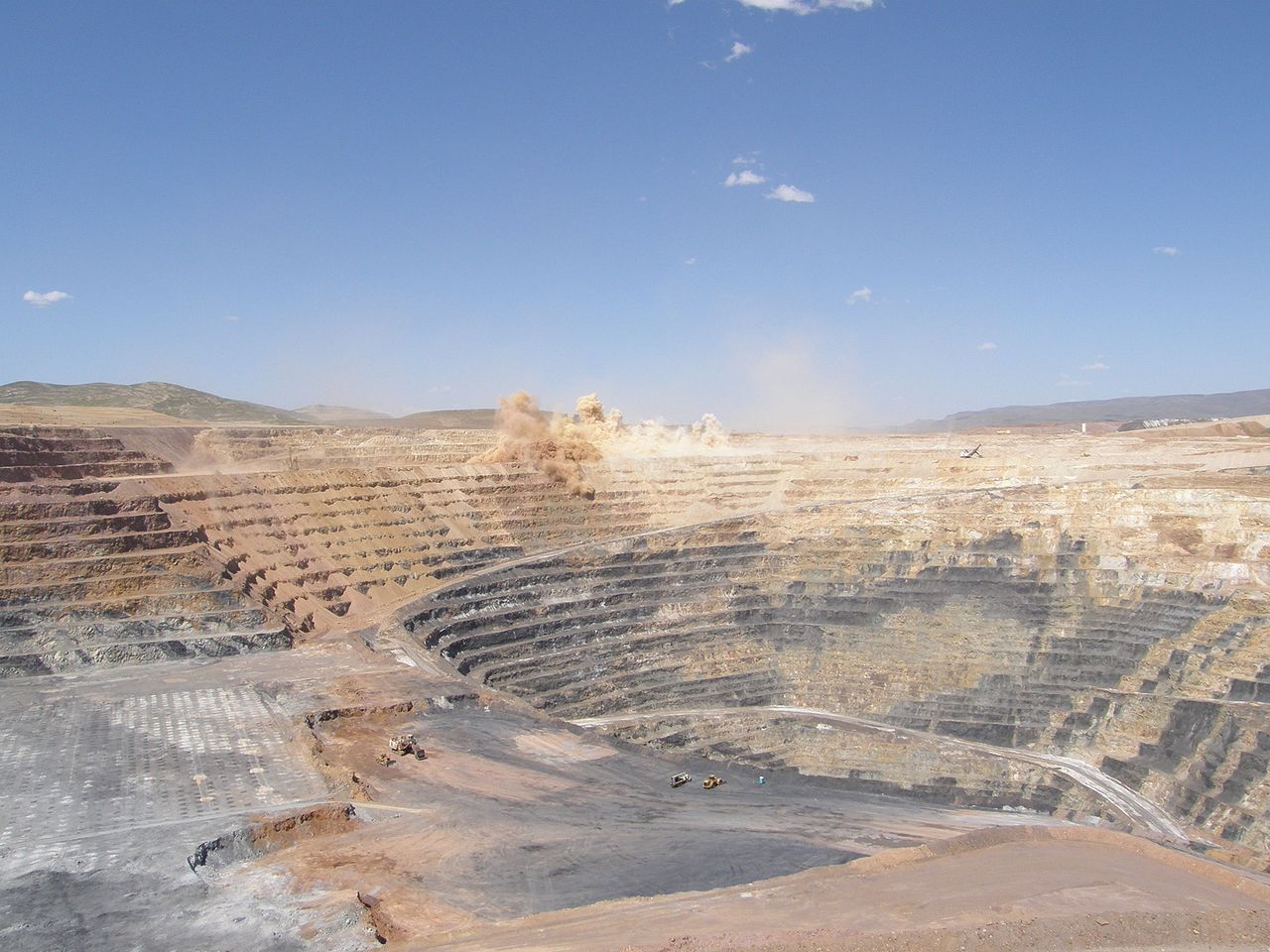
[click for photo credit]Here is the Twin Creeks gold mine in Nevada.
“Twincreeksblast” by Geomartin – Own work. Licensed under CC BY-SA 3.0 via Commons [click to enlarge]Then finally, a picture of the Chicago O’Hare airport that I took myself a few years ago.
Chicago O’Hare Airport, June 3, 2012 [click to enlarge]These are visible, tangible examples of anthropogenic change in the Earth.
I know this is anecdotal and not very scientific, but given these visible examples of what humanity has done to the planet, do we really want to believe that we didn’t modify our air just as drastically? Too bad we can’t see the CO2, and what it does to the planet. We’ll just have to wait a hundred years when our grandchildren won’t be able to walk in lower Manhattan or when most of coastal Florida will be under water. Let’s not even talk about New Orleans.
I wonder what our descendants are going to say in 2100, when they watch the 2015 videos of Marco Rubio or Scott Walker saying that they were not willing to jeopardize oil or coal mining jobs or have the price of gas rise, in the face of this hoax?
I just found out through this article that mammoth tusks are being dug out of the thawing permafrost in the arctic by the thousands. They are sold to the ivory carving industry in China at $1,900 per kilogram. The growing Chinese middle class has a voracious appetite for ivory jewelry. Paleontologists are suggesting that this perfectly legal practice should become illegal to protect the not yet extinct elephant.
There are several statements of fact in this article that I found alarming:
I didn’t know there was such a thing as an “ivory carving industry.” Of course, now that I think about it, it makes sense, but it had never crossed my mind before.
The elephant is doomed. The Chinese are just starting to get wealthy, and there are many of them. The ivory carving industry isn’t going to back off as long as a single tusk remains. The country where reportedly 4,000 people die every day because of air pollution isn’t going to care about regulating its consumption of a commodity that is harvested in another continent on the other side of the globe. As long as there are Chinese with money, elephants will be hunted – more than ever, as they become more rare and therefore more expensive.
Global warming is thawing the permafrost. A few decades ago it was difficult to find any mammoths. Now, it seems, you can go out there with a shovel and dig for tusks and sell them for a fortune. There is a significant movement still in the United States and the rest of the world that is “denying” global warming. They say that just because glaciers are melting at unprecedented rates, and permafrost is melting in the arctic, it does not mean that the warming is man-made. It’s just a natural occurrence, like it has happened many times in history. The fact that it’s been 800,000 years since we had 400 ppm of CO2 in the atmosphere, as we do now, is not enough evidence. Since it’s not man-made, why worry about it. Keep burning that oil!
I am at a loss for suggestions on how to save the elephant, other than save some DNA so we can clone them later, along with the mammoth.
NASA has published an online study in the journal Earth and Planetary Science Letters which suggests that the Larsen B Ice Shelf among other ice glaciers in the Antarctica is fast collapsing and losing its shape due to global warming and other environmental factors, and that the ice sheets could be gone by 2020.
I know that Ted Cruz is what we call a “climate denier.” That’s a person that believes that either the world is not warming at all, or, if it actually is warming, it is part of a natural cycle and we can’t do anything about it.
Anthropogenic or not, if the Larsen B Ice Shelf disintegrates by 2020 and allows further glaciers behind it to slip down into the ocean, we’ll see some serious real estate implications in the next 20 years in Miami, New York, Boston, San Diego, Seattle – to list only a few obvious U.S. cities affected.
So Ted Cruz wants to gag NASA, the one governmental body by far the most qualified to study this issue in the world, and most likely the best at it. I don’t understand the rationale? If you don’t study a phenomenon, you won’t understand it with certainty. Studying and learning never hurts. Even if the warming is natural, the implications are serious, and we need to prepare for them.
Yet, Ted Cruz wants us to stick our collective heads in the sand. Why? The only motivation I can come up with is giving more time to Koch Industries, Shell, BP, Chevron and Exxon Mobile to rape the world.
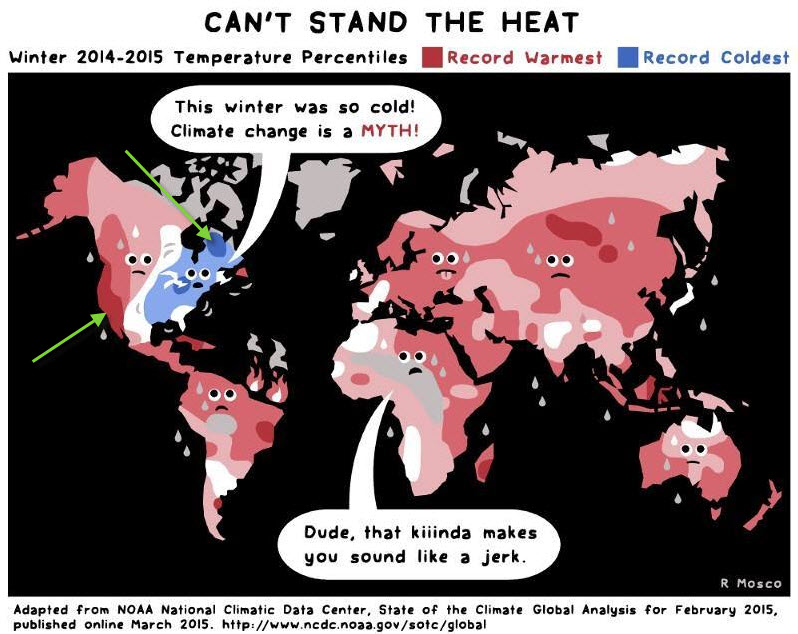
Climate is a matter of perspective. If you don’t travel much, you can easily get the wrong impression.
[click to enlarge]Our company has offices where the two green arrows are. The record coldest place and one of the record warmest places this winter. I don’t have to tell you what it was like a month ago to travel in 8 hours from the warm side to the cold side. Almost 100 degrees difference in temperature.
Today the governor of California went on national TV and told climate deniers to wake up and smell the drought. While this was theatrical and effective, it was no more or less showman-like than what the senator with the snowball did a month ago in Washington. Sorry, Mr. Brown, but the fact that it has been dry in California for a few years by itself if proves nothing about climate change. I would have expected more substance from our governor.
The drought in California is serious. I have never seen our lakes so low and our hills so brown. And I am very concerned about our water use.
This is the view I have when I back out of our garage. The gate in the middle of the picture is our front garden gate. Everything behind it is our responsibility to groom and water. The home owners association if responsible for everything in front of the gate. It’s lush and green, because it gets watered heavily, and much water runs off the driveway and down the gutter. Hundreds of houses in our neighborhood are watered this way. Millions of houses in California.
While I have the power to flush my toilet less, I am in dismay when I realize that a month of no toilets would probably save less water than is getting spread over my front lawn every day – and I have no control over that.
Here is the water usage in California:
This is worse than the 80/20 rule. 80% of our water in California goes into agriculture, and it produces 2% of our economic output.
Yet, the governor in his directive has targeted the 20% residential and industrial users to curb their water use by 25%, while the agricultural community is just given “guidelines.” This makes no sense to me.
It show how much water the entire city of Los Angeles uses in a year (about 0.8 billion cubic meters). Then it compares this to the amount of water needed to produce the walnuts exported overseas from California (1.0 billion cubic meters), and the water needed to produce the almonds exported overseas from California (2.3 billion cubic meters). Ten percent of all our water is used for almonds. Almonds cover 940,000 acres in California.
I say, we forget about producing almonds and shipping them to the rest of the world, and we have plenty of water for all the cities in California for a very long time.
None of this makes any sense to me.
Governor Brown, wake up and smell some common sense.
Now that Ted Cruz announced he is a presidential candidate, his views are getting analyzed more carefully by the experts. This debate should be fun over the next few months.
Ted Cruz on Global Warming:
My view actually is simple. Debates on this should follow science and should follow data. And many of the alarmists on global warming, they’ve got a problem cause the science doesn’t back them up. And in particular, satellite data demonstrate for the last 17 years, there’s been zero warming. None whatsoever. It’s why — you remember how it used to be called ‘global warming’ and then magically the theory changed to ‘climate change’? The reason is it wasn’t warming, but the computer models still say it is, except the satellites show it’s not.
Summary by Chris Mooney in the Washington Post:
In claiming the globe hasn’t warmed in 17 years, Cruz selectively highlighted satellite temperature data, rather than other data (which NASA and NOAA recently used to call 2014 the hottest year on record). He also selectively focused on one year (1998), rather than examining the aggregate temperatures of many years or decades. And finally, a key scientist who studies this type of satellite data, and whose work was cited by Cruz’s spokesman (as backup), criticizes Cruz’s approach.
Senator Inhofe tried to make the case that global warming is fake because it is currently very cold in the Eastern United States. It is indeed right now unusually cold in the Eastern United States, but the planet on the whole is having an unusually warm year. We here in California have had unseasonably warm weather, but Inhofe probably hasn’t been here in a while. To make his point, he held up a snowball and dropped it on the Senate floor.
How can Senator Inhofe expect us to treat him with any respect?
Throwing that snowball would be like me holding up a Big Mac and claiming that world hunger doesn’t exist.
Senator Whitehouse does a wonderful job setting the Senate straight: You can believe every major American scientific society, or you can believe the senator with the snowball.
The scary thing is, Inhofe chairs the Senate’s Committee on Environment and Public Works. How likely is an Inhofe-chaired committee to pass well-designed environmental legislation?
How likely is the Republican Party to gain the respect of the educated and scientific community in our country with flag bearers – and snowball throwers – like Inhofe in the lead?
Imagine all the people in the world disappeared today. Gone. I recognize this is a hypothetical scenario, one that has a low likelihood of happening, but — it could happen. An Ebola-like plague could sweep the world and eradicate the human race in a matter of a few weeks. There have been doomsday books, like Stephen King’s The Stand that were based on just that premise. My favorite book about this subject is Earth Abides by George Stewart. Both novels start out with just about all people dead, and one single survivor eventually finding another one, starting the long process of building a new world from scratch and from the ruins of the old world.
The World Without Us is not a novel. It is a speculative work taking on many of the controversies of our society, including overpopulation, climate change and runaway pollution. Every chapter explores, from its own viewpoint, what it would be like if humans simply were no longer here.
Here is an example. What would happen in New York City if humans disappeared. Surprisingly, the city would come to pieces very quickly, must faster than other places out west.
Schuber peers down into a square pit beneath the Van Siclen Avenue station in Brooklyn, where each minute 650 gallons of natural groundwater gush from the bedrock. Gesturing over the roaring cascade, he indicates four submersible cast-iron pumps that take turns laboring against gravity to stay ahead. Such pumps run on electricity. When the power fails, things can get difficult very fast. Following the World Trade Center attack, an emergency pump train bearing a jumbo portable diesel generator pumped out 27 times the volume of Shea Stadium. Had the Hudson River actually burst through the PATH train tunnels that connect New York’s subways to New Jersey, as was greatly feared, the pump train— and possibly much of the city— would simply have been overwhelmed.
Weisman, Alan (2007-07-10). The World Without Us (p. 25). St. Martin’s Press. Kindle Edition.
650 gallons of natural groundwater run into that one subway station every minute, and pumps must keep running 24 hours a day to keep it try. When the power runs out (and that’s another chapter), in a half hour the water would be high enough to flood the tracks and trains could no longer pass. In 36 hours the entire subways system would fill up. Weisman goes on:
Even if it weren’t raining, with subway pumps stilled, that would take no more than a couple of days, they estimate. At that point, water would start sluicing away soil under the pavement. Before long, streets start to crater. With no one unclogging sewers, some new watercourses form on the surface. Others appear suddenly as waterlogged subway ceilings collapse. Within 20 years, the water-soaked steel columns that support the street above the East Side’s 4, 5, and 6 trains corrode and buckle. As Lexington Avenue caves in, it becomes a river.
Weisman, Alan (2007-07-10). The World Without Us (pp. 25-26). St. Martin’s Press. Kindle Edition.
This is just about one of our great cities.
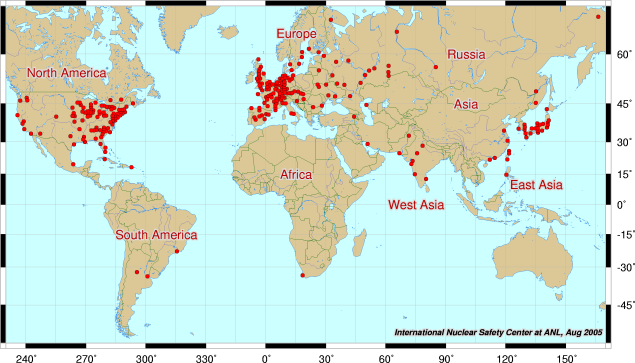
There are 441 operating nuclear power plants in the world. Without the regulating eye of humans, many of these plants would go through some form of catastrophic failure and eventual meltdown. Imagine 441 Chernobyls around the world. Check out this map and find how close you live to one? Hey Australia! Safest place on Earth in case of a meltdown.
Source: International Nuclear Safety Center at Argonne National Laboratory.
This map is from 2005, I could not find a newer one, but given how long it takes to build such a plant, and considering that they are not building many more, it’s pretty close.
The World Without Us was published in 2007. Given today’s pace of development, and pollution in China (check out this link and be shocked), and runaway fossil-fuel-burning, things are much worse than described by Weisman in 2007, when there were only 6.5 billion people on the planet, rather than seven.
We’re adding one million people to the planet every four days.
The World Without Us reads like a fast-paced thriller, where the bad guys are out the make the world go away. As I read the book, I realized that I was in it, and it wasn’t a thriller, it wasn’t a novel, it was a giant reality show, and my life, and the life of my children, and their children, was on the line.
Don’t you understand what I’m tryin’ to say
Can’t you feel the fears I’m feelin’ today?
If the button is pushed, there’s no runnin’ away
There’ll be no one to save with the world in a grave
Take a look around you boy, it’s bound to scare you boy
It is hard for me to swallow that people can still say that “climate change” is a hoax. What evidence do they need? Fourteen of the fifteen hottest years in history were in this century. We went over 400 ppm for carbon dioxide in the atmosphere, measured on Mauna Kea. This is the highest reading in 800,000 years. There are people that say this is all coincidence.
Inhofe says that “man is arrogant” for thinking he can change the climate. Man doesn’t need to be arrogant to mess things up. Man messes things up by accident and ignorance alone. Look at the great Pacific Garbage Patch, a vast swirling vortex north of Hawaii.
During his first 1,000-mile crossing of the gyre, Moore calculated half a pound for every 100 square meters of debris on the surface, and arrived at 3 million tons of plastic. His estimate, it turned out, was corroborated by U.S. Navy calculations. It was the first of many staggering figures he would encounter. And it only represented visible plastic: an indeterminate amount of larger fragments get fouled by enough algae and barnacles to sink. In 1998, Moore returned with a trawling device, such as Sir Alistair Hardy had employed to sample krill, and found, incredibly, more plastic by weight than plankton on the ocean’s surface.
Weisman, Alan (2007-07-10). The World Without Us (p. 123). St. Martin’s Press. Kindle Edition.
So man can foul up the ocean by dumping stuff into it, from ships, through rivers, through leaking landfills.
What stunned Charles Moore most was learning where it came from. In 1975, the U.S. National Academy of Sciences had estimated that all oceangoing vessels together dumped 8 million pounds of plastic annually. More recent research showed the world’s merchant fleet alone shamelessly tossing around 639,000 plastic containers every day. But littering by all the commercial ships and navies, Moore discovered, amounted to mere polymer crumbs in the ocean compared to what was pouring from the shore.
Weisman, Alan (2007-07-10). The World Without Us (pp. 121-123). St. Martin’s Press. Kindle Edition.
639,000 plastic containers dumped into the ocean every day! Senator Inhofe, I would think you agree that we are definitely fouling up the ocean. What makes you think we’re not fouling up the atmosphere as well? Is it because you can see plastic floating, but you can’t see the carbon dioxide? You believe in God, right, so you do believe in things you can’t see.
We’re messing with the planet big time, and it’s about time our leadership recognizes it and takes responsibility for it on our behalf. After all, they represent us. It was refreshing to see Obama stand up for science yesterday in the State of the Union Address, and it was encouraging to see the Senate vote today.
Pretty soon the deniers will simply look ridiculous in their affirmations, as ridiculous as a medical doctor in a 1955 commercial telling us we should smoke Camel cigarettes.
Voters just made it so Senator Inhofe will be the chair of the Senate Environment and Public Works Committee. Inhofe is one of the most vocal and devoted “climate deniers.” In 2012, he wrote a book titled The Greatest Hoax: How the Global Warming Conspiracy Threatens Your Future.
Inhofe cited the Bible:
“Genesis 8:22 that I use in there is that ‘as long as the earth remains there will be seed time and harvest, cold and heat, winter and summer, day and night.’ My point is, God’s still up there. The arrogance of people to think that we, human beings, would be able to change what He is doing in the climate is to me outrageous.”
It is outrageous to me that we put a man like this into a position of immense power where he can jeopardize or wipe out the work of thousands, no millions of people who study climate science, who are responsible in their use of resources, who want to make sure that there is a world for our children to live comfortably in.
Quoting divine power or bronze-age scripture to make national (or international) policy regarding environmental responsibility is outrageous and we, the voters, should be outright ashamed for ourselves for allowing this to happen.
Inhofe belongs in a church, where he can spew drivel all day long to eager followers without really doing any damage.
I am worried now. But maybe I shouldn’t be worried. After all, God’s going to fix it, right?
Below is the map of how people responded to the question: “Is global warming a threat to the environment?”
The deeper the red, the more the answer was Yes. The deeper the blue and purple, the more No.
What I take away from that is:
In the cities, in the large metropolitan areas and where most of the universities are, we are leaning to the red, to the Yes. In the coal and oil states we’re in the deep No. And then there is Texas and the South.
Global Warming by Congressional District [click to enlarge]This link gets you to the actual map, where you can search for your own zip code, and scan for results by county, zip code, congressional district, senatorial district and other filters. You can zoom in and out, and pan the map around.
The most important point I took away from this poll is this: The question was not: “Do you think that global warming is man-made?” Whether it is man-made or not is not part of the question. It was: “Is global warming a threat to the environment?”
It’s pretty hard for me to come up with a scenario where an educated person will say “Well, no, cranking up the Earth’s temperature by 2 degrees Celsius is not a problem at all. Let’s go and melt to Antarctic ice sheet and flood Los Angeles, Miami and New York. Go right ahead.”
That would be the essence of saying No as an answer to this question.
This color-coded map in Robinson projection displays a progression of changing global surface temperatures anomalies from 1880 through 2013. Higher than normal temperatures are shown in red and lower then normal temperatures are shown in blue.The final frame represents global temperature anomalies averaged from 2009 through 2013. For more info check this NASA site.
After I viewed this, I violated my own rule to NEVER read comments below YouTube videos lest the inanity crush me, and I found this comment by Dee Jordan:
To use her works, I find it “truly hilarious” that she didn’t have enough insight and reading skills to figure out that this was not an absolute map, but a map showing deviation from the norm.
The problem is that most people don’t have enough sense of science to know the difference and they suck up drivel like this and teach their children — not well.
We received this flyer in our water bill this month:
I passionately believe in conservation and preservation of our environment.
But I find this flyer ridiculous.
“Serve water to restaurant patrons only upon request” must be the most ludicrous suggestion of water conservation man has ever come up with. I agree, it’s not the first time we hear this. I agree, it’s not just the glass of water we drink or do not drink, but it’s the dishwashing that is also saved (presumably). Somebody show me how a restaurant that does not serve up water actually saves measurable amounts of dish washing water by not washing those glasses.
But the whole thing misses the point. Six months ago I wrote about California, Water and Rice. There I observed that in California, we use 85% of our water for agriculture, 5% for industry and only 10% for residential consumption – what is addressed in this flyer.
We grow some of the most water-intensive crops in California. Check out this article for stunning details. 99% of all U.S. almonds are grown in California, and it takes 1.1 gallons of water to grow a single almond. Let me say this again:
It takes 1.1 gallons of water to grow a single almond.
I like almonds. But given a choice between drinking an extra gallon of water a day and eating ONE ALMOND, I’ll take the water any day.
How do you reconcile these water use regulations for residents when you live in a state that has 124 desert golf courses?
I would have been more accepting of this pamphlet if it had given information about measures on agricultural use – where conservation initiatives actually would make a measurable difference.
If a farmer has statistics he can share, I’d appreciate it. I couldn’t find much data online, on the contrary. I found rationalizations why we can’t touch Californian agriculture.
“California’s agriculture is critical to the world’s food supply,” said assemblywoman Kristin Olsen, who represents part of the San Joaquin Valley, who had lobbied hard against the restrictions. “An inability to produce that food would clearly be devastating to health and human safety not only in California but around the globe.”