Book Review: The One Command – by Asara Lovejoy

About a year ago I bought (and promptly returned) a tape program titled The One Command by Asara Lovejoy. The review I gave it speaks for itself. Over the months I have received comments about that post. It pops up all the time in search engines and a lot of people visit that page. Sometimes the comments challenge me. The most recent challenge was this one on April 12:

Norbert maybe you should read the book and listen to the full cd set?

Bill

Ok, ok, I agree. I should not be blasting the program if I haven’t read the full book. So I went on Amazon to buy the book. I got it used for $10. I didn’t follow my own rules of reading the Amazon reviews first. Oh boy, oh boy.

I started reading. I tried to continue. This book has 243 pages, and it has about 10 pages of real material. Everything else is fluff, filler, endless repetition and psychobabble. The actual six step process described by the author includes:

  1. Ground
  2. Align
  3. Go to Theta
  4. Command
  5. Expand
  6. Receive with Gratitude

This is described, not very well, in pages 47 through 54.

For instance, here is the entire description of Align:

Once you are well grounded, imagine the power and force of Earth’s energy coming into your body, and align your heart to that force. As you take a breath in and then exhale, imagine your breath exhaling out in all directions around you as you clear negativity and align with love. You increase the power of your desires when they resonate in harmony and you strengthen, like a lightening rod, the clarity of creating what you desire when you claim it in love.

I understand the power of suggestion and self-suggestion. I have learned to use self-hypnosis effectively. But that took time, practice and much more instruction than this. How does one “strengthen, like a lightning rod, the clarity of creating what you desire when you claim it in love?”

Half the book is filled with testimonials of people who used the techniques and achieved miraculous results. People command the universe to solve their financial problems and the next day their answering machines are full of messages of people products orders for products they could not sell before.

“I issed The One Command and in moments my house was leased after months of no interest.” — Maureen Bell, author of Multicultural Feng Shui

The book contains 243 pages and 47 chapters. The chapters are disorganized and repetitive. I honestly tried to do my duty and “read the book” but I simply couldn’t stand it. Soon I started thumbing around, back and forth, trying to find the interesting parts.

I found none.

In the end I spent $10 so I can have this useless and utterly unreadable book on my shelf.

Boeing vs. Airbus – 40 Years of Trends

Say I had told you in 1972, when almost all the world’s aircraft companies were in the U.S., all giants themselves: Boeing, Lockheed, Martin Marietta, McDonnell, Douglas, Hughes, Lear and the list goes on, that I wanted to start a new aircraft company that builds airliners.

You would have told me I was crazy, out of my mind kind of crazy. One does not start aircraft companies.

Well, in 1972, a group of people at Deutsche Aerospace in Germany, and at Aerospatiale in France did just that, and soon a small consortium called Airbus was starting to build and sell airliners.

In the U.S., consolidation brought the companies together. McDonnell Douglas bought Hughes, Boeing bought McDonnell Douglas (who would ever have thought that possible in 1972) and now there is really only one American giant aircraft company that builds airliners: Boeing.

Boeing has struggled from time to time. Over the years I was lucky enough to do work for Boeing, hang around in their factories, get to know their workers, processes and decision-making approaches. I was just a small contributor on their shop floors, never really got to know management, but I always liked the company. For a long time, Boeing had the only very large airliner on the market, the venerable 747. Until a few years ago. The Airbus 380 is larger.

Looking at the chart below shows Boeing and Airbus market share and deliveries.

Source of Graphic

This chart essentially indicates Airbus deliveries going steadily up, almost every year, along with its market share. Airbus and Boeing market share met and crossed in 2002 and Airbus is now the largest aircraft company in the world, both in terms of market share as well as in annual deliveries.

Boeing is fighting back. The 787 should give it a new edge. But looking at a chart that spans more than three decades, and looking at the trend, what would you bet will the next 10 years look like? Which direction are the two steady lines going to go?

Which of the two companies would you invest in?

There were many critics of Airbus over the years. They asserted that Airbus was not a real company, but it was heavily subsidized by a number of governments, including Germany, the U.K. and France. True. Government run industry? Hmm, not a happy word in the 2012 election season in the U.S.

Against all odds, a bunch of engineers in socialist Europe decided in 1972 to start a company to build airliners, and within 40 years made it into the largest airline manufacturer in the world. In 2012, Airbus hired another 4,000 employees making the employee count around the world approximately 60,000.  In comparison, Boeing commercial airplanes group employs about 81,000 people.

What I would not have deemed even remotely possible happened: a virtual startup took over a market that the U.S. owned absolutely.

It was done by:

  • Sheer engineering prowess in Germany, France and the U.K.
  • Manufacturing efficiencies
  • Breakthroughs in material science (composites)
  • Perseverance
  • Focus
  • Government subsidies
  • Education

It worked.

Fate and the Circle of Life

In the Los Angeles riots on April 30, 1992, Elvira Evers, then 7 ½-months pregnant, watched her Compton block fill with vehicles full of stolen loot. The nearby swap meet had turned into a free-for-all. Suddenly she was shot in the womb. The news story was that the youngest victim of the riots was not even yet born.

Elvira Evers was rescued and had an emergency caesarean section. She didn’t wake up for a week. The baby, Jessica, had an injured elbow, but both mother and daughter were saved. Check this link for an article and pictures.

When I see a 20-year-old girl living now, who was a hair’s breadth from death before she was born, it causes me to marvel at the circle of life, fate and the purpose of every human being.

Book Review: Voyage – by Stephen Baxter

Published in 1997, Baxter’s Voyage is an alternate history novel. It chronicles a time of space exploration in the United States between the early days of the space program in the late 1950ies, through 1986. President Kennedy survived the assassination attempt in November of 1963, albeit confined to a wheelchair. Johnson succeeded him because he was medically disabled, but Kennedy continued to provide vision and motivation to the people and the government regarding the space program, and sending manned missions to Mars. In Voyage, we follow real historic characters, like Neil Armstrong, Nixon, Agnew and many contributors in the space program, interspersed with fictional characters, like Natalie York, the first woman to set foot on Mars.

In the 766 page novel, Baxter does an excellent job developing the characters and creating a plausible story and a possible approach to a manned mission to Mars in the decade of the eighties.  Indeed, this was Nixon’s plan when we succeeded in landing on the moon.

Here is a link to information about von Braun’s plans and proposals to the Nixon Administration in August 1969, right on the heels of the successful first moon landing. This site also shows some good concept drawings of the technology required to accomplish the plans.

The story in Voyage follows this von Braun and Nixon plan in concept and elaborates on it.

Baxter has researched the topics extensively. He describes details of the Apollo missions and technical minutiae that make it hard to believe he was not himself an astronaut on these missions. He takes us right on the missions, and we participate, sometimes white knuckled, in daring feats in spacecraft, real or imagined.

I didn’t finish reading this book. In fact, I only read the first 10% or so, then skimmed around in the middle and read the end. I did this not because the story didn’t captivate me. I am intensely interested in the space program – and the lack thereof right now. I just decided there were too many books on my reading shelf that needed attention, and I didn’t want to divert my time into fictional stories of an age now long past, musing about what might have been.

Police Escorts High Speed Luxury Convoy

When you and I drive a bit too fast, we get pulled over, we get a lecture, and we pay a fine. If somebody with enough money to buy a Maserati wants to drive fast, he asks the state police to escort him.

A few state police officers in New Jersey seem to have made some very bad judgment calls when they decided to escort a convoy of luxury sports cars, including a Fort GT40, Porsches, Ferraris and more along the Garden State Parkway to Atlantic City. The convoy was weaving through traffic at speeds of over 100 miles per hour at times, all the while escorted and led by state troopers with lights flashing.

It looks like a police sponsored high-speed race in the middle of everyday traffic.

Two state troopers have been suspended over allegations they provided an unauthorized escort to a group of sports cars.

The Star-Ledger newspaper said witnesses had complained to police about the caravan — which one witness dubbed “Death Race 2012” — saying they saw patrol cars with emergency lights flashing at the front and rear of the sports cars.

The article in this link on MSNBC has a video worth watching. It takes you right into the middle of the scene to witness the action. The guys videotaping aren’t holding back their astonishment and excitement.

Caterpillar of Feathers – by José Luis Rodríguez

This photo is titled “Oruga de Plumas” (Caterpillar of Feathers) by the artist.

José Luis Rodríguez is an amazing nature photographer. Here is his bio – in Spanish only. He also has a very well-done nature photography site.

.

Hiking Black Mountain

Last Sunday Trisha and I hiked Black Mountain, the prominent dark cone just east of Rancho Penasquitos with all the antennas on top. This was my first time hiking Black Mountain. On a good day, you can see the ocean, Point Loma, the islands off  the coast, downtown San Diego, Cuyamaca Mountain in the east, Palomar Mountain to the north and all of North County.

Sunday was fogged in completely. When we started, we could see no further than a few hundred feet. The mountain, we knew, was there, but we could not see anything. So we started hiking up the trail from the Hilltop Community Park (red arrow) at 735 feet elevation. It was 2.05 miles and took 48 minutes to get to the top (blue arrow) at 1552 feet.

Here is our trail:

From a distance, Black Mountain looks like a smooth cone with “grass” cover. Hiking up, here is Trisha with the “grass,” which is actually impenetrable shrubbery of all kinds, sprinkled with Manzanita everywhere.

When we got to the top, as expected, we had a 360 degree view of absolutely nothing:

Finally, on the way down it cleared up a bit, and we actually saw the mountain we were just on, kind of:

Overall, a great hike of two hours or so, a good workout. The trail is half trail, rough and rocky, and then toward the top it’s a truck road. Not a pretty hike, but very quick to get to and a good workout right in the heart of San Diego County.

Decline in Education in California

In the mid 1960ies, California was ranked fifth in the United States in per pupil spending on education. During those years, California built one of the finest university systems and community college systems in the country. People from other countries and states came to California to learn how to implement colleges. The people of California had a purpose, a vision and a will to create an unsurpassed educational system.

With the cuts of recent years, we have started the process of dismantling our educational system. Expected cuts in future years are Draconian and will do serious damage which it will take decades to overcome.

In 2012, California is in rank 42 in per pupil spending. Below California are Arizona, Idaho, Mississippi, Nevada, North Carolina, Oklahoma, Tennessee and Utah. Per pupil spending for 2010/11 for California is $8,689. Rank #1 is New York with $17,750, twice the amount of California.

In 2012, it costs $44,563 to incarcerate a prisoner for a year in California, the highest cost in the nation. That cost is almost the price of a year at Harvard University with room and board. The average cost per prisoner for the U.S. is $28,817. We are currently building the best prisons in the country. We’re doing to prisons now what we did to education in the 1960ies.

So let me get this right:

We went from #5 to #42 in education.

We are at #1 in prison expenses.

A society’s values are reflected by the things it spends its money on. If I drive a Hummer, a minivan, a Prius or a 1965 VW Beetle, you are going to draw conclusions about my lifestyle and my values.

Right now – in California – we’re building prisons and we’re dismantling education, systematically, ruthlessly.

Big question: Are we #1 in prison expenses because we’re #42 in education?

Mountain City, Tennessee

There is a little town by the name of Mountain City, Tennessee, at the very eastern tip of the state (red arrow):

Of course, Tennessee is a long state, and Memphis is on the very western end (blue arrow):

You can still see the red arrow pointing to Mountain City, which does no longer show up on this map with this resolution.

It is surprising that Mountain City is closer to Canada than to Memphis.

To illustrate that, I have drawn a circle entered on Mountain City (red arrow), starting in Memphis (green arrow), ending in Ontario, Canada (blue arrow). You can click on the maps to zoom in:

I know you really wanted to know that.

Discovery to Final Resting Place

The Space Shuttle Discovery swoops over the Capitol dome and Washington Monument on its way Tuesday to the National Air and Space Museum.

Picture credit to Bernie Sanders’ Blog.

Many more photographs in the Orlando Sentinel.


Movie Review: Larry Crowne

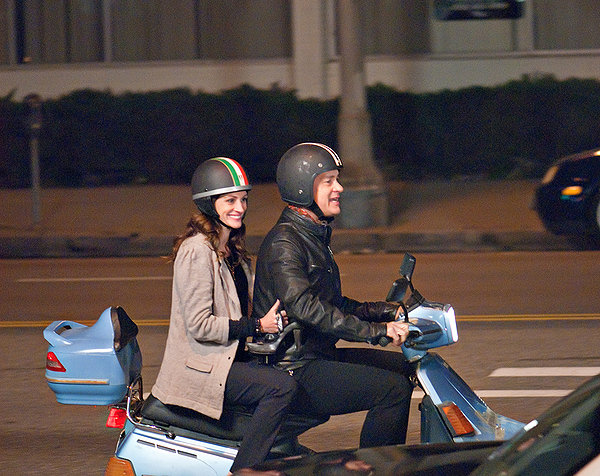
Larry Crowne (Tom Hanks) went into the Navy after high school, then started working at a big box store in suburbia, California where he languished for twenty years in an upbeat and middle class life. Until he got laid off. The mortgage on his house upside down because he bought out the ex-wife, not a day of college in his life, he quickly finds that he must start over again. He enrolls in college, where he gets drawn into a young scooter-driving crowd that teaches him how to break out of his middle-age rut. A new hair cut, a new wardrobe, a new apartment and a job as a short-order cook catapult him back into college-age, and he likes it.  Mercedes Tainot (Julia Roberts) is his instructor in Speech 217. She hates her husband, her work and her life and teeters on the dark edge of alcoholism. Larry and Mercedes come together from entirely different directions in an attempt to clean up the messes of their lives.

This is a light comedy, written and directed by Tom Hanks. It’s like Tom Hanks and Julia Roberts sat down in a diner one day, bored with nothing to do and no big important movie to make, and they baked this idea up on a napkin story board. Then he made this movie. The acting power of those two stars pulled this through. Otherwise it would have been an useless film. Larry Crowne is a feel-good movie with no redeeming value. It made me wonder what it would be like to cast off all my burdens and go back to college. Would I enjoy bouncing around with twenty-somethings, tending bar to make a living, while taking art-classes?

Maybe I would.

Rating: **

Reflections on Gates vs. Trump

Why is it that when I listen to Trump I can’t help but think of him as a buffoon, and when I listen to Gates, nothing but scholarship comes up?

They are two very rich and famous men that have had a large impact on our society. I venture to say that Gates on a much more prevalent and fundamental level.

I can’t really say that a successful real estate developer, who built a great hotel, golf course or casino or two contributed to society something that made a real difference. And I can live fine without ever having to see another episode of The Apprentice.

On the other hand, I have used many of Gates’ products every day, all day, since 1987. That’s 25 years of continuous daily use. Gates has helped eradicate polio through this drive, vision, money and charisma, marshalling the help of thousands of medical professionals.

Gates – or Trump?

This article in Forbes drives home this comparison. If I had to hitch my wagon to either of these horses, it would be Gates.