
Category: Visualizing
Ark Encounter – Hmmm
Ken Ham built the Ark Encounter, a Christian theme park. It is scheduled to open next month.
It cost tens of millions of dollars to build a “life-sized” replica of Noah’s ark.
I wonder how Noah, who was reportedly over 500 years old, with his sons, would have built such a thing with Bronze Age tools. He didn’t have access to cranes, and trucks, and roads to haul in lumber, and steel scaffoldings, and modern steel nuts and bolts and braces.
But I have to admit, it would be a cool thing to see.
Just How Much is a Billion?
A million seconds is about eleven and a half days.
A billion seconds is 31 years and 8 months.
Just How Big is the Milky Way?
If the earth were the size of the period at the end of this sentence, then the Milky Way would be the size of the continental United States.
That big.
At that scale, the Andromeda Galaxy would be a pinwheel about twice the size of the continental United States, floating about 40,000 miles out in space, or about a quarter of the way to the moon.
Now look at the earth again: —> .
U.S. Military Spending – Take Two
In January of 2013, I wrote this post about U.S. Military spending. Most of the numbers and basic facts, as well as my suggestions on what to cut still stand today, three years later (the numbers used here are for 2014). However, there are some developments that I should point out:
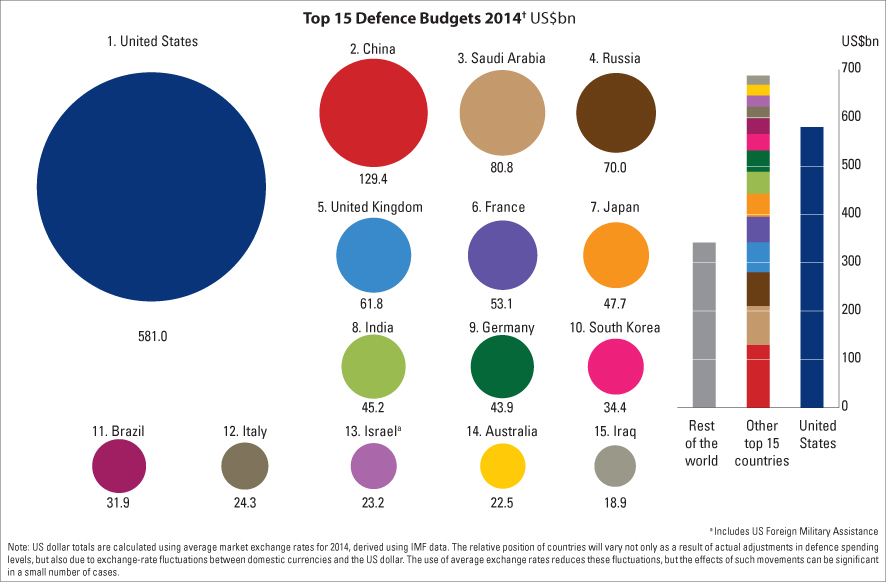
I put these numbers in a chart ranking the top ten military spenders in the world.

The U.S. still spends more than the next NINE COUNTRIES COMBINED on the military, yet the population of the U.S. (321 million) is about one tenth of that of all those countries combined (3.1 billion). So overall we’re spending more than 10 times as much per capita as every other country in the world on the military. And this is AFTER all the “terrible” cuts by Obama.
Interestingly, with the rise of Saudi Arabia in this chart, they are above our ranking in spending per capita. The U.S. does about twice the spending of the major European nations per capita, about four times that of Russia and 18 times that of China.
When I listen to the Republican candidates during the debates, they are ripping into the current administration for slashing the military budget and destroying our military capability.
Really?
Are they telling me that it takes ten times the spending per capita of the next nine countries combined to defend our country?
Are we getting that much less value for our spending than China and Russia?
Seriously?
Or are we just spending stupidly, to use a Trump term?
Perhaps we should stop spending our military money in other countries. We’re not defending the United States and its citizens. We’re blowing money on the military industrial complex which has a vested interest in wars going on overseas all the time.
We are fanning the flames of terrorism on purpose. We’re killing innocent civilians and children by the scores with our drones. And at home we’re telling the voters that we have to be afraid of terrorists killing us.
Fear works.
None of this makes any sense to me.
Montana Geography Lesson
The south-east corner of Montana is closer to Texas than to the north-west corner of Montana. I know you’re all going to run and check your maps now.
Putting Iran into Perspective
There is a general hatred of Iran that festers in the United States. This hatred is constantly stoked by the political right and it surfaces now more than ever, due to the recent nonproliferation talks and the “deal with Iran” that everyone on the right seems to call such a “bad deal” without providing substance as to why.
I was stationed as a soldier at Luke AFB in Arizona in the late 1970s. We were training Iranian pilots in American fighter jets then!
It all came apart in the late 1970s, and on November 4, 1979, under President Carter, the Iranian revolutionists captures 52 American diplomats and took them hostage for 444 days. The hostages were released “coincidentally” the day Reagan took office.
According to Wikipedia:
Fifty-two American diplomats and citizens were held hostage for 444 days (November 4, 1979, to January 20, 1981), after a group of Iranian students, belonging to the Muslim Student Followers of the Imam’s Line, who were supporting the Iranian Revolution, took over the U.S. Embassy in Tehran.
This is when our hatred of Iran started, over 35 years ago. When it happened, I had Iranian friends from my time as an exchange student. Of course, we lost all contact.
This got me thinking about Iran and its people.
Here is a population chart as of 2011 – which is the most recent data I could find (Wikipedia):

As of 2011, there were about 75 million people in Iran. It’s by far the largest Middle Eastern country.
About 48 million Iranians, or 64 percent of all of them, or about two-thirds, were born after the hostage crisis. They do not know an Iran of the pre-revolutionary time.
About 62 million Iranians (all those highlighted in yellow) were about 15 years old or younger or not born at the time of the revolution. That’s a full 83 percent who were either children or not even born then.
Only 17% of all Iranians are therefore old enough now to have realistic memories of the time before the revolution.
I am personally older than 68 million Iranians or 91 percent of all of them.
And this is all data as of 2011. By 2015, there are probably about 5 million more – so the numbers are even worse.
The vast majority of Iranians are young people who want peace, stability, prosperity, education for themselves and their children. They don’t want war with America or anyone else. They want to travel, they want to visit the Grand Canyon and New York City, like all the people in Japan and China and France and Germany. They want to live normal lives, without hunger, censorship, and religious oppression.
In a few more years, all the old wackos will be dead and the only people left are the young generations.
We should watch Iran closely, but we should give them a chance to join the community of civilized nations, those that don’t preemptively invade or attack other sovereign nations, like we…
— hmmm, I guess not like we.
Rumination about Planet Kepler 452b

The headline in USA Today was startling. A ‘Goldilocks’ planet was found, one that could harbor life as we know it, based on the fact that there could be liquid water on its surface. It’s a bit lager than Earth, approximately 12,700 miles in diameter, compared to Earth’s 7,926.
What the article didn’t say, however, is what it would be like to stand on that planet, earthlike or not. With a diameter this large, the volume of the planet would be about 4.3 times that of earth, so its mass would also be that much bigger.
Gravity is proportional to mass. This means that if you weigh 150 lbs on Earth, you’d weigh more than 4 times as much, over 600 lbs on 452b.
We couldn’t land there and be comfortable. Any beings used to that, probably squat end Jubba-like, would feel like bouncing balls on Earth.
The planet is 1,400 lightyears away. If beings on that planet sent us a message in the year 600, the message would arrive just about now.
To put the time into perspective: In the year 600, Pope Gregory the Great decreed “God Bless You” as the religiously correct response to a sneeze. In the year 600, quill pens, made from the outer feathers of crows and other large birds, became popular. Mohammed, the founder of Islam, was alive during that time.
Suppose we received a message from any 452b beings. If we responded now, our answer would reach them around the year 3,400.
If we could build a ship that could travel at a tenth the speed of light (which is way beyond our current capabilities), it would take the ship 14,000 years to get there.
I am ready to go. Where do I sign up?
Aiming for Pluto and Hitting It – the Incredible Size of Space

If you ever want to visualize the incredible size of just our solar system, and how it is almost completely empty, go to this website by Josh Worth.
On that site you can scroll from the sun to the various planets, and as you scroll, you “feel” how small the planets are and how far they are away. If the moon were the size of a pixel, as seen in the picture above, Earth would a tiny dot of a few pixels and about 35 millimeters away from the moon.
Pluto is smaller than the moon. The moon has a diameter of 3,474 km, and Pluto only 2,368 km. It’s only 18% the moon’s mass. So it would be smaller than a pixel, and could not even be seen on this scale.
However, on this scale, it would still be about 685 meters away from this point. That’s about a third of a mile or the length of about seven football fields.
So, if the Earth were the size of this dot on this picture, then Pluto would be a speck of dust a third of a mile away.
The New Horizons spacecraft left Earth in January 2006 and has traveled more than eight years. It’s the fastest human-made object ever, traveling about 100 times faster than a modern jetliner. And it has been on the way for eight years leaving that blue speck on the screen aiming for that speck of dust 685 meters away.
And it’s going to hit it three days from now.
Surprising Facts of Geography
- The closest state to Africa is Maine.
- Alaska is the northernmost, westernmost, and easternmost U.S. state.
- The southeast corner of Montana is much closer to Texas than to the northwest corner of Montana.
- Reno, Nevada is further West than Los Angeles, California. Check it out here.
- Spokane, Washington is further west than San Diego, if only by a third of a degree (117.4250 West vs. 117.1625 West)
- Mountain City, Tennessee is closer to Canada than it is to Memphis, Tennessee. Check it out here.
- Alaska is the westernmost, northernmost and easternmost state in the U.S.
- All of South America is east of Ohio, or Atlanta, Georgia, for that matter.
- Rome is further north than New York City.
- Regensburg, Germany is on the 49th degree latitude, the same as the long, straight border of the United States and Canada. This means that all of the continental United States is south of Regensburg, Germany.
Visualizing the Size of the Solar System
When I posted about visualizing the speed of light a couple of days ago, one of my readers pointed out another site that did a great job helping visualize the size of the solar system. If the moon is one pixel wide, what are the various sizes of the objects and their distances from each other. It starts out with the sun and you can scroll to the right to start getting to the planets. There is also a “speed of light” button on the right lower corner, the “C” button, which turns on auto scroll at the speed of light. Thanks, PS, for pointing out this site to me.
Visualize the Size of the Solar System by Clicking Here
Visualizing the Speed of Light
Here is an amazing video that shows what it would be like to be sitting on a beam of light traveling away from the sun, flying by Mercury, Venus, Earth, some asteroids and finally arriving at Jupiter, 45 minutes later. It really gives a sense of the immense size of the solar system, not to mention the universe.
Visualizing Stars and Religions
Common wisdom says there are about 6,000 stars visible with the naked eye on earth. Of course, half of them are below the horizon. Of the 3,000 stars above the horizon, 500 of those too close to the edge, or obstructed. That leaves about 2,500 visible stars on a clear, dark night.
There are 4,200 religions in the world.
That means that there are more religions in the world than there are stars you can see on a clear night.
Visualizing North America on Jupiter
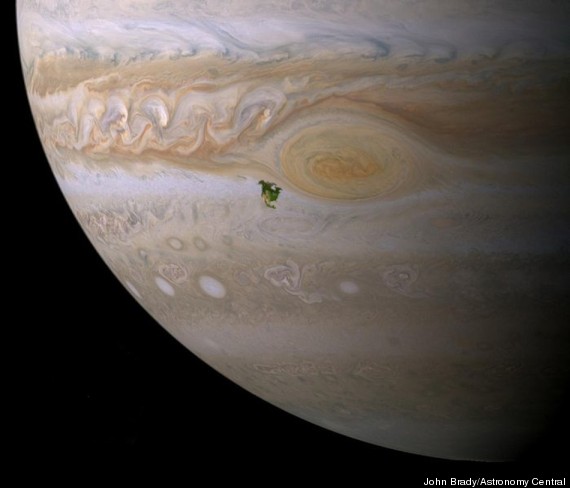
The green speck is what North America would look like on Jupiter to scale.
Flashes of Consciousness in the Vast Dark
While we marvel about the possibility of millions, even billions of intelligent civilizations in the universe, we really only know for sure of one: our own. It has, as a sentient culture only existed for a couple of hundred thousand years. If I can classify civilization as a group of sentient beings that records its history, then we’re only about 5,000 years old as a civilization. If technology is the defining factor, we’re only about 150 years old. All these time spans are very short in the context of cosmological terms, where time periods are counted in millions of years, even billions. We also don’t know how long a civilization lasts. Our own has so far not lasted long, and there are some signs that we’ll do something stupid soon and it will have been a very short period indeed.
So let’s speculate that an intelligent civilization lasts about 10,000 years from first recording its history until flaming out and dying off.
Our universe is 13.77 billion years old and the Earth is 4.54 billion years old. There are almost half a million 10,000 year spans in 4.5 billion years. So our civilization, based on my assumptions here, lasts about half-a-millionth of the time span of the earth.
If other planets on other stars had similar timescales, and if there were half a million such planets in our galaxy, all forming about at the same time the Earth formed, we could conceivably have had half a million civilizations on these planets alone without overlap. This means every one of those civilizations could have existed throughout its entire life-cycle without ever knowing about the existence any of the others. All of them could have been advanced technological civilizations with active programs in place to scan the sky for signs of life. They still would never have seen a trace of any. They existed, but separated from each other by time.
This makes me think of camera flashes in a stadium:
Watching the short video above I can’t help but think of each of the flashes to be a 10,000 year civilization somewhere in our galactic neighborhood. The short video spans perhaps 10 million years of time. We’re one of them flashing right now, but we never saw those before us or after us. Yet they all exist.
Taking this thought process further: If the universe is 13.77 billion years old, and the Earth only 4.54 billion, there could have been several full solar systems that came and went before ours even started.
Let’s say a solar system formed when the universe was 5 billion years old, and matured to the current state of ours at 9 billion years. There could have been highly advanced civilizations in that solar system that never knew about ours, since our own sun had not even formed at that time.
So when we think about civilizations in the universe apart from ours, we have to think not only about those that may exist right now, but all of those that have ever existed, and now we can multiply the current estimates of possibly trillions (see my post about this here) to millions of trillions.
Meanwhile, it would be nice if we could finally find just one flash of consciousness in the vast dark. Just one.