The Long Life of an HP Printer

I don’t care much for HP monitors and computers, but their printer technology, which is what they originally became known for, seems unbeatable. When I started our company in 1993, I first bought an HP 4L laser printer. It had a neat small footprint, cost about $500, and printed 4 sheets a minute – that was a whopping speed then. We soon expanded, and needed a laser printer off the server that all of us could access. So we bought an HP LaserJet 6P.

LaserJet6p
This printer was somewhat faster and had a sheet feeder in the back. After a number of years, when we bought the next enterprise printer for color printing, we reassigned the old 6P to the accounting office for check printing and occasional reports.

For 20 years, it just kept chugging away. Last week there was some problem with the drum, and we could have spent a hundred dollars on labor to get it fixed. So we decided to finally retire it.

The 6P just printed, printed, printed for 20 years – and I am sure it would have continued for another 20 years, if we had just wanted to spend the money to have it repaired.

With a bit of sadness and nostalgia, I bid it farewell.

Gov. Brown and the Drought in California

Today the governor of California went on national TV and told climate deniers to wake up and smell the drought. While this was theatrical and effective, it was no more or less showman-like than what the senator with the snowball did a month ago in Washington. Sorry, Mr. Brown, but the fact that it has been dry in California for a few years by itself if proves nothing about climate change. I would have expected more substance from our governor.

The drought in California is serious. I have never seen our lakes so low and our hills so brown. And I am very concerned about our water use.

Front Yard

This is the view I have when I back out of our garage. The gate in the middle of the picture is our front garden gate. Everything behind it is our responsibility to groom and water. The home owners association if responsible for everything in front of the gate. It’s lush and green, because it gets watered heavily, and much water runs off the driveway and down the gutter. Hundreds of houses in our neighborhood are watered this way. Millions of houses in California.

While I have the power to flush my toilet less, I am in dismay when I realize that a month of no toilets would probably save less water than is getting spread over my front lawn every day – and I have no control over that.

Here is the water usage in California:

Water Use in California

This is worse than the 80/20 rule. 80% of our water in California goes into agriculture, and it produces 2% of our economic output.

Yet, the governor in his directive has targeted the 20% residential and industrial users to curb their water use by 25%, while the agricultural community is just given “guidelines.” This makes no sense to me.

The biggest use of water in agriculture is alfalfa, which is largely a crop for feed for cows. The next largest is almonds. It takes more than one gallon of water to grow a single almond. We also grow a lot of rice in California.

Here is an interesting chart from Mother Jones:

la-vs-exports_v3_0

It show how much water the entire city of Los Angeles uses in a year (about 0.8 billion cubic meters). Then it compares this to the amount of water needed to produce the walnuts exported overseas from California (1.0 billion cubic meters), and the water needed to produce the almonds exported overseas from California (2.3 billion cubic meters). Ten percent of all our water is used for almonds. Almonds cover 940,000 acres in California.

I say, we forget about producing almonds and shipping them to the rest of the world, and we have plenty of water for all the cities in California for a very long time.

None of this makes any sense to me.

Governor Brown, wake up and smell some common sense.


Garbage Down the Toilet

flushable_wipesAre you flushing baby wipes down the toilet? Or – ahem – condoms?

Recently there was some media attention on this, originally triggered by a piece by Matt Flegenheimer in the New York Times. It was also picked up by All In with Chris Hayes on MSNBC. Chris visited a New York sewer treatment plat and showed what the workers have to go through, removing the wipes from the sewer. Large containers of unimaginable “trash” fill up every twenty minutes. Workers have to remove the stuff from the works, which get gummed up by the unimaginable “trash.” Fortunately the TV does not transmit the stink.

Flushable in Pipes

Then I saw this article on the blog grist.org talking about flushing condoms down the toilet.

We have this idea that whatever we flush down the toilet magically disappears from the world. That dead fish or mouse may well make it out of our apartment or house. That condom likely slips along, that baby wipe is small enough to be whisked away. But somebody down that long line of pipes will have to remove it from the water and haul it to a landfill.

So rather than throwing things down the toilet – which is not a recycling unit that we see on spaceships in science fiction movies – it would be a lot cheaper for society to put that stuff in the trash. The trash truck is a lot cheaper than the entire chain of events it takes to remove the condom from the water and put it into a – you got it – trash truck to be hauled to the landfill.

I learned a lot from the New York Times article, the MSNBC piece and the Grist blog entry. If you are buying “flushable” wipes, if you are “buying it” that these wipes just disappear in the sewer system, you might be interested in researching these articles I am linking to.

Let’s not flush money down the toilet.


Glyphosate (Roundup) is Not Harmful to Humans

… or so this Monsanto Lobbyist says:

He says you could drink it. The interviewer counters, and offers him a glass. “I am not an idiot,” he says.

The hypocrisy of this guy is appalling. Then he calls the interviewer a “complete jerk” as he walks off the set in panic.

Worldwide Waste of Food

The food discarded by consumers and retailers in just the most developed nations would be more than enough to sustain all the world’s 870 million hungry people if effective distribution methods were available.

— New York Times, Editorial Board

As with most civilization technologies, the solution to this waste is infrastructure. None of us want to waste food. Nobody decides to take more food at Souplantation than they can eat, just to leave it for the busboy to take away, okay, almost nobody. I have seen violators!

Here is a post I wrote about food waste at the Hampton Inn a couple of years ago. In that article I pointed out the eggs I noticed in the trash can after they cleared the breakfast buffet at 10:00 am.

Waste at Hampton Inn
Wasted food at the Hampton Inn

I pointed out in that post, if they simply didn’t peel the eggs before they put them on display, they would not have to throw them out every day. And sure enough, soon after that all the Hampton Inns started serving unpeeled eggs and have done so ever since. My post was probably a coincidence and perhaps aligned with consumer complaints from many people to cause them to change this.

If there were a way to get the extra four-inches of the Subway foot-long that I can’t quite eat to some starving child in Somalia, that child would get calories for several days out of that sandwich. But there is no way.

If there were a way to let supermarkets transport the food they are forced to throw into the dumpsters to a country where there is a food shortage, many mouths would be fed.

Since transporting our waste is not practical and possible, the ultimate solution is to figure out less expensive ways to produce the food where it is needed. We’re right back at sustainable agriculture, and the infrastructure required to support it. Solving the world hunger problem is a project of decades, not years, and requires continuous commitment from individuals and governments.

Since governments by nature only care for their own problems and needs, the misaligned distribution of infrastructure and wealth cuts out the poorest nations. We need to find a profit incentive. Some entrepreneur must find a way to make distribution of food technologies and food itself to developing nations profitable, and then things will start rolling.

Here is a need. Does anyone have an idea how to fill it?

If you would like to learn more about world hunger, key facts and statistics, here is a valuable link.

Ruminations on Self-Driving Cars

Exciting Times Ahead

I believe that over the next 20 years, self-driving cars are going to revolutionize they way our world works unlike any technology we have seen in a long time, since, maybe, cars themselves a hundred and twenty years ago.

The Challenges

I recently read that Google’s self-driving cars have already logged 700,000 miles on California roads without driver intervention. But there are many challenges ahead for them.

Here is an article about simple things Google’s self-driving cars can’t handle yet, including bad weather, potholes, roads that haven’t been googled yet and handling road construction.

Elsewhere I read that there are three challenges that may seem innocuous at first that really get in the way. First is dealing with an empty parking lot. Picture a shopping mall after hours. There are no reference points, just faded marks in the pavement. The cars supposedly don’t know what to do with that.

Another problem is driving into multi-level parking garages. I am not surprised. I know many humans that hate driving in parking garages. They are often very tight, usually poorly lit, and traffic rules don’t apply. It is never clear which way is up or down, and whether a path is one-way or two-way. How would a self-driving car be able to deal with that?

Finally, handling traffic lights with the rising or setting sun right behind them. I must admit, I also have problems with that. I remember times when only careful management of the visor, quick glances at the lights, and following the lead of other cars around me was able to get me across the intersections and hopefully out of the blast-zone of the setting sun. A camera alone on top of a self-driving car would not have a chance.

All these examples are formidable challenges for self-driving cars. But they all can be overcome, not necessarily by software and algorithms, but by infrastructure.

Infrastructure

When the telephone was first invented, many skeptics predicted that it would never work. After all, you’d have to run a wire to every house you want to call. That’s certainly never going to happen. Well, we all know that it actually did happen. Not only that, we have already leapfrogged that stage, and nowadays you don’t need to run a wire to a house anymore and still get telephone reception. The trick with making the telephone successful was not the technology of the phone itself, but the infrastructure around it: a wire to every house and every office in the country.

Before cars, when our only method of transportation was walking, riding a horse or a horse and buggy, the stage-coach concept revolutionized long-distance travel. The passengers rode in a comparatively comfortable closed cabin on cushioned seats, the cabin on strong springs, while a team of horses pulled the coach. The distance from station to station was just long enough for a team of horses to handle. The passengers reached the station, got refreshments while the horses were changed, and then traveled right on for the next station, and so on. Long distance travel in the horse and buggy age was not possible because of super horses, but because of the infrastructure of the properly spaced stations, and the people who serviced them.

When motor cars came about, critics said they would never work. You’d have to pave roads to everywhere you want to go. Besides, they’d break down in the middle of nowhere leaving you stranded all the time. And you’d have to put gasoline into them. You’d need filling stations all over the place. We all know that faster than anyone would have believed it, we built paved roads, interstate highways, gas stations are everywhere, and cars can go coast to coast without ever breaking down.

As traffic increased, the traffic policeman in the middle of the intersection directing the flow could no longer handle it and we invented traffic lights. Now traffic lights are everywhere, making mass automobile traffic possible.

It’s not the car that made the automobile society, it was the infrastructure built around the car.

What Robots Need

A self-driving car is a robot, before it is a car. Robots don’t need traffic lights. Robots don’t need white lines on the side of the road and double yellow ones in the middle. Robots don’t pass other robots in dangerous areas.

While we are currently in a transition period, and our robots need cameras to look at green and red traffic lights, sometimes outshone by the sun, this will not be the solution for the long-term.

Roads will be outfitted with electronic markers that give direction to cars. The robots will sense the edges of the roads by using such markers they can pick up at high speed, rather than having cameras try to find while lines or other obstacles.

The robots will have inter-robot communication. Cars next to each other will communicate with each other. This means that they will be able to drive 70 miles per hour bumper to bumper without jeopardizing anyone. They won’t need traffic lights in intersections. All the cars approaching from all directions will “negotiate” who goes first. Nobody will need to stop. Cars will simply zoom through in all directions, making sure that there is enough spacing for cross traffic. Stopping at red lights will become obsolete.

Freeways will not have two directions anymore. The cars will figure out how many lanes in each direction they need and just take them. Traffic will self-regulate.

Then, when a car gets to a point where it doesn’t know how to go on, it will simply pull over and issue the “take over, human” command. A joystick will pop out of the dashboard that will allow the human passenger in the car to guide the car up that dirt driveway, around the old oak tree, to grandmother’s house and safely park it in the grass without running over the flower beds.

Valet World

When our cars can handle themselves like this, we really don’t need parking lots anymore at airports, train stations, shopping malls or restaurants downtown. We will simply have our cars drop us off at the front door wherever we are going. Then the car will drive away to a parking garage that’s designed just for cars. The cars will stack themselves up like sardines. No humans will have to enter those garages, the doors of the cars don’t have to swing open, and the cars can simply sit in total darkness and wait until their humans are done with dinner, or shopping, or work, and call them back using their apps on their smart watches – or brain implants.

Cities will be clean again. The only cars on city streets will be those that are on their way to drop off or pick up their passengers. They will park in peripheral facilities away from the human activity.

If cars just come and pick us up and drop us off, why would we even need to own cars anymore? Cars could become just pods that pick us up at our houses or apartments and take us to the nearest mass transit station, or airport. On the other end of the mass-transit, we’d get off and another car would pick us up and take us where we’re going.

If we’re not going anywhere, we don’t need a car. So we won’t own any.

Cars will then likely just be electric. For longer road trips, it will work like the stage coaches. The car will take us as far as its charge allows it to go. It will find the nearest charging station. We’ll transfer to another car and on we’ll go.

Jetsons are Here

Our future with self-driving cars won’t be in Toyota Priuses with fancy software and camera and radar hood on top of the car. Our future won’t be flying cars like we all saw them with the Jetsons. Our future will be a different mass transit system altogether. And it won’t be the self-driving cars that make it all possible. It will be the infrastructure designed specifically for the robots.
 

Book Review: The World Without Us – by Alan Weisman

World Without Us

Imagine all the people in the world disappeared today. Gone. I recognize this is a hypothetical scenario, one that has a low likelihood of happening, but — it could happen. An Ebola-like plague could sweep the world and eradicate the human race in a matter of a few weeks. There have been doomsday books, like Stephen King’s The Stand that were based on just that premise. My favorite book about this subject is Earth Abides by George Stewart. Both novels start out with just about all people dead, and one single survivor eventually finding another one, starting the long process of building a new world from scratch and from the ruins of the old world.

The World Without Us is not a novel. It is a speculative work taking on many of the controversies of our society, including overpopulation, climate change and runaway pollution. Every chapter explores, from its own viewpoint, what it would be like if humans simply were no longer here.

Here is an example. What would happen in New York City if humans disappeared. Surprisingly, the city would come to pieces very quickly, must faster than other places out west.

Schuber peers down into a square pit beneath the Van Siclen Avenue station in Brooklyn, where each minute 650 gallons of natural groundwater gush from the bedrock. Gesturing over the roaring cascade, he indicates four submersible cast-iron pumps that take turns laboring against gravity to stay ahead. Such pumps run on electricity. When the power fails, things can get difficult very fast. Following the World Trade Center attack, an emergency pump train bearing a jumbo portable diesel generator pumped out 27 times the volume of Shea Stadium. Had the Hudson River actually burst through the PATH train tunnels that connect New York’s subways to New Jersey, as was greatly feared, the pump train— and possibly much of the city— would simply have been overwhelmed.

Weisman, Alan (2007-07-10). The World Without Us (p. 25). St. Martin’s Press. Kindle Edition.

650 gallons of natural groundwater run into that one subway station every minute, and pumps must keep running 24 hours a day to keep it try. When the power runs out (and that’s another chapter), in a half hour the water would be high enough to flood the tracks and trains could no longer pass. In 36 hours the entire subways system would fill up. Weisman goes on:

Even if it weren’t raining, with subway pumps stilled, that would take no more than a couple of days, they estimate. At that point, water would start sluicing away soil under the pavement. Before long, streets start to crater. With no one unclogging sewers, some new watercourses form on the surface. Others appear suddenly as waterlogged subway ceilings collapse. Within 20 years, the water-soaked steel columns that support the street above the East Side’s 4, 5, and 6 trains corrode and buckle. As Lexington Avenue caves in, it becomes a river.

Weisman, Alan (2007-07-10). The World Without Us (pp. 25-26). St. Martin’s Press. Kindle Edition.

This is just about one of our great cities.

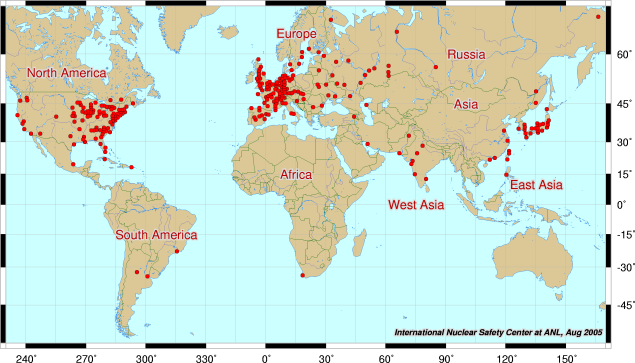
There are 441 operating nuclear power plants in the world. Without the regulating eye of humans, many of these plants would go through some form of catastrophic failure and eventual meltdown. Imagine 441 Chernobyls around the world. Check out this map and find how close you live to one? Hey Australia! Safest place on Earth in case of a meltdown.

world_map_nuclear
Source: International Nuclear Safety Center at Argonne National Laboratory.

This map is from 2005, I could not find a newer one, but given how long it takes to build such a plant, and considering that they are not building many more, it’s pretty close.

The World Without Us was published in 2007. Given today’s pace of development, and pollution in China (check out this link and be shocked), and runaway fossil-fuel-burning, things are much worse than described by Weisman in 2007, when there were only 6.5 billion people on the planet, rather than seven.

We’re adding one million people to the planet every four days.

The World Without Us reads like a fast-paced thriller, where the bad guys are out the make the world go away. As I read the book, I realized that I was in it, and it wasn’t a thriller, it wasn’t a novel, it was a giant reality show, and my life, and the life of my children, and their children, was on the line.

Don’t you understand what I’m tryin’ to say
Can’t you feel the fears I’m feelin’ today?
If the button is pushed, there’s no runnin’ away
There’ll be no one to save with the world in a grave
Take a look around you boy, it’s bound to scare you boy

— Barry McGuire, Eve of Destruction

Choose not to read this book at your own peril.

Rating - Four Stars

Welcome to the Priushood – Take Three

It’s been over a year now that I have driven a Prius, and I am loving it. Being a Toyota, nothing ever goes wrong. It just works. I change the oil every 5000 miles and I put in gas when it needs it. My tank does not hold more than thirty dollar’s worth, and it lasts for almost 500 miles, depending on where I go and how I drive.

It is the most rewarding in traffic jams. Braking charges the battery, and when I stand, the engine is completely off. No emissions, no fuel burns. Stop and go, or in parking lots, the engine never really kicks on, so I just drive on electric. It feels good, not just because it helps protect the environment, but because every second my engine doesn’t run while I don’t need it I am not buying gas.

Opinion of Global Warming by Congressional District

Below is the map of how people responded to the question: “Is global warming a threat to the environment?”

The deeper the red, the more the answer was Yes. The deeper the blue and purple, the more No.

What I take away from that is:

In the cities, in the large metropolitan areas and where most of the universities are, we are leaning to the red, to the Yes. In the coal and oil states we’re in the deep No. And then there is Texas and the South.

Global Warming by Congressional District
Global Warming by Congressional District [click to enlarge]
This link gets you to the actual map, where you can search for your own zip code, and scan for results by county, zip code, congressional district, senatorial district and other filters. You can zoom in and out, and pan the map around.

The most important point I took away from this poll is this: The question was not: “Do you think that global warming is man-made?” Whether it is man-made or not is not part of the question. It was: “Is global warming a threat to the environment?”

It’s pretty hard for me to come up with a scenario where an educated person will say “Well, no, cranking up the Earth’s temperature by 2 degrees Celsius is not a problem at all. Let’s go and melt to Antarctic ice sheet and flood Los Angeles, Miami and New York. Go right ahead.”

That would be the essence of saying No as an answer to this question.


Obama Declares: San Gabriel Mountains National Monument

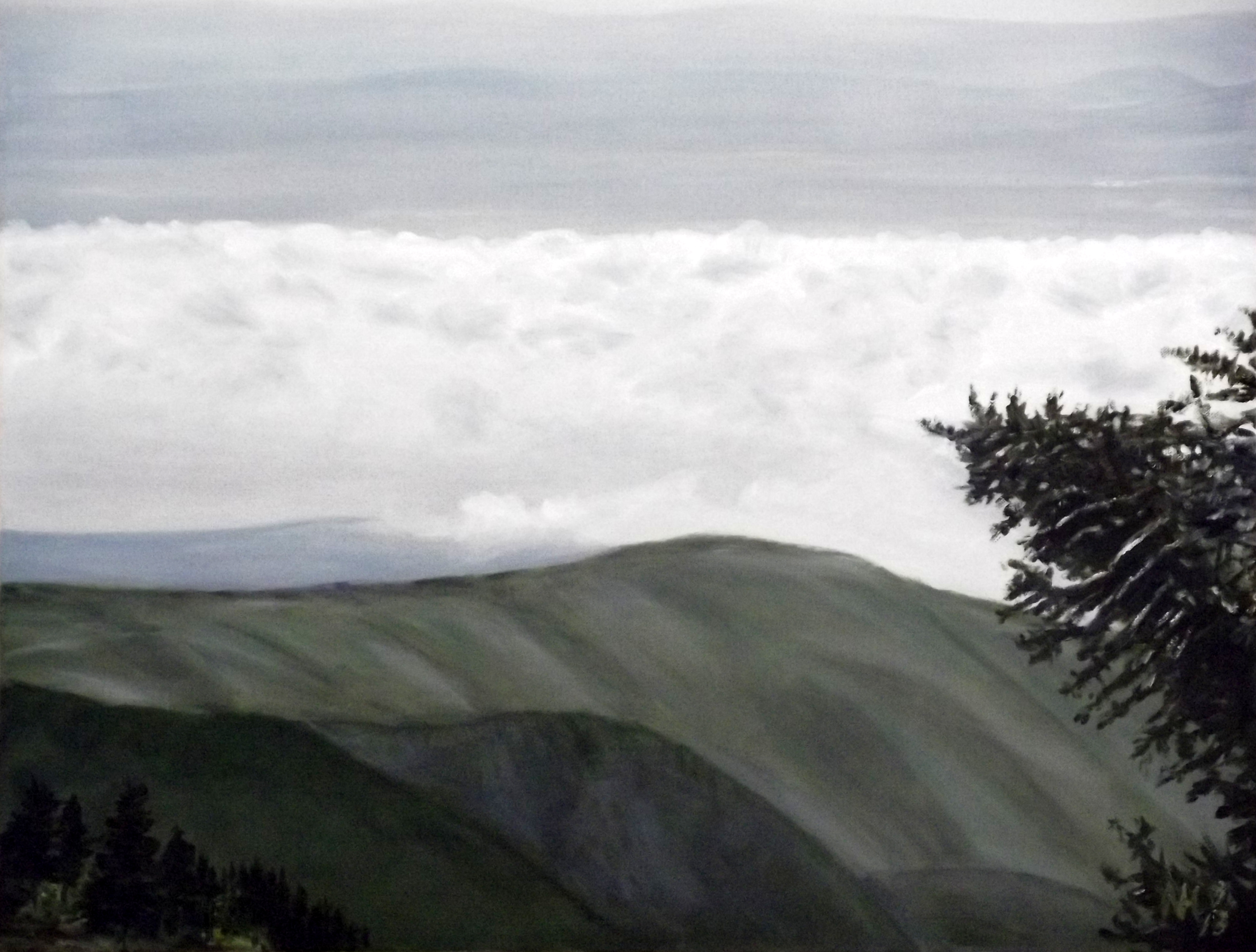
Clouds over Mojave
Painting: Clouds over Mojave fashioned after view from Devil’s Backbone on the hike to Mt. Baldy

The San Gabriel Mountains are one of my favorite hiking destinations. I made the painting above after a trip in May 2013. One of the most beautiful places in the world.

After a long time planning, President Obama yesterday declared the Angeles National Forest the San Gabriel Mountains National Monument.

Of course, there was fierce opposition.

Assemblyman Tim Donnelly, who was protesting the “Federal land grab” of the Monument (the land is already Federally owned), and an unidentified woman who said she “feared the UN would seize control of the San Gabriel Mountains if Obama were to declare them a national monument (no comment).

Modern Hiker

Protesters from groups like Public Lands for Public People, the owner of the Mt. Baldy Lodge and the California Off-Road Vehicle Association (CORVA). They were led on by a number of public officials from the San Gabriel area.

I am grateful to President Roosevelt the First for his conservation efforts and the creation of the National Park system. This is one of the fundamentally “good” functions of the federal government. If the government didn’t make such efforts, there’d be coal, gold and silver mines in all our mountains, there’d be McDonalds restaurants on top of our peaks, there’d be roads to ski resorts everywhere in our wildernesses – there would be no wilderness left.

Some articles:

Modern Hiker (where the above quote comes from)

Hiking Angeles Forest (blog by my friend Kyle Kuns)

I feel strongly that wilderness and natural beauty in our country is much more important than gross national product. The generations that follow us will be grateful.

I would be glad to have more of my taxes allocated to conservation. Sign me up!


Once There Were Billions

Passenger-Pigeon-300x208This week we had a very sad anniversary: Exactly one hundred years ago, on September 1, 1914, the last passenger pigeon in the world, named Martha, died in the Cincinnati Zoo.

Scientists estimate that there were three to five billion passenger pigeons in North America when the Europeans first arrived. It was the most abundant bird on the continent.  More than a quarter of all birds were passenger pigeons.

Relentless hunting by humans was the cause for their demise. Pigeons served as cheap food for slaves and the poor. After a slow decline through the beginning of the 19th century, the collapse became catastrophic between 1870 and 1890. The populations never recovered, and the last pigeon died in 1914.

Pretty much nobody alive today has ever seen this bird.

We are doing the same today to elephants. There are only about 600,000 African elephants and 30,000 to 50,000 Asian elephants alive today. Already 20% of all elephants are in captivity. It is estimated that there were 1.3 million elephants in the world in 1979. So in 35 years, we have cut the population in half.

Conservationists estimate that in the last three years 100,000 elephants were killed by poachers. This is up sharply from about 20,000 a year only a few years ago.

To put this into perspective:

Poachers are killing about four elephants an hour right now, 24 hours a day, every day, every year.

And it’s all about the ivory. In most parts of the industrialized world, ivory is tightly controlled or even banned now. However, in China, ivory carving is deeply rooted in tradition and massive amounts of ivory are still being consumed for that purpose. Newly rich Chinese love to shower each other with gifts of elaborately carved pieces of ivory.

But even in the United States, we don’t all agree. Obama has recently faced opposition from, believe it or not, the National Rifle Association. If ivory can’t be sold, then guns or rifles with ivory inlays in the handles, could also not be sold. So the NRA opposes the initiative.

The insanity of it all is mind-numbing. If the killing goes on at “only” the current rate, there won’t be any elephants left in 20 years. Like any population, once it is small enough, it can no longer sustain itself and it will collapse. We may be the last generation that can still witness live wild elephants.

Then what are the Chinese going to carve? Then what are we going to inlay into our rifle butts?

Unlike the burning of fossil fuels, which we can’t just stop overnight, we could easily just stop buying ivory. Cold turkey. The killing would stop overnight.

But it doesn’t. And just like there are no more passenger pigeons, there will soon be no more elephants.

California Water Use Restrictions

We received this flyer in our water bill this month:

Water Use RestrictionsI passionately believe in conservation and preservation of our environment.

But I find this flyer ridiculous.

“Serve water to restaurant patrons only upon request” must be the most ludicrous suggestion of water conservation man has ever come up with. I agree, it’s not the first time we hear this. I agree, it’s not just the glass of water we drink or do not drink, but it’s the dishwashing that is also saved (presumably). Somebody show me how a restaurant that does not serve up water actually saves measurable amounts of dish washing water by not washing those glasses.

But the whole thing misses the point. Six months ago I wrote about California, Water and Rice. There I observed that in California, we use 85% of our water for agriculture, 5% for industry and only 10% for residential consumption – what is addressed in this flyer.

We grow some of the most water-intensive crops in California. Check out this article for stunning details. 99% of all U.S. almonds are grown in California, and it takes 1.1 gallons of water to grow a single almond. Let me say this again:

It takes 1.1 gallons of water to grow a single almond.

I like almonds. But given a choice between drinking an extra gallon of water a day and eating ONE ALMOND, I’ll take the water any day.

How do you reconcile these water use regulations for residents when you live in a state that has 124 desert golf courses?

I would have been more accepting of this pamphlet if it had given information about measures on agricultural use – where conservation initiatives actually would make a measurable difference.

If a farmer has statistics he can share, I’d appreciate it. I couldn’t find much data online, on the contrary. I found rationalizations why we can’t touch Californian agriculture.

“California’s agriculture is critical to the world’s food supply,” said assemblywoman Kristin Olsen, who represents part of the San Joaquin Valley, who had lobbied hard against the restrictions. “An inability to produce that food would clearly be devastating to health and human safety not only in California but around the globe.”

Reuters

Hmm, all this talk gave me the munchies. I’ll have a handful of healthy almonds and a tumbler of ice water.

Visualizing the Water on Earth

global-water-volume-fresh-large
[click to enlarge] Source: USGS

This is an excellent visual of our earth, with all its water sucked out of the lakes and oceans. This is what the earth would look like dry. The water is collected in one large sphere visible over the Western United States. This illustrates how thin a layer our oceans actually are.

The largest blue sphere over the western United States represents all of Earth’s water. Its diameter is about 860 miles and its volume is about 332 million cubic miles.

The smaller  sphere over Kentucky, that looks like a pin, is all the fresh water on Earth. 99% of that is ground water, which we cannot directly access. The sphere has a diameter of 169 miles and a volume of 2.5 million cubic miles.

The tiny blue dot over Atlanta represents the fresh water in all the lakes and rivers on the planet. Those are really our accessible water resources. It’s what we can drink and use to flush our toilets and water our crops. This sphere is only 35 miles in diameter and has 22 thousand cubic miles of water.

Check out this resourceful USGS article for more details.


California in Extreme Drought

California is in an extreme drought. We are told to flush our toilets sparingly. Yet we still plant rice and alfalfa all over the Central Valley.

This morning I flew into Sacramento. The shiny rectangles you see are fields standing under water, as far as the eye can see.

Water in Sacramento
Water Fields in Sacramento [click to enlarge]