Movie Review: The Rocky Horror Picture Show (1975)

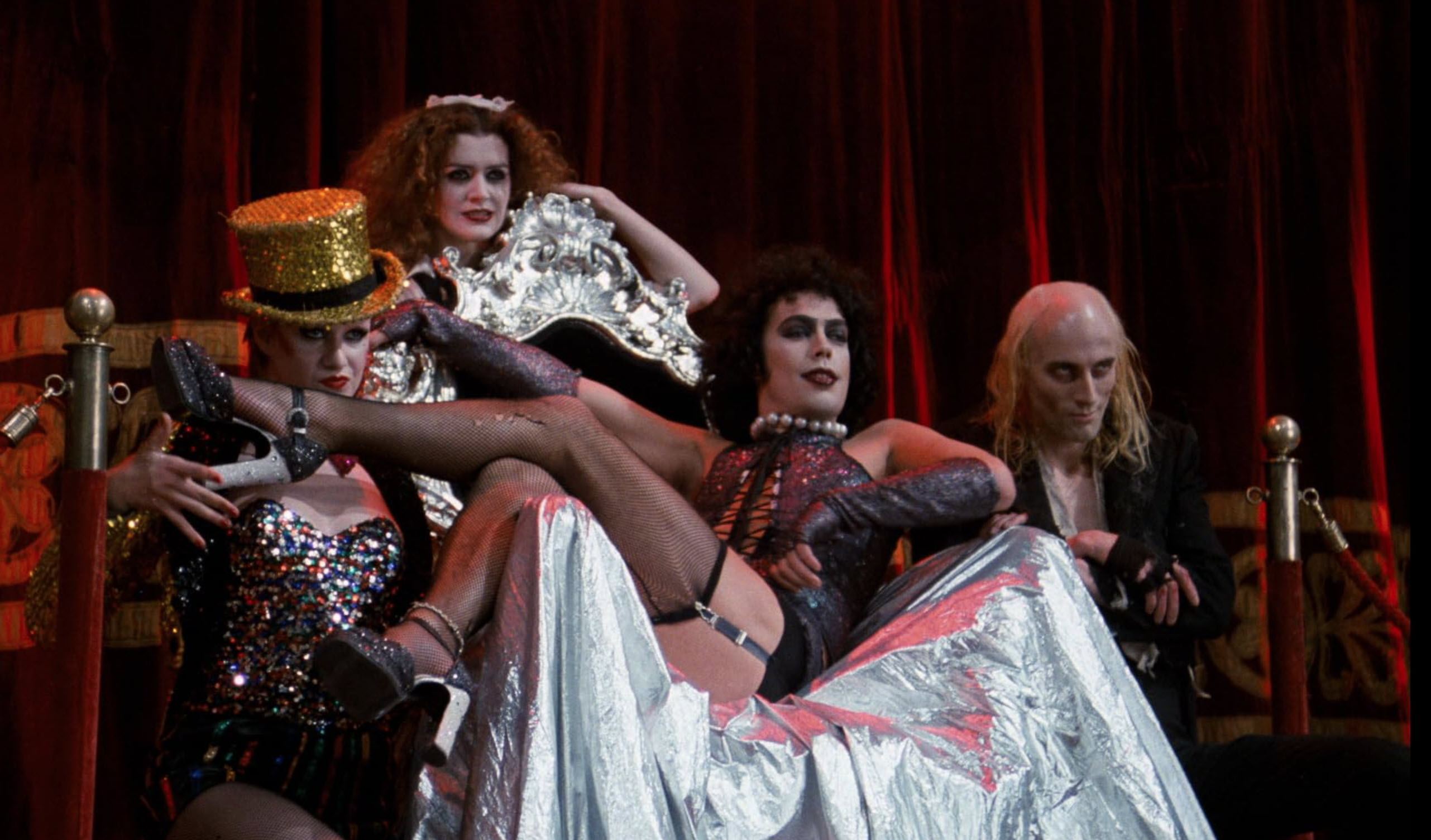
The Rocky Horror Picture Show was first released over 50 years ago in 1975. It first was a box office flop, but by 1977, alternative movie theaters started midnight showings and it quickly created a cult following. I am aging myself when I tell you that I must have seen the movie at least 20 times in the years of 1978 and 1979, always at midnight, in Phoenix, Arizona. It was a great event to bring our friends and guests to.

While visiting my son and his girlfriend for Thanksgiving, we looked for cult movies to watch, and we talked about The Room, which my son had made us watch ten years ago. I will reassert here that The Room is the worst movie all all time. But speaking of cult movies, I remembered The Rocky Horror Picture Show, and so we watched it together. For me it was the first time after many decades, and while I had remembered many vignettes, much of it I had forgotten about. For instance, the singing lips through the initial scrolling of the credits was such an iconic feature – how could I possibly forget it?

The Rocky Horror Picture Show is a rock musical that crossed many cultural threshold in its time. It was also one of the first audience participation movies. People came to the theater dressed up like the characters, they recited key lines of dialog before they came up in the movie, and there was much audience participation, like throwing rice during the wedding scene, throwing toast and lighting cigarette lighters (we didn’t have smartphones with flashlights then). Going to see The Rocky Horror Picture Show was much more than just going to a movie, it was an experience that you took your friends to.

The film opened up the world for the LGBTQ+ community. It celebrated gender fluidity, queerness, cross dressing, sexual liberation and bisexuality in an unapologetic manner at a time when such images or concepts were rarely dealt with in mainstream society or media. It provided visibility and a sense of community for people who had few opportunities for public expression of queerness.

The music is pop rock and original to the movie. The songs stayed with me over the decades. In particular the “let’s do the time warp again” song is the one I think about when I think about The Rocky Horror Picture Show.

Susan Sarandon has a lead role as Janet, and it was one of her earlier movies at the beginning of her career. Also, notable is Meat Loaf’s role as Eddie in the film. Tim Curry, who plays the lead character of Dr. Frank-N-Furter, was already a Broadway actor when he appeared in the movie. He rose to prominence with this role.

The Rocky Horror Picture Show was a sanctuary where outsiders, misfits, and young people exploring identity could gather without judgment. I was proud to be part of that world as a 20-year-old, just coming of age and looking forward in wonder to the world awaiting me. Life was just getting started. “Don’t dream it—be it” became a catch-phrase for me, and I still fondly remember those days.

Watching The Rocky Horror Picture Show with my family felt a bit like passing a torch. It was nostalgia all the way.

Movie Review: The Penguin Lessons (2024)

Penguins must be good teachers. When watching The Penguin Lessons I immediately thought of My Penguin Friend, a movie I watched last year.

It’s a very similar story. Through sheer coincidence, a penguin attaches itself to a human who is not necessarily interested in the bird, but over time taking care of it, falls in love with the animal. In this case, the human is an English teacher at an Argentinian prep school during the mid 1970-ies, when Argentina was taken over by a military coup which installed a fascist government. 30,000 Argentinian citizens “disappeared” during those years, never to be heard from again. This is the backdrop to the simple lives of a few teachers and school staff who support them. The penguin, seemingly one person at a time, befriends everyone at the school, and all lives are improved. The students pay attention to their studies, the teachers enjoy healthy relationships with the students and each other, and the staff serving them come to know them and include them in their lives.

How does a simple, single penguin accomplish all that?

It happens in My Penguin Friend, and it happens here, in The Penguin Lessons.

Watching this movie in 2025, when activities like those in Argentina in 1976 are occurring in our country today, all I can say is that we could use some penguins just about now.

Movie Review: One Battle After Another (2025)

On a quiet, almost dreamy Sunday morning in Kahului, Maui, my wife and I walked into the Regal theater in the downtown mall to watch One Battle After Another. We would not have been interested in this movie just from watching the trailers. It looks like a bang bang shoot me up action thriller that we’re usually not interested in. But we had a trusted recommendation that it was one of the best movies in a long time, so we decided to give it a chance.

The Regal in Maui has a weird setup with huge screens and, in this case, only less than 30 seats in three rows. The back row was taken, so we sat in the middle row, where we literally had to recline the seats all the way back and look up at a 45 degree angle to the huge screen looming over us. Not a comfortable way to watch a movie, and I would not want to go back to that theater.

The weird surroundings and the strange seating position were both jarring, so when the movie started with its first act, its extremely fast-paced opening, the rapid-fire succession of many scenes, the relentless and very loud music, it just helped transport both of us into another world, not one we particularly liked. I had my doubts at that time.

But minute after minute built the story, and once the second act came along, the deep suspense and the gripping story just took over.
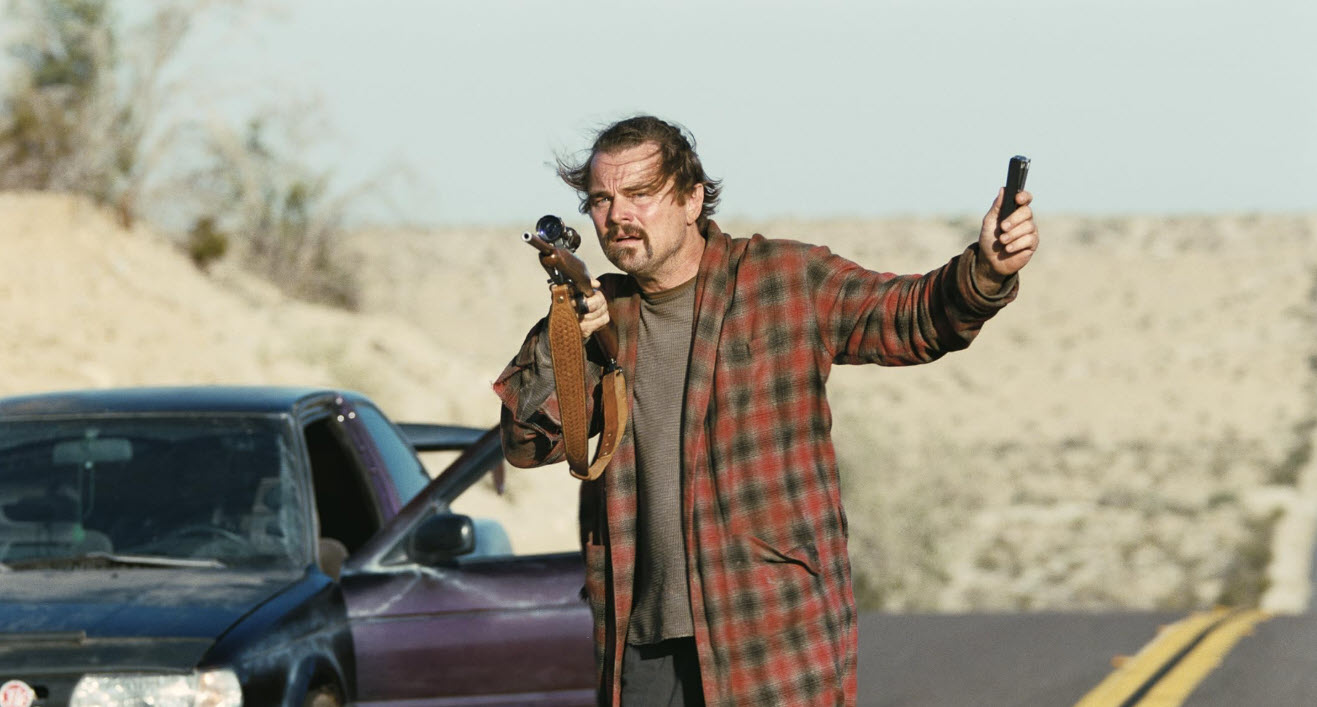
America is more divided now than it ever was in my lifetime in this country. Today our ideological differences are huge, we have camps where immigrants are detained without due process, we are watching a militarization of our cities, and outright physical aggression is commonplace, at least if we can trust what our media feeds us. This is the backdrop for this story, and I have to refrain from taking sides and making any political statements or voice opinions. The timing of this film is impeccable, and it will make millions of us think about what we’re doing to our country.

The story starts when we are introduced to the French 75, a fictional radical left-wing terrorist group that frees detained immigrants with force, blows up military installations, robs banks, all as part of a left-wing ideology.  They wage One Battle After Another in their war against the government. The first act of the movie tells a story of radical politics, violence, repression and generational legacy.

There is Bob (Leonardo DiCaprio), which is not his real name, who is a bomb expert and there is Perfidia (Teyana Taylor), a black firebrand who clearly gets off sexually on physical violence and a mission of revolution. The two are a couple within the larger terrorist group, doing battle, until their child is born and they have to take very different turns in life. This is where the bang bang first act stops and the second act begins, following the life of Bob raising his daughter as a single parent in a makeshift, quiet life.

One of their military nemesis, Col. Steven Lockjaw, decides to come after them 16 years later with the full force of the US government to settle old scores. He hunts them down, and in a flurry of escapes, father and daughter are separated. Lockjaw is a ferocious soldier with a twisted, sick psyche who will stop at nothing to get his way.

Here is the strange part: Lockjaw is played masterfully by Sean Penn. For the first half of the movie I didn’t even realize it was Sean Penn. I had to look it up online during the movie and then I saw this character in a whole different light. Both DiCaprio and Penn are playing their roles like absolute professionals. They carry the movie. The sound track, if you call it that, is intense. Heavy piano scores speed the action and somehow my heartrate went along with it.

At the end of the 2 hour and 42 minute movie I sat there spent. It was difficult to watch. It made me think. Going back out into the afternoon Maui sunshine seemed surreal. It has made me think all day.

I am still thinking.

Book Review: Der Fuchs im Hühnerstall – by Ephraim Kishon

It’s been a long time since I have read a book in German. Der Fuchs im Hühnerstall, or translated The Fox in the Chicken-Coop, is a biting satirical novel of the government machinations and bureaucracy of Israel. I first read it when I was in my teens after it first came out in 1969.  I remembered it fondly. But I lost that copy over the years. I could not find a Kindle version, so I bought a hardcover anthology of Kishon’s three novels, this being his first one.

Amitz Dulnikker is a cabinet-level politician in the Israeli government in his late sixties, at the sunset of his political career. Due to health reasons he decides to take a long vacation, incognito, in a remote village in the north of Israel, near the Lebanese border. The farm village of Kimmelquell specializes in growing caraway seeds as their product. It’s an idyllic place, with no electricity, where many inhabitants are illiterate, and where no outsiders are ever accepted. When Dulnikker and his young aide arrive they are quickly overwhelmed by the backwardness of the villagers and their dull lives. Dulnikker, ever the statesman, starts fomenting competition in the villages, primarily for his own amusement and to bring “civilization” to the poor farmers. Pretty soon, the events that he sets in motion take on a life of their own and control slips away. Eventually, he and his aide are finding themselves victims of their own instigations.

Kishon wrote originally in Hebrew, but I was not able to find any copy. The German edition was first published in 1969 by Langen Müller Verlag in Munich, translated into German by Emi Ehm.

The book has also been translated from Hebrew into English by Jacques Namiel and it appears under the title The Fox in the Chicken-Coop, published by Bronfman Publications in Tel-Aviv in 1971. However, a little research shows that while the books have the same (translated) title, they tell completely different stories. The English version is not a translation, but a completely different novel, with different characters, albeit also about political absurdities in Israel. This has confused many readers. As a result, unfortunately, it seems that there is no way to read this story in English.

Hebrew or German it must be.

Book Review: Tell Me How It Ends – by Valeria Luiselli

Valeria Luiselli is an immigrant from Mexico. She lives in New York with her husband and daughter. Early in her career as a writer, while she was still in the process of seeking her own Green Card, she was hired by the federal immigration court in New York to translate for child asylum seekers. The book was written in the 2014 – 2016 timeframe, before Trump came to office, while the Obama administration was still dealing with the refuge crisis at the southern border of the United States. There is also a postscript dated 2017, just as the book was published, and Trump’s first administration had taken over.

She illustrates, in the words of children as young as three or four years old, up to teenagers, how the American court system handles the crisis. Why are thousands of unaccompanied children arriving at the border, where they are giving themselves up to the immigration authorities? What are their motivations? Why are they here, and what is their fate when they are here?

Tell Me How It Ends is a powerful indictment of the American immigration policy. The children are the victims. Yet, they are  the ones whose lives are destroyed before they ever have a chance to grow up. It deals with the source of the problem in the first place, the utter violence and lawlessness in the Central American countries where the children come from, and it all traces right back to American drug use and consumption of drugs coming from Central America, and the thriving arms trade of American weapons back to those countries.

It is ironic to read this book now, eight years after it was first published, while the Trump Administration is applying a radial approach to solving the problem, deporting the most vulnerable and innocent victims of the whole malaise that causes this problem in the first place, demonizing the victims.

As I see it, particularly after reading Tell Me How It Ends, what they are doing now is not going to fix the problem whatsoever. It will just cause immense harm to those families and children affected directly. History will not judge us favorably for these years and these actions under our watch.

The book is only 99 pages long. I read it in hardcopy. I don’t have solutions. But I have a better understanding of why, and I can only fathom the immense damage that is being inflicted on a whole generation of Latin American children.

Tell me how it ends, because I do not know!

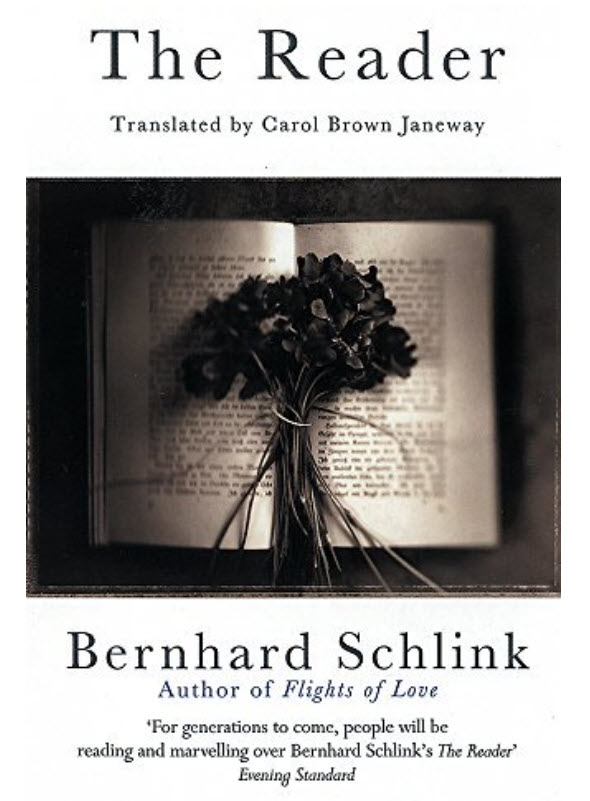
Book Review: The Reader – by Bernhard Schlink

Hanna is a 37-year-old woman who lives alone in a German city after World War II. Michael is a 15-year-old school boy. Chance and fate brings the two together. Teenage hormones and puppy love drive the boy, and an erotic affair quickly evolves between the two. They spend a year or so meeting up at her apartment, after her work, and after his school. He reads classic novels out loud for her, then they shower, then they have sex, then they snooze, and then he goes home to his unsuspecting parents and siblings.

One day Hanna disappears without a trace. Michael at first has a difficult time dealing with that, but in time he gets over it. He goes on and eventually becomes a lawyer. Then, suddenly and unexpectedly, he sees Hanna as a defendant in a trial that he and his classmates are observing. The trial reveals to Michael that Hanna was a guard in a Nazi concentration camp during the war.

The Reader deals with the issue of government atrocities, and to me it was a very timely read. We are at a point in American history where the government seems to trample on its own Constitution, and for the sake of soundbites and news clips arrests its own citizens, apparently without due process, and sends them to offshore hellhole prisons. This situation remind me of what happened in Germany in the 1930 and through 1945. Germany killed over 6 million prisoners, mostly Jews, many of them were German citizens. I’d venture to say that Hitler himself didn’t kill a single person. Somehow he convinced an entire population to do his bidding, and his killing, and thousands of soldiers, guards, and SS troops thought it was okay to commit unspeakable atrocities against their own countrymen. I never understood how this was possible. Yet now, while we’re not killing people, we’re sending innocent people, children who are citizens of our country by birthright, and foreign students with legal visas, to prison camps. Is this a first step?

The Reader tackles this problem. What happens to the emotional life of a person who knows she has committed atrocities and has to live with it? It is a well-crafted novel, a love story of sorts, but difficult and emotional read.

Movie Review: Conclave (2024)

I went to see the movie Conclave not expecting to enjoy it much. Its subject matter does not personally appeal to me.  The word conclave comes from the Latin word clavis (key) and the prefix con, which means a place that can be locked up.

Based on ancient church custom, the cardinals that elect the next pope are sequestered in the Sistine Chapel until a pope is chosen. It’s a very political process. Back through the ages, they just had to be locked in, but in today’s world of communication devices, mobile phones, and “bugs” this is a little more challenging. As everything related to the old Catholic religion, the process is terribly ritualized.

After the previous pope dies unexpectedly, his good friend, Cardinal Lawrence (Ralph Fiennes) is assigned the task of running the conclave. What he didn’t expect  was that he’d discover a trail of secrets and intrigues that could upset the politics of the church.

There are some tremendous plot twists along the way that make the movie not only an educational experience, teaching about this obscure process in the church, but give it the feel of a thriller.


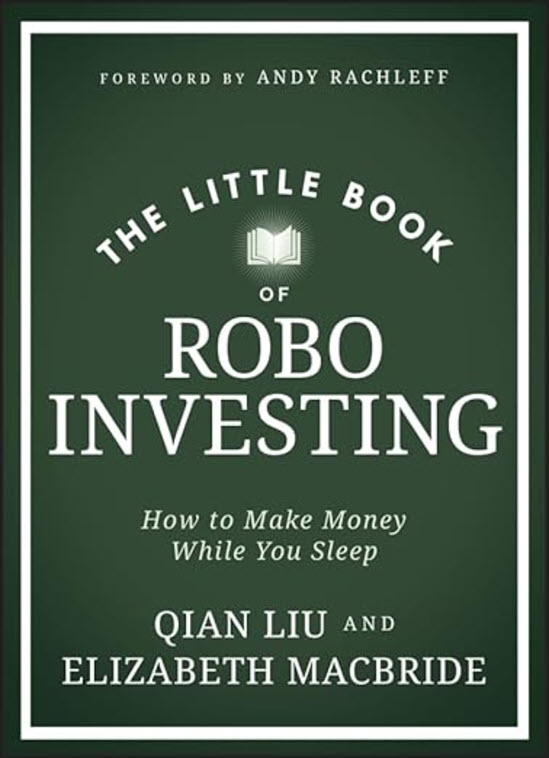
Book Review: The Little Book of Robo Investing – by Qian Lui and Elizabeth Macbride

The subtitle “How to Make Money While You Sleep” makes it sound like this is a get-rich-quick book with some shady theme. Not at all.

The authors are seasoned professionals in the investment industry who have collaborated for many years and worked at a number of investment companies.

If you are a seasoned investor and you want to learn about the modern, automated online platforms for portfolio investing, this is your book. You can read it in a few hours and know exactly what your next steps should be.

If you do not know about investing but you realize you should start putting money aside and start building wealth, or at a minimum start saving for retirement, this book is absolutely written for you. It teaches about assets and asset classes, diversification, minimizing fees and taxes, and leveraging the power of compounding. If you think investing is buying stocks in companies directly, this will teach you what the risks are with that, and why diversified portfolios, in the long term, always beat the market.

If there is a modern book on Investing 101 – this is it. You should buy this book, work through it, and no matter how much or how little money you have to start with, you should pick one of the recommended platforms and sign up. It takes 20 minutes. You will see your money grow immediately and daily. You will feel like you know what you’re talking about and you will be comfortable with the process.

Most importantly, you will be on your way to a healthy financial future.

Enjoy Robo Investing.

Book Review: Unshakeable – by Tony Robbins

Early in my career, when I was just a 30-year-old computer programmer, I picked up a tape program from the mail order firm Nightingale Conant, which eventually became the largest audio program publisher. The tape program was called Unlimited Power and was narrated by Tony Robbins, and it was based on the book with the same name. It came out in 1986 when he was just 26 years old.

I put the cassettes in a portable player and over lunch walked the hills behind the business park in Carlsbad where I worked, and over the weeks and months that followed, Tony Robbins changed my life. Unlimited Power taught the young me techniques and habits that over time significantly contributed to who I am today. Needless to say, I always admired Tony Robbins. I attended some of his seminars in person, and I read and listened to additional programs he produced over his long career.

When I was out browsing at Barnes and Noble recently I stumbled upon Unshakeable and picked it up without hesitation. It turns out it was a great read, and true to my history with Tony Robbins, I learned a lot. He teamed up with several exceptional people in the financial world to educate the reader about how to invest safely and profitably, including Peter Mallouk, who has been ranked the #1 financial advisor in the US for several years by Barron’s.

The book analyzes the ups and downs of the markets, and we learn that after every bull market comes a correction. It’s a great reference work if you want to find out the difference between investing in stocks directly, or in funds, what mutual funds are, the significance of index funds and how to pick a financial advisor. Unshakeable teaches you how to put together an actionable plan designed to deliver financial freedom.

No matter your income or your current stage of life, this book will provide the tools to help you achieve your financial goals more rapidly and with confidence and safely.

The only downside – Unshakeable was published in 2016, just as the first Trump administration went underway. It does not cover what happened since, and of course the entire disaster that the financial world underwent due to Covid had not happened yet. However, the message Tony Robbins delivers here is timeless. If you read this book and only benefit one tenth as much as I did from Unlimited Power almost 40 years ago, it will be well worth it.

Movie Review: Lee (2023)

I must be on a Nazi grand tour. After reading Slaughterhouse Five and then Woman at 1,000 Degrees, both of which deal with Nazi atrocities and how they affected the individual lives of innocent contemporaries, I now watched Lee, a biopic about the war correspondent Lee Miller, starring Kate Winslet.

Lee Miller was an American fashion model who eventually became a photographer. Before World War II she was in France working for Vogue magazine. As Germany occupied France and Paris, she asked to be sent to the front lines as a war correspondent. As she followed the action, she came in contact with the local populations, including the innocent women and children. What she saw compelled her to tell the story in pictures, and she quickly made a name for herself. Eventually she ended up at the Dachau concentration camp at the time of the liberation by the Americans and there she witnessed the full impact of the Holocaust. Ravaged by post traumatic stress syndrome for pretty much the rest of her life, she was not a very happy or successful mother to her only son, Antony. She said she did the best she could.

Antony never knew his mother’s past and legacy. He only discovered her documents, her photographs and mementos after she had died in July 1977. He documented her life and wrote her biography, which became the basis for the movie.

Lee is not a feel-good movie. It’s hard to follow at times, especially in the beginning. But it builds, and without sensationalizing war, without explicit battle scenes, it tells a story of great suffering and immense evil. And in these times, where dictatorships seem to be in vogue again – pun intended – Lee is a good movie to watch to remind yourself about what happens when one group of people suddenly decides to give one person the power to persecute and harm entire populations of others they don’t understand and therefore they don’t like.

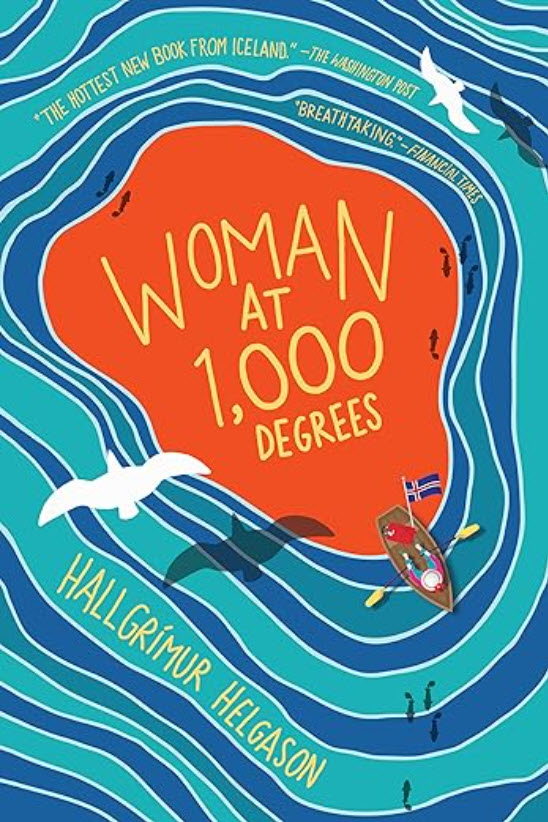
Book Review: Woman at 1,000 Degrees – by Hallgrímur Helgason

Not too long ago I read Slaughterhouse Five, which has as one of its central themes the firebombing of Dresden during World  War II. The novel Woman at 1,000 Degrees starts with this sentence:

I live here alone in a garage, together with a laptop computer and an old hand grenade. It’s pretty cozy.

Jonas, my hiking guide in Iceland earlier this summer, recommended the author Helgason and specifically this book when I asked him about Icelandic literature. Not only did I read about life in Iceland, but I read about World War II from the view of an Icelandic girl named Herra Björnsson who, at the age of ten, through a series of events resulting from very bad luck, ended up alone in Europe during the war. The story around the firebombing of Dresden in Slaughterhouse Five painted horrific picture of what went on during that war. The experiences of Herra in Denmark, Germany and then Poland illustrate what it was like for a child, a girl, to be abandoned alone in the maelstrom of chaos. She was cast out, abused, starved and raped again and again, over years, and only through seeming miracles she found her way back home after the war. The story tells the plight of the innocent population, Germans, Poles, Russians and Danes, during the Nazi regime and its wars of aggression and racial extermination. It rang home for me, as I recalled stories my own father has told me again and again of the horrors of war he himself had to face when he was a ten-year-old child refugee from the east as the Third Reich was collapsing.

Helgason tells the story in vignettes, showing Herra as an eighty-year-old woman dying in a garage in Reykjavík, then as a young girl in Iceland, as an adolescent during the war in Germany, and as a young woman in Argentina as she had to flee Germany with her Nazi father. We follow Herra at various stages of her life, not in chronological order, but in order of increasing horror as we witness the atrocities she is forced to endure that eventually end with her on her deathbed, lonely, yet full of spunk, in a garage.

Herra narrates the story of her life. She is quite insightful, as this excerpt shows:

She was married to an Italian countertenor who was now a pilot in Mussolini’s air force. He had participated in the invasion of France, one of the most ludicrous operations in the total absurdity of the Second World War: Italians in the flower of their youth sacrificing their lives so that the word TABAC could be changed into TABACCHI on some tobacconist’s signs in a few Alpine villages.

Helgason, Hallgrímur. Woman at 1,000 Degrees (p. 96). Algonquin Books. Kindle Edition.

If you have been reading my blog you will likely know that I love languages, and Icelandic strikes me as a particularly exotic language. With that in mind, you might understand why I especially enjoyed the following page, where Herra characterizes some of the languages she knows:

We Icelanders therefore walk around with gold in our mouths, a fact that has shaped us more than anything else. At least we don’t squander words unnecessarily. The problem with Icelandic, however, is that it’s far too big a language for such a small nation. I read on the web that it contains 600,000 words and over 5 million word formations. Our tongue is therefore considerably bigger than the nation. I did get to know other languages pretty well, but few are as solemn, because they’re designed for daily use. German strikes me as the least pretentious language, and its people use it the way a carpenter uses a hammer, to build a house for thought, although it can hardly be considered attractive. Apart from Russian, Italian is the most beautiful language in the world and turns every man into an emperor. French is a tasty sauce that the French want to savor in their mouths for as long as possible, which is why they talk in circles and want to ruminate on their words, which often causes the sauce to dribble out of the corners of their mouths. Danish is a language the Danes are ashamed of. They want to be freed of it as soon as possible, which is why they spit out their words. Dutch is a guttural language that gulped down two others. Swedish thinks it’s the French of the north, and the Swedes do their utmost to relish it by smacking their lips. Norwegian is what you get when a whole nation does its best not to speak Danish. English is no longer a language but a universal phenomenon like oxygen and sunlight. Then Spanish is a peculiar perversion of Latin that came into being when a nation tried to adapt to a king’s speech impediment, and yet it is the language I learned the best. Few of these nations, however, have mastered the art of silence. The Finns are Icelanders’ greatest competitors when it comes to silence, since they are the only nation in the world that can be silent in two languages, as Brecht said. We Icelanders, on the other hand, are the only country in the world that venerated its language so much that we decided to use it as little as possible. This is why Icelandic is a chaste old maiden in her sixties who has developed a late sex drive and desires nothing more than to allow herself to be ravished by words before she dies.

Helgason, Hallgrímur. Woman at 1,000 Degrees (p. 56). Algonquin Books. Kindle Edition.

This is not a book you’re just going to pick up at Barnes and Noble as you browse through their offering. Icelandic authors are not generally prominent in the United States. Nonetheless, I recommend you find Woman at 1,000 Degrees and experience a novel of an entirely different kind.

Book Review: Hillbilly Elegy – by J.D. Vance

Published in June 2016, when Vance was just 32 years old and about three years after he graduated from Yale Law School, Hillbilly Elegy is a remarkably good book and a must read, no matter what your political bent may be. There is also a Netflix movie that I have reviewed here.

Vance wrote the book long before he had political ambitions. It is a passionate and highly descriptive narrative of his own personal life and upbringing. He is only one year older than my daughter, so I could relate to the chronology of when and how Vance grew up and what shaped him.

The odds against such a child just simply surviving the desperate fight out of drugs, poverty and despair, let alone being successful, and achieving a stellar political career, are astronomical. In the end, I took away that the United States Marines saved the boy, made him a man, and served as his springboard. Vance tells not only his and his family’s personal story, but he shows us what social and class decline feels like in huge swaths of this nation. It helps us understand the decline of the rust belt, and the impact of manufacturing leaving our country for she shores of Asia.

It is therefore no surprise to see how some of Vance’s political views were shaped. I have a hard time understanding where some of the controversies come from that he has created since he associated himself with Trump. After reading his book, the Trump-Vance alliance seems unlikely and I can’t quite figure out how it happened. It almost does not make any sense. Perhaps it’s just the next logical step for him to ascend the ladder. While he obviously disagrees with some of Obama’s policies, views and strategies, he admired Obama and modeled some of his own life to Obama’s rise. That, I speculate, might have driven him to Trump as a stepping stone to the national stage. After the Trump era is over  and Trump is gone, Vance will still be a young man and now we all know him, don’t we?

There is also nothing about any couch in this book, and nothing objectionable that might push you away from Vance as a character. On the contrary, you want to meet him and chat with him at a backyard BBQ.

I am not going to vote for Trump-Vance, but I am telling you that Hillbilly Elegy is a remarkable book. If you are at all interested in understanding the decline of America’s white middleclass, you need to read it.

Book Review: The Wager – by David Grann

The Wager is about a shipwreck in 1741, and the desperate conditions the castaways found themselves in on a desolate island in Patagonia. It is about what happens to humans when they are deprived of everything, comfort, security, purpose, water, food and most of all, hope.

An Armada of British ships sails for the Pacific around the southern tip of South America during the war with Spain, hunting for a treasure-filled Spanish galleon. All but one of the ships perish. The Wager is one of them. This book tells the story of the castaways and their quest for survival.

The life of a sailor was rough. If they reached their objective and conquered a ship, the rewards could be huge. A sailor’s share could be worth as much as 20 years of wages, and the captain would be set for life with a fortune to retire. However, it was hard to get men to sign up for the terrible risks, and for being away from wives, children, family and home for several years at a time. To solve the problem, the navy employed “press gangs” which were militarized units that simply captured hapless men who were at the wrong place at the wrong time, bound them, and hauled them onto ships. Drunken men might wake up miles from shore, never to return. Their families would simply know that they never came home one night. Those men, if they then stood up for themselves, were mutineers, and would be hanged for the offense. And thus was the glorious life of a sailor in His Majesty’s Navy.

The Wager is a non-fiction account of the journey, through the eyes of several of the key participants, mostly recovered from their journals. It is entertaining, captivating and shocking at the same time. In a world, where we can fly from Chile to London in 14 hours, it is difficult to imagine that in 1740, it took a year – if you succeeded to get around Cape Horn – and that was a big IF.


While talking about shipwrecks and sailing, I have read several books about sailing and shipwrecks over the years and reviewed them here:

Endurance – by Alfred Lansing – I read and reviewed this book in 2016; it tells the story of the Shackleton expedition to Antarctica in 1914.

Caliban’s Shore – by Stephen Taylor – Read in 2009, this is about a shipwreck in the 1780 timeframe on the east coast of South Africa.

More about sailing: Two Years Before the Mast – by Richard Henry Dana – Read in 2017, this tells the story of a two-year journey in the 1830s to California around Cape Horn from the point of view of a sailor.

And while we’re at it, you might be interested in Empire of Blue Water – by Stephan Talty – which I reviewed in 2008. It’s a book all about pirates.

Movie Review: The Boys in the Boat (2023)

I knew very little about rowing. The son of one of my colleagues was on the UCLA rowing team during his four years in college. I knew it was a strenuous sport, and somehow I associated it with New England, particularly Boston. During visits to Boston and Cambridge I remember seeing rowing teams practice on the river there. I didn’t know it was an Olympic sport.

A friend recommended the book by Daniel James Brown, and when he stated that the movie was out, I thought I’d skip the book and go right to the movie, directed by George Clooney.

The story is a fairly predictable sports drama set in 1936 in Seattle, Washington, during the height of the Great Depression. A few underprivileged but ambitious boys applied for the junior rowing team at the University of Washington, not because they thought of themselves as champions, but because the were desperately trying to somehow pay their way through college. Getting on the team came with room, board and tuition.

The sport is brutally hard, not only on the physical level, but also emotionally. It is truly a team sport. Eight rowers and and one coxswain must be completely coordinated as one machine. There is no room for any ego or heroes on the boat. It’s all about the boat.

The Washington team is the underdog. It shows their training by a very competent coach and it follows them through local and national tournaments all the way to Hitler’s 1936 Olympics.

I found myself in the edge of the seat, as it is expected in a sports movie (remember Rocky, Chariots of Fire, Ford v. Ferrari, and a hundred others). At the end I walked out of the theater very satisfied. The underdogs won. I learned a lot about a sport that I had not paid much attention to. I gained respect for rowing.

I very much recommend you go see The Boys in the Boat.


Movie Review: Oppenheimer (2023)

Oppenheimer is a biography about the physicist J. Robert Oppenheimer and the effort of the United States to build the world’s first atomic bomb.

Oppenheimer (Cillian Murphy) is America’s foremost theoretical physicist with nobody of his stature challenging him. Driven by the military with relentless pressure, led by Major General Leslie Groves (Matt Damon), Oppenheimer almost singlehandedly assembles a team of world-class scientists, builds a town from scratch in the New Mexico desert, and creates a terrifying technology that nobody, including himself, fully understands. At one point he states that he does not know for certain whether setting off the bomb would not create a nuclear chain reaction that could destroy the world.

Along with the tremendous work and achievements of the scientists, the politicians of the time are paranoid about leaks, spies and Nazi infiltration. Communism looms large as the enemy, and anyone with communist connections is automatically suspicious. It does not help that Oppenheimer brings his brother into the project, who joins the Communist Party against Oppenheimer’s warnings. His wife (Emily Blunt) and his mistress are both former Communists. Interleaved with the storyline of the development of the bomb is always the congressional investigation into Oppenheimer and the scientists around him.

The story is huge, and its participants include Einstein and Truman. And with a running time of three hours it is of epic length. I found it overwhelming  at times, slow and repetitious at other times, but exciting nonetheless. When I walked out I was quiet and dumbfounded about the stupidity and arrogance of humanity.

I am giving this movie “only” 3 stars, but something is nagging me: I think this is the kind of movie I need to watch more than once. The first time is just to get familiar with the story and the characters. It won too many awards, it is too highly lauded, for me to give it a down-graded score. I will take another opportunity and watch it again – and I may write another review at that time.