
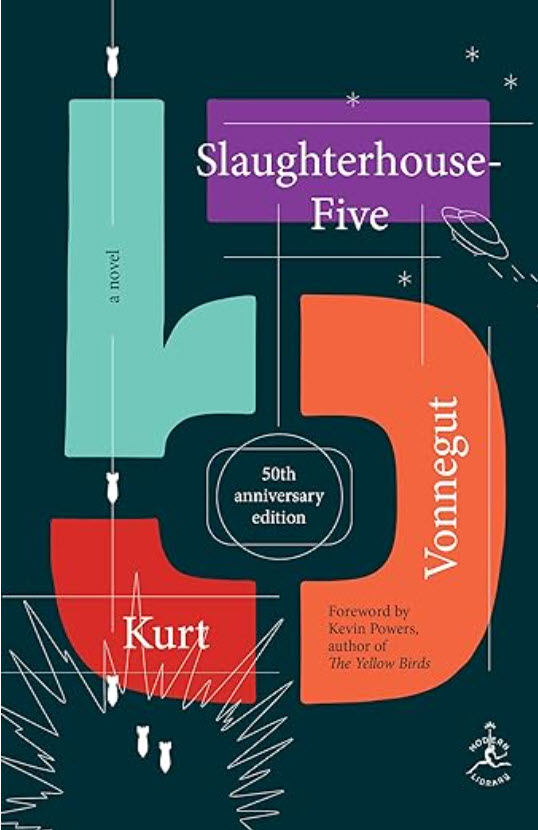
There isn’t a list of best books in the English language or best American novels that Slaughterhouse-Five is not part of. It’s a classic. It’s an anti-war novel. It was first published in 1969. As it often is with me and classics, I don’t particularly agree with the general sentiment, and so it with this book. I enjoyed reading it, not because it had me riveted from the start, but because it’s a fairly short book (190 pages), and it’s a classic, and I felt that it was time to ride it out. In the end I gave it two stars.
The story is based on autobiographical experiences of the author. He was a soldier in the United States Army in World War II and an eyewitness to the firebombing of Dresden by the Allied Forces. To put things in perspective, the Hiroshima bomb killed some 71,000 people in Japan. The bombing of Dresden killed an estimated 135,000 people, mostly civilians. The images of that event obviously haunted Vonnegut for the rest of his life, and prompted him to write this book. The anti-war message is of course what makes the book.
I found it confusing and unnecessary to include the alien abduction side story, or for that matter the time-travel segments. The author used time travel to allow him to tell the story in non-chronological order, jumping around the protagonist’s life as he felt suitable. The alien abduction segments seem to be there only to give the author a vehicle to convey speculation on the nature of time, free will and eternal life. Perhaps the pseudo-science fiction nature of the book brought readers. To me, it was distracting. It’s a good anti-war story, and it leaves you in horror, but there are many other anti-war books.
You should read Slaughterhouse-Five because it’s an American classic that everyone should have read. Then you can make up your own mind.
So it goes.
