Book Review: Delta-V by Daniel Suarez

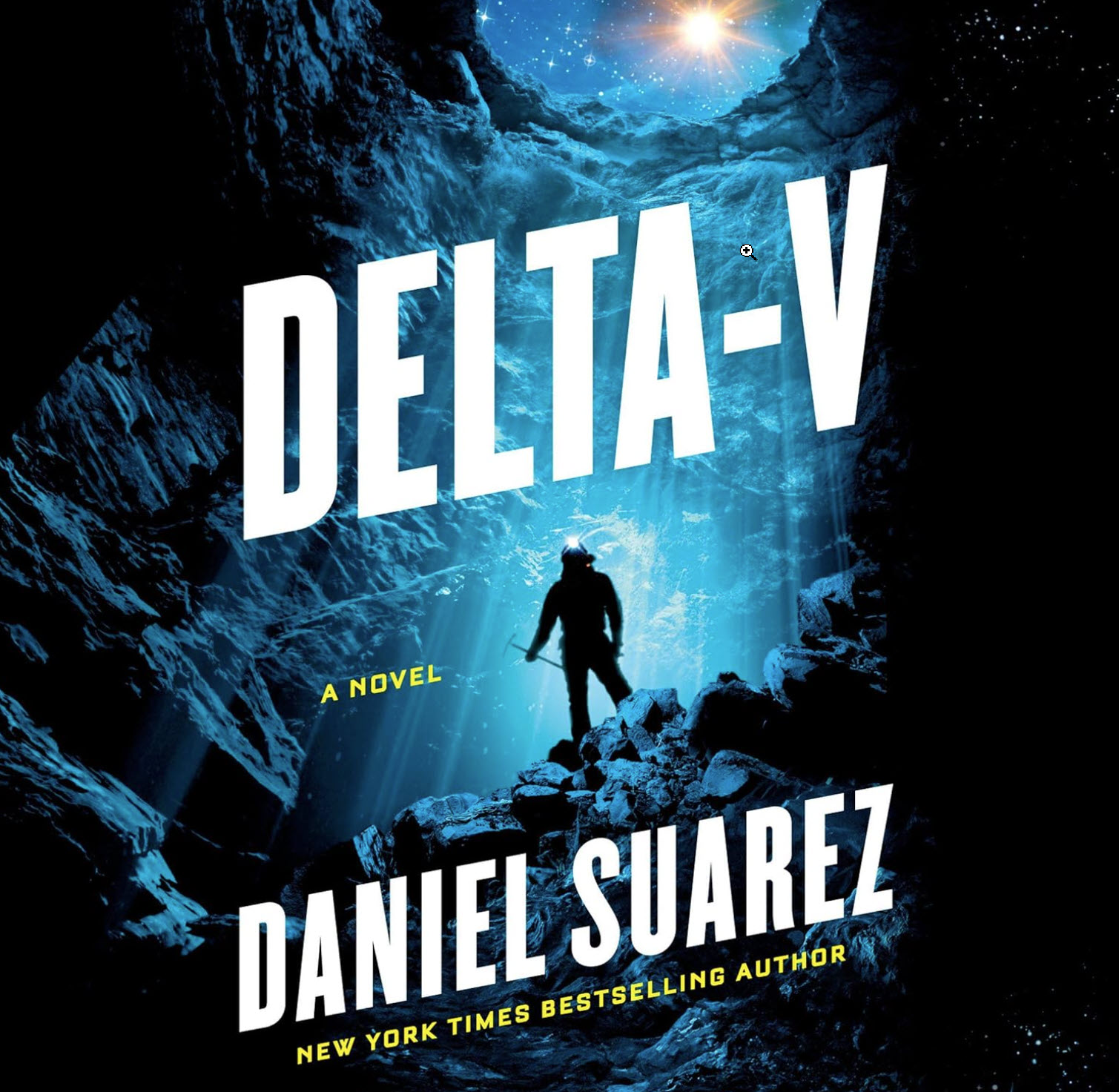
About 10 years in our current future, in the mid 2030ies, a number of private companies as well as the usual government agencies, like NASA and ESA, are trying to get into the business of mining asteroids. The goal is to kick off an entire new economy, including manufacturing in space. One of the biggest problems with space development is that every liter of water, every chicken wing to eat, every computer, literally everything we need in space has to be lifted from the surface of Earth into orbit at an exorbitant cost. How exorbitant?

During the Space Shuttle era, it cost about $54,000 per kilogram of mass. That’s the cost of lifting one liter of water into space. That’s because the Space Shuttle used expendable rockets. Now, with SpaceX’s Falcon Heavy, a reusable vehicle, the cost has come down dramatically, to about $1,400 per kilogram. Still a huge cost, considering how much material it takes to build a space station to live in.

If asteroids can be mined for metals, water, oxygen, the ingredients to make rocket fuel, and everything else we need, those raw materials are already in space and the cost to deliver them where they are needed, like in factories in lunar orbit or earth orbit, is much lower. Clearly, whoever can deliver materials in space to space is going to get very, very rich.

In Delta-V, this is the basic story. A renegade billionaire secretly builds a space ship outfitted to mine a near-earth asteroid. He recruits and trains an elite group of astronauts and sends them into deep space for the first mining mission.

Things do not go as planned, the billionaire turns out to be a fraud, and the minors are stranded in deep space with no obvious way to get home.

Delta-V is a well-written story of our near future in the current environment, where we are transitioning from government-controlled missions to private enterprises. I learned a lot about the technicalities of asteroid mining. For instance, I was always naively assuming that astronauts could just land an an asteroid and start digging. I didn’t realize that the surface of many asteroids is highly toxic to humans and damaging to electronics, so it’s not that simple. While the premise of the novel is fairly far-fetched, it taught me many things I didn’t know about the technicalities of asteroid mining, including how to get there, how to get back, and what’s involved in being there, let alone that the minimum trip duration is at least four years.

Overall, Delta-V is an entertaining story – and – you might have guessed it, there is a sequel.


Book Review: Shroud – by Adrian Tchaikovsky

A generation starship has arrived at a star with a moon around a gas giant planet. The moon is tidally locked to the planet and has a very thick atmosphere, so thick that no light makes it to the surface. That’s why the people call the moon Shroud. The surface air pressure is twenty times that of Earth normal and since the moon is larger than Earth, the gravity on the surface is twice that of Earth. To top it off, it’s an ice-bound moon, it’s extremely cold and the atmosphere is mostly ammonia. The ship also discovered that the moon screams with electromagnetic energy to a point where all signals are completely drowned out.

So why are they interested in the moon? To harvest its natural resources. When they send down the first probes, they survive just minutes before the are destroyed. Eventually they send drones with cameras and searchlights to see what might be going on, and they discover that there is life on Shroud.

The surface is truly an alien hell for humans. Yet, they are building a lander suitable for the environment with plans to send down explorers. During an unexpected accident on the ship, two women are using the lander as a lifeboat and end up stranded, you guessed it, on the surface of Shroud, in that truly hellish environment.

Shroud is about humanity meeting an unexpected alien intelligence, so alien, that it they can’t figure out any way to communicate with them. I have often complained in these pages that the aliens in science fiction novels are too hokey, too much like  humans, or perhaps little green men, to be believable. The Shrouded, as they call them, are believable, and their utter alienness makes them the best part of this book. The story is mostly slow, boring, and the humans seem bland and their politics is trite. But the illustration of the complexities of trying to communicate with something that does not even recognize you as a being, that has no concept of something even as fundamental to us as light, and sight, and eyes, and individual minds, makes the story interesting.

It kept me reading.


Book Review: Colony One Mars – by Gerald M. Kilby

The first human colony on Mars consisted of a number of habitats and 54 colonists. An intense, 6-month-long dust storm covered all the solar panels and destroyed much of the facility. After all contact was lost, and satellite imagery showed much of the facility destroyed, it took several years before a new mission could be launched to investigate what might have happened.

Six astronauts eventually landed nearby and started investigating. What they found was not quite what they expected. In particular, apparently there were survivors. Quickly, however, some of the crew members started getting ill, experienced psychotic episodes and started turning against each other.

Colony One Mars is the first book of a series of six books. I knew that when I picked it up. After reading, I now realize that it’s not really a book, but the first chapter of a long book of six chapters. There is no real resolution, no end, many questions remain unanswered, and yes, you want to pick up the next book. And I guess that is the point.

However, it is just not good enough a story that I want to spend more time on it. This book reminded me of The Object by Joshua T. Calvert, which I reviewed about a year ago, where I said this verbatim:

Without spoiling the book for you, I just have to add that it’s always baffling when there is a space mission where Earth selects its best and brightest to go to meet an alien vessel, and those brilliant super astronauts do really, really stupid things once they are out there on their own. Perhaps that makes for an exciting plot, but for me it’s just distracting. These people are idiots out there, and when I read the story, it does not draw me in. It loses me and I want it to just move on and be done.

The only difference is that the mission does not visit an alien vessel, it visits a derelict colony on Mars, but the mission participants are for the most part cardboard characters with no real personalities. There is a female Ph.D. biologist who is the protagonist. The mission commander and the first officer are both one-dimensional humans who seem to be built just for the simple plot of this book. The author really does not bother to build characters for the entire crew. They are just there to move things along.

There is a commercial faction on Earth who pulls the financial strings of the mission, called COM, which stands for “Colony One Mars.” There are board members who are pure evil, motivated only by money, who are the actual culprits and who use people as expendable pawns in their game of riches.

Interestingly, there is a character named Leon Maximus, who is introduced here:

Leon Maximus, on the other hand, Peter admired. He was motivated by a seemingly sincere desire to advance human civilization. To make it an interplanetary species. To establish a Planet B, as he liked to call it. He was a rare breed indeed. None of this would have been possible if it were not for him and his genius. His company had developed the rocket technology to get the first colonists to Mars. Still, it was a slow tedious process. It was an eight month trip and, with the way the planets orbited each other, a tight two year launch window.

Kilby, Gerald M.. Colony One Mars: Fast Paced Scifi Thriller (Colony Mars Series Book 1) (pp. 80-81). Outer Planet Media. Kindle Edition.

You can move the letters of Leon around and match them to a real person in our time who is obsessed with colonizing Mars.

There are a lot of raving reviews out there about this hard science fiction book and it being a page-turner. Well, I turned the pages all the way through, but it’s really a story that is very contrived and just not all that interesting. If you want a real Mars story, you need to read The Martian, by Andy Weir.

Colony One Mars is the first book of a series, but I won’t read the other five.


Book Review: Foundation Trilogy – by Isaac Asimov

Isaac Asimov published the Foundation Trilogy in the early 1950ies.

  • Book 1: Foundation (1951)
  • Book 2: Foundation and Empire (1952)
  • Book 3: Second Foundation (1953)

I first read the three books some 40 years ago in my twenties, but I only had vague memories. I remember them being good and, at the time, iconic. When a friend recently made a reference to them I decided to read them again. Usually I review books individually, but after reading the full trilogy, I came to the conclusion that they need to be combined. The books don’t stand on their own. The trilogy is really just one very long book.

Asimov added several more books to the series, two prequels and two sequels:

  • Book 4: Foundation’s Edge (1982) – sequel
  • Book 5: Foundation and Earth (1986) – sequel
  • Book 6: Prelude to Foundation (1988) – prequel
  • Book 7: Forward the Foundation (1993) – prequel

Book 7  was published after Asimov’s death in 1992.

I have not read any of the other four.

The trilogy plays about 10,000 years in the future. Humanity has invented interstellar travel by using ships that can make hyperspace jumps to travel the vast distances between stars.

The population of the galaxy at that  time is estimated to be quintillions of people, living on about 20 million planets which they call “worlds.” The capital of the Galactic Empire is the planet Trantor, which is completely covered by a gigantic city and has a population of approximately 40 billion people. The Empire is at a breaking point. The mathematician Hari Seldon invents the science of psychohistory, which allows him to predict the future. He creates a foundation of scientists with the objective to rebuild a new empire out of the chaos and lawlessness of millennia of anarchy.

Asimov builds a world, a universe, a psychology and a political system in the Foundation Trilogy. What strikes me reading it now in 2025 is that it is really not a science fiction story, but a story of politics. The Galactic Empire could be the Roman Empire, or even the United States of today. In the Foundation Trilogy, people live on planets, but they could just as well live in city states of the Roman Empire. The people travel on spaceships, but the technology is mysterious and not really described. Asimov refers to “nuclear” energy as the solution to all energy problems. The spaceships just seem to be able to travel vast distances without needing to take on fuel – because they have “nuclear” engines. The Foundation is the preeminent power in the Galaxy because it’s the only political entity that still knows to to control nuclear energy. There is no time dilation since the ships seem to just make jumps but never really accelerate in normal space. He does not bother to explain any of this technology. It is simply the basis of the story, which is mostly told via dialog between key characters. There are also no computers, and there is no Internet. Messages are sent via vacuum tubes, like those we still see in bank drive-ins. The Foundation Trilogy is a political novel, not a science fiction story. Another thing that I found odd is that there are absolutely no aliens in this universe. You’d think that Asimov would have assumed that there are alien civilizations amongst the 20 million inhabited worlds, but there is not a single alien in the entire story.

Essentially, Asimov wrote the Foundation Trilogy as a political saga in “space” based on the knowledge he had in the 1940ies.

I am pretty sure that if I had rated the trilogy when I first read it 40 years ago in the 1980ies, I would have given it three stars. But today, I found it fairly uninteresting, not particularly suspenseful, with hokey science and an inadequate depiction of a space-traveling society. That maxes out at 1.5 stars.


Book Review: The Man Who Folded Himself – by David Gerrold

David Gerrold wrote The Man Who Folded Himself first in 1973. There are additional revisions in 2003, that mention the American Airlines flight 191 crash of May 1979 and of course, 9/11 in 2001, both events that hadn’t happened yet in 1973.

In the foreword, Robert J. Sawyer, a science fiction writer himself, praises the novel and cites it as the book that got him started as a science fiction writer. Reviewers call it the best time travel story of all time. It was definitely the first truly unique one since H.G. Wells’ novel in 1895.

Dan Eakins inherits a time machine from his uncle, who served as his guardian. It comes with instructions, and it’s truly powerful without limits. He can basically transport himself back and forth to any point in time.  This means he can change history, if that’s what he wants to do. He can get rich by betting on the horse he knows will win the race from reading tomorrow’s paper. And, most central to the plot, he can run into himself by visiting his own apartment tomorrow, where the tomorrow version of himself is living.

This creates a truly complex plot and a story line that is very difficult to follow.

In the end, there isn’t much going on, and all the alternative selves he meets are not just confusing us, the reader, but himself.

If you are into time travel stories, I say this is a must-read, not because it’s a good story or particularly well-written, but because it pioneers the genre and sets the stage for many future time travel novels that make more sense, are more entertaining and realistic, and where more is actually going on.

The book is only 130 pages long, and I read it on a single flight from Hawai’i to California.


Book Review: The Object – by Joshua T. Calvert

Melody Adams works for NASA as a physicist and astronomer. One night, in Hawaii, she discovers an odd object near Pluto with attributes that don’t make any sense. She and her associate quickly come to the conclusion that the object must be coming from outside the solar system. Furthermore, it does not behave like a natural object. When she goes public with her discovery, she quickly loses credibility with the scientific community and NASA, and gets fired.

Fast forward a few years, when the object is observed again near Saturn, slowing down. All doubts are erased. Melody quickly gets back in good graces with NASA, and she eventually gets the commander post as an astronaut on a mission to rendezvous with the object. Once on the journey, things quickly go wrong, and a rift develops between the crew on the ship and Earth and its petty politics.

The book, even on its cover, is portrayed as hard science fiction. It plays in the near future, and the characters all use today’s technology. But I don’t think this is hard science fiction, like Andy Weir’s The Martian. Actually, I found it kind of hokey. Melody Adams, the protagonist, is one of those female astronaut superheroes. She is smarter than everyone else, she has a Ph.D. in physics, she is at the top of her astronaut class, and – as you would not suspect – she sleeps with Jim, the NASA administrator. That whole side plot of being in love with Jim makes no sense, does not contribute to the plot, and I could not quite figure out why it was there.

Without spoiling the book for you, I just have to add that it’s always baffling when there is a space mission where Earth selects its best and brightest to go to meet an alien vessel, and those brilliant super astronauts do really, really stupid things once they are out there on their own. Perhaps that makes for an exciting plot, but for me it’s just distracting. These people are idiots out there, and when I read the story, it does not draw me in. It loses me and I want it to just move on and be done.

Book Review: The Artifact – by Peter Cawdron

Seldom do I get 50% into a book before I decide I am no longer interested. This is one of those.

Hundreds of miles south of the Mediterranean in Libya, the British archeologist Susan Tayler is searching for the tomb of an Egyptian family. Rumors has it that in that general area in the Sahara desert, there was a meteorite that fell many thousands of years ago, before even the pyramids were built. It eventually made it into folklore. Chance would have it that Susan finds just that meteorite in the tomb and tries to take it home to England with her to hand it over to the ESA or NASA.

The book tells the story how she and her bodyguard O’Connor are finding the meteorite. They are promptly ambushed by Boco Haram terrorists, escape, and make their way through the Sahara in an old Jeep with the alien artifact wrapped in a blanket.

It’s a neat idea, but there are so many plot holes, the thing just does not make sense. If you are really an archeologist, why would you take it upon yourself to haul an artifact of such significance through a hostile and terrorist-ridden desert, through many strange countries, just to hand it to NASA? Why would you not just call them in on the coordinates and extract the thing with all the power of the western nations combined? But it was not only that, it was the inane dialog, the stupid things these supposedly bright and super-hero people were constantly doing, that just finally got to me and I put the book down at 50%.

As always when I don’t finish reading a book, I refrain from rating it.


Book Review: The Songs of Distant Earth – by Arthur C. Clarke

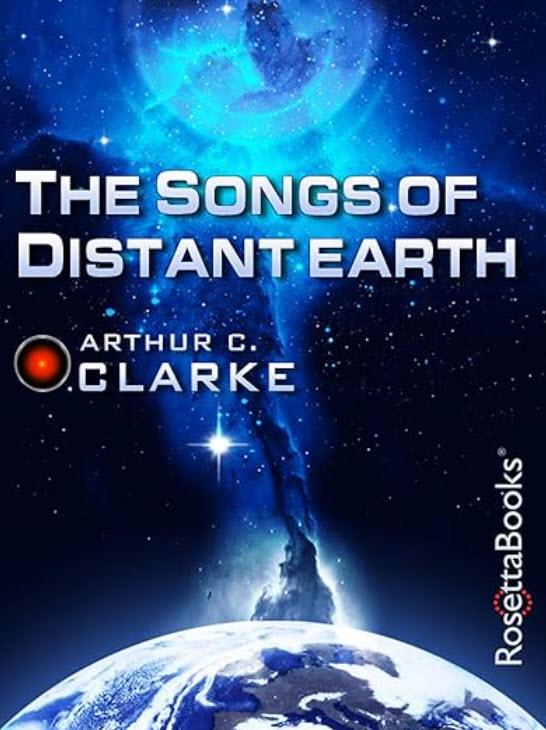
Arthur C. Clarke first published The Songs of Distant Earth in 1986. It was based on a 1956 short story of the same title, and Clark had supposedly stated that it was his favorite of all his novels. I remember reading it decades ago, probably right around when it was published, but I had forgotten all about it.

It plays in a world about 2000 years in the future where Earth and the entire solar system was destroyed when the sun went nova. Humanity had almost a millennium notice of the event occurring, but as is usual with humanity, it does not always act rationally when obvious doom looms. We have seen this with what Al Gore called global warming in the last century.

The story plays on the planet Thalassa, a human outpost started by a seed ship, a robotic vessel that carried frozen human embryos and the technology and automation necessary to establish a colony on an alien planet. Thalassa is a water world with just an archipelago of three islands, similar to Hawai’i on Earth, and with no other continents. Humans have lived there in a relative paradise and stability for centuries.

When a starship arrives with millions of refugees from Earth, the balance of culture and society on Thalassa may be upset.

Clarke explores the logistics of a world where travel at relativistic speeds between stars is possible. In such a world, ships may arrive at any given populated planet only every few hundred years and the event would be marked with historical significance. The story also illustrates the cultural implications of inter-planet communications when a starship leaves one planet, scheduled to arrive at another three-hundred years later. All friends, lovers and children left behind would be centuries dead by the time the travelers arrive at their destination and are able to ship messages back.

Book Review: Clowns – by Peter Cawdron

This book caught my attention because it was a “first contact” (with aliens) book. After further research I learned that Cawdron has written many independent first contact books. This one was pretty bad, so I am not sure I will bother with any of the others.

Breezy is a Secret Service agent with a fast trigger finger. Olivia is a call girl who just made a deep fake sex movie to frame an important person. Then there is Buster, a clown and a mysterious “good guy” all around who seems to have a lot of power, influence and abilities. Oh, and there are aliens, too, who have a strong interest in human psychology and the welfare of the human race.

It’s an oddly action-packed story, told in the present tense, which give it a fast pace. You get into the thinking of the protagonists, and there lies the problem. The author is basically lecturing about his political views all throughout the story, and he is in the process forgetting to tell us a story. Most of the action is short, interleaved with endless exposition about various political views. He obviously has a problem with capitalism, is worried about climate change, corruption in the highest levels of government, the America military machine, abuse of women throughout the world, and so on.

He projects an aura of moral superiority which will turn many readers off. I don’t disagree with him on many of those views, but of course half of his readers will. By being so much in our face with politics, the story gets buried, and all those opposing his views will feel insulted. I only felt lectured to.

After the book ends, there is an Epilogue, which basically tells you all you need to know. It’s a cheap way out. He seems to have realized that the book’s story is weak, so he has to button it all up in a tell-all epilogue. There is also an Afterword, where he discusses all the major concepts as well as his various political views and statements.

As a result, you don’t really need to read the book. Just read the Afterword. You’ll get everything out of the book that there is, and you don’t have to read a bad book all the way through. In a way, the author provides the Cliff Notes right in the book.

Book Review: Yestertime – by Andew Cunningham

Ray Burton, a journalist from Florida, travels to Flagstaff, Arizona to support a good friend who is dying of cancer. After his friend dies, he drives to the outskirts of the city to visit Hollow Rock, a ghost town. By accident he stumbles into a hidden cave where he finds a trunk left by a man named Stan Hooper in 1870. Along with some old belongings, there is a note, and a camera with several memory cards. Clearly, that can’t be. So Ray picks up the trunk and drives it home to Florida. When he starts researching the name Stan Hooper online, he soon gets a visit from a couple of goons with the NSA.

This is a very poorly written book, and I am not worried about giving away some of the plot – it’s so inane anyway. There are time portals sprinkled around the world that are one-way. In other words, you can go from the cave in Flagstaff to the bustling western mining town of Hollow Rock just by walking through a passage in the cave. But you can never go back. The only way out is another portal to another time. You hope you can find your way back home, but none of the characters traveling in time ever do.

We never find out who built the portals and why, but a group of six people in the year 2105 figured it out and started traveling the portals – why? – that’s not clear. There seems to be no mission. They are not allowed to tell anyone about the portals, and they are willing to just kill one another for blabbing, but still, they all blab. That’s how Stan Hooper started traveling, and that’s how Ray got involved.

The book has no end. It just stops suddenly, and it’s an obvious setup for a sequel or a series. I won’t read the next books since there isn’t enough of a story to keep me interested.

The author does not seem to know how to tell a story. He doesn’t show the reader. He tells the reader. The book is mostly exposition, with some terrible dialog sprinkled in. The characters, including the protagonist, are all shallow and non-descript. Even their names are boring: Mitch, Herb, Max, Stan, Alan, Hal, Natalie, Jim.

He likes the characters to kiss: “…he said, smothering her in kisses…” or “…in his arms and kissed her deeply….” or “…her arms around me and kissed me hard on the lips….” All the kisses are “deep” and “hard.” Of course there is also sex, but the way it’s told is too weird:

Natalie and I were becoming closer with each day. She was as genuine a person as I could have hoped for. Being around her made me understand why she had wanted to escape the movie world. But she also seemed to genuinely have feelings for me, even though I was almost twenty years older than her. Just as she had the first night, the second night back in the cabin she had slept with me on the floor. No sex, just companionship and the need to be close. There was something more, but we’d only known each other for a few days, so I guess I’d see where it led.

Oh, well, it led to more of the same.

One strange coincidence: This book plays a lot in and around Flagstaff, Arizona, and I actually was in Flagstaff last Saturday when I read the final chapter of Yestertime. After I closed the book in my Kindle, I went over to Google Maps and searched for Hollow Rock, just in case. I might have wanted to search for the cave.

I didn’t find any Hollow Rock.

Book Review: Children of Time – by Adrian Tchaikovsky

Children of Time is a book I had known about for a long time but never decided to read. One of my – somewhat illogical – reasons was that it deals a lot with spiders. I don’t like spiders at all. You should have seen me on my walk this morning when I went out before 6:00 am, apparently the first walker in my neighborhood. I ran right into a spider web between my house and a tree that obviously was just woven over night. I did the incredible spider dance, frantically brushing my face and body to get rid of any nasty that I might have picked up. Yes, I don’t like spiders at all.

My son-in-law, also an avid science fiction reader, recently mentioned that the book Children of Time was one of his favorite science fiction stories of all time. That was enough to put me over the edge and I finally read it. It’s a big book with a print length of 608 pages, but it’s even a bigger book content-wise.

There are four main themes in this story that are woven together to create this plot.

  • Theme 1 – Earth is being destroyed and polluted by humans to the point where it becomes uninhabitable
  • Theme 2 – Humans leave in generation ships
  • Theme 3 – Terraforming technology
  • Theme 4 – Evolution and uplift

As you might imagine, every one of these themes is a complex subject for a novel, but putting four into the same book seems impossible. Yet, the author accomplished just that.

For Theme 1, this is an epic story. Humanity has achieved travel to the stars. The solar system is populated with colonies and terraforming technology. The first starships have left to explore other star systems. But at home on Earth, humans have polluted the planet to the point where is no longer livable, and various factions, including religious ones, are starting to go to war over resources. Eventually, humanity self-destructs, not only physically, but a computer virus (a little far fetched) disables all automated systems it can reach. Only the farthest-away space ships have a chance to evade the virus. Eventually, a few thousand years go by, and that world is known as the “Old Empire.” A new generation of humanity rises from the ashes and again ascends to space travel. Their level of technology is well below that of the Old Empire, and much of their frontier work is comprised of finding and salvaging Old Empire technology. Usually they find it in orbiting hulks of ancient space stations. These new humans are now spreading again to the stars in search of planets they can terraform.

For Theme 2, there is no magic technology that overcomes the speed of light, so the starships only travel at a fraction of the speed of light, making journeys take decades or even centuries. Since humans can’t live that long, they are put to sleep cryogenically and the ships operate robotically and wake  humans only when they arrive at their destinations, or when there is a problem or a decision to be made.

I love generation ship stories, enough that there is an entire category that labels them in this blog. You can select it on the Categories dropdown on the right. This is a pretty good generation ship story.

For Theme 3, it always strikes me as odd that the Earth is so polluted and destroyed, it can’t be lived on, but some dead ice planet light years away can be terraformed so human life can sustain itself. Is it really easier to terraform an alien environment than to rekindle the Old Earth? Maybe not, but it sure makes for a good foundation for a story about star travel.

For Theme 4, this is a book about evolution, and more importantly, uplift, the process where one species helps another along in evolution to develop sentience. In this story, a human-developed virus is released into nature with the intent of helping apes become intelligent and sentient. Humans intended to create a slave race. However, things did not go as planned, there were no apes for the virus. But there were spiders. Over time, as the spiders became more and more intelligent, they became sentient, rose to be the dominant species on their planet, developed civilization, technology and eventually space travel.

Imagine if spiders became as smart as humans? What would their dwellings look like? What kind of society would they build? How about their cities? What about wars and weapons? How would they communicate?

And now imagine humans landed on the planet of the spiders. What would the spiders think of them? And how would the humans view the spiders? Would they be able to communicate?

Children of Time is a good uplift story. However, it does not come close to the works of  the master of uplift, David Brin. If you are interested in this subject, I recommend you read Sundiver, Book 1 of the Uplift Saga, to get you started. I do not have a ready review of that, since it’s been too long ago that I read those books, but I found them utterly fascinating.

I am glad I read Children of Time and I made it past my fear of spiders, at least for the book. I am still killing them when I see them in the house, though.

Book Review: We Are Legion (We Are Bob) – by Dennis E. Taylor

A  long time ago in a galaxy far, far away, I was a young computer programmer. My work was programming machines using what we called assembly language, which is basically working on the chip level. To program the machines, I had to burn EPROMS (chips) that I then plugged into circuit boards before I could run the program on a machine. Needless to say, I learned a lot about computers and particularly peripheral devices that are connected to computers, like actuators, sensors and motors that would actually make the machines move and do something useful.

During that time, I was also very interested in artificial intelligence. This was 40 years ago, and things were very rudimentary. I used to tell my associates that one day I’d be able to upload my consciousness into a computer and become independent of my body. I would be a machine who is conscious. Of course, I said I’d not want to just be some industrial robot, like the ones I was working on, but I’d want to be a spaceship. With weapons. I could just feel my ray guns itch.

I was also an avid science fiction reader, and I knew about von Neumann probes. 

A von Neuman probe is a self-replicating spacecraft without humans. It leaves the earth, spends decades or even centuries traveling to other stars, where it searches for raw materials and resources to build another copy of itself. Each copy then does the same thing. After a few centuries, the galaxy would be full of its clones.

Von Neuman is an interesting figure in his own right. Read up on him here. Sadly, he died in 1957 at the age of 53. He was a child prodigy. From Wikipedia:

Von Neumann was a child prodigy. When he was six years old, he could divide two eight-digit numbers in his head and could converse in Ancient Greek. When the six-year-old von Neumann caught his mother staring aimlessly, he asked her, “What are you calculating?”

When they were young, von Neumann, his brothers and his cousins were instructed by governesses. Von Neumann’s father believed that knowledge of languages other than their native Hungarian was essential, so the children were tutored in English, French, German and Italian. By the age of eight, von Neumann was familiar with differential and integral calculus, and by twelve he had read and understood Borel’s Théorie des Fonctions.

Now let’s get to the book We Are Legion (We Are Bob).

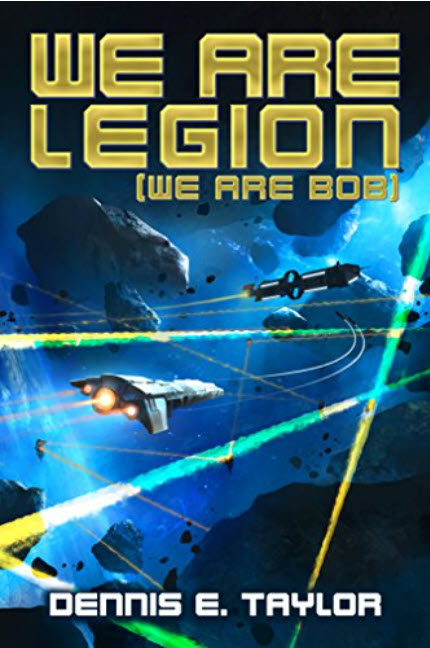
Bob Johansson is a software entrepreneur in our time. He has just sold his software company, he is wealthy, and he is just starting to look forward to a life of leisure. He signs up with a cryogenics company which, upon his death, will deep freeze his head, with his brain and presumably his consciousness, until sometime in the future when technology is far enough along that his mind can be loaded into a machine.  As (bad) luck would have it, as soon as the contract is signed he is hit by a car crossing a road. The world goes dark and he dies.

He snaps into consciousness in the year 2133. It’s a very different world from the one he knows. The United States, as we know it, no longer exists. The religious right had won several elections, the country went through an economic meltdown, and eventually a theocracy arose as the leading power in what used to be the United States. Also, the world political situation was drastically different, with a Eurasian block, the Chinese, Australia, and a Brazilian militaristic power.

Bob finds himself a replicant, which is a consciousness without a body, basically a computer program. He can be turned on or off from the outside and he can be backed up and copied. He is destined to be sent off into space in a von Neumann probe to explore other star systems.

While political unrest escalates on earth, he barely gets away before disaster strikes and a nuclear exchange decimates the people of earth. Bob reaches another star system and starts making copies of himself.

This book explores the feasibility of von Neumann probes, and it speculates on what the world would be like from the perspective of a human being who is completely disembodied and exists only as a computer program.

This is a debut novel and as such well-written and paced. There are none of the annoying problems we often encounter in debut novels, like poor writing, grammatical and spelling errors, and the like. The author must have used a good editor to make sure the book is clean of such distractions. The character development is a bit awkward, and the dialog sometimes stilted. But the subject matter kept me – obviously – interested and I wanted to find out what would happen next.

There was no ending. The book stopped virtually mid-paragraph. While this is a series of four books, and the author thinks of them as one story, he should have done a better job of finishing up book one for those who will only read it. But he didn’t even make an attempt of that.

While I enjoyed the book, I think I have absorbed the main concepts of human intelligence embedded in space ships. The rest is now just drama and more politics, and I can do without. So I won’t be reading the rest of the series.


Minor Spoiler Alert

The author chooses to make one of the factions of villains the leaders of the theocracy in the former United States. He portrays them as zealous, stupid, cunning and manipulative. Obviously, the author is an atheist and he does not have much respect for Christianity or religion as a whole. When I read some of the 1-star reviews on Amazon, it became apparent that he pissed off many religious people who took the book as an assault on them, their values and of course their religion. Some called it a diatribe, a left-wing assault on the country, and the like.

I didn’t see any of that when I read the book, but then, of course, I am not religious and I don’t make any effort to place myself into the shoes of religious people. I certainly think that theocracies are terrible for humanity as a whole, and I don’t have any praise for Christianity.

When it comes down to it, the author could have left all this theocracy stuff out. It didn’t really matter much in the plot, since Bob freed himself early on from the shackles his masters tried to put him into, and for the rest of the plot, Christianity had no valid active role. The way I see it, the author drew the ire of a large part of the population of the country, and therefore potential readers, by presumably ridiculing them and their beliefs, when he could have achieved the very same plot and story and message without doing that. Any other regime would have worked just as well.

Maybe his critics are right, maybe he did want to spread his message and agenda with this novel, but I think it backfired.

We turn to science fiction to let our minds reach, to experience wonder and awe, and for entertainment. We don’t turn to science fiction to get political rants or religious or anti-religious doctrine.

So, if you are a Christian, you might not like this book, and you best leave it be.

Book Review: Split Second – by Douglas E. Richards

A brilliant physicist discovers that he can transport matter back in time, but only by 45.15 millionths of a second. That does not seem like a capability a that has any practical applications. However, as soon as the physicist sends an email to a close associate asking him to check his math, he and his girlfriend are abducted by a black operations team.

While that does seem like really bad news, it quickly gets worse, when the government team gets attacked on route by another force, which results in a gun battle that kills everyone but the girlfriend, who barely escapes. She hires a private detective to help her figure out what is going on.

What could possibly be so important that the government is literally willing to kill for it in cold blood?

Douglas E. Richards knows how to write page turners. His heroes are the most brilliant in their fields in the world. His villains are the most ruthless.

The concept of time travel in Split Second is based on leaving a copy of an object in the same space, while the earth moves to a different space in a given time interval. The earth rotates in 24 hours, which means that any point on its surface moves faster than a jet plane toward the east. The earth also circles around the sun in 365 days. The sun circles around the center of the galaxy once in about 250 million years. And our entire galaxy moves in yet another direction in space. Physicists have determined that this means that you and I move about 242 miles per second. This means that we, and any object, move about 58 feet in 45 microseconds. With the technology these guys invented, you can make a duplicate of any object and have it appear 58 feet away from where you copied it. It’s all very complicated and makes for a good story.

But somehow the author glossed over the minor point that the direction of the duplication always needs to trail the movement of the earth in the universe, which is in a constant direction. So as the earth rotates, this can be up, or down, or towards the west or east or anything in between. It can’t be controlled.

Yes, this is science fiction and you just have to accept that there is some magic tech involved. However, it bothered me that a book based on this much Einsteinian thought experimentation left this minor detail out of the equation. It kept getting in my way as I followed the plot.

Richards lives in San Diego, and so do I. This means that many of the locales he uses are very familiar to me and I can actually almost follow along, from Torrey Pines to San Ysidro, from Camp Pendleton to Orange County. Most importantly, I have spend a lot of time hiking and off-roading on Palomar Mountain, which is an important location in the plot of this story, and I therefore had very vivid and clear pictures in my head as I read the book.

I enjoyed Split Second enough to read it within a few days while traveling. I bought the second book in the series titled Time Frame since I was sure I’d want to know how the story continues. But after reading a few dozen pages into the sequel I quickly lost interest. I am sure it’s also a very fast-paced plot but I just wasn’t interested in reading more about this specific cast of characters and I decided not to read the next one after all.

Book Review: Unidentified – by Douglas E. Richards

Jason Ramsey is a science fiction writer who becomes obsessed with UFOs, particularly in light of the huge media activity about UFOs in the years between 2017 and 2021. He is on a quest to find out what UFOs really are, why they are here, and what their intentions are.

In his quest for the truth, he discovers realities upon realities that none of us are aware of, right in front of our faces, as he unravels not just the role of humanity on this planet, but the role of humanity on a galactic scale.

Of course, no good science fiction story would be complete without a heroine who is exceedingly smart, superbly attractive, trained as a lethal combatant, and of course in love with the hero.

Unidentified tries to grapple with what UFOs are and what role aliens play in our lives. It speculates extensively about alien technology and alien motives. The book is extremely well researched and documented with literature references.

It is definitely a page-turner, and it had me interested to find out what is going on. There is a lot that got me thinking, but there were also many areas that I felt were over the top, particularly where it concerns alien invasion of human minds, implanting memories, and controlling human actions.

I liked the fact that the author made this a stand-alone book. He could have easily made it a setup for a series, but he chose to finish the story.

I enjoyed it enough to pick up another book by the author right away which I am reading now.


Book Review: The Vanished Birds – by Simon Jimenez

The Vanished Birds is the debut novel of Simon Jimenez. It is a big novel, dealing with humanity and its place in a world where star travel is commonplace, where there are many worlds populated by humans, and where large corporations are the de-facto governments that set all the rules and have ultimate power over the people.

The central character is Nia, a young female captain of a trader star ship with a crew of just a handful of people, a pilot, an engineer, a maintenance tech, a doctor, and someone in charge of cargo. Star ships travel through “folds” which are a sort of hyperspace where time is distorted like it would be at relativistic speeds.

Kaeda, a young boy on an agricultural planet meets Nia for the first time when he is 7 years old. She gives him a flute, which he treasures. The ship only stays for a day to take on cargo, and then leaves, to come back 15 years later, on the next “shipment day.” That’s how long it takes for the round trip. However, on board the ship, only 8 months pass. When Nia returns 8 months later, Kaeda is now 22 and they start a love-affair – at least so Kaeda thinks. Within a few years of Nia’s time, she sees him a few more times as he ages, and Kaeda’s entire live passes. He is an old man the last time she visits.

There is also an Asian engineer named Fumiko, who designs space stations. And there is a mute boy who apparently has  extraordinary powers.

As you might guess, this book is definitely a space opera that speculates on humanity’s distant future and extraordinary technology. It’s a large book with big ideas. Interestingly, there are no intelligent aliens in this world, which seems strange, given the scope of humanity’s reach.

I liked the concepts, I enjoyed reading it, but I would not classify it as a great novel, even through it was nominated for a number of awards.