The Freedom Riders in 1961

In 1961 the Congress of Racial Equality (CORE) undertook a tactic aimed at desegregating public transportation throughout the south. These tactics became know as the “Freedom Rides”.

The first Freedom Ride took place on May 4, 1961 when seven blacks and six whites left Washington, D.C., on two public buses bound for the Deep South. They intended to test the Supreme Court’s ruling in Boynton v. Virginia (1960), which declared segregation in interstate bus and rail stations unconstitutional.

In the first few days, the riders encountered only minor hostility, but in the second week the riders were severely beaten. Outside Anniston, Alabama, one of their buses was burned, and in Birmingham several dozen whites attacked the  riders only two blocks from the sheriff’s office. With the intervention of the U.S. Justice Department, most of CORE’s Freedom Riders were evacuated from Birmingham, Alabama to New Orleans.

CORE website

This was in the spring of  1961. Blacks were beaten by white mobs because they dared ride on a bus, go into “whites only” toilets, sit at the counter of diners next to whites.  The police looked on while the beatings happened. No white thug was ever charged for any crime.

John Lewis was there with the Freedom Riders to witness it first hand. He went on to become a U.S. congressman on January 3, 1987 and still serves today.

Three months later, in Hawaii, a baby boy was born to a young white mother, a college student and a black father, a student visiting from Kenya. That little boy would grow up and eventually win the White House in 2008.

Disrespect of the President

The news is full of statements by politicians and everyday citizens which are “disrespectful” of the president. Some people say this has got worse over the last few years. Reading history and historical biography books I recognized that making fun of the president is as old as the institution of the presidency itself.

Here is what they said about John Adams, when he tried to push for an elaborate title for the president:

At the start of Washington’s administration, Adams became deeply involved in a month-long Senate controversy over the official title of the President. Adams favored grandiose titles such as “His Majesty the President” or “His High Mightiness, the President of the United States and Protector of Their Liberties.” The plain “President of the United States” eventually won the debate. The perceived pomposity of his stance, along with his being overweight, led to Adams earning the nickname “His Rotundity.”

— Wikipedia

And Ben Franklin liked to refer to Adams as “Your Superfluous Excellency.” I am sure His Rotundity had some appropriate answers to Ben Franklin.

Book Review: Downtown: My Manhattan – by Pete Hamill

hamill1Pete Hamill is a New Yorker, and he loves to write about New York.

I first learned about him when I read his Novel Forever about five years ago. I gave that story a four star rating at the time.

In Downtown, Hamill simply tells the history of New York. And what a way to do it! Move over, history teachers. We think of history as a dry list of dates when things happened in a stuffy world we don’t care about anymore.

Hamill loves his city and he loves to tell about it. Of course, he can draw on his own lifetime for the last 70 years or so, but he owns and has read over 500 books on New York that he can draw on.

The outcome is a very readable tale, broken down into topical chapters, about one of the most fascinating cities of the world.

I was born and raised in Regensburg, Germany, a city literally 2000 years old with building sections and walls still in place built by the Romans in the B.C. days. As a kid,  I hung out in taverns and cafes in buildings built in 1300. Yet, I am fascinated about New York and its history, when the first tents were “only” pitched there by the Dutch settlers in 1625 or thereabouts. What is it about New York that made it so much the “center of the world” that it is today? What caused it that Regensburg is a city of 100,000 people – and not growing – after 2000 years, and New York started from some 200 people in 1625 and became the largest city in the world for many decades, and is still today the hub the modern world turns around?

It is the spirit of the New Yorkers that made the difference through the centuries and you have to read Downtown to understand what I am talking about.

Rating: *** 1/2 (out of 4)

The Middle East – A Trash Bin of History

After a few comment exchanges with one of my readers below this post and a few ongoing posts, we took our discourse offline and continued via emails. I kept arguing that we need to keep our hands and guns out of the Middle East and let it stew until it burned itself out (even though they have proven that they won’t since the death of Muhammad), and he kept countering that I had my head up my ass ignoring the endless, never-ending threat.

He didn’t offer workable solutions, I didn’t offer any either, but my overall approach was way cheaper, because it doesn’t involved “boots on the ground” and $1.1 million Tomahawk cruise missiles.

Then he wrote me an email list night with this paragraph in the middle of it:

The truth, in my opinion, is that the “Middle East” is one of those trash bins that will not go away on its own. Replete with bad history and bad ideas. Unfortunately, one of its worst ideas, Islamic imperialism, is pushing beyond its tribal borders. And again, the nightmare of our global history demonstrates that wishing away such bad ideas comes with yet another horde of barbarians at the door.

And while the statement is just an extension of his argument all along, there was one word embedded that got my attention: Horde.

The horde of barbarians at the door is a powerful image that elicited the emotions that I am sure he intended me to have.

I have written about the Mongol empire before, here and in my book review of The Journeyer.  Between 1200 and 1300, founded and established largely by Genghis Khan, it covered 33 million square kilometers (about 13 million square miles) which is about a quarter of the world’s land area today and the majority of the known world then. That makes it the largest continuous empire in history. Even the Soviet Union was not that large.

Mongol Empire

Genghis Khan’s hordes completely overran all civilizations they encountered. They effectively employed horses as military technology, their warriors were fierce and fearless fighting machines, and their brutality and complete horde behavior was unseen until then. This combination of traits, along with Genghis Khan’s military instinct, quickly made them the world’s first and only super power.

As they advanced against civilization after civilization, they brutally killed all the men and raped and then enslaved the girls and young women. The Mongols killed approximately 11% of mankind or about 40 million people.

A Carnegie Institution research project claims that the Mongols may have caused the world’s first anthropogenic climate change, that time cooling the earth. By killing so many people, vast tracts of agricultural land could no longer be cultivated for generations, and natural reforestation took over the fallow fields, removing significant amounts of carbon dioxide from the atmosphere to cause noticeable global cooling.

Genghis Khan himself raped so many women and fathered so many children, it is estimated that some 10% of the male population of Asia are his direct descendants. The harem that he kept was of enormous size. In Mongolia alone as many as 200,000 of the country’s current two million people could be Genghis Khan descendants. Did Khan contribute to mankind in any tangible way other than spreading his seed? For the most part, he was a barbarian.

What does all this have to do with today’s militant Islamic Imperialism?

People and “governments” that condone stoning of its own citizens, killing of apostates, raping of females belonging to different tribes of their own religion, and ritual beheadings of innocent people are certainly barbarians.

When hordes of barbarians take over neighboring countries, or grow within countries, they need to be stopped at the root, at the beginning. Not doing so can cause the deaths of millions. Khan could have been stopped before he got big enough. Britain and France could have squashed Hitler when he took over the Rheinland in 1936, and in the process averted WW II. Stalin could have been stopped before he killed 10 million of his own people.

To repeat my reader’s comment:

…the nightmare of our global history demonstrates that wishing away such bad ideas comes with yet another horde of barbarians at the door.

This got my attention. Now, what do we do?

 

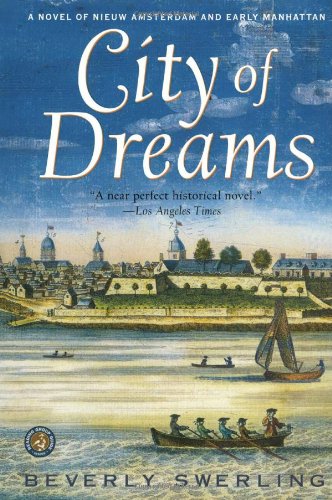
Book Review: City of Dreams: A Novel of Early Manhattan – by Beverly Swerling

City of DreamsIn the 1660s, Nieuw Amsterdam was a rough and primitive settlement of a fort and a few houses on the southern tip of Manhattan Island.

Here is what the settlement looked like in 1664, a view looking north toward the tip of Manhattan.

Nieuw Amsterdam 1664
Gezicht op Nieuw Amsterdam by Johannes Vingboons (1664) This is an early picture of Nieuw Amsterdam made in the year when it was conquered by the English under Richard Nicolls. [click to enlarge]
In 1625, when the town was founded, there were only 270 people who lived there. The population may have grown to a couple of thousand by 1661, when our story starts with Lucas and Sally Turner, who stumbled off their small wooden ship onto the island. They had spent eleven brutal and utterly exhausting weeks at sea. Peter Stuyvesant, the colony’s director-general, ruled the settlement with an iron fist.

Lucas Turner was a barber and a surgeon. As luck would have it, Stuyvesant was gravely ill due to kidney stones just as Lucas arrived, the only person in the colony that knew how to help. This put him in the favor of the director-general and gave him and his sister a start. Sally Turner was smart with herbs and started an apothecary.

Soon the hardships of the colony got the better of the siblings, and they eventually became enemies. Both founded their own families. Sally’s descendants were the Devreys, Lucas’ were the Turners.

The novel follows the generations of families through almost 140 years, up to 1798. The story reminds me of Rutherfurd’s book New York, which also begins in 1664 and leads the reader through 2001. Like Rutherfurd did, Swerling takes us through the lives of the people in the period. We literally find ourselves surrounded by disease, suffering, hunger, despair, and the human reaction to all these challenges, as we follow the characters through their lives.

I love historical novels. I cannot resist them. Especially those about New York. Pete Hamill, Edward Rutherfurd, and now Beverly Swerling all have their own style. Swerling does not shy away from sex and lust, and she has a peculiar penchant for description of filth and disease.

Regardless of all the gross parts, I loved every minute of it. If you want to learn about life in the 1700s, if you are looking for a human story that is situated during the time of the American Revolution, City of Dreams is a great book to read.


Looking Up the Length of Wall Street

Looking up Wall Street

Last week I visited Wall Street. I took the above picture standing down by the river underneath FDR Drive looking up the entire length of Wall Street, which terminates at Trinity Church, its steeple visible at the end.

Map of Wall Street

On this map you can see where I stood at the beginning of the red arrow, taking the photograph up the “canyon” of Wall Street. Trinity Church is at the top of the hill, about half way across the tip of Manhattan, at the green arrow of this map. The whole length of Wall Street is only about 0.7 miles long.

There are several different stories about why the street is named Wall Street. The most popular one is that there was a wall in the 1600s that separated the city from the wilderness and kept the Indians out.

1280px-CastelloPlanOriginal

This picture [public domain] comes from Wikipedia. Click to enlarge and you see a map of 1660, showing a wall on the right side of the city across the island.

Here is a picture [public domain] of Wall Street showing what it looked like in 1789, when Washington was inaugurated there. In the back you see Trinity Church.

New_York_City_Hall_1789b

The point where I was standing when I took the picture at the top of this post, at the very end of Wall Street, down by the water, is where the slave market used to be. The upstanding citizens of New York went there to buy slaves. They separated mothers from their small children, husbands from their wives, just for commercial gain. This went on from 1625 well into the 1800s. When I stood at the very spot, I tried to sense the ghosts of anguish, injustice and greed, I attempted to feel how a slave would have felt, just off the ship from Liberia after a harrowing journey in chains – facing a hopeless life.

Today I had dinner at a Panera Restaurant in a large shopping area in the suburban sprawl of Southern California, when I suddenly realized that the entire length of Wall Street would probably fit into the parking lot of the huge shopping mall where I was sitting.

Worlds away from Wall Street.

Send Your Own Kids to Iraq!

The news these days is full of pundits and saber rattlers who want the U.S. to go back to war in Iraq. The whole gang at Fox News, it seems, but also Senator Lindsey Graham and his cronies, are calling for war. Regardless of what former presidents did, it is not the job, or legal prerogative, of the president to declare war. The president has the authority to use military action if America’s safety is at risk, or American lives are under immediate threat. This is not the case here.

Why isn’t Congress cutting short its vacation, going back to Washington and engaging it the deliberative job it has, debating this issue and coming to the conclusion that it’s time to declare war – or not? Only Congress can declare war.

I am tired of listening to congressmen on TV spouting off about the president doing nothing. I want them to put their vote where their mouth is. I want them on the record. It’s easy to wage war from a comfy chair in the Senate.

I want them, and all the pundits asking for war, to send their own children and grandchildren to Iraq and Syria to do this noble job of defending the safety of America in the forsaken deserts of the Middle East. Let them take the first bullets shot by crazed, hypocritical zealots spewing medieval dogma, somehow protecting America.

Once their children are there, doing the shooting, they may just have a right to call up ours and send them there, too.

The First Amendment to the U.S. Constitution

Congress shall make no law respecting an establishment of religion, or prohibiting the free exercise thereof; or abridging the freedom of speech, or of the press; or the right of the people peaceably to assemble, and to petition the Government for a redress of grievances.

Bill_of_Rights_Pg1of1_AC
[picture credit: Wikipedia]
The freedom of speech is one of our most important rights in this country – and sadly, much of the rest of the world is not so lucky to be born in a country like the United States.

There are others, of course, like England, or Switzerland, or Germany, where the freedom of speech is held dearly. But shall I remind us all that in Germany that freedom of speech didn’t work so well after January 30, 1933, when Hitler became Chancellor. Within days, freedom of speech was all but a farce.

So tenuous are our laws – let them not be tenuous in the United States. Let us protest when we see transgressions.

Freedom of Speech1
[picture credit: Wikipedia]

ISIS, the Yazidis, and Atrocities

Yazidi Girl Poses
Yazidi Girl in Refugee Camp [picture credit: Simon Tomlinson and Tom Mctague]
Check out this photo essay by Simon Tomlinson and Tom Mctague in MailOnline which illustrates the plight of the Yazidis under the threat of Muslim extremists.

Fears are growing for the 300 Yazidi women reportedly kidnapped by Islamic State fighters last week amid claims they would be used to bear children to break up the ancient sect’s bloodline.

The minority group is originally Aryan and has retained a fairer complexion, blonde hair and blue eyes by only marrying within the community.

But in a furious bid to convert all non-Muslims, ISIS jihadists have vowed to impregnate the hostages.

This is why I don’t have much respect for religions. What kind of god is this that allows young men to think they have the right to take women and children, like the girls on the photos of this post, and “impregnate them” just to destroy their “blood lines?”

Yazidi Girl Rests
Yazidi Girl in Refugee Camp [picture credit: Simon Tomlinson and Tom Mctague]
What kind of people are these ISIS guys that smile on TV while talking about killing innocent little girls like these – or impregnating them?

What kind of society is this that accepts this behavior as acceptable, as in the case of these ISIS people, interprets it as god’s will?

What kind of country are we that we really think we are going to make a difference with guns in societies that have persecuted each other in the name of their gods, be that Zoroaster 4,000 years ago, or the “prophet” Muhammad 1,300 years ago, and all the whacky dogma he brought along and passed on to an entire geographic region?

Unfortunately, or perhaps fortunately, when you want to contribute in a shooting war, you have to pick one side or the other. Right now, in Syria and Iraq, we can’t seem to figure out which side we want to back. All sides seem to have “terrorist” threads within them. No matter which side we arm, we end up arming people we used to shoot at or who used to shoot at us.

Atrocities everywhere. Let’s send in American soldiers so there can be more confusion. It reminds me of one of those bad heist movies where the mob, the law and the marks all shoot at each other in an Italian restaurant, until everyone is moaning and bleeding on the black and white tile floors under red and white checkered tablecloths.

Great idea.


The Afghan Girl

The Afghan Girl

According to Wikipedia, journalist Steve McCurry took this picture of an Afghan girl in a refugee camp in 1984. The image appeared on the June 1985 cover of National Geographic and quickly became iconic. It has been named the most recognized photograph in the history of the magazine and the cover is one of the most famous of National Geographic.

The picture became a symbol of the Afghan conflict in the 1980s, when the Soviets waged their war there, and when the U.S. armed the mujahedeen – a group from which indirectly Osama bin Laden eventually arose.

She was known only at the Afghan Girl. Nobody, including McCurry knew her name. Since Afghanistan remained closed to the Western world until the Taliban was finally removed by the Americans in 2001, any of McCurry’s attempts to find and identify her remained unsuccessful, even though a number of women came forward, falsely, and a number of men claimed she was their wife.

Eventually she was located in 2002 when she was around thirty years old, in a remote region of Afghanistan. Her name was Sharbat Gula and her identity was confirmed using iris recognition. She vividly recalled being photographed. She had been photographed on only three occasions: in 1984 and during the search for her when a National Geographic producer took the identifying pictures that led to the reunion with Steve McCurry. She had never seen her famous portrait before until they showed it to her in January 2002.

Here are her pictures in 2002:

Gula
[photo by Steve McCurry]
And with her family:

Gula with Family
[photo by Steve McCurry]
Check out this article in National Geographic for more detail on the story and more pictures.

Text

Another Story of a Prisoner of War in Vietnam: Hubert Buchanan

Hubert BuchananIn the wake of yesterday’s post about John McCain returning to Vietnam, I came across this story of another prisoner of war: Hubert Buchanan. He did an AMA (ask me anything) on Reddit on August 9th. He spent some of his time at the “Hanoi Hilton” where he undoubtedly met John McCain, who was also there at the time.

Here is a picture essay from Reddit.

And here is the Reddit AMA.

Life, Liberty and the Pursuit of Happiness – And Due Process

George Takei, the actor/activist who calls himself a “proud gay Japanese-American” tells the story of how he and his family were taken from their home in 1942, and put in a prison camp.

Takei’s parents were both born in America. One in Sacramento, the other in San Francisco. They lived in Los Angeles and had two children. Takei was 5 years old in 1942.

The U.S. government simply rounded up all “Japanese-Americans” as “enemy non-aliens” and put them in prison camps. Their only crimes: The looked like Japanese, the enemy that had attacked Pearl Harbor and waged a war of conquest in the Pacific.

Just like the Germans rounded up Jews as “enemies of the state” and put them into prison camps, Americans did the same.

It’s shocking how easily we are willing to undermine our own Constitution, our Bill of Rights, our freedom, give up due process, — so we can hate and abuse those that we decide, as a group, we don’t like anymore. It happened in 1942, and it can easily happen again today.

Here is Takei’s inspiring story in his own words:

How To Make Your House Unsellable

[click for photo credit]

Excellent tile work, though. Nobody has ever accused Nazis of not being good tradesmen.

Now I really want to see pictures of the rest of the house.

President Theodore Roosevelt’s Grave

Today I had a late afternoon flight out of New York and nothing on my agenda for the morning.  So I decided to drive the half hour from the Kennedy Airport area to Oyster Bay to visit President Theodore Roosevelt’s grave.

I must admit that I hardly ever visit graves. To me, this was more a visit of historical education.

Fenced In Grave

The grave is nicely fenced in so there is no direct access. Of course, I was able to stick my camera through the bars and get a good view of the gravestone.

Roosevelts Grave

Looking into the other direction to the right,  Oyster Bay is visible behind the April-bare trees.

Oyster Bay

While I was there in a contemplative mood, two separate and distinct feelings hit me:

Roosevelt was only 61 years old when he died. That’s only four years older than I am right now. I have a tendency to compare myself and my stages in life with famous people, and the outcome is usually awe of what they accomplished, and motivation for me.

Then it struck me that while I was there, there wasn’t another soul around. In fact, I venture to say that I was the only person in that entire cemetery this Good Friday morning. Roosevelt, powerful and popular as he was when he was living, his grave is now solitary, and anyone can walk up to it, sit at the bench, and most likely be there all alone for hours in reflection, with no interruption from anyone.

This place, that must have been the center of the American stage when Roosevelt was buried in 1919, is now an empty place of solitary reflection.

Today, it was there only for me. I had my moment.

The American Presidents – Washington to Lincoln

Wait But Why sums up the nation’s history through Lincoln in one sentence:

Aggressive (and controversial) expansion of United States territory exacerbated the nation’s tensest and most divisive debate—slavery—by forcing the question of whether the new territories should be able to self-determine whether or not to allow slavery, highlighting the haziness around where state rights end and federal power begins and accelerating the nation toward Civil War.

Here is a fascinating blog entry with lots of neat statistics and facts about the American presidents and history.