
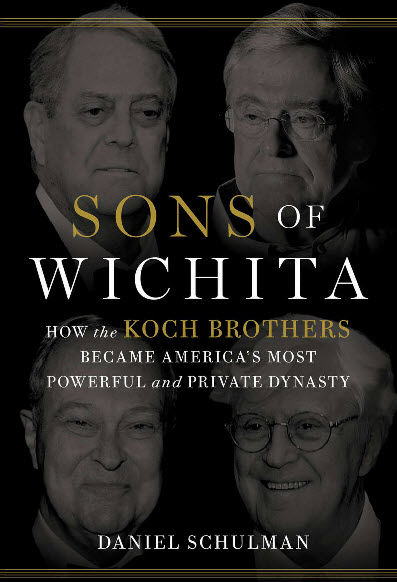
Book Review: Sons of Wichita – by Daniel Schulman

Sons of Wichita

The “Koch Brothers” have been a household name in American politics over the past twenty years; since Obama, however, they have been vaulted into the spotlight. They are either revered or loathed, depending on the point of view. Sons of Wichita digs deep into the Koch family history and background, and leads us all the way to the present time. Their story starts in the earlier part of the 20th century, when Fred Koch, a young and ambitious engineer starts building a business in Wichita, Kansas.

The sad fact is that once people begin to get something for nothing then they want more and more at the same price. It destroys their independence, their self-reliance, and transforms them into dependent animal creatures without their knowing it. The end result is the human race as portrayed by Orwell— a human face ground into the earth by

— Fred Koch

Fred had four sons, not just two, as we commonly think of the “Two Koch Brothers”, David and Charles. There are also Frederick, who is the oldest, and Bill, David’s twin, who are known a “the Other Koch Brothers” in their own right and with their own legacies.

Some one-star reviewers on Amazon complain about how this is not a business book but a “soap opera” of American politics. I don’t agree at all. The author didn’t try to write a business book. It’s a biography of a remarkable family. Whether you like or dislike their politics, their characters or their deeds does not really matter. He tells the story like it was and is, and readers can make up their own minds and form their own opinions.

Fred Koch created a company out of nothing during a difficult time in America. The depression, the second World War and finally the post-war years. To make it possible, he was engaged in decades of stressful legal battles. Nevertheless, he built a company that was doing some $70 million dollars in business a year when he handed the reigns to his second-oldest son Charles, then a man in his early thirties. Charles turned that 70 million dollar business into a 90 billion dollar business, more than a thousand times as big.

Charles possessed an uncanny ability to sniff out profitable ventures, and when he occasionally mired the company in money-losing deals, he quickly cut his losses. The results of his leadership spoke for themselves. Between 1960 and 2006, the company’s revenues increased from $ 70 million to $ 90 billion. During that timeframe, an original investment of $ 1,000 in Koch Industries would have swelled to $ 2 million, a rate of growth that outperformed the S& P 500 by a factor of 16. This was not just dumb luck. Charles had a formula.

— (p. 243)

After reading the book, I have come away with several main thoughts myself:

  • Fred Koch, the patriarch of the dynasty, instilled in his sons a set of values that eventually resulted in what they built. Those values are based on modesty, privacy, extremely hard work, lack of entitlement of any type, and shrewd business skills.
  • A spirit of fighting for the last crumb, and litigating mercilessly, under all conditions, was etched deeply into all four brothers. That attitude resulted in a business empire unlike any other in this country.
  • There were shady deals and ruthless deeds, some possibly illegal and doubtlessly immoral, that are at the foundation of the businesses of the Kochs.
  • Fred fostered political activism and passed it on to his sons. A powerful belief in the destructiveness of communism and socialism, based on what father and sons learned in the Soviet Union, was the foundation of their libertarian activities, which eventually led to their current Tea Party affiliations and American conservatism.
  • Before reading Sons of Wichita, what I knew about the Koch Brothers came from what I learned from their activities over the past decade in American politics, mostly from reports of the liberal media, including Rachel Maddow and Lawrence O’Donnell. That information was admittedly narrow and biased. I have gained respect for the Koch brothers as individuals, and I admire their business skills and approach.
  • There are a lot of activities of the Koch empire that may not be so clean, and the term “organized white-collar crime” is not far from the surface. I am not qualified to judge what has really happened, and whether these adverse claims would stand.
  • Anything the Koch Brothers are involved in must be taken seriously, very seriously.
  • They are now all in their sunset years, and as the new generation takes over, things will get softer and I would expect their political activism to fade.

While the book is not an easy read, I found it a page-turner nonetheless. It provides a fascinating view into one of America’s richest and enigmatic families.

Rating - Three Stars

Democratic Party and the Minimum Wage

In response to the Democratic Party’s vote, Terrence Wise, a Kansas City, Mo. McDonald’s and Burger King Worker and member of the National Organizing Committee of the Fight for $15, issued the following statement.


The Democratic Party’s move shows a growing understanding that $15 an hour is what American workers everywhere need to survive and support their families. When fast-food workers first went on strike three years ago in New York City, most people gave them no shot to win. But the movement caught on in every corner of the country and big wage increases are now spreading from coast to coast. By joining together, speaking out and going on strike, we’re changing the politics of the country. And we’re going to keep on fighting until every underpaid worker in this country wins $15 and a union.

The eventual outcome will be:

  • Profitability of fast food restaurants will go down or become negative, making them go out of business.
  • Services will become worse, since restaurants will not be able to afford the help they need.
  • Mom and pop businesses, like local pizza shops and diners will no longer be feasible.
  • Top-tier restaurants will start installing more kiosks so customers purchase electronically and there will be fewer staff members.

All those outcomes will result in fewer minimum wage jobs in the country, and more unemployment. Those that are benefiting from the extra pay that the new minimum wage offers them are doing it on the backs of those that lose their jobs and the students that can no longer get jobs after school and on vacations.

Overall, our country will be less competitive and less prosperous. Sorry, everyone does not “deserve” some minimum wage. Those that have the education, skills, energy and willingness to contribute something to society that society is willing to pay them for will get paid. Imposing minimum wages just slows us all down more and undermines our long-term viability as a competitive nation in the world.

Previous thoughts of mine of this subject here.

CEO Pay, Billionaires and Income Inequality

Scrooge

Bernie Sanders and his followers have been blasting billionaires and CEOs for their greed. They insinuate that the blight America is in is the fault of the billionaire class. They vilify CEOs for their greed. They say that they don’t deserve to make that much money, as compared to the middle class.

Based on this list at PayScale.com, the CEOs of the large corporations make salaries of 83 times as much as the average employee in their companies.

So, if the average employee makes $60k a year, the CEO makes about $5 million a year. I hate to say this, but if you “only” make $5 million a year, you’re not going to become a billionaire. Billionaires are not where they are because they live frugally, save their money, and get regular raises. If you make $5 million, as the average CEO of a large company in this list makes, you have to spend nothing and save all your salary for 200 years to become a billionaire.

So bringing up CEO salaries, and how they compare to average workers, does not make sense when talking about billionaires. To become a billionaire, you either have to inherit a lot of money (like the Walton clan did), or, as it is the case with most billionaires, you have to create a very unique and highly successful company, make it take off, make it grow, and then either sell it, or take it public. It’s not easily done, and it won’t happen if you’re mostly interested in a paycheck. I just wrote a post about some prominent billionaires and what I think about Bernie Sanders’ comments about them here.

I don’t know what exactly Sanders wants to do about this problem of CEOs making more money than average workers. Do they deserve it? I don’t know. It’s the jobs of the boards that put the CEOs in place to decide, not mine, not Sanders’, and not the government’s. The government cannot dictate to companies what they pay their employees, within some limits. Yes, there are minimum wages, and I have outlined what I think about minimum wages here. But there are no maximum wages.

The only thing the government can do is tax. I agree with most people: taxation should be fair. I do not believe that a CEO should pay less taxes than his secretary. Why is the tax code so complicated?

If Sanders suggested that everyone pays the same percentage, I’d be all for it. What is that rate? 17%, or 25%, or 34%? Pick a number.

The guy flipping burgers pays that rate, I pay that rate, Bernie Sanders pays that rate, and the CEO of Disney pays that rate. I’d have no problem with that, and I’d say that most people won’t.

But here is the rub: Many low-income people pay no taxes at all. Why? Churches are tax exempt? Why in the world do we allow that? The government should make up its mind how much money it has to extract out of the people in income taxes as a percentage. Then the tax code, which everyone says is so complicated, gets really simple:

  • How much money did you make last year? ______
  • Multiply this by 0.XX, where XX is that number we all agree on is fair.
  • Send that money to the government.

The entire tax code is three lines long.

For those that believe it’s not fair that CEOs make millions of dollars I simply say that: Just become a CEO. Then you can make that kind of money. Get the education that it takes. Start with an entry-level job, preferably in the sales department and work your way up. When the CEO job opens, apply for it and get it. You can then earn the big bucks.

Oh, that’s a lot of work, huh?

Well, there you have it. That’s the difference between being the CEO and flipping burgers.


Musings about Vilifying Billionaires

Bernie1

Bernie Sanders has been getting headlines and filling up stadiums of people with his message:

Let us wage a moral and political war against the billionaires and corporate leaders, on Wall Street and elsewhere, whose policies and greed are destroying the middle class of America.

Here is another quote:

Sanders, an independent, is seeking the Democratic nomination for president. On Saturday, the second day of a three-day Iowa swing, pointed out how FDR called the wealthy protectors of the status quo “economic royalists.”

“He said, ‘They hate my guts. Never have they hated someone as much as they hate me. And I welcome their hatred,’” Sanders said.

“And let me echo that today: If the Koch Brothers and the billionaire class hate my guts, I welcome their hatred. Because I am going to stand with working families.”

In a 1936 speech at Madison Square Garden, just days before his reelection, Roosevelt described his opposition as “the old enemies of peace: business and financial monopoly, speculation, reckless banking, class antagonism, sectionalism, war profiteering.”

“They are unanimous in their hate for me — and I welcome their hatred.”

— Des Moines Register

He is basically saying that billionaires are bad people, criminals, and financial and moral rapists of the middle class.

I call this whole line of thinking bullshit. Bernie may have some good ideas. I admire his zeal and energy, but he needs to drop this silly line of thinking because it makes no sense.

I am not a billionaire. I am not a millionaire. But I have been a business owner and job creator all my life. For the vast majority of my career, I was responsible for meeting payroll. I know a thing or two about business.

There are very few billionaires in the country. Forbes lists about 400 or so. The exact number does not matter. The fact is, they would all pretty much fit into one Boeing 747. It’s not a lot of people.

I have read the biographies of a number of billionaires, including several of Bill Gates, several of  Steve Jobs ( – by Isaacson), and one of Elon Musk ( – by Vance).  I have learned a thing or two about billionaires in the process.

I actually talked with Ted Waitt, the founder of Gateway 2000, at a CEO round table in San Diego. There were about 10 to 15 of us CEOs of local companies who invited business personalities on a monthly basis, and one time our guest was Ted Waitt. At the time he was worth about $1.4 billion. Ted talked about the days when he started Gateway in his family barn in Sioux City, South Dakota. He started the company on September 5, 1985 with a $10,000 loan secured by his grandmother.

On September 5, 1985, I was a computer programmer in San Diego, making $26,000 a year. I could have started a computer company in my garage. But I didn’t. Ted did. He talked about the early years trying to keep the company going. “Every morning we’d go to the mailbox and see what checks we received, and then the accountant and I would decide which bills to pay that day,” he said, and to every one of us CEOs in the room, that rang home loud and clear. Everyone who ever had to meet payroll has run out of money and has had to figure out how to make it past that. All too often, the solution came in form of a personal credit card in the owner’s wallet – or worse.

Ted Waitt didn’t become a billionaire because he ripped off people, stole from the middle class, or was greedy. He was successful because he provided a product (computers) at a time when the personal computer business was booming, and supplied that product at a fair price, with high quality, and with little overhead, since he pioneered the concept of mail-order computers (along with his rival Michael Dell at the time). He was eventually successful because we worked 18 hour days, 7 days a week, for years and years, and took enormous risks. He shipped millions of good computers. Our company bought all Gateway machines in the early years. He created thousands of high-paying jobs in – of all places – South Dakota, until he couldn’t fill the positions anymore, having pretty much employed everyone available within commuting distance. That’s when he moved the company to San Diego. Ted Waitt, through his sheer tenacity, brutally hard work, long hours, his creativity, vision, and leadership built a billion-dollar company, made himself fabulously wealthy (billionaire), made many of his partners and investors very wealthy, employed thousands of people, became a major industrial factor in Sioux City, South Dakota, and supplied good, solid computers, made in the USA, to millions of people for many years.

We don’t want to strike down people like Ted Waitt! We need more of them, many more of them, if the USA is to ever again be an industrial nation that creates and ships products all over the world.

I don’t need to talk much about Bill Gates, who has been the wealthiest person in America for some 25 years or more now. Gates, of course, heads off the billionaire class, and in my estimation he is one of the most brilliant business men of our entire generation. He has created an entire industry. He employed many thousands of people, now for more than 40 years. Many thousands of ex-Microsoft workers are millionaires now in their retirement. Microsoft still fuels our US economy. It’s one of the companies that still makes stuff right here and exports it all over the world. Microsoft is a major job creator.

Apple is the most valuable company on the planet, with today’s market cap at $661 billion. Steve Jobs became a billionaire many times over, not because he raped the middle class, but because he reinvented an entire host of industries single-handedly, including computers, movies (Pixar), music distribution (iTunes), cell phones (iPhone), and modern computing (iPad). It is reported that Apple is now working on a car. I guess it’ll be called the iCar?

Steve Jobs was a billionaire when he died too early. He, too, created good American jobs and industries that will fuel our national economy for decades to come. Apple is one of the most recognized brands on the planet. He founded the company on April 1, 1976. I remember that day, because on that very day I reported to military boot camp. Every soldier remembers that day vividly. Jobs built his company through relentless hard work, vision, persistence when everyone around him told him it could not be done. He ran several companies in parallel for years (Pixar, Apple). Apple would not exist without Jobs. There would be no Apple stores everywhere. We would not be using iPhones. Smart phones might look different entirely today if it hadn’t been for Apple’s creativity and leadership. Jobs was a billionaire, and he produced more value for the US than thousands of average workers combined.

Then there is Elon Musk, an immigrant from South Africa who arrived first in Canada as a teenager in the late 1980s with a few hundred dollars in his pocket. Eventually, he cofounded PayPal, and after it was sold, started Tesla, the electric car company, SpaceX, the rocket company, and he was heavily involved in SolarCity, the solar energy leasing company. With Tesla worth over $40 billion, and SpaceX still private, but estimated at more than $12 billion, Musk is a multi-billionaire and he got there by taking huge risks, working extremely hard for decades and having an outsized vision of what can be done.

Did you ever think it would be possible to start a brand-new car company? Or how about a rocket company that will compete with Russia and NASA? That’s exactly what Musk did, from scratch, in his garage, with his own money, that he made from writing code for PayPal – while the rest of us went to work every day at our jobs. Now he too employs thousands of people in several companies. Those companies are still growing and creating jobs in America, every day, every week, every month.

We need more people like Waitt, Gates, Jobs and Musk in this country, not less. Bernie Sanders does not know what he is talking about when he vilifies billionaires.

Granted, I just listed a few prominent ones here, but I could go on and on. Go and study up on the biographies of the wealthiest people in this country, and you’ll find that for the most part, they are the ones that have created opportunity, wealth and welfare by providing superior products for the US and the rest of the world.

So when I quote Sanders again from the top of this post:

Let us wage a moral and political war against the billionaires and corporate leaders, on Wall Street and elsewhere, whose policies and greed are destroying the middle class of America.

I can only say: what an idiotic statement!

Protectionism Never Works – Very Long

Daimler Benz uses Tesla’s batteries and their powertrain for their electric cars. Toyota uses a Tesla motor. Consumer Reports rated the Tesla Model S higher than any car it ever reviewed. Automobile Magazine and Motor Trend named it the Car of the Year in 2013. It exceeds 200 miles on a charge, and getting better. The Tesla is here to stay.

Yet, Texas decided that consumers cannot buy it in their state, since Tesla does not subscribe to the dealer-based business model, where dealers, which Tesla considers unnecessary middlemen, simply mark up the product. So any Texan that wants a Tesla has to travel out of state to get one.

The ride-sharing company Uber provides a superior service and an alternative to taxicabs. When you request an Uber car on your smartphone, you see where the cars in your area are. It tells you when it will arrive. You see it coming toward you on a map. You also see a picture of the driver, his or her name, a picture of the car coming for you, the make and model, and the license plate number. When you step into into the car, which usually comes faster than advertised, you greet the driver by name, he already knows your name and has your number. If he had trouble finding you he already called you. You get your ride and when you are done, there is no worry about the price. It’s set by the system. There is no tip. You need no cash or credit card. You simply get out of the car and the fare shows up in your account seconds later. No flagging cabbies. No strangers behind plexiglass walls. No racket with prices. The prices are better than cabs.  No hassles with tips. Much safer for both the ride and the driver, since both are registered by the system. It’s a truly superior service.

Yet, in New York City, they are now going to “study the impact of Uber” before they will allow it to grow. Well, of course it’s going kick taxicab butt! The day of the taxicab racket is over. In New York City, you have to have a “Medallion” to drive a cab, which costs more than $1 million. With Uber, you just sign up.

Protectionist regulation, like in the example with Tesla and Uber, never work, at least not very long. The new service or product, if truly better, will blow the old established ones away.

Why is there Netflix? Why are we not streaming Blockbuster into our televisions?

Why aren’t we uploading our pictures to Kodak.com? Why do Instagram and Flickr even exist?

Why aren’t we buying our books at Borders.com and all our products at Sears.com? Why was Amazon able to rise?

Why is Google a verb? Why don’t we “Excite” or “Yahoo!” or “Alta Vista” or “Bing?”

Why don’t we buy our music at TowerRecords.com instead of at iTunes?

Because in every case, the old stodgy institutional company was not nimble enough to realize what was happening to them until it was too late, and the newcomers provided superior products.

Good luck, Texas, with your trying to keep Teslas out of the state and propping up your car dealers.

Good luck, New York, holding up the medallion-based taxicab culture.

Good luck, protectionists!


Indefinite Pessimism

August is coming up, and yes, Europeans go on vacation for a long time. Peter Thiel calls it “Europe’s famous vacation mania” in his book Zero to One, in the excerpt below:

Indefinite Pessimism

Every culture has a myth of decline from some golden age, and almost all peoples throughout history have been pessimists. Even today pessimism still dominates huge parts of the world. An indefinite pessimist looks out onto a bleak future, but he has no idea what to do about it. This describes Europe since the early 1970s, when the continent succumbed to undirected bureaucratic drift. Today the whole Eurozone is in slow-motion crisis, and nobody is in charge. The European Central Bank doesn’t stand for anything but improvisation: the U.S. Treasury prints “In God We Trust” on the dollar; the ECB might as well print “Kick the Can Down the Road” on the euro. Europeans just react to events as they happen and hope things don’t get worse. The indefinite pessimist can’t know whether the inevitable decline will be fast or slow, catastrophic or gradual. All he can do is wait for it to happen, so he might as well eat, drink, and be merry in the meantime: hence Europe’s famous vacation mania.

— Thiel, Peter; Masters, Blake (2014-09-16). Zero to One: Notes on Startups, or How to Build the Future (p. 63). The Crown Publishing Group. Kindle Edition.

I agree with him. I have sat in many a café in Germany and chatted with intellectuals, and the feeling of powerlessness when facing world affairs is overwhelming. Here is a nation that not so long ago wanted to rule the world and turned out to be one of the most aggressive of all, yet now it seems almost paralyzed.

But they all get many weeks of guaranteed paid vacation.

Vacation is an entitlement.

And that’s one of the reasons I am not there.

Book Review: Elon Musk – by Ashlee Vance

Musk

The subtitle for this book is Tesla, SpaceX, and the Quest for a Fantastic Future.

There are not many people in history that have created a billion-dollar company. The odds against are astronomical. Elon Musk has created several billion-dollar companies, and right now he is running two of them simultaneously. That is utterly astounding. What does it take to do that?

This biography describes who Musk is and how it came about that he was able to accomplish what he did. It starts with his childhood in South Africa, his rocky upbringing and unfortunate family circumstances. He landed in Canada with the proverbial few dollars in his pockets and started working hard, taking menial jobs and trying to be creative. And he made it big. He is now one of the icons of high-tech business in the world. And he has only just started. As I write this, he is only 44.

The biography of Elon Musk is required reading for anyone who wants to start a business.

I have started a business, and run one, and am still running one. Elon Musk started his first business after mine was already established, and he built Tesla and SpaceX long after I was already rolling along. There is a lot I can learn from him.

Reading this excellent biography by Ashlee Vance was a good start.

Rating - Four Stars

Volatility of Gas Prices in California

I drive by two adjacent gas stations every day on my way to work. There is a Chevron station right next to a Shell station. I can never figure out how that works for either of them. Why are there two stations on that corner where one would be just fine?

As I drive by, I can monitor the price of gas as it fluctuates. Usually, the two stations are within a penny or two of each other, which makes sense.

In the last few days I noticed a huge shift, illustrated in this chart:

Gas Price Volatility

How can the price of a commodity like gas jump 20% overnight, as it did from Wednesday to Thursday at Chevron? Then you can see how Shell caught up, but not quite, on Friday. Needless to say, the Chevron station was completely empty on Thursday. After filling up a tank at Shell vs. Chevron, the difference in price would be about $8, enough for a lunch special at Pickup Stix.

My question is: What kind of market is this, where a commodity like gasoline can jump 20% in a day? Isn’t the market intended to buffer us from these kind of fluctuations? Something makes me suspicious that we’re subject to some kind of manipulation.

I still remember those days when Enron manipulated the power market and we experienced brown-outs and enormous price spikes for no discernible reason in California. We later found out that some of the “smartest guys in the room” at Enron manipulated the market and duped us all, millions of us. They sucked money out of our wallets while the sucking was good. In the aftermath, one person committed suicide (Baxter), a few people (Skilling) went to jail and none of us got our money back. Thousands of shareholders lost their life savings. That was Enron.

What’s going on with the gasoline market in California?

Coming Soon: The China Chicken Express

The USDA recently approved that it’s ok for U.S. chicken to be shipped to China for processing, then shipped back to the U.S. for human consumption. This was previously not done because it was not seen as economically feasible. As it turns out, it’s already being done for some seafood, like salmon and crab from Alaska.

According to Tom Super, a spokesman for the National Chicken Council:

“Economically, it doesn’t make much sense,” Super said. “Think about it: Chinese company would have to purchase frozen chicken in the United States, pay to ship it 7,000 miles, unload it, transport it to a processing plant, unpack it, cut it up, process/cook it, freeze it, repack it, transport it back to a port, then ship it another 7,000 miles. I don’t know how anyone could make a profit doing that.”

Apparently it makes sense now. This is alarming, however, in light of the horrible Chinese food safety conditions. The USDA has no way of overseeing how clean some food processing plant in some backwater of China is.

This means that we’re not only outsourcing our manufacturing now, and our pollution with it, but we’re also starting to outsource our processing labor and services. Pretty soon we’ll fly to China to get a hair cut. Hey, it makes sense.

I am not in favor of excessive regulation. But we have the USDA in place to protect us from bad food products. Remember the toxic drywall from China a few years ago? Tens of thousands of houses were built with drywall that started to stink after a couple of years. Now we’re shipping our chicken to China so Chinese hands can touch them, before they show up in our children’s school lunches?

We need to figure out how to do things cheaper in the United States, or we’ll be a second-rate consumer nation completely under the economic and nutritional control of others, China foremost.

Make no mistake about it in this upcoming presidential election season: This is about jobs in the United States. Every chicken processing job is now at risk.


High Speed Rail in the United States

California is in the process of building the most expensive and slowest high speed rail line in the world. Politicians love to make fun of this project. Yet, we need high speed rail – efficient and effective high speed rail – so badly in this country.

There is a rail line planned from Victorville, California to Las Vegas, Nevada. For those of you that are not from Southern California, Victorville is a community in the high desert.

Victorville

Victorville is a bedroom community about 40 minutes north of San Bernardino, over the mountains, in the Mojave desert. People commute from there into the San Bernardino valley for work. It’s also a stop on the way to Las Vegas, or up Highway 395 into the Sierras.

I cannot imagine driving to Victorville, which would be about two hours from Los Angeles or San Diego, then park my car and get on a high speed train to complete my drive to Las Vegas. By the time I am in Victorville I am through the hard driving, and the remaining two to three hours are easy.

I imagine the line won’t be completed to Los Angeles or San Diego because of land constraints and expenses of building a train line in the middle of urban areas. But that’s where we need them the most. If I could get on a high speed train in San Diego to Las Vegas, and be there in a couple of hours, I definitely would use the train.

The Victorville to Las Vegas line is definitely a boondoggle that makes no sense to me.

Then there is the planned connection between Los Angeles and the Bay Area, which also gets terrible press by many politicians.

Here is a summary of the high speed rail initiatives in the United States.

Now let’s compare our initiatives with those of the rest of the world, particularly in China. Here is a map showing high speed rail lines in the United States, superimposed over all our rail lines.

America's High Speed Rail System

[source language=”Wikipedia”][/source]


This admittedly looks pretty anemic for a large, industrialized country. Here is China’s map, in comparison:

China's High Speed Rail Lines

China is approximately the same land size of the United States. Yet, it has more high speed rail than the entire rest of the world combined. And it’s still building more. Here is a chart that illustrates this:


High Speed Rail

My take-away from this:

China has more high speed rail than the entire rest of the world combined. China is currently building almost twice as much high speed rail as the entire rest of the world combined. The United States is ranked along with tiny countries like Belgium, Austria, Taiwan and Uzbekistan in its installed base. Greece, yes, Greece is building more high speed rail right now than the United States.

High speed rail, the way we think of it, is apparently not practical in the United States. China knows something about infrastructure that we’re not paying attention to, and our children and grandchildren will pay that price. China will be able to move military equipment and troops all over their country with rapid speed. We cannot match this, and even if we started now, we’d be decades behind.

China just started building all this infrastructure within the last 15 years or so. Yes, China is a very polluted country with disregard for human rights, individual freedom, and the environment. Nevertheless, they are building infrastructure like mad, and we are not.

I think the United States is on a dangerous path of rapidly losing its competitiveness in the world by disregarding its infrastructure, and high speed rail capacity is one aspect that illustrates this.


Facebook Ruminations and the Lack of Jobs in America

Browsing the Forbes Magazine Special Issue Meet the Richest People on the Planet, I found Mark Zuckerberg with a fortune of $33.4 billion as number 16 on the list. Footnote: I just tried to get you a link to this article on-line. Forbes website sucks. It is choked with video ads to the point where you can’t find the content. Click on this link at your own risk.

As of today, Facebook’s market cap is $234 billion and rising. Facebook has about 7,000 employees according to Wikipedia.

How does a company that young, with comparatively few employees, have such immense value? 7,000 employees is VERY LITTLE for a company that large and valuable. For comparison, J.P. Morgan Chase has a market cap of $230 billion, about the same size as Facebook, but it has 63,000 employees worldwide. Both Target and Wal-Mart have over 300,000 employees each and have less market cap than Facebook.

Who are the job creators in this country? Well, it’s not Facebook.

I have “used” Facebook for many years, but I cannot say that I ever paid a penny for it. Ever.

The Facebook posts inserted in my feed are always ticklers with interesting headlines that have me clicking quite often to find out more, only to be redirected to some aggregator site that is so choked up with advertisements (I have seen pages with 20 ads within the user’s view) that the actual content is very hard to find. The sites are also so cumbersome and slow, it’s painful to navigate and it’s difficult to page through the content without accidentally hitting some advertisement. This is an example from today. Click on it and see what I mean.

In summary, the ads that Facebook leads me to are so annoying that I have conditioned myself to resist even clicking on content that looks vaguely interesting.

However, Facebook does have 1.3 billion users, 800 million of who log in every day. I am one of them. I check what’s going on with my friends. That takes about 5 minutes in the morning. I finish up clearing all my posts older than a few days – so my “wall” is usually empty, and I get out of there.

So how is it that something that creates so little stuff that can be sold, that really doesn’t CONSTRUCT or BUILD anything, creates such enormous wealth for its founders and owners?

The economy of the United States is built on companies like these now. They create value, but not a lot of jobs and really no “goods and services” that are pumped back into the economy. A few people and engineers in Silicon Valley get very rich, but the middle class across America does not get jobs out of those. Apple, by far the most valuable company on the planet by a factor of two, does most of its manufacturing overseas. Few jobs in America.

For America to be competitive, for the middle class to thrive, we have to “create jobs” here in this country. And unfortunately, it’s not something the politicians can do, no matter what the loud-talkers like Scott Walker, Mitt Romney and Jeb Bush trumpet.

I have spoken, and now on this sunny Saturday afternoon, I go back to work on the stuff I didn’t get done last week at the office.


Outrageous Apple Pricing

Apple is the most profitable company in the history of the world. Last quarter, Apple made $18 billion profit. The most ever done before was Exxon with $16 billion for a quarter. Ever.

Apple’s market cap right now is around $750 billion, that’s about twice that of Exxon/Mobil, the company that was the largest and most valuable company in the world for decades.

I predict Apple will be the first “trillion dollar company” in the not too distant future.

Here is why:

Adapter

I needed an adaptor to show my new iPad Mini on a projector for a demonstration. So plug it into an HDMI cable, I needed the “Lightning Digital AV Adaptor shown above.

I paid an outrageous $49 plus tax for this tiny piece of plastic and cable.

It made me sick, but I needed it.

And that’s how you build a profitable company.


Ted Cruz and Barack Obama Should Leave the Internet Alone

Cruz Tweet

Ted Cruz has been blabbering about Net Neutrality being Obamacare for the Internet.

Ted Cruz – the Internet, and its neutrality, were around 20 years ago when you were still getting debating awards at Princeton. Obama was still an attorney in a Chicago law firm. The Internet was working just fine without you, Ted Cruz, and you, Barack Obama, messing around with it.

For anyone who doesn’t know what Net Neutrality means, and why this is important, you should read this piece in the Oatmeal. Your 7-year-old will understand it after reading this.

By speaking about ensuring Net Neutrality, Obama is doing the right thing at the right time. In a free Internet we trust.

Job Creation – Bush vs. Obama

Job Creation

There may be a lot of problems with Obama, but job creation is definitely not one of them. How can you argue with the reality of this chart? What’s all this Republican talk about Obama and not creating jobs? Would we really want to go back to the Bush years? See how that worked!

Michigan Bans Tesla Stores

Michigan Gov. Rick Snyder signed a law effectively banning Tesla Motors  from selling its cars in the state. After Texas, Arizona, New Jersey and Maryland, Michigan is the fifth state to do so.

I cannot figure out what problem all these laws are trying to solve. I can go into an Apple store and buy an iPad directly from the manufacturer. I can go into my local gallery and buy a painting from the artist. Why can’t I buy a car from the manufacturer, if there’s a store right there?

They are arguing that it is good for consumers by protecting them.

From What? From Tesla?

I see this as protectionist laws. Our lawmakers, obviously “purchased” by the car dealer lobby, are trying to make sure that the middleman get his cut, it’s as simple as that.

If you have to have laws keeping others out of your market, if you have nothing more to offer in your business model that gives consumers some value in the process of “dealing” with you – pun intended, then you truly have a business model that sucks and you’re on your way out.

Check typewriter manufacturers, travel agents, video rental stores, water-bed stores and Kodak.

Fortunately, the free market doesn’t put up with that very long, and it finds a way around that.

Just wait and watch.