

Category: Economy
Trump’s First Day
I am sure if I tried hard enough I could find twenty statements by Trump about what he was going to do on his first day, sometimes his first hour, in office. Here is just one such statement:
He said he would move criminal illegal immigrants out of the country:
Day 1, my first hour in office, those people are gone
— at a rally in Arizona
Well, it’s Day 2 now. Are they gone?
Here is an entire post that discusses Trump’s speech.
Obviously, Trump will tell us that statement was not to be taken literally. That leads me to conclude that most of his statements are not to be taken literally. But then let’s reflect on one action he actually took on Day 1.
In one of his very first official acts of his presidency, Donald Trump has increased taxes on a million middle-class homebuyers by reversing a scheduled cut of 0.25 percent in mortgage insurance. This action undid a last-minute Obama order.
“It took only an hour after his positive words on the inaugural platform for his actions to ring hollow,” Schumer said. “One hour after talking about helping working people and ending the cabal in Washington that hurts people, he signs a regulation that makes it more expensive for new homeowners to buy mortgages.”
I am assuming this act has less to do with HUD or homebuyers, but with a symbolic reversal of an Obama order. However, let’s get the facts straight: Trump told the middle class of America he had their backs in the inaugural speech, and then an hour later he acted to cause middle-class families a financial burden.
His action facilitated redistribution of wealth from the middle class to corporation.
Buy American and Hire American
We will live by two rules now: Buy American and Hire American.
— Donald Trump – Inaugural Address, Jan 20, 2017


I wonder if Trump has been to Sears lately, or Wal-Mart, or JC Penney, places where non-billionaire Americans shop. Try to buy one piece of clothing that’s NOT made in China. I went to look for some shirts recently, and Made-in-Jordan was the only non-China label I found. I could not buy American, I could only buy non-China.
Of course, that is Trump’s argument. For the last 20 years, our trade policies have contributed to allowing this to happen. He is right on that, but it’s not the only reason. The fact that transportation costs have gone down and manufacturing costs in the United States have gone up is another main factor. It’s a complicated world, and simple popular slogans like Buy American and Hire American at an inaugural address do not solve the problem.
We have work to do. And if Trump wanted our respect, he should have bought hats that were made in America.
Chuckles about Trump’s Attack on BMW

In an interview with the German papers Bild and The Times, Trump complained that the car trade was “out of balance” with Germany.
“If you go down Fifth Avenue everyone has a Mercedes Benz in front of his house, isn’t that the case?” he said. “How many Chevrolets do you see in Germany? Not very many, maybe none at all … it’s a one-way street.”
— Donald Trump
First of all, I just walked down Fifth Avenue a couple of days ago, and there are no houses, and there are no cars parked in front of houses. It’s midtown Manhattan. But that’s beside the point.
Asked what Trump could do to make sure German customers bought more American cars, the German deputy chancellor Sigmar Gabriel said:
“Build better cars.”
It appears that Trump does not realize or know that BMW is already employing directly and indirectly nearly 70,000 people in the United States. Seriously, Trump really thinks our relationship with Germany is a problem for the United States?
Starting a trade war with Germany does not seem a smart move to me.
The Trumpian Fox has entered the Populist Henhouse – Bill Gross
Below a must-read article by Bill Gross, the King of Bonds. The key words:
His tenure will be a short four years but is likely to be a damaging one for jobless and low-wage American voters.
Populism Takes a Wrong Turn – by Bill Gross
The Trumpian Fox has entered the Populist Henhouse, not so much by stealth but as a result of Middle America’s misinterpretation of what will make America great again. Not having voted for either establishment party’s candidate, I write in amazed, almost amused bewilderment at what American voters have done to themselves. An Election Day Survey (Reuters/Ipsos) of 10,000 voters revealed the extraordinary fury of the American populist movement. Almost 72% agreed that “the American economy is rigged to the advantage of the rich and powerful”. Count me among them, yet in voting to deny Hillary Clinton the Henhouse, they “unwittingly” (lack of wit), let Donald Trump sneak in the side door. His tenure will be a short four years but is likely to be a damaging one for jobless and low-wage American voters. They were the force for Trump’s flipping the Midwest into a Republican Electoral College victory. But while the Fox promised jobs and to make America great again, his policies of greater defense and infrastructure spending combined with lower corporate taxes to invigorate the private sector continue to favor capital versus labor, markets versus wages, and is a continuation of the status quo.
For example, Republican pleas for tax reform are centered around the argument that America has one of the highest corporate tax rates in the world at 35%. Not so. Of the S&P 500’s largest 50 corporations, the average tax rate (including state, local and foreign regulations) is 24%. U.S. corporations rank among the world’s most lightly, as opposed to heavily, taxed. Trump policies also appear to favor the repatriation of trillions of dollars of foreign profits at extremely low cost under the logic that the money will be spent for investment here in the U.S. Doubtful. The last time such a “pardon” was put into law in 2004, no noticeable pickup in investment took place. Of the $362 billion that earned a “tax holiday”, most went to dividends, corporate bonuses, and stock buybacks. Apple or any other large U.S. corporation can borrow the money they need here in the U.S. at historically low interest rates to fund investment. A few have, but over $500 billion annually in recent years has gone to the repurchase of corporate stock and the increase of earnings per share, instead of earnings and GDP growth. Why would they need to repatriate anything for investment in the real economy?
Could a Clinton Administration have done much better? Probably not. Both the Clinton Democrats and almost all Republicans represent the corporate status quo that favors markets versus wages; Wall Street versus Main Street. That’s why the American public and indeed global citizens will continually take a wrong turn in their efforts to neuter the establishment and to regain several decades’ lost momentum in real wages versus real profits. Neither party as they now stand has bold policies beyond the reach of K Street Lobbyists. To my mind, there are better solutions than either party’s election platform, such as a Keynesian/FDR job corps or a Kennedyesque AmeriCorps that puts people to work helping other people. Such programs were never emphasized by either candidate. Let’s supplement welfare with a patriotic “Help America” jobs program, even if government organized. Would it be as efficient as a corporate-led effort? Of course not, but corporations are fighting structural headwinds, such as demographic aging, technological displacement of jobs (robotization), deglobalization, and overleveraged balance sheets. They focus on the bottom line as opposed to the public welfare. Government must step in, not by reducing taxes, which will only increase profits at the expense of labor, but by being the employer of last resort in hopefully a productive way.
Populism is on the march and a Trump victory will do little to halt its advance in future decades. If anything, it is demographically baked in the cake. Investors, as The Economist astutely pointed out, face a possible no-win situation. Unless the worker’s share of GDP reverses its downward trend, and capital’s share peaks, then populists worldwide will reject establishment parties in almost every future election – initiating in some cases growth-negative policies revolving around trade, immigration, and yes, in Trump’s case, lower taxation that may lower GDP growth, not raise it. Global populism is the wave of the future, but it has taken a wrong turn in America. Investors must drive with caution, understanding that higher deficits resulting from lower taxes raise interest rates and inflation, which in turn have the potential to produce lower earnings and P/E ratios. There is no new Trump bull market in the offing. Be satisfied with 3-5% globally diversified returns. The Wall Street, finance-led hegemon is fading. The Populist sunrise has barely broken the horizon.
A Tale of Two Billionaires – Hamdi Ulukaya and Donald Trump
The founder of the Chobani yoghurt company is Hamdi Ulukaya, a Muslim immigrant from Turkey. He came to upstate New York 10 years ago with nothing, bought an empty Kraft plant using an SBA loan, and started hiring employees. Ulukaya is now a billionaire. He just made some headlines recently:
The clip below shows how he got started:
This man is not even a United States citizen yet, but he has created jobs for over 2,000 people in the United States already, and growing. Yes, he is a Muslim immigrant.
When the interviewer asks him about how Obamacare affects his business, she is obviously expecting complaints. However, he says “I have bigger problems. I need to make more yoghurt.” I have to agree. Most business people are way less worried about their employees’ healthcare costs than they are about running the business. If the business is run well and is successful, healthcare costs are a footnote at best.
So here is an amazing success story created by an immigrant. To my dismay, I then saw somebody commenting with this under the YouTube video:

This kind of sentiment in our country makes me sick and embarrassed about my countrymen. Let’s just get this straight:
A guy comes from Turkey 10 years ago, a son of a farmer, penniless. He decides to start a yoghurt company. He goes to the SBA and borrows $800,000 and with that he rescues a factory in upstate New York that was being shut down by Kraft, and he proceeds to turn that $800,000 loan into a billion-dollar company, creates 2,000 jobs, then gives away 10% of his company to his employees, worth hundreds of thousands of dollars EACH, and Jim Allen III, Col. Richard Hunter and Lauri DEAGUIAR have a problem with that?
One complains about veterans dying in the streets. Why, if an immigrant farm boy from Turkey can start a yoghurt company and create American jobs, why don’t the veterans in the streets start some companies?
Another complains that he is a lying pig because, presumably there was a Turkish refugee in Idaho who raped a poor 5-year-old girl? I don’t get the connection. Sorry.
Here we have a self-made billionaire, who used the system, and borrowed $800,000 from the SBA, and built a great company. That’s Ulukaya. He is demonized by comments like this because he is an immigrant, and he is a Muslim.
I know of another self-made billionaire, who used the system (his words), and borrowed a small loan of $14,000,000 from his father, and built a great company. That’s Trump.
Both created thousands of jobs. Both are billionaires. Both “used the system.” One has never filed bankruptcy. Since he never had a billion-dollar loss, he presumably pays federal income tax.
But one is an immigrant, a Muslim and a not yet a citizen.
And the other is Donald Trump. He is running for president.
A tale of two billionaires.
You choose!
To Raise or Not Raise the Minimum Wage

I do not believe that raising the minimum wage solves the problem. I have outlined my thoughts on this subject in many blog entries, including this one. For more, just search “Minimum Wage” in the search box above. There are three main thoughts that this Facebook Meme triggered:
Raising the minimum wage artificially by government action does not work in the end. It tries to solve a problem with a short-term solution. At the end, unforeseen consequences just move the problem around to another area. Let me give you an example in California. We have had a system where low-income families have been receiving assistance for their childcare from the government for decades. A single mom working at Walmart for minimum wage does not make enough money to pay to have her children in childcare while she works. The government has been assisting that mom with subsidized childcare programs. Philosophically you may ask how that is the public’s problem? If mom has children and not enough education to get a job that pays a decent wage, that’s her problem. Why should taxpayers assist her? The answer is a moral one: The government is there to protect the children. Why do we make a child pay for the mistakes of a parent? What fault of the child is it that their parents do not know how to arrange their lives? So we provide quality education by putting them into quality childcare, while the parent finds a way out of this situation. This has been proven overall successful. You may differ with me, but that’s the argument. However, here is how this relates to this minimum wage discussion:
When the minimum wage was raised, and these parents made more money all of a sudden, they no longer qualified for subsidized childcare. So now they have to pay for their own childcare. But their raises were not enough to cover them. So now parents on that fringe had to quit their jobs, stay home with their children, draw on other welfare (food stamps, etc.) while they are not working productively, and the children lost the quality care and education. The children pay. And the public pays – just through a different channel.
States like Idaho, Oklahoma and Alabama, as quoted in the meme, that banned their cities from raising the minimum wage, are acting out of protectionist fear. The governments of these states obviously buy into my argument above that raising the minimum wage does not work in the end. So they don’t do it. However, then they muck with the system in their own way by preventing their cities to act on their own. This is protectionist behavior, and it also will have its own unintended consequences.
The real solution to this is to let the people, the market decide. If the wage that Walmart pays is too little, just DON’T WORK THERE. Find another job that pays more. If Walmart can’t find people willing to work for what they pay, they will raise their pay all on their own. That’s how the market works. This argument is easily made but difficult to put into practice. The problem is that many people who take these jobs simply do not have the education needed for higher-paying-jobs. That may be because their parents could not afford better care and education for them when they were children.
And that brings us right back to education, which starts at birth. The better we educate our people, the better off our society. China has about 60 more school days a year than the U.S. does. More is not always better, but you can see the intent. Early education for our children is paramount to the success of our society in the long run. It’s not about jobs today, it’s about jobs 20 years from now.
And that’s what I have to say about raising the minimum wage today.
The Shiny Face of Uber, and its Ugly Underbelly
I love using Uber.
When you get into a taxi in Germany, it’s almost always a new Mercedes, BMW or Audi, generally the large model, and spotless. The driver is well-dressed. The ride is superb. And then you pay a LOT OF MONEY.
When you get into a taxi in the United States, say New York City, the car is usually beat up, no more shocks left, the seat is often torn and the cushions disintegrated. The cab is filthy. The barrier separating the driver from me is too close and my legs bump against it. There is less leg room than in a Spirit Airlines flight. The driver speaks no English. He can’t take a credit card, because “the machine no works” and I am still expected to tip. Since I deal with cash, the tip is too much in the end. The receipt is usually a dirty business card where I have to fill in my own data. All that, if I can FIND and HAIL a cab in New York City in the first place.
Enter Uber.
I go to my app, and within a few seconds a driver accepts my hail. I see the map and the car coming. I know the name of the driver, the type of car, and the license number ahead of time, so I can look out for him. Within minutes he pulls up. I get in, and the driver greets me by name, and he already knows where I am going. The car is clean, he hands me a bottle of water, we chat pleasantly, if I want to, and he drops me off. I see the fare pop up on my phone, and it’s very reasonable. I love that I don’t have to hassle with a tip. The driver is his own contractor/boss/service business. I rate the driver 5 stars. Within minutes, I have an easy-to-read receipt in my email that I can use for my expense report if I am on a business trip. It does not get any slicker than that.
From the consumer’s point of view, the business model makes perfect sense. Here is a service industry that is putting the taxi business out of business.
The way I see it, Uber should not exist. The taxi companies should have created the app years ago and streamlined their business to be consumer oriented. There should be a checkered-cab-app. But there isn’t.
- Just like Google should not exist, because the dominant search engine at the time was Yahoo!
- Just like Amazon should not exist, since Barnes & Noble, Borders, and Waldenbooks owned the market and should have gone online.
- Just like Instagram should not exist because Kodak could have created it 10 years earlier.
- Just like FedEx should not exist, because the U.S. Postal Service owned the mail and shipping market.
- Just like Apple should not exist, because IBM was the behemoth of computing, and DEC was the upstart minicomputer giant.
But, alas, Uber exists because the taxi business sucks so badly and they created a much better mousetrap for a huge demand.
If you have ever wondered about the inner workings of Uber, how much money (or how little) the drivers make, and how it all works, read this superb article by Emily Guendelsberger in the Philadelphia Citypaper. It’s very long, but it’s exhaustive and serves as a great exposé.
After reading this article, it is clear to me that Uber is meeting a phenomenal demand left by the crappy taxi industry, that, with its bad business model, trashy service, inconvenient hailing system, and poor financial management, not to mention the outdated protectionist medallion system, is not able to cope very well with competition that is focused — what a novel concept — on the consumer.
Uber has to deal with the issue of commercial licensing and insurance. Uber has to deal with unionization efforts of their drivers. Uber has to take better care of its drivers, or some other company like it that does will gobble up those drivers eventually. But Uber definitely is focused on the customer, the consumer.
In summary, Uber (and its competitors) are an American service industry addition that was not there some years ago and has become a huge business because there was a gaping need. Its drivers are not making a living wage for the most part, but its customers are happy and well-served. Regulatory agencies and insurance companies need to catch up with “the problem” this industry created, but they eventually will.
The Giant Sucking Sound is Still Echoing 24 Years Later
The last time a billionaire ran for president in the United States it was Ross Perot, both in 1992 and then again in 1996. I voted for him each time, and certainly helped get Clinton elected the first time around.
Listen to the short clip in one of the 1992 debates. Perot warns us that we HAVE TO STOP shipping jobs into other countries.
What has changed?
The Giant Sucking Sound started in 1992, and 24 years later it’s still echoing in the empty factories in Detroit, and Cleveland, and Buffalo, and Rochester, and Syracuse and Toledo.
The billionaires, both Perot and Trump, I must admit, do understand the immense damage this is doing to our nation.
We have got to stop the sucking.
Senator Arthur Orr, Food Stamps and Walmart
Senator Arthur Orr from Alabama introduced legislation to not allow food stamps to be given to recipients who have cars. Among other things:
It also adds an entirely new level of bureaucracy, including a requirement that aid recipients sign a contract vowing to strictly adhere to the program’s rules or face jail time.
This is crazy. He wants to put people in jail for not following the food stamps rules? Jail is more expensive than food stamps.
The entire U.S. food stamp program costs about $72 billion a year. That’s how much the Iraq war cost us every year while it was going on. Did you know that 77% of all food stamp recipients are children?
Is it the children’s fault that their parents can’t find a job that pays enough of a wage that they can live on?
Walmart is the country’s most profitable corporation and one of the biggest in the world. An average employee at Walmart makes $8.81 per hour or $15,500 per year, which is well below the federal poverty line for a family of four.
Therefore, people who work at Walmart are forced to enroll in the taxpayer-funded food stamp program to feed their children.
Looking at this another way, Walmart is keeping their wages low so the public takes care of their employees using food stamps which they again use to purchase goods at Walmart. The company profits on both sides of the deal, and the American taxpayer pays the bill.
Studies have shown that a single Walmart can cost taxpayers over $1 million per year.
Now Senator Orr says we can’t give them food stamps if they have a car. So what happens? The parents need a job at Walmart because they can’t find any other decent manufacturing job in many of America’s small towns. Of course they need a car to get to work. They need food stamps to feed their children, but they can’t have a car to have food stamps?
What does he want to do? Let them starve? Euthanize them?
Being poor in our country is “being bad.”
The Deficit and the Debt
Most agree that the last GOP debate was less foolishly personal and trivial, and more substantive. What kind of substance was it, though? They talked about the “disastrous” fiscal policies of the Obama administration, and how going on like that would ruin the country. Really?
Here is a chart that shows the deficit reduction by Obama:

To be fair though, just reducing the deficit still increases the debt. Obama has added about $7 trillion to the national debt during his administration, overall. He’s just been adding less and less every year as the years went on. Unfortunately he won’t be in office long enough for this trend to continue and achieve a surplus.
The public thinks the Obama administration has increased the deficit. It has not. It has reduced it substantially. But it still has increased the debt.
Let’s look at debt instead:

Here we show how the public debt increased by percent of the GDP, by president. This shows that in relative terms, Bush and Obama are similar in their accumulation of new debt. Since Obama has another year in office, it will go up somewhat, but still not surpass Bush.
Those that make out Bush the hero of economic policy and Obama the villain need to deal with the reality that they are actually quite similar. The only difference is that when Obama leaves office next January, the economy won’t likely be in free fall, and the next president can continue to build on the deficit reduction and won’t need to start massive stimulus spending to keep the country moving.
What sticks out like the proverbial middle finger, however, is Reagan. The GOP debate candidates always like to point to Reagan as the fiscal policy genius that saved the world from communism, won the cold war, and through trickle-down economics saved the country’s economy. In reality, he added more debt to the nation than the three presidents before him combined, any other president since Nixon, by more than a factor of two.
Yet, when I listen to the GOP candidates, this is what they seem to want to go back to. That makes no sense to me.
How Much do U.S. States Contribute to the Economy

Reduction of Smog in the United States
Here is a picture of smog in the U.S.

It shows nitrogen dioxide, which we produce in gasoline engines in cars and trucks, and by burning coal in power plants. Due to work by the EPA, which first started curbing nitrogen dioxide in 1971, its concentrations have been falling over time.
Power plants have installed scrubbers to remove pollutants from their smokestacks, and car manufacturers have adopted catalytic converters. Since 2005, electric utilities have reduced burning of coal and gone to the cleaner natural gas. Our air is much better today than it was 10 years ago, and much better than 30 years ago.
Do we really believe this would have happened without the EPA?
Yet, there is Ted Cruz who yells he wants to abolish the EPA because it is a “job killer.”
One must wonder about the sanity of these people. During the Obama years, we have added over 14 million jobs in an unprecedented job growth period of 70 uninterrupted months. We have created way more jobs than were destroyed during the Bush years, particularly toward the end, when the economy crashed.
Yet, somehow, the EPA is killing jobs.
Do we really want to remove the EPA, start burning coal again, subsidize petroleum companies, and turn the yellow and blue areas read again on the map above?
Because that’s exactly what would happen.
I vote that we keep the EPA. It’s doing a remarkable job in our country, and with the “job killing” that’s going on (adding 14 million in 70 months) I am fine with it continuing to “kill jobs” at that rate.
U.S. Military Spending – Take Two
In January of 2013, I wrote this post about U.S. Military spending. Most of the numbers and basic facts, as well as my suggestions on what to cut still stand today, three years later (the numbers used here are for 2014). However, there are some developments that I should point out:
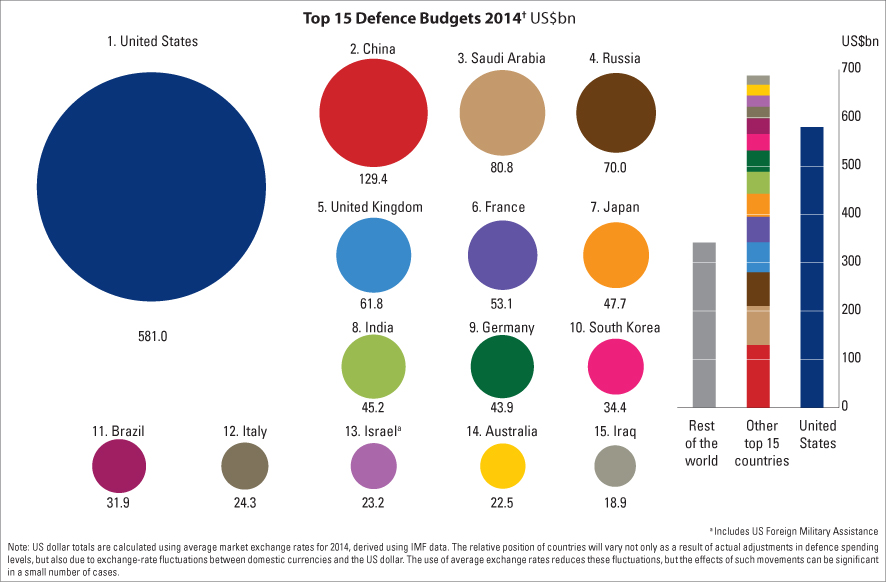
I put these numbers in a chart ranking the top ten military spenders in the world.

The U.S. still spends more than the next NINE COUNTRIES COMBINED on the military, yet the population of the U.S. (321 million) is about one tenth of that of all those countries combined (3.1 billion). So overall we’re spending more than 10 times as much per capita as every other country in the world on the military. And this is AFTER all the “terrible” cuts by Obama.
Interestingly, with the rise of Saudi Arabia in this chart, they are above our ranking in spending per capita. The U.S. does about twice the spending of the major European nations per capita, about four times that of Russia and 18 times that of China.
When I listen to the Republican candidates during the debates, they are ripping into the current administration for slashing the military budget and destroying our military capability.
Really?
Are they telling me that it takes ten times the spending per capita of the next nine countries combined to defend our country?
Are we getting that much less value for our spending than China and Russia?
Seriously?
Or are we just spending stupidly, to use a Trump term?
Perhaps we should stop spending our military money in other countries. We’re not defending the United States and its citizens. We’re blowing money on the military industrial complex which has a vested interest in wars going on overseas all the time.
We are fanning the flames of terrorism on purpose. We’re killing innocent civilians and children by the scores with our drones. And at home we’re telling the voters that we have to be afraid of terrorists killing us.
Fear works.
None of this makes any sense to me.
Redistribution of Wealth
Yesterday I heard some statistic that the richest 15 people in the United States have more wealth than the bottom 100 million combined.
Donald Trump is not one of those 15. On the Forbes list he is at rank 121 with his $4.5 billion. He always says he should be ranked higher and claims $10 billion, but be that as it may, objective observers put him at number 121.
I am sure I am part of the 100 million on the bottom. And so are likely you, my hardworking reader. What I don’t get is this:
When Obama was first running for office, some eight years ago, everyone called him the great “redistributer” even though the redistribution was well underway, starting with Reagan and going on through the Bush years. And the redistribution was not what we all were talking about. It was a redistribution of wealth from the pockets of workers like me and you to the pockets of the billionaire class like Trump. And Obama hasn’t slowed it down. It’s still going on.
What I also don’t get is this:
How in the world does Trump collect supporters among the 100 million, workers like you and I, and convinces them that he, one of the billionaire class, has our best interest in mind? Do Trump supporters really think he will do the right thing for the middle class and start stemming the tide of redistribution that has been going on for decades, so the wealth of the workers stays with the workers?
They really believe that he understands what it’s like to live paycheck to paycheck?
They really think he would even care?
So I sent another thirty-five dollars to Bernie Sanders today. Call me crazy.