Book Review: The Last Stop Video Shop – by Keith A. Pearson

Kevin Kershaw is a divorced man around 50 years old with a son from whom he drifted away and an ex-wife who needed to get away from him. He works joylessly in an insurance company office, accepting,  rejecting and challenging insurance claims by their policy holders. He does not have any real friends and he has lost his spunk to the point where he is considering ending it all.

One day, by pure coincidence, he finds a video shop in an out of  the way alley. Yes, in 2025, when we all stream Netflix, there is a shop full of VHS tapes. Kevin walks inside and gets to know the shopkeeper, an old and mysterious gentleman named Marty. He pulls out a VHS tape with Kevin’s name on it and gives it to him. There is a viewing room in the back of the shop with a small TV and an aging VHS player.

To his surprise, the short video is about Kevin himself when he was a child, showing him in scenes with his late mother. The shots were taken about his life where nobody was there to tape them at the time. It’s impossible, magical, but there it was. He soon finds out that there may be more tapes in future days, if he bothers to come back. And of course, he does.

The Last Stop Video Shop is a very slow moving story about a very boring life. For a while I found it hard to read, but it picked up the pace as it went along. There were eventually some uplifting experiences, as Kevin took the lessons from the videos seriously and made incremental improvements, which not only shaped his life, but those around him that the cared for.


2.5 stars

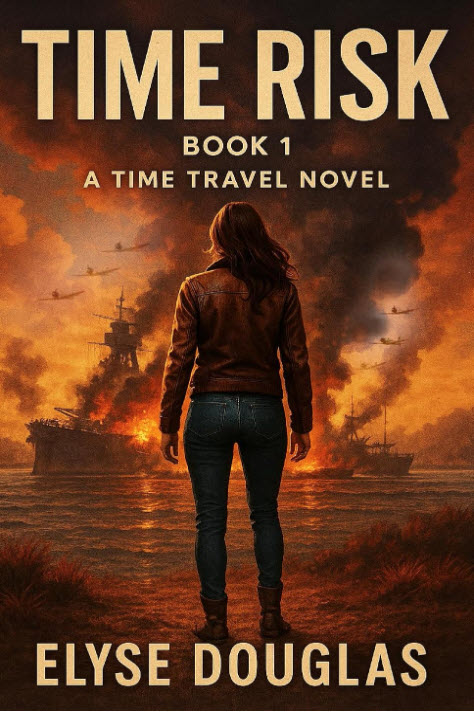
Book Review: Time Risk – by Elyse Douglas

Time Risk is a suspenseful time travel novel.

Andrew Whitlock’s father died during the Japanese attack on Pearl Harbor. He was one of the few pilots who made it off the ground, but he was shot down nonetheless. Andrew was an infant. His mother died soon after, and Andrew grew up in an orphanage. Despite his unfortunate early childhood, Andrew grew up to be a technology billionaire. He spent his life and career building a time travel machine.

Rachel Hunt is a former police homicide detective who is looking for work when Andrew’s men come knocking. They recruit her to travel back in time to Honolulu, arriving days before the Japanese attack. Her mission is to save Andrew’s father by keeping him from flying that morning.

When she arrives in Oahu, things immediately do not go according to plan, and soon Navel Intelligence and the local police are looking for her. She is hunted by the authorities as well as local thugs who are trying to make a few bucks. Things escalate quickly, and Rachel has to decide whether she is going to stick with her mission and save Andrew’s father, or whether she should just try to prevent the attack on Pearl Harbor altogether, and in the process change the history of the world.

The author’s name “Elyse Douglas” is the pen name for the married writing team Elyse Parmentier and Douglas Pennington. They specialize in time travel romance, women’s fiction and mystery. This is the first book of Elyse Douglas I have read.

Time Risk is a fast paced action thriller and a clever time travel story. I was ambivalent about it in the beginning, but it grew on me as it progressed, to the point where I am now considering reading some of the other books in the series, all time travel assignments of Rachel Hunt.

Book Review: The End Of The World As We Know It – edited by Christopher Golden and Brian Keene

Stephen King’s book The Stand is one of my all-time favorite novels. It first came out almost 50 years ago and I have read it several times. The book tells the story of a pandemic that wipes out over 99.9% of mankind. The world of The Stand plays in the aftermath of that pandemic. There are people who read this book once a year just for good measure. I believe it’s King’s grand opus and it’s 1,200 pages long.

I don’t usually like short stories or anthologies. When I came across The End Of The World As We Know It, I was skeptical. But once I started reading, I realized that the 34 stories by 34 different authors all play in the universe of The Stand. Some of them at the same time, as the disease ravages the world, others years later, and others yet decades and several generations later. They don’t all play in the United States either. Some are in other countries and continents. The anthology is over 800 pages long and it took me a while to read it – like about one story per session.

Stephen King has fully authorized this work about the harrowing world of The Stand. The stories are presented by award-winning authors and editors Christopher Golden and Brian Keene.

It features an introduction by Stephen King himself, followed by a foreword by Christopher Golden, and an afterword by Brian Keene. Contributors include Wayne Brady and Maurice Broaddus, Poppy Z. Brite, Somer Canon, C. Robert Cargill, Nat Cassidy, V. Castro, Richard Chizmar, S. A. Cosby, Tananarive Due and Steven Barnes, Meg Gardiner, Gabino Iglesias, Jonathan Janz, Alma Katsu, Caroline Kepnes, Michael Koryta, Sarah Langan, Joe R. Lansdale, Tim Lebbon, Josh Malerman, Ronald Malfi, Usman T. Malik, Premee Mohamed, Cynthia Pelayo, Hailey Piper, David J. Schow, Alex Segura, Bryan Smith, Paul Tremblay, Catherynne M. Valente, Bev Vincent, Catriona Ward, Chuck Wendig, Wrath James White, and Rio Youers.

I will go and find some of the works by these authors after reading their stories here.

Warning: If you have NOT yet read The Stand, this will not make sense to you. Read The Stand first, then this book. I highly recommend both.


Book Review: Phantom – by H. D. Carlton

It’s 1944 in Seattle. World War II is in full swing in Europe. Genevieve “Gigi” Parsons is a housewife living at Parsons Manor, a gothic house her husband John Parsons built for her. They have a 14-year-old daughter named Sera. John runs a successful accounting business. However, recently he has started drinking and gambling excessively, to the point where they are about the lose the house. Their marriage is deteriorating. John has started to abuse his wife, both emotionally and physically.

Eventually, Gigi finds out that John’s gambling debts are to the mafia. Around that time, she notices a mysterious man watching her from the shadows of the woods outside her home. Eventually, the man enters the house and the two start a love affair. Gigi is torn between her safe but boring life with her faltering husband and her daughter, and the passionate affair with Ronaldo Capello. She learns that Ronaldo works for the mob and has his eyes on her husband.

The passion scenes between Ronaldo and Gigi are abundant and the book is basically just porn.

Yes, porn.

Of the 326 pages, I am sure half of them are just graphic and explicit porn, nothing else. Carlton is a pretty good writer, so rather than just building transitions between the Chi Chi Bow Bow scenes, she weaves the porn into a novel with a full plot and a World War II mafia story. But I get kept getting the feeling that the entire story was just there so we could read about the great sex they were having all the time.

I have never read any romance novels; I guess this was my first and last one. I remember reading Fanny Hill by John Cleland when I was 15 or 16, and I remember it was highly erotic (to the teenager I was, of course). This is much more explicit, but I am not a teenager anymore, so it really didn’t interest me much.

When I researched the author after reading the book, I learned that Phantom is a prequel to the “Cat & Mouse Universe” books by the same author, but readable as a standalone story. It combines gothic elements, historical fiction, and mafia stuff with morally gray characters and intense emotional and sensual tension.

Carlton is a bestselling fiction author known for dark romance and thriller novels. While this stuff is not for me, the writing is actually pretty good. I will give it one and a half stars.


Book Review: Nobody’s Girl – by Virginia Roberts Giuffre

Here is an excerpt from pages 318 to 319:

I am making it publicly known that in no way, shape, or form am I suicidal,” I typed hastily but resolutely (making several spelling and grammatical errors that I’ve corrected here). “I have made this known to my therapist and GP—If something happens to me—for the sake of my family, do not let this go away and help me to protect them. Too many evil people want to see me quieted.

On April 25, 2025, Virginia Giuffre died of suicide at her home outside Perth, Australia. Nobody’s Girl was published posthumously on October 21, 2025. She finished writing this memoir shortly before her death. She had expressed a strong wish for the book to be published, regardless of her circumstances.

A close friend of mine is the father of one of the over 150 gymnasts who had been abused by USA Gymnastics doctor Larry Nassar. My friend has found it difficult to talk about what it is like to be a parent of a daughter who he entrusted to an academic institution for her education and training, only to be horribly betrayed, not just by the abuser, but by the entire system surrounding the abuse and allowing it to go on for such a long time. And yet, the sheer scale of Nassar’s abuse is paled by Epstein’s, as we all know now.

Virginia Giuffre has been one of Jeffrey Epstein and Ghislaine Maxwell’s most outspoken victims. Her dedication to bringing justice contributed to both Epstein and Maxwell to be convicted and put in prison. She was also the central figure who brought down Prince Andrew and eventually caused his ultimate expulsion from the monarchy.

In her own words, she describes her life, starting with her childhood, or should I say, the lack of her childhood. Her mother was a consistent drug abuser. Her father groomed her and then sexually abused her when she was a young as 7 or 8 years old. Worse, her father traded daughters with another man, so they could abuse each other’s daughters “for variety.” Her mother stood by and later claimed she didn’t know. This went on for years. As she got older, she ran away from home, only to be put into a correctional facility which – you might have guessed – also abused its teenage inmates. Her father was a handyman working at Mar-a-Lago when he got her a job as an assistant in the spa. She was 15. That’s where Maxwell first saw her.  She told her that she knew a wealthy man who would teach her to be a massage therapist and she’d get paid well while she was learning. That evening, after she got out of work, she was at Epstein’s estate in Palm Beach, thinking she was going to give a massage. During that very first meeting, Maxwell and Epstein manipulated her into sexually servicing Epstein. And that’s how several years of sexual abuse in broad daylight started. She even suspected that Epstein paid off her father, so he would let it happen. In the course of her service, Epstein forced her to perform sexual acts with hundreds of other men, billionaires, scientists, politicians, two U.S. senators, one former governor of a U.S. state, and – as we all know, Prince Andrews.

Eventually, after several years of servitude, she managed to break free of Maxwell and Epstein’s clutches, eventually get married and have a family. But for the rest of her life she was haunted by the horrors of the abuse she had endured.

Reading Nobody’s Girl illustrates how sexual abuse can first start, then proliferate, and how vulnerable minors, boys or girls, can become victims of repeat and systemic abuse by predators who are master manipulators. It also shines a powerful spotlight on our current system that protects powerful and wealthy people and shelters them from exposure. The victims are called whores, opportunists who accuse rich people just to extract settlements from them. They are accused as liars or even perjurers, when it’s the word of a powerful royal, politician or mogul against a young woman that they “rescued from the gutter.”

Nobody’s Girl is a very important book at a time when our news are flooded with “the Epstein files.” The whole rhetoric of what we are currently witnessing every day becomes all the more real and poignant after reading this book.

Now I must point you back to my introductory quote. Virginia Giuffre, after you read her book, you will find is not the kind of person who kills herself, just as she has reached some success in bringing justice to her perpetrators and helping the thousands of other victims out there whose lives have been destroyed.

Yet, the media and the government will have us believe it was a suicide.

I – for one – do not buy it.

Somebody got to her.

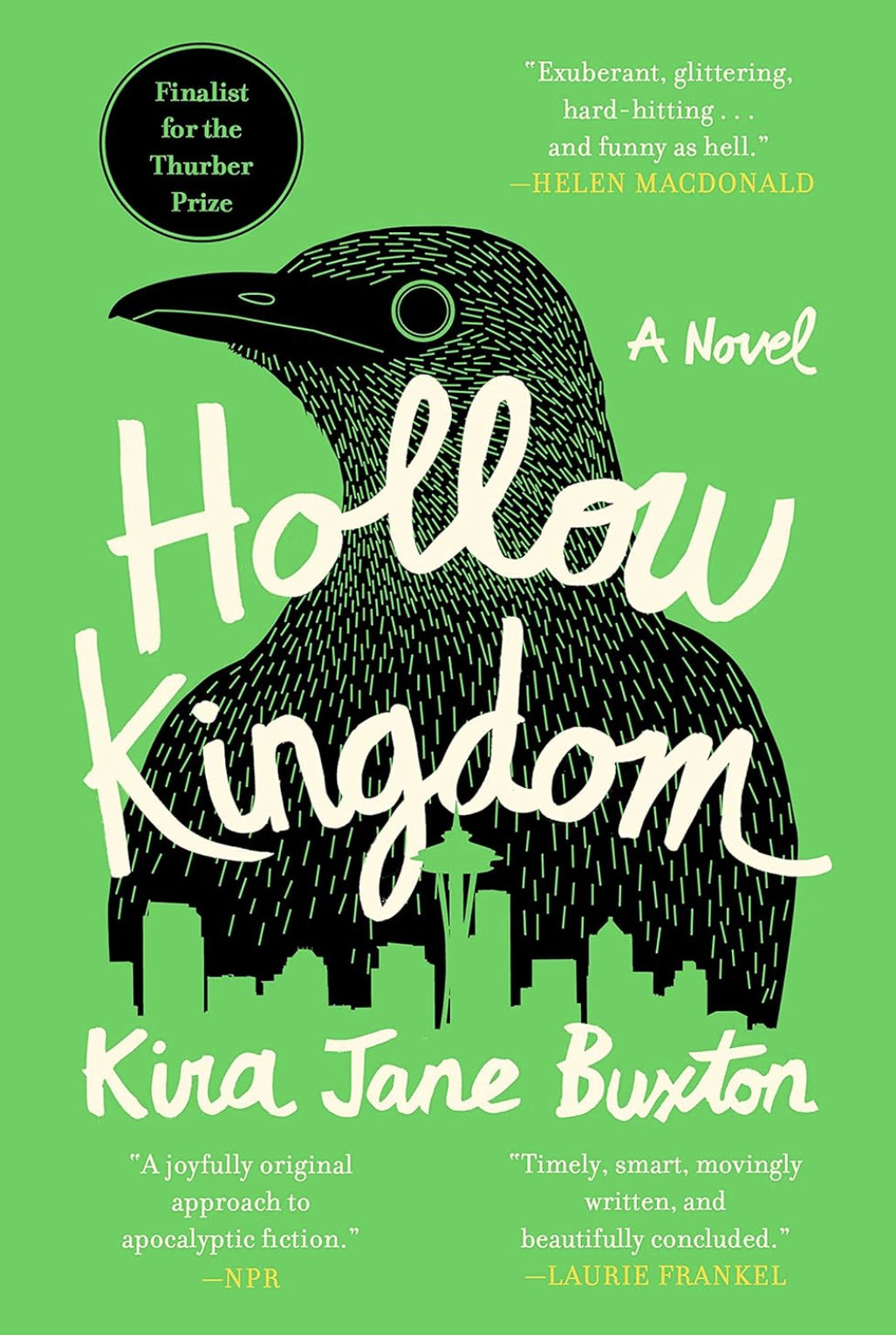
Book Review: Hollow Kingdom – by Kira Jane Buxton

I have always been fascinated by crows. They are known to be extremely smart and they can recognize and remember human faces. We have a lot of crows in our neighborhood, and I have been trying to befriend them. There is a bag of peanuts in their shells in our vestibule. When I see a crow perching on our roof or on the lamppost out by the street, I go get a couple of peanuts and put them outside while they can see me. No takers yet, no crow friends, but I will keep trying.

The protagonist of Hollow Kingdom is a domesticated crow. The crow is the narrator. The entire novel does not have a single human character. The only referenced human is Big Jim, who rescued the crow when he was just a chick and raised him as a pet. We know about Big Jim only based on flashbacks told by the crow.

Big Jim had named the crow Shit Turd, but he goes by S.T. (not surprisingly). His other pet is Dennis. S.T describes him this way:

Dennis is a bloodhound and has the IQ of a dead opossum. Honestly, I have met turkeys with more brain cells. I’d suggested to Big Jim that we oust Dennis because of his weapons-grade incompetence, but Big Jim never listened, intent on keeping a housemate that has zero impulse control and spends 94 percent of his time licking his balls.

Yes, S.T. thinks and talks like a human. In fact, all the animals in Hollow Kingdom talk, all the way from whales to spiders.

This book is about an apocalypse. All the humans get sick and eventually die of some virus, but not before they mutate in grotesque ways. Think of zombies that do nothing but eat each other and their pets. That’s got to suck if you are a dog or a cat trapped in a house with a sick human.

S.T. calls humans MoFos, based on the name Big Jim had for them. As he realizes that the MoFos are all going crazy, he goes on a mission to “free the domestics.” But how do you open doors and windows to let them out if you are just a crow, and your only friend is a (stupid) dog?

Hollow Kingdom reminded me a little of Stephen King’s The Stand. The premise in The Stand is that a manufactured disease kills off almost all of humanity. Only a very, very few survive to rebuild society. The entire story is based on a group of survivors trying to make a new world. In Hollow Kingdom, humanity disappears and nature comes back. Domesticated and wild animals try to make sense of what is happening.

Hollow Kingdom is a black comedy and satire, wrapped in a fable. It made me think about how fragile our society is, and how easily humanity could devolve.

Shit Turd’s point of view is delightful and comical. Overall, this book is unlike anything I have ever read before. Extremely readable, it’s also completely whacky.

I could not help but give it 4 stars.

Reading Hollow Kingdom is a whacky adventure.

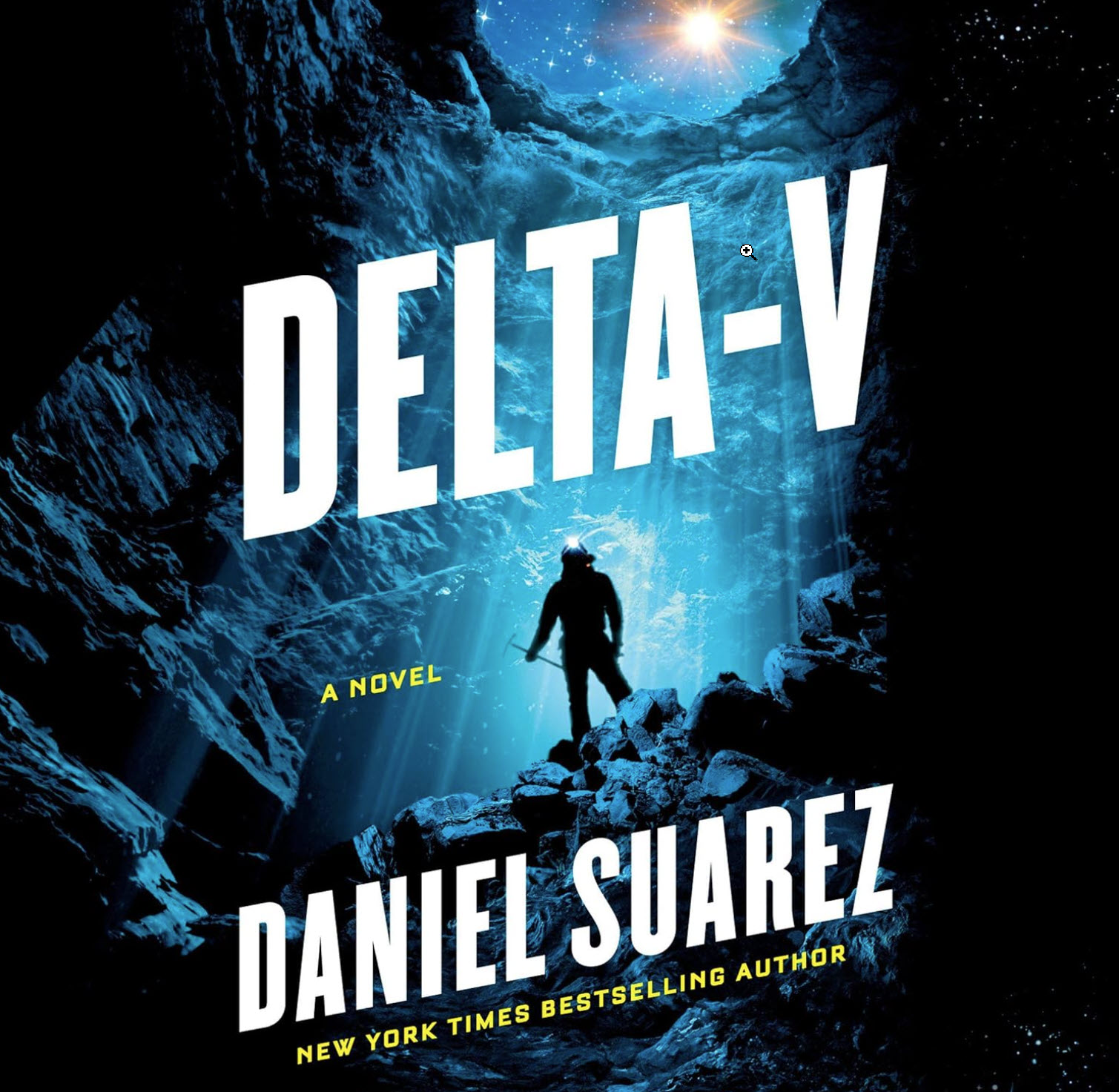
Book Review: Delta-V by Daniel Suarez

About 10 years in our current future, in the mid 2030ies, a number of private companies as well as the usual government agencies, like NASA and ESA, are trying to get into the business of mining asteroids. The goal is to kick off an entire new economy, including manufacturing in space. One of the biggest problems with space development is that every liter of water, every chicken wing to eat, every computer, literally everything we need in space has to be lifted from the surface of Earth into orbit at an exorbitant cost. How exorbitant?

During the Space Shuttle era, it cost about $54,000 per kilogram of mass. That’s the cost of lifting one liter of water into space. That’s because the Space Shuttle used expendable rockets. Now, with SpaceX’s Falcon Heavy, a reusable vehicle, the cost has come down dramatically, to about $1,400 per kilogram. Still a huge cost, considering how much material it takes to build a space station to live in.

If asteroids can be mined for metals, water, oxygen, the ingredients to make rocket fuel, and everything else we need, those raw materials are already in space and the cost to deliver them where they are needed, like in factories in lunar orbit or earth orbit, is much lower. Clearly, whoever can deliver materials in space to space is going to get very, very rich.

In Delta-V, this is the basic story. A renegade billionaire secretly builds a space ship outfitted to mine a near-earth asteroid. He recruits and trains an elite group of astronauts and sends them into deep space for the first mining mission.

Things do not go as planned, the billionaire turns out to be a fraud, and the minors are stranded in deep space with no obvious way to get home.

Delta-V is a well-written story of our near future in the current environment, where we are transitioning from government-controlled missions to private enterprises. I learned a lot about the technicalities of asteroid mining. For instance, I was always naively assuming that astronauts could just land an an asteroid and start digging. I didn’t realize that the surface of many asteroids is highly toxic to humans and damaging to electronics, so it’s not that simple. While the premise of the novel is fairly far-fetched, it taught me many things I didn’t know about the technicalities of asteroid mining, including how to get there, how to get back, and what’s involved in being there, let alone that the minimum trip duration is at least four years.

Overall, Delta-V is an entertaining story – and – you might have guessed it, there is a sequel.


Stephen King’s Birthday

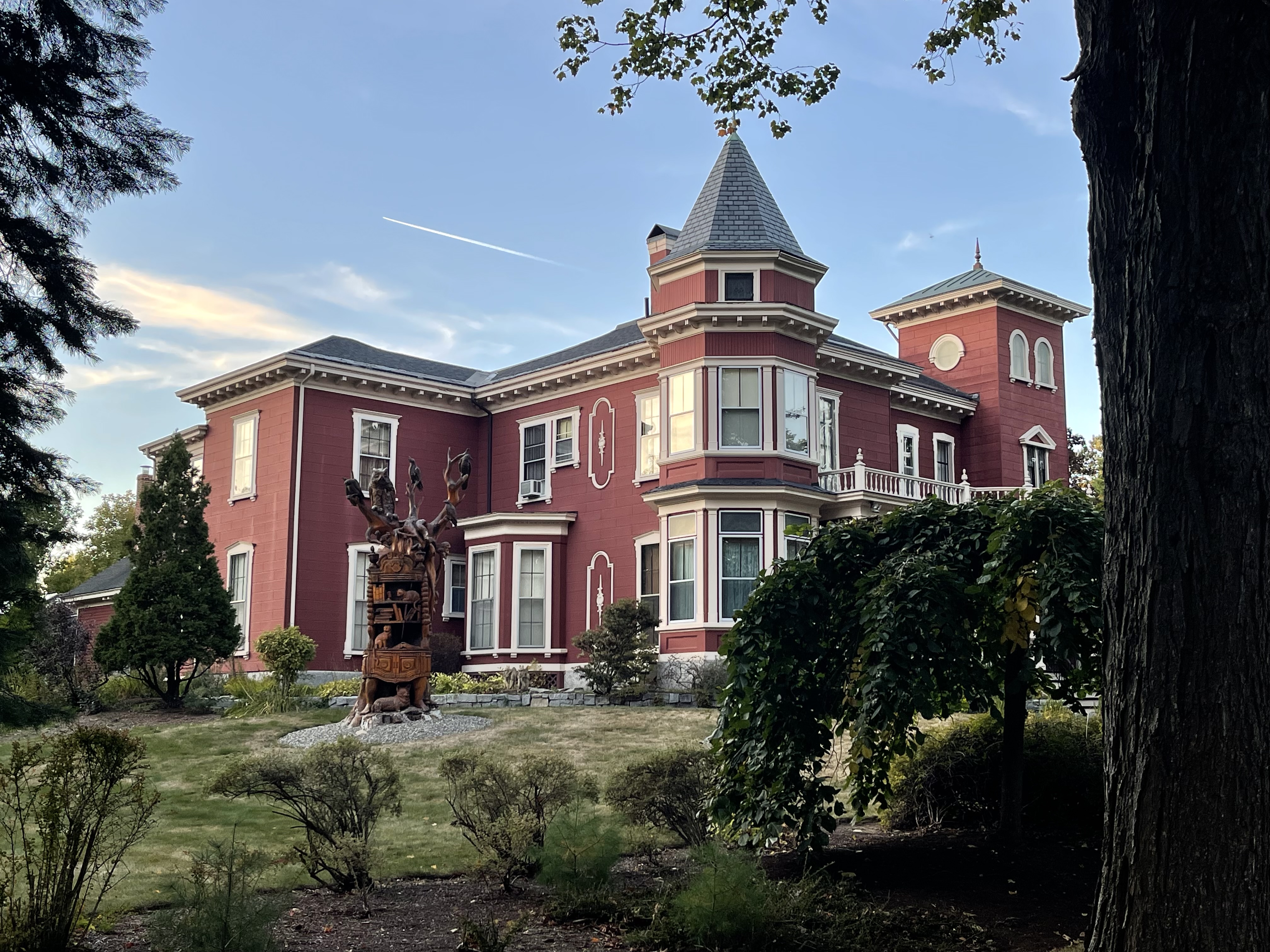
Today is Stephen King’s 78th birthday.

It just so turns out that we visited Bangor, Maine today and couldn’t help drive by his house. Here it is:

There is a statue carved out of the trunk of a dead tree in his yard. Here is a close-up:

For details, click on the image and zoom in.

The tree was a large ash tree in the front yard of Stephen & Tabitha King’s house. It was around 300 years old and had become infested with insects. When it needed to be removed, Tabitha wanted to preserve the tree in some way and she came up with the idea of turning the stump into a sculpture.

The piece was done by the wood carving artist Josh Landry from North Anson, Maine. He carved it using a chainsaw. It took him about a month.

The carving is full of symbols and references meaningful to the Kings and their life. Some of what the sculpture includes are a bookshelf, of course, and many animals like owls, ravens, cats, frogs and even a dragon. There is a corgi dog at the base, presumably a tribute to King’s dog Molly.

Tabitha King described her idea as wanting the tree to “give everything to us”: oxygen, the wood for furniture, and paper for books. She wanted to honor the role trees play in life, not just physically but metaphorically.

I think she succeeded.

Check out Josh Landry’s website here. There is even a picture of him on top of the sculpture.

Book Review: Der Fuchs im Hühnerstall – by Ephraim Kishon

It’s been a long time since I have read a book in German. Der Fuchs im Hühnerstall, or translated The Fox in the Chicken-Coop, is a biting satirical novel of the government machinations and bureaucracy of Israel. I first read it when I was in my teens after it first came out in 1969.  I remembered it fondly. But I lost that copy over the years. I could not find a Kindle version, so I bought a hardcover anthology of Kishon’s three novels, this being his first one.

Amitz Dulnikker is a cabinet-level politician in the Israeli government in his late sixties, at the sunset of his political career. Due to health reasons he decides to take a long vacation, incognito, in a remote village in the north of Israel, near the Lebanese border. The farm village of Kimmelquell specializes in growing caraway seeds as their product. It’s an idyllic place, with no electricity, where many inhabitants are illiterate, and where no outsiders are ever accepted. When Dulnikker and his young aide arrive they are quickly overwhelmed by the backwardness of the villagers and their dull lives. Dulnikker, ever the statesman, starts fomenting competition in the villages, primarily for his own amusement and to bring “civilization” to the poor farmers. Pretty soon, the events that he sets in motion take on a life of their own and control slips away. Eventually, he and his aide are finding themselves victims of their own instigations.

Kishon wrote originally in Hebrew, but I was not able to find any copy. The German edition was first published in 1969 by Langen Müller Verlag in Munich, translated into German by Emi Ehm.

The book has also been translated from Hebrew into English by Jacques Namiel and it appears under the title The Fox in the Chicken-Coop, published by Bronfman Publications in Tel-Aviv in 1971. However, a little research shows that while the books have the same (translated) title, they tell completely different stories. The English version is not a translation, but a completely different novel, with different characters, albeit also about political absurdities in Israel. This has confused many readers. As a result, unfortunately, it seems that there is no way to read this story in English.

Hebrew or German it must be.

Book Review: Blue Highways – by William Least Heat Moon

Blue Highways was first published in 1982, and that’s when I bought my copy. Here is a picture of it on my desk. The pages are yellowed, the print is small, and the book cost $3.95 in 1982. It’s been on my shelves, and in boxes, for all these years.
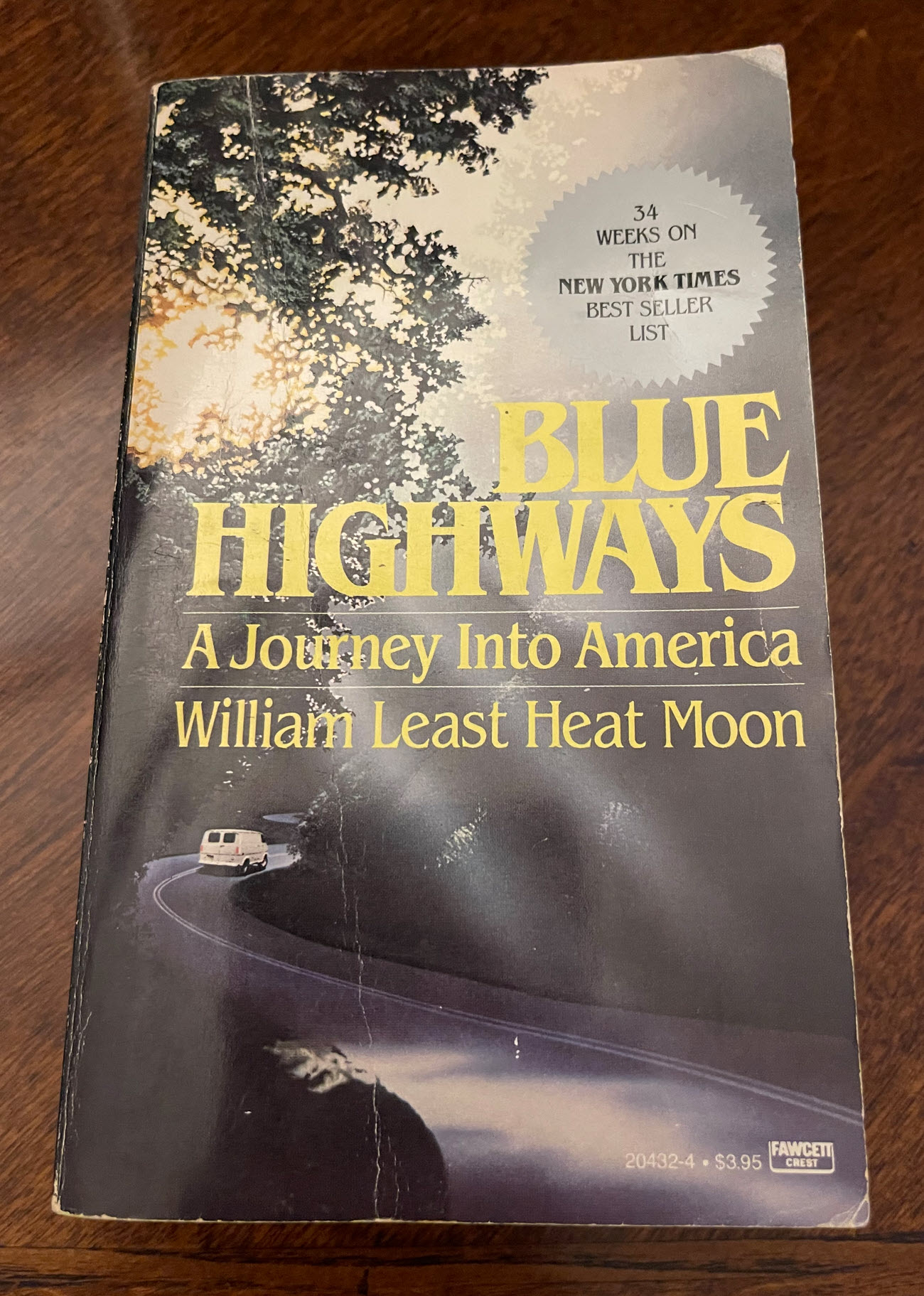
When I first bought it, I read perhaps 20 or 30 pages, and then I faded. It has 426 printed pages and the print is quite small.

Recently I bought it again on Kindle, at many times its original printed cost, just so I can read it in an acceptable formfactor. Printed books just don’t work for me anymore. And somehow I can read long books more successfully on Kindle, than when I have to turn physical pages.

And there you have it, I have read Blue Highways all the way through. It’s a classic, I have talked about it many times over the years with people, acting like I knew it, and now I have finally earned it.

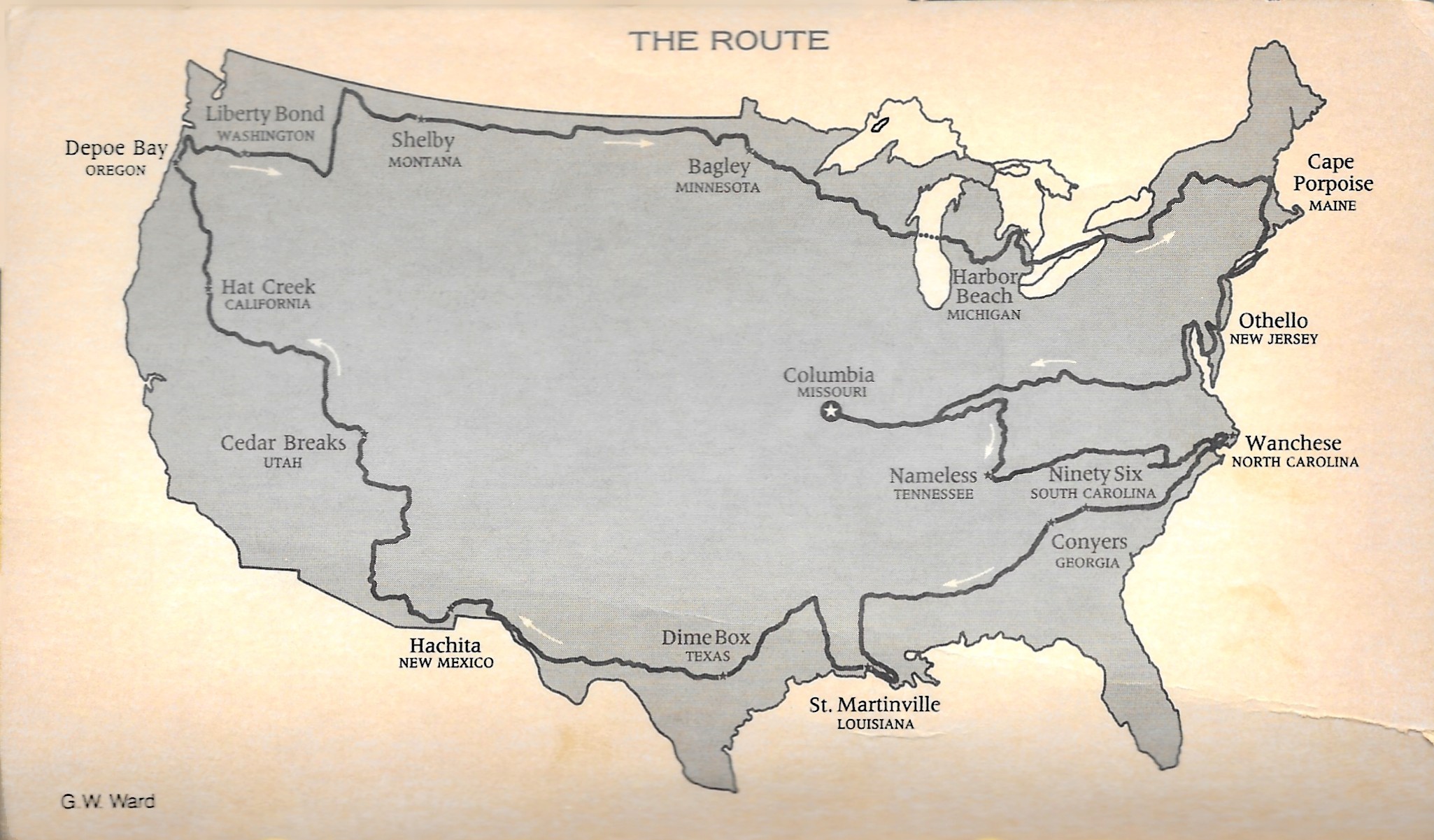
William Least Heat Moon is a travel writer, and Blue Highways is his most popular book, the one that put him on the map. On the first of day of spring, on March 20, 1978, he left his home in Columbia, Missouri in his van to travel around the country, avoiding all freeways, and  going only on country roads,  which were shown in blue on the maps of those days. Hence the title Blue Highways.

Here is a diagram of his van:

He called the van Ghost Dancing.

Ghost Dancing, a 1975 half-ton Econoline (the smallest van Ford then made), rode self-contained but not self-containing. So I hoped. It had two worn rear tires and an ominous knocking in the waterpump. I had converted the van from a clangy tin box into a place at once a six-by-ten bedroom, kitchen, bathroom, parlor. Everything simple and lightweight—no crushed velvet upholstery, no wine racks, no built-in television. It came equipped with power nothing and drove like what it was: a truck. Your basic plumber’s model.

Ironically, I had a high school friend who took his van, I believe it was an Econoline, across the country in the summer of 1978,  from New York state to Arizona, where I lived at the time, to visit us. It seems like more than one person traveled the nation is vans in those days, but not too many wrote books about it.

He circled the country clockwise as shown on the map below:
In his billfold he had four gasoline credit cards and twenty-six dollars in cash.  Hidden under the dash were all his savings: $428.

With that, he managed the trip around the country in three months, coming back on the first day of summer of 1978.

He tells vignettes of adventures or challenges, and he tells the stories of people he meets and spends time with along the way, be that hitchhikers, shop keepers, bar maids, gas station attendants, fishing boat skippers, ferry captains, and many, many residents in various small towns of America of the 1970ies.

I identified with the stories, because the late 1970ies is when I came of age and started my adult life. One of his stops is Kennebunkport, Maine. I now know that town because it became notorious through George H. W. Bush as his summer estate. The entire country learned about Kennebunkport. But Bush became president in 1989. Blue Highways was published in 1982, and the trip happened in 1978. Nobody then had ever heard of Kennebunkport, except for the locals there.

I saw many parallels of what one might encounter on a trip around the nation on blue highways today, and what it was like in 1978. It almost makes me want to retrace his trip.

Reading Blue Highways for me was rewarding just because I can now say I read the old yellowed book. It was a nostalgic trip through my early years. When I put the book down I decided I am definitely ready for an extended road trip.

I need to get out!


Book Review: Shroud – by Adrian Tchaikovsky

A generation starship has arrived at a star with a moon around a gas giant planet. The moon is tidally locked to the planet and has a very thick atmosphere, so thick that no light makes it to the surface. That’s why the people call the moon Shroud. The surface air pressure is twenty times that of Earth normal and since the moon is larger than Earth, the gravity on the surface is twice that of Earth. To top it off, it’s an ice-bound moon, it’s extremely cold and the atmosphere is mostly ammonia. The ship also discovered that the moon screams with electromagnetic energy to a point where all signals are completely drowned out.

So why are they interested in the moon? To harvest its natural resources. When they send down the first probes, they survive just minutes before the are destroyed. Eventually they send drones with cameras and searchlights to see what might be going on, and they discover that there is life on Shroud.

The surface is truly an alien hell for humans. Yet, they are building a lander suitable for the environment with plans to send down explorers. During an unexpected accident on the ship, two women are using the lander as a lifeboat and end up stranded, you guessed it, on the surface of Shroud, in that truly hellish environment.

Shroud is about humanity meeting an unexpected alien intelligence, so alien, that it they can’t figure out any way to communicate with them. I have often complained in these pages that the aliens in science fiction novels are too hokey, too much like  humans, or perhaps little green men, to be believable. The Shrouded, as they call them, are believable, and their utter alienness makes them the best part of this book. The story is mostly slow, boring, and the humans seem bland and their politics is trite. But the illustration of the complexities of trying to communicate with something that does not even recognize you as a being, that has no concept of something even as fundamental to us as light, and sight, and eyes, and individual minds, makes the story interesting.

It kept me reading.


Book Review: Never Flinch – by Stephen King

When you pick up a Stephen King novel you know you will be entertained. King is an excellent story-teller, and his characters always come out clear and real. The amount of detail is almost overwhelming, like watching an IMAX film in a high-resolution theater. You are right in the middle of it.

In Never Flinch, King tells the intertwining story of one serial killer with daddy issues, and one vigilante religious nut who is out to silence a woman’s rights activist by trying to kill her. The plot lines are intricate and carefully crafted. The story takes place in Iowa (mostly) in today’s world.

King has always been good about weaving in current events. Trump is in the story, so is JD Vance, the characters use the latest technologies, iPhones, social media and web sites. You can tell on every page that this plays right now. It becomes real.

The story itself is a crime thriller. He narrates it in the present tense, switching between the different characters and going deep into their psyches. King highlights the issues of religious zealous activism, people damaged by their  incompetent and outright abusive parents and the matter of abortion rights in the age of post-Dobbs.

I gave it only 2.5 stars for several reasons: The story itself, while it gave me some insight, didn’t really teach me anything. It’s just a thriller. I found no redeeming literary value. But this is Stephen King. He wrote many books that were much better overall, and this one was okay, but definitely not even in his top five, in my opinion.

In summary, Never Flinch is superb, vivid and masterfully told entertainment, and entertainment only.

Book Review: Colony One Mars – by Gerald M. Kilby

The first human colony on Mars consisted of a number of habitats and 54 colonists. An intense, 6-month-long dust storm covered all the solar panels and destroyed much of the facility. After all contact was lost, and satellite imagery showed much of the facility destroyed, it took several years before a new mission could be launched to investigate what might have happened.

Six astronauts eventually landed nearby and started investigating. What they found was not quite what they expected. In particular, apparently there were survivors. Quickly, however, some of the crew members started getting ill, experienced psychotic episodes and started turning against each other.

Colony One Mars is the first book of a series of six books. I knew that when I picked it up. After reading, I now realize that it’s not really a book, but the first chapter of a long book of six chapters. There is no real resolution, no end, many questions remain unanswered, and yes, you want to pick up the next book. And I guess that is the point.

However, it is just not good enough a story that I want to spend more time on it. This book reminded me of The Object by Joshua T. Calvert, which I reviewed about a year ago, where I said this verbatim:

Without spoiling the book for you, I just have to add that it’s always baffling when there is a space mission where Earth selects its best and brightest to go to meet an alien vessel, and those brilliant super astronauts do really, really stupid things once they are out there on their own. Perhaps that makes for an exciting plot, but for me it’s just distracting. These people are idiots out there, and when I read the story, it does not draw me in. It loses me and I want it to just move on and be done.

The only difference is that the mission does not visit an alien vessel, it visits a derelict colony on Mars, but the mission participants are for the most part cardboard characters with no real personalities. There is a female Ph.D. biologist who is the protagonist. The mission commander and the first officer are both one-dimensional humans who seem to be built just for the simple plot of this book. The author really does not bother to build characters for the entire crew. They are just there to move things along.

There is a commercial faction on Earth who pulls the financial strings of the mission, called COM, which stands for “Colony One Mars.” There are board members who are pure evil, motivated only by money, who are the actual culprits and who use people as expendable pawns in their game of riches.

Interestingly, there is a character named Leon Maximus, who is introduced here:

Leon Maximus, on the other hand, Peter admired. He was motivated by a seemingly sincere desire to advance human civilization. To make it an interplanetary species. To establish a Planet B, as he liked to call it. He was a rare breed indeed. None of this would have been possible if it were not for him and his genius. His company had developed the rocket technology to get the first colonists to Mars. Still, it was a slow tedious process. It was an eight month trip and, with the way the planets orbited each other, a tight two year launch window.

Kilby, Gerald M.. Colony One Mars: Fast Paced Scifi Thriller (Colony Mars Series Book 1) (pp. 80-81). Outer Planet Media. Kindle Edition.

You can move the letters of Leon around and match them to a real person in our time who is obsessed with colonizing Mars.

There are a lot of raving reviews out there about this hard science fiction book and it being a page-turner. Well, I turned the pages all the way through, but it’s really a story that is very contrived and just not all that interesting. If you want a real Mars story, you need to read The Martian, by Andy Weir.

Colony One Mars is the first book of a series, but I won’t read the other five.


Book Review: Tell Me How It Ends – by Valeria Luiselli

Valeria Luiselli is an immigrant from Mexico. She lives in New York with her husband and daughter. Early in her career as a writer, while she was still in the process of seeking her own Green Card, she was hired by the federal immigration court in New York to translate for child asylum seekers. The book was written in the 2014 – 2016 timeframe, before Trump came to office, while the Obama administration was still dealing with the refuge crisis at the southern border of the United States. There is also a postscript dated 2017, just as the book was published, and Trump’s first administration had taken over.

She illustrates, in the words of children as young as three or four years old, up to teenagers, how the American court system handles the crisis. Why are thousands of unaccompanied children arriving at the border, where they are giving themselves up to the immigration authorities? What are their motivations? Why are they here, and what is their fate when they are here?

Tell Me How It Ends is a powerful indictment of the American immigration policy. The children are the victims. Yet, they are  the ones whose lives are destroyed before they ever have a chance to grow up. It deals with the source of the problem in the first place, the utter violence and lawlessness in the Central American countries where the children come from, and it all traces right back to American drug use and consumption of drugs coming from Central America, and the thriving arms trade of American weapons back to those countries.

It is ironic to read this book now, eight years after it was first published, while the Trump Administration is applying a radial approach to solving the problem, deporting the most vulnerable and innocent victims of the whole malaise that causes this problem in the first place, demonizing the victims.

As I see it, particularly after reading Tell Me How It Ends, what they are doing now is not going to fix the problem whatsoever. It will just cause immense harm to those families and children affected directly. History will not judge us favorably for these years and these actions under our watch.

The book is only 99 pages long. I read it in hardcopy. I don’t have solutions. But I have a better understanding of why, and I can only fathom the immense damage that is being inflicted on a whole generation of Latin American children.

Tell me how it ends, because I do not know!

Book Review: The Reader – by Bernhard Schlink

Hanna is a 37-year-old woman who lives alone in a German city after World War II. Michael is a 15-year-old school boy. Chance and fate brings the two together. Teenage hormones and puppy love drive the boy, and an erotic affair quickly evolves between the two. They spend a year or so meeting up at her apartment, after her work, and after his school. He reads classic novels out loud for her, then they shower, then they have sex, then they snooze, and then he goes home to his unsuspecting parents and siblings.

One day Hanna disappears without a trace. Michael at first has a difficult time dealing with that, but in time he gets over it. He goes on and eventually becomes a lawyer. Then, suddenly and unexpectedly, he sees Hanna as a defendant in a trial that he and his classmates are observing. The trial reveals to Michael that Hanna was a guard in a Nazi concentration camp during the war.

The Reader deals with the issue of government atrocities, and to me it was a very timely read. We are at a point in American history where the government seems to trample on its own Constitution, and for the sake of soundbites and news clips arrests its own citizens, apparently without due process, and sends them to offshore hellhole prisons. This situation remind me of what happened in Germany in the 1930 and through 1945. Germany killed over 6 million prisoners, mostly Jews, many of them were German citizens. I’d venture to say that Hitler himself didn’t kill a single person. Somehow he convinced an entire population to do his bidding, and his killing, and thousands of soldiers, guards, and SS troops thought it was okay to commit unspeakable atrocities against their own countrymen. I never understood how this was possible. Yet now, while we’re not killing people, we’re sending innocent people, children who are citizens of our country by birthright, and foreign students with legal visas, to prison camps. Is this a first step?

The Reader tackles this problem. What happens to the emotional life of a person who knows she has committed atrocities and has to live with it? It is a well-crafted novel, a love story of sorts, but difficult and emotional read.