Visualizing the Size of the Solar System

When I posted about visualizing the speed of light a couple of days ago, one of my readers pointed out another site that did a great job helping visualize the size of the solar system. If the moon is one pixel wide, what are the various sizes of the objects and their distances from each other. It starts out with the sun and you can scroll to the right to start getting to the planets. There is also a “speed of light” button on the right lower corner, the “C” button, which turns on auto scroll at the speed of light. Thanks, PS, for pointing out this site to me.

Visualize the Size of the Solar System by Clicking Here


Visualizing the Speed of Light

Here is an amazing video that shows what it would be like to be sitting on a beam of light traveling away from the sun, flying by Mercury, Venus, Earth, some asteroids and finally arriving at Jupiter, 45 minutes later. It really gives a sense of the immense size of the solar system, not to mention the universe.

Earth in Saturn’s Rings

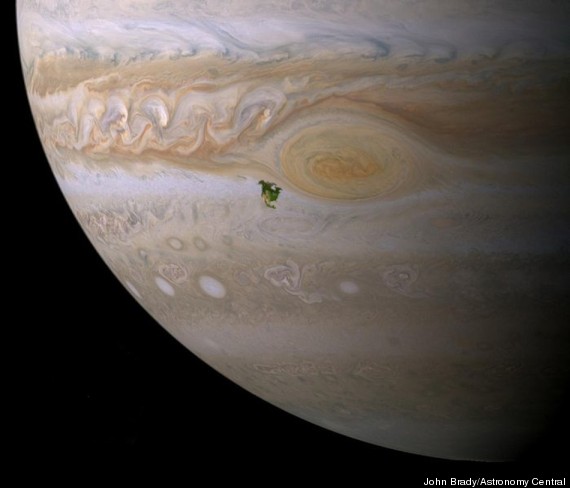
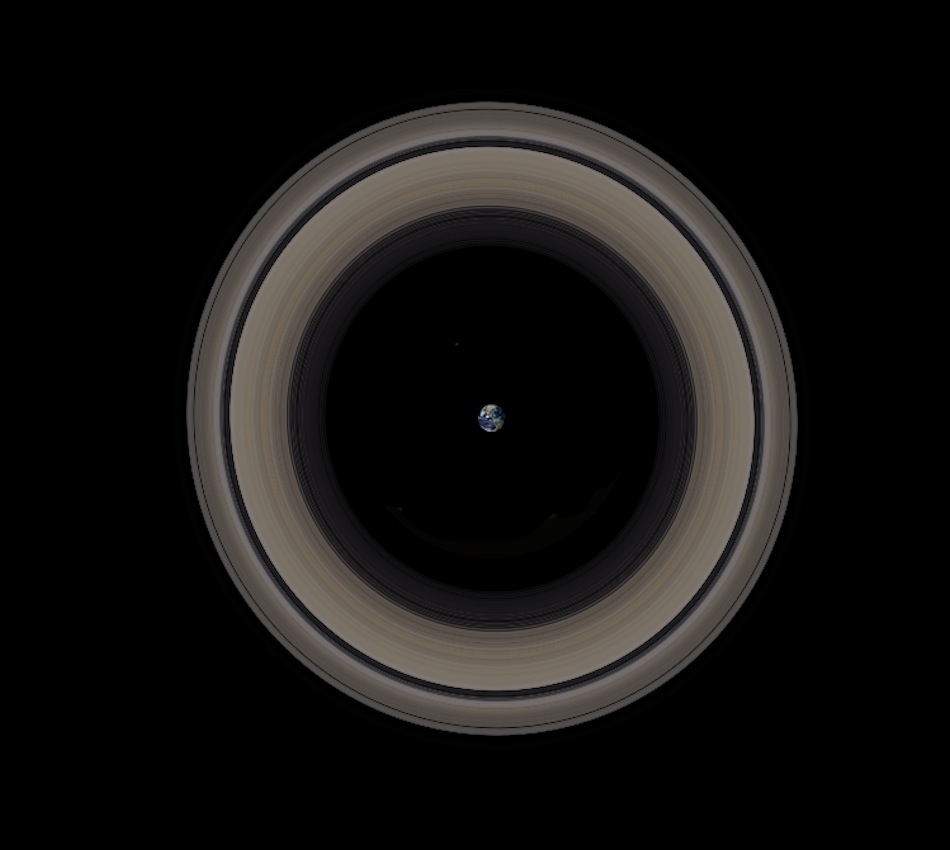
If the Earth were surrounded by the rings of Saturn, this is what it would look like.

Picture Credit: John Brady – Astronomy Central

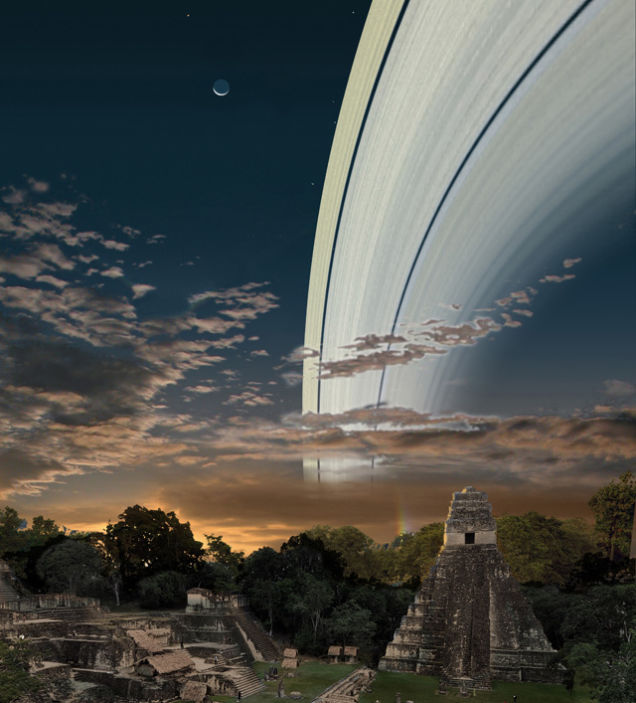
If we were on Earth, looking up, it might look something like this:

rings
click for picture credit: gizmodo.com.au

 
If Earth had a ring like that, it would never really be night. The sun would always be hitting the ring somewhere, and it would reflect on the Earth. There would always be “ringlight.” Also, the sun would sometimes be behind the rings, making for interesting visual spectacles, which we can’t even imagine. The ring is so thin, the sun would really hardly be obstructed, but the ring surely would light up in a huge corona.

The Sphere of Influence of Our Gods

To look at how important we are, and how important our Bronze-Age and Medieval scriptures are in our world today, as we know it, check out this chart. It’s designed to view from bottom up. Scroll to the bottom of this picture and then scroll up to read it.

Scale of Universe

Visualizing Stars and Religions

Common wisdom says there are about 6,000 stars visible with the naked eye on earth. Of course, half of them are below the horizon. Of the 3,000 stars above the horizon, 500 of those too close to the edge, or obstructed.  That leaves about 2,500 visible stars on a clear, dark night.

There are 4,200 religions in the world.

That means that there are more religions in the world than there are stars you can see on a clear night.

Pillars of Creation

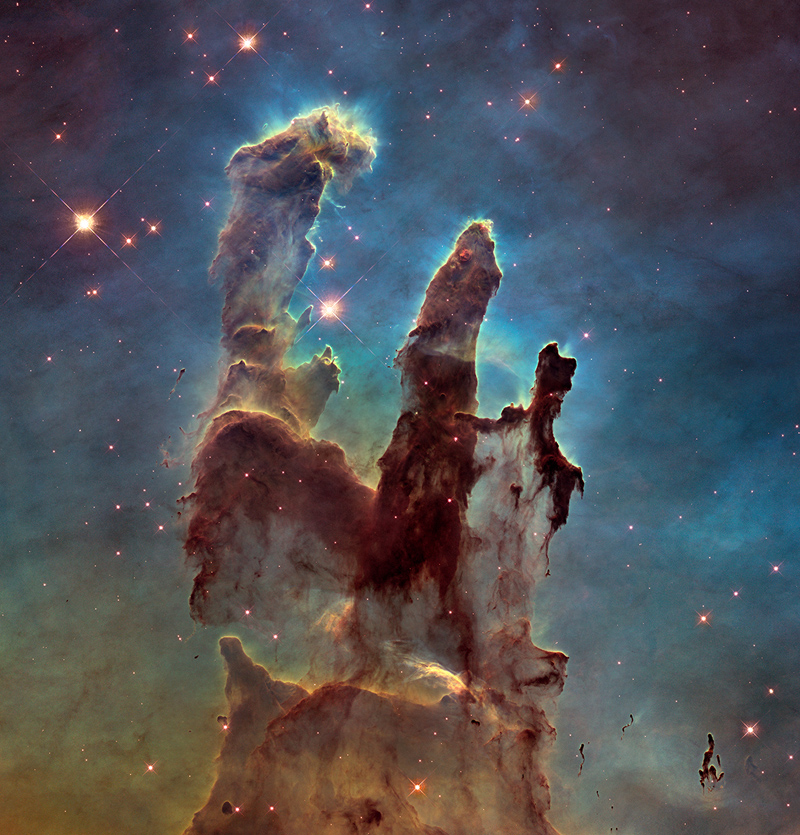
Pillars of Creation
Photograph by NASA, ESA, and the Hubble Heritage Team (STScI/AURA)

The Hubble Space Telescope took the iconic image of “Pillars of Creation” first in 1995. It shows three giant columns of cold gas bathed in the ultraviolet light from a cluster of young stars in the Eagle Nebula. Celebrating its 25th anniversary, NASA’s Hubble Space Telescope has taken a new set of pictures, showing a sharper and wider view of the structures in this visible-light image. These things are so massive, it boggles the mind. The pillars are about five light years tall. That means that if you boarded a Southwest Airlines plane and traveled about 500 miles per hour, it would take you about 1.35 million years to travel from the bottom to the top of one of the pillars. Even if you flew as fast as the International Space Station (about 17,000 mph), it would still take about 40,000 years to travel that distance.

Oh, and I forgot to mention, they are 6,500 light years away from us. The pillars we are looking at in this picture now are what they were 2,000 years before the great Egyptian Pyramid was built.

To travel there by one of our space capsules at 17,000 mph, I would have to travel 51 million years. I guess I won’t be going.

And yet, there they sit, the pillars of creation, minding their own eternal business, staring at us.


Musings about the Night Sky

When we look up at night in the city, if we’re not under a street light, we see a few stars. If you have ever been out in the desert at night, it seems like there are a million stars. In reality, we can only see about 4,000 to 6,000 stars with the naked eye.

Furthermore, those stars are all located pretty close to our solar neighborhood. Some are just a few light years, or tens of light years away.

Here is a diagram of the 50 stars closest to us, all of them within four to 16 light years. Interestingly, only nine of those stars are bright enough to be seen with the naked eye.

Here is another chart showing major stars within 50 light years. There are about 2,000 stars within that distance.

Some very popular recognizable stars are in the Orion constellation.

Orion
Orion by Akira Fujii – Hubble Space Telescope [click for credit]
In the Orion, there are the four main stars forming the outer rectangle and three main stars in the belt.

  • Betelgeuse (left upper – 427 light years)
  • Belatrix (right upper – 243 light years)
  • Saiph (left lower – 720 light years)
  • Rigel (right lower – 773 light years)
  • Alnitak (left belt – 812 light years)
  • Alnilam (center belt – 1350 light years)
  • Mintaka (right belt – 916 light years)

As you can see, they are all comparatively far away, so they are very bright stars, but all are in the approximately 1,000 light year range. So let’s visualize the size of a 1,000 light year bubble around us.

The galaxy shown in the picture below is similar to our Milky Way, at least for the sake of this mind exercise. Please notice the little circle at the tip of the red arrow.

Milky Way 2

Our sun is about 28,000 light years from the center of our galaxy. If you enlarge the picture, you’ll see a little circle at the end of the arrow. That’s approximately the sun would be with respect to the center of such a galaxy, and the bubble encircles the area of all the stars we can see with our naked eye on Earth. If you go outside right now and look up in the night sky, every star you see is actually in this little red circle. That’s how far we can see. That’s the “approximately 1,000 light year bubble.”

The point is, we can’t see very far.

In recent years, scientists at Caltech have come to the conclusion that half of all stars in the universe may be “rogue stars” which are stars that float outside of the major galaxies in the vast open spaces between. Such stars don’t have any neighbors, so there would be nothing in their 1,000 light year bubble. If we lived on a planet on such a star, there would be nothing in the night sky. No stars at all. Only endless blackness, and some “smudges” of light if there were any close-by galaxies. I wonder what psyche such a civilization would develop if the only celestial objects were moons (if any), planets (if any) and the occasional comets? Their entire mythology would be very different from ours.

On the other hand, if our sun were close to the center of the galaxy, where stars are packed tightly, our night sky would be glowing bright with light. We probably wouldn’t think of it as a night sky. It would just be somewhat less bright during the “night” phase of our days, when the sun was below the horizon. That, too, would have created a very different mythology.

So it turns out, night skies are not the same everywhere.


Andromeda in Night Sky

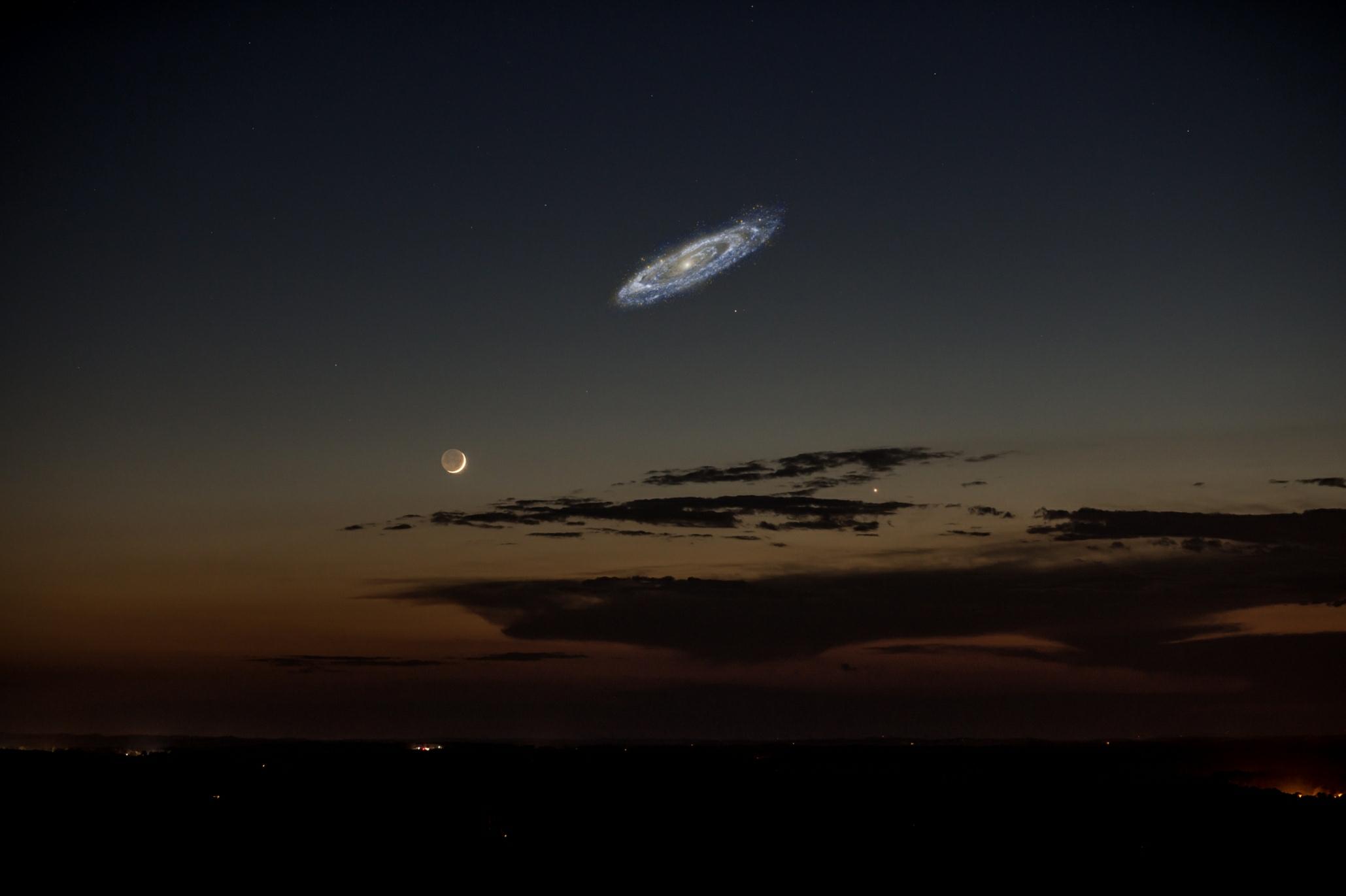
This is how big Andromeda actually would be in our night sky if it were brighter. Its light took two million years to get here. It’s moving in our direction at 245,000 miles per hour, and in 3.75 billion years, it will arrive and collide with our own galaxy. There are some 400 billion stars there. If there is an intelligent being that is lookup up in the night sky in our direction right now, they would see us as we were two million years ago. Our ancestors just started walking upright.

Andromeda1
Andromeda Galaxy – correct size in night sky next to moon- brightened.


Flashes of Consciousness in the Vast Dark

While we marvel about the possibility of millions, even billions of intelligent civilizations in the universe, we really only know for sure of one: our own. It has, as a sentient culture only existed for a couple of hundred thousand years. If I can classify civilization as a group of sentient beings that records its history, then we’re only about 5,000 years old as a civilization. If technology is the defining factor, we’re only about 150 years old. All these time spans are very short in the context of cosmological terms, where time periods are counted in millions of years, even billions. We also don’t know how long a civilization lasts. Our own has so far not lasted long, and there are some signs that we’ll do something stupid soon and it will have been a very short period indeed.

So let’s speculate that an intelligent civilization lasts about 10,000 years from first recording its history until flaming out and dying off.

Our universe is 13.77 billion years old and the Earth is 4.54 billion years old. There are almost half a million 10,000 year spans in 4.5 billion years. So our civilization, based on my assumptions here, lasts about half-a-millionth of the time span of the earth.

If other planets on other stars had similar timescales, and if there were half a million such planets in our galaxy, all forming about at the same time the Earth formed, we could conceivably have had half a million civilizations on these planets alone without overlap. This means every one of those civilizations could have existed throughout its entire life-cycle without ever knowing about the existence any of the others. All of them could have been advanced technological civilizations with active programs in place to scan the sky for signs of life. They still would never have seen a trace of any. They existed, but separated from each other by time.

This makes me think of camera flashes in a stadium:

Watching the short video above I can’t help but think of each of the flashes to be a 10,000 year civilization somewhere in our galactic neighborhood. The short video spans perhaps 10 million years of time. We’re one of them flashing right now, but we never saw those before us or after us. Yet they all exist.

Taking this thought process further: If the universe is 13.77 billion years old, and the Earth only 4.54 billion, there could have been several full solar systems that came and went before ours even started.

Let’s say a solar system formed when the universe was 5 billion years old, and matured to the current state of ours at 9 billion years. There could have been highly advanced civilizations in that solar system that never knew about ours, since our own sun had not even formed at that time.

So when we think about civilizations in the universe apart from ours, we have to think not only about those that may exist right now, but all of those that have ever existed, and now we can multiply the current estimates of possibly trillions (see my post about this here) to millions of trillions.

Meanwhile, it would be nice if we could finally find just one flash of consciousness in the vast dark. Just one.


Visualizing the Motions of the Solar System – Take Two

I am forever fascinated with motion and relativity. One such example is how the European spacecraft Rosetta matched up speed with a comet traveling at immense speed (of 40,000 miles per hour or 25,000 miles per hour – I can only seem to find conflicting values, still searching for confirmation of the correct speed). Another such example is the article I reblogged recently titled Visualizing the Motions of the Solar System. An astronomer friend corrected me and sent me this link: No, Our Solar System is Not a “Vortex.”

Of course, my point of blogging about DJ Sadhu’s video was to show a cool visualization. It gets the layman thinking in a different direction than the boring heliocentric model and all the graphics we ever see about the motions of the planets, as they just spin in circles around the sun. Sadhu’s video spurs the imagination and shows there is much more going on.

Phil Plait’s article is scientific and describes what’s actually happening, and he shows that there are many inaccuracies as to the motion of the sun and planets trailing it in that graphic. He calls Sadhu’s model plain wrong. I will leave it to the reader to study Phil Plait’s article for the various technical corrections, but I take away two main points that may help the layman (and me):

1. The sun is not moving away in a direction perpendicular to the plane of the solar system, like it is shown in Sadhu’s video. It’s actually much more along the plane, causing planets to overtake it and then fall behind again, an intriguing way to think about it.

2. The sun is moving in many more and much more complex directions. I talked about that in My Coffee Cup is Moving more than a year ago. Plait, of course, talks about many of these additional motions of the sun, which, if put into a computer graphic would compound the complexity. Interestingly, if you check the numbers you will see that the motions of the sun that are not directly the sun, like the motion of the galaxy itself, is much faster than the relative motion of the sun within the galaxy. Another vortex?

I thank the Honking Goose for originally posting this. I thank Sadhu for helping us visualize something very complex with his great computer graphics skills. I thank Plait for the scientific corrections to Sadhu’s statements and claims and for the additional clarifications. Science matters – even when we need to make it simple for the non-scientists like me. And I thank my neighbor (BP) for pointing out Plait’s correction to Sadhu’s graphics.

And now we all have learned a little more.

Musings about a Comet

Mankind did a remarkable feat today: It landed a probe roughly the size of a washing machine on a comet (named 67P/Churyumov-Gerasimenko) which hurtles through space toward the sun at a speed of 40,000 miles per hour, which is more than twice as fast as the space shuttles traveled in orbit. No other man-made objects ever traveled that fast. The Apollo missions reached 25,000 miles per hour, and the Voyager spacecraft are in interstellar space now traveling at around 35,000 miles per hour.

To rendezvous with an object moving that fast, the probe has to move just as fast, and then match the orbit of the object. Scientists have likened this feat to a fly trying to land on a speeding rifle bullet. Good luck. But that is just what happened today. The European Space Agency Rosetta craft has been in space for 10 years traveling to the comet waiting for this rendezvous.

The agency published a phenomenal picture which puts the comet into perspective:

Comet
Photo credit: Matt Wang, Flickr: anosmicovni. European Space Agency

Here is the three-kilometer-wide comet sitting behind Los Angeles. How is this for size?

The asteroid that hit the earth 65 million years ago causing the extinction of the dinosaurs is estimated to have been about ten kilometers wide, or about three times this big.

Another fascinating thought is that the comet is still 317 million miles away from earth, which means that it takes radio signals 20 minutes to get here.

If the earth were the size of a tangerine (about 5 cm across), the comet would be 1.25 miles away from the tangerine and would be smaller than a speck of dust. Now we can visualize this: The Rosetta spacecraft traveled off the tangerine sized earth to hit a speck of dust one and a quarter miles away.

Amazing.

Planet Formation

HLTau
Image of Planet Forming Disk Credit: ALMA (NRAO/ESO/NAOJ); C. Brogan, B. Saxton (NRAO/AUI/NSF)

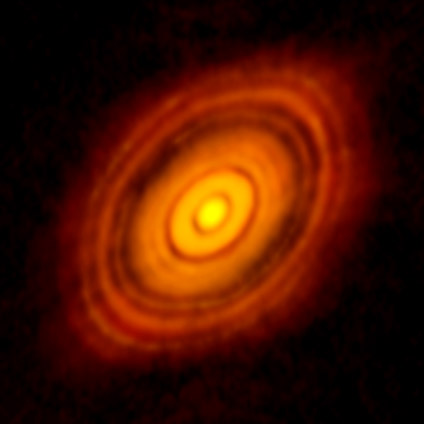
Here is an amazing image of a new star surrounded by a disk of gas that already is forming clumps that will eventually condense into planets. Read more details at the article here.

Our own solar system is 4.6 billion years old, so we floated around and looked like this then. And in another few billion years, when the gases of that disk will have condensed, and  planets will have formed, perhaps one of those planets will be just warm enough for liquid water to exist and not too hot for the greenhouse effect to go crazy, just maybe some life may develop.

And if by chance that life were to gaze up into the sky at our own sun, it will be a red giant close to the end of its life. It will be bigger than the orbit of Venus. Earth is expected to be able to support life for only another billion years. By then it will long have been turned into a dead ball of cinder.

And they – should they exist – would look at our sun and never know we were ever here.


Aliens

aliens1There has been a lot of press lately about Boyd Bushman, a former Lockheed Martin and Texas Instruments engineer who died on August 7th at the age of 78, who left behind a video with claims about extraterrestrial life as evidenced by the Roswell aliens. Here is a link to one such article. It’s going to take a bit more than a story told by a goofy old man in a poorly made video, showing grainy photographs about something that supposedly happened 67 years ago, to make me buy into little grey men with big heads.

Before I give my thoughts, though, I should state that I am absolutely certain (and note I don’t use the word “believe” here) that there is alien life outside of our planet. There may well be alien life within our own solar system, in the water moons of Jupiter’s Europa and Saturn’s Titan and Enceladus. But that’s just our front yard. There are 100 to 200 billion stars in our own galaxy, and even if only one in one thousand of those stars has a planet that could sustain life, and if only one in one thousand of those planets actually has life, and if only one in one thousand of those planets has developed intelligent life, there are still 100 – 200 planets in our own galaxy that have intelligent life – aliens.

Then there are at least 100 billion galaxies in the universe as we know it. That means that there would be 10 to 20 trillion intelligent civilizations in the universe. We are just one of those. So yes, there are aliens.

However, the idea that aliens like those that Bushman describes, are humanoid, is utterly improbably. If they had developed from common ancestors with humans, it would be understandable. But it is hard to imagine how those brothers of ours left the Earth some 50,000 years ago and went to colonize a planet 65 light years away, with just enough evolutionary divergence to become bald, smaller, frailer and have bigger heads and eyes, but still retain two legs, with knees bent forward, ten toes and ten fingers, two ears, two eyes, a mouth, a nose and a skull above it all with a brain shaped like a large human brain. The odds of aliens being humanoid are infinitesimally small.

Bushman says that the aliens communicated with humans telepathically. Let’s assume for a moment that telepathy exists, and two brains can communicate ideas across “thin air” without any other means, even though there is not one shred of evidence that such a feat is actually possible. Then it would make sense that two humans, with the same communications gear (our brains) could communicate with each other by that method. My question is: does telepathy use language? Is telepathy bound by language? Two healthy humans with high IQs cannot communicate with each other if one only speaks English and the other only Japanese or any other language. Anyone that has ever traveled knows what that means. If you don’t know the language, you have absolutely no idea what’s going on in the other person’s head – all you have left is body language, and that does not convey complex concepts. But here we have alien beings, presumably completely unrelated to humans, with no shared DNA,  with completely different evolutionary background (even though they look like small frail humans for some reason), and they can walk into a room and telepathically communicate with humans?

We have shared our planet with intelligent beings for as long as humanity has existed. Those beings are the whales, dolphins most prominently. Dolphins are thought by many researchers to be just as intelligent as humans. They simply didn’t start developing tools due to their natural environment and the evolutionary path they took. But they have language. And in all the centuries that we have shared with dolphins, in the decades that researchers and linguists have tried to learn the dolphin language, we have not yet succeeded. And here are dolphins, which share a large amount of DNA with us, who live on our planet with us, and we can’t communicate with them.

But aliens just crash at Roswell, get transported to Area 51, and start teaching our engineers advanced concepts?

Bushman says that the aliens come from a planet that’s 65 light years away but the trip only takes about one hour. We humble humans have so far not found any evidence that it is possible to travel faster than light. That is not to say that someone else hasn’t figured that out. So let’s assume that these aliens indeed have ships that can travel 65 light years in an hour.

Why don’t they have a shuttle service and a spaceport here on Earth? We could travel to their planet for lunch and be back at the office mid-afternoon for a meeting. Think about the trade, think about the cultural exchange we could have with such an ability to travel? Why did they come here in 1947, and then every few years, in secret, to be spotted on misty nights in the woods, killing cows, abducting humans, just to hide again? What’s with the secrecy? If they knocked on my door, I’d let them in. If they wanted to take my blood samples, go ahead. If they wanted to take me on a trip 65 light years to their planet, I’d go in a minute, and so would another million people.

Why hide in Area 51 surrounded by old Lockheed engineers?

Then, of course, there is the question whether our all so secret government really could keep such a story covered this long. So when Obama got elected, and he asked to get a tour of Area 51 and see the aliens presumably still living there, they told him, no, that was classified? I don’t buy it. A story that big would not be kept under wraps. Somebody would be cleaning the motel rooms where the aliens lived. Somebody would be cooking for them. Somebody would be manufacturing suits that fit them. Somebody would be building weird stuff based on their technologies.

Yet, there is not a single tweet with a picture of one of them. There is no Facebook post. There is no picture on Instagram. Nothing. No leaks, no real evidence, in 67 years! That is not possible.

Ah, of course, there is Boyd Bushman, with his grainy photographs held up in his goofy video. Maybe I have it all wrong.

Featured Artist: Mark Gee – Full Moon Rising

This was photographed by Mark Gee in New Zealand in real-time. There was no editing done whatsoever in this video. Make sure you read the description below the YouTube video:

This is my “Full Moon Silhouettes” short, as seen originally on Vimeo. It is a real time video of the moon rising over the Mount Victoria Lookout in Wellington, New Zealand. People had gathered up there this night to get the best view possible of the moon rising. I captured the video from 2.1km away on the other side of the city. It’s something that I’ve been wanting to photograph for a long time now, and a lot of planning and failed attempts had taken place. Finally, during moon rise on the 28th January 2013, everything fell into place and I got my footage.

The video is as it came off the memory card and there has been no manipulation whatsoever. Technically it was quite a challenge to get the final result. I shot it on a Canon ID MkIV in video mode with a Canon EF 500mm f/4L and a Canon 2x extender II, giving me the equivalent focal length of 1300mm.

— Mark Gee

And here is a link to his site and how he did it.


When I first saw this I didn’t realize it was in the Southern Hemisphere. I noticed that the moon rose to the left, rather than to the right, and I thought that the video was simply side-reversed. Then I saw that the moon looked different too. I have never been to the Southern Hemisphere, so I never could experience this live.

This experience reminded me of my own painting titled “Supermoon over Swiss Alps” modeled after photograph one of my friends took while in Switzerland, of the rising moon behind a mountain.

Supermoon in Swiss Alps