Visualizing the Reach of Humanity in Space

There are hundreds of billions of galaxies in the universe, most of them millions of light years apart from each other. Our own galaxy is the Milky Way. Of course, we’re living inside of it, so we cannot ever take a picture of it. The picture below is of another galaxy (Andromeda) that we think is similar to our own. But that’s close enough for this exercise in visualization. You can click on the pictures to enlarge them.

Milky Way 1 The Milky Way is about 100,000 light years in diameter. That means that the light takes 100,000 years to go from one edge of it to the other.  Our own sun is in a minor spiral arm, called the Orion arm, about 28,000 light years from the center of the Milky Way. That means it’s a little over halfway out from the inside. Milky Way 2 In the picture above I marked a random spot. Let’s just say that’s about 28,000 light years from the center. If you enlarge the picture, you’ll see a little circle at the end of the arrow. That’s approximately the bubble where all the stars we can see with our naked eye on Earth are located. If you go outside right now, every star you see is actually in this little red circle. That’s how far we can see. That’s the “approximately 1,000 light year bubble.” Milky Way 3 About 1930, when radio became popular, we started broadcasting. Our radio waves of Churchill speeches or Hitler diatribes started leaving the earth at that time. Since then, of course, we added Gilligan’s Island and I Love Lucy over the years, bringing us to Family Ties, Seinfeld and finally Breaking Bad. There is a bubble of radio waves that started leaving the Earth around 1930 in all directions. That bubble is now 170 light years in diameter and growing every second. That bubble represents the entire reach of technological humanity into our universe. In the above picture, I tried to put that bubble of 170 light years in perspective, and I found it’s just a tiny little dot. If you zoom in on the picture above and look at the little red dot at the end of the arrow, that’s about how far humanity’s “scream” into the world has reached, at the speed of light. It will take a while before the scream reaches any listeners anywhere – and they’d better not blink, lest they miss us entirely.

A Rock from Mars

image_2153_1-Nakhla-meteorite
[image credit: NASA]
A rock formed on Mars 1.38 billion years ago. About 11 million years ago, an impact event on Mars ejected this rock from the Martian surface. It then circled the sun along with Mars and Earth for 11 million years. On June 28, 1911, it “rained” down to Earth along with a number of other meteorites near El-Nakhla in Egypt. The meteorites are now called the Nakhla meteorites.

I was born some 45 years after it crashed and was collected, and I now get to marvel about it. The simple fact that we even know this, and can establish this much detail about the history of this one rock is fascinating.

Dust in the wind, we are.


Multiple fragments of the Nakhla meteorite fell to Earth on June 28, 1911 near the village of El-Nakhla in Egypt. Its crystallization age has been determined to be 1.38 billion years.

About 11 million years ago, an impact event ejected this rock from the Martian surface, after which it traveled through space and crashed into our planet in 1911.

45 Years Ago Today

Earth from Moon1

Three people were circling the moon that day. They took this picture, containing all of humanity in one shot. Then two of those people proceeded to land on the moon. It was a giant leap for mankind.

Moon and Saturn

Moon and Saturn
Photo by Colin Legg – click for picture credit

Colin Legg wrote a nice article about on occultation of Saturn by the moon, as seen above, in his blog Bad Astronomy.

Our Sun and Our Moon

My friend Cynthia’s house is on a north-south ridge in Poway, California. From her front yard she can look east over the mountains. From her back yard she can see far into the distance over the Pacific, on a clear day. She posted these two pictures a couple of days ago when the moon was full. At the same time she saw the rise of the full moon and the sunset over the ocean. Here are her pictures:

Cynthia's Moon and Sun
[click for picture credit]
Seeing this picture I marveled about the amazing beauty of our world. Especially our moon. We on Earth have a great, big moon that we can enjoy, very unlike any other moon in the solar system. It reminds me of the great old Jerry Jeff Walker song about the Luckenbach Moon:

They won’t believe we have such a big moon for such a small town!

We don’t just have a big moon for a small town in Texas, we have a big moon for a small planet. Scientists have speculated that the fact that we have a big moon is one of the most important contributing factors to life having started on Earth. A big moon causes strong tidal forces. Tides cause tidal pools. And tidal pools, for a billion years early in the life of our planet, provided just the right environment exposing microscopic amino acids to alternating periods of dry and light and darkness and wetness – an environment conducive to the formation of life.

And then there is the size of our moon as it relates to the sun. The moon and the sun on Earth look about the same size, and they are. The moon appears sometimes just a bit smaller than the sun. That occurs when it’s farther away in its elliptical orbit. If a solar eclipse happens at that time, there is a ring of fire around the dark disk of the moon. This type of eclipse is called an annular eclipse. The English word annular comes from the Latin word anulus, which means ring. At other times, when the moon is closer to the Earth in its orbit, it appears slightly bigger than the sun, and if an eclipse occurred then, the moon would cover the sun completely.

The fact that the sun and the moon appear the same size in our sky is completely and amazingly coincidental. The moon just happens to be 400 times smaller than the sun and the sun is 400 times farther away from us than the moon. So they just happen to look the same.

This wasn’t always the case in the history of our Earth. Since the Earth spins faster than the moon orbits, the tidal bulge raised on the Earth pulls on the lagging moon. This gradually raises its orbit and it slows down our day. Every year the orbit of the moon grows by about 3.8 centimeters and our day lengthens by about 0.000015 seconds.

This means that when the velociraptors, thought to be one of the most intelligent dinosaurs, ruled about 70 million years ago, when they sat on their back porches sipping their Cretaceous cocktails and watching the moon, the moon appeared much bigger. It was 2,660 kilometers closer to the Earth than it is now. Velociraptors would never have experienced an annular eclipse.

Likewise, in a few million years hence, the moon will be much farther away and it will therefore appear smaller. The days of the full solar eclipses on Earth are numbered.

We humans are lucky to be here on Earth just during this short astronomical time window where the moon and the sun appear to be the same size. The odds of that happening in our solar system are – well – astronomical. The odds of a big moon on another small planet, where the moon appears the same size as the star, are – well – astronomical astronomical.

Standing on Mars and Looking to Earth

Mars ain’t the kind of place to raise your kids
In fact, it’s cold as Hell
And there’s no one there to raise them if you did
And all this science I don’t understand
It’s just my job five days a week
A rocket man, a rocket man

– Elton John

I love being alive right now. The wealth of information and the amazing pictures our space programs bring us now make me marvel at the world the same way I did when I thumbed through encyclopedia when I was eight years old. That’s how old I feel – with all the magic turned on – when I look at the pictures below.

These were taken by the Mars rover Curiosity. At dusk, the Earth and the Moon are visible in the Martian sky as bright as Venus, the evening star, is from Earth.

A human with normal vision would see a bright star in the sky, with a tiny mote right next to it. The bright star is the Earth, and the mote is our Moon.

IDL TIFF file
[photo credit JPL/NASA – click to enlarge]
The picture above is such a picture. If you click on it to enlarge it, you will see the tiny pixel that is the Earth, as seen from about 99 million miles away, approximately the same distance as the Sun is away from the Earth.

You can’t even see the moon without zooming in. Here is a zoom:

IDL TIFF file
[photo credit JPL/NASA – click to enlarge]
Here is the Moon. I am even getting a chill looking at the mountain range on the bottom. These are mountains on Mars, and WE CAN SEE THEM.

For more information, visit the NASA website here.

On that little dot is where we all are, every one of us. We were all on that tiny spot when the rover took this picture a few months ago. Can you see yourself? Do your problems look small from this distance?

How about anthropogenic climate change? There are actually people in our U.S. Congress who are willing to bet the welfare of this tiny world because they don’t want to take precautionary measures, just in case they are wrong. And all for money for big oil, big coal, and big automotive.

I am in awe like an eight-year-old that I can see these pictures and I am proud of our science and technology that makes it all possible.

Dreams of the Rings of Saturn

Earth from Saturn
[photocredit NASA – click for original posting]

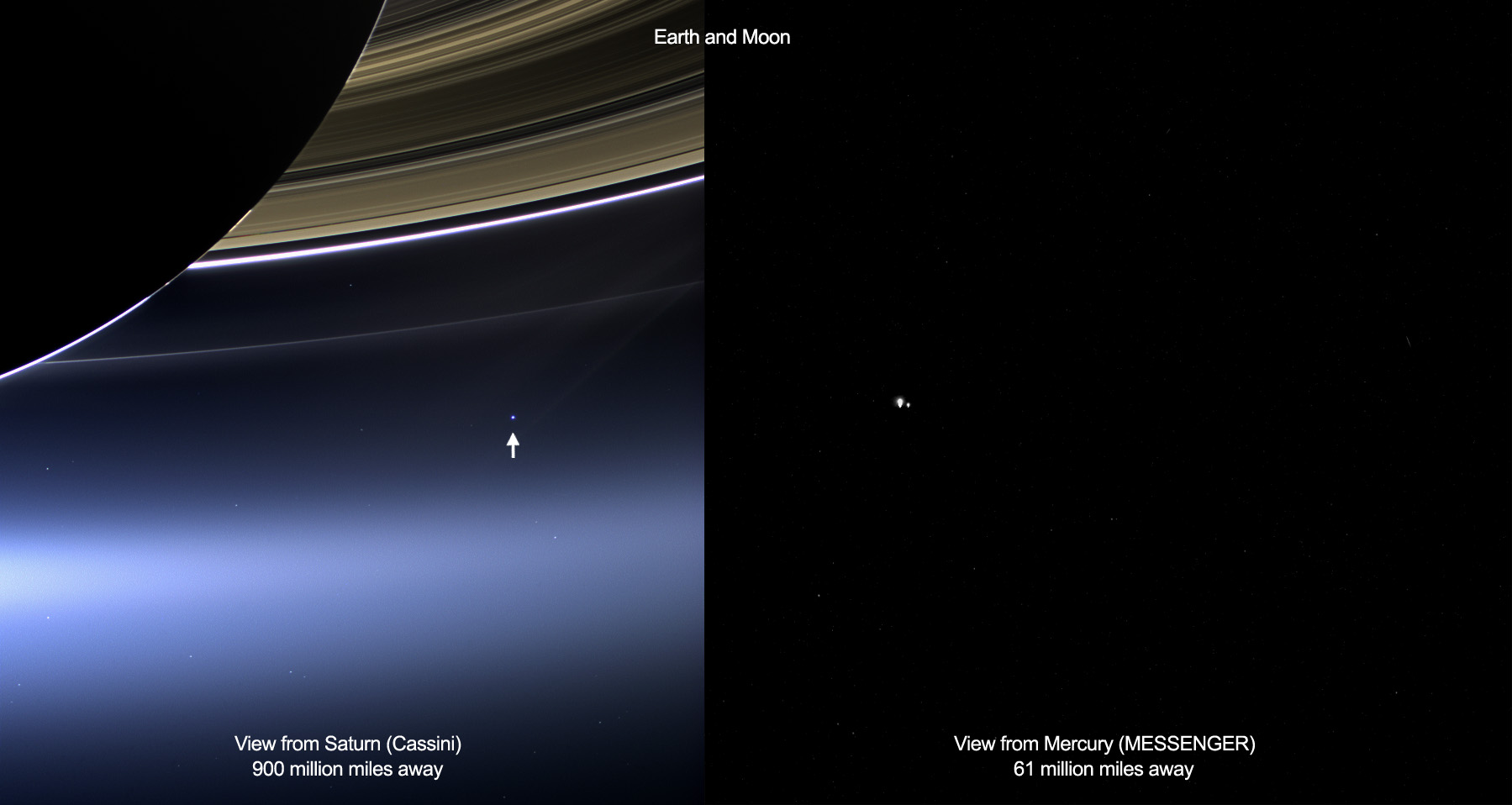
Here is the Earth with the Moon (not really discernible) as seen from the Cassini spacecraft, which is orbiting Saturn, taken on July 19, 2013. Earth is 898 million miles away. Above, of course, are the rings of Saturn.

I have always marveled what it would be like to “fly in the rings of Saturn.” Of course, that’s not easily done. The rings are actually pure ice fragments, some the size of dust and snowflakes, some the size of small cars, a few meters across, all orbiting the planet at orbital speeds.

Ring Material
[photocredit Wikipedia – click for original document]

The above image is an artist’s conception of what floating in the ring might be like.

This means that any craft actually flying “through” the ring would get smashed to pieces by particles slamming into it at orbital speeds. Unless, of course, the spacecraft were able to match the orbit of the rings in direction and speed and approached slowly into the plane of the rings. That would be a dramatic and exciting view, as the craft slowly descended onto the largest flat plane in the solar system.

Thinking about it, the earth is not flat, it’s curved, so even looking out over the seemingly flat plane of the Pacific ocean from the California coast, we’re actually looking at a curved surface. There are very few really flat planes in our world. Yet, the rings of Saturn, with a surface area many hundreds of times as large as that of the entire earth, are completely flat. Looking at such a large flat surface, and approaching it slowly from above or below, without any atmospheric disturbance or clouding, must be otherworldly, literally.

Then, getting really close and starting to resolve the solid plane into many individual ice boulders, pebbles, snowballs and ice crystals, and then finally floating among them, becoming for the moment part of the rings, would be an incredible experience.

Matching orbits with the ring’s structure is not trivial. The speed of particles of the inner ring is about 23.6 km/sec, and those of the outer ring 16.3 km/sec. For comparison, the speed of the International Space Station circling the Earth is 7.7 km/sec. We’re dealing with orbital speeds of twice to three times those of low-earth orbit. It would require a lot of fuel to accelerate a spacecraft to that speed to match orbits in order to dip down into the rings, something not likely to launch any time soon, but I get to dream, don’t I? Sometime in the next few hundred years, a space traveler surely will get to do that. I would like to be that space traveler.

Dreaming about just that, I found that there will be a movie for IMAX titled In Saturn’s Rings coming out in 2014, made exclusively by putting together more than a million individual actual photographs by Cassini, the Hubble Space Telescope, Apollo missions and others. Check out this amazing trailer. I am going to line up for tickets when it’s out.