Book Review: A Door Into Time – by Shawn Inmon

A Door Into Time – an Alex Hawk Time Travel Adventure

Alex Hawk is an ex-United States Special Forces soldier. He is divorced and lives alone in a house in Central Oregon. His 4-year-old daughter Amy lives with her mother nearby, but Alex has been an unreliable father, missing too many of Amy’s special life events.

One day he notices an anomaly in his basement. He pulls down some wood paneling, only to discover a brick wall. He breaks through the brick wall only to find another brick wall. Once he breaks that down, he finds a letter of warning from the previous owner of the house, next to a black outline of a door, a portal.

After gathering some survival gear into his backpack, he takes a few weapons, including a hunting rifle, and steps through the portal just to check it out. The world he finds himself in is vastly different from what he came from in Oregon. A flock of giant aviary creatures attacks him and wounds him. Then a group of human warriors rescues him from the attacking beasts, but they don’t let him return to the portal. They take him away as a prisoner.

Will Alex ever make it back home?

Minor Spoiler Alert

The portal in Alex’s basement leads into a human world in the far, far future, so far indeed that all traces of human civilization have been erased. There is no more technology. Humans are just individual, loosely connected tribes with stone-age weapons. The most advanced weapon is bow and arrow. There is no technology whatsoever.

Alex is taken prisoner and eventually adapts to their way of life. After stepping through the portal a few pages into the book, he never comes back, and the entire story plays in that ultra-future stone age world, where Alex makes his life as a warrior of the tribe. He spends years with them and becomes a general in their wars.

There are some plot holes, though. Think of it, a guy lives alone in his house and one day disappears. Years go by and nobody seems to investigate and follow him? There is a gaping hole in his basement with a door to another world, and nobody finds it and sends law enforcement through it? I was hoping that there would be some resolution at the end.

This is NOT a time travel book. I found it by searching for time travel, and it has the words “time travel” in the subtitle, but it’s really an alternate history / fantasy /adventure novel that plays in an imaginary human stone age environment. The premise is: How would a modern human, albeit with special forces training, fare in a stone age society?

If you’re interested in that, this book will work for you. If you’re looking for science fiction or time travel, stop right here. It’s neither.

I enjoyed reading the story, I wanted to know how the hero would do, and especially how he would get back home. But I didn’t get what I was looking for.

It turns out, this is the first book of seven in this series, and the end is abrupt and completely unsatisfying, simply to set up for book number two.

The book reminded me of Stephen King’s Fairy Tale. A kid goes through a portal in a shed in his yard and ends up in another world. But he comes back in the end, and the story is done.

The story also reminded me of the Sterling books starting with Island in the Sea of Time. The premise there is that an entire ship is transported 3,000 years into the past. Not quite the “future” stone age as here, but the bronze age in human history.

Since I don’t have time to spend seven more books’ worth of reading just to find out how Alex makes it home, I decided to stop right there. I am not sufficiently interested in the stone age world and its politics to spend more time in it.


Worldwide Waste of Food

I have written several posts in 2015 with the subject of waste of food. Here are links to both of them:

Worldwide Waste of Food

Child Hunger and Banquet Food Waste

Today I received an email from a reader who works on a university project about world hunger, who asked me to attach this information to my posts.

You can find that information at this link: World Hunger Facts and Statistics as well as at the bottom of the two other posts.

It has been eight years since I wrote these posts, and things have not gotten better. Due to impending climate disaster, there will be millions of climate refugees searching for “higher ground” and there will be crop failures all around the world which will exacerbate hunger. I welcome the research, the activism and the initiative of the new generation and university projects like the one my reader quoted. She took the time to search old posts and contact the writers – that takes work, and I applaud it.

Thank you, Debbie.

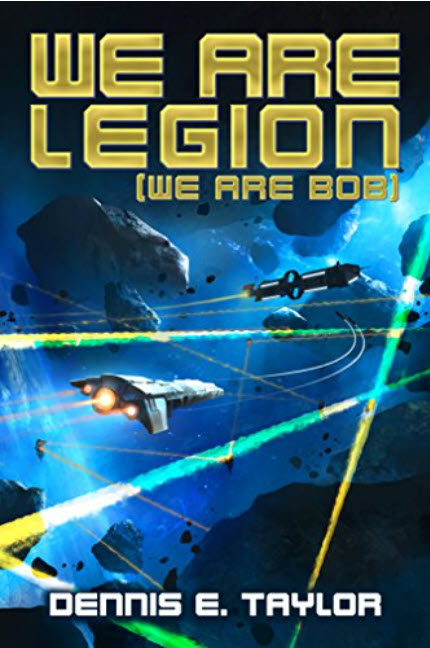
Book Review: We Are Legion (We Are Bob) – by Dennis E. Taylor

A  long time ago in a galaxy far, far away, I was a young computer programmer. My work was programming machines using what we called assembly language, which is basically working on the chip level. To program the machines, I had to burn EPROMS (chips) that I then plugged into circuit boards before I could run the program on a machine. Needless to say, I learned a lot about computers and particularly peripheral devices that are connected to computers, like actuators, sensors and motors that would actually make the machines move and do something useful.

During that time, I was also very interested in artificial intelligence. This was 40 years ago, and things were very rudimentary. I used to tell my associates that one day I’d be able to upload my consciousness into a computer and become independent of my body. I would be a machine who is conscious. Of course, I said I’d not want to just be some industrial robot, like the ones I was working on, but I’d want to be a spaceship. With weapons. I could just feel my ray guns itch.

I was also an avid science fiction reader, and I knew about von Neumann probes. 

A von Neuman probe is a self-replicating spacecraft without humans. It leaves the earth, spends decades or even centuries traveling to other stars, where it searches for raw materials and resources to build another copy of itself. Each copy then does the same thing. After a few centuries, the galaxy would be full of its clones.

Von Neuman is an interesting figure in his own right. Read up on him here. Sadly, he died in 1957 at the age of 53. He was a child prodigy. From Wikipedia:

Von Neumann was a child prodigy. When he was six years old, he could divide two eight-digit numbers in his head and could converse in Ancient Greek. When the six-year-old von Neumann caught his mother staring aimlessly, he asked her, “What are you calculating?”

When they were young, von Neumann, his brothers and his cousins were instructed by governesses. Von Neumann’s father believed that knowledge of languages other than their native Hungarian was essential, so the children were tutored in English, French, German and Italian. By the age of eight, von Neumann was familiar with differential and integral calculus, and by twelve he had read and understood Borel’s Théorie des Fonctions.

Now let’s get to the book We Are Legion (We Are Bob).

Bob Johansson is a software entrepreneur in our time. He has just sold his software company, he is wealthy, and he is just starting to look forward to a life of leisure. He signs up with a cryogenics company which, upon his death, will deep freeze his head, with his brain and presumably his consciousness, until sometime in the future when technology is far enough along that his mind can be loaded into a machine.  As (bad) luck would have it, as soon as the contract is signed he is hit by a car crossing a road. The world goes dark and he dies.

He snaps into consciousness in the year 2133. It’s a very different world from the one he knows. The United States, as we know it, no longer exists. The religious right had won several elections, the country went through an economic meltdown, and eventually a theocracy arose as the leading power in what used to be the United States. Also, the world political situation was drastically different, with a Eurasian block, the Chinese, Australia, and a Brazilian militaristic power.

Bob finds himself a replicant, which is a consciousness without a body, basically a computer program. He can be turned on or off from the outside and he can be backed up and copied. He is destined to be sent off into space in a von Neumann probe to explore other star systems.

While political unrest escalates on earth, he barely gets away before disaster strikes and a nuclear exchange decimates the people of earth. Bob reaches another star system and starts making copies of himself.

This book explores the feasibility of von Neumann probes, and it speculates on what the world would be like from the perspective of a human being who is completely disembodied and exists only as a computer program.

This is a debut novel and as such well-written and paced. There are none of the annoying problems we often encounter in debut novels, like poor writing, grammatical and spelling errors, and the like. The author must have used a good editor to make sure the book is clean of such distractions. The character development is a bit awkward, and the dialog sometimes stilted. But the subject matter kept me – obviously – interested and I wanted to find out what would happen next.

There was no ending. The book stopped virtually mid-paragraph. While this is a series of four books, and the author thinks of them as one story, he should have done a better job of finishing up book one for those who will only read it. But he didn’t even make an attempt of that.

While I enjoyed the book, I think I have absorbed the main concepts of human intelligence embedded in space ships. The rest is now just drama and more politics, and I can do without. So I won’t be reading the rest of the series.


Minor Spoiler Alert

The author chooses to make one of the factions of villains the leaders of the theocracy in the former United States. He portrays them as zealous, stupid, cunning and manipulative. Obviously, the author is an atheist and he does not have much respect for Christianity or religion as a whole. When I read some of the 1-star reviews on Amazon, it became apparent that he pissed off many religious people who took the book as an assault on them, their values and of course their religion. Some called it a diatribe, a left-wing assault on the country, and the like.

I didn’t see any of that when I read the book, but then, of course, I am not religious and I don’t make any effort to place myself into the shoes of religious people. I certainly think that theocracies are terrible for humanity as a whole, and I don’t have any praise for Christianity.

When it comes down to it, the author could have left all this theocracy stuff out. It didn’t really matter much in the plot, since Bob freed himself early on from the shackles his masters tried to put him into, and for the rest of the plot, Christianity had no valid active role. The way I see it, the author drew the ire of a large part of the population of the country, and therefore potential readers, by presumably ridiculing them and their beliefs, when he could have achieved the very same plot and story and message without doing that. Any other regime would have worked just as well.

Maybe his critics are right, maybe he did want to spread his message and agenda with this novel, but I think it backfired.

We turn to science fiction to let our minds reach, to experience wonder and awe, and for entertainment. We don’t turn to science fiction to get political rants or religious or anti-religious doctrine.

So, if you are a Christian, you might not like this book, and you best leave it be.

Movie Review: The Vanishing (2018)

In December of 1900, three lighthouse keepers stationed on Flannan Isle off the coast of Scottland disappeared without a trace. They were never heard of again. The authorities found a diary entry logged by the keepers where they write about a terrible weather as the one they have never seen in 20 years at sea. It is interesting to note that the general weather reports at the time indicated that the weather was fine and calmed. Nobody knows what happened to the three men.

The movie The Vanishing is a thriller based on what might have happened. We witness what their lives were like on the island during their shift, and how they got along with each other. One day, while making the rounds on the island, they discover what appears to be the wreck of a lifeboat in a crag. They lower the youngest and lightest of them down with a rope to investigate. He finds what appears to be a dead body, along with the crashed boat and a sea chest.

The body, as it turns out, was not dead. This sets off a series of events the men could not have anticipated. Quickly they find themselves in a quagmire of conflicting emotions. Lack of judgement, kneejerk reactions, and simple greed escalate their situation where soon they see no way out.

The Vanishing is a well-structured thriller with simple photography and virtually no sound track. I became part of the set and experienced the isolation, the cold, and the monotony of the life of the keepers. It made me think about the human experience under drastic and unbearable conditions.


Hiking Bottle Peak in Escondido, California

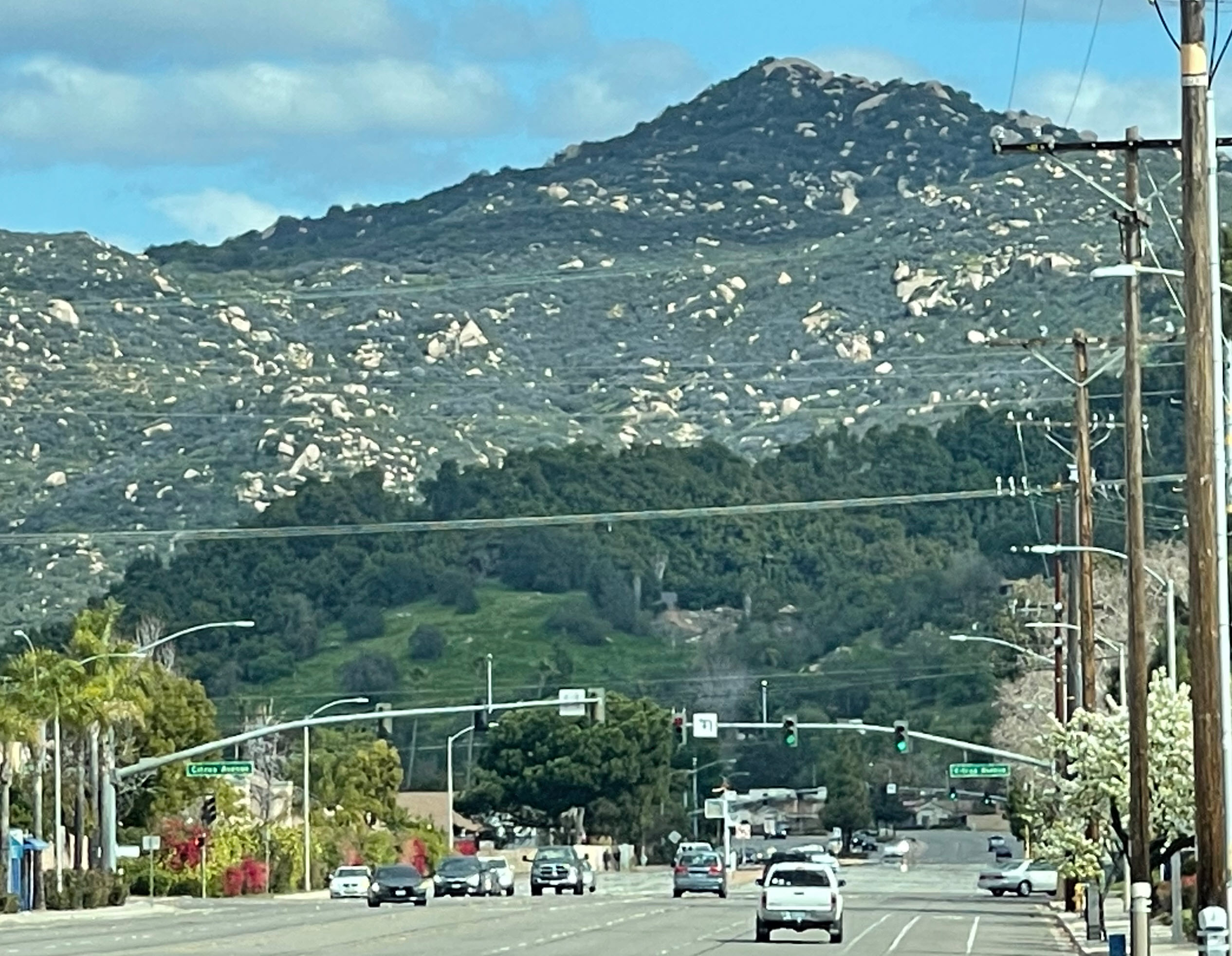
Bottle Peak is the mountain that towers over the end of East Valley Parkway, which is a long, straight and busy road in eastern Escondido. I have seen that mountain there for decades, and I have always wanted to climb it. I finally did it last Sunday, Superbowl morning.

It looks simple enough. It’s not far away. Here is another photo taken from closer to the end of Valley Parkway:
You’d think there are busy hiking trails and scores of hikers who climb that mountain every day, and particularly on the weekends, sort of like Iron Mountain in Poway. But no, it’s actually almost impossible to find the trail. I googled and found a few hiker blogs who had been there, and I checked their instructions and maps. I did an exploratory drive almost around the mountain and found nothing but locked gates and no access to the various roads.

Here is one blog post:

Iron Hiker: Bottle Peak

Here is another one that was more helpful to me:

Bottle Peak, Tombstone Peak | Nate’s Hiking Blog (natehikes.blogspot.com)

A couple of weeks earlier I actually used Nate’s map in his blog and tried to find the trail starting at Lake Wohlford Road. I had his map and his pictures, and I scrambled around in the impenetrable thickets on that slope for an hour and I could NOT find the trail. I gave up.

For this hike, I went over to Oakdale Road to find the beginning of the alternate and shorter route he describes. When I got there, I found a locked gate and No Trespassing sign. This didn’t look like something I should mess with.

About a hundred feet up the road towards the west from the gate I found a little access trail, but again a No Trespassing sign. I respect private property, so I thought I should not enter there either.

Disappointed, I went back to the beginning of Oakdale Road, about a quarter of a mile, right by Lake Wohlford Dam and found a creek I could climb up in. I parked my car in a small dirt pullout by the creek. No signs here.

And up the creek bed I went for 5 or 10 minutes of heavy scrambling. Sometimes I needed to pull myself up on tree roots. This is definitely not the intended trail, but I didn’t technically “trespass,” right?

The creek reached the access road that started down by the gate, and I proceeded up that. Oh, well, trespassing again. And here the journey starts. Below is my map and you can see that it was not trivial for me to find the actual trail. I marked the gate for you where I should have started at the Private Property sign, because, as you might see, that’s how I hiked back out. My start route up the creek ended up simply meeting that private road.

Then you can see several false starts. I first missed the trail head up the mountain and I turned around. Once on the trail, I also missed the main trail and went on a left fork which fizzled into nothing and a pile of trash. Eventually I found the right trail to the peak.

Heading up the road there is a large boulder with graffiti on your left. That’s a landmark.

Shortly after that, I got to a ridge, a highpoint on this road, with a rusty remnant of a gate. The actual trail up the mountain starts at a clearing on the left just 50 yards beyond the rusty gate.

The first time I got there I missed the trail and soon reached this sign:

See the first box: No Trespassing.

There are lots of access roads and a lot of neat peaks to climb up there, as Nate describes in his blog. But to get there, I had to trespass. They definitely don’t want any hikers up there. I think I need to call the information number shown on the sign and find out what’s up with all the rules.

Important however: if you try to climb the mountain and you get to this sign, you have gone too far and you need to turn around.

This is the spot where the trail starts, heading due east up the mountain.

I took a waypoint to save any hikers the hour I tooled around before I found it. Here it is: N 33.16461 W 117.00577, Elevation 1643 ft.

A few steps along the trail there is a little footbridge, which I found odd in such a desolate area.

As I told when I showed the map above, I made a left turn at a Y which turned out to be wrong. I went up a fairly overgrown trail and there was lots of old trash. This is a car door with bullet holes in it. Who takes a car door up a mountain trail just to shoot at it? From the looks, it’s probably been there for 60 years.

Finally the trail fizzled out completely and I could go no further. That’s where I found this. Who carries buckets stuff up a mountain and then leaves it all there? What’s the point?

I suspect this was at one time a camp of undocumented migrants. I can’t think of any other explanation why somebody would carry cans and jars and blankets and all kinds of other plastic trash way up on this remote trail. I could have filled a dump truck with various trash just on this little side trail.

Sad.

Finally I found the actual trail and it didn’t take me long to make it up the remaining 500 vertical feet to the peak. This photograph is near the peak. The boulders are huge.

Looking back, there was a good view of Tombstone peak on the left and Stanley Peak on the right. I have written about hiking Stanley Peak here.

Finally, the peak. There is a huge granite slab at the peak. The blue arrow points to the top, marked by a concrete platform that used to be the base of a lookout tower. Nothing but the slab remains. I left my poles at the base and scrambled up.

This is what’s called a Class 3 scramble: Moderate scrambling on steep, rocky terrain that requires handholds for upward movement and safety.

My hiking boots have good tread, but I needed my hands to pull myself up. I made use of the sturdy oak trees on the left side to pull myself up the first 6 feet, which was the steepest and most slippery. After I got past the tree, I just crawled up like a turtle until I got to the ridge, and then I walked the remaining 10 yards to the right to the top.

My 66-year-old self is not the same rock climber I was in my twenties, so I was quite proud of myself. But I was a bit nervous, because I was alone, and all it would take is a little slip of the foot….

I did come down on my butt, very slowly, and I would certainly do it again. It was worth it.

The view from the top is 360 degrees and priceless. I could see the Pacific in the far distance. The arrow points to Valley Parkway in Escondido, where the first picture in this post was taken.

Here is the same view in a full-sized format, so you can click on the picture and enlarge it.

I don’t have an exact mileage and altitude profile I can share, since I made so many little side trips finding the correct trail. I am baffled by how difficult it is to get there. I was out there for about two and a half hours and I did not see another soul. This was a Sunday morning, and nobody was on that mountain. It seems like a waste of nature, so close to the city, yet so far away from access.

I will find out from the Department of Parks and Recreation what the deal is and I’ll post this when I know.

All I can say is: I finally hiked Bottle Peak.

Disclaimer: I told you here that I had to go through several No Trespassing areas to get to this peak. I am not telling you that you should do that, too. However, I have not found any way up this mountain without trespassing – yet. 


Movie Review: A Man Called Otto (2022)

In March of 2021 I watched a movie titled A Man Called Ove. It was a 2015 movie in Swedish, with English subtitles. I gave it four stars. Here is my review. 

One of my readers at the time commented that there was a Tom Hanks adaptation on the way, and here it is.

This review is difficult to write because I could just copy the Ove review here. It follows the script that closely.

Otto (Tom Hanks) is 59 years old and lives alone in a housing development somewhere in the northern United States, judging from the snow. He loses his job by a forced retirement program. His wife passed away from cancer six months before. He grieves badly and visits her grave every day. He has no relatives or children. He is the self-appointed master of the condominium association of his little community. He does not care about the official roles, and he rules with an iron fist. Daily rounds include checking whether the garbage recycling is done correctly and whether gates remain closed. Driving of any type in the community is forbidden, and leaving a bicycle out is a serious infraction. He is a true curmudgeon and the essence of a grumpy old man.

One day new neighbors move in across the street from his place. Marisol (Mariana Treviño) is from Mexico.  She has two young daughters,  and is pregnant with her next. Her husband is the opposite of handy and has difficulty even driving a car. Otto has them in his sights immediately.

Otto is seriously depressed and he attempts suicide several times in the movie, only to be interrupted by Marisol and her family. An unlikely friendship develops, and gradually he gets drawn back into a semblance of purpose.

A Man Called Otto incorporates many flashbacks to when Otto was young and his romance with his wife Sonya (Rachel Keller). Interestingly, the actor playing young Otto is Truman Hanks, Tom Hanks’ 27-year-old son.

A Man Called Otto is a well-crafted film about an ordinary man’s life from young adulthood to retirement. While I gave Ove four stars, I am giving Otto “only” three. It is a little awkward from time to time where Ove was nothing but authentic. But it’s a good movie, it draws out a tear or two, and it made me think of “the circle of life.”

You should go and see it.