Category: Sustainability
Power Brown-Outs and Gas Prices
I remember clearly traveling in Northern California in May of 2000. I was driving through Glenn County and stopped for breakfast in a country restaurant off I-5. The table-cloth was red and white checkered, like Arafat’s headdress, my coffee was hot, and the omelet tasted great. I was reading the morning paper. Then the lights went out.
There was enough sunlight coming through the windows that I could finish my meal and my coffee, pay in cash – the register didn’t work, and leave.
In the most industrialized nation in the world, in the largest and most progressive state of that nation, California, we didn’t have the infrastructure in place to keep the power on? We were told, by the media, by the Bush administration, by the California government, that we simply had a power distribution problem. We were using too much power. Prices had been going up. Our electricity bills in San Diego had more than doubled. We were asked to conserve, not run air conditioners, turn off the lights, and “sacrifice for our country.”
Then, in the fall of 2001, Enron collapsed, and we found out that there were a bunch of traders who called themselves “the smartest guys in the room” who had been laughing about all of us idiot consumers in California, all the way to the bank. What they did was at a minimum “market manipulation,” but really, as we dug deeper, we found out that they had committed fraud on a massive scale.
Now our gas prices are way out of proportion with the market. Our demand for oil has gone down, due to electric cars and many other conservation measures. We have more oil than we can use right now. The price is not up because we don’t have enough, so supply and demand is not the problem. Our politicians agree that market manipulation is taking place. Even the head of Exxon Mobil, the largest oil company, states that based on a pure economic approach the price of a barrel of oil should be in the $60 range. Yet today, crude oil runs $104. Why is that?
Like Enron controlled electricity and its delivery, and purposely shut down power plants for no obvious reason just to create hardship for millions of residents in the Western United States, speculators are currently manipulating the oil market. How do they do that? They buy massive amounts of oil – which they don’t need and don’t ever even touch, just to keep if off the market. They wait until the price is up, and they sell it for a profit. Clearly, they are making money out of thin air, and essentially pulling the dollars out of the pockets of consumers filling up their tanks all over this country.
The question is, is this activity illegal? If it is not, it should be, just like price-fixing, abuse of monopoly power, collusion of contractors, kickbacks, bribery and all the racketeering we have learned about is illegal.
Some people say that not starting to build a pipeline that will eventually ship gas from Canada to the U.S. causes gas prices to be up right now. A pipeline that would be completed many years from now. A pipeline that would contribute a very small percentage of our consumption.
Ludicrous.
Remember Enron.
Upcycling
Upcycling – What a Cool Idea! Here is a whole blog associated with this concept!
Here is an old chair Devin painted and gave us a couple of Christmases ago:

Book Review: The Monkey Wrench Gang – by Edward Abbey

The Monkey Wrench Gang is a classic book by Edward Abbey, his most famous novel, published in 1975. Even though I had heard about the book over the years, I had never read it, never actually seriously considered it. It took Devin, who is doing environmental work in Arizona in the Coconino Rural Environment Corps, recommending Abbey to me, and then a texted reminder a few days ago, to finally get me cranking. Once I started, I could not stop and I read the book within a few days.
The story deals with environmental activism and sabotage to protect the American Southwest from runaway industrialization, particularly in the “four corners” area, the connection of Utah, Arizona, New Mexico and Colorado.
Through the popularity of this book the term monkey wrench came to mean, besides sabotage to machinery, any sabotage, activism and illegal activity to preserve wilderness, ecosystems and nature in general. If you are interested in the origin of the term monkey wrench, you can check Wikipedia here.
Abbey has a unique writing style, using chopped off sentences, quick exclamations, no unnecessary adjectives, that takes some getting used to.
The book starts:
When a new bridge between two sovereign states of the United States has been completed, it is time for speech. For flags, bands and electronically amplified techno-industrial rhetoric. For the public address.
The people are waiting. The bridge, bedecked with bunting, streamers and Day-Glo banners, is ready. All wait for the official opening, the final oration, the slash of ribbon, the advancing limousines. No matter that in actual fact the bridge has already known heavy commercial use for six months.
Long files of automobiles stand at the approaches, strung out for a mile to the north and south and monitored by state police on motorcycles, sullen, heavy men creaking with leather, stiff in riot helmet, badge, gun, Mace, club, radio. The proud tough sensitive flunkies of the rich and powerful. Armed and dangerous.
Reading the first few pages I almost abandoned the book, until, all of a sudden, the quick style grew on me.
An unlikely quartet forms during a ride down the Colorado river through the Grand Canyon.
- Doc is a general surgeon who works in Albuquerque, approaching fifty, widowed, burned out but with a fire in his belly for activism and the money to fund it.
- Bonnie Abbzug, a 28-year-old sexpot with an attitude who sleeps with Doc but is not quite sure why.
- Seldom Seen Smith is a Utah Mormon. He has three wives, who live apart by a day’s drive each, that he cycles through. They gave him the name Seldom Seen and you can figure out why. He is also an outfitter and wilderness guide.
- George Hayduke is a green beret, a Vietnam combat veteran and prisoner of war, a hard ass and a complete psychopath. An uncontrollable destruction machine.
The four form a bond of friendship based on a mission to “protect” the land. They start out cutting fuel lines in bulldozers and pouring sand in their gas tanks. It does not take long before they figure out that they can wreak more havoc by simply driving the bulldozers off cliffs into canyons. It gets more dangerous with every mission.
It’s also a comedy, and there are plenty of times when I laughed out loud. For example:
Second, for relaxation, Doc performed a hemorrhoidectomy, a simple operation – like coring an apple – that he always enjoyed, especially when his patient was the red-necked white-assed blue-nosed persecutor of topless dancers W. W. Dingledine (not the W. W. Dingledine? aye, the same!), District Attorney of Bernal County, New Mexico. Doc’s fee for the ten-minute rectal reaming would be, in this case, a flat $500. Exorbitant? Of course; of course it was exorbitant; but, well, the D.A. had been warned: Prosecutors will be violated.
Note the 1975 prices for surgery, $500. In another place in the book it lists the price of a gallon of regular gas at 49 cents, which seemed high to them when having to drive the immense distances in the Southwest.
I really enjoyed reading this and now, finally, after forgetting and forgetting and forgetting to sign up, I am making the reservations for Devin and me to hike the Grand Canyon North to South Rim this summer. Motivated!
Rating: ***
Secretary of Energy on Lower Gas Prices
Forget lower gas prices. Our Secretary of Energy does not really want them lower.
We’ll all have to put Nutella into our gas tanks soon. And stop taking showers.
NakedDC does a nice job outlining our gas future based on Barack Obama and Steven Chu.
Supply of Fossil Fuels
The most common fossil fuels we are using are oil, coal and natural gas. We started using them in earnest about 125 years ago, when combustion engines were invented. Of course, it started small and gradually increased, and today we are burning more fossil fuels than ever.
Estimates range widely on how much we have left. Some experts say there is only a 30 year supply of oil left. Others peg it at about 100 years. For the sake of making this simple, let’s say we have only used up half of all the fossil fuels in the world by now, and to make it even simpler, let’s say that our use is the same daily, from 125 years ago to 125 years in the future.
This would mean that mankind is using up all of coal, gas and oil on earth over a 250 year span.
It took nature to create this fossil fuel 450 million years. 250 years has 91,250 days.
Roughly every day we are using up as much fuel as it took nature 5,000 years to create. 5,000 years ago is about the time the pyramids were built. All the composting of wood and all other organic matter since then has made enough oil for a single day’s use.
I am writing this in the cabin of a jet plane on my way to an important meeting.
Re-Inventing the Wheel
Re-inventing the wheel must be one of the most overused and trite expressions of the English language. The wheel is what we associate with technology, that incredible power that makes our lives easier and more comfortable. After every hike, when I finally get back to the trailhead and take off my boots, slip into my sandals, back and legs stiff, feet aching, I invariably sit down in my car, turn the ignition, throw the car into gear and roll away effortlessly. On wheels. Ah, that’s how man was meant to travel!
We forget that our entire technological world is built on infrastructure. Even something as simple as a wheel would not work without infrastructure, without a road, or at least a path, and without some power, be it an engine, a horse, an ox, or a human in front of a rickshaw. GPS would not work without satellites. Cell phones would not work without cell towers, cars would not work without gasoline, which must be refined from oil, which must be transported from far-away places, which must be pumped out of the ground. Infrastructure.
I sometimes speculate what would happen if I were suddenly time-warped into the distant past, say into the stone age about 30,000 years ago, a time before the wheel had been invented. 30,000 years ago humans made stone axes. For thousands of years sharp stones were the ultimate and most advanced technology on earth. Finding myself there with nothing but my brains and my hands and not even the clothes on my back, what would all my knowledge and education get me?
I know how to program computers. I know how an internal combustion engine works. I know how fire works. I understand what a lever is, and I know about the wheel. Would I be able to make a wheel, knowing it has been invented? Could I build a wheel with my bare hands, with rocks, wood branches and reeds? How long would it take me, with all my knowledge and skills, to build a wheelbarrow from the elements, if I could not go down to Home Depot, where they have the infrastructure, and get the necessary parts, fittings, bolts and tools? It would probably take me the better part of a year and it would not be much of a wheelbarrow, assuming I survived long enough.
What if I got an infection? I’d know all I needed was antibiotics. I know, in principle, how they work. But could I make antibiotics? Penicillin was invented accidentally when bread mold stopped bacterial growth in a petri dish. Could I cure myself eating bread mold? How much would I need? And how would I manufacture bread mold without bread? The fact is, despite all my knowledge and understanding about health and medicine, I could die of the first bacterial infection I contacted.
Ruminations like these make me aware of how fragile our society is and how dependent it is on infrastructure. Disrupting any of the elements that feed that infrastructure would cause rapid breakdown of the entire technological chain and result in quick collapse. Of all the knowledge in the world, the most valuable skills would be medicine, pharmacy and most importantly, how to make the medicines from herbs, chemistry, some rudimentary physics, farming and gardening, hunting and trapping, and perhaps skills of breaking in a wild horse.
Anyone feel like re-inventing the wheel?
Wall Street Protests

While visiting New York City last week, we went down to Wall Street and checked on the ongoing protests.
There were, at that time, hundreds of people gathered, braving rain squalls, camping out in the park and on side walks, holding up hand-written signs, chanting, conducting drum circles, giving speeches, all against Wall Street greed and the establishment allowing it.
There were also hundreds of police, with barricades blocking access to buildings on Wall Street itself. Police had been arresting people, only to let them go again, so they would participate the next day. This has been gathering momentum.
I enjoyed milling about for a while, taking pictures, and listening to speakers.
However, I wonder where this can go? It’s not the anti-war demonstrations against the Vietnam War in the sixties, where the target was one person, Richard Nixon, who had the power to make a difference. You cannot protest against an entire establishment, our banking system, our financial system, free market enterprise and the way Wall Street works. This isn’t going to change if a million people flood lower Manhattan.
I predict it will stop as soon as it gets cold enough so camping out will no longer be possible. It has to fizzle. I see no focus.
Meanwhile, I have respect for people who are dedicated enough to participate for a cause they believe in.


Stephen Mather – Father of the National Parks
There is an excellent article in the Fall 2011 issue of National Parks, the magazine of the National Parks Conservation Association, by Kate Siber, titled The Visionaries.

An excerpt:
During Mather’s wanderings in the mountains, he encountered the famous naturalist John Muir, who spoke of grave threats to the wilderness. In 1914, two years later, Mather was so inspired by Muir’s devotion and horrified by the persistence of loggers eyeing the sequoias of Yosemite that he sent an indignant 26-page missive to Franklin K. Lane, the secretary of the Interior and fellow Berkeley alumnus, detailing the sorry state of the national parks. Lane famously responded with one sentence:
“Dear Steve, If you don’t like the way the national parks are being run, come on down to Washington and run them yourself.”
Outsourcing
Try and buy a T-shirt at Sears that is not made in China.
Try and buy ANYTHING at Wal-Mart that is not made in China.
Go to REI and check out their clothing. It’s made in China.
We don’t make anything anymore in America. Ok, we make airplanes, but Airbus is kicking our butts. We make cars, but Toyota and Hyundai and a dozen other companies are kicking our butts. We make software, some, anyway. But we don’t make enough.
I listened to David Zach, a futurist, recently, at a conference. He said we are outsourcing three things in this country:
- Baby boomers never want to pay full retail for anything, so in effect we are outsourcing our future.
- We outsource our labor issues.
- We outsource our pollution.
And we pay dearly for it. But much more dearly than we, our children will pay for it. Their American Dream is going to be much more difficult to achieve than ours was.
Where is mine?
All My Books
Over a lifetime, I have collected books, stored them, sold many in garage sales, given many away, donated books to libraries. Usually I have not had anywhere near enough room in the house for bookshelves to keep them all. I’d need a small library. I don’t know how many there are left. I’d have to count them. Here are the boxes in the garage that contain those books that I have considered worth keeping in 40 years of collecting and that are not on my shelves in the house now:
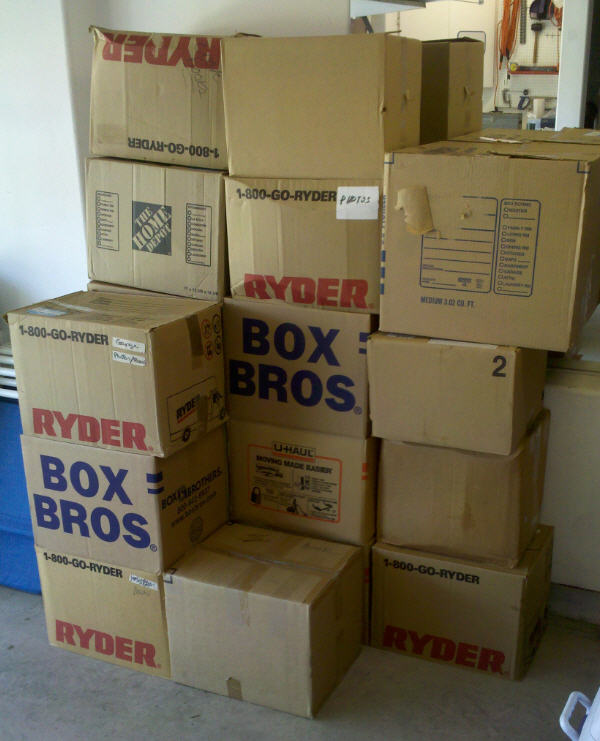
And here are all the 45 new books that I have bought and read since January 2010.

I have all of them with me all the time. I carried them to the bottom of the Grand Canyon, and more importantly, back up. I took them all with me on my trip into the Emigrant Wilderness.
When we last moved, the boxes took major lifting but the books in the Kindle got moved and I didn’t even notice.
All that is good.
Except, what do I do when Amazon, one day, goes out of business?
The Tortoise Stops the Power Plant
The article in Forbes Magazine of June 27, 2011, titled Spot the Tortoise discusses the plans for the Ivanpah Solar Electric Generating System, the first large-scale solar thermal power plant project to be built in the United States in 20 years.

The green spot on the right upper side of the image is a golf course. To the right of it, you can’t quite see it here, would be I-15, and in the distance, about 40 miles away, in the right upper corner of the image would be Las Vegas. When you drive from the Southern California to Las Vegas you drive right by this project. Have you ever noticed it?
There is endless Mojave Desert along this stretch of freeway. If you stop your car and walk a few paces into the desert, it becomes quiet and seemingly completely dead. Other than an occasional insect, you will probably not see a creature stir, not even a mouse. Yet, we know that the desert is the home of millions of desert critters, little rodents, spiders, tarantulas, rattle snakes, turtles, coyotes, all kinds of birds, and billions of insects. They all live there.
The 370 megawatt Ivanpah Power Plant, heralded as the harbinger of a clean, green energy future, is imperiled by a tortoise. Years of surveys during the planning estimated that there would be at most 32 of the iconic animals roaming the 5.6 square mile site. Now construction has been temporarily halted until a new environmental review can be completed, since government biologists now predict that there will be between 86 and 162 adult tortoises and 608 juveniles on the site.
I am a member of the Nature Conservancy. I pack every scrap of trash out of miles of wilderness. I believe strongly in our national park system and in the protection of nature. I have strong opinions on oil drilling, logging, air pollution and protection of endangered species.
Yet I think this is insane!
If the 162 adult tortoises don’t like it under the mirrors, they can amble right out of the bright lights and into the desert, which stretches for hundreds of miles in all directions. Next to the 5.6 square miles of the power plant are thousands of square miles of desert habitat, with lots of the tortoises’ cousins living on them, at an approximate population density of 162 adults per 5.6 square mile. Yes, young tortoises suffer a high mortality rate and may not begin reproducing until age 25. Yes, some of the juveniles may not make it away from the concrete trucks.
If we cannot build a power plant in the endless, forsaken, empty, seemingly dead, vast, hot, uninhabitable Mojave Desert because of 162 animals, we might as well give up. There is not a square foot left in the entire United States where we can build an outhouse lest we destroy the habitat of some worm. Let’s just stop building altogether.
30 years from now we will import all fossil fuels, if the earth still has any left, from Canada, Mexico, South America and the Middle East. All our nuclear powerplants will be decommissioned, and since building a nuclear plant takes 10 to 20 years, we won’t have time to build any, and we won’t have any expertise. We’ll have to hire French and Chinese firms to come in and build them for us. We won’t have solar plants because there are tortoises, snakes and tarantulas that need to procreate on those sites. I hope Hoover Dam keeps churning out hydroelectric power for many years to go.
Sustainable, renewable and clean energy appears impossible to create and maintain in our country. I think I had better start building a stable for the horse and buggy, and a shed for firewood.
Phonebook Recycling

Regularly, for many years now, I receive phone books on the driveway, in the mail, at the office, and I don’t even take them out of the shrink-wrap. They go right into the recycle bin. What a phenomenal waste of paper, ink, printing, distribution, postage and advertising money! Don’t the advertisers know that their message in this antiquated medium is no longer heard? I don’t remember when I went to yellow pages the last time to look for a product or service. It’s been at least ten years.
Breakfast Anyone?
On my way to work the other day I was in need of picking up a bite for breakfast. Feeling like some pastry, I stopped at a Panera. I bought a bear claw and a cinnamon roll (yes, pastry sugar shock). I expected to get a little paper bag, but instead the attendant put it into a nice box, added four napkins and topped it off with two plastic forks and knives, assuming there would be two different eaters.

This is what it looked like when I opened it at my desk.
I put the plastic utensils aside and enjoyed the pastry.
All the while I was dismayed about how much trash I generated with a little breakfast snack. A carboard box (trees) with a see-through cellophane cover (oil, manufacturing), four plastic utensils (oil, manufacturing, shipping) that I didn’t even use, four napkins (trees, albeit recycled material) of which I used one.
The pastry was great.