
Category: Education
Controversy about the University of Phoenix – and its Sponsored Stadium
 The University of Phoenix San Diego campus has taken more G.I. Bill money since 2009 than every school in the entire University of California system combined. Yet, its graduation rate is only 10%, its student loan default rate is higher than its graduation rate at over 26%, according to this USA Today study. While the average American community college spends more than $3,000 per student on instruction, the University of Phoenix spent fewer than $900 per student on instruction in 2010.
So they do good marketing, attracting veterans to get degrees after leave the military. The Arizona Cardinals Stadium in Glendale carries the name University of Phoenix Stadium. The New York Times reports that the university pays $7.7 million a year for that contract, locked in for 20 years. That’s more than $154 million.
That kind of money buys a lot of publicity this week at the Super Bowl, apparently short-changing education.
Here is an article where the University of Phoenix defends itself against a wave of negative publicity.
Uproar about Obama’s College Rating Plans
The Obama Administration is planning on creating a college rating system, which can be used to funnel financial aid to better performing schools. Read more about it in this article in Politico.
The Republicans are already in uproar: How dare we put a single rating on a college! It can’t be done! Different students will value different features of an education!
Well, okay, but just because it’s difficult does not mean we should not TRY to do this. We use rating systems all the time. We rate restaurants, movies, hotels, cars, airlines – we rate everything. Why not colleges?
And why make it complicated? Let the people do the rating! Yelp works great – it’s kept me out of many a bad restaurant experience. I say open the rating system up to consumers, and it will be so accurate, it’ll be scary. Then we’ll know quickly if Harvard and Stanford are worth the money.
I have a problem when government dimwits stop initiatives for improvements just because they don’t understand the issues, or don’t like the possible outcomes.
They can’t deal with the truth or reality.
Motivation and Enlightenment by Michio Kaku
Michio Kaku is a world-renowned scientist with a knack for educating the general, non-scientific public. This video is a great introduction to physics. Yes, there are inaccuracies here, he glosses over much, but he is an excellent educator with a passion for his field. One of the best there is. I spent 42 minutes watching this, and I am grateful that I did.
Spending Time with our Children
Students were asked on the 100th day of school: If they could have 100 of anything, what would it be and why?

After reading this heartbreaking plea from this little girl, all I could think is that she is apparently living in a healthy-looking middle class home, yet she is suffering so much emotional pain already!
This shows clearly what educators and engaged parents already know: We need to spend time with our children. We don’t need to buy them much. We just need to spend time with them. Take them with us. Read books to them.
We need to —
— teach our children well.
The Best Universities in the World
Today I came across a ranking of the 1000 best universities in the world at the site for the Center for the World University Ranking (CWUR). Their data is copyrighted, of course, so I did not copy anything. Their methodologies are well explained. When I reviewed the tables, it struck me that a large percentage of the very best universities was in the United States. For instance, you can see in one glance at the table that 15 out of the first 20 universities in the world are in the United States.
That got me interested in analyzing the numbers further. When I counted all 1000 and ranked them, I came up with 60 countries. I listed them in order of number of appearances in the chart below.
As you can see, out of 1000 of the best universities in the world, 229 are in the United States, 84 are in China, 74 in Japan, and so forth.
Please scroll down below this chart now.
| Top 1000 |
Count |
| USA |
229 |
| China |
84 |
| Japan |
74 |
| United Kingdom |
64 |
| Germany |
55 |
| France |
50 |
| Italy |
47 |
| Spain |
41 |
| South Korea |
34 |
| Canada |
32 |
| Australia |
27 |
| Taiwan |
25 |
| Brazil |
18 |
| India |
15 |
| Netherlands |
13 |
| Austria |
12 |
| Sweden |
11 |
| Belgium |
10 |
| Turkey |
10 |
| Finland |
9 |
| Poland |
9 |
| Switzerland |
9 |
| Iran |
8 |
| Ireland |
8 |
| Greece |
7 |
| Israel |
7 |
| Portugal |
7 |
| Hong Kong |
6 |
| Hungary |
6 |
| New Zealand |
6 |
| Czech Republic |
5 |
| Denmark |
5 |
| Norway |
5 |
| South Africa |
5 |
| Argentina |
4 |
| Chile |
4 |
| Egypt |
4 |
| Saudi Arabia |
4 |
| Malaysia |
3 |
| Russia |
3 |
| Thailand |
3 |
| Colombia |
2 |
| Mexico |
2 |
| Singapore |
2 |
| Slovenia |
2 |
| Bulgaria |
1 |
| Croatia |
1 |
| Cyprus |
1 |
| Estonia |
1 |
| Iceland |
1 |
| Lebanon |
1 |
| Lithuania |
1 |
| Puerto Rico |
1 |
| Romania |
1 |
| Serbia |
1 |
| Slovak Republic |
1 |
| Uganda |
1 |
| United Arab Emirates |
1 |
| Uruguay |
1 |
When I put this data in a chart format, it looks like this:

Of course, since 15 of the top 20 universities are in the United States, there are indications that the U.S. is heavier at the top, and just counting numbers does not do it justice.
So I counted the top 100 only and came up with this table:
| Country |
Count |
| USA |
53 |
| Japan |
8 |
| United Kingdom |
7 |
| Switzerland |
4 |
| Canada |
4 |
| France |
4 |
| Germany |
4 |
| Israel |
3 |
| China |
2 |
| Sweden |
2 |
| Netherlands |
2 |
| South Korea |
1 |
| Russia |
1 |
| Taiwan |
1 |
| Singapore |
1 |
| Denmark |
1 |
| Italy |
1 |
| Belgium |
1 |
Over half of all the universities in the top 100 in the world are in the United States.
And here is the chart for that:

I was actually surprised how low Germany scored in this. Looking back in the original table, sorted in rank order, the first time Germany shows up is in slot 82.
I have often criticized the educational system of the United States. Mostly I referred to our elementary and secondary schools. Clearly, we still have, by far, the best university system in the world. We are head and shoulders above everyone else. It is no wonder that so many foreign students come to the United States for their education.
This is a very critical edge that is vital to our social and economic welfare and health. Our university system keeps us competitive and energized. We should be proud of it.
Now, if our American students could only afford to go to college!
Trisha Sparring on Stage with Three World Champions of Public Speaking
In the mid 1990s, when I was an active member of Toastmasters International, I participated in a number of speech contests. It’s very challenging when you compete against accomplished Toastmasters, many of whom have years of experience. It’s like going into a sparring ring with a bunch of black belts. In the end, out of over 25,000 contestants worldwide, one will be the World Champion of Public Speaking. There is only one per year. It’s like winning a gold medal in the Olympics – the sport being public speaking.
Each year, the Toastmasters International Convention culminates in the International Speech Contest, the final speech contest which crowns the World Champion of Public Speaking. A panel of experienced Toastmasters judges evaluate nine contestants from different parts of the world, all of whom have advanced to the finals following a year-long process of elimination through club, area, district and semifinal competitions. Criteria used in judging includes speech content, organization, voice quality and gestures.
For a list of all the World Champions since 1938, click on the link in the above quote. Let me point out three of them:
- 1995 – Mark Brown
- 2001 – Darren LaCroix
- 2005 – Lance Miller
These three World Champions put on a training workshop today in San Diego that we attended. When we arrived, there was a basket where they collected business cards, presumably for a drawing of a set of CDs. Trisha dropped her business card for good measure. There were some 200 people there, so what would be the odds?
Since we had arrived a few minutes late, she did not know that the real purpose of the basket of cards was to draw “volunteers” to go on stage and start giving a speech that the masters would then critique. They picked three unlucky subjects. The third one was Trisha, who had no idea what was coming. She had no speech prepared.
Before she had time to get nervous, she found herself on stage, starting a speech she was making up on the spot, being critiqued brutally by not one, not two, but three World Champions of Public Speaking and all veteran professional speech coaches.

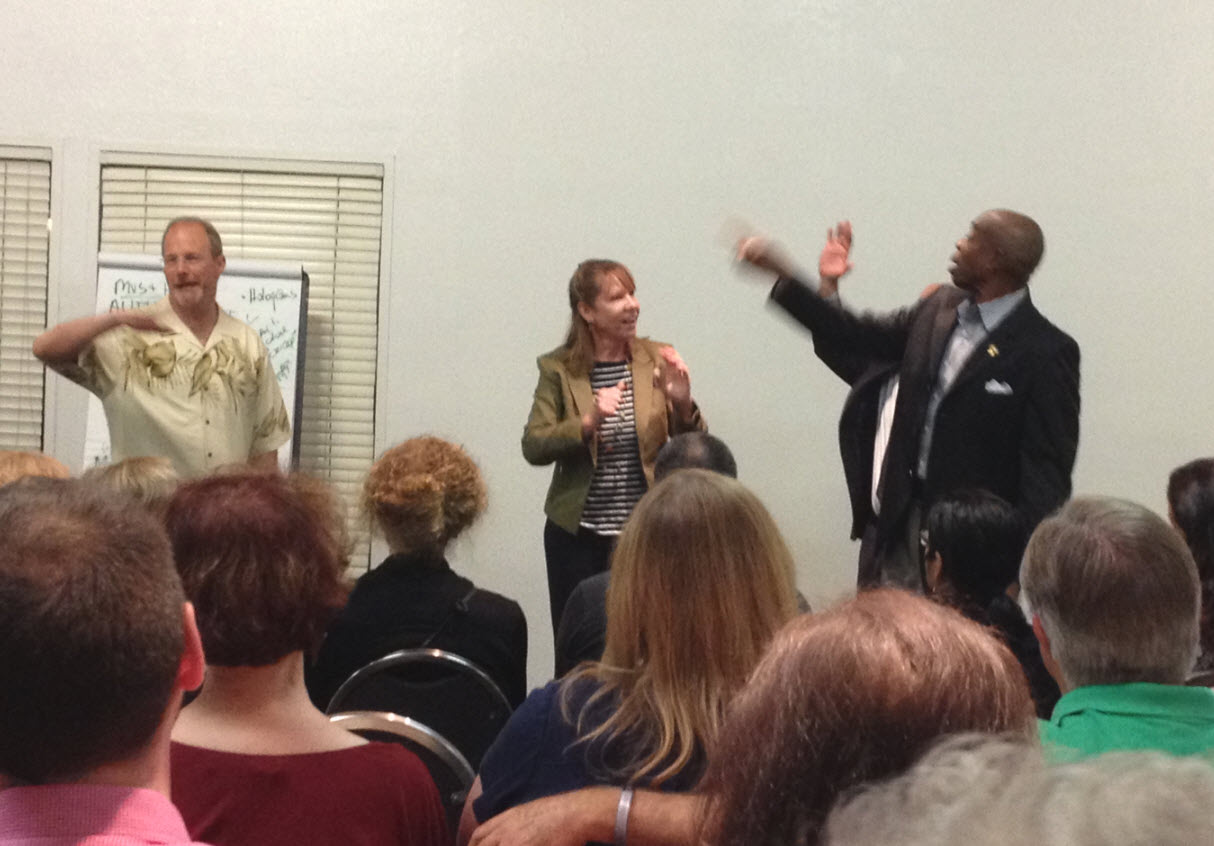
She held her own and I am proud of her.
I know there is a speech in here somewhere. One day it will start:
So I went to a speech training by three World Champions and I misread the situation and put my business card in a basket…
Kevin O’Leary and the Distribution of Wealth
Recent news by Oxfam stated that the richest 85 people on earth – yes 85 individual people which is about a half-full Southwest plane – have more wealth than the poorer half of the world’s population. 85 people control more than 3.5 billion people.
Kevin O’Leary, famous from Shark Tank on TV, said something that made no sense to me:
“I applaud that. That’s great news. If you work hard, you can be filthy rich one day!” — Kevin O’Leary
There are so many things wrong with that statement, I don’t even know where to start.
Working hard has nothing to do with getting rich, nothing at all.
Think about the miner in a coal mine in West Virginia, who started working in the mine when he was 14, and “retired” at age 54 with emphysema with nothing to show for but a few kids who are now also working in the mine, every day.
Think about the shop girl in Bangladesh who has worked 14 hour days since she was 8 years old, in a system oppressive to women, oppressive to the poor and illiterate, oppressive to everyone but the elite who live lavishly, fly corporate jets to New York so they can shop on 5th Avenue.
Think about the workers in the diamond mines in South Africa.
Think about the high school dropout in Dallas who works at Wal-Mart for minimum wage.
Think about the Chinese peasant.
Think about the El Salvadoran who is illegally in the United States to pick strawberries in the San Joaquin Valley and lives in a hovel, so he can send his money back to his family.
Every one of these people works very, very, very hard, all the time. None of these people will every be filthy rich, or rich, or even middle-class rich. Billions of people work very hard every hour of every day. Billions.
Those billions were not lucky.
Lucky to be born in an industrialized country in the late 20th century. 85% of the world do not qualify for that kind of luck.
Lucky to be born to a family that recognized the importance of education, sound health in childhood and solid family values.
Lucky to be born to parents who were not disadvantaged, in slavery, illegal aliens, uneducated, addicted to drugs, or homeless.
Lucky to be born smart, at the right time, with the right background, with the right parents, in the right country, in good health, with the right education, in the right field.
Yes, Bill Gates (and many others I could name here) had all these factors of luck. And not to take away from Bill Gates, in addition to all these luck factors, he worked hard, he took risks, and he was competitive. He earned his success.
But I am certain that Bill Gates, if he had been born in Bangladesh in a slum today, Microsoft would not have been created.
It was not just his hard work, Kevin O’Leary. There was much more to it than that. I know you worked your way up from a modest beginning yourself. I know you worked hard, you worked smart, you out-foxed the competition, you earned what you have. It was the fact that you were born in a capitalist country at a good time in history that laid the foundation so you could do that, and be what you are today.
Being a Canadian born in 1954 was one major prerequisite – omitted in your argument.
And that’s why you look like a prick in the video above.
Toastmasters International Makes a Huge Difference
I am an introvert. In 1994 I joined Toastmasters International. When people asked me why, I always told them that I knew that one day I’d have to give a million-dollar speech, and I wanted to be ready for it.
I was an active member of Toastmasters for about 10 years, went through their program and even won a number of speech contests. I have given many presentations, some as long as two full 8-hour-days, where much more than a million dollars of business was at stake, and I came through.
Today I can pretty much give a speech on demand. I still get the butterflies, everyone does, but I can control them and come out with success. Toastmasters has made that possible for me. I cannot imagine a business career where Toastmasters does not play an important role.
Here is an example of a presentation or speech that did not go so well.
Michael Bay is a successful movie producer of Armageddon, Pearl Harbor, and the Transformers film series. But success does not a speaker make.
Watch this and cringe. This is what we have Toastmasters for.
Largest Languages in the World
The largest languages in the world, based on the number of words in their largest dictionaries, are English, German, Russian, French and Spanish. I have studied all of them, even though my Russian only goes as far as learning the Cyrillic alphabet and a few Russian phrases.
The numbers are:
English – 616,000 words
German – 185,000 words
Russian – 130,000 words
Spanish – 100,000 words
French – 100,000 words
Being an English speaker, I am amazed that the English vocabulary is more than three times that of the next largest language, German. The average English speaker only recognizes 10,000 to 20,000 words, and the average active vocabulary is only about 1,000 to 4,000 words.
School in Afghanistan

This is a school in Afghanistan. This is the country we’re spending $10 million PER HOUR on defending.
Toys R Us and Corporate Stewardship
This is an actual Toys R Us commercial that stirred up sufficient outrage with parents and educators that the company apparently pulled it from the market.
I believe it was not the company’s intention to denigrate nature education and ridicule the efforts of tens of thousands of educators in schools, childcare centers and early education professionals by portraying their quest as boring and not worthy or valuable.
I am not saying that children don’t need toys, and I am not saying that Toys R Us is evil or misguided. It’s a big box store like all others, and it panders to our thirst for commercial extravaganza.
This commercial shows how the profit motives of a major corporation does not align with those of a society in general. The motive of the corporation is to sell its product, at a profit, and win against the competition. In retail, that is by swaying the hearts of the consumers and associate happiness with the product and drudgery and boredom with the competition.
In this case, the competition is nature education. There is no way a young child can see this ad and not take away that going to the forest is boring, forest rangers and naturalists are dry and dull, but a toy store is fascinating and exiting in comparison.
Nature was the only thing we had until things changed about a hundred years ago, and considering the course we’re going, nature may be the only thing we will have in the not too distant future, unless we start educating our young to appreciate nature, its beauty and complexity, and its value to every human on the planet.
Education starts with early education. Children need to learn what is really important in life, and they need to learn it early, so they can be responsible adults. We need more early educators and nature education programs. We need trained park rangers and nature interpreters who not only have a passion for nature, but who have training in education so they don’t appear like the “boring” actor in this Toys R Us video, but as vibrant and excited individuals that children want to spend time with.
Just like oil companies don’t have an incentive to keep the environment safe, clean and healthy, just as coal companies don’t have an incentive to keep the air clean, just as insurance companies don’t have an incentive to keep us healthy, just as drug companies don’t have an incentive to actually cure us, so do toy companies have no interest in educating our children.
This is the ugly underbelly of the free market. The free market does not have the best interest of the consumer in mind.
What is the alternative?
Education in mathematics, science, philosophy, nature, art, linguistics and literature. The more educated a society is, the more educated its individuals are, the better a chance that society has to do what’s right and best for it, and to see when commercialism goes way wrong.
Toys R Us went massively wrong with this ad, and I am sure they know it now, admission or not, but one bit of damage is done to some young minds, and to the company’s image in my mind.
Highest and Lowest Earnings with Bachelor Degrees
As it has been for decades, petroleum engineering comes in at the very top, with a $120k salary. And fighting around in the crowded field on the bottom, around $40k, is early childhood education.

100 Reasons Not to Go to Graduate School
I know a number of people who are going to graduate school, and I know other people who are thinking about going to graduate school for a variety of reasons. I never went, so I may not be the best person to give advice, and therefore I am not going to.
But I found this wonderful blog titled “100 Reasons NOT to Go to Graduate School” that lays it all out. Anyone considering graduate school should read all the entries in this post before making that crucial decision. The posts are well written, nicely cross-referenced, well commented and illustrated with classic paintings.
I know there are a number of eminent professors, graybeards and professionals bestowed with advanced degrees who occasionally stop in here read my blog – and I invite them to comment and set things straight.
I might also add that I am not sure if I am in favor or against graduate degrees in general. I believe it greatly depends on the dreams, goals and dispositions of the individuals. But it is good to read about “the other side.”
Therefore, read, oh young ones, read, before you make your wise and fateful decisions!
Elementary School in Germany in 1963
When reading an article about iPads being handed out to children in school as the standard learning tool in 2013, I suddenly remembered how I learned how to write exactly 50 years ago in the old country.
We had a Schultafel (school tablet). When I googled for it, I found this image:

The board is made out of black slate with a wooden frame. I remember it being about a foot wide and maybe 9 inches tall. The one on this picture is cracked. I remember mine being cracked too from time to time. It was too easy to drop it. When it got real bad my parents would buy me a new one. I still remember the feeling of a brand new Schultafel – it was special.
You wrote on it with a Griffel, which translates to the English word “pen” but is not accurate. A Griffel is a pencil whose core is not lead (or whatever black stuff is inside a pencil) but white like hard chalk. So you wrote with a chalk pencil on a black slate board. To sharpen the Griffel you used a pencil sharpener.
The board was two-sided, and the back was usually blank. There were no lines so it could be used for drawing. Some tablets had a checkered back, which was supposedly to learn arithmetic.
I remember homework in first grade being filling up the whole front of the board with the letter of the alphabet we had just learned that day. It took — forever — to fill up the board. It seemed like a huge task.
To erase, we had to use a wet, round sponge. The sponge was usually in a plastic container, kind of like a travel soap dish, that we kept in our backpacks. You had to remember to make the sponge wet at home so it was moist when you needed it. If you forgot, and it was dry, you had to ask another child for theirs when you needed to erase.
But the sponge didn’t really erase the chalk, it just made it wet. Then you needed a rag to dry it and in the process wipe the white dust off. The rag was attached on a string, perhaps a foot and a half long, to the board through the little hole in the frame that is visible on the right in the image.
We carried our stuff in Schulranzen, which are a kind of backpack. They looked like this:

Incredibly, this one in this image here apparently costs 195 Euros. My parents were poor. My Schulranzen can’t have cost more than a few dollars, and I got it in first grade and it lasted for many years.
 Here I am on my first day of school, in September 1962, with my Schulranzen on my back (and the traditional bag of candy in my arms).
When we carried the boards, they were in our backpacks, and the rag, attached to the string, would hang out of the backpacks, presumably so they could dry. Just picture all the little first graders with their backpacks, every one of them having a little rag on a string hang out dangling around as they walked to school.The rag never really dried properly and the dampness with the chalk dust created a characteristic dishrag-like smell that I’ll never forget.
Things have changed in 50 years. iPads would have seemed like pure magic then, yet they are commonplace today.
What will we have 50 years from now which will make our iPads look like a vintage Schultafel to us?