
When reading an article about iPads being handed out to children in school as the standard learning tool in 2013, I suddenly remembered how I learned how to write exactly 50 years ago in the old country.
We had a Schultafel (school tablet). When I googled for it, I found this image:
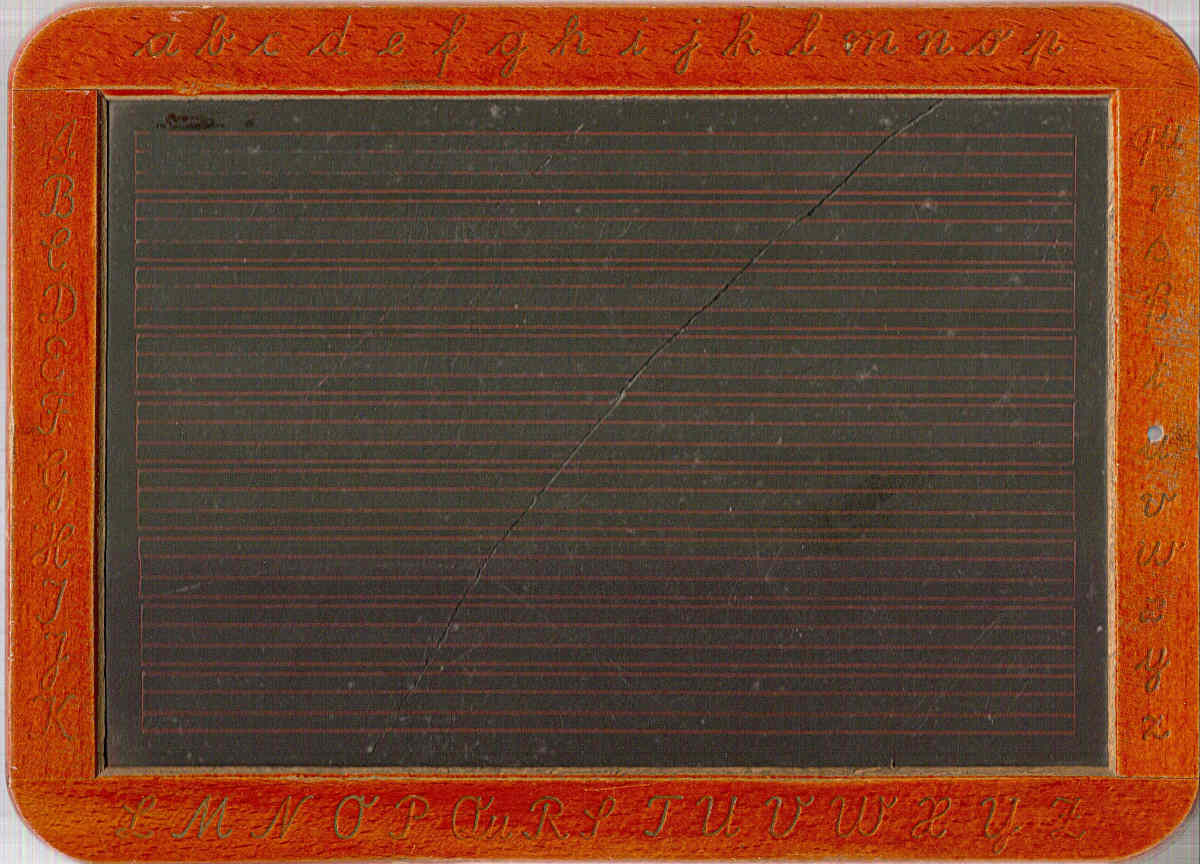
The board is made out of black slate with a wooden frame. I remember it being about a foot wide and maybe 9 inches tall. The one on this picture is cracked. I remember mine being cracked too from time to time. It was too easy to drop it. When it got real bad my parents would buy me a new one. I still remember the feeling of a brand new Schultafel – it was special.
You wrote on it with a Griffel, which translates to the English word “pen” but is not accurate. A Griffel is a pencil whose core is not lead (or whatever black stuff is inside a pencil) but white like hard chalk. So you wrote with a chalk pencil on a black slate board. To sharpen the Griffel you used a pencil sharpener.
The board was two-sided, and the back was usually blank. There were no lines so it could be used for drawing. Some tablets had a checkered back, which was supposedly to learn arithmetic.
I remember homework in first grade being filling up the whole front of the board with the letter of the alphabet we had just learned that day. It took — forever — to fill up the board. It seemed like a huge task.
To erase, we had to use a wet, round sponge. The sponge was usually in a plastic container, kind of like a travel soap dish, that we kept in our backpacks. You had to remember to make the sponge wet at home so it was moist when you needed it. If you forgot, and it was dry, you had to ask another child for theirs when you needed to erase.
But the sponge didn’t really erase the chalk, it just made it wet. Then you needed a rag to dry it and in the process wipe the white dust off. The rag was attached on a string, perhaps a foot and a half long, to the board through the little hole in the frame that is visible on the right in the image.
We carried our stuff in Schulranzen, which are a kind of backpack. They looked like this:

Incredibly, this one in this image here apparently costs 195 Euros. My parents were poor. My Schulranzen can’t have cost more than a few dollars, and I got it in first grade and it lasted for many years.
 Here I am on my first day of school, in September 1962, with my Schulranzen on my back (and the traditional bag of candy in my arms).
When we carried the boards, they were in our backpacks, and the rag, attached to the string, would hang out of the backpacks, presumably so they could dry. Just picture all the little first graders with their backpacks, every one of them having a little rag on a string hang out dangling around as they walked to school.The rag never really dried properly and the dampness with the chalk dust created a characteristic dishrag-like smell that I’ll never forget.
Things have changed in 50 years. iPads would have seemed like pure magic then, yet they are commonplace today.
What will we have 50 years from now which will make our iPads look like a vintage Schultafel to us?
Great story. Kristen A.