Book Review: Blue Highways – by William Least Heat Moon

Blue Highways was first published in 1982, and that’s when I bought my copy. Here is a picture of it on my desk. The pages are yellowed, the print is small, and the book cost $3.95 in 1982. It’s been on my shelves, and in boxes, for all these years.
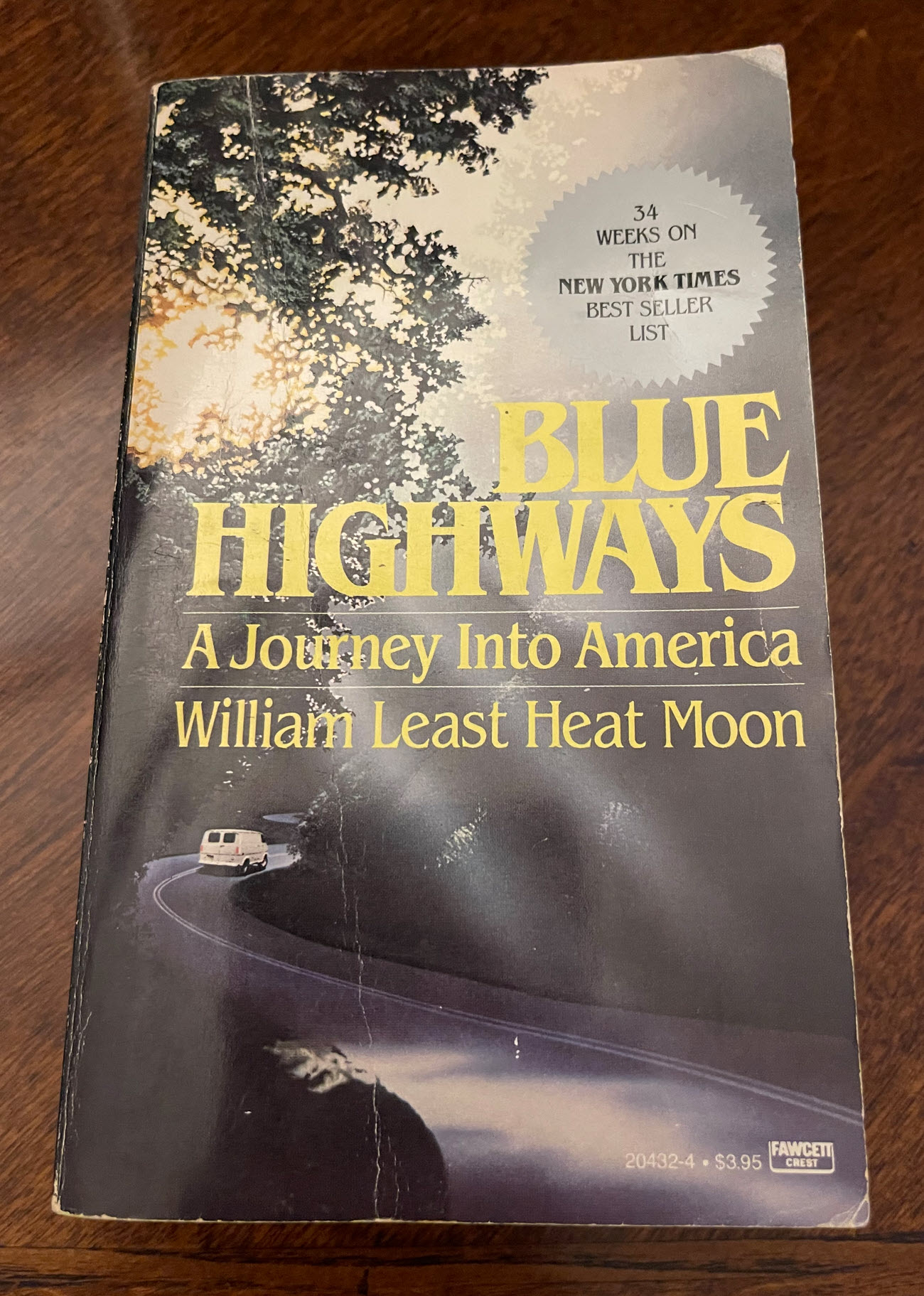
When I first bought it, I read perhaps 20 or 30 pages, and then I faded. It has 426 printed pages and the print is quite small.

Recently I bought it again on Kindle, at many times its original printed cost, just so I can read it in an acceptable formfactor. Printed books just don’t work for me anymore. And somehow I can read long books more successfully on Kindle, than when I have to turn physical pages.

And there you have it, I have read Blue Highways all the way through. It’s a classic, I have talked about it many times over the years with people, acting like I knew it, and now I have finally earned it.

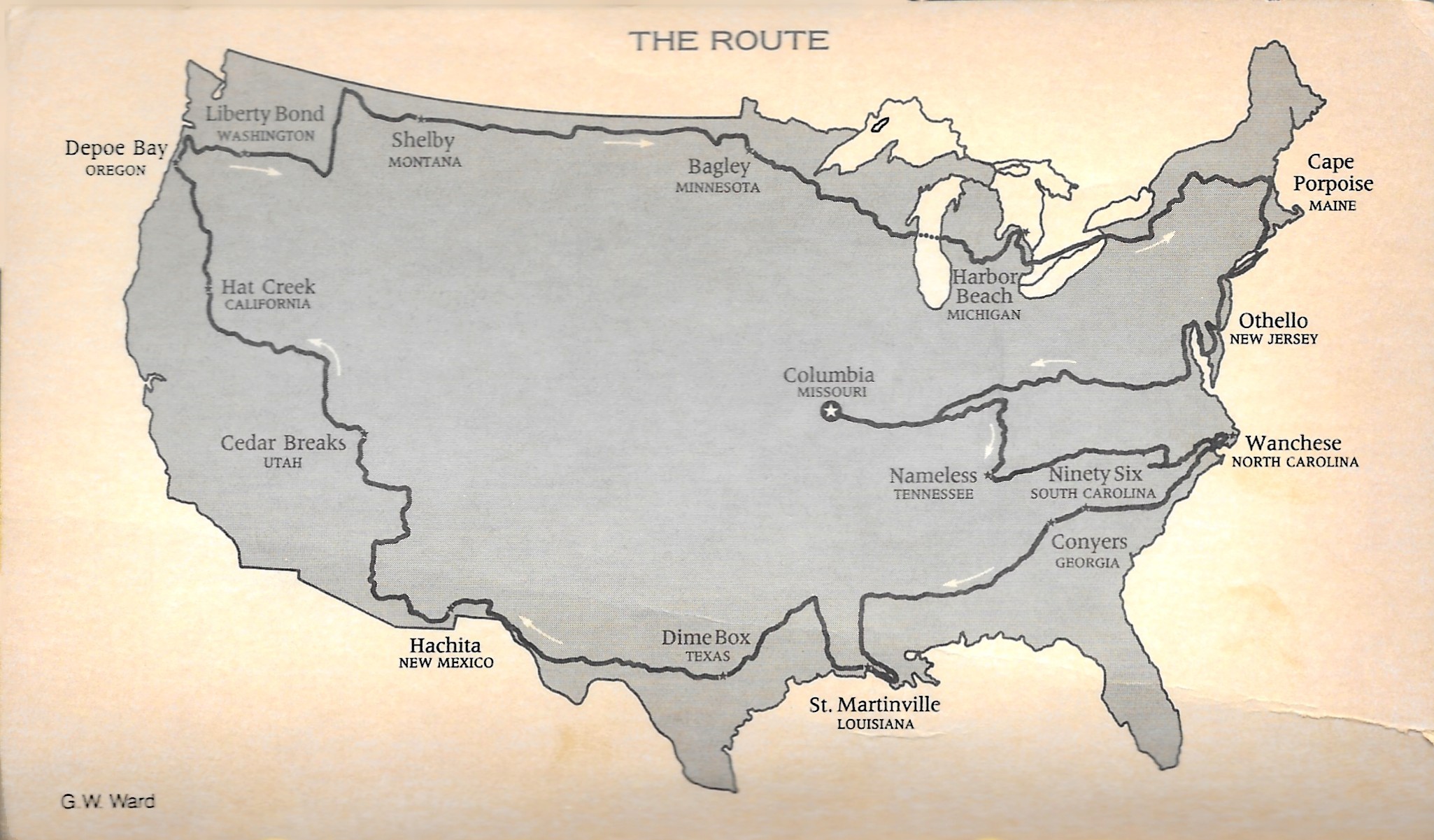
William Least Heat Moon is a travel writer, and Blue Highways is his most popular book, the one that put him on the map. On the first of day of spring, on March 20, 1978, he left his home in Columbia, Missouri in his van to travel around the country, avoiding all freeways, and  going only on country roads,  which were shown in blue on the maps of those days. Hence the title Blue Highways.

Here is a diagram of his van:
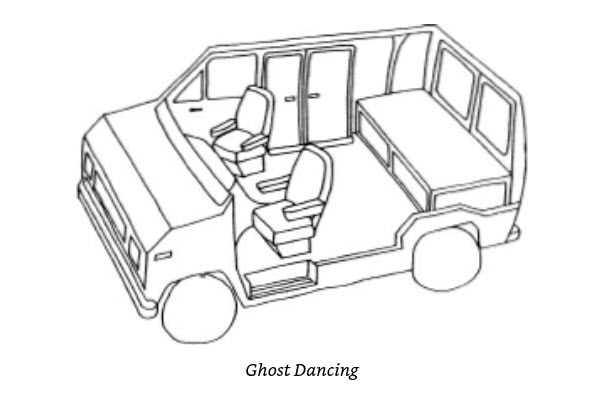
He called the van Ghost Dancing.

Ghost Dancing, a 1975 half-ton Econoline (the smallest van Ford then made), rode self-contained but not self-containing. So I hoped. It had two worn rear tires and an ominous knocking in the waterpump. I had converted the van from a clangy tin box into a place at once a six-by-ten bedroom, kitchen, bathroom, parlor. Everything simple and lightweight—no crushed velvet upholstery, no wine racks, no built-in television. It came equipped with power nothing and drove like what it was: a truck. Your basic plumber’s model.

Ironically, I had a high school friend who took his van, I believe it was an Econoline, across the country in the summer of 1978,  from New York state to Arizona, where I lived at the time, to visit us. It seems like more than one person traveled the nation is vans in those days, but not too many wrote books about it.

He circled the country clockwise as shown on the map below:
In his billfold he had four gasoline credit cards and twenty-six dollars in cash.  Hidden under the dash were all his savings: $428.

With that, he managed the trip around the country in three months, coming back on the first day of summer of 1978.

He tells vignettes of adventures or challenges, and he tells the stories of people he meets and spends time with along the way, be that hitchhikers, shop keepers, bar maids, gas station attendants, fishing boat skippers, ferry captains, and many, many residents in various small towns of America of the 1970ies.

I identified with the stories, because the late 1970ies is when I came of age and started my adult life. One of his stops is Kennebunkport, Maine. I now know that town because it became notorious through George H. W. Bush as his summer estate. The entire country learned about Kennebunkport. But Bush became president in 1989. Blue Highways was published in 1982, and the trip happened in 1978. Nobody then had ever heard of Kennebunkport, except for the locals there.

I saw many parallels of what one might encounter on a trip around the nation on blue highways today, and what it was like in 1978. It almost makes me want to retrace his trip.

Reading Blue Highways for me was rewarding just because I can now say I read the old yellowed book. It was a nostalgic trip through my early years. When I put the book down I decided I am definitely ready for an extended road trip.

I need to get out!


Polydactyly

Polydactyly, meaning “many fingers or toes,” is a congenital condition where individuals are born with one or more extra digits on their hands or feet. It can occur on its own or be associated with other genetic syndromes. I had never met anyone like this until now.

When we were in Vietnam, we took a little bamboo boat ride. These are traditional round boats that you can use to paddle up and down a river. One of the rowers was doing some stunts in the middle of the river, and when my wife climbed out of his boat she looked down and noticed “a lot of toes.” She made a comment, and we subsequently discovered that the man had six toes on each foot and six fingers on each hand.

We hadn’t really noticed it, until my wife pointed it out. It’s not like he made an effort to show that off, but when we realized it he was more than happy to pose. I am sure he knew an extra tip was involved.

When I googled the condition, I learned that there are many different  types. The one our friend above exhibits is quite rare, where all digits are fully developed and functional. Worldwide, polydactyly occurs in about 1 in 500 to 1000 births. That’s a lot more than I would have thought. It’s obviously not something we look for when we meet somebody, and it’s not something people would necessarily point out about themselves.

We enjoyed meeting our friend above and got his permission to take a picture.

Movie Review: A Complete Unknown

When Bob Dylan arrived in New York City in 1961 he was 19 years old and a complete unknown.

That’s the start of the movie A Complete Unknown. I was too young then, not even five years old, so I didn’t witness that epoch of music. I didn’t really get into Bob Dylan music until I was about 14, around 1970. But ever since then, I would call Dylan my favorite musician, and I do it to this day. Many years ago I painted a Dylan portrait, as I liked to do with some of the iconic artists I admired (Beethoven, Henry Miller, Nietzsche). Dylan belonged in that collection.

Over the years, I accumulated pretty much all of Dylan’s vinyl records, and  lost them in later years during one of my moves.

When we entered the Regal movie theater on the afternoon on Christmas day, opening day for A Complete Unknown, all seats were full, and the average age of the moviegoers was probably around 75. We were on the younger side. And there it was quite obvious: Dylan had a momentous impact on not only the music of his generation, and many other musicians that followed him, but also on the emotional lives of his followers. When you search this blog for “Bob Dylan” you get dozens of entries returned, referring to movie and book reviews, and many other references to Dylan, and how he influenced my critical thinking, my artistic endeavors, and how his style affected my own poetry writing. I have to admit that I am not much of a musician; the only instrument I ever used was a harmonica – and fittingly, the first song I ever learned on the harmonica as a 16-year-old was Blowing in the Wind.

A Complete Unknown follows Dylan’s early career through his initial quest toward electric music during the iconic performance at the Newport folk music festival of 1965.

Timothée Chalamet plays Bob Dylan, and he does an amazing job. During the movie, he has to play and sing 13 Dylan songs. He practiced for over five years preparing for this so he could sing and play his own guitar as well as the harmonica. Dylan’s style on the harmonica is unique and unpredictable, and even that Chalamet mastered, along with the voice and the guitar. Noteworthy is also that Monica Barbaro, who played Joan Baez, also did her own singing and brought a convincing performance imitating the iconic singer’s unique voice.

How do you cram four extraordinary and foundational years of an iconic artist into a two hour movie without shaving off many details, like the massive influence of the Beatles on American music during the same period, and how that affected Dylan? You have to pick your battles and focus on the most poignant episodes and illustrative events. Those of us who are really interested in Dylan, the artist, have read numerous biographies for all the detail we need.

A Complete Unknown is just one more adventure to have when experiencing Dylan, the icon, and for me, this made a 4-star movie.


My Humble Tribute to Kris Kristofferson

Kris Kristofferson was always in my life.

He entered it with a bang with the movie A Star is Born, alongside Barbra Streisand, which remains one of my favorite. The soundtrack still haunts me and catapults me back to the early years of my adulthood. The last time I saw him was at a concert right here in Poway, California. It was a very small venue, we sat quite close. It was an unimposing, empty stage. There was a microphone, a chair and a stand with a bottle of  water. He was a thin and humble man, apologizing for his cold. He had to blow his nose on stage between songs. The only instrument was his guitar. That may have been some eight years ago.

When we were in Maui recently he had just played at a hall there, and we were sorry we had missed the date.

Kristofferson was an amazing and talented person. In San Mateo High School he wrote award-winning essays that were published in magazines. When he went to Pomona College, his achievements in rugby, American football and track and field got him to appear in Sports Illustrated on March 31, 1958. He graduated with a B.A. summa cum laude, in literature. Then he was awarded a Rhodes Scholarship and went to the University of Oxford. There he won awards for boxing (of all things), he played rugby for the college, and started writing songs. Soon he recorded records.

Under pressure from his family, he joined the U.S. Army, eventually became a captain and a helicopter pilot. He also completed Ranger School. When he was stationed in West Germany in the early 1960s, he resumed his music career and started a band. He was offered an assignment to teach literature at West Point, but turned it down.

He tried to get Johnny Cash to record a tape of his, but he didn’t get his attention. So he flew a helicopter and landed it on Cash’s lawn. With a beer in one hand and recordings in an other, he finally got his attention and his music career took off.

But that was not enough. He started acting and was quite successful in a number of films.

Finally, one of my readers just commented that he discovered John Prine and Steve Goodman. At this time in the late 60s, early 70s, Goodman and Prine were playing in small local clubs in Chicago. Not only did he have talent himself, he recognized it when he saw it.

In January 2021, Kristofferson announced his retirement. His final concert was held in Fort Pierce, Florida, at the Sunrise Theatre on February 5, 2020, accompanied by the Strangers.

This man was good at everything he touched!

It’s an astounding and intimidating resume. Per his Wikipedia page, he is said he would like the first three lines of Leonard Cohen’s “Bird on the Wire” on his tombstone:

Like a bird on the wire
Like a drunk in a midnight choir
I have tried in my way to be free

Kris Kristofferson died yesterday at his home in Maui. I will miss him.

Pirro’s Ludicrous Warning to Taylor Swift

Mainstream personalities such as Fox News host Jeanine Pirro recently warned Swift not to “get involved in politics.”

Who is Pirro to tell any celebrity not to get involved in politics? Apparently the Right is worried. Not like there isn’t any precedent:

  • Ronald Reagan
  • Jesse Ventura
  • Arnold Schwarzenegger
  • Mehmet Oz
  • Donald Trump

With the exception of Oz, all actually won office, and all except Ventura were Republicans. Ventura was with the Reform Party.

So it apparently works when celebrities run for office. Maybe Swift should run for president.

Oh, no, she is not qualified because she is not old enough, per the constitution. She is only 34 now. However, she would be 35 by inauguration time. Close enough for me.

There is another candidate running who is not qualified, that one for instigating an insurrection in the past. It does not seem to stop him.

Whether any of these people know how to govern does not seem to be a question anyone is asking. You just have to be popular, rich, willing to spend lots of money and time, and win elections.

So Pirro, in my opinion, is way out of line telling a celebrity not to get involved in politics. If I were Swift I’d get involved out of spite.

Right Time, Right Place – but Wrong Man

Last week I was driving the rural roads of upstate New York, going from Albany west on Route 20. My destination was the Fenimore Art Museum in Cooperstown, which had a special exhibition of Wyeth family figure drawings that I wanted to see.

I was scheduled for a work meeting at noon local time, and I planned to be in town by then and catch it on my computer using my Verizon hot spot for network access. Once I entered town about 20 minutes before my call, I drove down the main street and got lucky: In the middle of town, busy with people and cars all around, I found an empty parking space on the right side of the road that I was able to parallel-park into.

I left my engine running, since it was really hot outside, and got set up for my meeting with my laptop leaning against the steering wheel.

Then I looked up and out my side window, and this is what I saw:

This is the main entrance to the National Baseball Hall of Fame in Cooperstown, New York. People save their money to take their kids on vacation to come here as a destination. And here I was parked across the street from it for a prosaic business meeting.

I have to explain here that I do not know anything about baseball. I have been to exactly one game in my life and I was bored. I do not know any names of any baseball players, except Babe Ruth, oh, and maybe Joe DiMaggio – that was another baseball player, right? Oh, and I also have to add that in 1982, I once got a private tour of their home stadium and facilities by the chief financial officer of the Chicago White Sox; I was working on the season billing program for the White Sox when I was working for Ticketmaster.

I didn’t go into the Hall of Fame after my meeting. Rather, I tried to find some lunch down the street at a diner, but the diner was closed, so I stopped at the sushi place next door. I was reading and eating my myself. At the table next to me there were a couple of old Italian-looking guys in their late 70ies, one of them with a cane, having their lunch. While I am sitting there, a family man with his teenage son comes up to the old guy with the cane and asks him for an autograph for his son. They are chatting it up for a while, the boy awestruck, quiet and just smiling.

So I was at the National Baseball Hall of Fame and didn’t go in, and I sat next to an old legend whose name I don’t know.

I was definitely at the right time, at the right place – but I was the wrong man.

AFS Reunion in Croatia

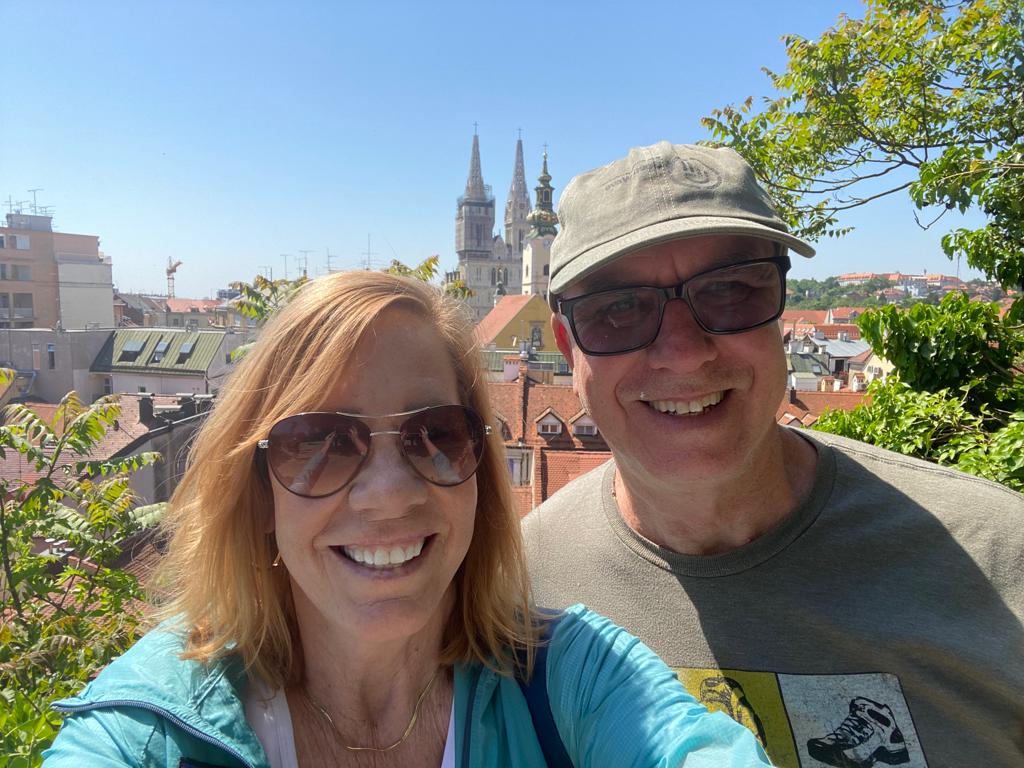
About 30 former AFS exchange students in 1974 from over 14 different countries, many with their spouses, had a reunion in Croatia this week.

We came to this reunion from Denmark, Germany, Switzerland, Austria, Croatia, England, Luxembourg, Guatemala, Costa Rica, Brazil, Argentina, Chile, Thailand and the US. I maybe forgetting a country or two.

We’re all 64 or 65 years old, and share one life-changing experience, a year abroad in the US with the AFS program. Here is a group picture.

Here are some of us on our first day in the country getting some much needed refreshments.

Here is a shot of us at the initial welcome dinner in Zagreb, the capital of Croatia.

For about 10 days, all these 65-year-olds were 18 again.

Tribute to a Teacher

“I’m a success today because I

had a friend who believed in me 

and I didn’t have the heart

to let him down.”

— Abraham Lincoln


There are two teachers I remember who made a difference in my life early on. My parents were not able to provide guidance, leadership or direction. When I was in German elementary school in my little town, when I was 10 years old in 5th grade, there was one classroom for the first eight grades. The first row of six kids was the first grade. The second row was the second grade, and so on. In the morning, Herr Sicheneder started in the front and gave the “little ones” assignments and then he worked his way back. I was in 5th grade, and he usually combined grades 5 through 8 and taught them together, at least in subjects where it made sense, like history or geography. After 8th grade, you were done with school and everyone went to a trade school and start a three-year apprenticeship for a trade. I was a shy little boy who had no idea where he was going.

Herr Sicheneder pulled me aside one day and told me that I should apply for prep school. This was in 1966. In the German school system, in those years, maybe 5 to 10 percent of all kids got to go to Oberschule (high school), in German called Gymnasium, which was the only pathway to higher education and university. To get in, you had to pass an entrance exam. I had no idea what was involved, how you applied, and what the exam was like. Herr Sicheneder kept me in school after all the other kids went home for many months and tutored me. I still remember many of the drills today, almost 60 years later. Wegen, während, statt, kraft, oberhalb, unterhalb, diesseits, jehnseits are all German prepositions followed by the genitive case. Who knows stuff like that? I do, because Herr Sicheneder made sure I had them all memorized. He drilled me in German, mathematics, essay writing and whatever else was in the exam. I have no memory of taking it, but I passed, and in the fall of 1967 I started taking the bus to the city every day and went to Oberschule. Herr Sicheneder was the single most important influence on the direction of my life by a long shot. He put me on a course that resulted in what I am today, and without him, my life would have been very, very different.

Herr Sicheneder was in his late fifties then. As an adult, I never got the chance to go back and thank him for what he did for me. He passed away many decades ago.

I met the second teacher with similar impact on my life on my first day in Gymnasium at the end of August 1967. My professor of Latin and German, and my homeroom teacher, was a young man right out of university perhaps in his first year of teaching, by the name of Wolfgang Illauer. I had Professor Illauer in Latin and German for three years. Being a bit of a German literature snob, he taught us discipline in writing, grammar and spelling and made sure we appreciated German literature. Professor Illauer taught me how to write, imparted critical thinking, instilled values for beauty, art, literature and general culture. Being a professor of the classic languages of Greek and Latin, he had a strong classical background which rubbed off on me. Professor Illauer was my coach and teacher between ages 11 and 13, and he shaped my intellectual and cultural trajectory unlike any other teacher I remember. As I grew into the upper grades, I never saw him again.  Eventually I went on a scholarship foreign exchange program to the United States and got my entire college education here.

A number of years ago I googled Professor Illauer and being the academic he was, he had given some lectures as a guest professor in his retirement. I found his email address. We connected and established correspondence, mostly sharing our thoughts on literature, poetry, writing, education and all the things that academics of the classics are interested in.

Finally, a couple of weeks ago, we met in person for the first time after more than 50 years. I spent a night at the Hilton at the Munich Airport, and he drove in from Augsburg to have dinner with me. When I was a child, he was a god. Today, we’re almost equals, two old men interested in a common quest for language and education. We’re on a first name basis and use the German familiar form of address. We talked about Tolstoy. Wolfgang recently read War and Peace in the original Russian language. Go figure. He recommended that I read Somerset Maugham’s short stories, which he reads in English.

I spent a couple of hours over dinner with an “old friend” and one of the two teachers with immeasurable impact on my life.

Wolfgang reads this blog. This is my thank you.


Camping with Devin – 27 Years Later

Devin was a Boy Scout when he was little. The picture below was taken of the two of us the morning after camping with his troupe at a Boy Scouts camp in Balboa Park in San Diego. I don’t have any exact record of the date, but I am guessing it was 1995 or 1996. Devin was seven or eight years old then.

Today we went back to re-enact the photo. I still have the same jacket, and the same chairs we used then. We got permission by the San Diego – Imperial Council of the Boy Scouts, found camp site #1, and sure enough, the fire pit was still there. We tried to match the same pose, even though this one was in late afternoon light, the old one was early in the morning.

Devin is now an experienced outdoorsman and athlete, and works for the California Conservation Corp. And I try to keep up, climbing and hiking as much as I can. It all started with the Boy Scouts.

It meant a lot to me to go back to the same spot, with Devin now three times the size he was then, and sit in the same chairs.

Too bad we didn’t bring any coffee.

Devin on Clouds Rest in Yosemite

Here are some pictures Devin sent me this morning. He is on top of Clouds Rest in Yosemite. This is a 9,931 foot mountain in Yosemite with amazing 360 degree views of the park. It’s not the highest peak in Yosemite, but since it’s so close to “the Valley” it’s very prominent.

I’ll be visiting him in camp at the beginning of September, and I’ll definitely hike to the top of this mountain while I am there. It’s about a five-mile hike one way from camp, or about 10 miles from the trailhead. As always, you can click on the pictures to enlarge them – and when looking at this view, you had better do that!

Here is a selfie of him with Half Dome in the background and the Yosemite Valley to the right.

Here is a better view of Half Dome and the Valley.

If you want to read about my climb of Half Dome in 2012, here is the link. It was one of the most iconic hikes of my life. I am looking forward to hiking Clouds Rest now.

Thanks for the inspiration, Devin.

Branson in Space

Richard Branson  took the first ride to space today in the spaceship he dreamed up, designed and built – over decades. It’s a phenomenal achievement for a private individual, and it celebrates human ingenuity, perseverance, drive and creativity.

In the early morning, at 3:00am, Musk showed up at Branson’s house to wish him well. Branson tweeted this.

As I read  the responses, I was astonished that there were quite a few adversarial ones. I posted a few here with my own comments.

Red talks about the “age of extreme greed” presumably accusing Branson, attributing his success to greed. There is so much wrong with this tweet.

  1. Who decides what is pointless as a task to spend one’s time on. I wonder what hobbies Red has that are less pointless.
  2. Branson is a private citizen who opened a record store in England when he was a young man. He called it Virgin Records, and eventually built an airline and now a space tourism company – from scratch. I wonder what Red has accomplished in his life that we can all read about?
  3. I wonder what infrastructure systems are failing, and how fixing those is somehow Branson’s responsibility?

Then I saw Natasha’s post below:

She is worried about the destruction of the world, and questions Branson and Musk about what they contributed to the world. Well, Musk probably has made more changes to our current world than almost anyone, perhaps except Steve Jobs. He has built a car company from scratch, and forced every major automaker in the world to start producing electric vehicles. Then he started a rocket company and revolutionized how America sends humans into space,  and in the process saved billions of taxpayer funds by drastically reducing costs. Musk came to Canada with a single suitcase in the early 1990ies and one of his first jobs was shoveling out a sewer line, standing knee-deep in shit. In 1995, he arrived in California, got enrolled at Stanford and then dropped out to start a software company. I wonder what Natasha’s credentials are, what she has done to save the world, and how it compares to the records of Branson and Musk.

Hmm, private citizens can spend their money on whatever they want to spend it on. I wonder what Neo’s fantasies are and what he spends his money on that is so lofty.

Scientific innovation is not a waste of money, it’s usually a seed to greater things. These guys are not billionaires because they are greedy, or were born rich, they are billionaires because they spent their entire lives coming up with new ideas and then materializing them, and getting back up after every setback and failure (and rocket explosion) and starting over again. Musk has earned fortunes through the companies he has started and almost lost them again every time, starting the next ones. But he has persisted.

Rolf has an interesting angle. He apparently thinks that it’s Branson’s responsibility to plant 100 million trees, or build the first efficient water desalination plant.

Why have we never heard of Rolf Oehen and his revolutionary desalination plants that he has invented and built. And I might ask, how many trees has Rolf planted? Surely not 100 million.

Has he planted any trees?

Then there is Greenspaceguy! He blankly states that billionaires don’t pay income tax? Really? How does he know? Does he listen to Bernie Sanders, perhaps?

The irony is that Branson isn’t even a U.S. citizen. He’s British. I certainly don’t know what income taxes he pays, but he wouldn’t owe the U.S. government trillions.

And no, billionaires are not created by not paying taxes. I know plenty of poor people who don’t pay taxes, but they are not becoming billionaires. You become rich by building stuff that millions of people want to buy and spend their money on. Then, after you make a lot of money, you get to start paying taxes on it. The money doesn’t come from nothing. It comes from human ingenuity, perseverance, drive and creativity.

I think I need to stop right here and enjoy Branson’s “overnight success” that he has worked his entire life on.


The Celebration of Ignorance

It was 1995.

Hardly anyone in the world knew what email was, and had never sent or received one. The first traces of the Internet were just surfacing. Google didn’t yet exist (it was created in September of 1998). Amazon was just founded less than a year before. Big tech was Microsoft on the desktop. Apple was just about to plunge into failure after Windows 95 was released, and it looked like it was going to die. Elon Musk had just moved to California to attend Stanford University but decided instead to pursue a business career, co-founding the web software company Zip2 with his brother.

That was when Carl Sagan wrote his book The Demon-Haunted World.

He had a vision of the future more than 20 years out that is eerily accurate and reflective of what we’re experiencing now, with the dumbing down of America in full swing. Here is an excerpt:

I have a foreboding of an America in my children’s or grandchildren’s time – when the United States is a service and information economy; when nearly all the key manufacturing industries have slipped away to other countries; when awesome technological powers are in the hands of a very few, and no one representing the public interest can even grasp the issues; when the people have lost  the ability to set their own agendas or knowledgeably question those in authority; when, clutching our crystals and nervously consulting our horoscopes, our critical faculties in decline, unable to distinguish between what feels good and what’s true, we slide, almost without noticing, back into superstition and darkness. The dumbing down of America is most evident in the slow decay of substantive content in the enormously influential media, the 30-second sound bites (now down to 10 seconds or less), lowest common denominator programming, credulous presentations on pseudoscience and superstition, but especially a kind of celebration of ignorance.

It is now 2021. Good morning, everyone!

Featured Artist: Tatsuo Horiuchi

Tatsuo Horiuchi wanted to paint after he retired, but he didn’t want to spend money on supplies, and he didn’t want to buy a painting program. So he used what he already had: Microsoft Excel.

After using Excel for three decades myself, I didn’t know you could possibly use it to paint. I am amazed about the level of creativity and ingenuity this artist exhibits.