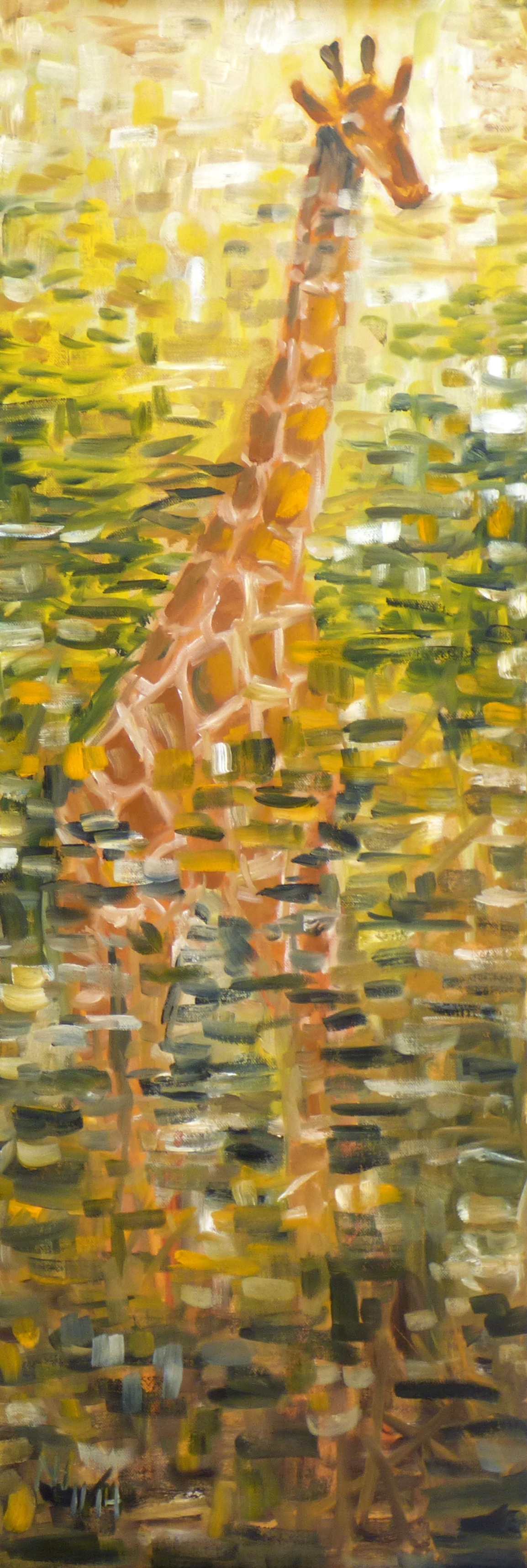
Trisha brought back more than a thousand pictures from her safari in Botswana last year. There is plenty of animal material to inspire many more paintings. I purposely wanted to loosen up on the brush and not make this photorealistic. I think I succeeded sufficiently. I did this specifically for this framing idea:
We have this ornate frame around the house which had an old mirror in it, and doors that flip open. I took the mirror out. Here is a picture of the empty frame. The opening is 24″ x 18″.
I bought a piece of plywood, cut it to the right size, and painted the elephant motif on it, so I can staple it behind the opening in this frame – after it’s varnished. It should be a fun conversation piece for the entryway at our house. I’ll post a picture when it’s done.
In summer 2014, I went boating in New York with my friend Kevin and his family. At sunset, looking west from his dock, the neighbor’s boat sat on a boat lift, silhouetted by the bright setting sun behind the clouds.
I used a simple sienna, brown and yellow palette, and applied only broad, wild brushstrokes. This is not my usual style. I wanted to see what I could do with a large brush, showing mood and color, and leaving the details to the imagination.
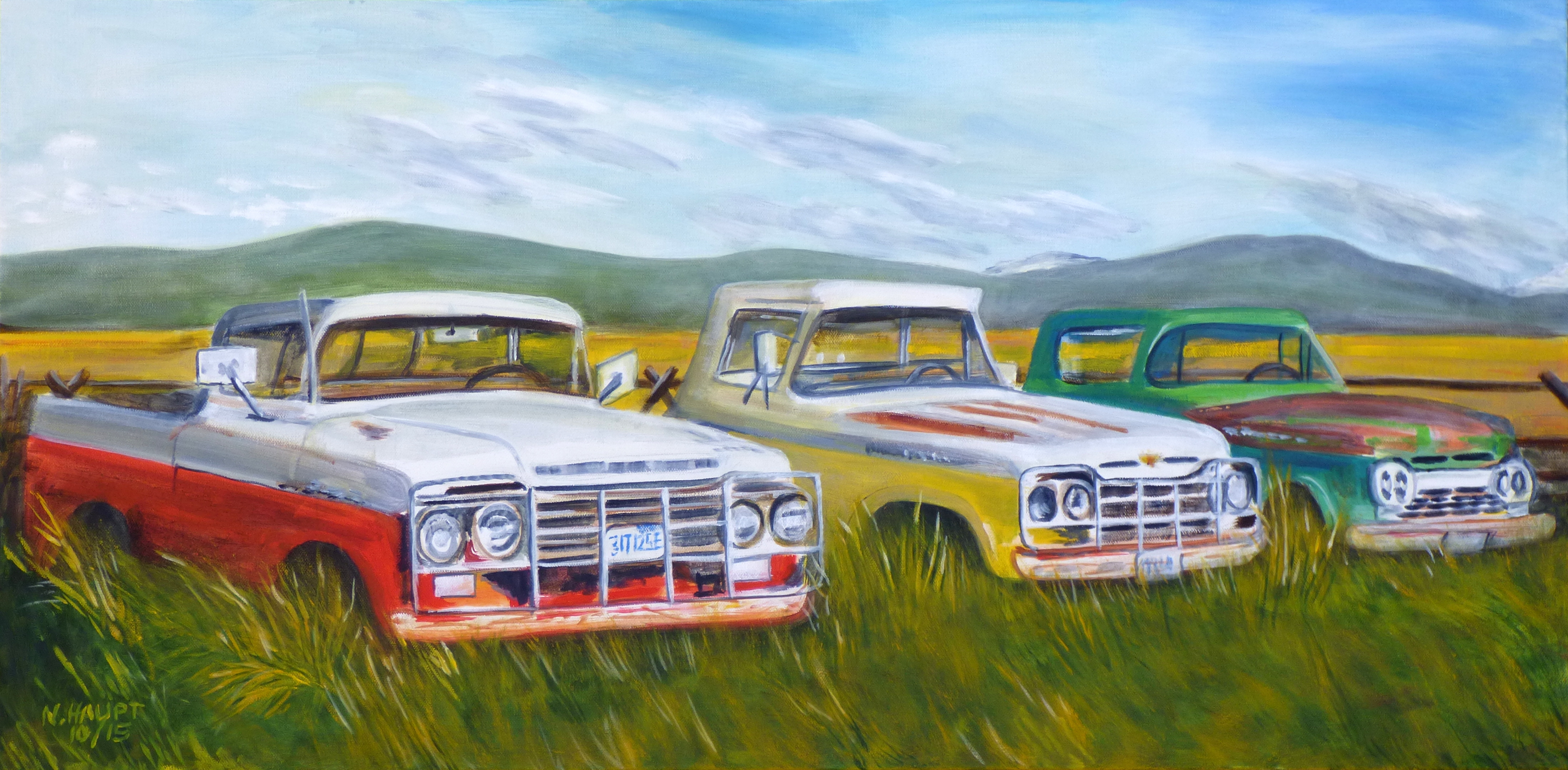
While we were staying at Lucy and Tony’s house in Montana in September, I was fascinated with the old trucks resting behind their barn. Here is the resulting painting.
What is there to do on a cold and drizzly night in Bozeman, Montana? Go to a Pecha Kucha Night!
Pecha Kucha is a unique presentation format. 20 slides, each slide is on the screen for 20 seconds. That’s 400 seconds. The presenters pick any subject they are passionate about. It’s not like a speech at Toastmasters, because the audience does not really look at the presenter, but rather the slides. So the presenter can read off a script. There is no need to memorize. The subject can be anything at all. Several examples of the Bozeman Pecha Kucha were:
George Mattson: “Growing up in Yellowstone”
Sadie Cassavaugh: “Puppets on the Verge”
Judith Heilman: “Racism, Ignore it … And it Won’t Go Away”
Those were just three of the 10 subjects. I was very impressed with the quality of the presentations. I will seek out Pecha Kucha events again back home in San Diego.
How did this get started, and what does Pecha Kucha mean?
First, the name is not pronounced as you have been pronouncing it reading it here. I tried to record a WAV file and upload it, but WordPress does not allow it. So I can’t “play” it for you. The words are Japanese, and the first syllable of each is suppressed. So try this:
p’CHAk’CHA
So the “p” and the “k” are just hinted, the “e” and the “u” are swallowed completely, and the accent is on CHA each time. If you want to hear it from native Japanese speakers, go to this link and click the arrows.
The words stand for “noisy room of people talking” and it’s an onomatopoeia for loud chitchat. The word pecha is an Japanese onomatopoeia for the splashing of water against a wall, and kucha is an onomatopoeia for crunching of paper.
In case you want to know: an onomatopoeia is a word that sounds like a sound. One of the most famous English onomatopoeia is “cockadoodledoo.” Another more common one is “hiss.”
Pecha Kucha started in Tokyo in 2003 as a one-time event, but quickly caught on and is now practiced all over the world. Just google Pecha Kucha in your community and you’ll find local events.
At the Philadelphia Museum of Art there are only a handful of van Gogh paintings. The most prominent one is one of his sunflowers. Mother Roulin and her Baby is another, less famous one.
Van Gogh painted a lot of pictures of Mother Roulin, either by herself, or with her baby. There are also several paintings of just the baby, as well as a few charcoal or pencil sketches.
I took this picture at the museum off the original with my iPhone. It brings out the colors well.
The colors are truly van Gogh, and so are the brushstrokes and the free style. Circling the outlines of figures with cobalt blue is a common van Gogh technique.
But really, look at the lack of finish work of the hands, the mother’s face and, most importantly, the face of the baby, which looks like a panda.
If one of my paintings ended up like that, I’d wipe that face and start over again, and over again, until it looked like a baby’s face. Madame Roulin was probably not very happy with this and probably didn’t hang the painting up, unless Vincent was in the house. “Wow, your baby is ugly,” visitors would have said.
But who am I? Just a guy who has done a hundred paintings in his life and painted over another 500 because they didn’t turn out, sort of like van Gogh’s Roulin painting.
But he died and then became Vincent van Gogh. And that makes Mother Roulin and her Baby special, world famous and very valuable.
Today I visited the Philadelphia Museum of Art. One of the most impressive paintings I saw was this huge painting (84″ x 118″), done by Thomas Eakins in 1889.
This is one of the most important paintings in the history of medicine. It used to hang in the John Morgan building at the University of Pennsylvania School of Medicine. It is now at the Philadelphia Museum of Art.
Thomas Eakins – The Agnew Clinic, 84″ x 118″ [click to enlarge]
Today I saw more original Van Gogh paintings than in my entire life combined up to this point. It was a glorious day.
The Clark Art Institute is one of a small number of institutions in the world that is both an art museum and an international center for higher education, research, and critical discussion of the visual arts.
The Clark currently exhibits Van Gogh and Nature, featuring nearly fifty paintings and drawings from thirty museums and private collections around the world.
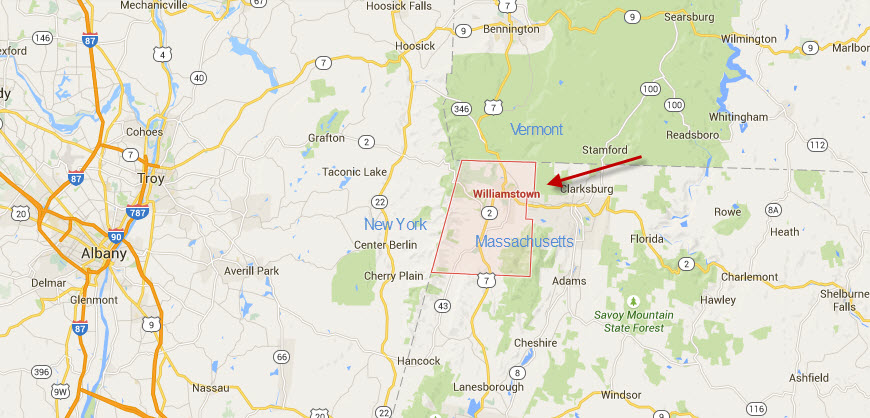
The Clark is not easy to reach. It’s in the small town of Williamstown, Massachusetts, in the very north-western corner of the state, close to Vermont and New York.
[click to enlarge]I came in on Route 2 from New York, a small country road over major mountains with 10% grades and prominent truck run-away ramps. When I left, for change of scenery, I decided to use Route 7, which was not much better, but I had great views of idyllic Vermont valleys, farms and homes.
The Van Gogh exhibit is open from June 14 to September 13 only.
There were many Van Gogh paintings that I had never seen before, annotated with explanations of the artist’s life at the time, where they were done, and the circumstances. There were also photographs of the actual locales, when available.
One of the paintings showed flowers in a copper vase. Then, four feet to my left, protected in a glass cube, was the actual vase. That took my breath away.
As always when I see Van Gogh paintings, I am speechless and humbled about the fact that this artist never saw his own success, never sold a single painting, no matter how hard he tried. If only he knew that more than a hundred years after his death, thousands of people would drive over the hilly mountains of Western Massachusetts and pay $20 a piece to stand in line and spend a few minutes in front of each painting or even just his drawings and sketches; and millions of people all over the world view him as one of the premier artists of all time; and that his works sell for tens of millions of dollars each.
If only he had had the opportunity to sell a painting or two, to earn some respect and success! That just might have prevented his death, and given us decades more of Van Gogh art that never came to be and forever remained locked in his soul.
Source WikiArt [click to enlarge]Last week I visited the Los Angeles County Museum of Art (LACMA) and saw the original Tea in the Garden by Henri Matisse. I love Matisse, and most of his contemporaries including van Gogh (my favorite), Monet, Manet, Gaugin, Cezanne, Seurat – and many others of the period. When I go to an art museum, I usually seek out those artists first, before I wonder off into rooms with the older European paintings.
Often it strikes me how “unfinished” the paintings of the masters are. I saw many versions of van Gogh’s irises (Google it and you will see) where there is bare canvas between brushstrokes indicating leaves.
Recently I visited my friend (PG) in Germany, who loves the expressionists, and is a hobby painter himself, and we talked about how crappy some of the paintings of the masters are. Sections of the paintings obviously don’t fit together and were completed at different times with different palettes. The drawing is often atrocious. The detail shoddy. The finish – oh, the finish!
In Tea in the Garden, all of this occurs. This is a very large painting (140 x 211 cm). The woman sitting in the center is a model of Matisse. The woman on the right is his daughter. The drawing of both is atrocious. These figures would not make it in any live drawing class in a community college today. The form of the dog is miserable. The background, to the left of the tree, is divided into three distinguished sections, almost done separately. It looks like they were not completed when he thought the rest of the painting was finished and he quickly slapped down some paint to “finish” them. They don’t even work with each other. The path on the left does not look like a path. It’s way too dark and defined in the back to look real. The chairs are poorly defined and sloppy. The back legs of the right chair are too light in the shadow and therefore not “real.” I could go on and on.
If this were my painting, this would be my very first draft. Assuming the paint was still wet, I’d now take a rag and wipe it all into the canvas, producing the overall “feeling” of the painting, and then I’d lay detail over the top of it. I would put at least another 100 hours of work into it before I would call it finished.
I am a dilettante. Matisse is a master. I have never sold a painting – haven’t even tried. Matisse’s work is in the best museums in the world. Perhaps, after you have a name, your drafts, your crappy work, is also famous?
I love Matisse. He inspires me. But standing in front of Tea in the Garden, I can’t but say that it’s a crappy, unfinished painting. Not even pleasant to look at.
We went to see Big Eyes on New Year’s Eve. As we drove home around 10pm, ready to pop a bottle of champagne, I wanted to do one thing: Go into my studio and paint.
Big Eyes is a dramatization of the real life story of Walter and Margaret Keane in the early 1960s. I don’t have an opinion about Margaret Keane’s paintings and their value as art. But, boy, was she prolific. She cranked out lots of paintings, where I am lucky do finish three or four a year!
The story is a simple one: Margaret (Amy Adams) was recently divorced with a young daughter, trying to make a living in San Francisco as an artist in the 1950s, an age when women in business were not yet taken seriously. At an outdoor art show Walter Keane (Christoph Waltz), who exhibited his work next to her, charmed her sufficiently that within a few months they were married.
Walter was not much of an artist, but he was a master salesman and showman. Once he figured out he could sell his wife’s work by claiming it as his own, their fortunes started to improve. Soon he was a celebrity, and she was a prisoner in her own life. The lies and the fraud were so enormous, there seemed to be no way out.
The movie Big Eyes starts out a little slow in the beginning but picks up speed nicely. Margaret’s doom, gloom and suffering is clearly coming through Amy Adams’ acting. However, Waltz seems way over the top. It’s almost like watching a goofy cartoon character when he gets moving, particularly during the court scenes in the latter part of the film. I found his performance unreal and distracting from the pace and feeling of the rest of the movie. It was like having Jim Carrey do his cartoon stuff in a serious film. When I researched about Walter Keane later, I found that the real-life Margaret said that he was even more loony than Waltz portrayed him in the movie. Here is an article a lot of background information, including pictures of the real Keanes back in the 1960s.
SoundViz is a website where you can record or upload a sound and turn it into a graphical representation. The sound could be a song, a melody, the name of your lover spoken by you, or any other sound that has meaning to you.
The site instantly turns it into a graphic image. You can then attach colors and shape the graphs, as well as give it a title.
Here I recorded myself saying TaDaaa!
When done, you can order prints of various sizes, delivered by mail, ready to display: