One Very Smart Crow

I cannot say anything to add to the impact of this video.

This shows abstract thinking, planning, problem solving and creativity all at once – in an animal. It represents a powerful argument and example against human exceptionalism.

I believe humans are not the only animal that uses tools, that thinks, that has a sense of identity and self. I don’t believe that humans are different in kind from all the other animals.

Japanese Prime Minister Defends Dolphin Hunting

Time Japan Dolphins
from Time Magazine, Feb 10, 2014 – page 9

The Prime Minister of Japan, one of the most industrialized nations in the world, actually defended the Japanese practice of Dolphin hunting since it was “deeply rooted in their culture.”

What a lame excuse!

The Korowai tribe of south-eastern Papua is thought to be one of the last surviving tribes in the world engaging in cannibalism. Obviously, cannibalism is deeply rooted in their culture. Do we therefore allow it to happen?

The Mayans, just a few centuries ago, made human sacrifices to their gods. They tore the beating hearts of their victims out of their chests, before they decapitated them. This practice was deeply rooted in their culture. Would it therefore be acceptable to let it continue today?

Early Christians stoned female adulterers to death if they got caught. Being passed down from the Old Testament, this law was deeply rooted in the Christian culture. Do we stone adulterers today?

I think the Japanese Prime Minister should have more sense in 2014 and set an example that his nation can be proud of.

The Japanese should stop hunting dolphins and whales.

Related Posts:

Are Orcas more Human than Humans?

Der Panther – A Poem about Wild Animals in Captivity

When I was in grade school in German class, my teacher had us memorize poems. One of the poems I can still recite flawlessly today. It is “Der Panther/The Panther” by Rainer Maria Rilke, written in 1902, and it goes like this:

Sein Blick ist vom Vorübergehn der Stäbe
so müd geworden, daß er nichts mehr hält.
Ihm ist, als ob es tausend Stäbe gäbe
und hinter tausend Stäben keine Welt.

Der weiche Gang geschmeidig starker Schritte,
der sich im allerkleinsten Kreise dreht,
ist wie ein Tanz von Kraft um eine Mitte,
in der betäubt ein großer Wille steht.

Nur manchmal schiebt der Vorhang der Pupille
sich lautlos auf –. Dann geht ein Bild hinein,
geht durch der Glieder angespannte Stille –
und hört im Herzen auf zu sein.

Poetry, as always, is exceptionally difficult to translate, if not impossible. Here I found a surprisingly good translation, credit Wikipedia, that provides the content. It does not have the powerful and profound impact of the original German, not by a long shot, but it gives you an idea of the message:

His gaze against the sweeping of the bars
has grown so weary, it can hold no more.
To him, there seem to be a thousand bars
and back behind those thousand bars no world.

The soft the supple step and sturdy pace,
that in the smallest of all circles turns,
moves like a dance of strength around a core
in which a mighty will is standing stunned.

Only at times the pupil’s curtain slides
up soundlessly — . An image enters then,
goes through the tensioned stillness of the limbs —
and in the heart ceases to be.

Here is a website that shows the original and several different translations by different authors, all with their own strengths and weaknesses. I am apparently not the only person who loves this poem and has tried to convey its essence to English speakers.

SeaWorld Stock Drops

SeaWorld’s stock is down 25% from its high point. The company blames it on “bad weather” affecting theme park attendance. However, the company is aware of the negative publicity brought by the surprise hit movie Blackfish. Before going public, the company described the risks to its business:

An accident or an injury at any of our theme parks or at theme parks operated by competitors, particularly an accident or an injury involving the safety of guests and employees, that receives media attention, is the topic of a book, film, documentary or is otherwise the subject of public discussions, may harm our brands or reputation, cause a loss of consumer confidence in the Company, reduce attendance at our theme parks and negatively impact our results of operations. Such incidents have occurred in the past and may occur in the future. In addition, other types of adverse publicity concerning our business or the theme park industry generally could harm our brands, reputation and results of operations. The considerable expansion in the use of social media over recent years has compounded the impact of negative publicity.

Statements by the company try to discredit the movie, calling it “shamefully dishonest.” SeaWorld recently took out a full-page advertisement in seven major newspapers condemning “inaccurate reports” while reiterating its advocacy for killer whales and their humane treatment.

But the facts tell another story. There are no records of killer whales in the wild ever attacking or killing humans. Of course, humans have a difficult time getting near the animals, so that alone does not really say much.

However, I have seen elephants, tigers and bears in zoos perform repetitive motions in their cages, wandering back and forth in the same pattern, wearing down the concrete beneath their feet. I have recently seen the dolphins at Dolphin Encounter in Hawaii circle their little enclosed habitats over and over again.

It is no surprise that an animal weighing up to 10 tons that is kept in a tight tank, fed on a diet of thawed fish, might exhibit similar stress. Like circus animals, they have to perform regularly, and often they are separated from their cubs or relatives against their will.

Between 1960 and 2012 there have been 114 cases of orcas in captivity attempting to harm their handlers or trainers.

It will be interesting to see if the business model of SeaWorld can survive this severe blow.

Orca Tries to Communicate with Humans

Here is an orca exhibiting strange behavior. I can only assume it’s one of these possibilities:

1. The orca is trying to communicate with humans, and it’s using the only sounds that humans consistently seem to produce under water. He thinks it’s our way of communicating and he’s answering in “our language.”

2. The orca is simply “parroting.” A parrot has the ability to hear complex sounds and reproduce them.

3. The orca is being funny, mimicking us and essentially laughing at us.

If any reader has other suggestions, I’d be glad to listen.

New Painting: Weapons of Male Destruction

Weapons of Male Destruction
Weapons of Male Destruction, December 2013, oil on canvas, 24″ x 24″

Where does the term Weapons of Male Destruction come from?  Try stepping on one of those shoes upside down barefoot in the dark in the middle of the night, and you will know.

Elephant Abuse in Thailand

Elephants are known to be one of the most intelligent species on Earth, right along with cetaceans and primates (which includes humans).

According to Wikipedia, the elephant brain of elephants is similar to that of humans in terms of structure and complexity. Elephants exhibit a wide variety of behaviors, including those associated with grief, learning, mimicry, play, altruism, use of tools, compassion, cooperation, self-awareness, memory, and language. Further, evidence suggests elephants may understand pointing: the ability to nonverbally communicate an object by extending a finger, or equivalent. All indicate that elephants are highly intelligent; it is thought they are equal with cetaceans and primates in this regard. Due to the high intelligence and strong family ties of elephants, some researchers argue it is morally wrong for humans to cull them. Aristotle once said that elephants were “the animal which surpasses all others in wit and mind.”

I learned a lot about elephants when I read the book Modoc, which I reviewed here.

In Thailand, wild elephants were once abundant, but now there are only about 2,000 left. In contrast, 4,000 elephants are kept in captivity by humans, both for work and for tourism. It is the highlight of many a vacation to have a picture taken riding an elephant.

I was shocked when I saw this  video, which exposes some of the abuse of the elephants, just so tourists can have their pictures. This is a must-see video for anyone about to travel to Thailand.

The Surfing Crow

Watch this, and then tell me that animals don’t have consciousness.

Here is another Russian video with the same concept. Crows having fun in the snow. I have no other explanation for it.

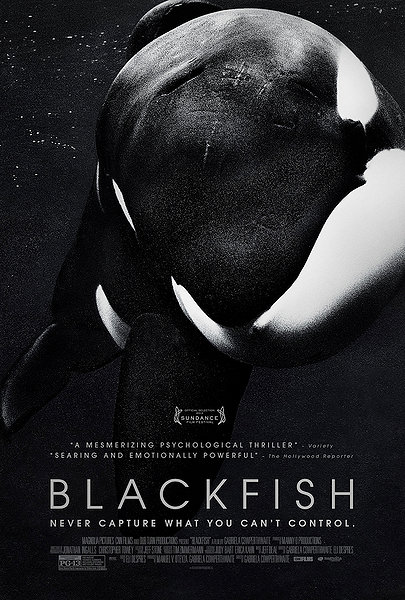
Movie Review: Blackfish

BlackfishBlackfish is an eye-opening documentary of 83 minutes directed by Gabriela Cowperthwaite. It includes gruesome footage never seen before of injuries and deaths of whales and human trainers.

The profitable marine theme park industry, with Sea World at the top of the pyramid, does not want its lead attraction, the orca show, to be disparaged or challenged. As a result, Sea World apparently creates false facts, misleads its own trainers, and covers up the truth after accidents inevitably happen.

The documentary tells the story of the notorious performing whale Tilikum, who, unlike any orca in the wild, has taken the lives of several people while in captivity.

Tilicum was captured when he was only four or five years old and brutally taken away from his mother and has lived in captivity ever since.

If I had been taken away from my mother at age five and kept all my life in a 12 by 16 foot cell, the proportional equivalent of a killer whale tank at Sea World, while having to perform stupid and unnatural tricks for audiences on a regular schedule, I would have been psychotic too by the time I was 45 years old.

Having a life-long interest in non-human intelligence, I had to watch this documentary. Evidence to my interest in cetaceans and their intelligence is the fact that “Cetaceans” is one of the categories in this blog that you can search. Here is one article that deals specifically with intelligence of whales.

I think that the time of animals in circuses is gone. That counts for elephants in big tents, lions and tigers in Las Vegas, and whales and dolphins at Sea World and any other captive commercial programs. Ironically I just got back from Hawaii, where I talked with a trainer working for Dolphin Encounter.

Dolphin EncounterThey have 13 dolphins who live and perform there, supposedly all born and raised in captivity. She argued that the dolphins have it better there than they would in the wild, with free healthcare and room and board. There happened to be a veterinarian there doing stomach imagery with scopes down the dolphins’ throats while we were standing there watching.

The dolphins seemed ok, but we can’t talk to them, and they can’t tell us how they feel – so how do we know?

The documentary movie Blackfish brings this controversial subject right in front of the public. It can’t be good for Sea World. I am saying this when I live within 30 minutes of the park in San Diego. Sorry, Sea World, it’s time to figure out how to make money without imprisoning and enslaving fellow sentient species.

Rating - Four Stars


Fox Cub Really Needs Help

Animals know more about people than we think. Here is a darling little Russian video of only 45 seconds that makes the heart warm.

Translation:

1: He’s coming to us

1 & 2: It’s a fox cub

2: Hold the phone and film

1: Oh fuck he’s in, come on, come on

2: Where is the thank you?

1: Thank you (In cute voice imitating fox)

1: He would have died that way

Commuter Dogs in Moscow

Commuter Dogs

In Moscow, there are stray dogs that learned to commute to downtown from the suburbs to scavenge for food. The dogs prefer the less populated cars at the beginning and end of the trains and they stick together to help each other so they don’t miss the right exits. They even learned how to use traffic lights to cross safely. Every evening, they ride back  home to the suburbs where they hang out for the night. This has been going on for 20 years, several dog generations. Clearly, they teach each other.

Read more about it here.

I think we don’t give animals enough credit. They really aren’t very different from us.

Book Review: Dolphins, Myths & Transformation – by Ryan DeMares

DeMares is the first person to hold a doctorate in interspecies communication. Her emphasis is on transpersonal consciousness, the human-nonhuman animal bond, and bio-ethics.

Much of DeMares’ research focuses on the mammals with the highest intelligence, including primates and cetaceans. Surprisingly, there are more animals than we think that have rudimentary language. For instance, prairie dogs have extensive vocabularies for danger intrudors, with different words for human, antelope, coyote, snake and so on, with even distinguishing words for color and shape of the intruders.

But in this book, she focuses mostly on dolphins. There are many other dolphin researchers that she introduces, including the infamous John Lilly, who is probably more known to us from his 1960ies subculture of drugs and particularly LSD, than from his groundbreaking dolphin research. Both Lilly and DeMares believe that dolphins are at least as intelligent as humans, perhaps even more. They believe they have a complicated language, oral history, ethics and highly developed social order.

The book also talks about the more foo-foo stuff, like dolphins as healers, dolphin consciousness and how it affects humans, the euphoria and well-being that humans achieve from swimming with dolphins, dolphin dreams, and the like. I went quickly through those pages, but I ate up the science stuff.

The complexity of the dolphin brain, its very different way of perceiving the world, particularly through echolocation, is highly inspiring.

I did not know that the US Navy uses Low Frequency Active Sonar (LFAS) that turns out to be a highly destructive technology that causes extreme suffering, bleeding, disorientation and permanent physical damage, including death, to cetaceans. The navy just started using this technology in 2003, when this book was written, and it was not being deterred by animal rights activism and scientists. I don’t know what the navy has done with LFAS since, but if it has applied it as planned, there must be carnage out there now. I need to do online research to confirm this.

DeMares’ book is a must-read for anyone interested in cetaceans, cetacean intelligence, alien linguistics and alien studies (since I consider dolphins aliens in a true sense of the word).

I have made jokes about his: We humans always wonder what it would be like if aliens landed on earth. They clearly would not speak English. Would we be able to communicate? Absolutely not. We have aliens living in our midst, all over the oceans, the cetaceans. They are just as smart as we are, yet very few humans have ever had anything resembling a conversation with a dolphin. We have walked this earth, if you include our earliest ancestors climbing on trees in Africa, for about 6 million years. Cetaceans have been here for 20 to 50 million years. Yet, we have no connection with them.

DeMares has helped with positive progress in  this quest with Dolphins, Myth & Transformation.

Book Review: Into the Deep – by Ken Grimwood

If you read my post about Replay, Ken Grimwood’s time travel novel, you would have seen my reference to Starsea, a movie that takes a central role in the plot of Replay.

Into the Deep is the story of Starsea. Dolphins, and cetaceans in general, are presented as sentient beings with a level of intelligence equaling that of humans. In the book, we get to know four human protagonists, a marine biologist, an investigative journalist, a petroleum engineer and a tuna boat captain. The four become, through the course of the story, interconnected and end up collaborating at the end, as unlikely as it would seem at the beginning. We also get to know many dolphins, with names like Ch*Tril, Qr/Tal, Tk/Lin, etc. The author does a wonderful job telling the story from the point of view of the dolphins, and we start thinking like they do, we view humans like a dolphin would.

We humans can visually look around a room and see a bottle of wine on the coffee table, a painting on the wall, a candle burning in the mantle of the fire place, and the television set on, sending pictures our way, all with a scan of our eyes, taking in object shapes, textures of those objects, colors and opacity of the objects.

Dolphins can see like we do. However, they can also echo locate, sending ultrasound signals out into dark or murky water and hear the echoes coming back like a submarine’s sonar. Using no vision at all, a dolphin can create a picture in its brain with that same level of detail. It can ‘see’ a coin on the bottom of the sea, a lobster crawling, a rock in its way, and it could determine the texture and shape of those objects, as clear as we can do it with vision. But it goes a little further. Since it’s sonar, the dolphin can look right through soft tissue and ‘see’ the skeletal structure underneath, of humans, sharks or other dolphins. If a dolphin were to have a racing heart due to an adrenaline rush from being frightened, another dolphin would clearly see that racing heart. A dolphin can draw conclusion about another dolphin from seeing inside like we humans can when we see somebody blushing, perhaps.

The dolphins call the humans land-walkers. They see them only from a distance, except when they come out to the sea in strange, fragile hulls with large white dorsal fins on top of them. The dolphins observe the humans and think of them as communication handicapped, since they apparently can only communicate by flapping their front-mounted blowholes making crude noises in a narrow frequency band.

Here is an excerpt from the point of view of one dolphin that has swum up to a beach where he is surrounded by a bunch of people delighted about his appearance:

Then he turned his attention to the young ones. They swarmed around him, reaching out to touch him with the squirmy little growths that sprouted from the ends of their upper appendages. He allowed the contact, even enjoyed it when they stroked him gently; but he remained alert, because each of those wriggling growths was tipped with something hard and sharp, like miniature crawler-claws. He’d received a few painful scrapes on his delicate skin during the first few of these encounters, but the young ones seemed more careful now, and usually onely touched him with the soft pads beneath their claws.

One young female, smaller than the others, was standing hesitantly aside from the boisterous group that had rushed to meet and touch him. Tk/Lin scanned her internally and saw that her heart was racing, the muscles around her stomach were tight. An adult male was urging her forward in the water, but she held back, clearly afraid.

Tk/Lin peeled away from the crowed of fearless young ones around him and made his way slowly, ever so slowly, toward the trembling little female. he stopped two beak-to-flukes from her and raised his head above the surface, swaying it to and fro in a gentle rhythm timed to mimic the normal land-walker heartbeat. The young one watched, entranced, but  still she clung to the lower limbs of the long male behind her.

Two of the bigger young ones came splashing toward Tk/Lin, eager for more active play, but he warned  them away with a slight thwap! of his flukes against the water. They retreated, and Tk/Lin turned his attention once more the the frightened little female. Keeping his distance from her, he rolled methodically from one side to the other, showing her his dorsal, his pectoral fins, his soft white belly. She watched in silence, her eyes round.

One of the many-colored spherical things filled with air that the young ones often tossed to Tk/Lin was floating nearby. he nudged it with his beak, and it rolled across the placid surface to the young female. She reflexively let go of the adult’s limbs and caught it between her own upper appendages. She stared at the toy for a moment, then at Tk/Lin, and gave the weightless sphere a push back in his direction. He chittered his approval and bounced it back toward her, a little harder this time.

The young one’s face contorted, her mouth curling upward at the sides in the land-walker gesture that Tk/Lin had learned to recognize as indicative of amusement or contentment. She slapped the toy back again, through the air above the surface; her aim was off, but Tk/Lin easity darted to meet it and toss it back to her. The young one squealed and tossed the brightly colored sphere again and again, ignoring the adult behind her. Her muscles were relaxed now, Tk/Lin scanned, her heartbeat steady and normal.

As I stated in my review of Replay, I am fascinated by the concept of cetacean intelligence and I will write some blog entries about that subject alone shortly.

Into the Deep, of course, is a fictional story, with a plot line that stretches a bit beyond where I would have taken it, but it’s wrapped into basic concepts that are fascinating and entertaining.