Book Review: The ’86 Fix – by Keith A. Pearson

Craig Pelling is a 46-year-old man in England in 2016. He lives in alcohol-soft middle-age, to use a Pink Floyd phrase. He is pudgy, balding, out of shape, lazy and overall a fairly unlikable character. He has lived for more than 20 years in a love-less marriage, and his career, by his own standards, has been lackluster. When an old high school classmate and bully of his becomes his new boss, his whole world comes crashing down.

His parents are moving out of their house into a retirement home and ask him to come home and clean out his childhood room. When he turns on the computer, something surreal happens and he is transported back into this 16-year-old body. He gets to spend a weekend as his teenage self, with his middle-aged man’s experiences and knowledge of his future. He is determined to set some things right. Can he fix his life, and the lives of those around him? He definitely tries.

The first half of the book is describing Craig’s failures and current situation in 2016. It’s kind of slow and boring, being the fairly unlikeable character that he is. At about the mid-point he performs the time travel, and things get much more interesting. The pace picks up.

But the ending is terrible. Readers want to see the hero win, they want an upbeat story. The ending is deflating and depressing, and it becomes obvious that the writer simply set us up to read the sequel.

In addition to lack of editing regarding the plot, and the marketing of the book, it also has a good number of grammatical errors that somewhat distracted me. I was going rate this book two out of four stars, but the horrible ending just depressed me and I am downgrading it to 1.5 stars.

But that’s apparently not going to stop me from buying Beyond Broadhall, the sequel. I want to know what happens to Craig next.

Book Review: The Planters – by Victor Zugg

After reading A Ripple in Time, I wrote this review but I didn’t think I would read another Zugg book. Then one of my readers commented under that review, challenged me by pointing out a grammatical error in my blog entry while I criticized Zugg for his, and told me there was a sequel. Well, I couldn’t leave a time travel book unread.

But, unfortunately, it’s not a time travel book.

Mason, the protagonist, makes it back to 1720 at the end of A Ripple in Time. In The Planters, he comes out on the other side and the story tells how he finds his way back to the plantation, reunites with Karen, Jeremy and Lisa, and how they make a living running a plantation in 1720.

The twist is Nathan, one of the antagonists in A Ripple in Time, who unexpectedly survived the pirate raid and comes back to the plantation. While the story illustrates life in 1720 in South Carolina, and while the four survivors are occasionally drawing on their knowledge of history to drive their actions, and while Mason uses his Glock automatic pistol once to save their lives against pirates, there is absolutely no time travel in this book. Therefore, it would have been more effective to just call it a historical novel, but as such, it would not have lived up to those of the greats like Bernard Cornwell, for instance.

There were no significant grammar error in The Planters, unlike there were in A Ripple in Time, or at least I didn’t notice them. Perhaps the author had more proofreading done. I applaud that.

The way the story ended left it open to another sequel, which I definitely will not take the time to read.

Book Review: First Encounter – by Jasper T. Scott

Trappist-1 is a star system about 39.5 light years away. The star is an ultra-cool red dwarf star in the constellation Aquarius, and it is found to have several earth-like planets with the potential to support life. Humanity sends a starship to explore the system.

The Forerunner One, a starship capable of traveling at half the speed of light, is outfitted with a crew that spends the 78-year journey mostly in cryogenic sleep. At half lightspeed, time on the ship moves 15% slower than it does back on Earth, due to relativistic time dilation.

But while all this is good stuff for a solid science fiction story, it’s not really relevant. As it turns out, the crew arrives at their destination, and without much thought or preparation (would you think?) they land on one of the planets, only to be attacked by the local fauna within a few hours of landing.

The local intelligent species is aviary. They are smaller than humans, about 4 feet tall, skinny, birdlike, and they can fly. The humans call them Avari. They have far superior technology compared to the humans, and within a day of arriving, having traveled most of a century, the humans are driven back to their ship and forced to flee – you get it – back to Earth.

Spoiler Alert:

It turns out that the Avari have technology to cloak themselves and even their ships. So they can be invisible. Two of them sneak on board of the human ship undetected and start wreaking havoc on the way home. Not only that, they breed a hybrid avari-human fetus in one of the females on board. Obviously, this sets things up for a lot of surprises on the trip home.

There is a twist at the end, which makes it clear that the entire book First Encounter is just there to be a setup for a series of books called The Ascension Wars, and this is Book 1.

I didn’t care too much about the writing style, the loose and unrealistic plot, and the shallow character development overall. First Encounter seems a little bit like pulp fiction, or worse, action hero comic book material. If you like light science fiction, this might be reasonable entertainment. But for me, I am done reading this series.


Book Review: The Space-Born – by E.C. Tubb

Here is a generation ship story that could have been something, but unfortunately, it was not much of anything.

First, look at the cover above! It has nothing to do with the story, nothing at all. Of course, you don’t know that when you first pick up a book. As the trite saying goes, “thou shalt not judge a book by its cover.” Covers don’t matter much anymore in the age of digital delivery, when you don’t see the book laying around or on the shelf anymore. So why do covers still matter to me? I subscribe to the opposite: “Thou art entitled to judge a cover by its book!”

Call me old-fashioned, but I want my book covers to relate to the story – somehow. And this does not.

“The Ship” in this story is a giant egg-shaped vessel that spins on its center axis. Inside the decks are arranged in concentric circles, the outermost decks being the “lowest” ones with an artificial gravity due to the centrifugal force of about 2g. In the center, around the axis, is No-Weight, since there is no spin at all. The decks between No-Weight and the lowest decks are under progressively stronger g-forces. Look at the cover above and now tell me how this spaceship might resemble the actual ship in the story.

The ship left Earth about 300 years ago with 5,000 souls on board. It is on a journey to the star system of Pollux, which is one of the main stars in the constellation of Gemini, where earthbound research has found that there is a high likelihood of several habitable planets. Pollux is about 33 light-years away. At a speed of about 1/10th of the speed of light, the journey should take about 300 years.

The inhabitants of the ship are born, grow up, choose careers that are needed to maintain the ship and its small society, and once they reach a certain age around 40, they are old enough that they need to make room for the next generation. In a society that is stagnant and cannot grow in size for 300 years, where resources are absolutely limited and where there is no room for error and no possibility of replenishment,  it’s clear that absolute discipline is necessary to maintain a stable society and a healthy population.

The problem is: a computer decides who has to die when, and the “psych police” then executes the candidates, basically by murdering them, and making it look like they died by accidents. And here lies my problem with this story.

As I said above, the ship left Earth about 300 years ago. That would be like us living in an enclosed environment where 14 generations before us lived and died, since about the year 1720. That puts things into perspective. Would you not think that in 300 years they would have devised a method of maintaining a stable society that includes some form of natural death and does not rely on systematic and institutionalized murder? And would you not think that the population might have figured out what’s going on and worked on a better solution?

Be that as it may, this is the central conflict of the book, and a twist at the end makes the whole thing a bit more palatable than it was for me through 90% of the book. So it went from half a star to one-and-a-half stars in my rating.

It is, after all, a generation ship story, and I have a search category for this in my blog, and I always read them when I come across them.

Book Review: Genesis – by Ken Lozito

Genesis is the first book of the author’s First Colony series. The story starts about the year 2200 on earth when humanity decides that it needs to send its first colony to the stars. Mankind pools its resources, builds a massive starship the call the ark, and recruits about 300,000 of its best and brightest for the one-way journey of 80 years. The travelers sleep in stasis, which means they are not conscious during the journey.

The protagonist is Conner Gates, a colonel in the special forces, who leads his squad on some of the most dangerous missions in the solar system. Through a series of unexpected events, he ends up as an unwitting stowaway on the ark. He is portrayed as a know-it-all expert of all trades and therefore wholly unrealistic and cartoon-like. Conner is just not acting like a real person would.

The story plays entirely on an alien planet hundreds of years in the future, but what is actually going on is pretty much military training nonsense that could be happening anywhere on earth.

The book is crafted in a way that the author is building a world for a series of books that can have stories take place in that world. He spends a lot of time on the minutiae of military training of special forces recruits, which fits the plot, but is overdone considering the larger epic he is trying to create. The last 10 percent of the book is very different from the main work and is presumably only there to set the stage for the next book in the series.

I don’t know why the book is called Genesis, and I can’t find anything on the cover that actually relates to the story.

In the end, while it was an interesting read, it wasn’t interesting enough for me to spend the time to read the next book in the series. There are eight, by the way. I am stopping at one.

Book Review: The Visitor: First Contact SF – by Tony Harmsworth

Evelyn Slater is a young British astronaut on the International Space Station in the near future in 2036. She is a mission specialist with a psychology degree who is assigned to command the first spacecraft specifically designed to capture and destroy low earth orbit debris. During the first mission out with her Russian pilot Yuri, they encounter an artifact they immediately recognize as alien. When she eventually returns to earth, Evelyn leads a team of scientists who study the alien device.

The Visitor is a first contact science fiction story that plays largely in today’s world. It speculates about the response of our international community when it discovers that there truly are aliens. Xenophobia, religious hate and bigotry get the masses riled up.

The author writes in a stilted style. He does not show the story, he tells the story. It’s not clear why he picked a woman as the protagonist. It would have worked just as well with a man, and he would likely have been able to portray the male thinking a little bit better. The Visitor is described as a “hard science fiction” story, but it did not strike me as very hard. I enjoyed the detailed descriptions of life on the space station. He must have had access to first hand information. Otherwise, the story is weak and, frankly, not very interesting. All the characters are flat and colorless. Nothing seems real or realistic. Reading The Visitor, I was constantly aware of the fact that it was just the author’s way to communicate his political and philosophical views, thinly wrapped into a shallow plot.

At the end, he sets it up for a sequel, and I don’t think I am interested enough to read it.

Movie Review: Ad Astra


Roy McBride (Brad Pitt) is an astronaut in the nearer future, a time when trips to the Moon and to Mars are routine and humanity has started venturing farther out, mining the asteroid belt, and reaching for the gas giants. When Earth is suddenly bombarded by massive and destructive power surges from a mystery energy source at the planet Neptune, McBride is recruited to help. As it turns out, the only person who ever traveled to Neptune was his own father, a decorated astronaut who was the first to reach Jupiter, then Saturn, and finally embarked on a mission to the edge of the solar system, to Neptune, presumably to seek out alien intelligence in the universe. But when he arrived, he and his crew perished and were never heard from again – or were they?

NASA suspects that the elder McBride near Neptune is still alive and has something to do with the power surges that threaten to destroy the earth. In order to communicate with him, NASA recruits his son, Roy McBride, because they think the father is likely to respond to the son. And thus he goes on a long journey.

Ad Astra is the Latin expression for “to the stars.” There nothing about stars in this movie, other than neat special effects of space travel. The entire movie and the ludicrous story that does not make any sense just seem to be an excuse to string together some interesting and effective special effects.

I watch pretty much every “large” science fiction movie because I am interested in space travel and humanity in the future. So I enjoyed the movie, even though it insulted my intelligence every few minutes along the way. There is so much wrong with this story, it’s hard to know where to start.

Warning: Significant Spoilers Below – even though I don’t think they’ll really interfere with your enjoyment of the movie, since it’s such a weak plot anyway.

First the basic premise: NASA recruits Roy for the top secret mission to travel to Mars, via the Moon, to send a message to Neptune to his father, with the option to eventually fly out to Neptune to stop the threat to the Earth. The journey to the moon is equivalent to an airline ride coast to coast for us. It’s all routine. But when they arrive on the moon, for some odd reason, they have to travel by rover overland to another base from where the rocket to Mars is launched. But there are now pirates on the moon, and they prey on travelers and attack them by rover. Everyone is in spacesuits and they are shooting each other up, like in a western, but rather than riding horses, they ride rovers in space suits. I wonder what the pirates are trying to gain. The whole chase is just a useless filler that takes up 5 or 10 minutes of movie time and adds nothing to the story.

Along the way to Mars, there is a mayday call from a research vessel, and the ship stops to try to help. I will spare you with what happens on that research vessel. It again has nothing to do with the movie other than adding some special effects footage and scary scenes. The problem is, how did the chemical rocket they were riding to Mars stop along the way, line up with the stranded vessel and match trajectories so they can board via space suit? And then start up again going on to Mars. The trip to Mars is supposed to take a few days, so the stopping and starting along the way would have taken massive amounts of acceleration that no human could possibly endure. But, it’s a movie, I guess.

Once Roy arrives on Mars, he is guided into a secret sound-proof room where he records a message to his father that is then sent to Neptune via a laser beam. After sending the second message, it appears there is a response. That is quite odd, since Neptune is about four light hours away from Mars, so the round trip of a message would take eight hours. You would not stand there waiting for it. But that’s what it looks like they are doing. Then they decide to send Roy back to Earth because they think he is not psychologically ready to continue with the mission. So explain to me why Roy bothered to travel to the Moon, get attacked and almost killed by pirates, then on to Mars, just to record a message? He could have recorded that message in his living room on Earth and they could have sent it to Neptune.But, it’s a movie, I guess.

He eventually forces his way onto the ship that travels on to Neptune. The trip will take 79 days. Again, massive accelerations and speeds are required to make that happen, and it’s not clear how the simple chemical rocket technology they have accomplishes that. As we observe him on his journey, there are some convenient shots of the ship right in front of Jupiter first, and then a bit later of Saturn, as if the outer planets were all lined up in a straight line and the ship would travel from one to the other. As it is, the planets are spread out all over the solar system, often on different sides of  the sun, and a rough alignment only happens every few centuries. It seems to have happened for Roy’s journey.

Neptune has a thin set of rings. Roy put his craft in an orbit right above the plane of the rings, so he has to conveniently dive through the rings to get to the craft of his father. I enjoy thinking about floating in the rings of Saturn, and I wrote this entire post about that. So I enjoyed that scene, even though it was way too contrived. I also got a kick out of how Roy decided to return to his craft through the rings after he loses his shuttle. He uses a sheet metal panel to protect himself against impact of ring particles as the dives through. Then he finally gets back and collides with his own craft due to their velocities not being matched very well. Good scene there.

Finally, when the movie is over, somehow Roy has to travel back to Earth. To do that, he invokes a Deus ex Machina technique: he uses a nuclear explosion to propel him. Somehow the three dimensional vector between the nuclear explosion and his ship is perfectly aligned so the ship travels through the 2 billion miles plus back to Earth and hits it exactly. Yeah, sure!

As you can see, this is a movie for people that do not understand science, know nothing about space travel, and just want to see neat special effects. They might enjoy this

For the geeks, like me, Ad Astra is just silly and a waste of a good opportunity. All that money and technology could have made a good movie and a good story instead.

Movie Review: Landline

Landline was released in 2017, but plays in Manhattan in the 1990s.

Two sisters are struggling with their own lives. Ali, the teenager, is fighting with coming of age troubles, boyfriends, drugs and growing up in the big city. The older one, Dana, is recently engaged but finds herself in lust with an ex-boyfriend and is trying to come to terms with her feelings. They discover that their father is having an affair and they try to figure it out without telling their mother.

This Woody-Allen-esque drama plays in Manhattan in the 1990s. You can tell because all the phone calls are done on landlines. No Internet, texting or smart phones. There is on old Mac computer that contains files that expose the dad. Why he would just leave those files on the family computer for all to see is strange and an apparent plot hole.

I don’t know why the movie is called Landline. The title has nothing to do with the story. I also don’t know why they staged this in the 90ies. It might have been more effective, and simpler to do, if it had played today.

It’s mildly entertaining, makes you think about family, love and dreams of youth that dissipate as we go through life.

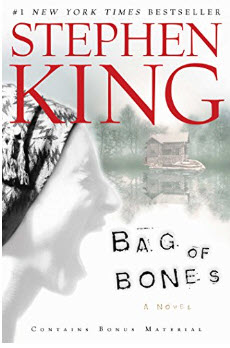
Book Review: Bag of Bones – by Stephen King

Mike Noonan is a successful novelist in his early forties in Maine. When his wife Jo suddenly and somewhat inexplicably dies in the prime of her life, Mike goes into crisis. Writer’s block keeps him from working. To get a break, he decides to move into their vacation home in the south of Maine.

Surrounded by small town life, the starts to see improvement right away. But then he meets Maddie, a woman in her early twenties, a widow, with a three-year-old daughter named Ki. Mike quickly falls in love with the little girl, and in lust with her mother.

He finds out that the tech billionaire named Max Devore, who has a house in town, is the grandfather of Ki, and he is trying to wrest custody from Maddie. As Mike starts helping the young mother fight back, he encounters that he does not live alone in his house.

There appear to be ghosts.

Stephen King is a master storyteller. Bag of Bones is a thick book of 529 pages. It drew me in and kept reading, despite the fact that large portions of the narrative are about Mike’s dreams. Stephen King writes a lot about dreams in many of his books. The Stand is full of dreams. Dreams of King books are always nightmares, and he describes them explicitly and in detail.

I can’t stand reading about dreams. They may move the story along or embellish it, but I always lose interest when I have to read about somebody’s dream, and I start turning the pages quickly to get through them. The violent ghosts, the killed children, the dark secrets of the town that everyone hides from the strange intruders like Mike, all get jumbled together into a plot line that probably works, is meticulously sketched out in Stephen King’s notes, but sorry – I got lost quickly and it went downhill from there.

King is a master storyteller, and I kept reading because I just enjoy his skills. But other than that, this book is just a Bag of Bones.


Movie Review: The Hunted


In 2003, L.T. (Tommy Lee Jones) is cozy in his retirement in his cabin in the woods in Oregon. He used to be in the special forces, where his assignment was to train soldiers to kill in hand-to-hand combat. When someone brutally slaughters four deer hunters, the FBI calls on L.T. to help them find and apprehend a murderer. They suspect a rogue special forces soldier.

Sure enough, Aaron (Benicio Del Toro) is one of L.T.’s trainees, one of the best there is, and mentally damaged beyond hope by terrible trauma he was exposed to during the conflict in Kosovo.

When L.T. comes after Aaron, he is unarmed, and it is not clear what he was thinking. Two trained killers are at each other’s throats for the duration of the movie.

This is Rambo, First Blood, part two, only much less refined. Two men, trainee and mentor, fight to the death with — it had to be that way — knives they made from scratch in the woods. L.T. fashions a knife from rock splinters. Aaron forges a knife from scrap steel he finds at a ruined embankment. As the two go at each other, we are subjected to completely unrealistic blood scenes. The human body only has about six quarts of blood. It seems like both fighters spill more than that in each of their fights, and they somehow keep walking away without bandages each time.

The Hunted has been around. It was released in 2003, and you have probably seen it flipping through the channels more than once over the years.

If you want to watch a movie about a damaged special forces soldier going berserk, watch Rambo, First Blood instead. It’s a much better movie.

Movie Review: Breaking In

Rich, old, fit black man in big city puts on headphones and expensive watch and goes for a jog. Bam! He gets hit by car and dies. Shock – I didn’t see that coming.

His estranged daughter and her two children are driving to his house in the country to get ready to sell the house. The house turns out to be a mansion with all kinds of security gadgetry. But something does not seem right.

Four bad guys had broken in. They somehow got wind that the old man had liquidated all his assets and there was a lot of cash in the safe in the house. All they had to do is find the safe, open it, and take the money.

But darn it, the family shows up and makes things difficult.

The mom and her children turn out to be quite resourceful against the four bad guys, of which one is a very bad psycho guy.

A predictable story, told many times over. Normal people get in the way of really bad people, and have to fight their way out. In this case, with the gadget house, it’s Home Alone for Adults.

Alright, I was entertained for a bit, found myself cheering for the underdog, but in the end there was nothing much to remember about this movie.

Book Review: The Sparrow – by Mary Doria Russell

In the year 2019, scientists at the Arecibo radio telescope in Puerto Rico searching for extraterrestrial signals, finally succeed. They identify signals from the star Alpha Centauri that are unmistakably artificial. Through clever trials the scientists conclude that the signals are music. Mankind has found another intelligent and technological species.

Alpha Centauri is 4.3 lightyears away, the closest star to our own. A close-knit clique of friends in Arecibo, led by Jesuit priests, decide to launch a human mission in a spaceship to Alpha Centauri. The Jesuits want to meet those other “children of God.”

They build a makeshift spaceship using an asteroid and mining equipment and technology that is capable to accelerate to about 90% of the speed of light within a year, making the trip from Earth to Alpha Centauri take about 17 years, including acceleration, deceleration and mid-cruise coasting. However, due to time dilation at relativistic speeds, the crew only experiences eight months of travel. The idea is that they can go to meet the aliens, spend a few years there, and come back, and be five years older, while of course the time on Earth would have advanced almost 40 years by the time they came back.

Eight people go on the journey, four of which are Jesuit priests, the Father Superior also being the captain and pilot. The other four are the young astronomer who found the signal, a young female scientist and a doctor/engineer married couple in their sixties.

They reach their destination, find two coexisting species of aliens, and start communicating with them. Through a series of misunderstandings and accidents, most of the crew perish over the period of a few years, and only the protagonist, Emilio Sandoz, a young priest, eventually returns to Earth in 2060. He is severely injured, seriously distraught and psychologically damaged.

Now the Jesuits want to know that happened.

I read this book as it was recommended to me as a good science fiction book with a focus on philosophy and morality. I welcomed the tip since I love first contact novels, particularly when they are coupled with relativistic space travel concepts. The Sparrow promised to be all that.

I was also intrigued since I had speculated myself about traveling to Alpha Centauri, and what that distance would mean:

If the sun were the size of a red blood cell, which is about seven micrometers in diameter, then the distance to Alpha Centauri would be about 219 meters. That’s a little bit more than the length of two football fields. Ok, let’s picture that. The sun is an invisible speck the size of a red blood cell with the solar system the size of a tangerine. The nearest star and its planets  would be more than two football fields away. Just imagine the massive amount of empty space in all directions, left, right, forward, back, up down of empty space. 

See the entire post here for reference.

The Sparrow edition on my Kindle is 518 pages long. It was first published in 1996. So 2019, the start of the journey, was in the distant future, and the Search for Extraterrestrial Intelligence (SETI) program was still in its early stages. No significant exoplanets had yet been found. It was a bit odd to read this book for the first time now, in 2018, when 2019 is just a few weeks in the future.

While this book has earned a lot of awards and acclaim, and gets great reviews, I found it very hard to read and extremely disappointing overall.

All the Jesuit philosophy packed into the story just took up space and bored me. Pages and pages of Emilio dealing with his own celibacy vows while he was lusting for the only eligible young female on the crew didn’t add to the plot in any way, and simply didn’t interest me. This book could have been condensed to about 200 pages, would not have lost any impact, and it would have been a better book.

In der Kürze liegt die Würze.

And then there were the aliens. Two conveniently humanoid species, one evolved from a herd animal, to become the worker and slave race, the other evolved from a carnivore and predator species, both adapted to each other to look like humans with tails. Also, conveniently, they talked human-like languages that the humans could learn quickly, and their social behaviors and customs were like those of exotic human populations, not aliens.

The book’s structure made it difficult to read. There are two leapfrogging lines, one telling the discovery, the journey out, and the stay of the humans with the aliens, starting in 2019. The other starts in 2060, when Emilio returns and follows the enquiry into what happened.

Through this, the reader already knows that the journey does not end well, and the whole book is about finding out what exactly happened. But the narration is so poor and inconsistent, I found it hard to follow. Sometimes it seemed like the protagonist was talking and telling the story, other times the writer used lots of exposition to tell the story. It was always inconsistent and jarring when the switch happened from one mode to the other.

Endless pages about the “philosophy” and “morality” as some readers praised it just seemed like psychobabble to me. The book’s description calls it “deep philosophical inquiry.”  I felt like the author wanted to lecture me with her worldview, which I didn’t care about, and she packaged it into a pseudo science fiction book to make it interesting to me.

It didn’t work.

Reading The Sparrow was work. I finished only because I try to finish every book I start. I am glad I am done. And I will NOT read the sequel, titled Children of God.


Movie Review: In Saturn’s Rings

I have waited for In Saturn’s Rings for several years and have followed their Facebook page. It took the producers years longer to finish it than they thought it would. It was supposed to be done on December 31, 2014, but was finally finished on May 4, 2018. It is a 42-minute documentary made exclusively from real photographs taken by spacecraft, from the Hubble Space Telescope to the Cassini-Huygens space craft. The movie uses no computer generated graphics (CGI) technology. All images are arrangements of actual photographs.

There are not many places in the country where the film is currently shown. On my visit to New York City I decided to go out to the New York Hall of Science in Flushing, NY, about 30 minutes outside of Manhattan where it is currently playing.

I have always been fascinated with Saturn and its rings, and I have written plenty about it here. Here is one of my descriptions from almost five years ago where I marvel about floating in the rings and then actually refer to this movie.

But I was disappointed. Perhaps I am spoiled by the amazing CGI production in movies and documentaries where pictures are enhanced and animations are smooth and stunning. In Saturn’s Rings seemed flat and boring in comparison. But again – I realize that there is value in looking at actual photographs, not made-up stuff. And I give the producer credit for that.

However, there is too much fluff in the movie. It starts out with the Big Bang and plays images of Hubble of distant galaxies. Then it moves into an odd collage of photographs of science and scientists, wasting a lot of time on those flying and merging still photographs that didn’t add any value to the message or the film itself. There were fillers, and there were too many of them.

The film is narrated in parts, but some of the descriptions of images were subtitled rather than narrated. I found that annoying. The images were there for a short time, and rather than looking at the images, I found myself reading the captions that described what I was looking at while the narrator was silent. Then the images were gone and the next ones came up. I missed them. This happened a lot.

In Saturn’s Rings is an admirable effort but ultimately not worth it. The images you see in the movie would be much more valuable in a book. Buy a book on the Cassini mission and I am sure you will see the best photographs there. You can read the captions in leisure, and then look at the images as long as you want. In the movie, you only have a few seconds before the next one comes along. Having the image move, or zoom in or out is not adding enough value to account for the brevity of the viewing experience.

As coincidence would have it, I was flipping through the channels yesterday and came across the Science Channel and found Space’s Deepest Secrets – Cassini’s Grand Finale. This was a documentary about the Cassini mission and it showed spectacular graphics of Saturn taken by Cassini but it also provided professional narration and interviews of scientists along with the history of the program. The subject was similar to that of In Saturn’s Rings, but done much better.


Movie Review: We The Animals

We the Animals is the story of three brothers of a Puerto Rican family in the U.S. who have a strong bond amongst each other. Manny and Joel are the older ones (somewhere between 10 and 12 years old) and Jonah is the youngest at 10. Jonah is different. He is more sensitive, and likes to draw. To avoid ridicule, he does it when hiding under this bed where he has stashed his notebook inside the bottom of the mattress. Their father, Paps, is loving and supportive to them, but abuses his wife and from time to time abandons the family. Their mother, Ma, is very young and tries to shelter the boys, particularly Jonah, from the world. But she is not very successful, as she descends into depression and virtually abandons her care of her kids for days on end. The boys are left to fend for themselves, by stealing, by scavenging, and by sticking to each other. We the Animals!

This is a thought-provoking film with interesting, refreshing cinematography, quite a bit of fantasy, that gets into the heads of the boys. Their acting is superb. But I found the movie hard to watch, due to the disturbing subject matter.  After a while I felt I knew what the story was, and I just wanted it to be over. I was bored. It ended abruptly after 92 minutes, but if it had ended after 60 minutes, I would not have missed anything either.

Book Review: Boy Gone – by Mark Wayne McGinnis

Scotty, a nine-year-old boy, and his dog, can’t wait to run down to the beach upon arriving at their parents’ summer house on Nantucket. They are never seen again, until they mysteriously reappear 16 years later.

As we learn later, Scotty was abducted by a UFO. The aliens have a noble mission to save humanity from complete destruction due to a massive cosmic calamity, and abducting human children is part of that mission.

I was looking forward to a nice alien story, but I was disappointed. The aliens are called the Vallic and they are 97 percent energy. Viewed by a human they are simply faint blue outlines – of humanoid structure. I was disappointed because, like in so many science fiction books, here are aliens that are humans in costumes.  Not only are they humanoid, they have males and females, and the voices of the females are softer and they have – breasts. To top it off, they speak English. McGinnis is a creative author, with great ideas. Why couldn’t he have been a little more creative with the aliens?

The story employs some interesting concepts, but it was just too crude and simple for me. The author is actually a pretty good story teller, he moves the plot along, but there are too many of these “oh seriously?” moments sprinkled throughout, I never got fully immersed in the story. He kept reminding me that this was not real, with unbelievable fabrications (like aliens in human form who speak English), cardboard characters, caricatures of government officials, crazy magic-like science, and flat and boring protagonists. I was never immersed in the world he created.

I was going to blast the author for using the cutesy word “ginormous” a number of times. I really thought that was a made-up word. Before I complained, though, I looked it up, and sure enough, it’s in the dictionary, with its synonym humongous.

I stayed with it to the end, only to be disappointed that there was no resolution, no end. The book ended from one paragraph to the next, where the author tells us to wait for the next book in the series. I hate books with no ends, especially when I read one where I don’t know there won’t be an end because the author is planning a series all along. My bad.

Sorry, I won’t be reading the next one. After reading this whole book I am just not interested enough in finding out what happens next.

But I did learn that ginormous is an English word, not just slang.