Here is a video of a German language slam poem with a powerful impact. There are no English versions that I could find. The title is Behind Us My Country. If you know German, you must listen to every word. If you don’t know German, you should play a minute or so to get the cadence of the poem, and how the two speakers alternate.
Below is my translation. You can see the speaker on the right and the one on the left. Both tell their stories.
This is a powerful explanation of the complex sentiments of Germans toward refugees, that an American will likely not be able to understand.
But it rings true for me personally, as I am the son of a refugee myself and as my entire life, the person I am, is shaped in many ways by the experiences of my father who often might have said himself: Behind Us My Country.
Behind Us My Country
Everything I am was born there
Everything that was home to me
The square, where we children played
The smile of my first love
The apple tree in our park
And the little lake hidden behind the mountain
The hot tea on the tin tray
Creased story tellers
Laugh wrinkles decorate their faces
Chattering on the way home from school
Night was until the parents slept and then out again
The squeaking bicycle of my brother
The poems of Rudas
And the smell of wet lawn
Radios that despite tortured tuning still carry out the melodies
The singing of my sister in the morning
My mother, my mother with her eternal money worries
And I don’t know why: Ladybugs
All that was my home
All that way once my home
But I could not stay anymore
Behind us the war
The fresh grave of my parents
The last clump of dirt is still rolling off
It hasn’t found it final spot yet
So fresh is my mourning
And nothing has been digested
I could not stay any longer
The spoke of us as the living dead
Our people forced into trains that slid along in the smoke of the locomotives
Our doors smashed
Shopping windows in shards
Our parents intimidated, our siblings abuse
Cruel news from friends that were still there
Most had disappeared
It was impossible to stay, not another day
The next step in my city is the last step in my country
And the worst step then onto this rusty boat
Next we turn, then we hold on, and then it will sink
Turned over to the sea
In the ocean, without consolation
The moon hides behind the clouds
The night so dark, you see nothing
For hours, nothing
And when I close my eyes in the dark
I hear the voice of my mother
Around us the lord is only the sea
As if our boat was the heart of all things
I open my eyes and gaze toward the sky
Prayers are our sails
Life vests will take over the rest
But the hope they cannot carry
A man swims toward me
Here, take him, I can’t go on anymore
He is one year old and his name is Berstin
His father slides out of the vest into the eternal dark blue
That’s how I became father the first time
In the ocean
He handed him to me
The man in the vest gave me his inheritance
Arrived in exile, I learned quickly
the most important words are permit to day, sorry, and thank you
Arrived in exile I saw a family reunited after a long time
How the father wimpered out of good luck
Deep from inside with the shame of a man who seldom cries
I followed that family step by step
But only with my gaze
Arrived in exile
But the earth of home comes along on the soles of our feet
I am from there, and I have memories
I was born like people are born
I have a mother that loves me
And it breaks my heart
In the letters that she writes I can see how meanwhile her hand has a tremor
When I say homesick, I say dream
Because the old home hardly exists any longer
Do we stay here, do we become beach again?
Not quite sea, not quite land
Do we stay here, we become beach again.
Not quite sea, not quite land
Arrived in exile, a man welcomes me
The other waves foreign flags
Sometimes one feels the love, sometimes one feels the hate
They look at your head scarf
They look into my passport
But don’t be angry, forgive them
They forget the love, they forgot the love
I wish them peace
On the contrary, show them, stand up
Tear off our legs and we walk on our hands
Tear off our legs and we walk on our hands
We will make the best of our lives until our lives end
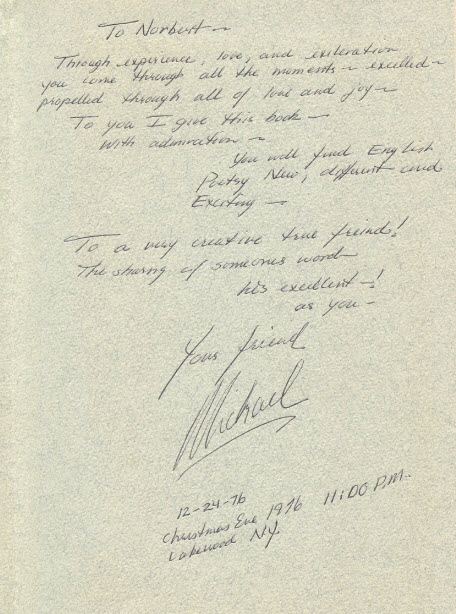
In my book purging efforts, I came across a book of poetry titled From the Berkeley Hills by George P. Elliott. My friend Michael T. gave it to me on Christmas Eve 1976 at 11:00pm, as he signed the book inside the cover.
He gave me the book when the author was still alive. We were both boys only, just out of high school. That day, when he gave me that book, was likely the last time I ever saw him.
Yet, the friendships we form at that age last forever, and the books we sign for each other stay with us, until one day when we’re gone, our children pick them off dusty shelves, open the covers and wonder who “Michael” might have been. Then they might open up to page 46 and find:
At Midnight
My hemisphere puts on
Duncely dark again.
And what was it to me
What the world wore
So long as I had a girl
With a bed to her naked back?
So long: not long enough.
For recently myself
Have donned like a dunce hat
Doubt of the monstrous works
Twirling toward day. I,
Who could fall those mortal nights
Ignorantly into sleep,
This mortal night cannot.
Everyone has memorable or favorite songs. When we hear them, we are instantly transported back to a time in our lives, sometimes to a specific period in our lives, like the senior year of high school, or even a specific day, like that first night with that special girl by the camp fire.
I noticed that when I hear such a song, I instantly mind-travel back to that period, or season, or day, when I first heard the song, or when it was popular on the radio. Some of the associations are so vivid, I can smell the air, I can see where I drove when I heard the song, sometimes as long as 40 years ago.
So I did something that I could not have done only ten years ago: I made a list of 50 songs that had special meaning to me. Predictably, many of those were songs that were popular in my youth and younger years when I tended to be more into music. To refresh my memory, I sampled collections of hit songs in some of the target years, and favorites jumped out at me that I had forgotten about.
Then I went on iTunes and bought the collection one song at a time (unless I already had it on CD somewhere). There are no artists with two songs on the list. I just picked the top 50. I called the playlist “Nostalgia.” When I play that list, in random order, I can literally mind-travel, jump around over the years and decades, and imagery of long past events flash bright in front of me, feelings and moods come to life, and the people of those days are suddenly around again – copies of their former selves, of course.
My mind always ponders mathematical implications. I realize that my list is unique in the universe. If a million other people all picked their own top 50 favorite songs and called the list “Nostalgia,” every list would be different. I’d venture to say that if I asked any random person about their list, I might not find a single one of my songs on their list. Yet, every one of us would have those unique, personal experiences when mind-traveling down memory lane.
Why can music do this to us? How is the melodic word, propped up by rhyme and rhythm, able to create such powerful associations in our heads to recreate the smells, the feelings, the places we lived when we were first imprinted with these songs?
Modern human evolution covers only a very short time span, perhaps 200,000 years, perhaps much less. Until very recently, like only a few centuries ago, knowledge and experience had to be transmitted from one person to another, from one generation to the next, by spoken and most likely sung words. Music and poetry may well have evolved to be so important in our experience now because it helped package knowledge and experience by creating associations. It’s easier to remember a poem that rhymes and is associated with a melody than it is to remember just spoken words. Those of our ancestors that were able to make those powerful associations and benefited by surviving and passing on those skills were the ones whose tribes survived through the ages. That’s probably also why we have songs that get stuck in our heads. We call them earworms.
Our brains are not good at remembering strings of numbers or words. But they are excellent at recognizing patterns, like seeing faces in tree bark or angels in clouds or animals in the stars of the night sky. When smells, images, feelings about people and places, come together with sounds, rhymes and rhythms – in short music – then magic is created.
That magic can now fuel the trips down our memory lanes unlike any generation before us could – because we have playlists to arrange them, iTunes to buy the songs from, and YouTube to trigger our memories about periods or things we have forgotten. The Nostalgia playlist is like the shoebox of photographs in the attic on steroids.
I am looking forward to a rare visit by my daughter tonight. She and her boyfriend will stay with us for a couple of nights. That reminded me of a poem I wrote the night she moved out of the house into her first apartment for her second year in college on August 26, 2004. Here it is, almost 10 years old:
Your Bed is Gone
Your bed is gone,
Your big girl bed,
That we bought when you were
Just eleven years old.
It is now in a strange apartment,
In another city,
In another life.
You needed help moving,
But you directed the effort,
Made sure we wrapped things
So they didn’t get scratched.
You have a credit card now,
To buy your own books,
You are taking care of yourself.
I have done my job well.
We had breakfast this morning,
All four of us together,
With all four beds still here in this house.
It was the last breakfast
With you as a child,
Forever to remember,
Just as the first
Breakfast ever with you.
Now I know for myself
The pain I brought to my parents
When I left at eighteen,
To a distant place,
On the far side of the world.
It took this long to learn.
The evening sun casts its shadows,
Disappears in an orange glow.
Without my permission,
It takes away this August day.
A new era starts.
I am still here, but you
Are in another life.
Your bed is gone,
Your big girl bed.
I am done as a dad,
And now ask for the honor
To be your friend.
Die Zeit ist hin, du löst dich unbewußt
und leise mehr und mehr von meiner Brust,
ich suche dich mit sanftem Druck zu fassen,
doch fühl ich wohl, ich muß dich gehen lassen.
So laß mich denn, bevor du weit von mir
Im Leben gehst, noch einmal danken dir,
und magst du nie was rettungslos vergangen,
in schummerlosen Nächten heimverlangen.
Hier steh ich nun und schaue bang zurück,
vorüber rinnt auch dieser Augenglick,
und wieviel Stunden dir und mir gegeben,
wir werden keine mehr zusammen leben.
—-
Poetry is very difficult to translate into another language. Here is my humble and awkward attempt to convey the meaning to those of my readers that do not understand German:
The time is gone, you withdraw subconsciously
and softly ever more from my chest,
I try to hold on to you with gentle pressure,
but still I feel I have to let you go.
So let me thank you one more time,
before you’re far away from me in life,
and may you never wish back in sleepless nights
that which is hopelessly lost and gone.
Here I stand and look back anxiously,
as even this moment vanishes from us,
no matter all the hours we have spent,
we may never have another one together.
I have been following the slam poetry scene for some years now, and Corey Taft is my favorite poet in the genre. Here is one of his older poems, from a number of years ago. I saw it live at the time and it gave me pause. Enjoy.
The Full Moon Poets have their poetry slam in Encinitas on the evening of a Blue Moon – Tonight. We just got back. As always, it was an amazing contest. Rudy Francisco and Corey Taft, the usual finalists, both superstars of the local slam poetry scene, were actually tied for first place at the end, something that had never happened before. So both pulled a fourth poem out of their mental drawers and blew us away at the end. Mind you, neither knew that they needed to prepare more than three poems, but both had one ready.
Rudy won in the end – and he deserved it.
If you have never been to a poetry slam before, do yourself the favor and go. Always, when leaving the event, I hear people say to their partners or groups that “this was much better than I would ever have expected.” A poetry slam is a different art form altogether, and some of these guys are amazing.
It’s a great way to spend a blue moon night in Encinitas.
Listen my children and you shall hear
Of the midnight ride of Paul Revere,
On the eighteenth of April, in Seventy-five;
Hardly a man is now alive
Who remembers that famous day and year.
He said to his friend, “If the British march
By land or sea from the town to-night,
Hang a lantern aloft in the belfry arch
Of the North Church tower as a signal light,–
One if by land, and two if by sea;
And I on the opposite shore will be,
Ready to ride and spread the alarm
Through every Middlesex village and farm,
For the country folk to be up and to arm.”
Then he said “Good-night!” and with muffled oar
Silently rowed to the Charlestown shore,
Just as the moon rose over the bay,
Where swinging wide at her moorings lay
The Somerset, British man-of-war;
A phantom ship, with each mast and spar
Across the moon like a prison bar,
And a huge black hulk, that was magnified
By its own reflection in the tide.
Meanwhile, his friend through alley and street
Wanders and watches, with eager ears,
Till in the silence around him he hears
The muster of men at the barrack door,
The sound of arms, and the tramp of feet,
And the measured tread of the grenadiers,
Marching down to their boats on the shore.
Then he climbed the tower of the Old North Church,
By the wooden stairs, with stealthy tread,
To the belfry chamber overhead,
And startled the pigeons from their perch
On the sombre rafters, that round him made
Masses and moving shapes of shade,–
By the trembling ladder, steep and tall,
To the highest window in the wall,
Where he paused to listen and look down
A moment on the roofs of the town
And the moonlight flowing over all.
Beneath, in the churchyard, lay the dead,
In their night encampment on the hill,
Wrapped in silence so deep and still
That he could hear, like a sentinel’s tread,
The watchful night-wind, as it went
Creeping along from tent to tent,
And seeming to whisper, “All is well!”
A moment only he feels the spell
Of the place and the hour, and the secret dread
Of the lonely belfry and the dead;
For suddenly all his thoughts are bent
On a shadowy something far away,
Where the river widens to meet the bay,–
A line of black that bends and floats
On the rising tide like a bridge of boats.
Meanwhile, impatient to mount and ride,
Booted and spurred, with a heavy stride
On the opposite shore walked Paul Revere.
Now he patted his horse’s side,
Now he gazed at the landscape far and near,
Then, impetuous, stamped the earth,
And turned and tightened his saddle girth;
But mostly he watched with eager search
The belfry tower of the Old North Church,
As it rose above the graves on the hill,
Lonely and spectral and sombre and still.
And lo! as he looks, on the belfry’s height
A glimmer, and then a gleam of light!
He springs to the saddle, the bridle he turns,
But lingers and gazes, till full on his sight
A second lamp in the belfry burns.
A hurry of hoofs in a village street,
A shape in the moonlight, a bulk in the dark,
And beneath, from the pebbles, in passing, a spark
Struck out by a steed flying fearless and fleet;
That was all! And yet, through the gloom and the light,
The fate of a nation was riding that night;
And the spark struck out by that steed, in his flight,
Kindled the land into flame with its heat.
He has left the village and mounted the steep,
And beneath him, tranquil and broad and deep,
Is the Mystic, meeting the ocean tides;
And under the alders that skirt its edge,
Now soft on the sand, now loud on the ledge,
Is heard the tramp of his steed as he rides.
It was twelve by the village clock
When he crossed the bridge into Medford town.
He heard the crowing of the cock,
And the barking of the farmer’s dog,
And felt the damp of the river fog,
That rises after the sun goes down.
It was one by the village clock,
When he galloped into Lexington.
He saw the gilded weathercock
Swim in the moonlight as he passed,
And the meeting-house windows, black and bare,
Gaze at him with a spectral glare,
As if they already stood aghast
At the bloody work they would look upon.
It was two by the village clock,
When he came to the bridge in Concord town.
He heard the bleating of the flock,
And the twitter of birds among the trees,
And felt the breath of the morning breeze
Blowing over the meadow brown.
And one was safe and asleep in his bed
Who at the bridge would be first to fall,
Who that day would be lying dead,
Pierced by a British musket ball.
You know the rest. In the books you have read
How the British Regulars fired and fled,—
How the farmers gave them ball for ball,
>From behind each fence and farmyard wall,
Chasing the redcoats down the lane,
Then crossing the fields to emerge again
Under the trees at the turn of the road,
And only pausing to fire and load.
So through the night rode Paul Revere;
And so through the night went his cry of alarm
To every Middlesex village and farm,—
A cry of defiance, and not of fear,
A voice in the darkness, a knock at the door,
And a word that shall echo for evermore!
For, borne on the night-wind of the Past,
Through all our history, to the last,
In the hour of darkness and peril and need,
The people will waken and listen to hear
The hurrying hoof-beats of that steed,
And the midnight message of Paul Revere.
The German poet and writer Annette von Droste-Hülshoff was born in 1797. Her poem Die Vergeltung (the retaliation) is about a shipwreck during a storm. A passenger survives and floats in debris, knowing that he will eventually sink and die. When he finds a sick man clinging to a strong log, he dislodges and drowns the sick man to save himself. Eventually he is rescued and his journey turns into another unexpected direction…
I cannot translate this poem into English, just as I could not translate Shakespeare into German. Some things need to remain what they are.
When I was 14 years old, in German class, we had a teacher who occasionally made us memorize poems. We hated him for that. We thought he did it because he was able to keep us busy without having to do any preparation work himself. While that might have been right, I am amazed that over 40 years later I still remember a number of the poems I had memorized in his class, the longest of which is Die Vergeltung, and I am grateful for having done it.
Granted, there were sections that were no longer on the surface now. My endeavors with memory, after reading Moonwalking with Einstein, have motivated me to spend a couple of hours dusting off Die Vergeltung so I’d have it on instant recall for the rest of my life.
My teacher may no longer be alive, but if he knew that I still know his assigned poems today, I think we would be happy.
For those of you who can read German, enjoy:
Die Vergeltung – Annette von Droste Hülshoff
Der Kapitän steht an der Spiere,
das Fernrohr in gebräunter Hand,
dem schwarzgelockten Passagiere
hat er den Rücken zugewandt.
Nach einem Wolkenstreif in Sinnen
die beiden wie zwei Pfeiler sehn,
der Fremde spricht : “Was braut da drinnen!”-
“Der Teufel”, brummt der Kapitän.
Da hebt von morschen Balkens Trümmer
ein Kranker seine feuchte Stirn,
des Äthers Blau, der See Geflimmer,
ach, alles quält sein fiebernd Hirn!
Er läßt die Blicke, schwer und düster,
entlängs dem harten Pfühle gehn,
die eingegrabnen Worte liest er:
“Batavia. Fünfhundertzehn.”
Die Wolke steigt, zur Mittagsstunde
das Schiff ächzt auf der Wellen Höhn.
Gezisch, Geheul aus wüstem Grunde,
die Bohlen weichen mit Gestöhn.
“Jesus, Marie! wir sind verloren!”
Vom Mast geschleudert der Matros’,
ein dumpfer Krach in aller Ohren,
und langsam löst der Bau sich los.
Noch liegt der Kranke am Verdecke,
um seinen Balken fest geklemmt,
da kommt die Flut, und eine Strecke
wird er ins wüste Meer geschwemmt.
Was nicht gelang der Kräfte Sporne,
das leistet ihm der starre Krampf,
und wie ein Narwal mit dem Horne
schießt fort er durch der Wellen Dampf.
Wie lange so! – er weiß es nimmer,
dann trifft ein Strahl des Auges Ball,
und langsam schwimmt er mit der Trümmer
auf ödem glitzerndem Kristall.
Das Schiff! – die Mannschaft! – sie versanken.
Doch nein, dort auf der Wasserbahn,
dort sieht den Passagier er schwanken
in einer Kiste morschem Kahn.
Armsel’ge Lade! sie wird sinken,
er strengt die heisre Stimme an:
“Nur grade! Freund, du drückst zur Linken!”
Und immer näher schwankts heran,
und immer näher treibt die Trümmer,
wie ein verwehtes Möwennest;
“Courage!” ruft der kranke Schwimmer,
“mich dünkt, ich sehe Land im West!”
Nun rühren sich der Fähren Ende,
er sieht des fremden Auges Blitz,
da plötzlich fühlt er starke Hände,
fühlt wütend sich gezerrt vom Sitz.
“Barmherzigkeit! ich kann nicht kämpfen.”
Er klammert dort, er klemmt sich hier;
ein heisrer Schrei, den Wellen dämpfen,
am Balken schwimmt der Passagier.
Dann hat er kräftig sich geschwungen
und schaukelt durch das öde Blau,
er sieht das Land wie Dämmerungen
enttauchen und zergehn in Grau.
Noch lange ist er so geschwommen,
umflattert von der Möwe Schrei,
dann hat ein Schiff ihn aufgenommen,
Viktoria! nun ist er frei!
Drei kurze Monde sind verronnen,
und die Fregatte liegt am Strand,
wo mittags sich die Robben sonnen,
und Bursche klettern übern Rand,
den Mädchen ists ein Abenteuer,
es zu erschaun vom fernen Riff,
denn noch zerstört, ist nicht geheuer
das greuliche Korsarenschiff.
Und vor der Stadt, da ist ein Waten,
ein Wühlen durch das Kiesgeschrill,
da die verrufenen Piraten
ein jeder sterben sehen will.
Aus Strandgebälken, morsch, zertrümmert,
hat man den Galgen, dicht am Meer,
in wüster Eile aufgezimmert.
Dort dräut er von der Düne her!
Welch ein Getümmel an den Schranken! –
“Da kommt der Frei – der Hessel jetzt –
da bringen sie den schwarzen Franken,
der hat geleugnet bis zuletzt.” –
“Schiffbrüchig sei er hergeschwommen,”
höhnt eine Alte, “ei, wie kühn!
Doch keiner sprach zu seinem Frommen,
die ganze Bande gegen ihn.”
Der Passagier, am Galgen stehend,
hohläugig, mit zerbrochnem Mut,
zu jedem Räuber flüstert flehend:
“Was tat dir mein unschuldig Blut?
Barmherzigkeit! – so muß ich sterben
durch des Gesindels Lügenwort,
o, mag die Seele euch verderben!”
Da zieht ihn schon der Scherge fort.
Er sieht die Menge wogend spalten –
er hört das Summen im Gewühl –
nun weiß er, daß des Himmels Walten
nur seiner Pfaffen Gaukelspiel!
Und als er in des Hohnes Stolze
will starren nach den Ätherhöhn,
da liest er an des Galgens Holze:
“Batavia. Fünfhundertzehn”
Very seldom do I stumble across poetry that really touches me. Mondnacht (moon night) is one such poem. I saw it as a youth, memorized it, thanks to a persistent, and at the time loathed, German teacher. I wrote it into the cover of a book some time later. Then I completely forgot about it. Last week, I happened upon the book that lay dormant in a box for 40 years, opened the cover, and there it was. It touched me deeply once again.
[I cannot convey this in English. If you can read German, may it lift your soul and fly away with you.]
Mondnacht
Es war, als hätt’ der Himmel
Die Erde still geküsst,
Dass sie im Blütenschimmer
Von ihm nun träumen müsst’.
Die Luft ging durch die Felder,
Die Ähren wogten sacht,
Es rauschten leis’ die Wälder,
So sternklar war die Nacht.
Und meine Seele spannte
Weit ihre Flügel aus,
Flog durch die stillen Lande,
Als flöge sie nach Haus.
I have, in these pages, often decried Germans and the harm and hurt they have collectively caused the world in the 20th century. To be fair, they have also immensely contributed to the world’s treasures in literature, poetry and music. All three are represented in the musical rendition of Mondnacht above. Enjoy!