On Top of Mauna Kea

I knew that I didn’t have time to hike up Mauna Kea, so I planned only for an exploratory hike.  Mauna Kea means white mountain, because in the winter it  is snow-covered. This is the highest mountain in the Pacific (and in Hawaii) at 13,803 feet. Since 17,000 feet of the mountain’s base is also under water, it is often credited with being the largest mountain on Earth, rising over 30,000 feet from its base, which is twice that of Everest.

However you look at it, hiking Mauna Kea is not for the faint of heart. I just drove to the visitor center, about six miles from the Saddle Road, at 9,200 feet, parked my car and hiked about 1,000 vertical feet up the trail just to explore – so I’d know what to expect next time.
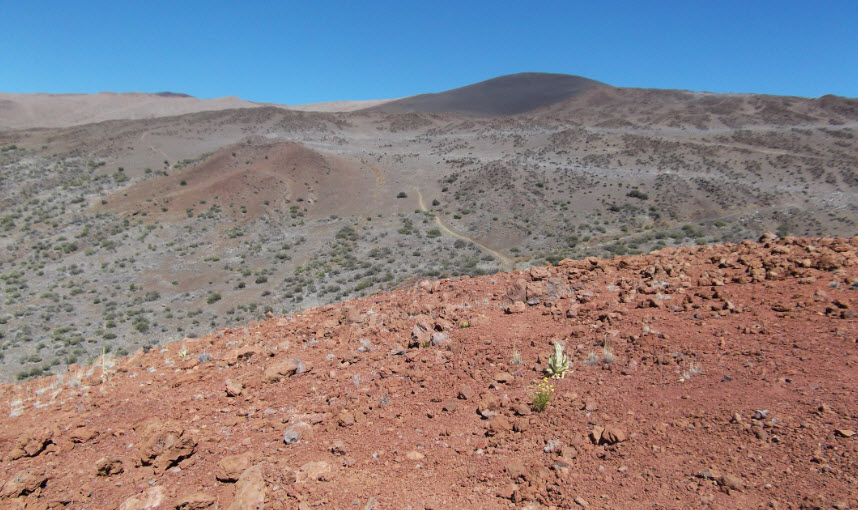
Trail

This picture shows what it looks like. Completely barren, moon-scape-like cinder cones of red lava is all there is on this mountain. In the center of the picture you can faintly see the trail, going up and curving to the left behind the cone in the left center. The top of the picture is not the peak – that is much further behind.

Road

The road is not paved all the way up. The first six miles to the visitor center from Saddle Road is paved. Then comes a section of five miles of gravel road, followed by another four miles of pavement at the top. This picture shows the gravel road. The road is badly washboarded, and on the right side it’s quite sandy, particularly at the steep sections. I drove a regular sedan. I only got stuck once when it was steep and I went very slowly. My front wheels started spinning and the car drifted to the right. I had to back down gently to a better spot, pick up some speed and race over the steep part.

Road2

After what seemed like endless dirt road, I finally reached the welcome pavement. You can see the road snaking up the right cone. That is still not the peak,  but I am getting close.

Peak

Finally at the top. The peak in front is the top of Mauna Kea.  I hiked along the ridge on the left. Up on top (you can click to enlarge) is a youth group chanting in native Hawaiian. Once I got there I joined and listened to their stories.

Standing on Peak

Here I am standing on the very peak – the roof of the Pacific. Other than the other Hawaiian Islands, it’s many thousands of miles in every direction to the nearest land. At almost 14,000 feet, I am very light-headed and clumsy, and unsteady on my feet. Humans are not designed to go from sea-level to 14,000 feet in a few hours. I was lucky that is was a warm day. The high on the mountain was 52 degrees. I didn’t need the down jacket I had brought for the occasion. It can be zero degrees and blizzard conditions up there within a few hours of nice sunshine. I was lucky, and I had great, clear views in all directions.

Looking East

This is the view east. Down below those clouds is the city of Hilo.

Looking South

Looking south, in the distance, is the massive mountain Mauna Loa (black mountain), only a hundred feet or so lower than Mauna Kea. This is the largest volume of mountain in Hawaii. It is said that the landmass of Mauna Loa is bigger than that of all Hawaiian Islands combined. Its broad expanse is awesome, and the top of Mauna Kea is one of the few places where it is possible to even see the entirety of it.

Looking West

Of course, facing west, we can see some of the many telescopes on top of Mauna Kea, one of the most famous places for astronomers in the world. In the background we can see the island of Maui which is basically dominated by the volcano Haleakala. The air is usually not clear enough to see all the way to Maui, so this was a special day. Here is a zoomed picture:

Maui Visible

You can see the peak of Haleakala between the two domes and the island of Maui stretching all the way to the right edge of the picture.

Mauna Kea is an impressive mountain and an experience. The native Hawaiians don’t think of it as a mountain, they think of it as their ancestor. I need to come back when I have a full 8 – 10 hours to do the round-trip hike so I can feel its soul.

Hawaii: Walking on Brand-New Land

The Hawaiian islands were formed by a single hot spot under the Pacific that has been spewing lava for tens of millions of years, while the Pacific plate is moving from east to west. The oldest of the islands are toward the west, the biggest one remaining is Kauai. There are older islands west of Kauai, or remainders of islands, all washed back to the sea. Kauai is 5.1 million years old. That’s all. Oahu is 3 million years old. Maui is 1.32 million years old. The Big Island is only 400,000 years old.

The volcano Kilauea is the most active volcano in the world. It is flowing right now. Yesterday we went down to the current lava flow and walked on land that did not exist eight years ago. Eight years ago.

For me nothing brings the transient state of the world to life as powerfully as a visit to Hawaii. I can see the world changing in front of me here.

New Land

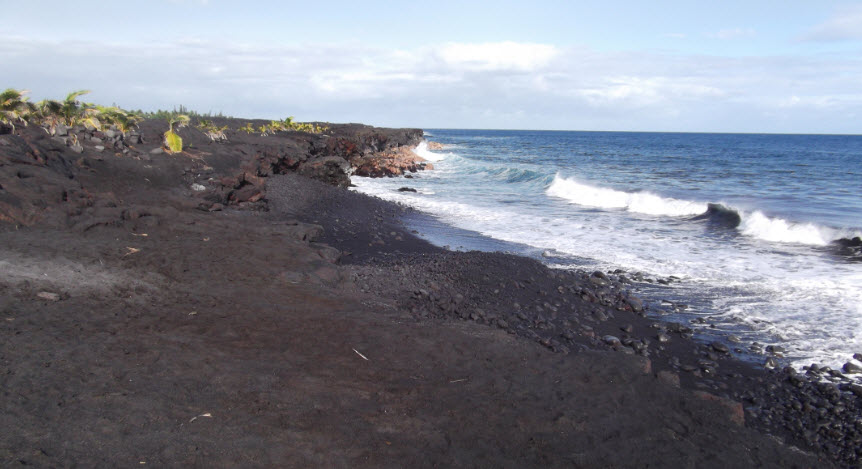
Here I was standing on the land created from lava flow only a few years ago. I was looking back toward the Kilauea volcano in the background, in the mist. This  is where all this lava I am standing on came from.

Black Sand Beach

A quarter of a mile out toward the ocean, there is a new “beach.” It’s all black, course sand from ground-up lava. Coconuts start sprouting in the background.

Coconut Germinated

Humans, of course, help nature along, bringing coconuts out to sprout on the new land.

Edge of the Land

I looked for a high point in the lava fields and looked back toward the old coast. The green stripe on the top of this photograph is where the old coast line was. There was a road, shops, houses, and a nice, sandy beach, not many years ago. Now there is nothing but new lava, and the beach moved at least a quarter of a mile away.

Edge of the Land A

Here is a zoomed look to the old coastline.

Somehow, when the lava came, it flowed down parallel to the coast into the ocean and it spared these shacks, houses and the jungle behind them. But nature (or the volcano god Pele) could change its mind tomorrow, and wipe all that out.

Some half a million years from now, when the Big Island of Hawaii is washed down and separated into three individual islands, some hotel chain may create a resort on this beach, and a new island may loom to the south of it, an island that  does not exist yet, but is growing from the ocean floor right now.

Humanity is fortunate to be able to stand here and watch this spectacle of geology during our civilization, nothing but the blink of an eye in geological time scales.

Toys R Us and Corporate Stewardship

This is an actual Toys R Us commercial that stirred up sufficient outrage with parents and educators that the company apparently pulled it from the market.

I believe it was not the company’s intention to denigrate nature education and ridicule the efforts of tens of thousands of educators in schools, childcare centers and early education professionals by portraying their quest as boring and not worthy or valuable.

I am not saying that children don’t need toys, and I am not saying that Toys R Us is evil or misguided. It’s a big box store like all others, and it panders to our thirst for commercial extravaganza.

This commercial shows how the profit motives of a major corporation does not align with those of a society in general. The motive of the corporation is to sell its product, at a profit, and win against the competition. In retail, that is by swaying the hearts of the consumers and associate happiness with the product and drudgery and boredom with the competition.

In this case, the competition is nature education. There is no way a young child can see this ad and not take away that going to the forest is boring, forest rangers and naturalists are dry and dull, but a toy store is fascinating and exiting in comparison.

Nature was the only thing we had until things changed about a hundred years ago, and considering the course we’re going, nature may be the only thing we will have in the not too distant future, unless we start educating our young to appreciate nature, its beauty and complexity, and its value to every human on the planet.

Education starts with early education. Children need to learn what is really important in life, and they need to learn it early, so they can be responsible adults. We need more early educators and nature education programs. We need trained park rangers and nature interpreters who not only have a passion for nature, but who have training in education so they don’t appear like the “boring” actor in this Toys R Us video, but as vibrant and excited individuals that children want to spend time with.

Just like oil companies don’t have an incentive to keep the environment safe, clean and healthy, just as coal companies don’t have an incentive to keep the air clean, just as insurance companies don’t have an incentive to keep us healthy, just as drug companies don’t have an incentive to actually cure us, so do toy companies have no interest in educating our children.

This is the ugly underbelly of the free market. The free market does not have the best interest of the consumer in mind.

What is the alternative?

Education in mathematics, science, philosophy, nature, art, linguistics and literature. The more educated a society is, the more educated its individuals are, the better a chance that society has to do what’s right and best for it, and to see when commercialism goes way wrong.

Toys R Us went massively wrong with this ad, and I am sure they know it now, admission or not, but one bit of damage is done to some young minds, and to the company’s image in my mind.

My Ancestry – We Are All Related

A lot of people are doing ancestry research. Some find they are from “royal” descent in England. Others find relations that they didn’t know they had. This prompted me to think about ancestry and statistics.

I am fortunate that both of my parents are still alive, but all my grandparents have long passed away. I knew three of my four grandparents and I have good memories about them. My maternal grandmother died after childbirth ten years before I was born, so I never knew her. From ancestry research conducted by one of my sisters I also know the names of all eight of my great-grand parents, but it stops there.

This made me think about putting a chart together, showing how many ancestors I have as we go back through the generations. Here is the chart:

Ancestors

To make it simple, I assigned 25 years for a generation. This assumes that our parents and ancestors waited until they were about 25 to have their offspring. This leads to stunning insights:

Going back only 17 generations or about 400 years, my ancestors fill up a football stadium. In other words, if I collected all the people whose eggs and sperms were necessary to make me around the year 1600, I’d need a football stadium to seat them all.

Going back 20 generations, it’s a million people.

There is a magic crossover point at 28 generations, highlighted in the chart. The estimated world population 675 years ago was about 450 million and the corresponding European and North American population then was 130 million (highlighted in yellow in the chart).  Also, my ancestor count is about 130 million at that time. Since I happen to be Caucasian and don’t show any obvious African or Asian traits, I would presume that most of the people that made me were European. That means that it took every single European in the world alive in the year 1325 to make me.

Statistically speaking, if you are a white North American or European right now, you and I are fully related. Your ancestors (all Europeans) are also my ancestors. All of them.

It is worth pointing out that the numbers in the ancestors column are not cumulative. Each row counts just the ancestors necessary to create me at that generation. To count all of them, I’d have to add up all the columns down to the target generation, so the total number is about double that given row.

Of course, going down to only generation 34, not even a thousand years ago, it takes more than all the people in the world today to contribute, no matter what race or continent we are talking about.

So, yes, King Henry II was my grand-daddy.


Goblin Toppler Glen Taylor Possibly Prosecuted

A few men toppled a Goblin and bragged about it by posting a video on Facebook. To top it off, they were supposedly boy scout leaders. Now there are further headlines about the Utah government possibly prosecuting the perpetrators criminally.

In their defense, they are claiming that this rock would have fallen anyway and could have injured somebody. Hmmm.

Does that mean we should put a concrete wall around the Grand Canyon because somebody could accidentally fall into it? Does that mean we should cut down and haul every dead tree out of the woods because when it finally falls over, somebody might be standing there and get killed?

The argument is ludicrous and sounds like an excuse of a person embarrassed about doing something very stupid.

One boulder isn’t going to make a difference. If it was really close to falling, it would have fallen during the next storm anyway. The chances, however, that it would have fallen on a person are probably millions to one.

The most damaging aspect is that it invites copycats. What if thousands of visitors invaded the park to find rocks they could topple. Next thing we know, they come with 2x4s to use as levers.

Here is a powerful argument why the Park Service SHOULD be closing parks and facilities during a government shutdown.

There are just too many morons walking free.


Yosemite from 36,000 Feet

Whenever I fly home to San Diego from Sacramento I try to sit in a window seat on the left side of the plane. When the weather is clear, and the route of the plane is just right, I have a phenomenal view of Yosemite Valley. Such was the case when I came home last Friday:

Yosemite from Plane 1

As always, please click on the image and get a larger view. For those of you that don’t recognize the two giant landmarks in Yosemite, I have pointed them out in the image below.

Yosemite from Plane 2

It takes just a few minutes to fly over this most splendid part of our state, and if you don’t know what you’re looking for, you can miss it entirely. However, I have spent many hours looking up from the base of the valley on El Capitan, a sheer wall of thousands of feet. Climbers spend many days scaling this vertical wall.

A year ago I hiked up Half Dome. It was a fantastic hike and a great adventure which I described in the post behind this link.

I am fascinated by different perspectives we humans get to have. Being on such a massive mountain, being totally at the mercy of our gear and our training, we feel like ants in the grandiose splendor of nature. Yet, hours later, for a small amount of money, we can be on an airliner cruising over these massive mountains at 36,000 feet, making them look like tiny anthills themselves.

This is how we will feel a few hundred years hence when we have figured out how to make starships, when we leave the solar system and we look back on that pale blue dot that is the entire earth.

It’s at times like this when I feel fortunate to be alive in an age where I have both the opportunity to climb a mountain like Half Dome in the wilderness, and then fly over it as if I were a god.

Banana Tree is Back

Banana Tree

Last winter, our banana tree in the back yard died after a frost spell. We were hoping that it would come back in the spring, but it didn’t. Later in the spring I cut it off at the stump (that’s the round thing in the picture).

After many months of nothing, at the beginning of August, a new shoot came up. The banana tree is fighting back!

I will try to devise something to keep the frost away this coming winter to give it a fighting chance for next year.

Kummakivi, Finland

Kummakivi1
[click for source credit] retkipaikka.fi
Nature makes phenomenal works of art. If I used this motif and made it into a painting, critics would say it’s unreal and hokey. The same is true for spectacular sunsets. You can’t paint them because they look fake and contrived. There are not many paintings of sunsets – sunsets are the prerogative of photographers.

Volunteer Palm

In Southern California, Mexican palm trees often grow wild. We occasionally find seedlings in the strangest of places, along walls, in cracks in cement, or in the middle of lawns. If left alone, they will grow to about six feet in height in a few years. I have seen volunteer palms that I let grow on my property some 25 years ago become massive palm trees of 50 feet of height or more.

At work I park my car every day near a planter border, which is surrounded by a concrete berm. Recently I noticed a little palm growing right by the concrete, surrounded by ground cover. It had burgeoned to about 8 inches in height with three or four leaves.

Then one morning I arrived to notice that the gardeners had trimmed the weeds in the parking lot. They had completely chopped off the little tree, apparently with a set of large clippers. There was nothing left but a little wood stump of about an inch in diameter. I was frustrated since I had enjoyed watching the thing grow.

Volunteer Palm

This morning, just a week after it had been chopped off, I got out of my car and look what I saw: A leaf had shot out of the center of the stump. It must have already been in there, because the ends of the leaf are still “sawed off.” The little tree didn’t give up. Hopefully there will be enough time for it to grow strong before the gardeners come back for another trim.

Volunteer palms are one of my favorite trees.

Visitor Hawk

He hangs around our yard, six feet from our window.

Hawk1

I am not a birder, so I don’t actually know what type this is. I know some birders read this blog – so feel free to comment and set me straight.

Hawk2

Here he went over to perch on our umbrella. Other times he sits on the luggage rack on top of my van.

Moon over Swiss Alps

Of all the “supermoon” pictures people have posted and shown this last week, this is my absolute favorite, taken by my good friend. No tricks, just a good zoom, taken from the balcony of where they’re staying in Switzerland. Where are my hiking boots?

Moon over Swiss Alps
Moon over Swiss Alps – by Val Tigh

German Engineering for Flood Protection

The last few weeks brought us headlines of the terrible floods in Southern Germany, Austria, the Czech Republic and Hungary. Heavy rains brought the flood levels above anything seen in 500 years (some claim). Yes, Germans have been keeping records this long. My hometown of Regensburg lies at the northernmost point of the Danube river, and the city is therefore surrounded by water. Here is a picture from my sister’s house:

6-6-2013 8-01-20 AM

Their house, fortunately for them, lies on a hill, and the water didn’t reach far enough up. Through the center of the picture is their road, which was completely impassable. To the right is a bike path. Then there is an embankment down to where the Danube normally crests, several meters lower. All of it hidden now under several meters of muddy water.

What impressed me is the German flood control technology, used everywhere to keep the water back:

Flood Protection Wall

They have these specially designed walls they put up to hold back the rivers. Simple fire-engine pumps and hoses are applied to pump the leakage back. The hose is held down by a few sandbags. Using this technology they were able to stave off massive damage to entire city blocks. I am not sure this could have been done with simple sandbags the way we’re using them in this country.

The Eye of God

eye of god

This composite picture by the Hubble space telescope and several earth-bound telescopes offers a dizzying look down what is actually a  trillion-mile-long tunnel of glowing gases. The tube is pointed nearly directly at Earth, so it looks more like a bubble  than a cylinder.

The picture shows the Helix nebula. It is created late in a Sun-like star’s life by a torrential gush of gases escaping from the dying star. The Helix nebula is 650 light-years away from us, so its angular size corresponds to a huge ring diameter of nearly 3 light-years across. That’s approximately three-quarters of the distance between our Sun and the nearest star.

The picture went viral when it first came out in 2002. It was dubbed “the eye of god” by the general public. NASA never referred to it by that name.

In a few billion years, this fate could happen to our own sun. Where will our souls be then?